
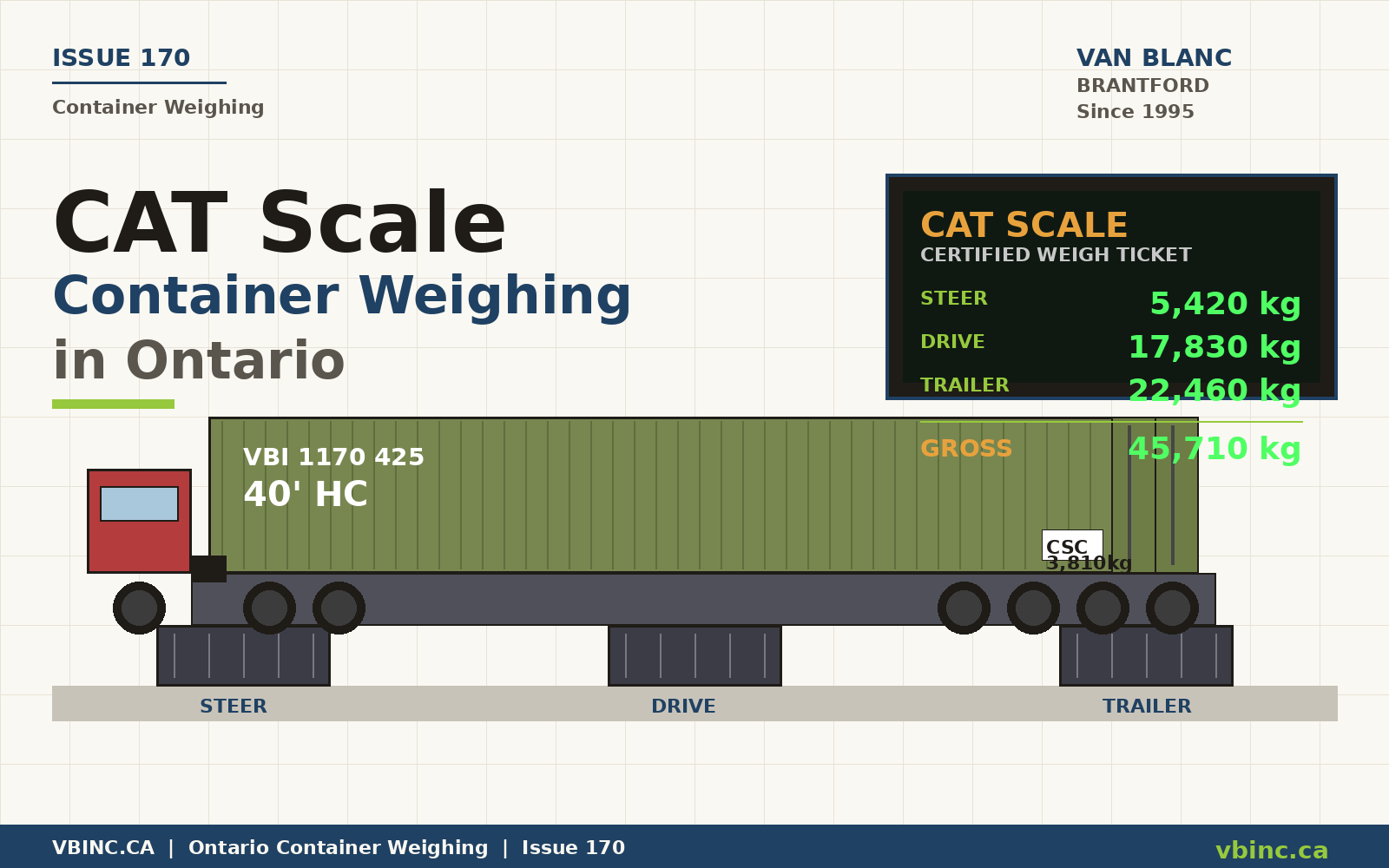
Quick Answer: CAT Scale container weighing in Ontario is an inexpensive single-session fee at certified truck-stop platforms, far cheaper than one overweight citation. A 20ft container’s tare runs 4,800-5,100 lbs; a 40ft runs 8,200-8,600 lbs. Stamp the ticket before transport so MTO axle weights under Regulation 413/05 stay legal. Pricing varies by grade, size, and freight zone, so call Christian or Paul for a same-day quote. Family-run since 1995, 4.9 stars across 140+ verified Google reviews. Delivery in 1-3 days from our 4 Brantford yards.
In This Guide
- Why Should You Weigh a Container Before Transport?
- Where Are CAT Scales Located in Ontario?
- How Much Does a Shipping Container Weigh by Type?
- What Does the Tare Weight on a CSC Plate Mean?
- What Are Ontario’s MTO Axle Weight Limits Under Regulation 413/05?
- How Do You Weigh a Container on a CAT Scale?
- Where Can You Weigh Between Brantford and Your Site?
- CAT Scale vs Inspection Station vs Private Yard Scale: Which Counts?
- What Does a Certified Weigh Ticket Cost in Ontario?
- When Should You Weigh Before Self-Hauling a Bin?
- FAQs
Reading time: about 14 minutes.
Why Should You Weigh a Container Before Transport?
A loaded or self-hauled shipping container should be weighed before transport because Ontario fines overweight axles under Highway Traffic Act Regulation 413/05. A 20ft dry tare runs 4,800 to 5,100 lbs and a 40ft High Cube runs 8,400 to 8,800 lbs, so a certified CAT Scale ticket confirms your axle math is legal before MTO does.
Most buyers think of a shipping container as a known quantity. It is not. A 20ft Wind & Watertight bin sitting in our Brantford yard could weigh 4,800 pounds empty, or it could weigh 5,200 pounds depending on the build year, the steel gauge, and whether the floorboards were swapped at some point in its sea life. A 40ft High Cube can run anywhere from 8,200 to 8,800 pounds. The weight stamped on the CSC plate is a starting point rather than a guarantee.
For most retail buyers taking a single bin on a tilt-deck delivery from our yard, this is not your problem. The carrier Van Blanc books knows the trailer’s payload rating, and the route is planned around legal axle weights. You get a container on your gravel pad and you never think about scale tickets.
But for the contractor who moves his own bin between sites on a goose-neck trailer, the farmer who hires a flatbed and a friend’s truck to shift a bin across the concession, or the small fleet running a multi-container project across the GTA, the calculation matters. Ontario’s Highway Traffic Act Regulation 413/05 governs how much weight you can put on each axle. Overload an axle by 1,000 kg and you are looking at a Ministry of Transportation Ontario (MTO) overweight fine that scales with how far over you are, plus the prospect of being held roadside until you offload. That is where checking your loaded weight against the legal envelope earns its keep.
Why Tare Weight Is Not a Constant
The International Organization for Standardization sets dimensional standards for freight containers under ISO 6346 and ISO 1496-1, but tare weight is a manufacturer specification rather than an ISO-mandated number. Different builds, different steel gauges, different floor materials (apitong vs bamboo vs OSB-patched), and decades of repairs all push the real tare a few hundred pounds off the plate value. The CSC plate is current when stamped. Twenty years later the bin may weigh different.
Where Are CAT Scales Located in Ontario?
CAT Scale (Certified Automated Truck Scale) is the most widely used commercial weighing network in North America, with more than 1,675 scales across the United States and Canada. The scales are owned and operated independently at truck stops and travel centres, but they all meet the same accuracy standard: legally certified, Weights and Measures Canada approved, and recognised by MTO and the courts.
In Ontario the network is thinner than south of the border because the province leans on its inspection-station infrastructure for enforcement weighing, but CAT scales exist along the major freight corridors. The 402, 401, 400, and Queen Elizabeth Way each have CAT-certified stops within a reasonable detour of most container destinations. The Wyoming, ON location at Highway 402 Exit 25 (just east of Sarnia) is the western-corridor anchor for buyers running international moves through the Bluewater Bridge.
The black-and-gold CAT sign is what you look for. A scale at a truck stop that does not carry that sign may still be functional, but its ticket carries less legal weight if you ever need to challenge an MTO citation. For container buyers, the certified ticket is worth the small premium.
Christian LeBlanc, second-generation operator: “Most buyers hauling their own bin have never thought about a scale ticket until an inspector waves them onto the static scale. I tell them to plan the CAT stop the same way they plan the fuel stop. Five minutes and a printed ticket is cheaper than any overweight fine in this province, and it settles the argument at the roadside.”
Use the CAT Scale App Before You Leave the Yard
The CAT Scale app (free, iOS and Android) shows every certified location in real time and lets you pay by phone, so you skip the fuel-desk line. Buyers hauling a bin themselves typically plan their first stop around it: load, run to the nearest CAT, weigh, then route to the destination with the ticket in the cab.
How Much Does a Shipping Container Weigh by Type?
Shipping container weight varies by size and grade. Here is what Van Blanc sees on the yard floor across the four grades we carry. Numbers reflect actual weighed values from carrier scale tickets on our deliveries over the last 24 months rather than catalogue specs.
| Container Type | Tare (lbs) | Tare (kg) | Max Gross (lbs) | Max Payload (lbs) |
|---|---|---|---|---|
| 20ft Standard Dry | 4,800-5,100 | 2,180-2,310 | 67,200 | 62,100-62,400 |
| 20ft High Cube | 5,200-5,400 | 2,360-2,450 | 67,200 | 61,800-62,000 |
| 40ft Standard Dry | 8,200-8,400 | 3,720-3,810 | 67,200 | 58,800-59,000 |
| 40ft High Cube | 8,400-8,800 | 3,810-3,990 | 67,200 | 58,400-58,800 |
| 45ft High Cube | 10,500-11,200 | 4,760-5,080 | 67,200 | 56,000-56,700 |
| 20ft Reefer | 7,000-7,400 | 3,180-3,360 | 67,200 | 59,800-60,200 |
| 40ft HC Reefer | 10,200-10,800 | 4,630-4,900 | 67,200 | 56,400-57,000 |
Two practical takeaways. First, a 40ft reefer is roughly the weight of a 20ft dry container on top of the 40ft dry weight, because of the spray-foam insulation, the refrigeration unit, and the heavier-gauge floor. If you are buying a reefer for cold storage and never plan to plug it in, you are still hauling that extra weight every move. Second, the spread between low and high end within one grade can be 400 to 600 pounds. That is the spread between catalogue specs and weighed reality, and if you are still deciding between footprints, our breakdown of every standard container footprint pairs each size with its real-world weight. A scale ticket matters most when your axle math is tight.
Most retail buyers do not bump up against maximum gross weight, because they are buying an empty bin for storage. Where weighing matters is when the bin is loaded for transport, when the buyer is moving a populated container, or when the trailer is rated for less than the bin’s empty tare suggests it should carry safely.
What Does the Tare Weight on a CSC Plate Mean?
Every shipping container that has ever moved internationally carries a CSC plate under the International Convention for Safe Containers, 1972, and learning to read that data plate during a yard inspection tells you most of what you need before you pay. The plate is welded near the right-hand door or on the door itself and includes the container’s serial number, build date, manufacturer, max gross weight, allowable stacking weight, and tare weight at time of manufacture.
Three things to know about the stamped tare:
- It is accurate at build, and not necessarily today. A 1998 container that has been repaired three times, had its floor swapped, and had reinforcing welded across the threshold weighs more than the plate says. Christian sees this every week on used inventory. The plate is a reference rather than a court document.
- It is in metric. CSC plates use kilograms. North American buyers thinking in pounds need to convert (multiply by 2.2046). A plate that reads “TARE 2300 kg” is a 5,070-lb container.
- It may have expired for international shipping. CSC certification is valid for five years from manufacture, then renewable on periodic inspection. For domestic Ontario use, an expired CSC plate is irrelevant. For export, it matters.
Christian LeBlanc, second-generation operator: “When a buyer asks me how much a bin weighs, I tell them what the plate says and then I tell them to add 200 pounds to be safe. That extra 200 pounds is what a working container picks up over time, between repairs, repainting, and the floorboards getting heavier with treatment. Run the math like that and you will not be surprised at the scale.”
What Are Ontario’s MTO Axle Weight Limits Under Regulation 413/05?
The Highway Traffic Act Regulation 413/05 sets the weight envelopes for commercial vehicles operating on Ontario highways. The rules cover gross vehicle weight, gross combination weight, and individual axle limits across more than thirty vehicle configurations.
For container buyers, the practical numbers to know are these. A standard tandem-axle drive group on a tractor is limited to 18,000 kg (39,683 lbs) under SPIF (Safe, Productive and Infrastructure-Friendly) standards. A tridem-axle trailer group is limited to 24,000 kg (52,910 lbs). The steering axle of most highway tractors is rated at 5,500 to 6,800 kg depending on tire size and suspension. A standard 5-axle tractor-trailer combination has a gross combination weight limit of 39,500 kg (87,082 lbs) on most provincial highways, with SPIF configurations going as high as 63,000 kg on designated routes.
Pull a 40ft container loaded with 30,000 lbs of cargo on a tandem-axle goose-neck trailer rated for 25,000 lbs, and you are roughly 9,000 lbs over the trailer’s structural rating before you ever cross a scale. The trailer may handle it physically, but if the MTO pulls you over and finds an overloaded axle group, the fine is assessed on a sliding scale that climbs steadily for every 100 kg you are over the limit.
Where MTO Actually Weighs Trucks on the 403
The Brantford-to-Hamilton corridor on Highway 403 runs past two MTO inspection stations: Aldershot eastbound (between Burlington and Hamilton) and Cambridge westbound (north of the 401 split). Both have certified static scales and rolling-load detectors. If a carrier is hauling a one-trip 40ft from our yard to a Hamilton site, the route is planned around peak inspection hours. If you are hauling your own bin, knowing those locations matters.
How Do You Weigh a Container on a CAT Scale?
Weighing a container on a CAT Scale is straightforward once you have done it once. Most CAT scales weigh three groups separately: steering axle, drive axles, trailer axles. The total gross is the sum.
- Pull onto the scale platform. Three positions are marked: steer axle on the front pad, drive axles on the middle, trailer axles on the rear. Each axle group needs to be fully on its pad.
- Stop and signal. CAT scales have a call box. Hit the button and state your truck number, the company name if applicable, and your trailer configuration.
- Wait for the indicator. The display inside the scale house shows the weights for each axle group. The first weigh of a session carries a modest flat fee, and a re-weigh after you reposition the load costs only a fraction of that.
- Collect the ticket. The printed ticket shows steer, drive, trailer, gross, date, time, location, and scale serial number. This is the legally certified document. For an ocean export, the same ticket feeds the verified gross mass declaration the shipping line needs before the box is loaded.
- Keep it in the cab. If MTO pulls you over within a reasonable window of the weigh, the ticket establishes your weight at the scale. Combined with knowing what you have not loaded or unloaded since, it is your roadside defence.
For container moves out of our Brantford yard, the typical carrier workflow is: load the bin, drive to a certified scale, weigh, then route. If the bin is empty and the trailer is rated correctly, the weigh confirms what the carrier already calculated. If the bin is being moved loaded, the scale ticket is doing real work.
Where Can You Weigh Between Brantford and Your Site?
For a container leaving our yard at 90 Morton Avenue East for a delivery point elsewhere in Ontario, or for a bin you are moving yourself anywhere in the region, here is where the certified scales sit along the major arteries. None of these are an extreme detour; most add five to twelve minutes round trip.
| Direction From Brantford | Nearest Certified Scale | Detour Time |
|---|---|---|
| East (Hamilton, Niagara, Toronto) | Hamilton Petro-Pass, 740 Parkdale Ave N (24-hour, 905-543-0673) | 10-15 min |
| West (Sarnia, Windsor, US border) | CAT Scale, Wyoming ON, Hwy 402 Exit 25 (519-845-0023) | Direct route |
| North (Cambridge, KW, Guelph) | Active Scale Brantford service location (certified field weigh) | Same-yard option |
| Northeast (Toronto, Markham, GTA) | Active Scale Markham, plus multiple Hwy 401 CAT stops | 15-25 min |
| East (Kingston, Brockville, Ottawa) | Various Hwy 401 corridor truck stops with CAT scales | Route-dependent |
The Hamilton Petro-Pass is the most-used by container haulers running the 403/QEW corridor because it sits between the Stoney Creek interchange and the Hamilton harbour industrial zone. Twenty-four hour availability means a contractor leaving a job site late can still weigh before the morning MTO patrol picks up. For a Van Blanc bin going to a Burlington site, the route is yard, 403 east, exit at Aldershot for Parkdale, weigh, return to 403, finish to the site. About 90 minutes of total drive time.
CAT Scale vs Inspection Station vs Private Yard Scale: Which Counts?
Not every scale carries the same legal authority. Container buyers occasionally try to weigh at a private yard scale (gravel pit, grain elevator, scrap yard) and assume the number is good. The number may be accurate, but the certificate is not equivalent to a CAT ticket.
| Scale Type | Legal Weight | Relative Cost | When to Use |
|---|---|---|---|
| CAT Scale (Weights & Measures certified) | Full legal standing | Low single-session fee | Pre-transport verification, MTO defence, export documentation |
| MTO Inspection Station static scale | Full legal standing (enforcement) | No charge (you are being weighed) | Not optional; you stop if directed |
| Private commercial scale (Active Scale, regional) | Depends on certification | Higher per weigh, deployment may add to it | Field weighing, equipment commissioning, internal records |
| Gravel pit / grain elevator scale | Operator-attested only | Often free or token charge | Rough estimate, internal use only, not for MTO defence |
The distinction matters when you are documenting a load for someone else, exporting through the Port of Hamilton or the Port of Montreal, or building a paper trail for an insurance claim. CAT scales and certified commercial weighing services produce documents that hold up. Yard scales do not.
Active Scale for Field Calibration
For container fleets, modification shops, or contractors running multi-bin projects, Active Scale’s Brantford field service can weigh on site with a Measurement Canada accredited mobile platform. Costs more per weigh than CAT but eliminates the road trip. Worth a call if you are stamping ten containers a month with documented loaded weights.
What Does a Certified Weigh Ticket Cost in Ontario?
A certified weigh ticket in Ontario is inexpensive. CAT Scale’s standard rates are public and consistent across the network. As of the 2026 rate sheet, the first weigh of a session is a low flat fee, and a re-weigh during the same session (you reposition the load and weigh again) costs only a fraction of that first weigh. The scales accept credit card at the fuel desk or through the CAT Scale app on your phone.
Private commercial scales (Active Scale field calibration, regional weigh providers) typically charge several times the CAT rate for a single certified weigh, more if a field crew has to deploy. Volume agreements bring per-weigh costs down for fleets and modification shops.
The real cost is in not weighing. An overweight ticket from MTO under Regulation 413/05 is assessed on a sliding scale that rises with the overload severity. Hold-roadside enforcement (you cannot leave until you offload) adds towing or freight costs. The arithmetic favours the ticket every time.
When Should You Weigh Before Self-Hauling a Bin?
A fair share of the containers we sell get moved again later by their owners rather than by a booked carrier. Usually it is a contractor with a goose-neck trailer he uses for other jobs, a farmer with a flat-deck he runs for hay, or a small fleet that wants the bin on its own equipment. Whichever grade you settle on when you choose a bin from our Brantford stock, the tare on that specific unit is what your trailer rating has to carry on every later move.
Here is when we strongly recommend the pre-trip scale stop, even for an empty bin move:
- Goose-neck trailer with a tandem-axle drive truck hauling a 40ft. The 8,400 lbs of bin plus a 6,000 lb trailer plus driver and fuel can push the drive axles over 18,000 kg if the tractor is loaded forward.
- Flat-deck trailer rated under 20,000 lbs carrying a 40ft HC or 45ft HC. Even empty, you are 8,500 to 11,000 lbs on the trailer. Add a wedge of cargo and you are over rating.
- Reefer container moves in any configuration. The 7,000-11,000 lb empty weight surprises buyers who priced the haul for a dry-bin assumption.
- Multi-bin loads. Two 20fts on one flat-deck can sit pretty on the trailer but distribute weight forward of the trailer king pin, overloading the tractor drives.
- Routes through MTO inspection station corridors. If the 403, 401, or 400 corridor MTO stations are active, a roadside weigh is a coin flip. The pre-trip scale lets you adjust before it costs you.
For an empty 20ft on a properly rated trailer with a half-ton truck, the scale is usually unnecessary. For anything bigger or more complex, a quick stop to confirm the load-verification side of an Ontario haul is the cheapest insurance you can buy. Two of our regular contractor buyers have learned this the hard way and now build the CAT stop into every move.
Worth the Drive to the Brantford Yard
Buyers from across Ontario regularly drive to our 90 Morton Avenue East yard to walk the bins before they pay. Christian will go through the CSC plate, point out the tare reality versus the stamped figure, and help you plan the scale stop for any later move you make yourself. It is part of how we earned 4.9 stars across 140+ Google reviews. Worth the drive for the quality, family customer service with thirty years of experience.
Ready to price your container?
Tell us the size and your postal code and we’ll send back an all-in number, container, delivery, and placement, usually within 1-3 days. No pressure, no mystery fees.
Family-run in Brantford since 1995 · 200+ containers in stock · 4.9★ across 140+ Google reviews · every box graded by a person, walk it before it lands.
Frequently Asked Questions
How much does a CAT Scale weigh cost in Ontario?
The first weigh at a CAT-certified scale in Ontario is a low flat fee as of 2026, and a re-weigh in the same session (you adjust the load and weigh again) costs only a fraction of that first weigh. You can pay at the fuel desk or through the free CAT Scale mobile app. The ticket is Weights and Measures Canada certified and stands up in MTO enforcement situations.
How much does a 20ft shipping container weigh empty?
A 20ft standard dry container weighs between 4,800 and 5,100 lbs (2,180 to 2,310 kg) empty. The exact tare depends on the build year, the manufacturer, and any repairs done in the bin’s working life. The CSC plate near the right-hand door shows the tare at time of manufacture in kilograms. Add roughly 200 lbs for a used container with normal repair history.
How much does a 40ft shipping container weigh empty?
A 40ft standard dry container weighs 8,200 to 8,400 lbs (3,720 to 3,810 kg) empty. A 40ft High Cube runs slightly heavier at 8,400 to 8,800 lbs because of the extra foot of steel. A 40ft High Cube reefer runs 10,200 to 10,800 lbs because of the insulation and refrigeration unit, even if the unit is not plugged in. Always weigh before transport if your trailer rating is tight.
Where is the closest CAT Scale to Brantford?
Hamilton Petro-Pass at 740 Parkdale Avenue North is the closest commonly used certified scale, about 10 to 15 minutes from our Brantford yard via Highway 403 east. It operates 24 hours and accepts the CAT Scale app for payment. For buyers heading west toward Sarnia or the US border, the CAT Scale at Highway 402 Exit 25 in Wyoming, Ontario is the next certified stop.
Do I need to weigh an empty container before transport in Ontario?
Not legally for most retail buyers taking a properly rated tilt-deck delivery; the carrier Van Blanc books has the axle weights pre-calculated. You should weigh when self-hauling on a goose-neck or flat-deck with a borderline trailer rating, when moving a reefer (heavier than expected), when running multi-bin loads, or when routing through MTO inspection station corridors on the 403, 401, or 400.
What does Ontario Regulation 413/05 limit for container hauling?
Regulation 413/05 sets axle weight limits under the Highway Traffic Act. A tandem-axle drive group is limited to 18,000 kg, a tridem-axle trailer group to 24,000 kg, and the steering axle is rated 5,500 to 6,800 kg depending on tires. Gross combination weight tops out at 39,500 kg for standard configurations, with SPIF designs reaching 63,000 kg on designated routes. Overweight fines are assessed on a sliding scale that rises with how far over the limit you are.
Is the tare weight on the CSC plate accurate?
The CSC plate tare is accurate at time of manufacture and not necessarily today. Containers gain weight over decades of working life as floors are repaired, panels are patched, and reinforcing is welded. Christian recommends adding about 200 lbs to the plate tare for realistic planning on used containers. The plate is a reference number; a CAT scale ticket is the document that proves current weight.
Will MTO ticket me for an empty container that is over axle limits?
Yes. MTO enforces axle weight under Regulation 413/05 regardless of whether the load is “cargo” or just a container. If your tandem drive group reads 20,000 kg because the bin sits forward of the trailer king pin, the ticket applies. The container’s empty status is not a defence. The pre-trip CAT scale is what tells you whether your axle math works before MTO does.
Can I weigh a container on a gravel pit or grain elevator scale instead?
The number may be accurate but the document is not equivalent. Gravel pit and grain elevator scales are typically operator-attested rather than Weights and Measures Canada certified. For internal records or rough estimates, fine. For MTO defence, export documentation, or insurance paper trails, only a CAT-certified scale or a Measurement Canada accredited commercial scale (such as Active Scale field calibration) carries full legal weight.
How long is a CAT Scale weigh ticket valid?
The ticket reflects your weight at the moment of the weigh. There is no formal expiration, but its evidentiary value drops once you have loaded, unloaded, refuelled, or changed cargo significantly. For roadside MTO enforcement, a ticket from earlier the same day with the same configuration is strong evidence. For an export document or insurance claim, the weigh date and time are what matter, and the ticket is valid for as long as the configuration has not changed.
Sources
- Government of Ontario. (2024). Highway Traffic Act, Regulation 413/05: Vehicle Weights and Dimensions for Safe, Productive and Infrastructure-Friendly Vehicles. ontario.ca/laws/regulation/050413
- Ontario Trucking Association. (2024). 2024 Ontario Vehicle Weight and Dimension Guidebook. ontruck.org
- CAT Scale Company. (2026). CAT Scale Locator and Rate Sheet. catscale.com/cat-scale-locator
- International Maritime Organization. (1972, current with amendments). International Convention for Safe Containers (CSC), 1972. imo.org
- International Organization for Standardization. (2022). ISO 6346:2022 Freight containers: Coding, identification and marking. iso.org/standard/82754
Reach Van Blanc in Brantford
We have been supplying shipping containers across Ontario since 1995. Our warehouse is at 90 Morton Avenue E in Brantford, and we deliver right across the province on a cash-on-delivery basis. No surprise fees, no chase-the-paperwork.
Van Blanc Ent. Inc. 90 Morton Ave E Unit 1B, Brantford, ON N3R 7J7 +1 888-509-6658
If you are planning to move a bin on your own trailer later, call ahead and we will walk through the CSC plate, the realistic tare, and the closest certified scale on your route. Fast 1-3 day carrier delivery to every region across Ontario, shipped from our 4 Brantford yards.