
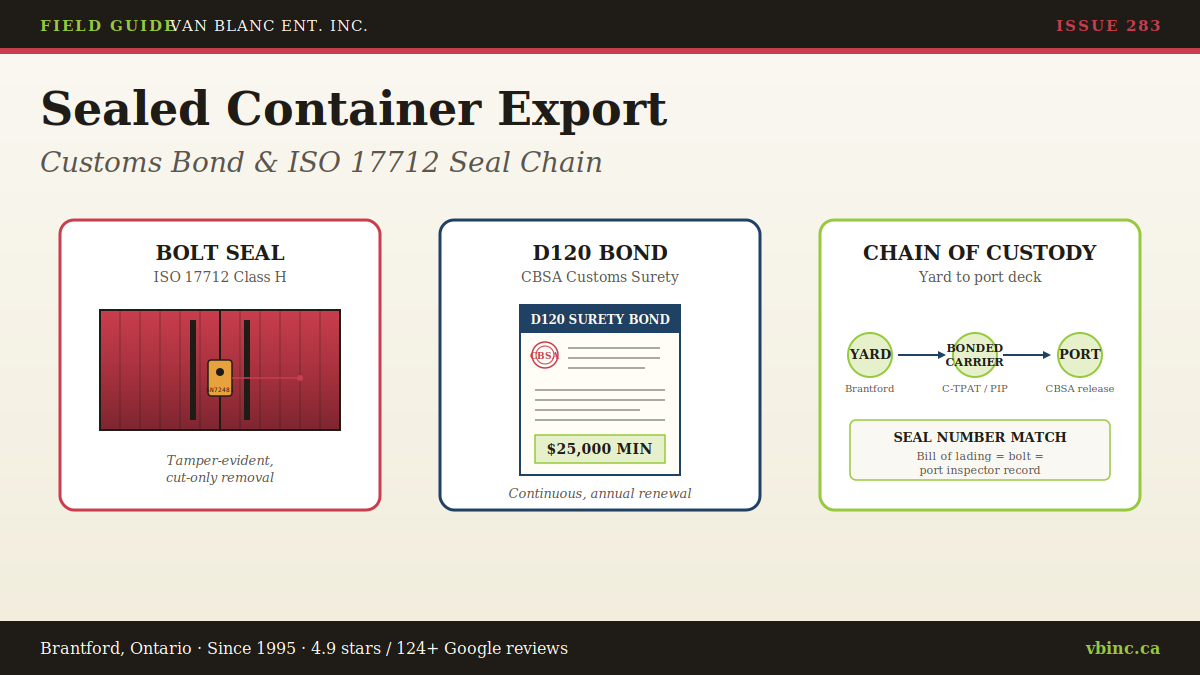
Quick Answer: A sealed container export customs bond Canada shippers post is a CBSA-recognised surety instrument (typically a D120 carried at a continuous minimum face value) that guarantees duties on goods moving in-bond from a Brantford yard to a Halifax, Montreal, or Vancouver port under an intact ISO 17712 high-security bolt seal until CBSA officers release it. Tell us your delivery address and we will quote real costs: no anchored numbers, just honest pricing. Real Brantford yards, real reviews (4.9 / 140+), real 1-3 day delivery. Family-operated since 1995.
In This Guide
- What a Sealed-Container Export Bond Actually Covers
- Why Canada Requires the Bond on Sealed Exports
- D120, Continuous, and Single-Trip Bonds, Plainly Explained
- The ISO 17712 Seal Layer That Pairs With the Bond
- Bonded Carrier, C-TPAT, PIP, and FAST Credentials
- The Document Trail From Brantford Yard to Port
- Real Brantford-to-Port Routes Ontario Exporters Use
- Common Mistakes That Trigger CBSA Holds
- What the Bond and Seal Setup Actually Cost
- How Van Blanc Coordinates the Setup, Step by Step
- FAQs
Reading time: about 14 minutes.
What Does a Sealed-Container Export Bond Actually Cover?
A sealed-container export bond is a CBSA-recognised surety guarantee covering the regulatory liability on a container moving in-bond from an inland yard to a Canadian port, not the cargo value. It backstops duties, excise, and seal-integrity penalties, and it pairs with a high-security seal to form the chain of custody the border agency accepts.
An Ontario exporter shipping a steel coil, a baler, a load of finished pallets, or a converted Sea Can to a buyer in Pakistan or the UK does not just hand the box to a trucker and wave goodbye. The container leaves a Brantford yard sealed, travels under a chain of custody to a deepwater port, and only clears the country once a Canada Border Services Agency officer has accepted the manifest, the seal record, and the bond covering the move.
The bond is a financial guarantee. It tells CBSA, in writing: if anything goes wrong in transit, if the seal is broken without authorisation, if the contents diverge from the declaration, the surety will pay the assessed amount up to the bond limit. The bond covers the regulatory exposure, not the cargo value.
This matters for VBinC buyers because the same 40ft High Cube that gets converted into a job-site office in Hamilton can, on a different week, end up packed with finished goods bound for Aqaba or Felixstowe. Paul has watched this pattern play out for two decades. He came up through Asian import trade before pivoting Van Blanc to containers in 1995, and the bond-and-seal layer is the part of the supply chain most operators learn the hard way. Our wider walkthrough of how an Ontario container clears CBSA and the port is meant to keep that learning curve short.
Why Does Canada Require a Bond on Sealed Exports?
Canada does not require export bonds out of administrative habit. The bond exists because the government cannot physically watch every container between the inland point of stuffing and the port deck. The bond, paired with a high-security seal, is the substitute for a permanent escort. If the seal is intact at the port and the bond holder is in good standing, CBSA accepts that the goods moved as declared. If the seal is broken or missing, the bond is exposed. The same logic governs in-transit movements where US-origin cargo uses Canada as a corridor between two US points.
The Three Things a Bond Protects Against
Customs bonds for sealed export movements typically backstop three exposure types: (1) duty or excise liability if the goods are deemed not to have actually left the country; (2) penalties for seal-integrity failures, broken seals, missing seals, mismatched seal numbers between origin and port; (3) regulatory penalties for misdescription, missing permits, or unreported value differences. The bond is not insurance on the cargo. It is a financial backstop for CBSA against the carrier and exporter.
Christian LeBlanc, second-generation operator: “Most of our buyers are sending the box to a job site overseas, they are not crossing an ocean themselves. They want to know one thing: will this bin clear the port without a holdup. I tell them the bond and the seal do the watching the government cannot do in person, and the day it leaves our Brantford yard is the day that chain of custody starts.”
What Is the Difference Between a D120, Continuous, and Single-Trip Bond?
The D120 is the CBSA form that posts a continuous customs bond. Most Ontario exporters who ship sealed containers more than a handful of times a year carry a continuous D120 sized to a minimum face value set by CBSA and scaled to their duty exposure. The bond renews annually and covers every movement during the term, so the per-shipment overhead disappears.
For a one-off export, a single-trip in-bond movement is the simpler instrument. A licensed customs broker arranges a single-trip bond for one container, one route, one shipper, one consignee. For an Ontario manufacturer doing two or three international shipments a year, the math favours single-trip every time. Under the CARM (CBSA Assessment and Revenue Management) transition in 2024 and 2025, individual importers and exporters now need to carry their own bond rather than relying on a broker’s umbrella.
How To Tell Which Bond Fits Your Volume
- One to three export containers a year: Single-trip in-bond, arranged per movement, typically through your customs broker. Lowest setup cost, highest per-movement fee.
- Four to twenty export containers a year: Continuous D120 at the floor. Best fit for steady mid-volume exporters.
- Twenty-plus containers a year, or high-value cargo: Continuous D120 sized above the floor, plus a CARM-compliant importer security bond if you also import. Talk to a surety specialist about layering.
- Cargo with excise exposure (alcohol, tobacco, fuel): Bond sizing scales with potential excise liability. Treat the floor as a starting conversation only.
The ISO 17712 Seal Layer That Pairs With the Bond
The bond is the financial layer. The ISO 17712 high-security seal is the physical layer. Together they form the chain of custody CBSA accepts as proof the container moved as declared.
ISO 17712:2013 classifies seals into three tiers: I for Indicative, S for Security, and H for High Security. The H tier is what C-TPAT membership requires and what most international destinations now demand at port. A high-security bolt seal is a hardened steel bolt with a locking body that, once seated, cannot be removed without cutting the bolt. Cable seals use a steel cable of at least 3.5 mm diameter that frays visibly on any tamper attempt.
| Seal class | Use case | Required for export? |
|---|---|---|
| Class I, Indicative | Low-stakes domestic moves, signal only | No |
| Class S, Security | Mid-tier domestic, some short-haul international | Sometimes |
| Class H, High Security (bolt or cable) | International export, C-TPAT and PIP movements, any port that requires ISO 17712:2013 certification | Yes, almost universally |
Two practical notes that catch first-time exporters. First, the test certificate on the seals must be dated within the most recent 24 months. ISO 17712:2013 requires independent re-testing on that cycle. A box of bolt seals bought four years ago and never tested again is not compliant. Second, the seal number gets recorded on the bill of lading, on the manifest, and on the customs declaration. If those three numbers do not match, CBSA holds the load.
Buy Seals in Lots, Record Numbers in Sequence
Order high-security bolt seals in lots of 50 or 100 from a CTPAT-listed supplier. Record the seal numbers in sequence in a yard logbook the moment they get installed. When the trucker pulls up at the port and the inspector asks for the seal number, the number on the bolt matches the number on the manifest matches the number in your logbook. That three-way match is what makes the bond work.
Bonded Carrier, C-TPAT, PIP, and FAST Credentials
The trucker moving the sealed container from a Brantford yard to the port is not interchangeable. Canada requires that any carrier transporting in-bond goods beyond the first point of arrival, or between Canadian points under a bonded arrangement, hold bonded carrier status with CBSA. Bonded highway carriers post their own surety bond with CBSA, sized to the value of the in-bond cargo they move. Standard highway carriers cannot accept these loads.
Sitting on top of that base is the trusted-trader stack. C-TPAT is the U.S. Customs and Border Protection partnership. PIP is its Canadian equivalent, administered by CBSA. FAST is the joint program that gives certified carriers access to dedicated border crossing lanes. For a Brantford-to-Halifax move that stays inside Canada, the bonded carrier status is what matters. For any move that touches the US border, the C-TPAT and PIP layers save several hours per crossing and reduce secondary inspections.
What This Looks Like From a Brantford Yard
Highway 403 puts a Brantford yard on the direct corridor between southwestern Ontario manufacturers and the port stack at Montreal or Halifax. A bonded carrier pulling a 40ft High Cube out of a Brantford yard at 7 a.m. is at the Toronto loop by 9 a.m., past Quebec City by suppertime, and into Halifax 24 hours later. The bond and the seal hold the load together through every weigh station, every plaza, every random inspection along the way.
The Document Trail From Brantford Yard to Port
A sealed export container does not move on a single piece of paper. The document trail is layered, and each layer answers a different regulatory question.

The commercial invoice declares what is in the box and what it is worth. The packing list itemises the contents. The bill of lading is the carrier’s receipt and contract. The export declaration, filed through the Canadian Export Reporting System, tells CBSA the goods are leaving the country. The bond paperwork, either the continuous D120 number or the single-trip bond reference, ties the movement to the financial guarantee. The seal number, recorded across all of the above, ties the physical container to the documents. Some destinations add one more layer on top, and our guide to wood-packaging treatment and fumigation certificates covers when that paperwork is required.
The Six-Piece Document Stack
A clean sealed container export typically carries: (1) commercial invoice, (2) packing list, (3) bill of lading naming the bonded carrier, (4) Canadian Export Reporting System reference number, (5) bond reference, either D120 number or single-trip bond ID, (6) seal number recorded on the bill of lading and verified at the port. Missing or mismatched data on any of the six is the most common reason a shipment gets held at the gate. A clean stack moves through without conversation.
Paul has given us the same talk every time a buyer asks us to coordinate a converted office container to an overseas job site.
Paul LeBlanc, Owner: “I have watched containers sit at the port for ten days because the seal number on the bill of lading did not match the seal on the door. The bond is in place. The carrier is bonded. The cargo is exactly what was declared. None of it matters until that one number lines up. That is the whole game.”
Real Brantford-to-Port Routes Ontario Exporters Use
Most Ontario sealed-container exports leave the country through one of four port stacks: Montreal for European traffic, Halifax for transatlantic and West Africa, Vancouver for Asia and Oceania, and the New York and New Jersey complex for US east-coast departures. Each route affects how the bond and seal arrangement gets structured.
Montreal is the closest deepwater port. From a Brantford yard the haul is about 700 kilometres up the 401 corridor, and a bonded carrier turns the move in a single day. Halifax is the second option for UK, Mediterranean, or West Africa cargo, with a haul of roughly 1,800 kilometres run as a relay over two days. Vancouver handles Asia-bound cargo via CN or CP intermodal rail (about 4,400 kilometres, five to seven days), with the bond and seal carrying through the rail leg the same way they would on a highway move. The New York and New Jersey route works for buyers on a transatlantic service that calls Newark before Montreal, and the FAST lane saves several hours at Buffalo or Lewiston for a C-TPAT certified carrier.
Common Mistakes That Trigger CBSA Holds
After twenty years of watching Ontario exporters work through this, the same handful of mistakes show up over and over. None of them are exotic. All of them are avoidable.
The Six Holds We See Most Often
- Seal number mismatch: The bill of lading says one number, the bolt on the door says another. The shipping clerk transposed two digits at 4:30 on a Friday. The port will not release the load.
- Expired seal certification: The bolts were tested 30 months ago, six months past the ISO 17712 re-test window. The shipper does not know. The port inspector does.
- Bond face value too low: The exporter holds a continuous bond. The shipment is high-excise alcohol carrying far more potential excise exposure than the bond was sized for. The bond does not cover the liability and the load stalls.
- Non-bonded carrier on an in-bond leg: A standard highway carrier picks up the load thinking it is a domestic move. It is actually an in-bond export, and that carrier cannot legally move it past the first port of clearance.
- Missing CERS reference: The Canadian Export Reporting System number is not on the documents. The clerk filed it after the truck left. CBSA wants the number on the paperwork the driver hands over, not in an email later.
- Wrong incoterm: The commercial invoice says DDP, the buyer in Egypt thinks it means delivered duty paid at his warehouse, the freight forwarder thinks it means delivered to the port. Goods sit in a bonded warehouse in Alexandria for two months while everyone argues.
How Much Does the Bond and Seal Setup Actually Cost?
The cost of a bond-and-seal setup is less a fixed price than the sum of a few drivers. Bond premiums move with your credit profile, your shipping volume, and the surety you work with, so the table below maps the line items to what pushes each one up or down rather than printing a number that goes stale the moment the surety market shifts.
| Line item | What drives it up or down | Frequency |
|---|---|---|
| Continuous D120 customs bond | Face value posted, credit profile, and surety appetite; higher excise exposure and weaker credit raise the premium | Annual |
| Single-trip in-bond bond | Cargo value and route on a single movement; cheaper to set up than a continuous bond but priced per trip | Per shipment |
| ISO 17712 H-class bolt seals | Order quantity and supplier; buying in lots of 50 or 100 lowers the per-seal rate | Per container |
| Customs broker filing fee | Complexity of the entry and number of line items declared | Per shipment |
| Bonded carrier surcharge over standard rate | 10 to 20 percent premium over a standard highway rate for the bonded leg | Per move |
| C-TPAT and PIP joint application (one-time) | Internal staff time only; there is no government application fee | One-time |
The lead-time math is just as important as the cost math. A first-time continuous D120 takes two to four weeks from application to active coverage, longer if the surety asks for additional financial documentation. A single-trip bond can be arranged in 24 to 48 hours through a broker. Seal procurement is overnight if you have a CTPAT-listed supplier on speed dial; one to two weeks if you do not.
How Van Blanc Coordinates the Setup, Step by Step
Van Blanc does not write the bond and we do not issue the seals. What we do is coordinate the moving pieces for buyers who tell us up front that the bin is going overseas. The same hand-offs sit inside the broader CBSA clearance and port-logistics process, and they run the same way every time, with the same four steps.
First, before the container leaves our yard, we confirm with the buyer or freight forwarder which bond instrument is in place (continuous D120, single-trip, or carried by the forwarder). Second, we confirm the carrier is bonded and, where the route requires it, C-TPAT and PIP certified. Third, the seal goes on at our yard, not at some intermediate point; the seal number gets recorded on our yard release ticket and photographed against the container number plate, and that photo travels with the bill of lading. Fourth, we do not consider the move complete until the port confirmation comes back through the forwarder.
Why Buyers Drive To Brantford To Walk the Bin
For exporters, the bin itself matters as much as the paperwork. A CSC-plated one-trip container with current certification ships through any port without seal-related complications, which is why exporters bound for a long ocean leg often ask us about a freshly built box with a current plate. A cargo-worthy used container with an expired CSC plate is a different conversation, and our notes on checking a used box before you pay for it spell out what to look for. Buyers come to our Brantford yard to walk the bin in person, read the plate, and confirm the steel is what they need for the destination port. Worth the drive for unbeatable quality, family customer service with thirty years of experience.
Frequently Asked Questions
What is a sealed container export customs bond in Canada?
A sealed container export customs bond is a CBSA-recognised surety instrument, typically a D120 carried at a continuous minimum face value, that guarantees the regulatory liability for a container moving in-bond from an Ontario yard to a port of exit under an intact ISO 17712 high-security seal. The bond protects CBSA against unpaid duties, broken-seal penalties, and misdescription exposure, not the cargo value itself.
How much does a D120 customs bond cost for export shipments?
A continuous D120 bond at the minimum face value is priced as an annual premium that varies with your credit profile and the surety you work with, while a single-trip bond is priced per movement and is cheaper to set up for a one-off shipment. High-volume exporters or high-excise cargo may need a bond sized above the floor, which scales the premium accordingly. Talk to a surety broker before you book the first export.
Do I need a high-security ISO 17712 seal on every export container?
Yes, for almost every international destination. ISO 17712:2013 H-class bolt or cable seals are required by C-TPAT and increasingly mandated by destination ports worldwide. The seal certificate must be dated within the most recent 24 months because the standard requires independent re-testing every two years. An expired certificate gets the load held at the gate.
What is the difference between a continuous bond and a single-trip bond?
A continuous D120 bond covers every export movement for a full year and suits exporters running four or more containers annually. A single-trip in-bond bond covers one specific shipment from origin to port and suits one-off or low-frequency exporters. Continuous is cheaper per movement at volume. Single-trip is cheaper overall for low-volume shippers.
Can a non-bonded carrier move a sealed export container?
Not legally, once the movement is in-bond. Canadian regulations require that any carrier transporting in-bond goods past the first point of arrival, or between Canadian points under a bonded arrangement, hold bonded carrier status with CBSA. Bonded carriers post their own surety bond with CBSA, sized to the value of the in-bond cargo they move. Standard highway carriers cannot accept these loads.
How does C-TPAT and PIP membership help a sealed container export?
C-TPAT is the U.S. trusted-trader programme and PIP is its Canadian counterpart. Carriers and exporters certified in both face fewer inspections, faster border clearance, and access to FAST dedicated lanes at land borders. For Ontario exporters shipping through a US east coast port like Newark, C-TPAT and PIP harmonisation typically saves several hours at the border and reduces secondary-inspection exposure.
What documents travel with a sealed export container from Brantford?
A clean sealed export carries six documents: commercial invoice, packing list, bill of lading naming the bonded carrier, Canadian Export Reporting System reference number, bond reference (D120 number or single-trip bond ID), and the seal number recorded across all of the above. Missing or mismatched data on any of the six is the most common cause of a port hold.
What happens if the ISO 17712 seal is broken in transit?
A broken seal is the single biggest red flag CBSA looks for. If a seal is broken legitimately for inspection en route, the inspector applies a new seal and records the new number on the manifest. If a seal is broken without authorisation, the bond is exposed and the load is held pending investigation. Photographing the intact seal at the yard before departure helps establish chain of custody.
Does Van Blanc issue the customs bond or the seal directly?
No. Van Blanc supplies the container and coordinates the export move with your customs broker, freight forwarder, and bonded carrier. The bond is issued by a surety company through your broker. ISO 17712 seals are sourced through a CTPAT-listed supplier. We confirm the bond is in place, verify the carrier is bonded, install the seal at our Brantford yard, and photograph the seal number against the container plate before release.
How long does it take to set up a customs bond for export from Ontario?
A first-time continuous D120 typically takes two to four weeks from application to active coverage, longer if the surety asks for additional financial documents. A single-trip in-bond bond can be arranged in 24 to 48 hours through a broker. ISO 17712 seal procurement is overnight from a stocked supplier and one to two weeks from a cold-start supplier relationship. Plan ahead for first-time export shipments.
Ready to price your container?
Tell us the size and your postal code and we’ll send back an honest, all-in number, container, delivery, and placement, usually within 1-3 days. No pressure, no mystery fees.
Family-run in Brantford since 1995 · 200+ containers in stock · 4.9★ across 140+ Google reviews · every box graded by a person, walk it before it lands.
Sources
- Canada Border Services Agency. (2024). D120 Customs Bond. Government of Canada. cbsa-asfc.gc.ca/services/export/menu-eng.html
- Canada Border Services Agency. (2024). Highway Carriers. Government of Canada. cbsa-asfc.gc.ca/services/carrier-transporteur/hc-tr-eng.html
- International Organization for Standardization. (2013). ISO 17712:2013 Freight Containers, Mechanical Seals. iso.org/standard/55480.html
- U.S. Customs and Border Protection. (2014). ISO 17712 High Security Seals Bulletin. CBP Trade Programs. cbp.gov
- Canada Border Services Agency. (2024). Exporting Commercial Goods. Government of Canada. cbsa-asfc.gc.ca/services/export/menu-eng.html
Reach Van Blanc in Brantford
We have been supplying shipping containers across Ontario since 1995. Our warehouse is at 90 Morton Avenue East in Brantford, and we deliver right across the province on a cash-on-delivery basis. No surprise fees, no chase-the-paperwork.
Van Blanc Ent. Inc., 90 Morton Ave E Unit 1B, Brantford, ON N3R 7J7, +1 888-509-6658
Planning a sealed export and want a CSC-plated one-trip 40HC ready before your bonded carrier rolls? Walk our Brantford yard, read the plates, and pick the bin yourself. Getting the export and port-clearance side right works best when the container itself suits the destination port.
Related Reading
- Container Fumigation ISO 15931 Export Canada
- Shipping Container Export Ontario: CBSA Clearance, CSC Re-Certification, and Port Logistics
- Used Shipping Container Buying Guide: Grades, CSC Plates, and What To Inspect
- Shipping Container Scams: How To Spot Them Before You Send Money
- Customizing Shipping Containers: What Modifications Are Worth Paying For