
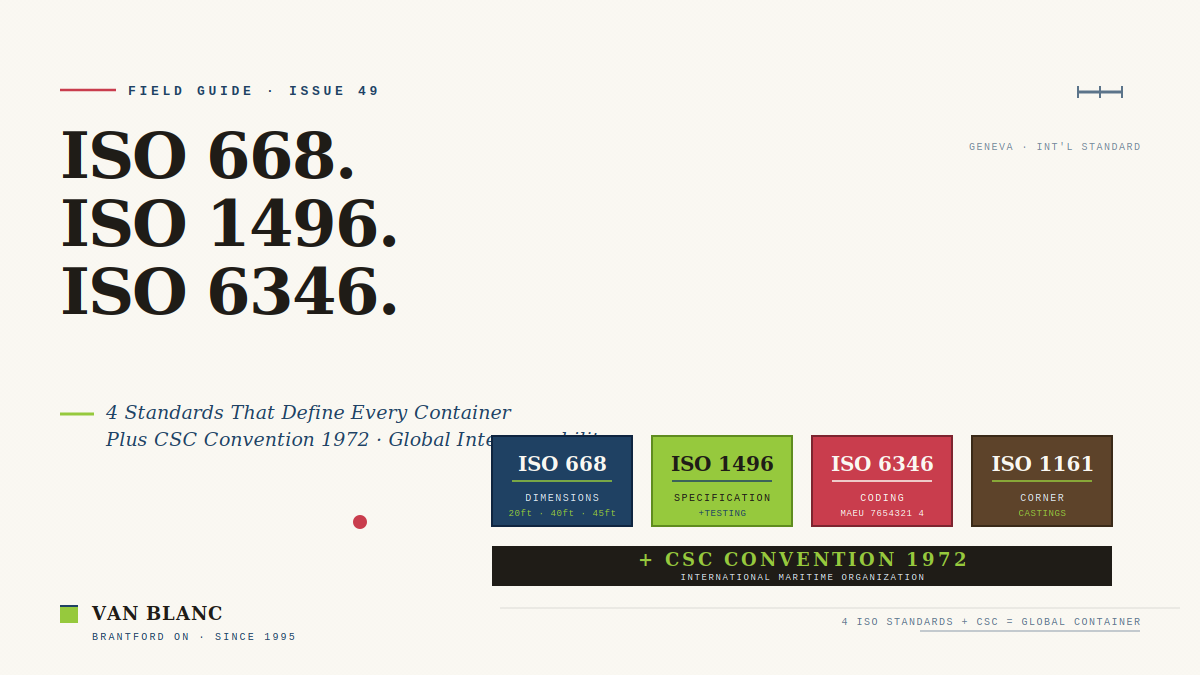
Quick Answer: Per Wikipedia, Intermodal container. Standard reference: Wikipedia, Intermodal Container. An “ISO container” is a shipping container built to International Organization for Standardization specifications: ISO 668 (dimensions), ISO 1496 (specification and testing), ISO 6346 (coding and identification), and ISO 1161 (corner fittings). Plus the CSC Convention (1972) governs safety inspection. Every shipping container in global trade since the late 1960s has been built to these four standards. This is why a container from Shanghai stacks identically on a ship to a container from Hamburg, why every container coding worldwide follows the same format, and why a Brantford buyer can verify any container’s specs by reading the CSC plate. In Canada 2026, what you pay for an ISO container depends on its size and grade. Van Blanc carries 200+ at our Brantford yard. Real lead times and COD-honest pricing, quoted to your specific address, call us at 519-754-6844. 30+ years operating, 4.9 stars on 140+ Google reviews. 1-3 day delivery Ontario-wide from our Brantford yards.
In This Guide
- What Does an ISO Container Mean and Why Do Standards Matter?
- ISO 668: dimensional standards (the 20ft, 40ft, 45ft, 53ft rules)
- ISO 1496: specification and testing
- ISO 6346: container coding and identification
- ISO 1161: corner fitting specification
- The CSC Convention: safety inspection framework
- Why ISO standards matter for Canadian buyers
- ISO Container vs Sea Can vs Conex Box vs C-Can
- Cost in Canada 2026
- FAQs (Google PAA answered)
Reading Time: about 14 minutes
Every shipping container in global trade follows four ISO standards: ISO 668 (dimensions), ISO 1496 (specification and testing), ISO 6346 (coding and identification), and ISO 1161 (corner fittings). Plus the 1972 CSC Convention (IMO) governs safety inspection. These five standards together define what “ISO container” actually means.
For a Canadian buyer, this matters because the standards are what make global container trade work. A container from Shanghai stacks identically on a Halifax cargo ship to a container from Hamburg. A CSC plate from CIMC factory is read identically by Canadian, American, German, and Japanese inspectors. A 40ft container has the same external dimensions whether you buy it in Brantford, Calgary, Vancouver, or Halifax. This guide explains each standard, why it exists, and how it shapes what you actually receive when you buy a shipping container in Canada.
What Does an ISO Container Mean and Why Do Standards Matter?
The International Organization for Standardization (ISO), headquartered in Geneva, is the global body that publishes technical standards across industries. ISO container standards started being developed in the late 1950s as commercial containerization (Malcom McLean’s 1956 SS Ideal-X voyage) and military containerization (US Army Conex boxes from 1952) created the need for international interoperability.
Before ISO standardization (mid-1960s and earlier):
- Sea-Land used 35ft containers
- Matson Navigation used 24ft containers (California traffic codes)
- US Military used Conex II at 8’6″ × 6’3″ × 6’10.5″
- European inland shipping used various sizes
- No two systems could interchange containers
The economic and operational chaos was obvious: containers couldn’t move between competing shipping lines, between rail and trucking, between ocean and inland transport. ISO standardization (1968-1972) created the unified system that today carries 90% of global non-bulk trade.
Today, “ISO container” is the technical industry term for a container built to ISO 668, ISO 1496, ISO 6346, and ISO 1161 specifications. Our container terminology glossary covers every standard plus every other container term Canadian buyers encounter. Other names like intermodal container, shipping container, sea can, C-Can, Conex box, describe the same product through different lenses (operational, vernacular, military, historical).
ISO 668: dimensional standards (the 20ft, 40ft, 45ft, 53ft rules)
ISO 668 is the foundational standard that fixes container dimensions worldwide. First published 1968, with revisions through 2020.
The five common ISO container sizes
| ISO Size Code | Common Name | External Length | External Width | External Height |
|---|---|---|---|---|
| 1D | 10ft | 2.991 m | 2.438 m | 2.591 m |
| 1C | 20ft Standard | 6.058 m | 2.438 m | 2.591 m |
| 1CC | 20ft High Cube | 6.058 m | 2.438 m | 2.896 m |
| 1AA | 40ft Standard | 12.192 m | 2.438 m | 2.591 m |
| 1AAA | 40ft High Cube | 12.192 m | 2.438 m | 2.896 m |
| 1EEE | 45ft High Cube | 13.716 m | 2.438 m | 2.896 m |
| (NA only) | 53ft High Cube | 16.154 m | 2.591 m | 2.896 m |
The 53ft is unique in two ways: it’s North American only (not part of global ISO trade) and it has a wider external width (2.591m vs the standard 2.438m). Every other ISO container in the world shares the same 8’0″ external width.
ISO 668 maximum gross weight ratings
ISO 668 also specifies maximum gross weight (container + cargo):
- 20ft: 24,000 kg (with 2016 amendment, up to 36,000 kg for certain Type 1CC)
- 40ft and 40ft HC: 30,480 kg
- 45ft HC: 30,000 kg
- 53ft HC: 30,480 kg
These ratings define how containers can be loaded for ocean, rail, and road transport. A loaded 40ft container at 30 tonnes gross approaches the maximum legal road weight in most jurisdictions, which is why container loading is carefully managed by shipping lines.
For full dimensional detail across all sizes, see our complete dimensions guide.
ISO 1496: specification and testing
ISO 1496 is the multi-part standard that defines how containers must be built and tested. The 1496 series has five parts:
- ISO 1496-1: General cargo containers (the standard 20ft, 40ft dry vans)
- ISO 1496-2: Thermal containers (refrigerated, insulated)
- ISO 1496-3: Tank containers (liquids, gases, pressurized bulk)
- ISO 1496-4: Non-pressurized dry bulk containers
- ISO 1496-5: Platform and platform-based containers (flat racks)
The four mandatory tests
ISO 1496-1 requires every container production run to pass four tests before leaving the factory:
- Water test: Container sprayed with water under high pressure to detect any leaks at door seals, panel seams, or roof joints.
- Lift test: Container lifted by all four top corner castings simultaneously to verify load-bearing capacity.
- Stacking test: Container loaded with weights simulating cargo and stacked under another container to test compression capacity.
- Racking test: Diagonal force applied to test the container’s resistance to parallelogram deformation under cargo ship rolling.
These tests are why every CIMC, Singamas, or other major manufacturer’s container delivers consistent structural performance. The testing happens before the container ever leaves the factory floor.
ISO 6346: container coding and identification
ISO 6346 (current version 2022) defines the standardized identification code on every container. Every ISO container has an 11-character code: 4 letters for the owner, 6 digits for the serial number, plus a check digit.
The 11-character ISO container code
Format: OOOO U NNNNNN C
- OOOO: Four-letter ownership code (BIC code), registered with Bureau International des Containers
- U: Equipment category (U for freight containers, J for related equipment, Z for trailers)
- NNNNNN: Six-digit serial number unique within owner’s fleet
- C: Single check digit (validates the owner + serial portion)
Example: MAEU 7654321 4 = Maersk owner code, freight container, serial 7654321, check digit 4.
Why the coding system matters
The ISO 6346 code is what allows global container tracking and customs processing. When a container arrives at the Port of Halifax, customs reads the code, matches it to the cargo manifest, and clears (or holds) the shipment. The same code reads identically at Vancouver, Montreal, Hamburg, Shanghai, or Singapore. No mistranslation, no ambiguity.
For a Canadian buyer, the ISO 6346 code on the cargo doors tells you:
- Original manufacturer (CIMC, Singamas, etc.)
- Owner code (shipping line or leasing company that operated the container)
- Serial number (unique fleet ID)
- Validation check digit (proves the code is authentic)
ISO 1161: corner fitting specification
ISO 1161 (1984) specifies the exact dimensions, geometry, and material of the eight corner castings (4 top, 4 bottom) on every standard ISO container.
Why this standard matters: corner castings are the load-bearing anchors of the entire container. They carry stacking loads (up to 12 high on cargo ships), accept twistlocks for crane lifting and chassis coupling, and define how containers connect to every piece of handling equipment worldwide.
ISO 1161 mandates:
- Exact corner casting positions (within 5mm tolerance)
- Standardized twistlock opening dimensions
- Material specifications (cast steel, specific strength rating)
- Load-bearing capacity (48-tonne shear strength for top castings)
This is why a Maersk container twistlocks identically to an MSC container, why a CIMC-built container couples to a CMA CGM container on a cargo ship, and why every container in the world fits the same crane spreaders. Without ISO 1161, the global container system would be a Babel of incompatible connections.
The CSC Convention: safety inspection framework
The International Convention for Safe Containers (CSC), adopted by the International Maritime Organization (IMO) in 1972, governs safety inspection of containers used in international transport.
CSC core requirements
- Every container must have a CSC plate riveted to the cargo doors
- Plate shows: manufacturer, manufacturing date, owner code, max gross weight, allowable stacking weight, rack test load, next inspection date
- First inspection: within 5 years of manufacture
- Subsequent inspections: every 30 months (2.5 years)
CSC compliance schemes
Two ways for owners to maintain compliance:
- ACEP (Approved Continuous Examination Programme): Owner runs continuous inspection on a rotating schedule
- PES (Periodic Examination Scheme): Fixed 30-month re-inspection cycle
What CSC means for Canadian buyers
For Canadian buyers of secondary-market containers, the CSC plate matters primarily for grade determination:
- One-Trip: CSC plate current with 5+ years remaining
- Cargo Worthy: CSC plate current with 0-30 months to next inspection
- Wind & Watertight: CSC plate expired or removed
- As-Is: CSC plate absent or unreadable
For Ontario stationary land use, an expired CSC plate doesn’t affect the container’s functional integrity. The structural envelope is identical. The CSC matters mainly if the container might re-enter international ocean service.
Why ISO standards matter for Canadian buyers
The practical implications of ISO standardization for an Ontario container buyer:
Identical dimensions everywhere
A 40ft Standard container in our Brantford yard has the same external dimensions as a 40ft Standard at any other yard globally. The CIMC engineering, the Corten steel grade, the corner casting positions are all identical. You’re not getting a “Canadian variant”; you’re getting the same engineering as the global container fleet.
Universal handling equipment
Any tilt-deck truck, any crane spreader, any forklift with adequate capacity can handle your container because the ISO 1161 corner castings are in standardized positions. This is why container delivery works smoothly across Canada. Every operator’s equipment fits every container.
Verifiable manufacturer and history
The ISO 6346 code on the cargo doors tells you who manufactured the container and who operated it in primary service. You can verify:
- CIMC, Singamas, Maersk Container Industry, or another major manufacturer (90% of all containers)
- Major shipping line ownership (Maersk MAEU, MSC MSCU, CMA CGM, COSCO, Triton TRIU, etc.)
- Age based on manufacturing date stamped on CSC plate
Structural guarantees
The ISO 1496 mandatory testing means every container left its factory passing water-tightness, lift, stacking, and racking tests. A container that’s 8-12 years old (Cargo Worthy grade) still has the same engineering envelope as a 0-2 year old One-Trip: both passed identical tests at the factory.
Resale liquidity
ISO standardization creates a deep secondary market. When you eventually resell your container, you’re selling into a global market with established grade standards (IICL inspection criteria, CSC plate status). This is why containers retain 30-65% of purchase value at the 5-year mark, there’s a real market for them.
ISO Container vs Sea Can vs Conex Box vs C-Can
| Name | Standards Compliance |
|---|---|
| ISO Container | Direct technical reference to ISO 668, 1496, 6346, 1161 + CSC Convention |
| Intermodal Container | Same ISO standards (intermodal capability requires the standards) |
| Shipping Container | Same ISO standards (generic global term) |
| Sea Can | Same ISO standards (Canadian dock vernacular) |
| C-Can | Same ISO standards (Canadian Forces vernacular) |
| Conex Box | Modern usage: same ISO standards. Original 1952 Conex was pre-ISO. |
For Canadian buyers, “ISO container” is the most precise term but rarely used in everyday speech. Most buyers and sellers default to “shipping container,” “sea can,” or one of the other vernacular names. The product is constant across all names.
Cost in Canada 2026
ISO container pricing in Canada follows a grade-and-size matrix, but the figure on your quote is set by a handful of drivers rather than a single list price. Here is what moves an ISO container quote up or down, and why:
| Cost Driver | How It Moves the Quote | Why |
|---|---|---|
| Size (ISO code) | Larger sizes (40ft, 45ft, 53ft) cost more than a 20ft or 10ft | More Corten steel, more floor area, higher freight to reposition |
| Grade (CSC plate status) | One-Trip is the premium tier; Cargo Worthy is mid; Wind & Watertight is the value tier | Newer units with current CSC inspection command more than retired, weathered boxes |
| Delivery distance | Quotes rise the farther the unit travels from our Brantford yard | Tilt-deck trucking is billed by distance across Southern Ontario |
| Steel market | Quotes track the price of Corten steel and global container availability | New-build cost and depot surplus shift the whole secondary market |
| Season and supply | Tighter inventory in peak demand periods firms up quotes | Spring and summer storage and project demand draw down yard stock |
Availability also varies by size and grade: 45ft and 53ft units rarely show up in Wind & Watertight condition, while 20ft and 40ft dominate the secondary market in every grade. For an exact, all-in number quoted to your address, ask us for a quote. Delivery from our Brantford yard is added depending on distance.
200+ ISO containers at our Brantford yard, you pick yours
Van Blanc carries over 200 ISO containers across our four Brantford yards. Every unit is built to ISO 668, ISO 1496, ISO 6346, and ISO 1161 specifications, with CSC plate verification at our yard. We let buyers walk the row, read each CSC plate, and pick the specific unit they want delivered. Brokers ship whatever depot inventory is closest; we let you verify the ISO codes and manufacturer before paying. Drive to 90 Morton Ave. East, Brantford. COD on delivery, 1-3 days across Southern Ontario.
Frequently Asked Questions
What does ISO mean for containers?
ISO stands for International Organization for Standardization, the Geneva-based body that publishes global technical standards. Container ISO standards include ISO 668 (dimensions), ISO 1496 (specification and testing), ISO 6346 (coding and identification), and ISO 1161 (corner fittings). Plus the 1972 CSC Convention from the International Maritime Organization governs safety inspection. Together these standards define every shipping container in global trade.
What are the 7 types of ISO containers?
The seven standard ISO container types under ISO 1496: (1) general cargo dry van, (2) thermal/refrigerated, (3) tank containers, (4) non-pressurized dry bulk, (5) platform/flat rack, (6) open-top, (7) ventilated. Dry vans represent approximately 90% of the global fleet by volume; reefers about 6%; tanks 0.75%; specialty types make up the remainder.
What is the ISO code for a 40ft container?
1AA for 40ft Standard (40′ × 8′ × 8’6″). 1AAA for 40ft High Cube (40′ × 8′ × 9’6″). The code denotes size class (4 length × 0 width and standard height for 1AA, or × 5 for 9’6″ height in 1AAA) under ISO 668 classification. The actual external dimensions are 12.192m × 2.438m × 2.591m (Standard) or × 2.896m (High Cube).
What is the ISO 6346 standard?
ISO 6346 (current version 2022) defines the standardized identification code on every container. The 11-character code consists of a 4-letter ownership code (BIC code), 1-letter equipment category (U for freight containers), 6-digit serial number, and 1 check digit. Format example: MAEU U 7654321 4. Allows global container tracking, customs processing, and equipment management.
What are the 5 most popular ISO standards for containers?
ISO 668 (dimensions and ratings), ISO 1496 (specification and testing in 5 parts), ISO 6346 (coding, identification, marking), ISO 1161 (corner fittings), and the IMO CSC Convention 1972 (safety inspection). Together these five standards define what makes a shipping container “ISO compliant” and enable global trade interoperability.
What are the major types of ISO containers in the Canadian market?
Five major sizes available in Canada: 10ft (1D), 20ft Standard (1C), 20ft High Cube (1CC), 40ft Standard (1AA), 40ft High Cube (1AAA), 45ft HC (1EEE), and 53ft HC (North American intermodal only). Plus refrigerated variants (reefers) of 20ft and 40ft HC. The 20ft and 40ft sizes dominate the Canadian secondary market by volume. Our dimensions guide covers every size with specs.
What is the difference between ISO and shipping container?
No practical difference. “ISO container” is the technical industry term referencing the international standards (ISO 668, 1496, 6346, 1161, plus CSC). “Shipping container” is the generic global term for the same product. Every modern shipping container in global trade is built to ISO specifications, so the two names refer to the same physical product.
Are ISO containers safe for stationary land use in Ontario?
Yes, excellent. The same engineering that handles 9-high stacking on Atlantic storms and 48-tonne shear loads on cargo ships is overkill for stationary Ontario use. ISO containers are built to ISO 1496 specifications with mandatory water, lift, stacking, and racking testing at the factory. After primary ocean service, they retire into the secondary market and serve as backyard sheds, farm storage, conversions, and cottage seasonal storage for 15-50+ additional years.
How do I verify ISO standards compliance on a container?
Read the CSC plate riveted to the cargo doors. The plate confirms ISO 1496 specification compliance and shows the manufacturer, manufacturing date, owner code, max gross weight, allowable stacking weight, and next CSC inspection date. The ISO 6346 code on the doors confirms the container is registered with the Bureau International des Containers. Together, these markings verify the container was built to ISO standards.
What does LCL vs FCL mean?
LCL = Less than Container Load. The shipper has cargo that fills less than a full container; multiple shippers share one container. FCL = Full Container Load. The shipper has enough cargo to fill an entire container; the container is dedicated to one shipper. For Canadian buyers of secondary-market containers, this distinction does not apply. You’re buying the empty container itself, not cargo space in it.
Pick your ISO container in person at our Brantford yard
Every ISO container in our Brantford yard came off a CIMC, Singamas, or other major manufacturer production line built to ISO 668, ISO 1496, ISO 6346, and ISO 1161 specifications. The CSC plate verifies it was tested per international standards. The engineering is identical to every container in global trade.
Van Blanc has been delivering ISO containers across Ontario since 1995. Paul and Christian LeBlanc walk our 200+ container Brantford yard with customers every week. We deliver across Ontario in 1-3 business days. Payment is COD on delivery.
Looking for an ISO container in Ontario?
Call Paul or Christian at 519-754-6844 or come walk the yard at 90 Morton Ave. East, Brantford. We’ll show you the ISO containers in stock, walk through the CSC plate verification and ISO 6346 codes with you, and confirm 1-3 day delivery to your Ontario property.
Ready to price your container?
Tell us the size and your postal code and we’ll send back an honest, all-in number, container, delivery, and placement, usually within 1-3 days. No pressure, no mystery fees.
Family-run in Brantford since 1995 · 200+ containers in stock · 4.9★ across 140+ Google reviews · every box graded by a person, walk it before it lands.
Sources & References
Authoritative external sources cited or referenced in this guide: