
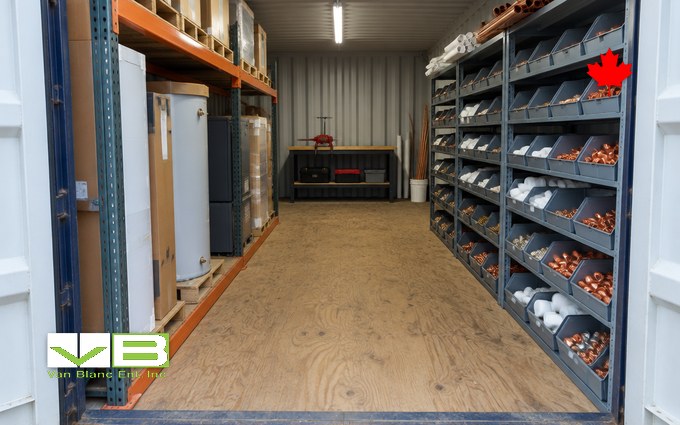
Quick Answer: An HVAC or plumbing contractor’s container setup is pallet racking for the boxed units on one wall, bin shelving for the fittings on the other, and a bench at the blind end when the box doubles as a mobile workshop. The ratio between racking and bins decides the whole layout.
In This Guide
- Two trades, one problem: bulk and fittings
- What the vans actually carry, and what the store holds
- The racking wall for units
- The bin wall for fittings
- The ratio, by trade
- The mobile workshop version
- Damp, sun and cardboard
- Refrigerant and gas cylinders
- Security for a parts store
- Twenty or forty, and the seasonal swing
- Buying the box
- The contractor’s setup checklist
- HVAC and plumbing container FAQs
Reading Time: 13 minutes
Two trades, one problem: bulk and fittings
HVAC and plumbing contractors store the same two kinds of things and want them in the same two kinds of places. The first kind is bulky, boxed and few: furnaces, air handlers, condensers, water heaters, toilets, tubs and the occasional boiler, each one on a skid or in a carton the size of a fridge. The second kind is small and countless: copper, PEX and ABS fittings, valves, straps, hangers, thermostats, capacitors, contactors, filters, flux and solder, by the hundred. The first kind needs racking that takes a skid and keeps a carton dry and upright. The second kind needs a wall of bins a technician can read from the aisle. That split is exactly how the trade hub’s HVAC and plumbing entry describes the setup, and the sentence it adds is the whole design: the ratio between the racking and the bins is what makes or breaks the layout. A plumber running service calls and an HVAC company installing new furnaces want the same container built in opposite proportions, which is why this guide spends a section on the ratio before it spends one on the box.
What the vans actually carry, and what the store holds
A working HVAC van carries the parts that close most tickets: capacitors, contactors, fuses, thermostats, filters and condensate pumps, plus a smaller set of control boards and motors, plus the tools that walk off if nobody checks them out. The stock-list guides published by dispatch software companies and by the distributors make the same recommendation: stock the van with the parts that close about 80 percent of the calls, and transfer the rest from the shop the morning of the job. The plumbing van runs the same way with a different list, fittings and valves by the box, a few common fixtures, the tools and the machine. That rule creates the store. If the van carries the 80 percent, the shop has to hold the other 20 percent plus the replenishment for the 80, plus every unit that goes in on an install, and it has to give it up in one pass at 6:30 in the morning. Inventory apps treat each van as a named location: a part loaded onto the van is a transfer, a part used on a job is a deduction, and the store is the location the transfers come from. The stock room guide’s flow and count rules apply directly; the difference is that a contractor’s store counts in furnaces as well as fittings.
| Lives on the van | Lives in the store | Why |
|---|---|---|
| Capacitors, contactors, fuses, thermostats, filters, condensate pumps | Replenishment by the case; the odd sizes | The van closes the call; the store refills the van |
| A few boards and motors | The full range, by model | Too many variants to carry; transferred the morning of the job |
| Common fittings, valves, straps, a fixture or two | Fittings by the box, fixtures by the pallet | Bin wall and racking; racking that takes a skid inside a box |
| Nothing bulky | Furnaces, condensers, air handlers, water heaters, tubs, toilets | Installs are scheduled; the unit goes out the day it goes in |
| Hand tools, meters, the threader if it is a service van | The bench, the spares, the loaners | The mobile workshop section below |
The racking wall for units
The racking wall is pallet racking bolted to the container floor’s cross-members along one long wall, two bays deep and two levels high, with the bottom level at floor height for anything that arrives on a skid and the upper level for cartons that a person lifts. Furnaces and water heaters stay upright and boxed; condensers sit on their skids; tubs and toilets go high because they are light for their size. The rack goes nearest the cargo doors so a skid comes off the delivery truck, onto a pallet jack, and straight into the first bay without a turn. Racking rated for container floors explains the beam capacities and why the uprights bolt through the cross-members rather than into the plywood alone; the plywood carries a skid but not a bolted upright. The aisle is the constraint: 18-inch bin shelving on the opposite wall and 42-inch racking on this one leave about 32 inches, which is a person and a pallet jack in single file. A contractor who needs both walls racked wants the forty-foot high cube, where the extra length lets the racking run down one wall and the bins occupy the last bays of the other.
The bin wall for fittings
The bin wall is open-front bin shelving on the wall opposite the racking, tilted bins low for the fittings picked by the handful and lidded bins high for the parts picked by the box, labelled in the order a job uses them: rough-in first, trim last. Copper by size, PEX by size and colour, ABS and PVC by size, then valves, then hangers and straps, then the electrical small goods an HVAC tech reaches for. Shelving that hooks the corrugation without drilling is the container-specific version, and it comes down the day the box moves. The rules that keep a bin wall honest are the ones every parts counter knows: nothing lives in an unlabelled box, the wall restocks from the supplier invoice rather than from memory, and a bin that is empty on Friday is on the order by Monday. The electricians’ fittings wall is the same wall with different contents, and the two trades can share a box on a mixed site as long as the labels do not.
The ratio, by trade
The ratio is the decision, and it follows the work. A service plumber running two vans wants a store that is mostly bin wall: fittings, valves and consumables by the box, with a short rack for the water heaters and the fixtures that a week’s calls will replace. A residential HVAC installer wants the reverse: racking for the furnaces and condensers the crew installs, with a shorter bin wall for the filters, thermostats and connectors that go with them. A new-construction plumber lands in the middle, with tubs, toilets and water heaters on the rack and a full bin wall of rough-in fittings. A refrigeration or commercial HVAC company wants racking, a cylinder store and a bench, and almost no bin wall, because the parts are model-specific and come in with the job. The mistake is to build the wall the catalogue shows rather than the wall the last six months of invoices show; a contractor who pulls a year of supplier invoices and sorts them by carton size has the ratio in an afternoon.
| Contractor | Racking wall | Bin wall | Bench | Box |
|---|---|---|---|---|
| Service plumber, two vans | Short: water heaters, a few fixtures | Long: fittings, valves, consumables | Yes, a vise and a threader | 20-foot |
| Residential HVAC installer | Long: furnaces, condensers, air handlers | Short: filters, thermostats, connectors | No | 20-foot or 40-foot high cube |
| New-construction plumber | Medium: tubs, toilets, water heaters | Long: rough-in fittings by size | Small | 40-foot high cube |
| Commercial HVAC and refrigeration | Long: units, coils, motors by model | Short | Yes, plus a cylinder store | 40-foot high cube plus the vented cylinder box the welding trade uses |
The mobile workshop version
Service plumbers often want the box configured as a mobile workshop rather than a store, and the difference is a bench and light. The workshop layout keeps the bin wall, shortens the racking to a single bay by the doors, and gives the blind end a bench with a pipe vise, the threading machine, a bender, a small parts cabinet and task lighting over the vise, with a duplex or two for the tools. The floor in front of the bench is the one place in the box that gets a rubber mat. A plumber who fabricates manifolds, threads nipples and pre-assembles a rough-in at the shop rather than on a customer’s floor gets an hour back on every job, and the box is the shop. The light and power a bench in a container needs covers the fixtures; the ESA inspection path for a container’s circuits covers the connection, which for an HVAC contractor with an electrician on staff is a morning’s work.
Paul LeBlanc, Van Blanc Ent. Inc.: “The plumbers want the bench and the HVAC guys want the rack, and they both want the box by the doors so the van backs up to it. I have delivered the same twenty-footer to both. The only thing that changed was which wall got the shelving.”
Damp, sun and cardboard
The stock in a contractor’s store has three enemies and the container answers two of them for free. The first is damp: a furnace or a water heater in a cardboard carton that sits in a puddle is a unit with a stained carton and a suspicious customer, and a box of brass fittings under a roof drip is a box that goes green. A container is a sealed steel room, and in an Ontario spring it sweats if it cannot breathe, which is why the vents that stop a steel box sweating are the first fit-out decision and the roof-drip fix for a box that already does is the second. Units stay on skids or on the rack, never on the plywood, and a desiccant bucket lives in the blind corner through March. The second enemy is sun: PEX tubing degrades in ultraviolet light and its manufacturers say to keep it out of daylight, and a coil of PEX that has spent a summer on a van’s roof rack is a coil the contractor should not install. A closed steel box is dark, which is the one place a container beats an open shed outright. The third enemy is heat, which matters for the cylinders in the next section and for the solder, flux and adhesives on the bin wall, and it is the reason the box faces away from the afternoon sun where the lot allows.
Cartons up, labels out
Store every boxed unit upright, the way the carton’s arrows say, with the model label facing the aisle. A furnace laid on its side to fit a shelf is a furnace with a damaged heat exchanger claim waiting to happen, and a water heater on its side is a dented jacket. The rack level heights are set by the tallest carton, which for a furnace is around 5 feet.
Refrigerant and gas cylinders
HVAC contractors store refrigerant cylinders and often propane or acetylene for brazing, and the rules for a pressurised cylinder do not change with the gas inside it: upright, restrained with a chain or a strap, caps on, out of direct sun, below the cylinder’s rated storage temperature, in a ventilated space with a low intake and a high exhaust, and separated by type. Refrigerant handling itself is the technician’s licence and the province’s regulation, and this page leaves it there. The store that meets those rules is a small vented box or the vented end of the main one, and the welding shop guide’s cylinder store lays out the vent placement, the rack and the separation distances in full; an HVAC company’s recovery and virgin cylinders live in the same room by the same rules. A twenty-footer with a chained rack at the blind end and louvres top and bottom is the common version; a ten-foot box beside the main store is the version for a company that keeps a lot of gas.
Security for a parts store
A parts store sits in the middle of the container security spec: below the copper vault, above the mower shed. Brass fittings, copper pipe, motors and the tools on the bench all have a scrap or a resale value, and a contractor’s yard on the edge of town is a known address. The spec has the same four parts every trade store gets. The shroud welded over the lock body puts the lock where a pry bar cannot reach; a disc lock that resists a cutting disc goes inside it; the box sits doors-to-the-shop under a light; and a cellular camera on the corner sends the alert. The camera build for a parked container covers the hardware, and the routine that beats every product is the Friday one: units in, doors locked, camera armed, van emptied. The weekend checklist for a loaded site box is the same routine written for a site, and it applies word for word to a store behind the shop.
Twenty or forty, and the seasonal swing
A twenty-foot container holds a two-van service plumber’s store or a small HVAC installer’s: one racking bay by the doors, a bin wall opposite, a bench or a cylinder rack at the blind end, and a single-file aisle. A forty-foot high cube holds a residential installer’s full season: racking down one wall for the furnaces and condensers, bins in the last bays opposite, room for a pallet jack to turn, and the extra foot of headroom that lets a furnace carton stand on the upper level. The seasonal swing sizes it. An HVAC company’s store is fullest twice a year, in April when the condensers arrive for the summer installs and in September when the furnaces arrive for the fall, and the racking has to hold the peak rather than the average; a store sized for July is a store with cartons in the aisle in September. The twenty-footer’s 19 feet 4 inches and the forty-foot high cube’s 8 feet 10 inches of headroom are the two numbers to lay the racking out against; the width, 7 feet 8 inches inside, is the same in both and is the reason the aisle is the thing to protect.
Pricing the parts store?
Tell us the trade, how many vans, whether the store holds furnaces or fittings, and where the box would sit. We will tell you twenty or forty, the grade, which wall gets the door and the vents, and one honest all-in number with a real lead time.
Family-run in Brantford since 1995 · 200+ containers in stock · 4.9★ across 140+ Google reviews · every box graded by a person, walk it before it lands.
Buying the box
The grade for a working parts store is cargo-worthy: structurally certified, doors that seal, surface rust that nobody minds behind a shop. A wind-and-watertight unit does the same job for less if the doors close tight and the roof is sound, and the grade ladder read from a contractor’s side puts the four grades in one table. A one-trip box is the choice for a store that faces the customer parking lot and carries the company colours. Whichever grade, the ten-minute walk-around before paying covers the doors, the floor, the roof, the castings and the plate. The fit-out happens at the yard: the man door, the vents and the lighting rough-in cut before delivery are done under drawings with the header framed, and the racking bolts in after the box lands so the contractor can supply it or have us fit it. What moves the number is size, grade, the fit-out and the distance from Brantford, and the pricing hub’s list of quote drivers is the same on every quote we write. We sell outright, never rent; a contractor who wants to spread the cost does it through an equipment loan through the company’s bank, and we supply the invoice, the grade and the serial number the lender asks for. Delivery is the tilt-deck that sets the box behind the shop in one to three days from our four Brantford yards, onto a level pad that keeps the racking plumb. Contractors who run a site box beside the shop box buy in pairs, and the multi-unit buying guide explains how that conversation goes.
Where the vans load
The parts-store calls come from the service belts: the HVAC companies around Kitchener and Cambridge, the plumbers across the Hamilton plumbing trade’s territory, and the installers working the subdivisions around Brantford itself. All of them are inside an hour of the Morton Avenue rows in Brantford, where the twenties and forties on the ground can be walked with Paul before the racking is ordered. Worth the drive for unbeatable quality, family customer service with 30 years of experience.
The contractor’s setup checklist
Before the box is ordered
- Pull a year of supplier invoices and sort them by carton size. That is the ratio.
- Decide whether the store is a store or a mobile workshop. The bench decides the blind end.
- Size the racking to the seasonal peak, not the average, and set the level heights to the tallest carton.
- Spec the vents before the racking; a sealed box stains cartons and greens brass by April.
- Decide where the cylinders live, and give them their own vented end or their own box.
- Write the security spec and the Friday routine, and put the tool crib’s check-out rule on a card by the door.
A store specified in that order loads two vans in one pass on the first Monday and holds the September furnaces without a carton in the aisle. The alternative most contractors are living with, units in a rented unit across town and fittings in the back of the van, is the arrangement the container-against-warehouse math prices, and the box behind the shop usually wins it.
Frequently Asked Questions
How should an HVAC contractor store furnaces and parts?
Boxed units upright on pallet racking bolted to the container floor’s cross-members, nearest the doors so skids roll straight in; fittings, filters, thermostats and connectors on a bin wall opposite, labelled in the order a job uses them. Vent the box low on one wall and high on the other so cartons and brass stay dry, and size the racking to the spring and fall peaks.
Can a shipping container be a plumber’s mobile workshop?
Yes. Keep the bin wall, shorten the racking to one bay by the doors, and give the blind end a bench with a pipe vise, the threading machine, a bender, task lighting and a duplex or two on an ESA-inspected circuit. A rubber mat in front of the bench and a man door on the long wall turn a box on your own lot into a shop the van loads from.
What size container does an HVAC or plumbing company need?
A twenty-foot container holds a two-van service plumber’s store or a small installer’s, with one racking bay, a bin wall and a bench. A forty-foot high cube holds a residential HVAC installer’s full season, with racking down one wall, bins in the last bays and headroom for a furnace carton on the upper level. Width is 7 feet 8 inches in both, so protect the aisle.
Does PEX or copper go bad in a container?
Copper, ABS and PVC do not. PEX degrades in ultraviolet light and belongs out of daylight, which a closed steel box provides better than a shed or a van roof rack. Brass fittings and cardboard cartons corrode and stain in a box that sweats, so the vents matter: a low intake and a high exhaust on opposite walls, stock on racks rather than the floor, and a desiccant bucket in spring.
How do you store refrigerant cylinders in a container?
Upright, chained or strapped, caps on, out of direct sun, in a ventilated space with a low intake and a high exhaust, separated by type and below the cylinder’s rated storage temperature, in a chained rack at the vented end of the store or in a small box of their own. Refrigerant handling itself is the technician’s licence and provincial regulation; the storage room is the part the container answers.
Is a container more secure than a rented storage unit for parts?
It is yours, on your lot, behind cam-lock doors with the padlock inside a welded shroud, under your light and your camera, with no access window and no monthly meter. The remaining risk is habit, so the Friday routine, units in, doors locked, camera armed, van emptied, matters as much as the hardware, and the site office and store pairing most contractors end up with follows the same rule.
Sources
- ServiceTitan. (2026). Top Ideas for HVAC Van Setup and Organization. servicetitan.com
- HomyScan. (2026). HVAC Truck Stock List: What to Keep on Every Van. homyscan.com
- FleetStock. (2026). HVAC Truck Inventory Software: Track Capacitors, Contactors and Tools by Van. fleetstock.app
- Simpro. (2026). HVAC Inventory Management Best Practices. simprogroup.com
- Carrier Enterprise. (2026). The Must-Have HVAC Inventory Stock List for Your Truck. carrierenterprise.com
- Canadian Centre for Occupational Health and Safety. (2026). Welding: Storage and Handling of Compressed Gas Cylinders. ccohs.ca
Reach Van Blanc in Brantford
We have been supplying shipping containers across Ontario since 1995. Our yard is at 90 Morton Avenue East in Brantford, and we deliver right across the province with payment on the day of delivery. No deposit, no upfront wires, no chase-the-paperwork.
Van Blanc Ent. Inc., 90 Morton Ave E Unit 1B, Brantford, ON N3R 7J7, 519-754-6844 (cell) or 1-888-509-6658 (toll-free).
If the furnaces are in a rented unit across town and the fittings are in the back of the van, call with the trade, the van count and your postal code, and we will tell you on the spot which boxes are on the ground and when a fitted one can land. Worth the drive for unbeatable quality, family customer service with 30 years of experience.