
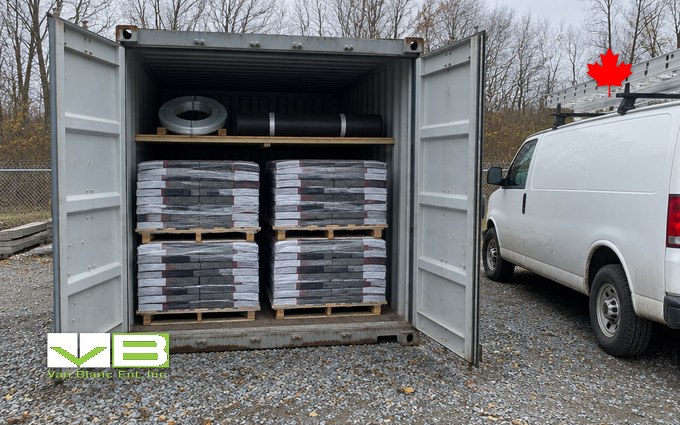
Quick Answer: A roofer’s container is a pallet floor with a clear door end: shingles flat on skids, one pallet high, first in, first out, out of the sun. A mobile detailer’s container is a base, not a wash bay: chemicals above freezing, a fill point, power, the trailer at the doors.
In This Guide
- Two trades, one box, opposite problems
- What a roofing contractor actually stores
- The shingle storage rules the manufacturers publish
- The pallet floor: how many skids fit, and the clear door end
- Heat, sun and the box in July
- The mobile detailing base: water, power and a warm shelf
- Tank math, pump and the trailer that backs up to the doors
- Winter: what the base does when the season stops
- Spec sheet: twenty or forty, grade, vents, floor, power
- The setup checklist
- Roofing and detailing setup FAQs
Reading Time: 12 minutes
Two trades, one box, opposite problems
Roofers and mobile detailers share a box on the trade setups hub because they share a yard problem, not a layout. Both run a business out of a truck or a trailer and need a fixed point that truck comes home to; neither needs the racking wall that a plumber or an electrician builds first. Past that, they are opposites. A roofer stores heavy material that arrives on a skid by forklift and leaves by hand, bundle by bundle, so the container is a floor and a lane. A detailer stores light material that freezes, breaks or walks off, and needs water and power more than shelf space, so the container is a base with a tap and a circuit. This guide takes each in turn, with the manufacturers’ storage rules for the shingles and the tank math for the trailer, and it is honest about the one thing a container is not for either trade: it is not a place to work on a roof and it is not a wash bay. The HVAC and plumbing setup’s racking-to-bins ratio is the layout these two trades do not need, and the contrast is the point.
Christian LeBlanc, Van Blanc Ent. Inc.: “The roofers want the box by the driveway with the doors facing the truck, and they want it empty at the front. They load it from the back with a forklift and take it out the front by hand. The detailers want the box by the tap and the panel. Same twenty-footer, two completely different spots on the lot.”
What a roofing contractor actually stores
Between jobs a residential roofing crew is holding leftover shingle bundles from the last three roofs, partial rolls of synthetic underlayment and ice-and-water membrane, drip edge and flashing in ten-foot lengths, ridge vent in cartons, coil nails by the case, roof jacks, harnesses and rope, two or three extension ladders, a compressor and the nailers, a pile of tarps and the pry bars and tear-off shovels that never fit in the truck. The bundles are the heavy half and the reason a shed or a van does not work: a bundle of architectural shingles is a two-hand lift, IKO sells its Cambridge and Dynasty lines at three bundles to the square and 56 bundles to the pallet, and a full skid is well over a tonne on four wooden runners. The ladders are the long half, the nailers and the compressor are the half that gets stolen, and the membrane and underlayment are the half that ages in daylight. A steel box answers all four: it takes the skid on a floor rated for a forklift wheel, hangs the ladders on the wall, locks the tools, and keeps the sun off the wraps. The weekend lock-up routine for a loaded box is the habit that goes with the nailers.
The shingle storage rules the manufacturers publish
Every asphalt shingle maker publishes a storage bulletin, and they agree with each other. Malarkey’s technical bulletin on storage and handling says the best practice is one pallet high, that double-stacking can indent, deform or stain shingles, particularly in warm weather or direct sun, and that if pallets must be stacked they go no more than two high and squarely, with the heavier shingle lines the most likely to be damaged. It says bundle wraps deteriorate under wind and UV until the bundles are unsafe to carry to the roof, which indoor storage prevents, and it says all stock rotates first in, first out. The Asphalt Roofing Manufacturers Association’s hot-weather guidance adds a cool, dry place, bundles as flat as possible, racks or bins if anything must go higher so the weight does not bear on the bundles below, and shingles kept in their packaging until they are applied so the sealant strips stay aligned. IKO, the Canadian manufacturer whose bundles most Ontario roofers carry, wants shingles flat, on pallets, off the ground, under a waterproof cover, and stored preferably above 10 degrees. The translation for a container is short: skids on the floor, one high, nothing on top of them, out of the sun, oldest by the door. The pallet loading pattern for a container floor is the forklift half of that rule.
| Rule | Who says it | What it means in a container |
|---|---|---|
| One pallet high; never more than two, squarely stacked | Malarkey | Skids on the floor, one high; the 40-foot box is the answer to more volume, not a second layer |
| Flat, on pallets, off the ground | IKO, ARMA | The marine-ply floor is dry and above grade; leave bundles on their skids |
| Cool, dry, out of direct sun; wraps degrade in UV and wind | Malarkey, ARMA | A closed steel box with a louvred vent at each end; shade or a light roof in July |
| First in, first out | Malarkey, ARMA | Oldest skid nearest the doors; new deliveries go deep |
| Racks or bins if stacking higher | ARMA | Wire-deck shelving for rolls and cartons, never for bundles |
| Keep in packaging until applied; prefer above 10 degrees | ARMA, IKO | Bundles stay wrapped; a small heater is optional for the winter leftovers |
The pallet floor: how many skids fit, and the clear door end
A 20-foot container is 19 feet 4 inches long and 7 feet 8 inches wide inside, which takes two rows of standard 48-by-40 skids with the 40-inch side across the box and a walking gap down the middle. Four skids per row fills the length; three per row leaves roughly seven feet clear at the doors, and that clear end is the whole layout, because bundles leave by hand and the crew needs a lane to carry them out and a place to stage the day’s load before the truck backs up. Six skids in a twenty, eight in a forty-foot box with a full lane, sixteen in a forty packed to the doors, all one high, all on the floor. The floor takes it: ISO 1496-1 rates a container floor for a point load of 5,460 kilograms on a single forklift wheel patch, so a skid of shingles spread over four runners is nothing to it, and the forklift’s own rules inside a box matter more than the pallet’s weight. Rolls of underlayment and membrane, drip edge and ridge vent go on wire-deck shelving along the blind-end wall above head height, ladders hang on hooks on the wall opposite the walking gap, and the compressor and nailers live in a lockable cabinet or a job box at the door end where the crew can reach them and a thief cannot. Nothing sits on a bundle. Ever.
Oldest skid by the door
First in, first out is a delivery rule, not a paperwork rule. New pallets go to the blind end and the crew works from the doors, which means the box is loaded from the far end forward. A forklift that puts the new skid at the door because it is easier has just buried last spring’s bundles for another season.
Heat, sun and the box in July
The one place a steel box works against a roofer is the sun. A dark container in an open yard in July runs hot inside, and hot is exactly what the bulletins warn about: bundles that stick, sealant that softens, wraps that fail. The fixes are the ones every hot-storage container uses. Vent the box at both ends so the air moves, put the box on the north side of a building or under trees if the yard has any, and paint the roof a light colour, because a light roof coat on a container knocks the solar gain down more than any other single change. Do not park the doors facing south-west. Keep the summer stock turning so no skid sits through August, and snap the bundles in the cool of the morning if they have stuck, which Malarkey says works better than fighting them at noon. Winter is the easy season: shingles stiffen in the cold and store well, and the leftover bundles from the last roofs of November sit out the winter in a dry box better than they would under a tarp in the yard. The winter routine for a closed steel box keeps the cartons of vent and the coil nails dry until April.
The mobile detailing base: water, power and a warm shelf
A mobile detailer’s business is in the van or the trailer: the tank, the pump, the pressure washer, the hose reel, the polisher, the extractor, the vacuum, the pads and towels and a shelf of chemicals. What the van cannot carry is the rest of the business, and that is what the base holds. The chemicals are the first reason: most detailing products are water-based and freeze, and a case of soap or a jug of ceramic spray that froze in the trailer in January is a case in the bin, so the base is an insulated box with a small heater that keeps a shelf above zero from November to March. The second reason is the water: a 100-gallon tank filled at a customer’s tap is a favour, and a fill point at the base, a frost-free hydrant or a tap inside a heated box, is the difference between a business and a hobby. The third is power: chargers for the cordless polishers and vacuums, a compressor for the air tools, lighting for the evening restock, all on a proper circuit rather than an extension cord across the driveway. The fourth is the laundry and the inventory, towels by the hundred and pads by the dozen, which want a dry shelf and a door that locks. The mobile vet’s base unit in a container is the same idea in a regulated trade, and the layout carries over almost unchanged.
What the base is not is a wash bay. A 20-foot box is 7 feet 8 inches wide inside, and a car is 6 feet wide before the doors open, so nobody details a vehicle inside a standard container, and a 40-foot high cube that could swallow a car leaves no room to work around it. The winter answer for the detailer who wants to keep washing is a heated garage bay or a shop with a floor drain, which is a building question, and the container’s honest job is to be the warm, dry, powered base beside it. Wash water rules are municipal and the base does not change them. What the box does change is the fixed cost: a detailer paying a monthly unit across town for chemicals and towels, with the trailer parked at home and the water coming from wherever the next customer lives, has three problems that one box on their own driveway or a corner of a commercial lot solves at once, and the monthly unit against a box bought once is the arithmetic.
Tank math, pump and the trailer that backs up to the doors
The trailer decides the size of the base and the fill point, so it is worth setting out. Car Wash Country’s tank guide puts the 100-gallon tank as the most common size in mobile detailing at four to five cars per fill; a 50-gallon tank does one or two cars and weighs 417 pounds full, a 100-gallon tank about 834 pounds, and a 250-gallon tank does ten to twelve cars at 2,085 pounds and belongs on a dual-axle trailer. Water is the heaviest thing a detailer carries, at a little over eight pounds a gallon, which is why the tank rides on ratchet straps to anchor points rated over a thousand pounds and why the fill happens at the base when the trailer comes home, not on the way to the customer. The plumbing order is the tank outlet to a bung fitting, a brass shutoff, a hose to a 12-volt pump for consistent pressure and easy priming, then the pressure washer and the hose reel. That chain is the fixed-station version of what a produce grower runs, and the wash-pack container’s water layout shows it plumbed into a box. At the base that means the trailer backs up to the doors within a hose length of the fill point, the pump and the pressure washer come inside for the night in winter, and the chemicals restock from the warm shelf. The enclosed trailer weighed against a container covers the detailer who is deciding whether the trailer itself should winter inside; at 7 feet 6 inches wide or less it can, tongue first, on the loading ramp from our accessory shelf over the door sill.
| Tank | Cars per fill | Weight full | Rides on | Base fill point |
|---|---|---|---|---|
| 50 gallon | 1 to 2 | 417 lb | Van or small trailer | Any tap and a hose |
| 100 gallon | 4 to 5 | About 830 lb | Van or single-axle trailer | Frost-free hydrant or an indoor tap |
| 250 gallon | 10 to 12 | 2,085 lb | Dual-axle trailer | Hydrant; the trailer’s own winter is a second question |
Winter: what the base does when the season stops
Both trades slow or stop from December to March, and the base earns its keep in the off-season by doing nothing dramatic. For the roofer it holds the leftover bundles dry and wrapped, the membrane rolls out of the daylight, the ladders off the ground and the nailers behind a lock, so April starts with an inventory rather than a landfill run. For the detailer it holds the chemicals above freezing, the pressure washer and the pump indoors so the seals do not crack, the polishers on charge and the tank drained, and it gives the trailer a place to sit that is not the street. Winterizing the trailer’s water system is the one job that cannot be skipped: drain the tank, run the pump dry, push RV antifreeze through the pump, the lines and the pressure washer, and bring the washer inside, because a frozen pump head is a spring repair that costs a week of bookings. The tire hotel’s swap-season routine is the auto-trade cousin of that winter, a box that fills in November and empties in April on a schedule.
Roofer or detailer, tell us which
Tell us the trade, what comes home on the truck, whether a forklift loads it, and where the box would sit relative to the driveway, the tap and the panel. We will tell you twenty or forty, the grade, the vents, the floor and the rough-in, and one honest all-in number with a real lead time.
Family-run in Brantford since 1995 · 200+ containers in stock · 4.9★ across 140+ Google reviews · every box graded by a person, walk it before it lands.
Spec sheet: twenty or forty, grade, vents, floor, power
For the roofer, a 20-foot box holds a small residential crew’s between-jobs stock with six skids and a lane, and a 40-foot standard holds a company running two or three crews with the season’s leftovers and the underlayment for the next month. Grade is wind-and-watertight for a skid floor, because surface rust on a box that holds shingles bothers nobody, and the money goes to two louvred vents, a light roof coat and a lockable job box at the doors rather than to a newer shell. Check the floor when you walk the box; a floor with soft spots is the one thing a skid of shingles will find. For the detailer, a 20-foot box is the right size for the base, and it is a one-trip box for a base that gets lined, insulated and panelled, with a man door beside the cargo doors, a window, an insulated wall for the warm shelf, and the rough-in for a tap and a small heater. We do the shell work at the yard: insulation, lining, the man door and window, the shelving, the vents and the lockbox. The final electrical connection, the circuit for the compressor and the chargers, is a licensed electrician’s job with an ESA inspection, and the water line is a plumber’s, and we say that on the quote. The workshop power and lighting layout is the circuit plan the detailer’s base borrows. What moves the number is size, grade, the lining and the rough-in, and the distance from Brantford, and the quote drivers on a trade box are the same list on every quote we write. We sell outright, never rent; a contractor spreading the cost does it through their own bank with the invoice and the serial number.
Where the roofing and detailing calls come from
The roofing calls come from the subdivision belts: crews working the Cambridge and Kitchener builds, the companies on the Hamilton mountain and the lower city, and the tear-off outfits around Brantford itself. The detailing calls come from the driveways: mobile operators in Burlington and Oakville and across the Mississauga service belt who are tired of a monthly unit and a customer’s tap. All of them are a delivery away. Worth the drive for unbeatable quality, family customer service with 30 years of experience.
The setup checklist
Before the box lands
- Roofer: count the skids you hold between jobs and add two. Three per row plus a seven-foot lane is a twenty; more is a forty.
- Roofer: decide where the forklift comes from and which way the doors face the truck; the box loads from the blind end and unloads from the doors.
- Roofer: vents both ends, light roof coat, ladder hooks on one wall, wire-deck shelving on the blind end, a lockable job box at the doors. Nothing on a bundle.
- Detailer: measure the trailer and the hose run from the fill point; the box sits within a hose length of the tap and within a cord length of the panel.
- Detailer: insulated and lined, man door, a warm shelf with a small heater, a circuit run by a licensed electrician, and the pump and washer inside for the winter.
- Both: walk the box at our rows in Brantford with the skid count or the trailer measurements, and check the floor and the door seals yourself.
A roofing box set up that way holds a season without a bundle lost to sun or a nailer lost to a Friday night, and a detailing base set up that way turns a trailer parked at home and a chemical shelf across town into one place the business comes home to. Both are the same steel; the difference is which wall gets the hooks and which end gets the tap, and the container against every other building a trade might buy is the wider comparison if the yard is also deciding between a box and a pole barn.
Frequently Asked Questions
How should shingles be stored in a container?
Flat on their pallets, one pallet high, never more than two and squarely stacked if they must be, out of direct sun, with the bundles left wrapped and the oldest skid nearest the doors. Vent the box at both ends and keep it out of the July sun with shade or a light roof coat, because heat is what makes bundles stick and sealant soften. Nothing goes on top of a bundle.
How many pallets of shingles fit in a 20-foot container?
Two rows of 48-by-40 skids with the 40-inch side across the box: four per row fills the length at eight skids, and three per row at six skids leaves about seven feet clear at the doors for carrying bundles out and staging the truck. A 40-foot box takes sixteen packed or about twelve with a full lane, all one high. The container floor is rated for a forklift wheel and takes the weight without comment.
Can a container floor take a pallet of shingles and a forklift?
Yes. ISO 1496-1 rates the floor for a point load of 5,460 kilograms on a single wheel patch, and a skid of shingles spreads well over a tonne across four runners. The rule that matters is the forklift’s: drive the centreline and place skids to either side rather than running the wheels down one sidewall, and bolt any racking to the cross-members, never to the plywood.
Can I run a mobile detailing business from a shipping container?
You can base one there. A 20-foot box, insulated and lined, holds the chemicals above freezing, the towels and pads dry, the polishers on charge and the pump and washer indoors for winter, with a fill point within a hose length of the doors. It is not a wash bay: a car does not fit in a standard box with room to work, so the winter wash bay is a heated garage question and the box is the base beside it.
What size water tank does a mobile detailing trailer need?
A 100-gallon tank is the common size at four to five cars per fill; a 50-gallon tank does one or two cars and weighs 417 pounds full; a 250-gallon tank does ten to twelve cars at 2,085 pounds and belongs on a dual-axle trailer. The tank rides on ratchet straps to anchors rated over a thousand pounds and feeds a 12-volt pump ahead of the pressure washer, and the fill happens at the base when the trailer comes home.
How do I winterize a mobile detailing setup in Ontario?
Drain the tank, run the pump dry, push RV antifreeze through the pump, the lines and the pressure washer, and bring the pressure washer and the pump inside a heated space for the winter, because a frozen pump head is a spring repair. Move every water-based chemical to a shelf that stays above zero, which is what an insulated container base with a small heater is for.
Does Van Blanc wire the power or plumb the water in a trade container?
We do the shell work at the Brantford yard: insulation, lining, man door, window, vents, shelving, ladder hooks and the lockbox. The final electrical connection and the circuit for a compressor or chargers are a licensed electrician’s job with an ESA inspection, and the water line and any drain are a plumber’s, and both are written on the quote as your trades rather than ours.
Sources
- Malarkey Roofing Products. (October 2020). Technical Bulletin: Storage and Handling of Asphalt Shingles. malarkeyroofing.com
- Asphalt Roofing Manufacturers Association. (2026). Recommendations for Storage and Application of Asphalt Roofing Shingles in Hot Weather. asphaltroofing.org
- IKO Industries. (2026). How Many Square Feet in a Bundle of Shingles: Bundle Coverage. iko.com
- IKO Industries. (2024). General IKO Storage Recommendations. iko.com
- Car Wash Country. (2026). Water Tanks for Mobile Detailing: Setup and Size Guide. carwashcountry.com
Reach Van Blanc in Brantford
We have been supplying shipping containers across Ontario since 1995. Our yard is at 90 Morton Avenue East in Brantford, and we deliver right across the province with payment on the day of delivery. No deposit, no upfront wires, no chase-the-paperwork.
Van Blanc Ent. Inc., 90 Morton Ave E Unit 1B, Brantford, ON N3R 7J7, 519-754-6844 (cell) or 1-888-509-6658 (toll-free).
If the bundles are under a tarp or the chemicals are in a unit across town, call with the trade and your postal code, and we will tell you on the spot which boxes are on the ground and when a fitted one can land. Worth the drive for unbeatable quality, family customer service with 30 years of experience.