
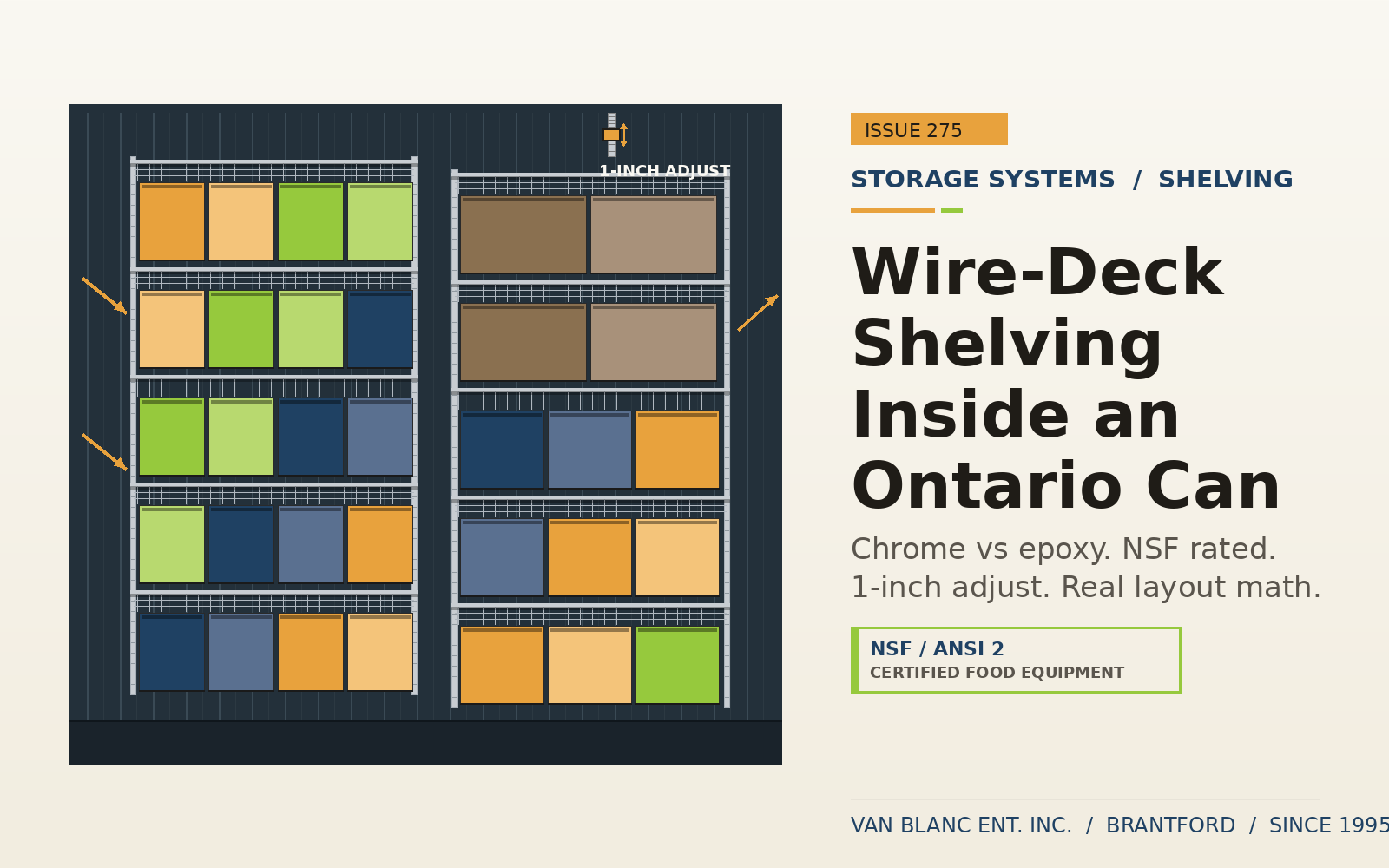
Quick Answer: Wire-deck shelving turns a 20ft shipping container into a dense parts room when you run two or three 72-inch units down each long wall. NSF-certified chrome handles dry parts and packaged goods; epoxy is the right pick when humidity inside the can climbs through Ontario’s freeze-thaw winter. Shelves adjust in 1-inch increments. Fast 1-3 day delivery to every region across Ontario from our 4 Brantford yards. Family-run since 1995, 4.9 stars across 140+ verified Google reviews.
In This Guide
- Why Is Wire Deck the Right Shelf Inside a Shipping Container?
- Chrome or Epoxy: Which Survives Ontario Humidity?
- What Does NSF Certification Actually Buy You?
- How Much Weight Can Wire Deck Shelving Hold Per Shelf?
- How Do You Lay Out Wire Shelving in a 20ft or 40ft Container?
- How Do You Anchor Shelving and Keep Airflow Inside a Container?
- Why Does Adjustable-Height Wire Shelving Matter in a Container?
- Which Bin and Tote Systems Match Wire Deck Shelving?
- What Does Wire-Shelving Install Day Look Like at the Brantford Yard?
- What Are the Five Most Common Wire-Shelving Mistakes?
- FAQs
Reading time: about 14 minutes.
Why Is Wire Deck the Right Shelf Inside a Shipping Container?
Wire deck is the right shelf inside a shipping container because open steel mesh lets airflow, sight-lines, and flashlight beams pass through the load, which a solid melamine shelf blocks. The mesh also drops dust to the floor instead of trapping grit, and it pairs cleanly with stackable parts bins for high-density storage.
Wire deck earns its place because the inside of a sea can is an unforgiving box: one fixed door opening, corrugated walls you do not want to drill carelessly, and a wood floor that flexes a little under point loads. That geometry has consequences for how shelving behaves. A solid melamine shelf turns the inside of a 20ft into a long dark hallway because nothing past the front rank gets airflow or sight-line. Open mesh changes the math entirely. It lets you see what is on the second and third tier from the door, lets a flashlight beam pass through, and lets cool morning air move through the load before the afternoon sun heats the roof panels. If you are weighing the full range of interior fit-outs, our complete walkthrough of container shelving systems lays out where wire deck beats solid shelving and where it does not.
Most buyers we work with have never thought of shelving as an airflow decision. They think of it as a square-footage decision. Both matter. A typical chrome wire unit at 48 inches wide, 18 inches deep, and 72 inches tall gives you five shelves at 30 inches of vertical clearance per tier (if you space them evenly). Two of those down the long side of a 20ft container, plus one on the back wall, gives you fifteen running feet of frontage and over 240 linear feet of bin-pocket capacity once you load it with stackable parts bins. The same job in a 40ft just doubles. Buyers move from “where am I going to put this stuff” to “I have leftover shelf space” almost overnight.
The other quiet advantage is that wire deck does not trap dust. A solid laminate shelf inside a container collects fine grit every time the door opens. The grit settles, mixes with whatever lubricant residue you carried in on a part, and turns into a paste that you scrub off twice a year. Wire deck just lets the dust fall through. The floor of the container gets a quick sweep, the shelves stay clean, and the parts you store at eye level look like they did the day you set them down.
Chrome or Epoxy: Which Survives Ontario Humidity?
Chrome versus epoxy is the question almost every buyer asks last and should ask first. Chrome wire shelving is plated steel with a bright finish. It is the standard finish at every big-box store, it looks clean in photos, and it is the cheapest tier. Epoxy is the same wire structure with a polymer coating baked over the chrome (or directly over the steel) that seals the metal from air and moisture.
Inside an Ontario shipping container, that distinction matters more than it would inside a heated commercial pantry. A 40HC sitting on a Norfolk farm goes from minus 20 in February to plus 32 in July. When that container is closed during a freeze-thaw cycle, the inside surfaces breathe condensation. We have walked into stored containers in April where the ceiling beads with droplets the size of peas after a cold night and a warm morning. Chrome holds up fine in a dry-storage container that is opened daily, restocked, and not left to swing through humidity unattended. Chrome rusts in a container that gets locked up for the winter with a few moist boxes inside it.
The simple field rule
If the container is going to be loaded and locked, opened weekly or less, and left through Ontario’s freeze-thaw winter, spend the extra and buy epoxy. If the container is a working storage room that gets opened every day on a contractor’s site or a parts counter, chrome holds up and looks cleaner.
Christian LeBlanc, second-generation operator: “I grew up around these containers and the one thing buyers underestimate every time is how hard an Ontario winter is on the inside of a locked box. A bright chrome shelf looks great in the showroom. Lock it in a sealed can from November to April with a couple of damp boxes on it and you are scrubbing orange off the bottom tiers by spring. When somebody tells me the can is getting shut for the season, I steer them to epoxy before they even ask the price.”
The cost gap is real but not gigantic. Across most Canadian suppliers we have seen, epoxy runs roughly 15 to 25 percent more than the equivalent chrome unit at the same dimensions and shelf count. Spread across the ten-to-fifteen-year service life of a good shelving unit, it works out to pocket change per year. The buyers who skip epoxy because of the up-front cost are usually the same buyers who call us 18 months later asking about rusted shelving in a container they thought was dry inside.
What Does NSF Certification Actually Buy You?
NSF certification is worth understanding before you spend. NSF/ANSI Standard 2 is the food-equipment certification mark you see on the labels of every commercial kitchen shelf in North America. The standard sets minimum requirements for materials, design, fabrication, construction, and performance of food-handling equipment, including shelves used in cafeterias, pantries, bakeries, and cold-storage rooms. A shelf with current NSF/ANSI Standard 2 certification means the unit was tested for material safety, sanitation cleanability, and resistance to moisture and grease at temperatures common to commercial kitchens.
That sounds like overkill for a shipping container parts room. It is not. Three real-world reasons:
Where the NSF mark earns its keep
First, if the container ever holds food-adjacent product (packaged dry goods, brewery supplies, restaurant inventory overflow, cannabis dry-storage), the NSF certification keeps you in compliance with the local public-health unit. Second, the manufacturing standard NSF certifies is also a good proxy for quality of welds, plating thickness, and shelf-clip design. NSF-certified wire shelving is generally better-made than the non-certified equivalent at the same price point because the certification audit catches sloppy fabrication. Third, NSF-certified shelves carry a visible mark that resale buyers recognize. If you ever sell the container or the shelving on, the mark is worth a small premium.
Verification is straightforward. The NSF online database lets you search by manufacturer, brand, or model and confirm the listing matches the exact series on the label. Buyers who want to be sure should grab the model number off the unit before placing the order, check it against the listing, and keep a print-out of the listing with the receipt. If you ever get inspected, the inspector wants to see the mark on the shelf and the documentation. The print-out closes the loop.
How Much Weight Can Wire Deck Shelving Hold Per Shelf?
Per-shelf capacity is where buyers get into trouble. They look at a “1000-lb capacity per shelf” sticker on a big-box wire rack and assume they can stack 1,000 pounds anywhere on the shelf. They cannot. The capacity rating is for a uniformly distributed load. Drop a 400-pound transmission case onto one corner of a 1,000-lb shelf and you have created a point load that may exceed what the shelf can hold even though it is well under the rated weight.
Real-world capacity tiers we see most often, by unit type:
| Unit type | Per-shelf rated capacity (UDL) | Best use inside a container |
|---|---|---|
| Light-duty chrome wire (residential grade) | 250 to 400 lbs | Boxes, tools, packaged goods, light parts |
| Heavy-duty chrome or epoxy wire (commercial grade) | 500 to 800 lbs | Parts bins, totes, modest castings, hand tools |
| Industrial wire deck on pallet rack uprights | 1,000 to 2,500 lbs (ANSI MH26.2 tested) | Pallet-load storage, heavy parts, machined components |
| Mobile wire shelving with casters | 500 to 800 lbs total unit | Lightweight inventory that needs to roll outside |
The other rating that buyers miss is the total unit capacity. A unit rated at 800 pounds per shelf with five shelves is not rated for 4,000 pounds total. It is usually rated for 2,000 to 3,000 pounds total because the uprights, casters (if any), and connecting clips are the bottleneck. Read the unit’s total-load spec on the data sheet before you load the bottom shelf with the heaviest stuff.
How Do You Lay Out Wire Shelving in a 20ft or 40ft Container?
The layout for wire shelving starts with real container measurements, not the catalogue images. Internal dimensions for a standard 20ft dry container land at roughly 5.9 metres long by 2.35 metres wide by 2.39 metres tall (19’4″ x 7’8″ x 7’10”). A 40ft high cube gives you about 12.04 metres long by 2.35 metres wide by 2.69 metres tall (39’6″ x 7’8″ x 8’10”). You lose roughly four inches of width to the corrugated walls if you measure peak-to-peak versus valley-to-valley, which matters when you are deciding shelf depth. If your inventory is long stock rather than boxed parts, the same wall space is better handled by a cantilever-arm setup for pipe and lumber, which we cover in a separate guide.
A common plan for a 20ft parts container:
- Two 48-inch by 18-inch shelving units down one long wall, end to end (96 inches of frontage on that side).
- Two more 48 x 18 units down the opposite wall, leaving a 35-inch centre aisle.
- One 36-inch by 18-inch unit across the back wall, perpendicular.
- Total: five units, twenty-five shelves at five tiers each, roughly 1,800 linear inches of shelf frontage.
For a 40ft high cube parts container, double the long-wall count to four units per side and switch the back-wall unit to a 48-inch. The extra ceiling height in a high cube also lets you run 84-inch-tall units instead of 72-inch, which adds another tier per unit if you space the shelves right. That is roughly 36 shelves for a 40HC laid out this way.
The same 20ft, a different layout
Auto shop running it as overflow parts storage: four units of 800-lb commercial epoxy down the long walls, deep-bin totes on the bottom three tiers for fasteners and small parts, top two tiers for boxed inventory. Heaviest items (brake rotors, gear sets) on the bottom tier where the load path goes straight to the container floor. Centre aisle wide enough for a parts cart. Same container, a contractor’s tool room: light-duty chrome at the back for receipts and packaged consumables, heavy-duty wire deck at the front for power tools and battery chargers. Wire mesh lets battery LEDs glow through so you can see what is charging without opening the front rank.
How Do You Anchor Shelving and Keep Airflow Inside a Container?
Anchoring starts with the floor. The container floor is plywood treated with insecticide and bedded over steel cross-members. It flexes a little, especially in the middle third of the unit. Buyers who set wire shelving directly on the floor without thinking about load paths sometimes end up with a corner unit that has gradually tilted because the cross-member under that corner is the one with a soft spot.
Three practical fixes:
- Footplates over the cross-members. The steel cross-members run perpendicular to the long axis of the container and sit roughly 12 inches on centre. If you can identify their position (tap the floor with a wrench and listen for the dull versus hollow ring), align the upright feet of your shelving over them. The load path then goes through plywood to steel instead of plywood to nothing.
- Levelling feet, not casters, on a stationary unit. Adjustable levelling feet (the threaded foot with a swivel pad) let you tune each upright by a turn or two so all four feet share the load. Casters on a unit you do not intend to roll just introduce four pivot points that wear unevenly.
- Strap to the wall logistics rings if the container has them. One-trip and many CW containers have logistics-loop rings welded inside the corner posts. A ratchet strap from each unit to a logistics ring stops the unit from walking forward when a tilt-deck truck delivers the container later or when the container gets moved.
Airflow matters because a closed container builds up moisture. Even with epoxy shelves, the wood floor and the steel walls still want to breathe. Leave 4 to 6 inches of clearance behind each shelving unit so air can move between the wall and the load. That single gap drops condensation on the wall steel by a noticeable margin in our experience, especially through the shoulder seasons when day-night temperature swings are largest.
Why Does Adjustable-Height Wire Shelving Matter in a Container?
Adjustable height matters because every decent wire shelving unit uses split-sleeve clamps that grip the grooved uprights. You snap the sleeve onto the upright at the height you want, snap the shelf onto the sleeve, and tap it down with a rubber mallet. The clamps adjust in 1-inch increments. That sounds trivial until you load a real parts container.
What changes the math: the boxes you actually own are not standard sizes. A row of medium tote bins might be 11 inches tall. A row of long-bin stackers for fastener storage might be 9 inches. A row of boxed inventory might be 16 inches. If your shelving adjusts in 4-inch fixed slots (some bolt-together commercial racks do this), you end up with 5 inches of dead air above the 11-inch totes because the next slot up is too tall to fit a 16-inch box on top. Multiply that by 30 shelves and you have buried ten cubic feet of usable storage in dead air space.
The 1-inch adjustment fixes that. You measure your tallest box, add an inch of clearance, set the shelf there, then measure the next stack, adjust to fit, work up. A buyer who spends an extra hour setting up gets back 10 to 15 percent more usable cubic footage versus the same container with fixed-increment shelving. That cubic footage compounds over years of restocking.
Paul LeBlanc, owner: “The buyers who get the most out of a container are the ones who treat the shelving like a workbench. They tune it. The first weekend after delivery, they spend two hours adjusting clamps so the bins fit the way their inventory actually moves. Six months later they have a container that runs like a parts counter. The ones who buy the shelving, set every shelf at the factory spacing, and walk away end up with a container that looks tidy and only holds about two-thirds of what it could.”
Which Bin and Tote Systems Match Wire Deck Shelving?
The bins matter as much as the shelves. Open-front stackable parts bins (Akro-Mils and equivalent Canadian brands like Quantum) come in standardized sizes that interlock with wire deck. The small-size bin (often around 7.5 x 4 x 3 inches) lets you put 24 bins across a 48-inch shelf for fastener storage. Medium bins (around 11 x 5.5 x 5 inches) give you 16 across the same shelf for sub-assemblies. Large bins (16 x 8 x 7 inches) give you six across for boxed inventory.
The reason wire deck works so well with these bins is that the bin’s open front projects through the front of the shelf where you can see and grab. Solid shelving forces you to either label every bin top (which you cannot see from below) or to pull bins forward to identify contents. Wire mesh lets you read a side label from below or grab a bin by its lip from underneath the shelf above. That single ergonomic choice cuts the time to find a part by roughly half in our own yard parts storage.
Practical bin sizing per shelf depth
- 14-inch deep shelves: small and medium bins only; large bins overhang and snag on the next shelf.
- 18-inch deep shelves: the sweet spot. Small, medium, and large bins all fit cleanly with the front lip flush to the shelf edge.
- 24-inch deep shelves: oversized bins or double-row layouts. Useful for high-volume fastener stocks or two-deep packaged inventory.
What Does Wire-Shelving Install Day Look Like at the Brantford Yard?
Install day usually starts with the container, not the shelving. If you buy a container from us and you are setting up a parts room, we typically deliver the container empty to your site, you order the shelving direct from a Canadian wire-shelving supplier, and the buyer’s crew installs it on site. Most parts-room buyers start by browsing the in-stock 20ft and 40ft units we have ready to deliver, then size the shelving to the can they pick. We have also had buyers who bought a one-trip from us, drove up to the Brantford yard to look at the container before delivery, and ended up scheduling the shelving install in our yard the morning the container arrived on the truck. That works well for buyers who do not have a forklift or a wide assembly area at their final site.
The install is straightforward. Two people can put up a 48-inch by 18-inch by 72-inch unit in roughly 25 to 30 minutes the first time, faster after that. The clamps tap on with a rubber mallet. The shelves drop into place. Levelling feet thread in. You set the unit in position, hand-tighten the levelling feet, load the bottom shelf with the heaviest items first to settle the unit, then work up. Four units fit a 20ft and they will be fully loaded within a few hours if the buyer pre-sorted their inventory into the bin tiers ahead of time.
Buyers who come to the yard for the install have one advantage over buyers who set up at the final site: we can show them the load-path tap test on the container floor, point out the logistics rings if the container has them, and answer the half-dozen small questions that come up during the first install (“how high do you set the top shelf if you want to reach it without a step stool?”, “do you bolt these to each other?”, “does the unit need to be exactly plumb or just close?”). Most of those questions take a minute to answer and save the buyer half an hour of fiddling.
Worth the drive for the install conversation
Buyers from across Ontario regularly drive to Brantford to look at the container before delivery. The drive is worth it more when shelving is part of the plan, because the first install on a wire-deck system inside a sea can is a learning curve that goes faster with someone walking the yard with you. We have watched dozens of these parts rooms go together in the yard over the years. Paul or Christian can point at what works and what we have seen go sideways. That conversation is part of why people choose a real Brantford yard over a pool supplier.
What Are the Five Most Common Wire-Shelving Mistakes?
The five most common wire-shelving mistakes come from thirty years of selling containers and watching buyers set them up. The same five come up over and over. Avoiding them is easier than fixing them.
- Buying chrome for a container that will be locked through the winter. Already covered above. Worth repeating because it is the single most common mistake. Spend the 20 percent extra and buy epoxy if the container is going to sit unopened through humidity swings.
- Buying light-duty residential shelving for a commercial parts load. A 250-lb residential shelf will hold for a while, but a fully loaded medium tote of bolts can hit 60 to 80 pounds. Stack four of those on a shelf and you are at 320 pounds, over the rated capacity. The shelf does not collapse immediately. It sags, then it deflects more, then the upright clamps fatigue, and one morning you open the door to a pile. Buy 500 to 800-lb commercial grade from the start.
- Skipping the levelling feet step. Buyers stand the unit up, do not turn the feet, and load it. Half the load goes through three feet because the fourth is in the air. The unit walks under load and the upright with the unloaded foot starts to tilt. Five-minute fix, easy to skip, big consequences six months later.
- No clearance behind the units. Already covered. Buyers push the shelving tight against the corrugated wall because they want every inch of aisle space. The wall stops breathing, condensation collects, and the back of the shelving rusts even if the front looks fine. Leave the four-to-six-inch gap.
- Putting the heaviest stuff on the top shelf. This one sounds obvious but it happens because buyers want frequent-use light items at hand height. The heaviest items belong on the bottom tier where the load path is shortest and where a clumsy bin drop does not become a head injury. Frequent-use light items go on tier two or three. Top tier is for stored boxes that come down once a quarter.
If you want to size a parts container before you order, Paul or Christian will hand you a tape measure inside a bare 20ft at the Brantford yard and let you mark out the aisle widths and shelf gaps yourself. Shelving is one of the simpler interior jobs; for the heavier build-outs, our overview of what we change inside a container before it ships covers doors, venting, and electrical rough-ins.
Frequently Asked Questions
How many wire shelving units fit inside a 20ft shipping container?
Most parts-room layouts use four to five 48-inch by 18-inch wire units inside a 20ft. Two down each long wall, optionally one across the back. That gives you twenty to twenty-five shelves of frontage and leaves a 30 to 35-inch centre aisle for a parts cart or hand truck.
Is NSF-certified chrome shelving rated for a shipping container parts room?
Yes for dry-storage use. NSF/ANSI Standard 2 covers food-handling equipment, but the same construction quality applies. NSF-certified chrome is rated for dry storage and works well in containers that get opened daily. For containers that lock up through Ontario winters, switch to epoxy coating because chrome rusts when humidity gets trapped inside.
What is the weight capacity of wire deck shelving per shelf?
Residential-grade chrome wire shelves typically hold 250 to 400 lbs per shelf as a uniformly distributed load. Commercial-grade chrome or epoxy units run 500 to 800 lbs per shelf. Industrial wire deck on pallet-rack uprights tests to 1,000 to 2,500 lbs per shelf under ANSI MH26.2. Always read the data sheet, not just the unit sticker.
Should I bolt the shelving to the container wall?
We do not recommend drilling the corrugated wall. Container walls are structural and the corrugations are part of the load path. Instead, use the logistics-loop rings welded inside the corner posts (if your container has them) and strap each unit to a ring with a ratchet strap. That holds the unit during transport or yard moves without compromising the wall.
Will wire shelving rust inside a shipping container in Ontario?
Chrome wire shelving can rust in a container that locks through Ontario winters because freeze-thaw cycles drive condensation onto interior surfaces. Epoxy-coated wire shelving resists that humidity and typically lasts ten to fifteen years in damp environments. For year-round storage with infrequent access, choose epoxy.
How adjustable is wire-deck shelving in a container?
Standard wire shelving uses split-sleeve clamps that adjust in 1-inch increments along grooved uprights. You set each shelf to fit the tallest box in that tier plus an inch of clearance. The 1-inch adjustment recovers 10 to 15 percent more usable cubic space than fixed 4-inch increment racks, which matters when you are paying for every cubic foot inside a sea can.
What sizes of wire shelving units work best in a 40ft high cube?
A 40HC gives you 8 feet 10 inches of internal height, which lets you run 84-inch-tall units instead of the standard 72-inch. That adds a sixth tier per unit if you space the shelves right. Eight units down the long walls (four per side) plus one or two on the back wall makes a parts room with roughly 35 to 40 shelves of frontage.
Can I roll wire shelving in and out of the container?
Yes if you buy units with locking heavy-duty casters rated for the load. Mobile units are useful for inventory that needs to come outside, such as event-day stock or seasonal rotation. Lock the casters once the unit is parked so it does not roll when the container is on a slight slope. Heavy-duty mobile units still carry a real per-shelf rating, so check the data sheet before you load one for transport.
How fast can Van Blanc deliver a container ready for wire-deck shelving?
We deliver across Ontario in 1 to 3 days from our 4 Brantford yards. Every quote comes with a real lead time, not a hopeful one. Buyers who want to see the container before delivery are welcome to visit the Brantford yard at 90 Morton Avenue East. Bring your shelf dimensions and we will walk a bare 20ft with you so you can see how the layout fits.
Sources
- NSF International. (2025). NSF/ANSI 2-2025: Food Equipment Standard. National Sanitation Foundation. blog.ansi.org/ansi/nsf-ansi-2-2025-food-equipment-standard
- Material Handling Institute. (2023). ANSI MH26.2-2023: Specification for the Design, Testing and Utilization of Welded Wire Rack Decking. ANSI Webstore. webstore.ansi.org/standards/mhia/ansimh262023
- International Organization for Standardization. (2022). ISO 6346:2022 Freight Containers, Coding, Identification and Marking. iso.org. iso.org/standard/82754.html
- RMI Rack Safety Activity. (2023). Revised ANSI MH26.2 Industrial Storage Rack Decking Standard Released. Rack Manufacturers Institute. rmiracksafety.org
- Industrial 4 Less. (2025). Epoxy Wire Shelving: Rust-Resistant Storage for Humid Environments. industrial4less.com
Reach Van Blanc in Brantford
We have been supplying shipping containers across Ontario since 1995. Our yard is at 90 Morton Avenue East in Brantford, and we deliver right across the province in 1 to 3 days on a cash-on-delivery basis. No surprise fees, no chase-the-paperwork.
Van Blanc Ent. Inc. 90 Morton Ave E Unit 1B, Brantford, ON N3R 7J7 +1 888-509-6658
If you are setting up a parts room and want to talk through the wire-deck layout standing in a bare container at the yard before you order, give us a call and we will book a time when Paul or Christian can show you around. The right shelving choice is easier to make in front of a real container than from a catalogue page.
Related Reading
- Storing pipe, lumber, and other long stock on cantilever arms
- Comparing every interior shelving system for a sea can
- The interior changes that earn their cost before delivery
- Reading grades and CSC plates when you inspect a used unit
- Why a new build holds up longest as a permanent parts room
- See the full range of sizes and grades we stock
Ready to price your container?
Tell us the size and your postal code and we’ll send back an all-in number, container, delivery, and placement, usually within 1-3 days. No pressure, no mystery fees.
Family-run in Brantford since 1995 · 200+ containers in stock · 4.9★ across 140+ Google reviews · every box graded by a person, walk it before it lands.