
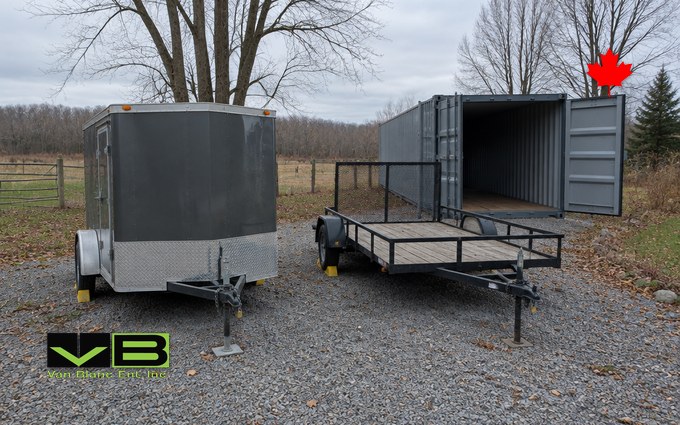
Quick Answer: Trailer storage in Ontario comes down to three places: your own lot, a storage yard, or a building. Winter care is the same everywhere: wash off the salt, grease the bearings, unload the tires, lock the coupler. A 20-foot container swallows a 6 by 10 utility trailer, tongue and all.
In This Guide
- The three places a trailer winters
- On your own lot: the pad, the cover, the lock
- The storage yard, and what the monthly meter buys
- Winter care, step by step
- Tires, bearings and the breakaway battery
- Trailer theft and the coupler lock
- The trailer and the load are two problems
- Which trailers fit inside a container
- The box, done properly
- The trailer storage checklist
- Trailer storage FAQs
Reading Time: 12 minutes
The three places a trailer winters
An Ontario trailer spends the winter in one of three places: on its owner’s lot, in a storage yard that rents a stall by the month, or inside a building. Each answers the four things that shorten a trailer’s life differently: road salt left on the frame, sun on the tires and the wiring, weight sitting on the same spot of the tread for five months, and the thief who can hook up and leave in ninety seconds. The utility trailer behind the garage, the boat on its trailer at the side of the house, the enclosed cargo trailer a contractor stores tools in, and the landscaper’s tandem all share those four enemies and choose differently among the three places. We are a shipping container yard, and this guide is honest about what a container does for a trailer: everything for the load, a great deal for a small trailer that fits inside, and nothing for the boat that does not. The camper storage guide’s four places is the same question one size up, and the answer here is smaller and simpler.
On your own lot: the pad, the cover, the lock
The lot is where most Ontario trailers winter, and the difference between a trailer that comes out in April ready to tow and one that comes out with a rusted frame and flat-spotted tires is three decisions. The first is the surface: a trailer parked on grass or bare earth sits in its own meltwater and wicks it up the frame, so the dealers say pavement, or planks and gravel under the wheels and the jack, and a compacted-stone pad that drains is the same pad that keeps a container square. The second is the cover: a breathable trailer cover or a carport keeps sun and snow off, and a tarp pulled tight traps moisture and does more harm than nothing; the shed side of that argument is the carport guide’s chapter on trailers and boats. The third is the lock, which has its own section, because a trailer in a driveway is the easiest vehicle on the street to steal. Shade helps the tires, a spot the plow does not bury helps the owner, and the tongue on a block rather than the jack foot in the mud helps the jack.
The storage yard, and what the monthly meter buys
A storage yard rents an outdoor stall, a covered stall or an indoor space by the month, and owners use one when the boat lives three hours from the house, the trailer will not fit the lot, or neighbours or a landlord object to a trailer on the driveway. What the meter buys is a fence, a gate code, sometimes a camera and a plowed lane, and for indoor stalls a roof over the tires and the wiring. What it does not buy is the wash, the grease or the battery charge, which are the owner’s job wherever the trailer sits, and it adds a drive to every spring launch and every fall haul-out. Yards fill in October and empty in April on a season-long term, and the ones near the lakes take reservations in summer. For the owner paying that meter for a small trailer and a load of gear that would both fit in a box on their own ground, the arithmetic is monthly floor rent against a steel room bought once.
| Place | Salt and moisture | Sun and weather | Theft | Cost shape | Fits |
|---|---|---|---|---|---|
| Own lot, uncovered | Wash it off yourself; park on stone or planks | Tires and wiring exposed; cover helps | Coupler and wheel lock, a light | Nothing after the pad | Anything the lot holds |
| Own lot, carport or cover | Same, drier | Roof over it | Same locks | The carport or the cover once | Boats and campers too tall for a door |
| Storage yard | Owner still washes and greases | Outdoor stall exposed; indoor stall covered | Fence, gate code, sometimes a camera | Monthly, seasonal term | Anything, at a drive away |
| Garage or shed | Dry | Covered | Locked door | The building | A trailer shorter than the bay; the garage guide’s door widths decide it |
| Container on your lot | Dry and vented through the winter | Steel roof and walls | Cam doors and a shrouded padlock | Bought once | A 6 by 10 or smaller in a 20; two in a 40; the load in either |
Winter care, step by step
The two Ontario trailer dealers whose guides rank for this question agree on the routine, and it is the same routine whether the trailer winters on the lot, in a yard or in a box. Wash it, including the undercarriage, with a gentle car or RV soap that will not strip painted parts, because the salt left on the frame in November is the rust on it in March. Dry it completely so mould does not start in an enclosed trailer. Inspect the seams and the seals on an enclosed trailer and reseal any that have lifted. Take out anything perishable or anything a mouse would want, and take out the batteries. Lubricate the coupler, the hinges, the locks, the electrical plug and the suspension with a corrosion inhibitor, and check the wiring and the lights before the trailer goes dark for five months so April does not start with a hunt for a broken ground. The rust prevention page’s account of what salt does to steel is the reason the wash comes first, and it applies to a trailer frame as much as to a box.
The one thing the yards will not do
A storage yard parks the trailer. It does not wash it, grease it, charge the battery or check the tire pressure, and an outdoor stall gives the sun and the salt the same five months they get on a driveway. Do the routine before the trailer goes to the yard, not after it comes back, and weigh the yard against a box you own before the second season’s invoice.
Tires, bearings and the breakaway battery
Tires, bearings and the battery are where a stored trailer is lost or saved. Tires that sit loaded on one spot for five months flat-spot, and tires in the sun chalk and crack; the fix is to take the weight off with jack stands under the frame, never under the axle tube or any part of the suspension, and either drop the pressure to the cold-weather figure or pull the tires and store them on their sides with plywood between them, in the dark. Bearings want fresh grease before storage, and a boat trailer’s surge brakes want the drums pulled and the moving parts lubricated so they do not seize. The breakaway battery on a braked trailer comes off, goes indoors, and gets charged every 90 days, because a battery left on a trailer through an Ontario winter is a dead battery in April. All of that is easier under a roof, and a trailer inside a box is a trailer whose tires, wiring and battery are out of the sun and the wet for the whole term; the sled and bike storage guide runs the same routine for machines that live on a trailer. A camper adds a water system to all of that, and the camper winterizing routine drains it, bypasses the water heater and puts antifreeze in the traps.
Trailer theft and the coupler lock
A trailer is stolen by hooking it up, which takes a stranger with a ball hitch about as long as it takes to read this paragraph, and an enclosed trailer full of tools is stolen with everything in it. The defences are cheap and layered: a coupler lock that fills the ball socket so nothing can hitch, a wheel lock or a chain through the wheel to a post, a hitch-pin lock on a trailer that stays hitched, a light over the spot, the tongue pointed at a wall so the trailer cannot be backed onto, and a photo of the serial plate in your phone. The best defence is a building, which is why contractors who lost a loaded trailer once tend to buy a box the following week; the enclosed trailer against a container is that story told properly, and the weekend security routine for a loaded box is the habit that goes with it. The container lock guide covers what a shrouded padlock and a disc lock do that a coupler lock cannot.
Christian LeBlanc, Van Blanc Ent. Inc.: “The trailer that gets stolen is the enclosed one with the tools in it, and the owner calls us about a box afterward. What I tell them is that the box is for the tools, and if the trailer is small enough it goes in too, tongue first.”
The trailer and the load are two problems
Most trailer storage questions are two questions wearing one hat: where the trailer lives, and where its load lives. A landscaper’s tandem is empty in December and its mowers, trimmers and blowers are the thing that needs a dry, locked room; the landscaper’s season vault exists for exactly that load. A contractor’s enclosed trailer is a rolling toolbox that should not be rolling in winter, and the tools want a box while the trailer wants a coupler lock. A boat on a trailer is a boat problem, covered in the boat winter storage guide, and the trailer under it is the smaller half. Splitting the two questions is the whole trick, because the load fits in a container every time and the trailer fits only sometimes, and an owner who stores the load in steel and the trailer under a cover has solved the expensive half of the problem for the price of the cheap half.
Which trailers fit inside a container
A 20-foot container is 19 feet 4 inches long and 7 feet 8 inches wide inside, with a door opening about 7 feet 8 inches wide and 7 feet 5 inches high. A 5 by 8 or 6 by 10 utility trailer, with a tongue that brings it to 14 or 15 feet overall, rolls in with room to walk around it, and a 6 by 12 fits with the tongue at the door. A 40-foot high cube is 39 feet 5 inches long inside with 8 feet 10 inches of headroom, takes two small trailers nose to tail, or a boat trailer under 7 feet 6 inches wide and about 38 feet long with the boat off, or one trailer and the whole load beside it. What does not fit is honest and short: an 8-foot-wide tandem, an enclosed trailer over 7 feet wide or 7 feet tall, a travel trailer, and any boat still on its trailer. Those get the carport, the yard or the shed, and the car shelter guide’s fabric buildings are the cheapest roof over a trailer too wide for a door. The sizes hub has every interior and door dimension for the tape-measure check.
| Trailer | Overall with tongue | Width | Fits a 20-foot? | Fits a 40-foot high cube? |
|---|---|---|---|---|
| 4 by 8 folding or 5 by 8 utility | About 12 to 13 ft | Under 6 ft 6 in | Yes, with room to walk around | Yes, two nose to tail |
| 6 by 10 utility | About 14 to 15 ft | Under 7 ft 6 in | Yes | Yes, two |
| 6 by 12 single-axle enclosed, 7 ft tall | About 16 ft | Under 7 ft 6 in | Tongue at the door; height is the check | Yes, one plus the load |
| 7 by 14 tandem enclosed | About 18 ft | Over 7 ft 6 in, over 7 ft tall | No | No; a trailer this size is its own storage |
| Boat trailer, boat off, under 7 ft 6 in wide | Up to 38 ft | Under 7 ft 6 in | No | Yes, one |
| Anything 8 ft wide, any travel trailer | Longer than the box or wider than the door | 8 ft | No | No; carport, yard or shed |
The box, done properly
A container that garages a small trailer and holds the load is a twenty-footer with the doors toward the drive, on four corner blocks and a stone pad, with the loading ramp from the accessory shelf at the sill so the trailer rolls over the 6-inch step and a louvred vent at each end so the box does not sweat on the first warm day; the louvred vents that keep a trailer garage dry explains why a sealed box rains on whatever is inside it. The trailer backs in tongue first or noses in tongue last depending on how it will come out in spring; the load goes on shelving that hooks the corrugation along one wall so the aisle stays clear for the trailer. A 40-foot high cube does the same for two trailers or one trailer and a season of gear, with the extra headroom for an enclosed trailer’s roof, and the forty-foot high cube’s 8 feet 10 inches is the number to measure the trailer against. The lock is a welded box around the padlock plus a disc lock inside it, and the trailer’s coupler lock stays on inside the box, because the box can be opened and the trailer can still be rolled.
Trailer and load, one box?
Tell us the trailer’s overall length with the tongue, its width and height, and what rides in it, and where the box would sit. We will tell you whether it is a twenty or a forty, the grade, the ramp and the vents, and one honest all-in number with a real lead time.
Family-run in Brantford since 1995 · 200+ containers in stock · 4.9★ across 140+ Google reviews · every box graded by a person, walk it before it lands.
Grade is the easy call. Wind-and-watertight, the grade a trailer garage needs, is a sealed used unit with surface rust that a back lot never minds; cargo-worthy is the upgrade if the box will be lifted or moved later, and one-trip is for the box that faces the street. What moves the number is size, grade, the ramp and the vents, and the distance from Brantford, and the quote drivers on a storage box are the same list on every quote we write. We sell outright, never rent; a buyer who wants to spread the cost does it through their own bank with the invoice and the serial number we supply. The tilt-deck that sets the box beside the drive lands it in one to three days from our four Brantford yards, and the twenties and forties lined up for sale can be walked at the Brantford rows with a tape measure in hand.
Where the trailers winter
The trailer calls come from the lake country and the trades: boat trailers and utility trailers around the Muskoka lakes and the Kingston waterfront, and contractors’ enclosed trailers across the 403 corridor from Hamilton to Brantford. All of them are a delivery away, and most of the owners drive in to walk a box with a tape measure first. Worth the drive for unbeatable quality, family customer service with 30 years of experience. When the load on that trailer is a boat, the wrap-or-roof comparison for Ontario boats measures which hulls roll into a 40ft high cube on their trailers.
The trailer storage checklist
Before the trailer goes dark for winter
- Measure it: overall length with the tongue, width at the fenders, height at the roof. That decides the lot, the yard, the shed or the box.
- Split the two problems: where the trailer lives and where the load lives. The load fits a box every time.
- Wash the salt off, undercarriage included, dry it, and reseal any lifted seams on an enclosed trailer.
- Grease the bearings and the brakes, take the weight off the tires on stands under the frame, and bring the breakaway battery indoors on a 90-day charge.
- Lock the coupler, chain a wheel, point the tongue at a wall, and photograph the serial plate.
- Park it on stone or planks under a breathable cover, a roof, or a steel room on your own lot, and never under a tarp pulled to the ground.
A trailer stored that way comes out in April with tread on the tires and no rust on the frame, wherever it spent the winter. The owner still paying a yard for a small trailer and a load of gear should measure the trailer once, because the whole problem may be an 8-by-20 steel room on their own ground, and the container against every other building it competes with is the wider comparison if the yard is also deciding where the mower and the quad sleep.
Frequently Asked Questions
Where is the best place to store a trailer for the winter in Ontario?
Under a roof, on a surface that drains, with the salt washed off and the weight off the tires. On your own lot that is a carport or a breathable cover over a stone or paved pad; in a building it is a garage, a shed or a container. A storage yard is the answer when the lot cannot hold it, at a monthly meter that does not include the winter care.
Can a utility trailer fit inside a shipping container?
A 5 by 8 or 6 by 10 utility trailer, about 14 to 15 feet overall with the tongue, rolls into a 20-foot container with room to walk around it; a 6 by 12 fits with the tongue at the door. A 40-foot high cube takes two small trailers or a boat trailer with the boat off. Anything 8 feet wide, over 7 feet tall, or a travel trailer does not fit and needs a carport or a cover.
How do I winterize a trailer?
Wash it, undercarriage included, and dry it; inspect and reseal seams on an enclosed trailer; remove perishables and batteries; grease the bearings and lubricate surge brakes; lubricate the coupler, hinges, locks, plug and suspension with a corrosion inhibitor; put jack stands under the frame and drop tire pressure or pull the tires; and bring the breakaway battery indoors on a 90-day charge.
Should I take the tires off a stored trailer?
Either take the weight off with jack stands under the frame, never the axle or suspension, and drop the pressure to the cold-weather figure, or pull the tires and store them on their sides with plywood between them, out of the sun. Tires that sit loaded on one spot for five months flat-spot, and tires in the sun chalk and crack. A box keeps them in the dark either way.
How do I stop my trailer being stolen?
A coupler lock that fills the ball socket, a wheel lock or a chain to a post, a hitch-pin lock if it stays hitched, a light, the tongue pointed at a wall, and a photo of the serial plate. The best defence is a locked building, which for a small trailer and its load is a container rather than the trailer itself.
Is a storage yard worth it for a trailer?
For a boat three hours from home, a trailer the lot cannot hold, or an owner whose driveway is not an option, yes; it buys a fence, a gate code and sometimes a roof, on a seasonal term. It does not buy the wash, the grease or the battery charge, and it adds a drive to every spring. For a small trailer and a load of gear, a box on your own lot is bought once.
Sources
- McFarlane Trailer Sales, New Hamburg, Ontario. (2026). Optimizing Storage Solutions to Protect Your Utility Trailer. mcfarlanetrailersales.com
- Hanna Trailer Supply. (2026). Boat Trailer Storage Preparation Guide and Utility Trailer Winterization. hannarv.com
- RV Storage Canada. (2026). Ontario RV Storage: Motorhome and Trailer Storage. rvstoragecanada.ca
- CFT Storage, Ottawa and Stittsville. (2026). Boat Storage Ottawa: On-Trailer, Haul-Out to Launch Day. cft-storage.com
- Harris Boat Works, Gores Landing, Ontario. (2026). Winterizing and Winter Boat Storage. harrisboatworks.ca
Reach Van Blanc in Brantford
We have been supplying shipping containers across Ontario since 1995. Our yard is at 90 Morton Avenue East in Brantford, and we deliver right across the province with payment on the day of delivery. No deposit, no upfront wires, no chase-the-paperwork.
Van Blanc Ent. Inc., 90 Morton Ave E Unit 1B, Brantford, ON N3R 7J7, 519-754-6844 (cell) or 1-888-509-6658 (toll-free).
If the trailer measures small enough and the load is the real problem, call with the numbers and your postal code, and we will tell you on the spot which boxes are on the ground and when one can land. Worth the drive for unbeatable quality, family customer service with 30 years of experience.