
Quick Answer: Store a kayak on its side or upside down on padded supports at the one-third points, a canoe upside down on its gunwales, both out of sun and off the ground. Cold never hurts a hull; sun, point loads and mice do. Past six boats, the rack becomes a building.
In This Guide
- Where We Stand
- The Thanksgiving Haul-Out
- The Four Rules Every Hull Shares
- Seven Ways to Store a Boat, Ranked Honestly
- What Each Hull Material Can Take
- What an Ontario Winter Actually Does
- Canoes: Gunwales Down, Screws Loose
- Paddleboards and Inflatables
- Renting a Rack Space
- The Fleet Problem: When a Rack Becomes a Building
- The Container Boathouse, by the Numbers
- Who Should Do What
- Kayak and Canoe Storage FAQs
Reading Time: 14 minutes
Where We Stand
This guide is written by a shipping container yard in Brantford, Ontario. We sell the steel box that a summer camp, an outfitter or a cottage association turns into a boathouse, and we have watched enough of them get fitted out to know where a rack stops being enough. We sell nothing to the person with one kayak and a garage, and the first two-thirds of this page are written for that person anyway, because the rules of storing a hull do not change with the number of hulls. The paddling facts come from the builders and retailers who publish them, Nova Craft in Ontario among them, read on September 15, 2026; the fleet arithmetic is ours, from the rowing shell boathouse and the summer camp storage page we have already written.
The Thanksgiving Haul-Out
Ontario paddling ends on a weekend, and it is usually the same one. The water drops below what anyone wants to swim in around Thanksgiving, the docks come out over the following two weekends, and by the first of November every kayak, canoe and paddleboard in the province is somewhere it will spend six months: a garage wall, a cottage crawlspace, a rack at a marina, upside down on two sawhorses under a tarp, or on the ground beside the shed where it was dropped in October and will be found, full of leaves and a mouse nest, in May. Where the boat spends those six months is what this page is about, and the honest news is that the cold is the least of it. A polyethylene hull at minus 25 is fine. The same hull on the ground in March sun, with 30 centimetres of wet snow on a tarp pressing its deck into the frozen grass, is a boat that will never track straight again. The powerboat winter storage guide covers the outboard and the trailer; this one is for anything with a paddle.
The Four Rules Every Hull Shares
Every builder’s guide comes down to the same four rules, and they matter in this order. First, support the hull where it is strong and spread the load: a kayak on its side or upside down on two padded cradles or straps set about a third of the way in from each end, a canoe upside down resting on its gunwales, never a kayak sitting on its keel on concrete or a canoe on its hull on the lawn; even a container’s floor is marine plywood rather than bare steel for the same reason. Second, never hang a boat by its grab loops or carry handles; they are for carrying, and a winter of hanging pulls the ends and stresses the deck. Third, keep it out of the sun. Ultraviolet light is what fades, chalks and eventually embrittles a plastic hull and yellows a composite one, and a boat that lives outdoors needs a cover or a roof over it, with air moving between cover and hull. Fourth, get it dry and get it off the ground: rinse, drain, sponge the cockpit, pull the drain plug, and store it high enough that ground moisture, snowmelt and animals cannot reach it. Everything else on the internet is a variation on those four.
The rule that gets argued about is vertical storage, and the honest answer is that a kayak can stand on its stern for a season if the stern is padded and the boat is strapped so it cannot fall, and that the same boat left standing for years slowly flattens where its weight rests. Vertical is a garage-space answer, and it works better for a short rotomoulded recreational boat than for a 17-foot composite sea kayak. The season-by-season gear guide works through where everything else goes and why the paddle craft usually end up with the worst spot.
Seven Ways to Store a Boat, Ranked Honestly
Ranked for a single household with one to four boats, best first. A wall rack in a garage or shed: two padded arms per boat, boat on its side, the boat off the floor and out of the sun, with the only cost being wall space and the only failure being arms too close together for a long hull. A ceiling hoist: a pulley and two wide straps lifting the boat flat against the ceiling, which uses space nothing else wants, and which fails when the straps are narrow or the boat is hoisted by its handles. A freestanding rack: the same padded arms on a frame, for a garage with no free wall, movable, and the usual answer for three or four boats. An outdoor rack under a roof: the cottage answer, boats on their sides under the deck or a lean-to, off the ground, out of direct sun, with the cover doing the rest. A shed: fine if it is long enough, and a 16-foot canoe is longer than most sheds, which is why the sea can and storage shed comparison exists. Vertical against a wall: the apartment and small-garage answer, padded, strapped, and rotated each spring. And last, on the ground under a tarp, which is where most boats actually spend the winter and where most of the damage on this page happens.
What a wall rack cannot do is hold a fleet. Two arms per boat at 18-inch spacing is three boats per eight feet of wall, and a garage runs out of wall before a family of paddlers runs out of boats. Wall-mount shelving in a container is the same hardware bolted to corrugated steel, which is where the fleet section below starts.
What Each Hull Material Can Take
| Hull | Typical boats | Cold | Sun | Point loads | Winter note |
|---|---|---|---|---|---|
| Rotomoulded polyethylene | Most recreational and fishing kayaks, Nova Craft TuffStuff and Old Town canoes | Fine to any Ontario low | The enemy: fades, chalks, embrittles | Deforms under a strap or a keel on concrete, worse in heat | Store on its side; never under snow load |
| Thermoformed ABS | Lighter touring kayaks | Fine | Better than polyethylene, still needs shade | Stiffer; cracks rather than dents at an impact in deep cold | Indoors preferred |
| Composite (fibreglass, Kevlar, carbon) | Sea kayaks, tripping canoes, racing hulls | Fine | Gelcoat yellows and chalks | Holds shape; cracks at a hard point load | Padded cradles; loosen tie-downs |
| Royalex and T-Formex | Whitewater and tripping canoes | Fine, but the hull and wood gunwales shrink at different rates | Needs shade | Tough | Loosen gunwale screws for the winter, per Nova Craft |
| Wood and canvas, cedar strip | Heritage and custom canoes | Fine dry; ruinous damp | Varnish fails in sun | Gunwales down on padded rails | Indoors, dry, off the floor on a rack, no exceptions |
| Inflatable kayak or SUP | Drop-stitch boards and boats | Do not fold below freezing | Store deflated in the bag | None | Dry completely, loosely rolled, above freezing |
The polyethylene row is the one that matters for most Ontario households, because most boats sold at Canadian Tire and Costco are rotomoulded, and rotomoulded plastic has a memory that works against you: it takes a set from any long-held point load, faster when warm, and a hull that spent the winter strapped tight over a sawhorse or standing on a rock comes out oil-canned along the keel. The motorcycle and snowmobile storage page deals with the same on-the-ground winter for machines, and the rule is the same: up, dry, dark.
What an Ontario Winter Actually Does
Four things, in order of damage done. Snow load first: wet March snow on a tarp weighs enough to press a plastic deck into whatever is under it, and a tarp tied tight to a hull is a snow-collecting sail; the fix is a roof, a rack under an overhang, or a cover that sheds, held off the hull with a ridge line so air moves underneath, as the canoe builders insist. Sun second: the winter sun is low and long on a south-facing wall, and a boat stored outside from November to May takes as much UV as a summer on the water. Animals third: a kayak cockpit is a dry, dark, sheltered tube, which is a description of a mouse house, and a spring cockpit full of nesting material and chewed foam is the commonest winter damage of all; a cockpit cover, and storage off the ground, are the fix, and a desiccant tub in a closed box keeps the foam dry as well. Cold last: it does almost nothing to a plastic or composite hull on its own, and the one real cold problem is the material mismatch on a Royalex or T-Formex canoe with wood gunwales, where the builders’ advice is to back off the gunwale screws in the fall so the hull can shrink without cracking at the fasteners. The passive-or-powered vent question covers the condensation side of storing anything in a closed steel box through the same winter.
Canoes: Gunwales Down, Screws Loose
A canoe is easier than a kayak and gets stored worse, because it is bigger. The rule is a single sentence long: upside down, resting on its gunwales on two padded rails or sawhorses set a third of the way in from each end, out of the sun and off the ground, and in a sling only if the sling is wide and supports the whole hull. Right side up on the ground is the worst of the options, because it fills with rain and leaves, and then with snow, and a 16-foot hull with a winter’s ice in it is the boat that cracks. Length is the practical problem in a suburban yard. A tandem tripping canoe is 16 to 17 feet, longer than a standard garage bay is deep with the car in it, longer than every kit shed, and the reason so many canoes live under the deck or on the side of the garage on a pair of brackets. The bunkie length-and-lot guide and the bunkie-or-container cottage page touch the cottage version of the same length problem.
Paddleboards and Inflatables
A hard paddleboard stores like a kayak, on its side or deck-down on padded arms, fin off, out of the sun, and it is the most UV-sensitive hull on the water, so an outdoor rack for a board is a rack under a roof or nothing. An inflatable board or kayak wants the opposite of everything above: deflated, rinsed, dried completely inside and out, rolled loosely rather than folded on the same crease, and stored in its bag somewhere that stays above freezing, because a drop-stitch seam folded and frozen is a seam that leaks in June. The basement is right and the unheated garage is wrong, which is one of the few cases on this page where an unheated steel box is the wrong building too.
Renting a Rack Space
Paddlers without a garage rent a rack. Paddle Toronto runs outdoor racks at a city-side office and on the Island near the marina, with the fee covering May 1 to September 30 and boats allowed to stay on the racks from October through April at no extra charge; the paddler supplies a cable, a combination lock and their own insurance, and the boat comes off by April 30 if the space is not renewed. That is the model at most clubs and marinas across the province: a rented slot on a communal rack near the water, outdoors, locked with your own cable, at your own risk. It solves the getting-to-the-water problem and does nothing for the sun and the snow, which is why the fleet section below matters to the clubs as much as to the camps; the arithmetic of a rented rack against a rented room against owning the building is on that page.
The Fleet Problem: When a Rack Becomes a Building
Somewhere past six boats the question stops being where to put the kayak and becomes what building holds the kayaks. That is the summer camp with 30 canoes and 20 kayaks that live outdoors all summer and need to be somewhere dry and locked from Labour Day to June. It is the outfitter on the edge of Algonquin or Killarney, the North Bay side of the park or the Sudbury side, with a rental fleet that has to be off the ground and out of reach of a truck with a trailer and bad intentions. It is the cottage association with a shared dock and a dozen boats nobody wants on the shoreline all winter, the scout troop, the school outdoor-ed program, the rowing or canoe club whose shells and sprint boats are worth more than the clubhouse. The traditional answer is a boathouse, which is a building on a shoreline, with everything that implies for cost, foundation and the years it takes. The cheap answer is a fenced rack, which keeps the boats off the ground and stops nothing else. The curling club summer storage page and the summer camp storage guide are the two versions of this problem we get called about most.
The Container Boathouse, by the Numbers
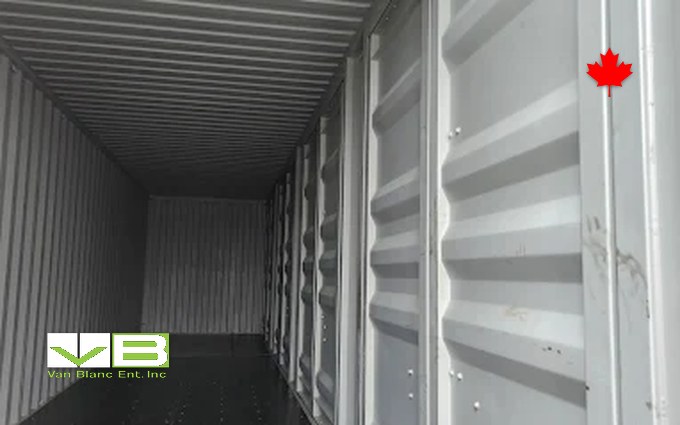
A shipping container is a steel building 8 feet wide that arrives on a truck, sits on a gravel pad or blocks at the top of the launch, and locks, and for a paddle fleet its numbers happen to be the right ones. A 20-foot container is 19 feet 4 inches long inside, which takes any recreational or touring kayak and every canoe up to 17 feet with room to walk past the ends. Wall racks bolted or welded to the corrugation on both long walls, three tiers high at about 30 inches of spacing, hold three boats per 8 feet of wall on each side: six to eight kayaks or canoes per side, 12 to 16 boats in the box, with the centre aisle clear for paddles, PFDs and the barrels. A 40-foot container doubles it: 24 to 32 boats on racks, or 20 with a working bench and the rental desk at the door end. The sea can interior figures has the interior figures and the metric dimensions table the metric ones.
What the box does that a fenced rack cannot is the four rules, all at once, for every boat. Off the ground, on padded arms, on their sides. Out of the sun entirely, which for a plastic rental fleet is the difference between a five-year hull and a ten-year hull. Dry, with the doors sealed on gaskets and the vents sized for the humidity; the cargo door gasket page and the vent-sizing guide are the two details. And locked, with four bars, a lock box and, for a camp closed all winter, a solar camera on the corner, which is the part the outfitter cares about most. Set it at the launch and the fleet is 30 metres from the water; set it at the gate and it is a shed. Delivery to a rural or cottage property covers what the truck needs to reach a shoreline site, and a used wind-and-watertight unit is the right grade, because the boats care about dry and dark and not about paint. The wind-and-watertight grade explained explains the difference.
The honest limits. A container is a corridor: boats go in and out lengthwise past each other, so the rack layout has to put the boats that go out daily at the door end and the boats that go out twice a summer at the back. An unheated box is wrong for inflatables and for the wood-and-canvas heritage canoe, which want a heated room; insulating a container covers what it takes to make the box that room, and most fleets do not need it. A 20-foot box on a shoreline is a steel box on a shoreline, and a cottage association that cares how it looks paints it or screens it. And the box needs a level pad and a truck route; the launch-side gravel pad is the site work, and it is a day.
Christian LeBlanc, Van Blanc: “The camp calls come in September, always the same story: the canoes are on the ground under tarps, something chewed through three of them last winter, and the insurance wants them locked up. A used twenty with racks on both walls takes sixteen boats. They measure the longest canoe, I tell them the inside is nineteen four, and that’s the whole conversation.”
For the camp, club or association that describes, the box is the one line we can speak to from the yard. A boat-storage container starts from a used wind-and-watertight unit with sound doors and a dry floor, from the used rows with sound doors at 90 Morton Avenue East, or a one-trip from the one-trip rows at the yard if it is going to be painted and screened on a shoreline; the 40-foot dry container is the fleet size and the 20-foot the cottage-association size. The yard’s own modification shop fits vents, a lock box and a man door before it leaves; the racks are strut and padded arms your own crew bolts to the corrugation in an afternoon. Every unit can be picked by number before any money moves, and it lands anywhere in the delivery area, shoreline included, including the Muskoka and Georgian Bay lakes, the Haliburton lakes and the Kawarthas, in one to three days with payment on delivery. Everything is sold outright; Van Blanc keeps no rental fleet.
Who Should Do What
One to four boats: a wall rack or a hoist in the garage, on their sides, out of the sun, cockpit covers on, and the canoe upside down on brackets under the deck if the garage is short. A cottage with a few boats and no garage: a rack under the deck or a lean-to at the shoreline, off the ground, covers held off the hulls, and the inflatables home in the basement. An apartment: vertical, padded, strapped, or a rented rack at the club with your own cable and lock. Past six boats, or any number of boats that belong to an organization with a liability policy, a locked building: a boathouse if the shoreline and the budget allow one, and a container on a pad at the launch if the boats need to be dry, dark and locked by October and the building needs to exist by then too. The buildings-against-a-container hub is the wider read for anyone still deciding what kind of building the fleet needs at all.
More than six boats? Price the boathouse once
Tell us how many boats and the longest one, whether it sits at the launch or the gate, and your postal code, and we will send an all-in number for the unit, the vents and door, and delivery, usually the same day. If your fleet is really four kayaks and a garage wall, we will say so. Or walk the used rows in Brantford and measure the inside yourself.
The two pages that finish this one are the rowing shell storage build, which takes the rack layout to its longest and most fragile hulls, and the lock and lock box comparison, for the outfitter whose fleet is the business.
Kayak and Canoe Storage FAQs
What is the best way to store a kayak?
On its side or upside down, on two padded cradles or wide straps set about a third of the way in from each end, off the ground and out of direct sun, with the cockpit covered. Never on its hull on a hard floor, and never hung by the grab loops or carry handles. A wall rack or a ceiling hoist in a garage does all of that; outdoors, a rack under a roof with a cover held off the hull does the same.
Is it better to store a kayak vertically or horizontally?
Horizontally on its side is better for the hull. Vertical storage, stern down on a pad and strapped to the wall, is fine for a season in a small garage and works best for short rotomoulded boats; left standing for years, the weight resting on the stern slowly flattens it. If vertical is the only option, pad the stern well, strap the boat so it cannot fall, and lay it flat for a while each spring.
Can a kayak be stored outside in an Ontario winter?
Yes, if it is off the ground, on its side on a rack, under a roof or a cover held off the hull so air moves and snow sheds, with the cockpit covered against mice. Cold does not damage a plastic or composite hull; what damages it is the weight of wet snow on a tarp pressing the deck, the low winter sun on a south wall, and a season of nesting animals in the cockpit.
Should a canoe be stored upside down?
Yes: upside down on its gunwales, which are the strongest part of the boat, on two padded rails or sawhorses about a third of the way in from each end, or in a wide sling that supports the whole hull. Right side up it collects rain, leaves and then ice, and a hull with a winter’s ice in it cracks. Royalex and T-Formex canoes with wood gunwales should have the gunwale screws loosened for the winter.
How many kayaks fit in a shipping container?
A 20-foot container is 19 feet 4 inches long inside and takes 12 to 16 kayaks or canoes on three-tier wall racks along both long walls, with the centre aisle clear for paddles and gear; a 40-foot takes 24 to 32, or about 20 with a bench and a rental desk. Any recreational or touring kayak and any canoe up to 17 feet fits lengthwise in a 20-foot box with room to pass the ends.
How much does it cost to store a kayak?
A rented rack slot at a club or marina is priced per season, usually May to September, with the winter months often included; the paddler supplies the cable, the lock and the insurance. A garage rack or hoist is a one-time hardware cost. For a fleet, the drivers are the number of boats, whether the building has to lock, and whether it sits at the water; a used container on a gravel pad with owner-fitted racks is priced as a one-time purchase, not a season.
How do you store an inflatable kayak or paddleboard for winter?
Deflate it, rinse it, dry it completely inside and out, roll it loosely rather than folding it on the same crease, and store it in its bag somewhere that stays above freezing, such as a basement. A drop-stitch seam that is folded and frozen leaks in the spring, which makes an unheated garage, shed or container the wrong place for an inflatable even though it is the right place for a hard hull.
Sources
- Nova Craft Canoe. (2026). How to: Winter Canoe Storage. novacraft.com
- Old Town Watercraft. (2026). Ultimate Canoe Storage Guide. oldtownwatercraft.johnsonoutdoors.com
- REI Co-op. (2026). How to Store a Kayak: Tips and Solutions. rei.com
- Paddle Toronto. (2026). Canoe, Kayak, and SUP Storage Toronto. paddletoronto.com
- Confluence Outdoor Canada. (2026). The ABCs of How to Store a Kayak. confluenceoutdoorcanada.com
- Van Blanc Ent. Inc. (2026). Rowing Shell Storage in a Container, Ontario. vbinc.ca
Reach Van Blanc in Brantford
We have been supplying shipping containers across Ontario since 1995. Our yard is at 90 Morton Avenue East in Brantford, and we deliver right across the province with payment on the day of delivery. No deposit, no upfront wires, no chase-the-paperwork.
Van Blanc Ent. Inc., 90 Morton Ave E Unit 1B, Brantford, ON N3R 7J7, 519-754-6844 (cell) or 1-888-509-6658 (toll-free).
If the rack you were planning turned into a boathouse somewhere in this page, call with the boat count, the longest hull and your postal code and we will tell you on the spot what is in stock and when it can land at the launch. Worth the drive for unbeatable quality, family customer service with 30 years of experience.