
Quick Answer: Boat winter storage is a two-part decision: where the hull sits, on a home pad, in a marina compound, or indoors, and how thoroughly it is winterized, since freeze damage, not weather, writes the spring repair bills. Everything soft or electronic should winter off the boat, somewhere dry and mouse-proof.
In This Guide
- Two Decisions, Not One
- The Winterization That Actually Matters
- The Storage Menu, Priced in Trade-Offs
- Shrink Wrap, Reviewed Straight
- Haul-Out Day, Run in Order
- The Mouse War
- What Should Winter Off the Boat
- Pontoons, PWCs, and the Odd Shapes
- The Home Pad, Done Properly
- The Insurance Winter
- The Spring File
- Boat Storage FAQs
Reading Time: 12 minutes
Two Decisions, Not One
Every October, Ontario hauls one of the continent’s great freshwater fleets out of the water, and every October a share of that fleet gets only half the decision right. Where the boat spends the winter, the driveway, a marina compound, a heated shed, is the visible half, the one the family debates. How the boat is prepared for the winter is the half that actually writes the spring bills, because the province’s freeze-thaw is indifferent to real estate: an engine block holding raw water cracks identically behind a locked marina fence and beside the garage. This guide runs both halves honestly, the way the province’s marinas and the boating press run them, and it finishes with the part of the puzzle our yard actually touches, which is not the hull at all but the half-boatload of gear that should never winter aboard in the first place. For owners deciding between film and a roof, shrink wrap set against indoor storage, lake by lake runs the wrap, the indoor waiting lists and the boats that fit a high cube door.
Christian, Van Blanc: “Cottage-country deliveries taught me the pattern: the container goes in beside the boat pad, and by November it holds the canvas, the cushions, the electronics, the kicker motor, and every life jacket the family owns. The boat winters like a hull and the gear winters like gear. The fellows who leave it all aboard are feeding mice a furnished apartment.”
The Winterization That Actually Matters
The winterization list is short, non-negotiable, and engine-specific, and the marine trade’s guidance converges on the same core everywhere. Water is the enemy in every line item: the engine gets its raw-water circuits protected, drained and run with marine antifreeze per its type, since inboards, sterndrives, and outboards each have their own procedure and their own vulnerable passages, and the cylinders get fogged or treated as the manufacturer prescribes. The fuel system winters stabilized, treated and run long enough to carry the stabilizer through the lines, with the tank kept near full so condensation finds no room to form. The freshwater and washdown systems drain completely, because a forgotten line splits as reliably as a forgotten block. Batteries come off the boat to spend winter on a maintainer somewhere temperate. None of it is exotic, all of it is cheaper than any single repair it prevents, and the honest budgeting advice is the trade’s own: the boat that skips the list saves a morning and gambles the powertrain. DIY owners with the manual and a torque wrench do this work routinely; everyone else books the marina’s winterization package and considers it insurance with a receipt.
The Storage Menu, Priced in Trade-Offs
| Option | What it buys | What it costs you |
|---|---|---|
| Home trailer pad | Free-ish, gear nearby, spring freedom | Your labour, your siting, your security |
| Marina outdoor compound | Fenced, plowed, professionally handled | Seasonal fees, wrap usually required |
| Indoor cold storage | Out of weather and sun entirely | Higher fees, hull inaccessible all winter |
| Indoor heated | Kindest to finishes and systems | The premium tier’s premium |
| Dry stack | Service-club convenience near water | Marina’s hours, size limits |
The menu reads like every storage ladder on this site: each rung buys protection and surrenders either money or freedom. Ontario’s marinas publish their programs plainly, per-foot seasonal packages that bundle winterization, wrapping, and compound storage, and the bundling is honest value for the owner who wants one phone call to end the season. The home pad wins for the hands-on owner with the space and the discipline, and it wins double for households already running a working yard, since the boat joins an ecosystem of buildings that store its gear and tools anyway. Indoor tiers earn their premium for wooden boats, high-finish hulls, and owners tired of wrap disposal. The honest tiebreaker is usually spring: the home boat launches when its owner feels like it, and the stored boat launches when the queue reaches it, a difference cottage-country veterans price higher than any fee schedule.
Geography votes too. The trailer-boat family within an hour of its lake keeps the hull home by default, while the family whose boat lives three hours north often winters it near the water, trading the driveway’s convenience for spring mornings that start at the launch instead of on the highway with a trailer in the mirrors. The marina compounds around the big lakes exist for exactly that math, and the honest menu reading includes it: the best storage address is downstream of where the boating actually happens, not of where the owner sleeps. The trailer under the boat has its own winter, and the trailer storage guide covers the salt, the tires and where a small trailer fits inside a box.
Shrink Wrap, Reviewed Straight
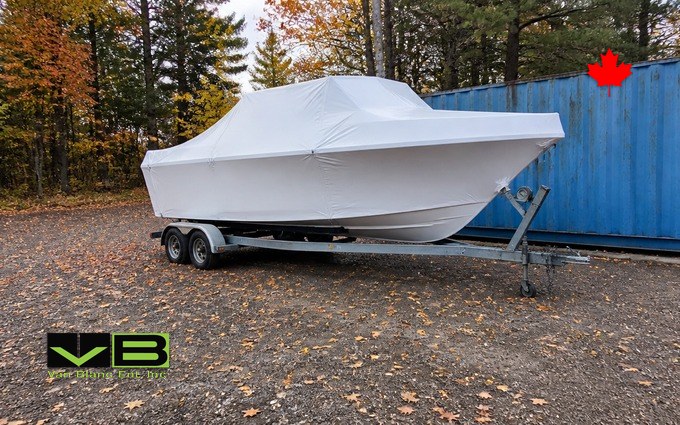
Shrink wrap earns its dominance honestly: heat-shrunk film over a strapped frame sheds snow and rain better than any tarp ever tied, it conforms to the hull without chafe points, and a professional wrap survives the winter’s wind intact. The trade-offs deserve equal billing. The wrap must be vented, because a sealed hull sweats and a winter of trapped moisture grows mould across every surface the film was protecting; the film is a single-season consumable with a disposal chore at the end, though recycling programs for it now run in much of cottage country; and a wrapped boat outdoors is still a boat outdoors, its wrap slowly yielding UV and its trailer sitting in plain sight, which is why compounds have fences. The tarp-and-frame alternative, done with real support and real tie-downs, remains the budget path and fails mostly where its builders skimp the frame, letting snow pocket and pool. And the quiet third option is the reusable canvas winter cover, a bigger first purchase that amortizes across seasons for owners planning to keep the boat. The honest summary: wrap is the best single-season skin money buys, and it is a skin, not a strategy.
The Marine Locker Beside the Pad
Your hull winters on its trailer; its gear should not. A sealed, locked container beside the boat pad holds the canvas, cushions, electronics, motors, and safety kit through the winter, mouse-proof and dry, and hands it all back in April. Real lead time, not a hopeful one. Fast 1-3 day delivery across Ontario from our Brantford yards.
Van Blanc Ent. Inc. · Brantford, Ontario · Since 1995 · 4.9 stars across 140+ Google reviews · Cash on delivery
Haul-Out Day, Run in Order
The season’s last boating day goes smoothest as a sequence rather than a scramble, and the crews who do it annually run the same order. The boat comes out on a day with working weather, because half the list is easier dry. The wash happens at the ramp or immediately after, hull scum removed while it is still soft, since a summer of waterline growth cures over winter into a spring grinding job. The strip-down follows while the decks are still open, every soft and electronic item into bins that were labelled last year, and the bins straight to their winter shelf rather than to a garage floor staging area that becomes their winter shelf by default. The mechanical winterization runs next, engine, fuel, water systems, batteries, while the tools are out and the daylight holds. The cover or wrap goes on last, over a boat that is clean, empty, and protected, never as the first step over a boat that still needs everything else. Written down it is one disciplined Saturday; done in fragments across three weekends it somehow becomes November, which is the month that catches the unfinished.
The Mouse War
Ask any marine upholsterer what pays the shop’s winter heating bill and the answer squeaks. Mice treat a stored boat as a gated community, entering through gaps no wider than a thumb, wintering in cushion foam, and seasoning everything with the damage deposits rodents leave, and the wrapped boat is if anything more inviting, warmer and dryer than the field it sits in. The war is won with denial rather than weaponry. Nothing edible or nestable stays aboard: snacks, paper charts, towels, cushions, PFDs, canvas, all of it leaves. Entry points get blocked where blocking is practical, exhaust and vent openings screened, the wrap’s ground gaps minded. Deterrents help at the margins, and the veterans rotate them skeptically, but every professional’s first sentence is the same: a boat with nothing to eat and nothing to nest in is a boat mice tour and leave. That logic is half the case for the off-boat gear strategy in the next section, and it is the half with teeth marks.
The mid-winter check closes the loop. One visit in January, wrap seams and vents inspected, a flashlight sweep of the bilge and console for droppings, tarp frames checked for pooling, takes fifteen minutes and catches every one of the winter’s slow problems while it is still small. The compound-stored boat gets the same check on the marina’s schedule or the owner’s drive-by; the home boat gets it on the way to the woodpile. Storage that gets looked at twice a winter almost never delivers a spring surprise, and the inspection habit costs less than any product sold to replace it.
What Should Winter Off the Boat
Strip the boat the day it comes out and the whole winter goes better: the soft goods, cushions, canvas, ropes, and PFDs, because foam and fabric aboard mean mould risk and mouse bedding; the electronics that hate condensation cycles, from removable chartplotters to the handheld VHF; the batteries, off to their maintainer; the kicker and trolling motors, the fuel portables, the safety kit, the dock lines, the tools. The pile is startling, most owners discover, half a garage of gear that was living aboard, and the question of where it winters is exactly the question our yard answers weekly in cottage country. A sealed container beside the pad or at the property’s working corner does what basements and garden sheds do not: steel that mice cannot enter, dryness the ventilation discipline in the condensation playbook keeps honest, a lock that answers the compound-fence question at home, and shelving that hands the gear back organized in April instead of archaeological. Most hulls on their trailers measure wider than a container’s 7 ft 8 in doors and winter beside the gear; a narrow hull that clears a high cube’s door can winter inside one, and wider ones can winter under a roof kit between two boxes.
Many people call us saying they can get a bin for $1,000 less on Facebook. Two weeks later some of them call back to say they got scammed. Boat season’s end runs on the same calendar as the scam season’s peak, and the rule holds everywhere: inspect in person, pay on delivery, buy from a yard with an address you can visit in February.
Pontoons, PWCs, and the Odd Shapes
The fleet’s odd shapes winter by the same physics with their own footnotes. The pontoon boat is the easy one mechanically, its outboard winterizing like any other, and the hard one geometrically, since its furniture-heavy deck is the mouse war’s richest battlefield and its flat top pockets snow that a vee hull would shed; pontoon owners cover with real pitch built into the frame or pay for it in spring canvas. The personal watercraft is the opposite, small enough to winter almost anywhere, and its jet-drive cooling passages are precisely where freeze damage hides, so the winterization manual matters more per kilogram than on anything else at the dock; the PWC is also the one hull in the family that genuinely fits through a container’s doors on its trailer or dolly, and more than one cottage-country box we have delivered winters a pair of them beside the gear shelves. Canoes, kayaks, and paddleboards ask only to be up off the ground, out of the sun, and stored on their strong points rather than their hulls, which a rack wall inside that same container or along its shaded side handles for a family’s whole paddle fleet. The pattern across the shapes is the season’s whole lesson in miniature: the storage answer follows the object’s actual geometry, never the category’s habit. Anything with a paddle rather than a motor has its own page: storing kayaks, canoes and boards through an Ontario winter.
The Home Pad, Done Properly
The home half of the fleet winters on trailers, and the pad deserves the same seriousness the marina compound sells. The base is the first job: packed gravel that drains, because a trailer wintering in a soft lawn is a trailer frozen into it by January and rutted out of it in April. The trailer takes the strain honestly with its tires blocked or the frame supported so the suspension and rubber are not carrying the full load through five motionless months, tire pressures topped and the wheels shaded or covered against sun-rot on the pads. The bow rides high enough that precipitation runs aft and out the drain plug, which winters in the open position in every climate that freezes. Siting respects the same physics every structure on this site respects: out of the roof-avalanche paths, off the low ground, and where the house’s lights and windows cover the investment. Done to that standard, the driveway tier matches the compound on everything but the fence, and the fence is what the locked marine locker and a hitch lock are for.
The Insurance Winter
The paperwork half of layup deserves five minutes before the wrap goes on. Boat policies treat winter differently across insurers, some with layup periods that assume the boat is out of service on stated dates, some with requirements about where and how the hull is stored, and a phone call in October that confirms the storage arrangement matches the policy costs nothing while a mismatch discovered after a February tree-fall costs the argument. The same call is the moment to confirm the gear’s situation, since the electronics and equipment stripped off the boat may fall under the boat policy, the home policy, or a gap between them depending on where they winter and how each insurer words it. Photographs close the file: the boat as stored, the gear as shelved, serial numbers where they matter, the two-minute record that turns any winter claim from an essay question into a checklist. Permits are managed by your municipality, so check with your local building or planning department before you order, a sentence that applies here to the gear locker rather than the boat, and at that scale the conversation is usually brief. None of this paragraph is dramatic, which is the point; the insurance winter is boring exactly in proportion to how well October documented it.
The Spring File
The best storage decision of the fall is a file folder, physical or phone, labelled for spring. Into it goes the winterization receipt or the DIY checklist as completed, because spring commissioning reverses the list and memory is a poor archive; the photos of how the canvas came down and the electronics unplugged; the battery’s maintainer schedule; and the short list of every fault the season ended with, the sticky gauge, the slow bilge switch, the trailer light that flickered, since winter is when parts arrive cheap and shops book easy. Owners who file the season’s end launch in May on the first warm Saturday; owners who trust April’s memory spend that Saturday in a marine-parts line. It is the same lesson every working building on this site keeps teaching, that the cheap disciplines compound, and nowhere do they compound faster than on the water, where every skipped winter chore surfaces in July at full price, usually far from the dock.
Ontario boating is a seven-month love affair with a five-month intermission, and the intermission is a maintenance discipline wearing a parka. Winterize like the freeze is certain, because it is; choose the hull’s address by trade-offs rather than habit; strip everything soft, electronic, or edible into dry locked steel; and file the season for spring. The boats that launch first in May are not the newest ones. They are the ones whose owners took October seriously.
Boat Storage FAQs
What does boat winterization actually involve?
Freeze protection, engine-specific: raw-water circuits drained and run with marine antifreeze, cylinders fogged or treated per the manual, fuel stabilized with the tank near full, freshwater systems drained completely, and batteries off to a maintainer indoors. It is a morning’s work or a marina package, and cheaper than any repair it prevents.
Is shrink wrap worth it for winter boat storage?
As a single-season skin, yes: it sheds snow better than any tarp and survives wind intact. It must be vented or the hull sweats into mould, it becomes a disposal chore each spring, and it does not change the fact that an outdoor boat remains outdoors. Reusable canvas covers amortize better for keepers.
How do you keep mice out of a stored boat?
Denial beats deterrents: strip everything edible or nestable, cushions, canvas, towels, paper, and snacks, screen the vents and exhaust openings, and mind the wrap’s ground gaps. A boat offering no food and no bedding gets toured and abandoned. The stripped gear winters best in sealed steel mice cannot enter at all.
Can a boat be stored inside a shipping container?
Sometimes. A boat fits when, on its trailer, its widest point measures a few inches under a container’s 7 ft 8 in doors. Its highest point must also clear the door height, 8 ft 6 in on a high cube. Personal watercraft and small aluminum boats are the usual fits. Wider hulls winter under a roof kit between two boxes, and the boxes keep the canvas, cushions, electronics, motors and safety gear dry and locked.
Is home boat storage as good as a marina compound?
Done properly, nearly: a drained gravel pad, the trailer blocked or supported, bow high with the drain plug open, siting clear of roof-shed snow, and lighting covering the investment. The compound’s real advantages are the fence and the bundled service; a hitch lock and a locked gear container answer most of the fence.
Sources
- Fenelon Falls Marina. (2026). Winterization Services. fenelonmarina.com. An Ontario marina’s published winterization and storage program
- Better Boat. (2025). The Real Cost of Winterizing a Boat. betterboat.com. The winterization task list and DIY-versus-shop trade-offs
- MarinaSeeker. (2026). Winter Boat Storage: Marina vs Dry Stack vs Home. marinaseeker.com. The storage menu compared across tiers
- RecNation. (2025). How Much Does It Cost to Winterize and Store a Boat? recnationstorage.com. Indoor, outdoor, and covered storage compared honestly
Reach Van Blanc in Brantford
We have delivered steel into Ontario’s cottage country since 1995, and October is our marine month: the lockers that catch everything a wintering boat should not keep aboard. If your haul-out pile needs a home with a lock, the rows at 90 Morton Avenue East are on the way to most of the lakes.
Van Blanc Ent. Inc., 90 Morton Ave E Unit 1B, Brantford, ON N3R 7J7, 519-754-6844
Setting up a boat pad or a gear locker? Call with the fleet and the property.