
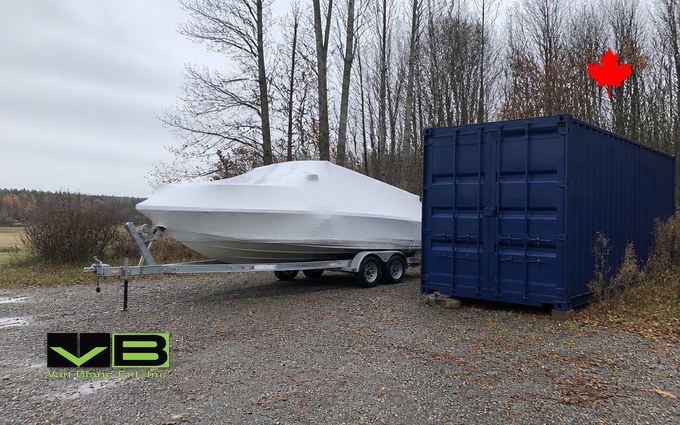
Quick Answer: Boat shrink wrap is usually 6 or 7 mil film, heat-shrunk over a strapped frame, vented and cut off in spring. Indoor marina spots fill early. A 40ft high cube holds a boat that clears its 7 ft 8 in wide, 8 ft 5 in tall door on the trailer.
Wrap, Roof or Box: Sections Below
- Boat shrink wrap vs indoor storage at a glance
- How boat shrink wrap goes on
- Is it worth shrink wrapping a boat?
- Shrink wrap limits through an Ontario winter
- Shrink wrap a boat yourself, in order
- Snowfall on Simcoe, Erie, St. Clair and Muskoka
- Indoor boat storage and its waiting lists
- Winterizing before any roof or film
- An indoor spot on your own land
- Which boats roll into a high cube
- A 20ft beside the wrapped hull
- Wide hulls under a two-box roof
- Pad, ramp, vents and truck access
- New or used steel for this job
- Spring launch from your own lot
- Wrap and indoor storage FAQs
Reading Time: 17 minutes
Boat Shrink Wrap vs Indoor Storage at a Glance
Boat shrink wrap is polyethylene film pulled over a frame of straps and poles, then heated until it shrinks drum-tight. It is vented, and it is cut off in spring. Indoor boat storage is any roof and walls a hull sits under from haul-out to launch. That covers a marina’s cold building, a heated shed, a forklift rack or your own barn. It also covers a high cube box whose door opens 8 ft 5 in tall. The marine service team behind torontoyachtclub.ca sums up the problem both solve. Winter damage comes from water that gets in, freezes and thaws, and Ontario hands out dozens of those cycles a winter.
Van Blanc Ent. Inc. sells shipping containers from 4 Brantford yards, and a box on your own lot is one of five places a boat can winter. The torontoyachtclub.ca team says most boats on Simcoe and Georgian Bay end up under wrap or a tarp. Fabric shelters sit in between, and a portable fabric garage weighed against a steel box has its own comparison.
| Choice | Snow and rain | Moisture under cover | Reaching the boat in winter | What comes back each year | Spring |
|---|---|---|---|---|---|
| Shrink wrap, outdoors | Sheds off a peaked frame | Needs vents and a dry boat | Zipper door, or cut and tape | New film and labour every fall | Cut off, recycled or binned |
| Tarp or fitted cover on a frame | Sheds where steep, pockets where flat | Breathes more than film | Untie a corner | Reused until it wears out | Dried and folded |
| Marina indoor, unheated | Kept off the boat | Low, though the building can freeze | On the marina’s hours | A seasonal storage fee | When the crew reaches you |
| Marina indoor, heated | Kept off the boat | Lowest | On the marina’s hours | A higher seasonal fee | Same launch queue |
| Container you own, on a prepared pad | Kept off the boat | Low, with vents and a dry boat | Any day, with your key | Nothing; bought once | The morning you pick |
Paul LeBlanc, owner, Van Blanc Ent. Inc.: “Before we talk wrap or roof, I ask for two numbers. The widest point of the boat sitting on its trailer, and the height to the top of the windshield. With those two I can tell you on the phone whether the boat rolls into a box, or whether the box holds everything else and the hull wants a roof between two of them.”
The trailer carries its own winter chores, and salt, bearings and tires on a parked trailer are covered on a separate page.
How Boat Shrink Wrap Goes On
Boat shrink wrap is linear low density polyethylene, LLDPE in the trade, sold by the roll. Mr. Shrinkwrap, a film supplier, wrote in its FAQ (archived in 2024) that it shrinks once heated and keeps tightening slightly as it cools. A propane heat gun does the heating. The wrapper first builds a frame of strapping and poles, peaked above everything on deck so snow and rain run off.
In the Getmyboat steps, film is unrolled bow to stern. It runs from the top of the boat to about a foot below the rub rail, where it is strapped and taped. Then it is shrunk from the bottom up. Vents go in so damp air can move end to end, and a zipper door goes wherever the owner will climb aboard. A good wrap has no slack to flap and no flat spot for water. A poor one is a sealed bag around a wet boat. Steel obeys the same physics, which is why Van Blanc explains moisture beading inside a closed box in October on its own page.
Film Gauge and Roll Width
Film gauge is counted in mil; one mil is one thousandth of an inch. Mr. Shrinkwrap’s FAQ listed film from 6 mil to 12 mil. Film supplier Dr. Shrink recommends 6 and 7 mil for boat storage, in rolls 12 to 60 feet wide. Shrink Wrap Muskoka, a cottage-country wrapper, rates 6 mil as standard marine grade for a season outdoors.
| Film roll | Boat length | Beam up to | Vents | Chart note |
|---|---|---|---|---|
| 12 ft by 175 ft | 0 to 16 ft | 7 ft | 4 | Fishing boats, low windshields |
| 14 ft by 150 ft | 14 to 19 ft | 8 ft | 4 | Runabouts, full windshields |
| 17 ft by 120 ft | 17 to 24 ft | 8.5 ft | 6 | Pontoons, cuddy cabins |
| 20 ft by 100 ft | 25 to 29 ft | 8.5 ft | 6 | Express cruisers |
Dr. Shrink calls every size approximate and says to over-ventilate. The 17 to 24 foot boats run to an 8.5 ft beam. That is wider than the 7 ft 8 in door on a standard forty-foot box or a high cube.
Is It Worth Shrink Wrapping a Boat?
Shrink wrapping a boat is worth it to most of the owners who use it. The BoatUS Foundation published survey findings in September 2022. Most of the 350 BoatUS members who answered named shrinkwrap as their top off-season cover. Around 90% of shrinkwrappers said they believe it protects their boats well, and 50% liked that someone else installs and removes it. The same survey turned up a quieter number: 12% used wrap because they did not know there were other options.
Wrap wins outdoors on geometry. Film pulled tight over a peaked frame gives snow nowhere to settle, and heat-sealed seams give a January wind nothing to grab. Shrink Wrap Muskoka adds that the support frame stops wrap from sagging and pooling, where an unframed canvas cover can sag.
What wrap leaves alone is the address. The boat is still outside, and the frame still carries every snowfall. An owner with room on the lot can change the address with one box that swaps summer and winter gear under a steel roof. So the question underneath “is it worth it” is whether the boat winters outdoors at all.
Shrink Wrap Limits Through an Ontario Winter
Shrink wrap limits come from the same property that makes it work: the film is a sealed skin, and it does not breathe. The torontoyachtclub.ca team describes what follows. Wrap a boat with water in the bilge, damp cushions or a folded canvas top, and that moisture stays sealed in for five months. It condenses on the cold plastic and drips back down. Their fix is vents, a dry bilge, the drain plug out and the cushions off the boat.
Colour changes the air under the film. Mr. Shrinkwrap’s archived FAQ says white reflects the most sunlight and keeps the temperature underneath steadier, which cuts condensation. Blue absorbs a little heat and is sometimes used in colder areas to help snow slide off. Clear lets in the most sun and needs extra ventilation. A steel box follows the same rule. Van Blanc lists a 330 mm square metal air vent among its container hardware and can fit one at each end before delivery.
Access is the next trade-off. Once the film is on, the way aboard is a zipper door, or a knife and 9 mil shrink tape to patch the cut. Marina hours set the rest. Harris Boat Works at Gores Landing on Rice Lake closes from December 1 through April 1, and owners cannot reach stored boats in that window. A box on your own lot has neither problem. Van Blanc can also cut a man door beside the heavy cargo doors for quick winter trips in.
Snow is the load the frame carries. Shrink Wrap Muskoka lists four usual causes of a mid-winter failure: thin film, rushed seams, missing support framing and sharp hardware inside the wrap. It asks for at least 6 inches of heat-bonded overlap at every seam. The BoatUS Foundation tested reusable covers on nine donated boats from 17 to 25 feet, and most needed bailing after rain or snow. Its advice carries over to film. Check the boat at least once a month, and after snow or heavy rain.
Then there is the clock. Mr. Shrinkwrap’s FAQ guaranteed its seasonal boat wrap for 6 months and called 6 months to a year a reasonable expectation. It would not recommend reusing a cover, because sun-aged film turns brittle. Shrink Wrap Muskoka puts the season at roughly seven to eight months, October installation to May removal. Wrap left on through spring days above 15°C, it warns, turns the cabin into a greenhouse. The trailer under it winters best on a drained gravel base that suits a steel box too.
Where Used Boat Wrap Goes
Used boat wrap carries the #4 low density polyethylene recycling code, and it does not have to go to landfill. Boating Industry Canada reported in April 2021 that Dr. Shrink had partnered with Switch Energy Corp. of Clinton, Ontario, for recycling throughout most of Ontario. The film can come back as plastic lumber, construction sheeting and garbage bags. It cannot go in a standard blue box, Shrink Wrap Muskoka notes, so ask your wrapper or marina where they take it.
Shrink Wrap a Boat Yourself, in Order
Shrink wrapping a boat yourself is work for two people and a dry day. The Getmyboat materials list is film, a propane heat gun, shrink wrap tape, strapping, padding, gloves and a knife. Getmyboat says to keep the heat gun moving so it does not burn the wrap.
Nine Steps From Bare Hull to Tight Film
- Winterize first: engine, fuel, water systems and battery, following the engine maker’s storage procedure and the layup checklist for trailered Ontario boats.
- Dry the boat. Pump out the bilge, pull the drain plug, take the cushions and wet gear off, and store the canvas top somewhere dry.
- Pad anything sharp, such as windshield corners, cleats, antenna bases and bimini frames.
- Build the frame from bow to stern, peaked above the tallest point, with poles anywhere the film could sag.
- Strap a perimeter band around the hull below the rub rail for the film to tuck under.
- Unroll the film from bow to stern, let it hang to about a foot below the rub rail, and heat-weld it to the band. Overlap any seam by at least 6 inches.
- Shrink from the bottom up with the gun moving, then go back over any loose spot.
- Cut in vents at both ends, the same passive airflow louvred vents give a closed steel box, and fit the zipper door. Patch small tears with shrink tape, running each patch at least 3 inches past the damage.
- Walk around the finished cover, then check it monthly and after every heavy snowfall.
Doing it yourself trades a day of labour for a wrapper’s per-foot rate, and a heat gun lasts many seasons. A mobile wrapper brings practice and speed, so ask whether they carry insurance for damage to the boat. Either way the hull winters outdoors, and the job comes round again next October. Owners who want out of that cycle can look at a 40ft high cube parked on their own ground, covered further down.
Snowfall on Simcoe, Erie, St. Clair and Muskoka
Snowfall changes a great deal from one Ontario lake to the next, and a wrap frame carries all of it until it slides off. Environment and Climate Change Canada’s 1981 to 2010 climate normals give a station near each of the four lake regions below. The spread is wide. Muskoka A records more than two and a half times the yearly snowfall of Windsor A.
| Lake region | ECCC station | Snowfall a year | Days with 5 cm or more on the ground | Days the high stays at or below 0°C |
|---|---|---|---|---|
| Lake St. Clair | Windsor A | 129 cm | 31 days | 44 days |
| Lake Erie, Niagara shore | Port Colborne | 138 cm | 25 days | 45 days |
| Lake Simcoe | Barrie WPCC | 223 cm | 83 days | 67 days |
| Muskoka lakes | Muskoka A | 338 cm | 114 days | 77 days |
Lake St. Clair owners see the least snowfall of the four, with about a month a year of 5 cm or more on the ground. A wrap near Belle River or Tecumseh carries the lightest snow load in the table. The moisture rules still apply there in full. Van Blanc delivers containers to Windsor and the St. Clair shoreline east of it in 1-3 days.
The Niagara shore of Lake Erie reads much the same. Port Colborne averages 138 cm of snow but only 25 days with 5 cm or more on the ground. Snow there tends to come and go, which leaves the freeze-thaw cycles the torontoyachtclub.ca team warns about. Owners from Crystal Beach to Fort Erie are served from the same yards as the Niagara Falls end of the peninsula.
Lake Simcoe is where the numbers turn. Barrie WPCC averages 223 cm of snow and 83 days with 5 cm or more down. A wrap frame on Kempenfelt Bay carries snow for weeks at a stretch. Shrink Wrap Muskoka notes the bay drops past forty metres, the deepest water on the lake. It is usually the last part of Simcoe to close. Boxes for Barrie lots around Kempenfelt Bay come from the same 4 Brantford yards.
Muskoka is the heavy end: 338 cm of snow at Muskoka A, and 114 days with at least 5 cm on the ground. That is close to four months. Shrink Wrap Muskoka writes that heavy wet snow presses on any span of wrap without internal framing. Wrap scheduling follows haul-out timing there. The wrapper puts the haul-out window at October 1 through November 10, and says some Muskoka marinas close crane operations by October 31. Van Blanc delivers to cottage lots from Gravenhurst to Lake of Bays in 1-3 days.
Indoor Boat Storage and Its Waiting Lists
Indoor boat storage in Ontario comes in more forms than the marina shed. Every form keeps snow and sun off the hull. They differ in temperature, in access, and in who holds the key.
- Marina cold storage is an unheated building. Harris Boat Works points out that indoor can mean a building that still freezes, so the winterizing is unchanged.
- Heated storage holds the building above freezing. Minimum temperatures and fuel policies differ, so get them in writing.
- Rack or dry stack storage lifts boats onto racks by forklift. The BoatUS Foundation notes some yards require shrinkwrap on racked boats, since pooled water under a loose cover adds weight.
- Self-storage sites rent indoor vehicle bays by the month, sized by length.
- A garage, barn or drive shed you own works when its door is wide and tall enough for the boat on its trailer, and a container fitted out as a garage is one way to add that door.
- A container on your own lot is indoor storage bought once, with the key in your pocket.
Supply is the catch with renting indoor space. The torontoyachtclub.ca team calls indoor storage the best protection and the most expensive. It reports limited spots at most marinas around the Simcoe and Georgian Bay waterfront. It adds that indoor is the option most people on Simcoe and Georgian Bay cannot get. Shrink Wrap Muskoka writes that marina winter storage at the Barrie end of Simcoe is usually full by September.
The same pattern shows up on other Ontario water. Tobermory Marine, at the tip of the Bruce Peninsula, says its indoor storage is widely sought after and generally fills up early. At Port Perry Marina on Lake Scugog, last season’s inside customers keep their spot by sending the request form and a deposit by September 5. Remaining inside spots go first come, first served. Harris Boat Works offers no indoor or heated storage at all.
An indoor marina spot is a reservation renewed each year on the marina’s terms. An owner who misses the date winters the boat outdoors under wrap and tries again next year. A box on your own ground has no list to join. A Van Blanc quote names the delivery day when you order, and delivery after the ground freezes still works on a prepared pad.
Questions for Any Storage Quote
Storage quotes are hard to compare, because “storage” covers very different packages. Harris Boat Works suggests putting the same questions to every provider:
- Is the space outdoors, indoors unheated, or indoors heated?
- Is shrinkwrap included, and with what framing, venting and access?
- Is engine winterization included, and to which procedure?
- What happens to the battery?
- Is spring commissioning in the contract or a separate job?
- Who moves the boat, and can you reach it during the winter?
- What is left out: trailer work, repairs, fluids, launch?
Winterizing Before Any Roof or Film
Winterizing and storage are two separate jobs. Harris Boat Works states plainly that shrinkwrap does not replace engine winterization. A cold building freezes like a yard, so raw water left in an engine block can crack it indoors as surely as under film. The engine maker’s storage procedure decides the fuel, the cooling system, the gearcase and the battery. Van Blanc’s boat winter storage playbook for Ontario owners covers that work, plus the mice and the gear that should winter off the boat.
One rule belongs to a boat stored in a Van Blanc box: the boat goes in dry. A container is sealed steel, and a wet bilge in a closed box behaves like a wet bilge under film. Vents at each end, the drain plug out and the cushions off do most of the work.
An Indoor Spot on Your Own Land
A shipping container is indoor boat storage you own. It is a steel room with full-width cargo doors at one end, and it is yours from the day it lands. A tilt-deck truck sets it on your ground. Where a fence blocks the tilt-deck, a HIAB crane lifts an empty 20ft over it, reaching 6 to 7 metres past the truck.
Nobody else sets the hours. The boat comes out on the first warm Saturday in April, or for one more run on a mild November weekend. There is no film to buy in fall and none to bag in spring. The same box holds the kicker motor, cushions, canvas, electronics and life jackets beside the hull. In summer it is a dry, locked room for everything else.
Van Blanc has sold containers across Ontario since 1995, and for boat owners the choice usually narrows to two sizes. The 20ft carries the gear or a personal watercraft. The 40ft high cube carries the boat itself, when the boat clears the door. Both sizes share a 7 ft 8 in door width. The high cube’s door stands 8 ft 5 in tall against the 20ft’s 7 ft 5 in. That is about 30 cm more height at the door.
20ft and 40ft High Cube Door Sizes
| Measurement | The 20ft box, measured for a boat owner | 40ft high cube |
|---|---|---|
| Door opening, width | 7 ft 8 in (2.343 m) | 7 ft 8 in (2.340 m) |
| Door opening, height | 7 ft 5 in (2.280 m) | 8 ft 5 in (2.575 m) |
| Floor length inside | 19 ft 4 in (5.898 m) | 39 ft 5 in (12.032 m) |
| Width inside | 7 ft 8 in (2.352 m) | 7 ft 8 in (2.350 m) |
| Height inside | 7 ft 10 in (2.385 m) | 8 ft 10 in (2.695 m) |
| Volume | 1,172 cubic feet | 2,700 cubic feet |
Every figure comes from the product pages for the two boxes. Both pages list one-trip and cargo worthy as the grades stocked in these sizes. A rig longer than the high cube’s floor has one more step up: the 45ft high cube, five feet longer at the same door.
Measure the boat on its trailer the same way. Take the widest point, which is often the fenders or the guide-ons rather than the hull. Take the height from the ground to the top of the windshield, console or T-top. Take the length from the coupler to the back of the outboard. Then leave a few inches each side at the door, so the trailer can be steered straight in through doors that face the drive.
Which Boats Roll Into a High Cube
Boats that roll through a container door are the narrow ones: personal watercraft, paddle craft, and small aluminum fishing boats on close-fendered trailers. The maker specs below show where the line falls against the high cube’s 7 ft 8 in (2.340 m) door width. Height on the trailer is the second check, and the arithmetic in the third column is ours.
| Boat | Maker’s figures | Against the door | The box for it |
|---|---|---|---|
| Sea-Doo GTI SE personal watercraft | 332 cm long, 125 cm wide, 114 cm high | About 109 cm of width spare; the 114 cm hull leaves 1.14 m of a 20ft’s door height for the trailer under it | A single 20ft box per watercraft; a 40ft high cube for two, nose to tail |
| Princecraft Resorter 160 SC, 16 ft aluminum | 4.9 m centre line, 1.9 m beam, 0.7 m maximum depth | Hull clears the width by about 44 cm; the trailer fenders and the windscreen top on the trailer decide | A 40ft high cube once width and height both clear its door |
| Canoes, kayaks and paddleboards | Narrow and light | Through either door by hand | Either size, racked on the walls |
| Runabout, 14 to 19 ft | Beam up to 8 ft in the Dr. Shrink chart | Fits only if, on the trailer, the widest point measures under 7 ft 8 in and the windshield top under 8 ft 5 in | A 40ft high cube when both clear; two boxes and a roof kit when they do not |
| Pontoon or cuddy cabin, 17 to 24 ft | Beam up to 8.5 ft | Wider than the door | Two boxes and a roof across the gap |
| Widest load allowed on an Ontario road | 2.6 m | About 26 cm wider than the door | Two boxes set 10 to 12 ft apart |
The personal watercraft is the easy case. A Sea-Doo GTI SE is 125 cm wide, leaving more than a metre of daylight in the door. Two of them nose to tail use 6.64 m of the high cube’s 12.032 m floor. That leaves about 5.4 m for trailer tongues and a walkway.
The 16 foot aluminum boat is the one worth measuring. Princecraft gives the Resorter 160 SC a 1.9 m beam, about 44 cm narrower than the door. The hull goes through with room to spare, and the trailer’s composite fenders decide the width. Princecraft lists a 0.7 m maximum depth but no height on the trailer. Measure to the top of the windscreen and hold that against the 8 ft 5 in opening on a high cube. Its 4.9 m hull leaves under 1 m of a twenty’s 5.898 m floor for the tongue and the outboard together. Once width and height clear, the 40ft high cube is the box for it. Princecraft lists a swing tongue on the standard trailer, worth asking about when floor length is tight.
Long, narrow hulls follow the same logic, and rowing shells racked along a forty’s walls show it at club scale. Ontario’s Highway Traffic Act sets the ceiling for everything wider. No load on a vehicle may be wider than 2.6 metres on a highway, and the Ministry of Transportation guide repeats the limit. A trailerable boat built near that width will not pass any container door. Those hulls still get a roof, two sections down.
A 20ft Beside the Wrapped Hull
A Van Blanc 20ft earns its place even when the hull winters under film at the marina or on the lot. It holds the soft goods the torontoyachtclub.ca team wants out of a wrapped boat, so nothing damp sits under plastic for five months.
In summer the contents flip, the same swap described in rotating mowers, snowblowers and boats through one steel room. The boat is on the water, and the box holds the snowblower and the patio set. One Sea-Doo on its trailer usually fits a 20ft as well. It is 332 cm long against a 5.898 m floor, so measure the trailer tongue and the height on the trailer to confirm.
Van Blanc’s layup list sends batteries to a maintainer indoors. In a box, that means an insulated unit with a power feed for a battery maintainer. That page covers factory-insulated units and spray-foamed boxes. The final electrical hookup on site is a licensed electrician’s job.
Wide Hulls Under a Two-Box Roof
A boat wider than any door can still winter under a roof its owner controls. Two containers sit parallel on level pads, and a roof kit spans the gap between them. Canadian vendors such as Future Buildings and Toro Steel supply the kits; Van Blanc does not sell or install them. Our write-up on canopy kits over paired boxes explains why a kit mounts to the corner castings and leaves the thin roof sheet alone.
The containers underneath are Van Blanc’s part. The two boxes need matched heights and sound corner castings, set level and square at the spacing the kit calls for. A roof-span gap runs 8 to 12 feet. How far apart to set two boxes for a roof covers the delivery order and the marking. For a boat, plan the wide end. A gap of 10 feet is 3.05 m, about 45 cm wider than Ontario’s 2.6 m road-width limit, or roughly 22 cm a side. Set the pair toward the 12-foot end when you want to walk around the hull.
The result is a boat shelter with a locked room on each side. The hull backs into the covered middle on its trailer, and the motors, canvas and gear go into the boxes. A roof over that gap carries the snow in the table above, so size the kit to the ground snow load in your own county. Ask the kit maker for the clearance under the eaves, and hold the bimini or windshield height on the trailer against it. Permits are managed by your municipality, so check with your local building or planning department before you order.
Pad, Ramp, Vents and Truck Access
A boat box takes four decisions, all made before the truck arrives. The pad comes first: compacted gravel that drains, under all four corners. It should be level side to side so a trailer never rolls toward a wall. Levelling and shimming a container on its pad covers the tolerances. The door end comes next. The doors should face the driveway in a straight line, so the trailer backs in without a jackknife. Settling that before the tilt-deck backs in beats fixing it afterwards.
Then the sill. A container floor sits above the ground on its rails. Van Blanc’s ramp and hardware list includes a container ramp 2000 mm wide and rated for 6.5 tonnes. Measure the trailer’s track, outside tire to outside tire, against that width. Last comes air: a vent at each end, so the box breathes the way a well-vented wrap does.
The truck needs room as well. A forty needs a long, straight run to the drop spot, and Van Blanc’s 40ft high cube page asks for about a 35-foot turning radius. It also flags overhead clearance, because the box rides about 13 feet tall on the trailer. On a cottage road, a photo of the drive and the drop spot lets us plan the run before the order.
Inside, a boat box is a garage with shelves. Shelving brackets along one long wall hold cushions, canvas and life jackets in labelled bins and keep the aisle clear for the hull. The cargo doors take a padlock inside a lockbox, and padlock and lockbox choices for cargo doors are compared on their own page. The trailer keeps its own coupler lock.
Sizing a Box for the Boat?
Send the boat’s widest point on its trailer, the windshield height, the length from coupler to motor, and your postal code. We will tell you whether it is a 20ft, a 40ft high cube or a pair spaced for a roof kit. Then we send one all-in number for the containers, with a real lead time. A phone call gets the fastest answer.
Family-run in Brantford since 1995 · 4 Brantford yards · 4.9★ across 140+ Google reviews.
New or Used Steel for This Job
Containers come in four grades: new (one-trip), cargo worthy, wind and watertight, and as-is. A one-trip box has made a single loaded voyage, which is where the industry name comes from. It keeps its factory paint, may carry minor handling marks, and has the longest service life and the best resale. That suits a box in view of the cottage or the road. New one-trip boxes with clean doors and factory paint are listed by size.
Cargo worthy and wind and watertight units are used. The 20ft product page describes cargo worthy as used 8 to 15 years, with valid CSC re-certification and doors that seal. It describes wind and watertight as used 12+ years, with the roof and floor sealed and heavier surface rust. Used boxes graded for a boat owner’s budget are sorted by grade. As-is units are donor and scrap stock with floor, frame or door faults. To weigh every option at once, the for-sale list, twenties through high cubes, every grade lays them side by side.
A quote moves with the size, the grade, the season and the steel market. A Van Blanc quote gives the container, delivery and placement as one all-in number. Van Blanc sells containers outright, and a buyer who wants to spread the cost arranges it with their own bank. Van Blanc provides the paperwork a lender wants: invoice, grade and the box’s serial number. Every quote comes with a real lead time, not a hopeful one, and the 4 Brantford yards keep more than 200 containers in stock. A listing that undercuts every Ontario yard by a wide margin is the Marketplace deposit pattern to walk away from.
Spring Launch From Your Own Lot
Spring shows the difference between the choices more plainly than fall. A wrapped boat waits for its film to be cut off, the straps and vents stripped and the plastic bagged. Shrink Wrap Muskoka schedules removal from late April through May. The Huntsville-area lakes usually lose their ice between April 15 and April 25. At a marina the boat also waits for the launch queue, and a rented indoor spot releases it when the crew gets to it.
A boat in a Van Blanc box on its owner’s lot comes out the morning the owner picks. Open the doors, hook up the trailer and roll it over the ramp. The box spends the summer holding the snowblower and the patio cushions, and in October it takes the boat back. The measuring starts with the two numbers Paul asks for. A quote request with the boat’s measurements usually gets an answer the same day.
Frequently Asked Questions
What is the most cost-effective way to store a boat?
Keeping the boat on its own trailer on your own property costs the least each year, because no one bills a seasonal storage fee. Outdoors, that means wrap or a framed cover every fall. Indoors, it means a garage, a barn or a container bought once, which ends the yearly storage bill and the yearly wrap together.
Can I shrink wrap my boat myself?
Yes. Two people with 6 or 7 mil film, a propane heat gun, strapping and tape can wrap a small boat in a day. Build a peaked frame and carry the film to about a foot below the rub rail. Strap and heat-weld it, shrink it from the bottom up, then cut in vents and a zipper door.
What are the downsides of shrink wrapping a boat?
Shrink wrap does not breathe, so a boat wrapped wet grows mildew unless the wrap is vented and the boat is dry. The film lasts one season and has to be recycled or thrown out each spring. Getting aboard means a zipper door or a knife and tape, and a weak frame lets snow sag and pool.
How much does it cost to shrink wrap a 20 foot boat?
Wrappers price by the foot of boat length, so a 20 foot boat is quoted on its length first. Shrink Wrap Muskoka charges one per-foot rate at its own yard and a higher one at your location. Dr. Shrink’s sizing chart puts wider and taller boats, and boats with arches, on bigger rolls of film. Doing it yourself means buying film, tape and a heat gun.
How long does shrink wrap last on a boat?
One winter. Mr. Shrinkwrap’s FAQ, last archived in 2024, guaranteed its seasonal boat wrap for 6 months and called 6 months to a year a reasonable expectation. It would not recommend reusing a cover, because film that has spent a few seasons in the sun turns brittle. Every fall starts with a new sheet.
Do boats need to be shrink wrapped?
No. A boat stored indoors needs no wrap. A boat stored outdoors needs a cover that sheds snow and keeps water out for five months. That can be shrink wrap, a tarp on a steep frame or a fitted winter cover. Some yards require shrinkwrap on boats kept in rack storage, so read the contract.
Will my boat fit inside a shipping container?
It fits if, on its trailer, its widest point measures a few inches under the 7 ft 8 in door. Its highest point, windshield included, must also measure under the door height: 7 ft 5 in on a 20ft, 8 ft 5 in on a 40ft high cube. Personal watercraft, paddle craft and small aluminum boats on close-fendered trailers are the usual fits, and wider hulls winter under a third-party roof kit between two boxes.
Sources
- BoatUS Foundation. BoatUS Foundation Findings #60: Boat Covers for Winter Storage (September 2022), checked October 2026.
- Boating Industry Canada. Boating Industry Canada: Dr. Shrink Expands Recycling Efforts With New Partnership in Ontario (April 2021), checked October 2026.
- Mr. Shrinkwrap and Dr. Shrink. Mr. Shrinkwrap: Boat and Industrial Shrink Wrap FAQ (live site unreachable October 2, 2026; read from the archived copy of May 29, 2024) and Go2marine: Dr. Shrink Boat and RV Shrink Wrap, with the sizing chart, checked October 2026.
- Shrink Wrap Muskoka. How Long Does Boat Shrink Wrap Last?, When to Winterize Your Boat in Muskoka, Shrink Wrap vs Canvas Cover for Boat Storage and Boat Storage in Barrie, checked October 2026.
- Getmyboat. Getmyboat: How to Shrink Wrap a Boat, Step-by-Step Guide, checked October 2026.
- Ontario marinas and marine services. Harris Boat Works: Shrinkwrap vs Indoor Boat Storage Ontario, Shrink Wrap vs Tarp vs Indoor Storage: What Actually Protects a Boat, Tobermory Marine Storage and Other Services and Port Perry Marina Boat Storage, checked October 2026.
- Environment and Climate Change Canada. Canadian Climate Normals 1981-2010, annual values for Windsor A climate normals, Port Colborne climate normals, Barrie WPCC climate normals and Muskoka A climate normals, checked October 2026.
- Ontario Ministry of Transportation. Ontario MTO: 2024 Ontario Vehicle Weights and Dimensions Public Guidebook, width of load, checked October 2026.
- BRP and Princecraft. Sea-Doo GTI SE 2026 Spec Sheet and Princecraft Resorter 160 SC Specifications, checked October 2026.
Measure at Haul-Out, Then Call
We have been supplying shipping containers across Ontario since 1995. The office is at 90 Morton Avenue East in Brantford, the four yards are all in Brantford, and we deliver across the province with payment on the day of delivery.
Van Blanc Ent. Inc., 90 Morton Ave E Unit 1B, Brantford, ON N3R 7J7, 519-754-6844.
Haul-out week is the week to measure. Bring the boat’s width on its trailer, the windshield height and your postal code to the call. We will say on the spot which box takes it and when one can land. Worth the drive for unbeatable quality, family customer service with 30 years of experience.