
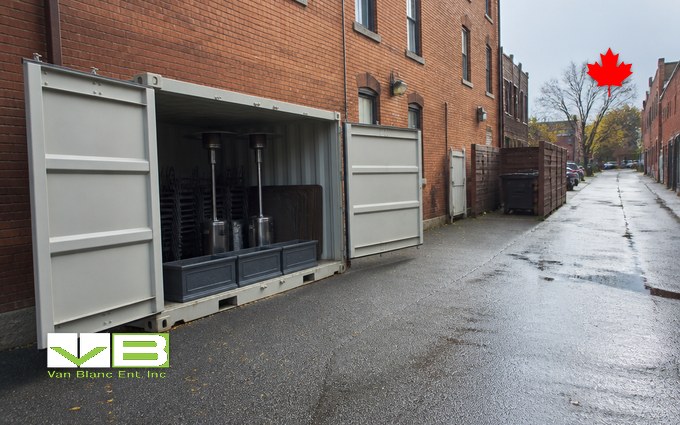
Quick Answer: Restaurant patio winter storage means clearing the patio by your removal date (Toronto curb lanes: October 1 to 15, 2026). Then dry and lock everything. A lockable 10ft or 20ft container behind the kitchen holds furniture, umbrellas and heaters, delivered by Van Blanc in 1-3 days across most of Ontario.
Inside This Restaurant Patio Guide
- Where Does Restaurant Patio Furniture Go in Winter?
- Patio Season End Dates by City
- Patio Inventory to Pack Away
- Patio Heater Storage and Propane Cylinders
- Furniture That Can Winter Outside
- Back Room, Locker or Steel Box
- A Lockable Box for Each Patio
- Packing Order on Closing Night
- New or Used Steel for the Patio Box
- Delivery Before the Removal Window
- Spring Setup From the Box
- Restaurant Patio Closing Checklist
- Patio Storage FAQs
Reading Time: 15 minutes
Where Does Restaurant Patio Furniture Go in Winter?
Restaurant patio winter storage is the off-season home for everything that worked the patio from spring to fall. That means tables, chairs, bar stools, cushions, umbrellas and their bases, heaters, planters and rail sections. On a curb lane it also means the platform deck. For a lot of Ontario restaurants, that home has been a corner of the dining room or the basement stairwell. Sometimes it is a back room that loses a shelf to stacked chairs every November. Each of those costs something. Chairs stacked by the host stand take tables out of service. Cushions that spend five months in a damp basement come back in April smelling like the basement.
The answer Van Blanc sells is a lockable steel container on the restaurant’s own property. A small sidewalk patio fits in a ten-footer tucked behind the kitchen door. Van Blanc has sold containers out of Brantford since 1995, and the box ships from our 4 Brantford yards in 1-3 days to most of Ontario. It can land the week before the patio comes in and stay put every winter after that. A full patio with umbrellas, heaters and platform sections goes into a twenty for the whole curb lane setup.
Paul LeBlanc, owner, Van Blanc Ent. Inc.: “Restaurants count a patio in seats. I ask them to count it in pieces: every chair, every table base, every heater, every umbrella and the planters along the rail. Do that count on a slow Sunday before the patio comes in and we can tell you on the phone whether it is a ten or a twenty.”
If you already know the count, the full size chart from ten feet up sets the lengths side by side.
Patio Season End Dates by City
Ontario patios close on different days. For storage, the date to plan around is the one your city sets for taking the patio down. Of the cities here, Toronto publishes the most detail. According to the City’s January 2026 release, CaféTO supported approximately 1,500 outdoor dining spaces in 2025. That count included 285 curb lane cafés, 579 sidewalk cafés and 703 private patio endorsements.
For 2026, the City’s timeline had curb lane cafés open from May 1 to 31, 2026, with temporary platforms installed by June 1. It sets October 1 to 15, 2026 as the window for operators to remove curb lane café patios and platforms. The January release also says many sidewalk cafés can remain in place year-round, which leaves their pack-up date to the operator. A curb lane operator ordering from Van Blanc for Toronto delivery, Etobicoke to Scarborough wants the box on site before the platform comes up.
Ottawa’s ByWard Market patios split the year. The ByWard Market District Authority lists a summer patio season from April 1 to October 31 and a winter season from November 1 to March 31. A market patio either packs up at the end of October or switches to a winter setup. Even the winter setup sends the summer umbrellas and cushions somewhere. In Niagara Falls, the City sets the sidewalk café operation period at April 1 to October 31 of each year. For a restaurant lot in downtown Kitchener or any city not listed here, the dates on your own patio agreement are the ones to work back from.
| City and patio type | Season as the city publishes it | What it means for storage |
|---|---|---|
| Toronto, CaféTO curb lane cafés | Opened May 1 to 31, 2026; removal October 1 to 15, 2026 | Box on site before the platform comes up |
| Toronto, CaféTO sidewalk cafés | Many can remain in place year-round | Operator’s call; cushions and umbrellas still come in |
| Ottawa, ByWard Market patios | Summer April 1 to October 31; winter November 1 to March 31 | Summer gear in by November 1; a 1-3 day run to Ottawa needs ordering early |
| Niagara Falls sidewalk cafés | April 1 to October 31 of each year | Box on site before October 31 |
| Kitchener and other cities | Set by your own patio agreement | Work back from the agreement’s end date |
Across those cities, the fall deadline and the spring start sit five to seven months apart. That is how long the patio needs a home. Curb lane cafés feel the squeeze most. All of them clear their platforms inside the same two weeks, when helpers and spare corners are hardest to find. A Van Blanc box ordered a week ahead is already in place when the work starts. The tilt-deck unloading sequence shows the open ground the truck needs that day.
Patio Inventory to Pack Away
A restaurant patio holds more separate pieces than its seat count suggests. The table below sorts a commercial patio by what each piece needs over winter, and whether it belongs in the container at all. A few things stay out of a closed box. Propane cylinders are covered in the next section, and soil-filled planters further down. Bar stock can freeze, so it goes back inside the restaurant along with the glassware. A Van Blanc box is unheated, so it sits at the outdoor temperature all winter. Why a closed box sweats in spring explains the damp spells that come with that.
| Patio item | Goes in the box? | How it packs |
|---|---|---|
| Stacking chairs and bar stools | Yes | Nested on a dolly or pallet along one long wall |
| Table tops and bases | Yes | Tops on edge, bases on the floor, hardware bagged to each base |
| Cushions and seat pads | Yes, bone dry | In breathable bags on wire shelving that keeps them off the floor |
| Market umbrellas | Yes, closed and dry | Lying along the length of the box in sleeves |
| Umbrella bases | Yes | On the floor near the doors, heaviest pieces lowest |
| Patio heaters | Yes, with cylinders removed | Upright and strapped to the wall |
| Propane cylinders | No | Upright in a locked outdoor cage or back to the supplier |
| Planters | Emptied ones only | Soil out, pots nested, clay and glazed pots inside |
| Rail panels and stanchions | Yes | Flat on the floor or on edge against a wall |
| Platform deck sections | Yes, if sized for it | Stacked flat on the floor |
| String lights, rugs, signs | Yes | Lights on reels, rugs rolled dry, the rest in labelled bins |
| Glassware and bar stock | No | Inside the restaurant |
Tables, Chairs and Bar Stools
Commercial patio furniture is built to stack, and stacking is what makes it fit. Aluminum and resin chairs nest on a dolly or a pallet, and a container ramp that bridges the door sill lets a loaded dolly roll straight in. Bar stools nest upside down on their seats. A run of chairs stood against the long wall leaves the middle of the box free as a walkway. Wash the salt and food off before anything goes in, then let it dry for a day. Grime left on over winter is harder to scrub in April. Table tops stand on edge with cardboard between them so the finish does not rub. The bases go on the floor. Bag the bolts from each knocked-down table and tape the bag to its base, since a box of loose hardware in spring is an afternoon nobody has. Freestanding shelves along one wall turn the upper half of the box into space for the light pieces.
Umbrellas and Their Bases
Umbrellas decide the box length more often than any other item. A closed market umbrella lies along the floor or a wall, and the 20ft gives it 19 ft 4 in of inside length. The 10ft is the tighter fit. Its inside length is about 2,840 mm, roughly 9 ft 4 in. Measure the closed umbrella from the finial to the foot of the pole before choosing the smaller box. Canopies go in dry and in sleeves, because a damp canopy rolled up in October is mildew by spring. On any used box, check the door seals that keep October rain off the canopies. The bases are the heaviest things on the patio. They sit along the floor near the doors, where a dolly can reach them, and nothing sits on top of them. A cantilever umbrella with a big cross base usually comes apart, so keep its bolts with the base.
Planters, Railings and Platform Decking
Planters with soil stay out of the box. Wet soil freezes, the pot takes the strain, and unglazed clay is the first to crack. Empty the soil into a covered pile, then nest the empty pots inside. Big self-watering planters that stay on the property all winter should be drained. Rail panels, stanchions and rope barriers lie flat on the floor or stand on edge, held by strap anchors fixed to the wall.
Curb lane platforms are the bulky item on a Toronto patio, since the platform comes off the street in the same October window as the furniture. Platform sections built narrower than the inside width of the box stack flat on the floor. The 20ft gives 7 ft 8 in across, so measure your largest section before choosing. The small things go into labelled bins: string lights onto reels, rugs hosed and rolled, and the host stand, A-frame signs, menu holders and table numbers boxed together. Keep a lock rated for a back lot on the doors, since stacked decking and aluminum furniture are worth stealing.
Patio Heater Storage and Propane Cylinders
Patio heater storage comes with one hard rule, and it decides what goes into the box. The Canadian Propane Association’s patio heater guidance says propane cylinders should never be stored indoors. Cylinders must stand upright behind tamper-proof protection that could withstand a vehicle impact, such as a locked cage or fenced-in area. If you store a patio heater indoors for security reasons, the guidance says to remove the propane cylinder first. It also says a cylinder counts as in storage whenever it is not connected to an appliance. Treat a closed Van Blanc container the same way: the heater bodies go in, and the cylinders stay out.
The heater towers go into the box upright, held by an e-track rail and a strap per heater tower so they cannot tip in the dark. Before they go in, check the hose and regulator for cracks. Tag any heater that would not light in September so it gets serviced over the winter. The cylinders go back to the propane supplier or into a locked, ventilated outdoor cage. Wall-mounted electric heaters and hard-piped natural gas units are a separate case, covered by their installer’s instructions. For anything else that might share the box, what may share a closed steel box runs through fuel, batteries and cleaning chemicals.
The heater rule in four lines
- Propane cylinders are never stored indoors, and Van Blanc treats a closed container as indoors.
- Cylinders stand upright in a locked cage or fenced area that could take a vehicle hit.
- Heaters may be stored inside once the cylinder is removed.
- A cylinder disconnected from its heater is in storage, so spares follow the same rule.
Furniture That Can Winter Outside
Some patio furniture can stay out, and the maker’s own guidance is the place to check. POLYWOOD makes furniture from HDPE plastic lumber. It says its frames can stay outside and uncovered year-round. The same guide says cushions belong in a dry place safe from weather and wildlife. It also says a cracked glass tabletop should be thrown out, because temperature swings make the crack grow until the top breaks. Wicker, fabric slings, cushions, canopies and glass tops are the pieces that pay for a winter outside. Those are the first things onto the upper shelves in a patio box.
Restaurants have their own reasons to bring in even weatherproof furniture. On a curb lane or a city sidewalk, the patio has to be cleared by the deadline anyway. On private property, chairs and tables left on an empty patio are easy to carry off overnight, and every missing piece is a reorder in April. Snow ploughed into the rail also hides damage until spring. A stack of aluminum chairs in a locked Van Blanc box behind the kitchen avoids all of that. A motion camera mounted on the container covers the steel itself.
Back Room, Locker or Steel Box
Restaurants handle the off-season in a handful of ways, and each has its place. The back room or a corner of the dining room is free and close. It is also space the restaurant pays for and needs for service, so the patio ends up stacked where it slows the staff all winter. The basement works for light pieces. Heavy bases and platform sections do not go down stairs easily, and damp basements are hard on cushions.
A self-storage unit across town is dry and locked. It adds a monthly bill and two truck runs a year, plus the staff time for both. The same half-year bill runs through garden centres and landscape crews, and how other half-year trades handle the off-season sets the patio beside them. A storage company can also drop a container, let you fill it and haul it to its own yard until spring. For a small business weighing its first box, a first-container buying guide for small businesses lays out the questions to ask any seller.
A container the restaurant owns sits behind its own kitchen. The patio goes in on closing night in the order it came off, and nobody books a truck to fetch it. In April the furniture is ten steps from where it gets used. It stays useful in summer too, holding winter enclosure panels, holiday decorations and spare chairs while the patio is out. An event company faces the same calendar with more road cases. The event-company depot that winters gear on site shows how that business lays out a box it owns.
A Lockable Box for Each Patio
A restaurant patio container is a standard dry shipping container set on level ground behind the restaurant or on the owner’s lot. It is locked with a padlock behind a steel lockbox Van Blanc welds on at the yard and left there year after year. That is the whole product: a steel box with a wood floor, sealed cargo doors and a size picked to the patio count. Four choices set it up for a restaurant: the length, the doors, where it sits and how many a business orders. Van Blanc sells all of it outright, delivered and placed.
Ten or Twenty for the Patio
The 10ft and the 20ft are the two sizes that suit patio storage. The choice comes down to the umbrellas, the platform and the heater count. A sidewalk patio with a few tables, bistro chairs, cushions and one or two heaters fits a 10ft. That size sits on a footprint of half a parking stall, factory-built or cut down. A curb lane or courtyard patio with long umbrellas, platform sections, rail panels and a row of heaters wants a 20ft. Every figure in this table comes from, or is worked out from, the 10ft and 20ft pages on vbinc.ca.
| Spec | 10ft dry container | 20ft dry container |
|---|---|---|
| Outside length | 2.99 m (9 ft 10 in) | 6.06 m (19 ft 10 in) |
| Inside length | About 2,840 mm | 19 ft 4 in (5.898 m) |
| Inside width | About 2,350 mm | 7 ft 8 in (2.352 m) |
| Inside volume | Approx. 16 m³ (560 ft³) | 33.2 m³ (1,172 cu ft) |
| Inside floor | About 72 square feet | About 148 square feet |
| Cargo door opening | 2,342 x 2,280 mm | 7 ft 8 in x 7 ft 5 in |
| Footprint on the lot | Half a parking stall | One parking stall |
| Typical patio | Sidewalk café, cushions, a heater or two | Curb lane or courtyard patio with umbrellas and platform |
The door opening matters as much as the length, and inside and door sizes for the twenty lists every measurement. Both sizes open about 7 ft 8 in wide at the cargo doors, so table tops, heater towers and platform panels go through on the same terms. What changes is depth. The ten holds the patio in one layer with a narrow aisle. The twenty holds it with room to walk in, find the bin labelled cutlery and walk out again. When the longest umbrella or deck panel runs past about 9 ft, the twenty is the answer.
Doors, Vents and a Lockbox
Every container comes with its cargo doors, and for a box opened twice a year they are all a patio needs. Some restaurants use the box through the season for spare chairs or the summer’s extra stock. Those can add a coiling roll-up door beside the cargo doors. On a ten, Van Blanc sells units with the roll-up already hung. A 20ft takes an 8 or 10 ft wide roll-up with about 7 ft of clear height. The cargo doors stay on either way. For a box on a busy lane, a puck lock the bolt cutters cannot reach is the upgrade over a standard padlock.
Vents matter more than insulation for a patio box. The furniture needs dry air, and a closed steel box goes through damp spells in fall and spring when warm days meet a cold roof. A pair of vents keeps air moving past the cushions and canopies, and vents that let a damp cushion breathe explains where they go. An insulated box earns its cost only when something inside has to stay above freezing. On a patio list that is usually nothing, since bar stock and glassware go back into the restaurant. The rest is routine: load everything dry, add a few moisture absorbers, and open the doors on a dry day in March.
Behind the Kitchen or on the Owner Lot
Put the box behind the kitchen, next to the back door the staff already use for deliveries, or at the far edge of the owner’s parking lot. A 20ft takes one parking stall and a 10ft takes half of one. That is the trade a restaurant makes in October, when the patio seats are gone anyway. The ground should be level and firm. Compacted gravel under the box or timbers under the corners keeps the floor flat and the doors swinging true. Face the doors toward the kitchen’s back door. Doors turned toward the kitchen entrance explains how to tell the driver which way before the truck arrives.
The delivery truck needs a straight run to set the box down. The straight run a delivery truck needs lists the width and overhead room to check. A laneway too tight for a twenty often takes a ten, and options for a narrow lane behind the restaurant covers the other ways in. Permits are managed by your municipality, so check with your local building or planning department before you order.
Restaurant Groups and BIAs
Plan one box per patio. Each location gets its own ten or twenty behind its own kitchen, so nobody drives furniture across town in October. Groups with several patios can order them together, and Van Blanc discounts delivery per box on multi-bin orders, starting at three units. Business improvement areas have a different list. They store shared planters, banners, street furniture, festival barriers and winter event gear owned by the BIA itself. A BIA box can be a twenty in a member’s lot. Its inventory list taped inside the door matters even more, since several people will open it. In Niagara Falls, the City’s sidewalk café season closes October 31, and restaurant patios around Niagara Falls that use the sidewalk work back from that date.
Your patio count, our size call
Tell us how many chairs, tables, umbrellas and heaters come off your patio, where the box would sit and your postal code. We match the patio to a box, pick the doors and vents with you, and send one all-in number with a real lead time.
Family-run in Brantford since 1995 · 4 Brantford yards · 4.9★ across 140+ Google reviews.
Packing Order on Closing Night
Packing a patio box well comes down to one idea: what goes out first in spring goes in last in fall. In spring the platform and rails usually go down before the furniture, and the furniture before the umbrellas, cushions and décor. So the décor and cushions go to the back of the box, and the platform sections end up nearest the doors. Plan for one dry day of washing before closing night. The packing itself is an evening’s work for a small crew, and the volume each length holds helps if the count is close.
- Wash furniture, cushions, canopies and rugs a day ahead and let everything dry fully.
- Photograph the patio layout and number each table, so spring setup follows the picture.
- Load the back wall first: bins of décor, lights and signs on a rack of open mesh decks, cushions in bags above the floor.
- Run umbrellas, closed and sleeved, along one long wall at floor level.
- Stand heater towers upright against the other wall and strap them. Cylinders go to the outdoor cage.
- Nest chairs and stools on dollies beside the umbrellas, keeping a walkway clear down the middle.
- Stack table tops on edge and bases on the floor, hardware bagged and taped to each base.
- Load umbrella bases, rail panels and platform sections last, nearest the doors, and tape the packing list inside the door.
A box packed that way opens in spring with the first job of the season right in front of the doors. Keep work gloves, a cordless drill and the hardware kit in a bin by the doors. The person setting up then never needs a trip back inside. Van Blanc can also add shelving brackets and larger air vents from the accessories list to the same quote.
New or Used Steel for the Patio Box
Containers come in four grades. Buyers call the first grade new; the industry calls it one-trip, because the box made exactly one loaded voyage from the factory. These arrive with clean paint and tight doors. Minor handling marks are possible, and we point them out in the yard. They suit a box that customers will see from the patio. Cargo worthy boxes are used and typically 8 to 15 years old, with surface rust and paint variance on a sound frame and floor. Wind and watertight boxes are used 12+ years, with more cosmetic wear and doors that close and seal. As-is units come with a written defect list, for buyers who know exactly what they need. What each of the four grades means is a short read before you choose.
Behind the kitchen, a used cargo worthy or wind and watertight box gives the patio dry, lockable steel on a sound floor. Where the box faces customers on the street, a new one-trip box in factory paint brings clean paint, tight doors and the best resale value. To compare them, every size and grade on the ground today, side by side sits on one page. Van Blanc keeps a 200-plus container inventory across the 4 Brantford yards, and you see the exact unit before you pay.
Delivery Before the Removal Window
A Van Blanc box reaches most of the province within 1-3 days of the order, shipped from our 4 Brantford yards. Eastern Ontario runs such as Ottawa take the same 1-3 days. Every quote comes with a real lead time, not a hopeful one. A restaurant that orders a week ahead has the box in place before its removal date. For a ByWard Market restaurant buying in Ottawa, order before the market season turns over.
A patio that comes in late is not stuck. A box can still land in November or December, and a December delivery on hard-frozen ground covers what changes. One warning applies all year. Plenty of buyers call Van Blanc about a cheaper container they saw on Facebook. Two weeks later some of them call back after paying a seller who never delivered. The pay-first listing pattern is worth reading before you send anyone a deposit.
Spring Setup From the Box
Spring runs closing night in reverse. Work from the opening dates in the table above, and open the box on a dry day a week before setup to let it air. Check the cushions for damp before they go out. Platform sections and rails come out first, then tables, chairs, umbrellas and heaters, and the décor last. While the box is open, look over its own paint. A touch-up on scraped paint each spring keeps rust from getting a start.
Inspect as things come out, while there is still time to replace what failed. Umbrella ribs and canopies, heater igniters and hoses, chair glides and table bases are the parts worth a look. The heaters get their cylinders back outdoors and a leak check by the manufacturer’s manual before the first lighting. Once the patio is out, the box holds the winter side of the business for the summer. If the restaurant ever wants the steel working year-round, a kitchen built inside a container covers the full food-service conversion.
Restaurant Patio Closing Checklist
Before the patio comes in
- Find your end date in the season table above, or on your own patio agreement.
- Count the patio in pieces before it comes in, then call with the count and your postal code.
- Pick the size: a 10ft for a small sidewalk patio, a 20ft for umbrellas, platform and heaters.
- Prepare a level spot behind the kitchen, with blocks or timbers set level under each corner casting, and clear the truck’s path.
- Book a dry day to wash and dry everything before closing night.
- Return or cage the propane cylinders, and never load them into the box.
- Empty planters of soil, drain self-watering planters and bring clay pots in.
- Pack in reverse of spring setup and tape the list inside the door.
- Lock the box and check it once a month through winter.
With the list done, call with the count. Containers for the 416’s curb lane cafés go out on the same 1-3 day schedule as most Ontario runs.
Frequently Asked Questions
When do restaurant patios close in Ontario?
It depends on the city and the patio type. Toronto set October 1 to 15, 2026 as the window to remove CaféTO curb lane patios and platforms, while many sidewalk cafés can stay year-round. Ottawa’s ByWard Market runs a summer season to October 31 and a winter season from November 1. Niagara Falls sidewalk cafés operate April 1 to October 31.
Can restaurant patio furniture stay outside over winter?
Some frames can. POLYWOOD says its HDPE frames can stay outside uncovered year-round, and your own maker’s care sheet answers it for other furniture. Cushions, canopies, fabric slings, wicker and glass tops should come in, and POLYWOOD says a cracked glass top should be thrown out. Restaurants have extra reasons to clear everything: public patios must be empty by the deadline, and furniture left on an empty private patio is easy to steal.
How should a restaurant store outdoor patio furniture in winter?
Wash and dry every piece, stack chairs and stools on dollies, and stand table tops on edge with the hardware bagged to each base. Keep cushions in breathable bags on shelves off the floor. Store it all in a dry, locked space close to the patio, packed in reverse of the spring setup order.
Where should patio heaters be stored for the winter?
The heater bodies can go indoors or into a container once the propane cylinder is removed. The Canadian Propane Association says cylinders should never be stored indoors. They must stand upright in a tamper-proof enclosure, such as a locked cage or fenced area, that could withstand a vehicle impact. Van Blanc treats a closed container the same as indoors, so the cylinders never go in the box.
What size container holds a restaurant patio?
A 10ft holds a small sidewalk patio with cushions and a heater or two, on about 72 square feet of floor. A 20ft, with 19 ft 4 in of inside length and about 148 square feet of floor, takes umbrellas, platform sections, rails and a row of heaters. Measure the longest umbrella and the largest deck panel before choosing.
Does a patio storage container need insulation or heat?
Not for furniture alone. Patio furniture, umbrellas and empty heaters need dry air rather than heat. Load everything bone dry, add a pair of vents and a few moisture absorbers, and keep anything that can freeze, such as bar stock, inside the restaurant. Insulation earns its cost only when the box must stay above freezing.
How much does a container for patio storage cost?
The price depends on size, grade, delivery distance, any doors or vents added, and the steel market that month. Van Blanc quotes each order instead of posting a number. Tell us the patio count, the size and your postal code, and we send back one all-in figure with delivery, usually the same day.
Sources
- City of Toronto. (2026). Curb Lane Cafés: Timelines for CaféTO 2026 Season. City of Toronto, Curb Lane Cafés, checked October 2026.
- City of Toronto. (2026, January 7). City of Toronto opens applications for the 2026 CaféTO curb lane outdoor dining program. City of Toronto news release, 2026 CaféTO program, checked October 2026.
- ByWard Market District Authority. (2026). Patio and Café Seating. ByWard Market District Authority, patio seasons, checked October 2026.
- City of Niagara Falls. (2026). Sidewalk Café and Patio Licences. City of Niagara Falls, sidewalk café operation period, checked October 2026.
- Canadian Propane Association. (2026). Patio heater safety tips. Canadian Propane Association, Patio heater safety tips, checked October 2026.
- POLYWOOD. (2026). How to Winterize Patio Furniture in 4 Easy Steps. POLYWOOD, How to Winterize Patio Furniture, checked October 2026.
Walk a Ten and a Twenty in Brantford
We have been supplying shipping containers across Ontario since 1995. Our public yard is at 90 Morton Avenue East in Brantford, one of our 4 Brantford yards, open to walk without an appointment.
Van Blanc Ent. Inc., 90 Morton Ave E Unit 1B, Brantford, ON N3R 7J7, 519-754-6844.
Bring the patio count and a photo of your back lot, stand inside a ten and a twenty, and pick the one that fits before the removal window opens. Worth the drive for unbeatable quality, family customer service with 30 years of experience.