
Quick Answer: A storage tent is a steel-tube frame under a polyethylene or PVC cover, anchored to the ground: the cheapest roof per square foot sold. Box-store tents carry no snow rating and a one-year cover; rated shelters carry both. Buy fabric for a season or a shape, steel for a decade.
In This Guide
- Where We Stand
- What a Fabric Shelter Is, in One Paragraph
- The Four Tiers, and the Names They Go By
- The Cover: Ounces, Years and Sun
- The Frame: Tube, Spacing and the Peak
- Anchoring: The First Thing That Fails
- Snow: The Rating, the Shovel and the Collapse
- What a Storage Tent Is Actually For
- What It Is Not For
- Where the Container Fits
- Who Should Buy Which
- Storage Tent FAQs
Reading Time: 14 minutes
Where We Stand
This guide is written by a shipping container yard in Brantford, Ontario. We sell the steel box that competes with a storage tent for the same driveway, the same farm lane and the same boat, so we have a stake in the last third of this page and none in the first two. We have also spent thirty years arriving at properties where a fabric shelter used to stand, which is its own kind of research. The product facts below come from the makers’ own pages, ShelterLogic, Chery Industrial, Cover-Tech and Tempo among them, read on September 15, 2026; the portable garages review and the car shelters in Ontario winters guide already cover the driveway version, so this page is about the category as a whole: what a tent is, which tier you are looking at, and what it is built for.
What a Fabric Shelter Is, in One Paragraph
Every product on this page, from the 10×10 tent shed at Canadian Tire to a 70-foot-wide fabric barn on a Bruce County farm, is the same object at different scales: a frame of galvanized or powder-coated steel tube bent into arches, spaced along the length and tied together with purlins, with a tensioned fabric cover pulled over it and fastened down, and the whole thing held to the ground by anchors. The cover keeps the rain off; the frame holds the cover up; the anchors keep the frame from becoming a kite. There is no floor, no insulation and no lock worth the name, and the building weighs so little that the wind, and the snow, and the anchors are the entire engineering conversation. The container-or-portable-garage head-to-head is the driveway comparison; this page is the category the garage belongs to.
The Four Tiers, and the Names They Go By
The names are the confusion. Storage tent, tent shed, portable shelter, temporary garage, portable garage, car shelter, tarp garage, fabric building, tension fabric structure, hoop barn: they overlap, and the same product is sold under three of them. The tiers underneath are clearer, and the price of the thing tells you which one you are looking at. The box-store tent is the first: a light frame, a 7.5 to 9 ounce polyethylene cover, a one-year prorated cover warranty, no snow rating, sold flat in a box at Canadian Tire, Home Depot, Costco, Amazon and Princess Auto under a dozen brand names, ShelterLogic’s Shed-in-a-Box and Garage-in-a-Box the best known. The rated shelter is the second: ShelterLogic’s ShelterTube line, rated for 80 miles an hour of wind and 43 pounds per square foot of snow, with covers from 9 ounces up to 14.5 and 21.5 ounce PVC carrying 10 and 15-year prorated warranties, and the heavier Chery, TMG and Cover-Tech shelters that publish similar figures. The seasonal car shelter is the third, and it is its own animal: the Tempo-style shelter that goes up in November and comes down in April by rule, which is why it can be light. And the fabric building is the fourth: Cover-Tech, Britespan, Chery’s engineer-stamped line, Sprung, the truss-arch structures on concrete piers or blocks that farms, municipalities and salt yards buy as buildings and that the Cover-Tech buildings review, the Britespan buildings review and Sprung’s structures, reviewed cover one by one. The maker behind most of those names in Canada is covered on its own in the ShelterLogic brand review.
| Tier | Sold as | Cover | Cover warranty | Snow rating | Anchors | Honest life |
|---|---|---|---|---|---|---|
| Box-store tent | Storage tent, tent shed, portable garage, Garage-in-a-Box | 7.5 to 9 oz PE | 1 year prorated | None; clear it | Augers or straps, supplied light | 2 to 4 years on the cover, longer on the frame |
| Rated shelter | ShelterTube, heavy duty, engineer stamped | 9 oz PE to 14.5 and 21.5 oz PVC | 1, 10 or 15 years prorated | Published: 43 psf on ShelterTube | Augers, concrete or ballast, specified | 10 to 15 years on a PVC cover |
| Seasonal car shelter | Tempo, car shelter, abri d’auto | Light PE, replaced often | Short | Not for accumulation; up November to April | Stakes and ties | Several seasons on the frame |
| Fabric building | Truss-arch, hoop barn, tension fabric structure | Heavy PVC, often 20-plus oz | 15 to 25 years | Engineered to the site’s snow | Piers, blocks, concrete | Decades, with a re-cover |
The Cover: Ounces, Years and Sun
The cover is the tent, and the number that describes it is the weight of the fabric per square yard. A 7.5 or 9 ounce woven polyethylene cover, the triple-layer ripstop kind on every box-store tent, is waterproof on the day it is installed and is worn out by ultraviolet light, not by rain: the sun breaks the polymer down, the fabric chalks and stiffens, it tears at the grommets and the seams, and in southern Ontario it lasts two to four summers before it leaks along the ridge, which is why the makers warranty it for one year prorated and sell replacement covers as a product line. A 14.5 or 21.5 ounce PVC cover is a different material, heavier, stiffer, heat-welded rather than sewn, with UV inhibitors that hold, and it is warrantied for 10 or 15 years because it lasts that long. The whole difference between a tent that disappoints and a shelter that does its job is in that number, and it is printed on the box.
Colour matters more than people expect. A white or light grey cover reflects sun and runs cooler inside; a dark green or tan cover absorbs it, ages faster and turns the tent into an oven in July, which matters for a boat’s upholstery or a bag of fertilizer. And a cover that is loose is a cover that flogs, and a flogging cover wears through at every frame contact in a season, so tensioning it after the first week, and again in the fall when the fabric has relaxed, is the maintenance that doubles its life. The what-can-take-a-tent list is where the things under the cover are sorted by what they can take.
The Frame: Tube, Spacing and the Peak
The frame is described by three numbers the box-store listing buries: the tube diameter, the arch spacing and the roof shape. Box-store tents run 1 3/8 inch tube on arches four or five feet apart; rated shelters run 2 inch and heavier tube on arches closer together, with a double-truss arch on the wider spans; fabric buildings run truss arches of welded tube on engineered spacing. Thicker tube and closer arches are what carry the snow, and they are also why a rated shelter weighs three times what a tent does and needs a crew to raise. The roof shape decides what the snow does: a peaked roof sheds it, a round roof holds a little more but takes the wind better, and a flat-roofed canopy is a snow shelf and should never be left up past November. The quonset hut buyer’s guide is the steel-arch cousin of the round-top tent, and container against quonset is the comparison for the buyer who wants the arch without the fabric.
Anchoring: The First Thing That Fails
Every fabric shelter that ends up in a neighbour’s field left the ground the same way: it was anchored as it came in the box, on a windy site, and the first real gust got under the open end. A storage tent is a sail with a frame in it, and the anchor is the only thing holding it down, so the anchor is where the money should go. The stakes in the box are for lawn on a calm day. Auger anchors, the 15-inch and 30-inch screw-in kind, with ratchet straps over the frame, are the minimum for a season; on a rocky or hard-packed site, concrete deadmen or a row of filled barrels; on asphalt, drilled anchors or ballast blocks. The makers publish the anchor kit for each shelter and most people skip it. Close the end panels in wind, because an open door turns the tent into a bag, and never leave a tent up unanchored while you think about it. How a container is anchored is the steel version of the same question, and the answer is that a 5,000-pound box on gravel mostly is not, which is its own argument.
Snow: The Rating, the Shovel and the Collapse
Ontario’s design snow loads run from about a kilopascal, 20 pounds per square foot, along the Lake Erie shore to two and three times that in the snowbelt east of Georgian Bay, in the Ottawa Valley and across the north, and a fabric shelter either carries its site’s load or it does not. The box-store tent does not, and the makers say so: the manual says to remove snow as it falls, and the peaked or rounded roof is there to help it slide. Left alone under a wet February snowfall it sags, the arches bow, the purlins pop, and the tent comes down on whatever is inside, which is the collapse photograph in every Reddit thread on the subject. The rated shelter carries a number, 43 pounds per square foot on ShelterTube, which is enough for the Lake Erie and Lake Ontario shore and marginal or short in the snowbelt, so the number has to be read against the site rather than taken as a yes. The fabric building is engineered to the site’s load and stamped, which is what the stamp is for. The honest rule: if the tent will be up in January, buy the rated one and read the rating, and if the site is the snowbelt, buy the building or the steel box. What a container roof carries puts the box’s figure beside these, and it is not close.
What a Storage Tent Is Actually For
Used honestly, the fabric shelter is a very good product, and it is used honestly for six things. A season: the boat or the trailer under cover from October to April on a cottage lot, with the tent down and rolled in May. A shape: a 30-foot cabin cruiser, an RV, a stack of hay bales or a boom truck that no shed or container fits, under the only roof that can be sized to them cheaply. A temporary need: the year of a renovation, the winter of a build, the months a business waits for its real building, where a delivered storage unit and a tent over the machines split the job. A cheap roof over an ugly problem: the woodpile, the mower, the garden centre’s overwinter stock. A farm’s overflow, where the farm storage page puts the container for what has to lock and the hoop building for what has to be dry and driven through. And the rated shelter or fabric building as a real building, on piers, with a PVC cover, for a yard, a riding arena, a municipal salt shed or an equipment bay, where the span and the light inside are the point and the decades-long cover warranty is real. The RV and camper storage guide is the long-vehicle case in full.
What It Is Not For
It is not for anything that has to be locked. A cover unzips, a frame unbolts, and a knife opens the rest; the tools, the sled, the ATV and the copper wire inside a tent are inside a tent. It is not for anything that cannot take a collapse, which in the snowbelt is everything, and in the south is the car and the boat you could not afford to lose. It is not for the decade, unless the decade is spent replacing covers: a box-store tent bought for its price and kept for ten years costs three covers and two frames, which is the price of the steel it was meant to save. It is not for a suburban lot where it can be seen, because the same fabric that lasts two years looks its age from the first, and the neighbours notice. And it is not a building, in the sense that its floor is the ground, its walls move, its inside is the outside with the rain removed, and anything stored on that ground for a winter is stored on wet ground. The sea-can-or-storage-shed page is the comparison for the buyer who has just crossed that line.
Where the Container Fits
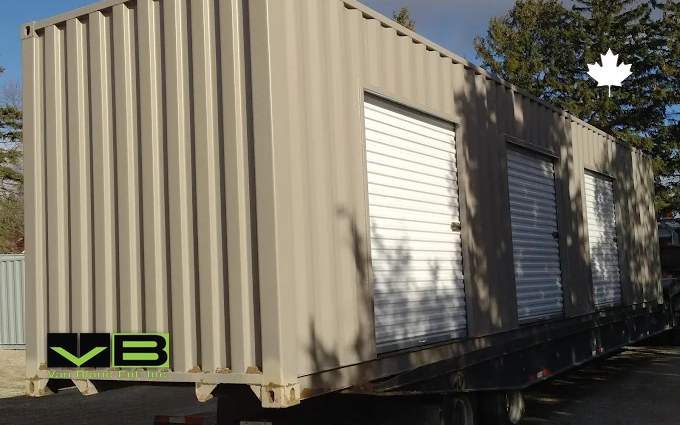
A shipping container is the thing the storage tent is standing in for. It is a corten steel box, 8 feet wide and 20 or 40 feet long, with a roof rated for six loaded containers stacked on it, walls that do not move, a marine plywood floor over steel, doors that seal on gaskets and lock on four bars, and a life measured in decades on a gravel pad with no cover to replace. It arrives on a truck and is set in an afternoon, which is the one thing it shares with the tent; everything else is the opposite. Where the tent wins is span and shape: the container is 8 feet wide, and the boat, the RV or the hay wants 12, 14 or 30. Where the container wins is everything the tent is not for: the lock, the snow, the decade, the ground. Container against a Sprung structure is the fabric-building version of that split, and the sea can size sheet has the interior figures for anyone measuring what would fit.
The pairing is more common than the choice. A farm puts the hoop building over the equipment and the container beside it for the chemicals, the tools and the parts that walk. A contractor puts the tent over the lumber for the build and the container as the tool crib for the years after. A marina puts the cruiser under fabric and the outboards, the electronics and the canvas in the box. A cottage owner puts the boat under a seasonal tent and the rest of the cottage’s winter in a container that stays locked until May. The honest question is never tent or box for the whole list; it is which items on the list can live under fabric and which cannot, and the ones that cannot are usually the ones that cost the most.
The limits, stated plainly. A container will not cover a 30-foot boat, will not span a riding arena, and will not be the cheapest roof per square foot on any list; a tent will. It is a steel box on a lot unless it is painted or screened. And the box needs a level pad and a truck route, which the province-wide delivery logistics page covers. For the buyer whose tent turned into a box somewhere on this page, the unit is the one line we can speak to from the yard: a used wind-and-watertight 20-foot dry box with sound doors from the used rows at 90 Morton Avenue East is the tent replacement for tools and the sled, a 40-foot high cube for the workshop takes the workshop or the season’s stock, and every unit can be picked by number before any money moves, with delivery anywhere in the delivery area we cover in one to three days and payment on delivery. Everything is sold outright; Van Blanc keeps no rental fleet.
Christian LeBlanc, Van Blanc: “I’ve delivered a lot of containers onto the exact spot where a tent stood the winter before. Nobody’s angry at the tent. It did a season for what a cover costs and then it did what fabric does in March. The ones who come out ahead used the tent for the boat and put the tools in the box from the start.”
Who Should Buy Which
Buy the box-store tent for a season or a shape, anchor it with augers and straps, close the ends in wind, clear the snow the day it falls, and take it down in April if it is a car shelter; expect a new cover in year three. Buy the rated shelter if it will stand through a winter south of the snowbelt, read the snow number against your site, and buy the PVC cover with the long warranty because the cover is the building. Buy the fabric building for a span, on piers, from Cover-Tech, Britespan, Chery or Sprung, and treat it as the building it is. And buy the container for everything on the list that has to be locked, has to survive the snow without a shovel, has to still be there in ten years, or has to sit on a floor instead of the ground. The hub of alternatives to a container is the wider read for anyone still deciding what kind of building the job needs at all, and the container grade ladder explains why wind-and-watertight is the right grade for a tent’s replacement.
Half the list needs a lock? Price the box once
Tell us what is going under cover, what has to lock, and your postal code, and we will send an all-in number for the container delivered and set, usually the same day. Or walk the Brantford yard and compare roofs and see what a steel roof looks like beside a fabric one.
The two pages that finish this one are the box-store kit reviews, brand by brand, which reads the box-store kits brand by brand, and the padlock-or-lock-box comparison, for the buyer whose whole reason for leaving the tent is the lock.
Storage Tent FAQs
What is the best tent for storage?
The one whose cover weight and snow rating match the job. For a season south of the snowbelt, a box-store peaked tent with a 9-ounce cover, anchored with augers and straps, is fine. For anything standing through an Ontario winter, a rated shelter such as ShelterTube, rated for 43 pounds per square foot of snow, with a 14.5 or 21.5 ounce PVC cover on a 10 or 15-year warranty. For a span or a decade, a fabric building on piers.
Can I use a tent as a shed?
For a season, for things that do not need a lock, yes: a mower, the patio furniture, the woodpile, a boat. As a shed for years, no. A storage tent has no floor, no security and a cover that ultraviolet light wears out in two to four summers, so a tent kept as a permanent shed costs a new cover every few years and still leaves the contents on wet ground behind a zipper. A shed or a container is the building; the tent is a roof.
Will a storage tent hold up under snow in Ontario?
A box-store tent will not; its manual says to remove snow as it falls, and a wet February snowfall left on it bows the arches and brings it down. A rated shelter carries a published number, 43 pounds per square foot on ShelterTube, which covers the Lake Erie and Lake Ontario shore and falls short in the snowbelt east of Georgian Bay, the Ottawa Valley and the north. A fabric building is engineered and stamped for the site.
How do you anchor a portable garage or storage tent?
With more than comes in the box. Screw-in auger anchors, 15 or 30 inches, at every leg with ratchet straps over the frame are the minimum on soil; concrete deadmen, filled barrels or ballast blocks on rock and hard pack; drilled anchors or ballast on asphalt. Close the end panels in wind, because an open end turns the tent into a bag, and tension the cover after the first week and again in the fall.
How long does a storage tent cover last?
A 7.5 to 9 ounce polyethylene cover lasts two to four summers in southern Ontario before the sun chalks it and it tears at the seams and grommets, which is why it carries a one-year prorated warranty and replacement covers are sold as a product. A 14.5 or 21.5 ounce PVC cover lasts 10 to 15 years and is warrantied for that. A light colour, a tight cover and snow cleared promptly all add seasons.
What are temporary garages called?
Portable garage, storage tent, tent shed, portable shelter, storage shelter, tarp garage, car shelter, fabric shelter or, in Quebec, abri d’auto; the seasonal driveway kind is often just called a Tempo after the best-known brand. They are all the same object, a steel-tube arch frame under a tensioned fabric cover, in four tiers: the box-store tent, the wind-and-snow-rated shelter, the seasonal car shelter and the engineered fabric building.
Is a shipping container better than a storage tent?
For anything that has to lock, sit on a floor, survive snow without a shovel or still be there in ten years, yes; a used 20-foot container on a gravel pad does all four with no cover to replace. For a season, a shape wider than 8 feet, or the cheapest possible roof over a boat or a stack of hay, a tent is built for the job. Most farms, contractors and cottages end up with one of each, and the split is by what is on the list.
Sources
- ShelterLogic. (2026). ShelterTube Wind and Snow-Load Rated Garage; Compare Wind and Snow Load Rated Shelters. shelterlogic.com
- ShelterLogic. (2026). Replacement Cover for the Garage-in-a-Box. shelterlogic.com
- Chery Industrial Canada. (2026). Storage Shelter Dome. mart.cherygroup.ca
- Cover-Tech Inc. (2026). Portable Garages and Car Shelters. cover-tech.com
- Tentnology. (2026). Portable Shelters. tentnology.com
- Van Blanc Ent. Inc. (2026). Container vs Portable Garage in Ontario. vbinc.ca
Reach Van Blanc in Brantford
We have been supplying shipping containers across Ontario since 1995. Our yard is at 90 Morton Avenue East in Brantford, and we deliver right across the province with payment on the day of delivery. No deposit, no upfront wires, no chase-the-paperwork.
Van Blanc Ent. Inc., 90 Morton Ave E Unit 1B, Brantford, ON N3R 7J7, 519-754-6844 (cell) or 1-888-509-6658 (toll-free).
If the tent you were pricing turned into a steel box for half the list somewhere in this page, call with what has to lock and your postal code and we will tell you on the spot what is in stock and when it can land. Worth the drive for unbeatable quality, family customer service with 30 years of experience.