
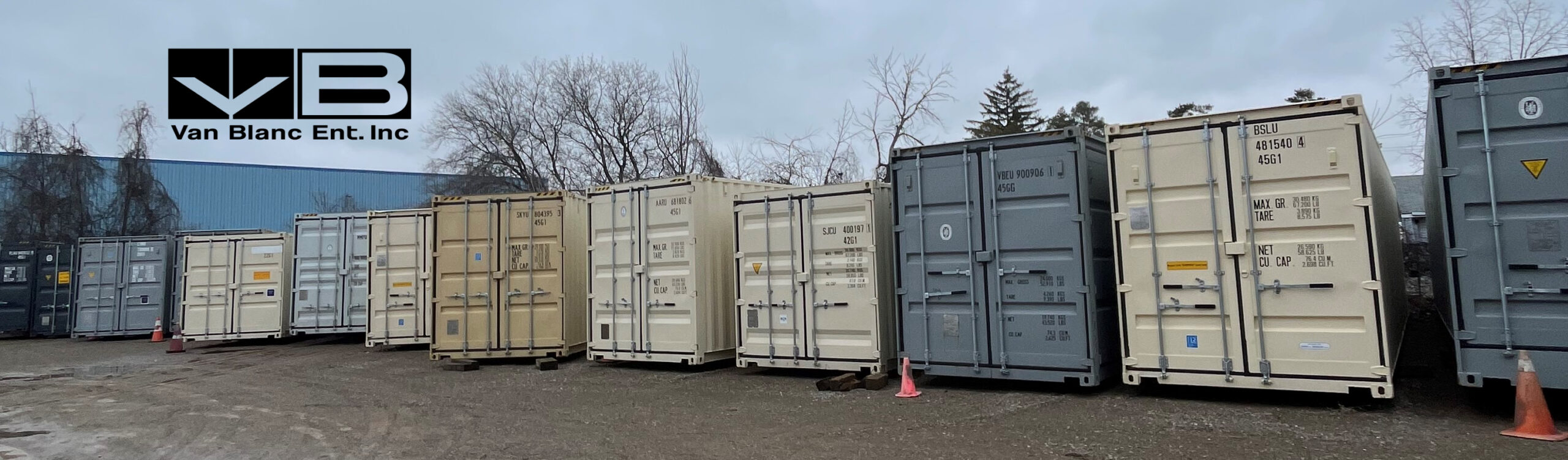
Quick Answer: A shipping container does not replace a drive shed, and any container yard that says otherwise is selling you. What a sea can does on a working Ontario farm is everything the drive shed cannot: seal, lock, and separate. Tools, seed, and crop protection behind steel while the machinery keeps the big doors. Van Blanc delivers farm bins in 1-3 days.
In This Guide
Reading time: about 9 minutes.
What a Container Cannot Do (Say It First)
A drive shed exists so a combine, a sprayer with the booms folded, and a grain truck can drive in, turn around, and park under one roof. That takes clear spans of forty to sixty feet and door heights no shipping container will ever offer. If machinery shelter is the job, you need the building, and the honest move for us is to say so in the first hundred words. Our own container vs pole barn comparison draws the same line for the same reason.
So why does a container yard in Brantford see farm buyers every single week? Because the drive shed, for all its span, has three structural weaknesses that steel boxes were born to fix, and because the years BEFORE the big build need something dry and locked in the meantime. That is this page. Part of the answer is the fabric roof that stands on two containers, and the Britespan review covers the Ontario builder that sells it as a product.
What Does Every Drive Shed Lack?
Walk any concession road and look at the drive sheds: big sliding doors that have not sealed since the nineties, gaps at grade that every raccoon in the county knows personally, and one corner where the good tools hide under a tarp because the whole building locks about as convincingly as a screen porch. A drive shed is a roof with ambitions. It keeps rain off machinery magnificently and secures nothing.
The Ontario Federation of Agriculture’s rural-security conversations circle the same reality farmers already know: farm theft is a drive-by crime of opportunity, and opportunity is a sliding door. A 20ft container parked at the shed’s gable end is the missing room: welded corten, marine door gaskets, and a welded lockbox that shields the padlock from bolt cutters. The drive shed keeps its job. The container takes over the part the drive shed was never built for.
The Gable-End Bin
The pattern we deliver most in Brant, Norfolk, and Haldimand: a Wind and Watertight 20ft tight against the drive shed’s end wall, doors facing the yard light. Hand tools, generators, chainsaws, fencing gear, and the batteries that used to walk away, all shelved at eye level behind steel. The combine never notices its new neighbour.
Why Do Farms Put Crop Protection in a Separate Steel Bay?
Sprays, seed treatments, and fuel do not belong loose in the same open volume as machinery, welding sparks, and barn cats. Separation is just good farm practice: a dedicated, sealed, lockable bay keeps crop protection products contained, keeps curious hands out, and keeps an incident in one steel room instead of one big wooden building. A container is purpose-built for exactly this: sealed steel, containable floor, ventilation added where the plan calls for it via simple modifications, and a lock that means it. Ask your input supplier how many of their rural customers store product in a sea can; the nods tell the story.
The Pre-Drive-Shed Years: The Two-Bin Stage
Every drive shed is preceded by a decade of wishing for one. Young operations and expanding ones run the same in-between play: two 40ft containers set parallel, a gap between them for a wagon or the pickup, and the whole arrangement doing shed duty for a fraction of a build while the operation grows into the real thing. Some farms roof the gap; our modification shop builds container-mounted roof structures under engineered drawings, and the pattern is common enough to have a name around our yard: the poor man’s drive shed. It is a stage, not a substitute, and when the big build finally happens the bins do not become waste; they become the secure bays beside it, or they resell, because steel holds value in a way sheds never will. The whole menu a farm yard can buy in the meantime, from a lofted barn to a fabric span, is sorted in the storage buildings for sale guide.
Christian LeBlanc, second-generation operator: “A cash-cropper near Scotland, Ontario ran two 40s with a tarped gap for six seasons while he saved for his shed. When the shed went up, he kept both bins: one became the chemical room, the other the shop overflow. He told me the shed cost more than his first farm, but the bins were the only part of the yard that never asked him for anything.”
The Shed Can Wait. The Lockup Cannot.
Tools and inputs need steel this season, not in three years. One call prices the bin that holds the fort while the big build stays on the drawing board.
The Drive Shed That Filled Up in 2019
The third buyer is the established farm whose shed has been full since two equipment upgrades ago. Machinery grows; buildings do not. Before pricing an addition, price a bin: seasonal implements, tires, totes, and the wall of stuff that is not machinery can move thirty steps into a container, and the shed goes back to doing its actual job. Delivery is a tilt-deck visit down the laneway, 1-3 days out from our 4 Brantford yards, placed where you point.
Which Container Fits Farm Duty?
Wind and Watertight is the working answer for most farm storage: sealed, rodent-proof, honestly weathered, and priced for a building that lives behind the shed. Step up to Cargo Worthy where resale matters, or new (one-trip) where the bin sits in the home yard and looks it. A 20ft handles the tool-and-chemical bay; the 40ft takes implements and pallets. If the sizes blur, the size decision guide settles it in four questions, or describe the yard over the phone and we will tell you on the spot.
A drive shed is a big build. Weigh every route in the compare your options hub first.
Frequently Asked Questions
Can a shipping container replace a drive shed?
No. A drive shed exists for machinery-scale spans and door heights no container offers. What a container adds beside one is the sealed, lockable, separated storage a drive shed cannot provide: tools, crop protection, seed, and anything theft-prone, behind welded steel.
What do farms actually use containers for beside a drive shed?
The three patterns we deliver most: a locked tool bay at the gable end, a separated crop-protection room with ventilation added, and overflow for the shed that filled up years ago. The drive shed keeps the machinery; the bin takes everything that needs to seal and lock.
Can you roof between two containers?
Yes, the parallel-bins-with-covered-gap arrangement is a common stage before a full drive shed build. Our shop builds container-mounted roof structures under engineered drawings. It shelters a wagon or truck for a fraction of a building, and the bins keep their value when the real shed arrives. The Cover-Tech review covers one fabric builder that publishes that container-mounted build and what it asks of the boxes.
Which grade should a farm buy?
Wind and Watertight covers most working-yard storage: sealed, rodent-proof, cosmetically weathered. Choose Cargo Worthy where resale matters, or new (one-trip) for the home yard. We list all four grades honestly, including As-Is, and tell you which your use actually needs.
How fast can a bin arrive at the farm?
1-3 days to most of Ontario from our 4 Brantford yards. The tilt-deck driver calls before the run, handles laneway access, and places the container where you point. You pick your exact unit by its container number and pay when it is on your ground.
Sources
- Ontario Federation of Agriculture. Farm advocacy and rural property resources. ofa.on.ca
- Government of Ontario. Agriculture and food. ontario.ca
- International Organization for Standardization. ISO 668, Series 1 freight containers, classification, dimensions and ratings. iso.org
Reach Van Blanc in Brantford
We have supplied working farms across Brant, Norfolk, Haldimand, and beyond since 1995, from a real yard you can walk. 4.9 stars across 140+ verified Google reviews, tilt-deck delivery down real laneways.
Van Blanc Ent. Inc., 90 Morton Ave E Unit 1B, Brantford, ON N3R 7J7, +1 888-509-6658
Planning the shed, stuck in the years before it, or overflowing the one you have? Describe the yard and we will tell you which bin earns its spot, and when a bin is not the answer.
Call 519-754-6844 Request a Free Quote