
Quick Answer: Cover-Tech is a Woodstock, New Brunswick maker, founded in 2004, of fabric buildings and portable garages on galvanized tube frames with X-brace purlins, in dome, gothic and straight-wall styles to 80 feet wide, under polyethylene covers with a 10-to-15-year prorated UV warranty. Its buildings can stand on two sea containers.
In This Guide
- Where We Stand (Read This First)
- What Cover-Tech Actually Is
- The Lineup, Decoded
- The Frame and the Cover
- What a Cover-Tech Building Is Genuinely Good At
- The Documented Trade-Offs
- Mounting a Cover-Tech on Sea Containers
- Cover-Tech vs Britespan vs Sprung
- Who Should Buy a Cover-Tech
- Who Should Buy a Container Instead
- The Containers You Would Buy Under It
- Cover-Tech FAQs
Reading Time: 14 minutes
Where We Stand (Read This First)
This review is written by a shipping container yard in Brantford, Ontario. We are not affiliated with Cover-Tech, we receive nothing from it or from any dealer that sells it, and we sell a product that competes with a small fabric building for one kind of buyer and sits underneath a large one for another. That second fact is why this page exists: Cover-Tech publishes sea containers among the things its buildings can stand on, so for a good share of its Ontario customers a container yard is a supplier rather than a rival. Read the whole page knowing both.
Facts about Cover-Tech were checked against cover-tech.com, its fabric buildings, portable garages, replacement covers, FAQ and about pages, on September 11, 2026, and are attributed where it matters. We did not scrape customer reviews and we make no claims about how the company treats its buyers. Whether a fabric building of any brand can go on a particular Ontario lot is a question for your municipality and an engineer, and this page does not answer it. Container or fabric building is the category head-to-head; this page is the brand.
What Cover-Tech Actually Is
Cover-Tech Inc. is a fabric-building and cover manufacturer at 86 Poplar Street in Woodstock, New Brunswick, founded in 2004 by Jason Cox, who by the company’s account went straight from high school into his family’s custom tarp and fabric building business before starting his own. That lineage shows in the product mix: alongside fabric buildings and portable garages the company makes custom tarps, insulated tarps, curing blankets and replacement covers for its own and other brands’ frames, and it sells through an online shop as well as dealers. It describes its portable garages as standing in every province and territory in Canada and in 30 American states, and everything is built in Canada.
Two things about that profile matter to an Ontario buyer. The first is that Cover-Tech is a cover company that also makes frames rather than a frame company that also sells covers, which is the right way round for a product whose wear part is the fabric. The second is geography: Woodstock is on the Saint John River near the Maine border, a long day’s freight from southern Ontario, and the shipping line on a quote reflects it.
The Lineup, Decoded
| Style | Widths (as published) | Shape and frame | Typical use |
|---|---|---|---|
| Dome | 36, 40, 50, 55, 60, 62, 72 and 80 ft, any length | Round-arch profile | Equipment, hay, boats, bulk cover |
| Gothic | 62, 72 and 80 ft, any length | Trussed frame with a 12-foot straight wall before the arch | Bulk storage, riding arenas |
| Straight wall (trussed) | 22, 32, 42, 52 and 62 ft, any length | Vertical walls, trussed roof | Shops, warehousing, full-height storage along the walls |
| Single pipe | 30 ft | Lighter single-tube arch | Smaller cover jobs |
| Portable garages | Vehicle-scale | Tube frame, fabric cover | Cars, trucks, seasonal shelter |
The gothic profile is the one Ontario farms and arenas ask about, because the 12-foot straight wall keeps the usable floor out to the edge where a pure dome loses it to the curve, and 80 feet is wide enough for a riding arena. The straight-wall trussed range is the shop and warehouse building. The portable garage is a different category entirely, the one the fabric garage review covers, and it should be judged by that page’s rules rather than this one’s.
The Frame and the Cover
From the company’s own specification: the frame is 2.375-inch high-tension galvanized steel tube, reinforced with welded cross braces for snow load, and the arches are connected by what Cover-Tech calls X-Brace purlins, which it describes as its own innovation, claiming to be the first and only fabric building manufacturer to use them, on the argument that a crossed purlin distributes snow weight and wind pressure across the whole truss rather than loading one point. The standard cover is a 14-ounce, 23-mil reinforced polyethylene with a prorated UV warranty of 10 to 15 years, in white, green, silver, beige and blue, with 22, 24 and 28-ounce PVC covers as upgrades.
Read those two paragraphs as a spec sheet for a mid-tier engineered fabric building. Galvanized tube with cross-bracing and purlins is the construction the category’s Canadian mainstream uses; a hot-dip galvanized truss, which Britespan builds on, is the step up in frame, and an extruded aluminum arch under an architectural membrane, which Sprung builds on, is the step up in both frame and envelope. The polyethylene cover is the honest mid-point: lighter and cheaper than PVC or a tensioned membrane, warrantied for a decade to fifteen years prorated, and replaceable, which is the business Cover-Tech is in.
What a Cover-Tech Building Is Genuinely Good At
Strengths first, because they are real. Range is the first: five styles and widths from 22 to 80 feet cover most of what an Ontario farm, contractor or municipality would put under fabric short of an arena-scale span. Canadian manufacture is the second, and it matters for parts and for the replacement-cover business the company runs, which means the wear component of the building is a catalogue item rather than a custom order. The X-brace purlin is the third, and while the “first and only” claim is the company’s own to make, the engineering logic of spreading load across a truss is sound and the welded cross braces on the frame are the right addition for a snow province. Mounting flexibility is the fourth: the company publishes wood post walls, concrete slabs, cement walls, pipe bases and sea containers as bases, which is a wider list than most and the reason the container section below exists. And the cover-first pedigree is the fifth: a firm that makes tarps for a living tends to get the seams, the tensioning and the UV package right.
The Buyer It Was Built For
A farm, a contractor’s yard or a small municipality that needs a wide dry roof over machines, hay, salt or boats, has a site that can take the footprint, wants a Canadian-made building at the polyethylene price tier, and either has a base already, two containers included, or is prepared to build one. For that buyer Cover-Tech, or a comparable Canadian fabric builder, is the right category, and a container yard’s role is the base or the lockable room, never the roof.
The Documented Trade-Offs
With the source for each. The cover is the wear part, and Cover-Tech’s own warranty language, 10 to 15 years prorated against UV, tells you the polyethylene envelope has a service life shorter than the frame’s; a building owned for twenty-five years is re-covered at least once, and the PVC upgrades exist because some buyers want to push that interval. The frame is galvanized tube rather than hot-dip galvanized truss or aluminum, per the specification, which is the right material for the price tier and the reason the tier exists; it is fair to ask any fabric builder for the coating specification and the truss spacing for your snow zone. Engineering is site-specific: the company designs for Canadian snow, but the load that applies to your building is the one on your stamped drawings, and a building that sheds snow well still needs a plan for where the snow lands. Freight from New Brunswick is a real line. And, as with every fabric building, security lives in the door and the base rather than the envelope, which is the argument for the containers underneath.
None of that is a reason to avoid the brand. It is what separates a polyethylene-covered galvanized-tube building from the aluminum-and-membrane end of the market, and the Sprung page reads that end with the same rules.
Mounting a Cover-Tech on Sea Containers
This is the section a container yard can write from experience. Cover-Tech lists sea containers among its foundation options, and the build it describes is the one the two-container roof kit guide covers in detail: two containers parked parallel, a gap between them the width of the building, and the arch bearing on the container tops so that the boxes become the building’s sidewalls and its lockable rooms at once. Ontario farms run it for tractors and implements, contractors run it as a yard shop, and townships run it for salt and sand, which is why our drive-shed alternatives page calls the parallel-bins-with-covered-gap arrangement a common stage before a full drive shed.
What the containers underneath need is specific. They should be the same height, which means two standard 8-foot-6 units or two high cubes rather than one of each; level, on a gravel pad built to spec or blocks, because an arch loaded off-level loads one side; anchored, because a fabric roof is a sail and the containers are its ballast; and sound at the top rails and corner castings, which is where the corner casting and twist-lock guide matters and where a wind-and-watertight grade rather than an as-is grade earns its price. The gap between the boxes is usable floor; the boxes themselves hold the tools, the fuel-adjacent gear and the parts behind steel doors with a welded-on lock box. The result is a building whose two most secure rooms were also its foundation, delivered on a tilt-deck before the fabric crew arrives.
Paul LeBlanc, Van Blanc: “Every spring I sell pairs of forty-footers to people putting a fabric roof between them, and I ask the same three things: are they the same height, is the pad level, and has the building company told you how it anchors to the castings. Get those right and it’s a good building. Get the boxes at different heights to save money and you’ve bought a problem that neither the cover warranty nor the box grade is written to cover.”
Cover-Tech vs Britespan vs Sprung
| Cover-Tech | Britespan | Sprung | |
|---|---|---|---|
| Where | Woodstock, New Brunswick | Wingham, Ontario | Calgary, Alberta |
| Frame | 2.375 in galvanized tube, welded cross braces, X-brace purlins | Hot-dip galvanized steel trusses | Extruded aluminum arches, 50-year pro-rata guarantee |
| Envelope | 14 oz reinforced polyethylene standard, PVC options; 10 to 15 years prorated UV | 12 and 13.5 oz HDPE; 20- or 25-year warranty | Tensioned architectural membrane; up to 25 years pro-rata |
| Widths | 22 to 80 ft | 24 to 210 ft | 30 to 200 ft |
| On containers | Published as a base option | Published; container top sets are a product line | Not among published foundation options |
No prices, because all three quote per project, but the rows say what each price buys: Cover-Tech is the polyethylene-and-tube tier with the widest style menu under 80 feet and a replacement-cover business behind it; Britespan is the steel-truss tier with the longest Ontario spans and the shortest Ontario freight; Sprung is the aluminum-and-membrane tier with the longest guarantees and the longest freight. For a build on two boxes, the two eastern builders publish the option and the Calgary one does not.
Who Should Buy a Cover-Tech
Buy a Cover-Tech, or put it in the tender with the other Canadian fabric builders, if the job is a wide roof at the polyethylene price tier, the width is 80 feet or under, the site can take the footprint and the snow-shed zone, you want a Canadian-made building with a replacement cover you can order from a catalogue, and, in the best case, you already own or intend to buy the two containers it will stand on. Hay, equipment, boats, salt and sand, a contractor’s shop and a riding arena at the gothic widths are the company’s own list, and it is the right list.
Ask for the PVC cover if the building will be heated or will stand for decades, ask for the truss spacing and the stamped snow load for your county, and ask what the company’s container-mounting detail expects of the boxes before you buy them, because that detail decides the grade you should order.
Who Should Buy a Container Instead
Keep shopping in the fabric aisle if the need is a few hundred square feet, if security is the first requirement, if the ground is a lane a tilt-deck can reach and a crew cannot, or if the building has to be usable this week. That buyer is buying a container, and container versus portable garage and the container garage page are the pages that size it; the snowmobile and motorcycle storage guide is the seasonal version. Past a thousand square feet the argument reverses and a row of containers is the wrong tool, as the quonset hut explainer and our arch-versus-box comparison say for the steel arch and the pole-barn page says for wood.
The Containers You Would Buy Under It
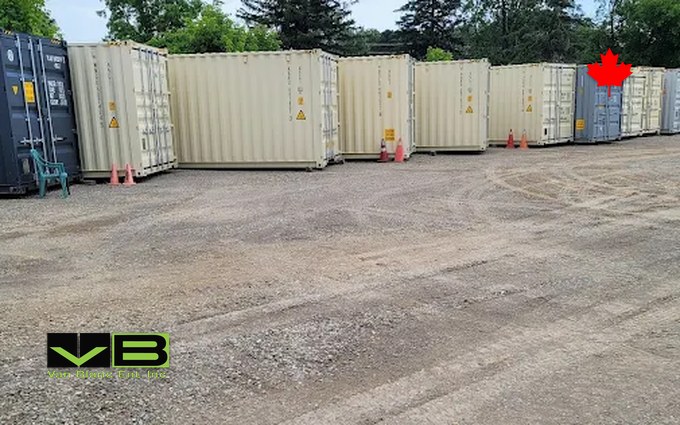
For the container-mounted build, the yard’s answer is a matched pair from our second-hand inventory: two 40-foot units of the same height, wind-and-watertight grade so the top rails and castings are sound, which our grade notes explain and the inspection checklist for rust lets you confirm on the ground. The taller high-cube 40 pair gives a foot more sidewall height and 320 square feet of lockable room per side; a pair of 20-foot dry containers suits a shorter building. For the standalone small building, one used 20-footer, delivered finished, is the shed.
Every container we sell is picked by a person and can be picked by you: drive to 90 Morton Avenue East, walk the rows with Paul or Christian, and choose the pair by their numbers and their top rails before any money moves. Payment is on delivery, after you have seen the boxes on your ground. Delivery is by tilt-deck in one to three days to the full Ontario service map, how the truck sets a pair down is on its own page, and our site-preparation page covers the pad, which for a pair means two level pads on one plane. The quote variables are on their own page. Whether the finished building can sit on a given lot is your municipality’s call, so check with your local building department before you order. Everything is sold outright; Van Blanc keeps no rental fleet and does not lease.
Putting a roof between two boxes? Price the pair once
Tell us the building’s width, the height you need at the sidewall, and your postal code, and we will send an all-in number for a matched pair delivered and placed, usually the same day. If your job is really a slab-and-posts job, we will say so. Or walk the pairs in Brantford and pick the pair yourself.
If you are still deciding what kind of building the job needs, the building-alternatives hub is the wider read, the public works storage guide is the municipal version of the salt-and-sand question, and the supplier reviews hub lists every supplier we have looked at, ourselves included.
Cover-Tech FAQs
Where are Cover-Tech buildings made?
In Woodstock, New Brunswick, at 86 Poplar Street, by Cover-Tech Inc., founded in 2004 by Jason Cox out of a family tarp and fabric building background. The company makes fabric buildings, portable garages, custom tarps and replacement covers, sells through dealers and an online shop, and says its portable garages stand in every province and territory and in 30 American states.
What widths do Cover-Tech fabric buildings come in?
Dome style in 36, 40, 50, 55, 60, 62, 72 and 80 feet; gothic style, with a 12-foot straight wall and a trussed frame, in 62, 72 and 80 feet; straight-wall trussed buildings in 22, 32, 42, 52 and 62 feet; and a 30-foot single-pipe arch, all in any length. Portable garages are a separate vehicle-scale range.
What is the Cover-Tech warranty?
The standard 14-ounce reinforced polyethylene cover carries a prorated UV warranty of 10 to 15 years, per the company; 22, 24 and 28-ounce PVC covers are offered as upgrades for longer service. The frame is 2.375-inch galvanized steel tube with welded cross braces and X-brace purlins. Ask for the frame coating specification and the stamped snow load for your county with any quote.
Can a Cover-Tech building be mounted on shipping containers?
Yes. Cover-Tech publishes sea containers among its base options alongside wood post walls, concrete slabs, cement walls and pipe bases. The build is two containers parked parallel with the arch bearing on their tops, so the boxes become the sidewalls and the lockable rooms; they need to be the same height, level on one plane, anchored, and sound at the top rails and corner castings.
Cover-Tech vs Britespan: what is the difference?
Frame and envelope tier, and geography. Cover-Tech of Woodstock, New Brunswick builds on galvanized tube with X-brace purlins under polyethylene covers warrantied 10 to 15 years prorated, to 80 feet wide. Britespan of Wingham, Ontario builds on hot-dip galvanized steel trusses under HDPE with 20- or 25-year warranties, to 210 feet, with container top sets as a product line. Both publish container foundations.
How does a Cover-Tech building handle Ontario snow?
The frame is designed with welded cross braces and X-brace purlins that the company says spread snow and wind loads across the whole truss, and the arch profiles shed snow. The load that applies to your building is the one on your stamped drawings for your county, and a building that sheds snow needs a plan for the drift along the walls, which on a container-mounted build lands on the container roofs.
Is a shipping container cheaper than a Cover-Tech building?
For a few hundred square feet of secure storage, yes, and it arrives finished. Past about a thousand square feet the comparison stops making sense, because a container is a small steel vault and a fabric building is a wide roof; the build most Ontario yards end up with uses both, two containers as the base and the lockable rooms with the fabric roof spanning the gap.
Sources
- Cover-Tech Inc. (2026). About Us. cover-tech.com
- Cover-Tech Inc. (2026). Fabric Buildings. cover-tech.com
- Cover-Tech Inc. (2026). Portable Garages, Car Shelters. cover-tech.com
- Cover-Tech Inc. (2026). Replacement Fabric Covers for All Brands. cover-tech.com
- Cover-Tech Inc. (2026). Frequently Asked Questions. cover-tech.com
- Britespan Building Systems. (2026). Atlas Series. britespanbuildings.com
- Sprung Structures. (2026). Frequently Asked Questions. sprung.com
Reach Van Blanc in Brantford
We have been supplying shipping containers across Ontario since 1995. Our yard is at 90 Morton Avenue East in Brantford, and we deliver right across the province with payment on the day of delivery. No deposit, no upfront wires, no chase-the-paperwork.
Van Blanc Ent. Inc., 90 Morton Ave E Unit 1B, Brantford, ON N3R 7J7, 519-754-6844 (cell) or 1-888-509-6658 (toll-free).
If the fabric building is settled and the next question is the two boxes it stands on, call with the width and your postal code and we will tell you on the spot which matched pairs are in stock and when they can land. Worth the drive for unbeatable quality, family customer service with 30 years of experience.