
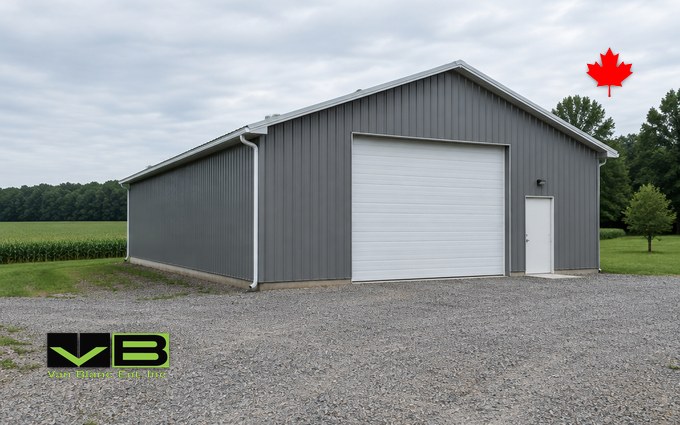
Quick Answer: Norsteel Buildings is a Markham supplier of pre-engineered steel buildings, in business since 2001, selling rigid-frame and C-channel systems and the bolt-together EasyBuild kit for spans of 35 feet and under. It carries an A+ BBB rating with no complaints on file in three years and a 25-year roof-panel warranty.
In This Review
- Read This First: Who Is Writing and Why
- Who Norsteel Is
- The Three Systems, Decoded
- The EasyBuild Kit, Line by Line
- The Warranties and What They Cover
- Norsteel on Quonsets, and What That Tells You
- The Documented Trade-Offs
- Norsteel Against Toro, Pioneer’s Dealers and the Arch Sellers
- What Norsteel Is Built For
- When a Steel Building Is the Wrong Building
- Norsteel FAQs
Reading Time: 13 minutes
Read This First: Who Is Writing and Why
Van Blanc Ent. Inc. is a shipping container yard in Brantford, Ontario. We are not affiliated with Norsteel Buildings, nobody at Norsteel pays us, and the steel boxes we sell compete with the small end of what Norsteel sells. That is the bias, stated once. Every fact about the company below was checked against Norsteel’s own site and its Better Business Bureau profile on the day of writing, the strengths come first because they are real, and the criticisms are documented trade-offs rather than opinions. The container appears near the end, for the buyer whose building is smaller than a steel frame wants to be. This review follows the same bar as the Toro write-up in this series and the rest of the brand reviews.
Who Norsteel Is
Norsteel Buildings is a Canadian supplier of pre-engineered steel buildings with its head office at 1405 Denison Street in Markham, Ontario, a western office in Aldersyde, Alberta, and a Caribbean office in Jamaica. The Better Business Bureau lists the company as in business since March 26, 2001, accredited since November 8, 2019, with an A+ rating and zero complaints on file in the last three years. The company says it has completed more than 4,000 projects and describes itself as one of North America’s top metal builders, citing five consecutive years of recognition from Metal Construction News. In Ontario it names Toronto, Ottawa, Hamilton, Kingston and Thunder Bay as places it has delivered, and says it serves both the southwest and the remote north of the province. It is a supplier rather than a builder in the on-site sense: Norsteel engineers, fabricates and delivers the building, and the customer or the customer’s contractor pours the foundation and erects it, with professional installation offered on the custom lines. A clean BBB record over the three-year window the Bureau reports is a good sign in this industry, and it is the first thing a buyer should know. The second is that Toro Steel Buildings lists the same 1405 Denison Street address as its head office and names Future Buildings as a sister company, so a buyer pricing either one should know the two share an address. The steel building guide’s sorting of the three industries that claim the phrase is the context for everything below.
The Three Systems, Decoded
Norsteel sells three building systems and the difference between them decides both the price and who erects it. The rigid frame is the industrial and commercial product: tapered steel columns and rafters bolted into clear-span frames, engineered for each building, with the widths, eave heights, crane loads, mezzanines, oversized doors, loading docks and future expansions the company lists as options. The C-channel system is the lighter-gauge cold-formed cousin, which the company positions for do-it-yourself assembly and mid-size spans. The EasyBuild kit is the packaged version for buildings 35 feet wide and under, sold as a bolt-together garage, workshop or storage building that a homeowner or a small contractor erects without specialized tools. Anything wider than 35 feet goes to the design team as a custom building. That threshold is the honest sorting line for a buyer: under 35 feet wide you are buying a kit and a weekend or two; over it you are buying an engineered building and a crew. The container-against-kit comparison covers the small end of that line from the other side.
| System | Width | Who erects it | Foundation | Where it fits |
|---|---|---|---|---|
| Rigid frame | Wide clear spans, custom | A contractor with a crane | Engineered slab or piers, designed to the frame’s column loads | Shops, warehouses, arenas, hangars, farm buildings |
| C-channel | Mid-size | Owner or contractor | Slab | Garages and workshops past the kit’s width |
| EasyBuild kit | 35 feet and under | Owner, bolt-together, no special tools | Slab, owner-supplied | Garages, small shops, storage; the size the detached garage guide prices against |
The EasyBuild Kit, Line by Line
The EasyBuild kit is the product most Ontario buyers are pricing when they search the brand, and its spec sheet is worth reading in full. The frame is galvanized steel, bolted together from components the company describes as lightweight, and it says a kit can be off-loaded by hand by five or six people in about two hours, which is the practical test of a kit that does not need a crane. Sidewall panels are 26-gauge steel in 14 colours; roof panels are 26-gauge high-tensile steel with an AZ55 Galvalume coating; trims, base trim and cover materials are 26-gauge in 10 colours. Service doors, gutters and downspouts, interior liner panels and overhangs are listed accessories. Every kit ships with engineered drawings stamped by an engineer, which is the document a municipality and an insurer ask for and the one many cheaper kits do not include. What the kit does not include is the concrete under it: the slab is the buyer’s, poured to the drawings before the steel arrives, and it is the single largest line in an EasyBuild project that Norsteel does not price. The slab-against-piles page explains why an engineered slab costs what it does, and the site-prep hub’s frost notes apply to a steel building’s slab exactly as they apply to a container’s pad.
What 26-gauge means
Steel panel gauge runs backward: a lower number is thicker. Twenty-six gauge is the common residential and light-commercial panel across the Canadian kit market, thinner than the 24-gauge panels some suppliers use on heavier commercial work and thicker than the 29-gauge on the cheapest carports. It is a fair spec for a garage or a shop, it can dent under a hard impact, and it is the reason the roof warranty is written against rust-through perforation rather than against dents. A container’s walls, for comparison, are 1.6 to 2 millimetre Corten, closer to 14 gauge, which the weathering-steel guide explains is why a box takes a forklift bump that a panel would not.
The Warranties and What They Cover
Norsteel’s published warranties are specific, which is a strength. The roof panels carry a 25-year limited warranty against rust-through perforation; the paint carries a 40-year limited warranty; chalking and colour change carry a 30-year limited warranty; and the stainless-steel-capped fasteners carry a lifetime warranty. Read the words carefully, because they mean what they say. Rust-through perforation means a hole, not surface rust or a scratch that discolours. Paint and chalking warranties are the coating manufacturer’s terms passed through, and they are prorated in this industry as a rule. The fastener warranty covers the fastener. None of the four covers the structure’s performance under a load the drawings did not anticipate, damage during erection, or a slab that was not poured to the drawings, which is the same set of exclusions every steel building carries and the reason the stamped drawings matter more than the warranty card. A buyer comparing Norsteel to a competitor should compare the same four lines, term for term, and ask both suppliers for the warranty document rather than the summary. The rust page’s account of what surface rust does and does not mean is the same distinction from the container side.
Norsteel on Quonsets, and What That Tells You
Norsteel publishes a page on quonset and arch-type structures, and it is candid in a way that is useful to a buyer. The company says arch buildings were once the affordable steel option and have become more specialized as building codes and municipal rules tightened, that they now serve a narrower segment of the market, and that cost and aesthetics have sent many customers toward its C-channel and rigid-frame systems instead. That is a straight-wall seller describing the arch, so read it as a position rather than a verdict; the arch sellers make the opposite case, and independent comparisons note that a 32 by 60 arch can go from site prep to an insulated shell in about six weeks where a comparable rigid-frame shop takes months and a crew with lifting equipment. Where the two sides agree is on the insulated building: straight walls take insulation and interior finish far more easily than a curve, which is why a heated shop in Ontario is usually a straight-wall building and a cold hay barn is often an arch. The quonset hut guide is the arch side of that argument, and the container-against-arch comparison is where the small end of both meets a steel box.
Christian LeBlanc, Van Blanc Ent. Inc.: “When somebody has a steel building quote and calls us, the quote is usually right and the building is usually too big for what they own. Norsteel builds a good shop. The question I ask is whether they need a shop or a locked room, and half the time it is the room.”
The Documented Trade-Offs
The trade-offs are the ones the product carries rather than anything about the company, and they are documented on Norsteel’s own pages. The first is the foundation: every Norsteel building sits on concrete the buyer pours to the drawings, and the rigid frame in particular concentrates its loads at the column bases, so the slab or the piers are engineered work rather than a weekend pour. The second is erection: a kit under 35 feet is a bolt-together project for a capable owner, but a rigid-frame building is a crane, a crew and weeks, and the company’s professional installation is an added service rather than the default. The third is the schedule: fabrication, delivery, the slab’s cure and the erection stack up into a season, which is normal for the class and slow next to anything that arrives finished. The fourth is the panel gauge, which is standard for the class and lighter than the heaviest commercial work. The fifth is the one every steel building shares: it is a building that needs a site, a slab and a crew before it is a room, and it does not move afterward. None of these is a fault. They are the shape of the product, and the Metal Pro review’s kit-and-foundation section describes the same shape from a dealer that sells arches.
Norsteel Against Toro, Pioneer’s Dealers and the Arch Sellers
The Ontario steel building market sorts into three groups, and Norsteel sits in the first. Toro Steel Buildings and Norsteel are the two Ontario-based rigid-frame and kit suppliers a buyer most often prices against each other, and the comparison is close: both list the same Markham head office address, both sell engineered straight-wall buildings with stamped drawings, and the differences are in the model lines, the colours, the warranty terms and the quote in your hand. The second group is the arch sellers, Pioneer Steel and the dealers that sell its buildings, SteelMaster, Future Buildings and Olympia, whose product is the quonset and whose pitch is the six-week shell and the do-it-yourself erection. The third group is the fabric and post-frame alternatives, Cover-Tech and Britespan on fabric, the pole barn builders on wood posts, which are priced for a cold building and ask more of the buyer on insulation and envelope life. Between Norsteel and Toro the differences show in the warranty documents and in a quote for the same drawing; between Norsteel and an arch, the deciding question is whether the building will ever be heated. The pole barn guide’s cost-per-foot chapter is the third read for a farm lot.
| Supplier type | Product | Erection | Heated building? | Best fit |
|---|---|---|---|---|
| Norsteel, Toro | Rigid frame, C-channel, bolt-together kits | Owner for kits, crew for frames | Yes, straight walls insulate easily | Shops, garages, commercial |
| Arch sellers and dealers | Quonset arches | Owner, panel by panel | Harder; curved walls | Cold storage, hay, equipment |
| Fabric and post-frame | Fabric on trusses; wood posts with steel skin | Crew | Fabric with an insulation package; post-frame yes | Farm lots, riding arenas, cheap covered floor |
| Container yard | Steel boxes, 8 by 20 or 8 by 40, roofed pairs | Delivered finished; a tilt-deck sets it in an afternoon | Yes, lined | Locked rooms, small shops, storage; not a wide span |
What Norsteel Is Built For
Norsteel’s straight-wall buildings are made for a slab poured to the drawings, from an Ontario supplier with a clean record and specific warranties. The EasyBuild kit covers buildings 35 feet wide or under that five friends can put up over a weekend; the custom rigid frame covers a span, a crane, a mezzanine or a door a kit cannot carry, with a crew in the budget. The Toro review reads its Markham neighbour on the same warranty lines. Any steel building in this class is a season of slab, delivery and erection before it is a room, and for a building that would fit in a box, the next section is the faster road.
Need the room, not the span?
If the steel building quote is for a locked, dry room that would fit in 8 by 40, tell us what goes inside and where it would sit. We will tell you the size and the grade, and one honest all-in number with a real lead time, with no slab to pour.
Family-run in Brantford since 1995 · 200+ containers in stock · 4.9★ across 140+ Google reviews · every box graded by a person, walk it before it lands.
When a Steel Building Is the Wrong Building
A steel building is the wrong building when the thing you need is a locked room rather than a span. A contractor’s tool and parts store, a farm’s chemical and seed lockup, a business’s overflow stock, a cottage’s equipment room and a hobbyist’s motorcycle bay are 8-by-20 and 8-by-40 problems, and a 30-by-40 kit on an engineered slab is a season and a concrete truck spent on space that will hold a lawn mower and a bench. A forty-foot high cube on corner blocks is a 320-square-foot steel room with an extra foot of headroom that arrives in one to three days from our four Brantford yards, sits on a drained stone pad with no slab, locks behind cam doors and a shrouded padlock, and leaves on the same truck if the business moves. Two of them set parallel with a roof kit spanning the gap make a covered bay between two locked rooms, which is the closest a container yard gets to a steel building and the honest limit of the comparison: it is a building for equipment and storage, not a clear-span shop with a crane. The container workshop guide is where the small-shop buyer should read next, because a lined and wired forty-footer is a 320-square-foot working shop.
Grade is the decision a steel building buyer never faces. The grade ladder, from one-trip to as-is runs from new steel to a donor shell, and a locked storage room wants wind-and-watertight or cargo-worthy while a lined shop wants one-trip. What moves the number is size, grade, any cut-ins and the distance from Brantford, and the pricing hub’s quote drivers are the same on every quote we write. We sell outright, never rent; a buyer who wants to spread the cost does it through their own bank with the invoice and the serial number we supply. The forty-footers in the Brantford rows can be walked with Paul or Christian, and the ten-minute inspection before paying is the whole due diligence a box needs.
Markham to Brantford
Norsteel’s head office is in Markham, and most of the steel-building quotes that reach us come from the same commuter belt: the Toronto contractors pricing a shop, the Hamilton trades pricing a store, and the farm lots south of the 401 pricing a lockup. All of them are within an hour and a half of the yard on Morton Avenue East in Brantford, and a buyer with a steel quote in one hand usually leaves with a clearer idea of which half of the building was the room. Worth the drive for unbeatable quality, family customer service with 30 years of experience.
Frequently Asked Questions
Is Norsteel Buildings a reputable company?
By the public record, yes. The Better Business Bureau lists Norsteel Buildings of Markham as in business since 2001, accredited since 2019, rated A+ with zero complaints on file in the last three years. The company reports more than 4,000 completed projects and five years of recognition from Metal Construction News. Ask for the stamped drawings and the warranty documents, as with any supplier.
What does Norsteel sell?
Pre-engineered straight-wall steel buildings in three systems: custom rigid-frame buildings for wide spans, cranes and mezzanines; a lighter C-channel system for mid-size spans; and the EasyBuild bolt-together kit for garages, shops and storage buildings 35 feet wide and under. Every building comes with engineer-stamped drawings; the foundation is the buyer’s.
What is the Norsteel warranty?
A 25-year limited warranty against rust-through perforation on the AZ55 Galvalume roof panels, a 40-year limited paint warranty, a 30-year limited warranty against chalking and colour change, and a lifetime warranty on the stainless-steel-capped fasteners. Perforation means a hole, not surface rust; coating warranties are prorated across the industry; read the full document, not the summary.
Can I build a Norsteel EasyBuild kit myself?
That is what it is designed for: lightweight bolt-together components, no specialized tools, and a kit the company says five or six people can off-load by hand in about two hours. You supply the slab, poured to the drawings, and the labour. Buildings wider than 35 feet are custom rigid-frame work and want a crew with lifting equipment.
Is a Norsteel building better than a quonset hut?
Different, rather than better. A straight-wall Norsteel building insulates and finishes easily and suits a heated shop; an arch goes up faster by hand and suits cold storage and hay. Norsteel’s own page says arch buildings now serve a narrower market; arch sellers dispute that. Decide whether the building will be heated first, then compare quotes for that building.
When is a shipping container better than a Norsteel building?
When the job is a locked, dry room rather than a span: a tool and parts store, a seed lockup, overflow stock, a motorcycle bay. A container on your own lot arrives finished in one to three days on a gravel pad with no slab and moves when you do. For a clear-span shop, a crane or a mezzanine, a steel building is designed for the span.
Sources
- Norsteel Buildings. (2026). Pre-Engineered Steel Buildings Canada. norsteelbuildings.com
- Norsteel Buildings. (2026). Ontario Steel Buildings. norsteelbuildings.com
- Norsteel Buildings. (2026). Metal Building Kits: Design and Options. norsteelbuildings.com
- Norsteel Buildings. (2026). Quonset Hut and Arch-Type Structures. norsteelbuildings.com
- Better Business Bureau. (2026). Norsteel Buildings, Markham, Ontario: Business Profile. bbb.org
- Quonset Canada. (2026). Quonset Buildings vs Steel Frame Buildings. quonset.ca
Reach Van Blanc in Brantford
We have been supplying shipping containers across Ontario since 1995. Our yard is at 90 Morton Avenue East in Brantford, and we deliver right across the province with payment on the day of delivery. No deposit, no upfront wires, no chase-the-paperwork.
Van Blanc Ent. Inc., 90 Morton Ave E Unit 1B, Brantford, ON N3R 7J7, 519-754-6844 (cell) or 1-888-509-6658 (toll-free).
If the building was always a locked room, call with what goes inside and your postal code, and we will tell you on the spot which boxes are on the ground and when one can land. Worth the drive for unbeatable quality, family customer service with 30 years of experience.