
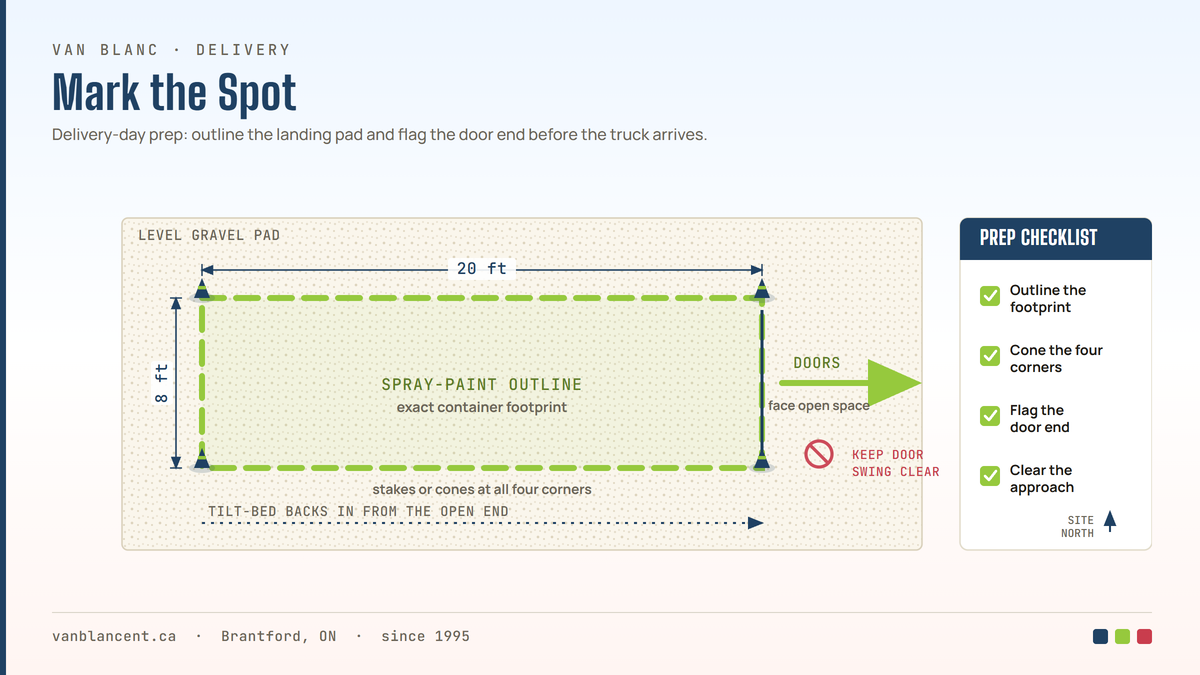
Quick Answer: To mark where you want your shipping container placed, drive stakes at the four corners of the footprint, spray-paint the outline, and set a cone or flag at the door end. A 20ft box covers about 20 by 8 feet. Keep the path and pull-out lane clear, then confirm the spot on a quick pre-delivery call.
In This Guide
Reading Time: 8 minutes
Why Does Marking the Spot Matter?
Marking where you want your shipping container placed means putting a visible target on the ground so the driver lands the box where you want it on the first try. A tilt-deck driver runs the controls from the truck and watches the container slide off the back as the trailer pulls forward. They cannot get out, eyeball your yard, and nudge a 2,300 kg steel box around by hand. The mark is how the plan in your head becomes the spot on the ground.
A container placement mark is the painted rectangle, corner stakes, and door-end cone that tell a tilt-deck driver exactly where the box should land and which way it should face. It replaces guesswork from the cab. With the spot marked, the driver settles the container on your lines in minutes, and you avoid a costly crane return trip to move it later.
Get the mark right and a Van Blanc delivery takes a few minutes: the truck backs in, the bed tilts, the container settles onto your stakes, the trailer pulls clear. Skip the mark and the driver places it wherever the truck happens to stop, which is rarely where you pictured it. Moving a landed container after the fact means a return trip with a crane, and that is the avoidable cost a few dollars of spray paint prevents.
Paul LeBlanc on the Marks That Save a Trip
“After 19 years in containers, I can tell you the delivery that goes wrong is almost never the truck. It is the spot,” says Paul LeBlanc, who founded Van Blanc in Brantford in 1995. “A customer who walks out and paints a rectangle with a cone on the door end has done ninety percent of my driver’s job for him. Five minutes of paint on a Saturday saves a crane on a Tuesday.” When you order a unit from our in-stock yard inventory, that delivery prep is the difference between a clean drop and a second visit.
How a Tilt-Deck Delivery Actually Lands the Box
A tilt-deck (also called a roll-off or tilt-bed trailer) is the standard way Van Blanc delivers across Ontario. The driver backs the trailer toward your marked spot, raises the front of the bed, and the container slides off the rear as the truck creeps forward. The box lands at ground level, so no crane is needed when the site has room. The container sets down roughly along the line the truck drove in on, which is why the direction you point the truck, and your door-end mark, decide whether the doors end up opening toward your yard or a fence.
What Should You Mark With: Stakes, Paint, or Cones?
The tools you mark a container spot with are stakes, spray paint, and cones, and you do not need anything fancy. The goal is a target the driver can read from the cab, in the weather you have on delivery day. Three simple tools cover almost every site.

- Wooden or metal stakes: Drive one at each of the four corners of the footprint. Stakes hold up on grass, gravel, and dirt and survive wind better than tape. Tie a strip of bright flagging tape to each so they read from a distance.
- Spray paint: Marking or inverted-tip line paint outlines the full footprint on grass, gravel, or a dirt pad. A painted rectangle is the clearest possible target. On a finished driveway, use cones instead so you are not painting your asphalt.
- Cones or flags: Set one cone at the door end of the footprint and another to mark anything the driver must avoid. Cones double as your no-go markers for a septic lid, a well head, or a soft patch.
A roll of bright flagging tape ties it all together. If you only have one tool, a can of spray paint plus a single cone at the door end will do the job on most rural and gravel sites.
How Do You Mark the Footprint and the Door End?
Marking the footprint means outlining the exact rectangle the container will occupy and showing which way it faces. A standard 20ft container sits on a footprint of about 20 feet by 8 feet (6.06 m by 2.44 m); a 40ft box runs about 40 feet by 8 feet. Measure that rectangle, square the corners, and mark them. Here is the order that works.
- Measure and stake the four corners. Lay out the real footprint for your size. Drive a stake at each corner so the box has a defined box to land inside.
- Paint the outline. Connect the corners with spray paint so the driver sees a full rectangle, not four dots.
- Mark the door end. The cargo doors are on one end. Set a cone there and tell the driver which end it is. This is the single most-missed mark, and it is the one that decides whether your doors open toward the yard or toward a fence.
- Leave room for the doors to swing. The cargo doors swing out almost flat, so keep roughly 6 feet of clear space past the door end. Doors facing a wall are doors you cannot use.
- Flag the no-go zones. Cone or paint anything the box and truck must miss: septic beds and lids, well heads, underground hydro or gas lines, soft ground, and low branches.
The Door-End Mark Is the One People Forget
Buyers spend time on the footprint and then forget to say which end the doors are on. A container is easy to set down backwards. Decide how you will use the box first: doors toward the driveway for loading, toward the yard for a workshop, away from the prevailing wind for storage. If you plan to add a man door, window, or roll-up later, our yard conversion work is easier to scope once the box faces the right way. Then mark that end clearly and say it out loud to the driver. It costs nothing and saves a crane trip.
How Much Room Does the Truck Need to Pull Out?
The room a tilt-deck delivery needs is a clean run in, a straight lane to slide the container off, and an exit. The driver needs more than the footprint. They need the manoeuvring space a loaded truck and trailer actually use. Walk the route the truck will take and remove anything in the way: parked vehicles, trailers, garbage bins, low branches, and loose debris that could puncture a tire.
The numbers that matter most are the straight pull-out lane and the overhead room. A tilt-deck slides the box off the back, so it needs a straight run behind the drop point: roughly 75 to 100 feet for a 20ft container and about 120 to 130 feet for a 40ft container, measured from the front of where the box will land. Plan for about 12 feet of width for the truck to turn, and keep the air above the spot clear, around 14 feet for a standard container and 16 feet for a high-cube during the tilt-off, so the raised bed misses power lines and branches.
| What to clear | Rough room to plan for | Why it matters |
|---|---|---|
| Straight pull-out lane (20ft) | About 75 to 100 ft | The trailer slides forward out from under the box |
| Straight pull-out lane (40ft) | About 120 to 130 ft | A longer box needs a longer slide-off run |
| Width for the truck | About 12 ft | Room to line up and turn the combination |
| Overhead clearance | 14 ft standard, 16 ft high-cube | The bed lifts high during tilt-off, clear of lines and branches |
| Door-swing space | About 6 ft past the door end | The cargo doors open out nearly flat |
These figures are guides, not hard promises. Every site is different, and the honest move is to describe yours to us before delivery day. If your lot is tight, a narrow lane or a backyard with no straight run, that is exactly the kind of thing a quick call sorts out. We have walked through the exact measurements in our breakdown of the access a drop-off needs.
Does the Ground Need to Hold a Loaded Truck?
Yes, the ground needs to be firm and level, and this is the part of marking that buyers underestimate. The mark tells the driver where the box goes; the ground decides whether the truck can get there. A loaded delivery truck weighs tens of thousands of pounds, and a tilt-deck puts a lot of that weight on the rear axle right at the drop point. Soft, wet, or freshly filled ground is where trucks get stuck, and a stuck truck is a worse delivery day than a missed mark.
Aim for ground that is firm, dry, and reasonably level: packed gravel, compacted dirt, asphalt, or concrete. After a heavy rain or a spring thaw, your driveway might hold while the lawn behind it will not. If the only good spot is across soft ground, mark it anyway and flag the soft section so the driver can decide the approach. For the longer story on lawns, fields, and mud, our note on whether a container can be set down on a lawn or a wet field walks through it.
The Farm-Gate Delivery
A working farm near Brantford wants a Wind and Water Tight 20ft sea can set as a feed and tool store along a fence line in the back field. The owner stakes the 20 by 8 foot footprint, paints the rectangle, and cones the door end toward the laneway so the doors open onto firm gravel rather than the muddy field. They flag a soft low spot the truck would otherwise cut across. The driver backs down the laneway, follows the straight run, and the box lands square on the stakes with the doors exactly where the loader needs them. Five minutes, no second guessing, no crane.
Who Should Be on Site, and Do You Need a Pre-Delivery Call?
Someone who knows the plan should be on site when the truck arrives, and a pre-delivery call is the cheapest insurance for the whole drop. That on-site person can be you or anyone you trust to confirm the spot, point out the door end, and answer a question. Keep a phone reachable before and during delivery in case the driver needs to check the route in. The marks do most of the talking, but a person on site closes any gap the paint cannot.

The real shortcut is the pre-delivery call. Describe your site to us before the truck rolls: the surface, the straight run you have, any tight turn, where the doors should face, and any obstacle you are worried about. We have been threading containers onto Ontario properties since 1995, and most of the trouble we see was foreseeable on a two-minute call. Mark the spot, then call and walk us through it. That pairing, a clear mark plus a quick conversation, is what gets the box exactly where you want it.
Christian LeBlanc, Van Blanc: “The best deliveries are the boring ones. The customer painted a rectangle, put a cone on the door end, and the driver just dropped it on the lines. When it goes sideways, it is almost always the spot nobody marked or the soft ground nobody mentioned. Mark it, call us, tell us about the mud. That is the whole trick.”
Ready to Book Your Delivery?
Mark your spot, then tell us about your site. Describe the surface, the room you have, and which way the doors should face, and we will tell you on the spot whether a tilt-deck drop works or whether we bring a crane. The fastest answer is a call.
Every quote comes with a real lead time, not a hopeful one, and we deliver in 1 to 3 days to most regions across Ontario from our Brantford yard. If you want the full picture of how a delivery runs from order to drop-off, our step-by-step look at order day through drop-off day ties the whole process together.
Frequently Asked Questions
How do I mark where I want my shipping container placed?
Drive a stake at each of the four corners of the footprint, then spray-paint the outline so the driver sees a full rectangle. A 20ft container needs about 20 by 8 feet. Set a cone at the door end and flag any no-go zones like a septic lid or soft ground. Confirm the marks on a quick call before delivery.
How much space does a tilt-deck delivery need?
A tilt-deck slides the container off the back, so it needs a straight pull-out lane: roughly 75 to 100 feet for a 20ft container and about 120 to 130 feet for a 40ft. Plan for around 12 feet of width to manoeuvre and 14 to 16 feet of overhead clearance during the tilt-off. Tight sites are common, so describe yours when you call.
Which way should the container doors face?
The cargo doors are on one end and swing out nearly flat, so leave about 6 feet of clear space past the door end. Point the doors toward how you will use the box: the driveway for loading, the yard for a workshop, or away from prevailing wind for storage. Mark the door end with a cone and tell the driver, because a container is easy to set down backwards.
Does the ground need to be firm for delivery?
Yes. A loaded delivery truck weighs tens of thousands of pounds and can sink or get stuck in soft, wet, or freshly filled ground. Aim for firm, dry, reasonably level ground such as packed gravel, compacted dirt, asphalt, or concrete. If the only good spot sits past soft ground, mark it and flag the soft section so the driver can plan the approach.
Do I need a crane to place a shipping container?
Usually no. On a tilt-deck delivery the container lands at ground level on its own as the trailer pulls forward, so no crane is needed when the site has the straight run and firm ground to allow it. A crane or HIAB comes into play only when access is too tight for a tilt-off, for example a confined backyard or placing a box over an obstacle. A quick call settles which your site needs.
Do I need to be on site when the container is delivered?
You or someone who knows the plan should be on site to confirm the spot, point out the door end, and answer any question the driver has. Keep a phone reachable before and during delivery. Good marks do most of the work, but a person on site closes any gap, and a pre-delivery call to walk us through your site prevents most surprises.
Sources
- International Organization for Standardization. (2022). ISO 6346:2022 Freight containers: Coding, identification and marking. iso.org
- Transport Canada. (2025). Cargo Securement Standard 10: Containerized cargo. tc.canada.ca
- Tradecorp. (2024). How Much Room Does a Shipping Container Truck Need at My Site? tradecorp-usa.com
- Boxhub. (2024). Shipping Container Placement: Where to Put Your Shipping Container. boxhub.com
Reach Van Blanc in Brantford
We have been supplying shipping containers across Ontario since 1995. Our warehouse is at 90 Morton Avenue E in Brantford, and we deliver right across the province on a cash-on-delivery basis. No surprise fees, no chase-the-paperwork.
Van Blanc Ent. Inc., 90 Morton Ave E Unit 1B, Brantford, ON N3R 7J7, +1 888-509-6658
Mark your spot, then call the Brantford yard and tell us about your site. We will tell you whether a tilt-deck drop lands it clean or whether we bring a crane.