
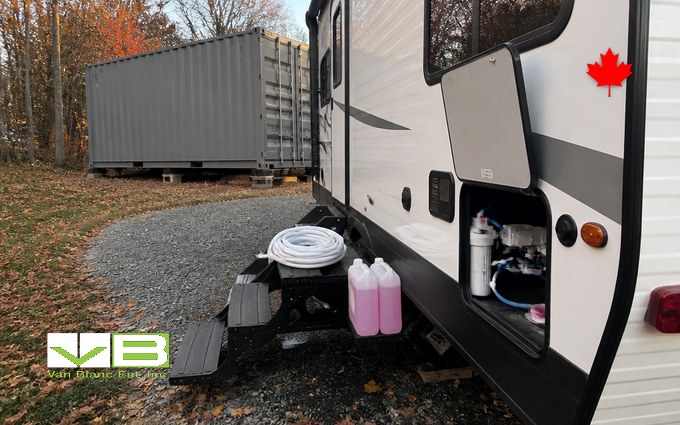
Quick Answer: To winterize an RV or camper, empty the holding tanks and drain the lines and water heater. Bypass the heater, then pump pink RV antifreeze to every tap, drain and toilet. Pull the batteries, food and bedding. Finish before the first night below 0°C (32°F). Gear can winter in steel.
The Camper Winterizing Order, Fall to Spring
- How to winterize an RV in Ontario
- Antifreeze or compressed air
- RV winterizing supplies
- Holding tanks and the water heater
- Clearing lines and low-point drains
- RV antifreeze through every fixture
- RV batteries over winter
- Propane cylinders stay outdoors
- Tires, mice and moisture
- Everything that comes out of the camper
- A 20ft gear room beside the camper pad
- Insulated or bare steel for camper gear
- Small campers that fit a high cube
- Dewinterize the RV in spring
- Camper winterizing checklist
- Ordering the camper gear box
- Frequently asked questions
Reading Time: 22 minutes
How to Winterize an RV in Ontario
Winterizing an RV means draining every line that could freeze and protecting what is left with non-toxic antifreeze. It also means shutting down the systems a long cold season can damage. KOA puts the line at the freezing point, 0°C (32°F). Below it, water left in a camper’s lines and traps expands as it freezes. The split fitting shows up in May as a puddle under the sink. Lines can freeze in one night, so the job happens after the last trip and before the first frost warning. Every camper with a water system needs it, from a travel trailer or fifth wheel to a tent trailer with a sink. Where the camper itself parks, from the driveway to an indoor bay, is weighed in our comparison of the four places a camper can winter.
In Ontario the camping calendar sets the date. The Grand River Conservation Authority books sites at its eight campgrounds from May 1 to October 15, with Laurel Creek, Guelph Lake and Elora Gorge among them. Sibbald Point Provincial Park on Lake Simcoe runs its 2026 camping season to October 26. For a trailer that camps around Waterloo Region, Guelph or Lake Simcoe, the winterizing weekend follows the last trip home in mid to late October.
Van Blanc sells shipping containers from 4 Brantford yards, and this guide has two halves. The first is the winterizing routine, built from owner guides by Grand Design, Winnebago, Keystone and Jayco. The second covers what those guides skip. That is where the mattress, the dishes, the hoses and the batteries spend the winter once they come out. It also covers when a small camper fits inside a high cube container itself. Inside measurements for each container length are the starting point for both.
Paul LeBlanc, Van Blanc Ent. Inc.: “A steel box sits at the same temperature as the yard around it, so it never replaces the antifreeze. Winterize the camper first. What the box does is give the bedding, the dishes and the hoses a dry, locked room for the winter, ten steps from the camper instead of down the basement stairs.”
Antifreeze or Compressed Air
Antifreeze and compressed air are the two ways to winterize a camper’s water lines, and most owner guides use one or both. The antifreeze method pumps pink, non-toxic RV antifreeze through every line until it reaches each tap. Any water left in a low spot is then mixed with something that will not burst the pipe. The air method fits a blow-out plug to the city-water inlet. Compressed air then pushes through each line until only air comes out of the tap. Winnebago’s guide is blunt about the pressure: don’t go over 30 PSI or you could damage the plumbing.
Either kit ends up on shelving bolted along a container wall once the job is done. Whichever method clears the lines, the drain traps and the toilet still get antifreeze, because a trap is built to hold water.
| Method | What goes through the lines | What it does well | Watch for | Spring work |
|---|---|---|---|---|
| RV antifreeze | Pink, non-toxic RV antifreeze, pulled from the jug by the water pump | Protects water left in low spots and in sags that air cannot fully clear | Never automotive antifreeze; bypass the water heater | Flush every tap until no pink shows, then sanitize |
| Compressed air | Air through a blow-out plug at the city-water inlet | Drinking lines stay free of antifreeze, so the spring flush is lighter | Stay under the maker’s pressure cap; run each tap hot and cold until only air comes out | A lighter flush |
| Both | Air first, then antifreeze in the traps and toilet | Dry lines plus protected traps and seals | Close the low-point drains before the antifreeze goes in | Flush the traps and sanitize |
RV Winterizing Supplies
Most RV winterizing supplies are bought once and kept with the rest of the off-season gear. RV antifreeze comes in 3.78 L jugs, one US gallon each. Recochem, a Montreal company, rates its Econo plumbing antifreeze down to -50°C when used undiluted. Its mix of propylene glycol, alcohols and water is non-toxic. Undiluted is the word that matters. Water left in the lines thins the antifreeze and lowers its protection, which is why draining comes first. Winnebago adds a firm warning: never use automotive antifreeze in a camper, because it is highly toxic. Keep the kit in one labelled tote so next October starts from one shelf. In a Van Blanc gear room, a wire-deck shelf at eye level is a good spot for that tote.
- RV antifreeze: at least two jugs, more for a bigger rig (quantities below)
- A water heater bypass kit, if the camper was not built with bypass valves
- A water pump converter kit or siphon hose, to pull antifreeze straight from the jug
- For the air method, a compressor with a regulator and a blow-out plug for the city-water inlet
- A socket for the water heater drain plug or anode rod, a bucket, towels and a flashlight
- Steel wool, mesh screen and white tire covers for the storage half of the job, plus a vent and a lockbox for the gear room
- The owner’s manual, because valve locations change from one floor plan to the next
Holding Tanks and the Water Heater
Jayco gives the order for the holding tanks: black tank, then grey, then fresh water. Grand Design’s six steps also start with empty black and grey tanks. Dump at a sani-dump or your own cleanout, and rinse the black tank with a wand if you have one. KOA’s checklist adds lubricating the termination valves so they open again in May. Flush and cap the sewer hose, then hang it with the fittings on a wall-mounted rack inside a steel box. When the fresh tank drains, Winnebago suggests opening all the low-point drains at the same time.
The water heater holds the biggest volume of water in the camper. Winnebago suggests turning it off the night before, so it is cool when you drain it. Shut off the power and the gas, then open the pressure relief valve to let the pressure out. Pull the drain plug or the anode rod and let the tank empty. KOA’s advice is to replace an anode rod that shows scaling or corrosion while it is out. Then set the bypass valves, or fit a bypass kit, so the antifreeze goes around the tank, which KOA’s guide says does not need any. Grand Design calls the bypass optional, but without it the tank wastes at least six gallons (about 23 litres) of antifreeze. Keystone points owners of tankless water heaters to the manufacturer’s manual. Pool owners close up the same way in November, and closing a container pool before the frost also ends with blown-out lines and pool-grade antifreeze in the returns.
Clearing Lines and Low-Point Drains
Draining the lines takes patience. Grand Design says to set a bucket or bowl under each faucet and run every sink and shower until the flow stops. That can take about fifteen minutes. The low-point drains, the valves or caps at the lowest points of the plumbing, stay open while the lines empty. Once nothing more comes out, close every faucet and close the low-point drains before any antifreeze goes in. That order settles a common question: faucets are open while the water drains and closed before the antifreeze is pumped.
With air, the blow-out plug goes on the city-water inlet and the compressor stays under Winnebago’s cap. One person inside opens each tap in turn, hot and then cold, until only air comes out. Do the toilet valve, the outdoor shower and the water filter housings too. Water left in a cold part finds the coldest night of the year, the same way moisture finds the coldest steel in a closed box.
The Water Filter Nobody Remembers
Inline water filters come out before the antifreeze goes in; KOA lists it as the second step. Winnebago’s guide says to remove a whole-house filter canister and its cartridge, then screw the empty canister back on. Bag and label the cartridges and keep them with the bypass kit in a mini container beside the camper pad.
RV Antifreeze Through Every Fixture
RV antifreeze goes in through the water pump. Fit the pump converter kit, put the siphon tube into one gallon of pink RV antifreeze, and switch on the pump. Open each fixture one at a time, cold side first, then hot. Close it when pink comes out steadily. Work through the kitchen, the bathroom sink, the shower, any second bathroom, the toilet and the outdoor shower. Grand Design’s last step is outside at the city-water inlet: push the valve until antifreeze shows. Open a second jug before the first runs dry, so the pump never pulls air.
How much antifreeze a camper takes depends on its plumbing. Winnebago’s guide calls for two gallons and says some RVs need more. Keystone’s step-by-step lists 4 to 6 gallons (about 15 to 23 litres). A small trailer with a bypassed heater sits near the low end. More fixtures, a second bathroom or a washer hookup push it higher. Buy the larger number. A leftover jug keeps until next fall, and spare jugs winter fine in a ten-footer parked by the hitch.
Traps, Toilet and the Odd Fixtures
Traps and the toilet get antifreeze poured in by hand. Grand Design suggests about one cup (about 240 mL) down each drain and into the toilet. Keystone goes further, with about one quart (about a litre) into each drain, P-trap and the toilet. Keystone also says to leave a little in the toilet bowl to keep the seals covered. The refrigerator’s ice maker line is drained rather than filled with antifreeze. Winnebago’s method is to unscrew the supply line at the exterior refrigerator access panel and raise the shut-off arm. A built-in washer follows its own manual. Wipe up any splashes, since KOA notes that antifreeze left on surfaces can stain.
RV Batteries Over Winter
RV batteries lose the winter to two things: a slow drain and the cold. A dry spot off the camper, such as an insulated container on the same lot, is half the answer, with one condition that depends on the battery. Jayco’s advice is to disconnect the negative cable so nothing in the camper keeps drawing power. For storage of several months, KOA suggests taking the battery out, keeping it somewhere warm and dry, and setting it on cardboard or a mat in case it leaks. Chemistry decides how much the cold matters, and the makers’ figures are in the table. For flooded lead-acid, U.S. Battery Manufacturing’s numbers show that a full charge is the protection. A flat battery in a cold shed is the one that cracks its case.
Lithium works the other way round. Cold storage is fine within Battle Born’s range, but the battery refuses a charge in the cold. A charger in an unheated box does nothing for a lithium bank on a January night. Charge it full in the fall and disconnect it. A heated corner of a foam-lined container with power run to it keeps a lithium bank above the maker’s line. Your own licensed electrician wires the power.
| Battery | What the maker says about cold | Before storage | Where it winters |
|---|---|---|---|
| Flooded lead-acid, fully charged | Freezes below -62°C (-80°F) | Charge it full and disconnect the negative cable | Out of the camper, on cardboard or a mat, somewhere warm and dry (KOA) |
| Flooded lead-acid, discharged | Freezes at -6.7°C (20°F) or higher | Do not store it flat | Charge it first, wherever it goes |
| Lithium (LiFePO4), Battle Born | Storage range -15°F to 140°F (-26°C to 60°C); no charging below an internal 24°F (-4°C) | Charge it full and disconnect at the switch or the positive main cable | Somewhere warmer, such as a heated, insulated box, if the spot can drop below -10°F (-23°C) |
A motorhome adds a chassis battery and an engine. Winnebago’s 2021 guide suggests a solar or trickle charger for the house batteries. Start the motorhome monthly to charge the chassis battery, and add fuel stabilizer if it will not be driven. Run the generator for half an hour each month.
Propane Cylinders Stay Outdoors
Propane cylinders have storage rules of their own, published by Ontario’s fuel safety regulator. Close the propane valve on the camper first, as Grand Design’s extra-mile list says. The hoses, the regulators and the barbecue grill can winter in the gear room, behind a welded steel hood over the padlock. The cylinders cannot. The Technical Standards and Safety Authority (TSSA) is plain: never store propane cylinders indoors or in a garage. Stand them upright and protect them against tampering, impact and falls. Keep them at least one metre (three feet) from any building opening, sidewalk or air intake. The TSSA suggests a locked cage or a fenced-in area. A closed steel box is indoors, so the cylinders stand outside it, upright in a locked cage or fenced area, at least a metre from its doors. The cage gets a padlock that matches the gear room’s.
Tires, Mice and Moisture
Slow damage is easy to put off, and the storage half of winterizing is all slow damage. Winnebago’s guide asks for a hard, level concrete pad with all four wheels blocked, front and back. Take some of the weight off the tires with leveling jacks or heavy-duty jacks, with the tires still touching the ground. Winnebago is firm that stabilizing jacks are not built for this. With no jacks, Winnebago’s fallback is to let the rig creep about 3 feet (0.9 m) two or three times over the winter, always in the same direction. That moves the load to a new patch of tire. White RV tire covers guard against cracking and dry rot. A cover over the whole camper should be breathable, since a tarp pulled tight traps moisture. Clear snow off the roof as it builds. The box beside the camper wants a base that drains too, and a gravel pad that drains and does not settle is the usual one.
Mice want food, nesting material and a way in. Winnebago’s list starts with the food: every bit of it comes out, with laundry and any cloth that held food. Wipe and vacuum, thaw the freezer, and block its doors open. Put a fresh, open box of baking soda wherever food was stored. Block the exhaust pipe with steel wool, screen the vents and fix failed caulking. KOA adds anti-rodent spray foam in crevices and shavings of perfumed soap near crevices and in cupboards, plus ant and roach traps. Leave cupboards open and the fridge propped so air moves through. A camper with nothing to eat and nowhere soft to nest is a dull place for a mouse. Moisture plays by the same rules inside a steel box. Passive vents set against powered fans covers how a container keeps its air moving through the cold months.
Everything That Comes Out of the Camper
Everything that comes out of the camper in October needs a place to go, and the list runs longer than most owners expect. Soft and edible things leave for the mice’s sake. Batteries come out because of the cold. The loose gear goes because it has no reason to sit in a parked rig until May. Add the winterizing kit, and a family trailer empties into a small room’s worth of totes. A garage holds it until the car needs the garage. A basement holds it until the stairs disappear. A rented storage unit is a monthly fee and a drive each way whenever something is needed. On the same lot as the camper, a steel box keeps it all in one place. Staking out where that box will sit is the first job.
- Bedding, pillows, towels, cushions, curtains that come off, and clothes left in drawers
- Food, spices, paper products, dish soap and anything a mouse can chew open
- Dishes, pots, the coffee maker and small appliances
- House batteries (warm storage if lithium), the charger and the tender leads
- Hoses, the sewer hose, fittings, the water pressure regulator and the filter cartridges
- Levelling blocks, wheel chocks, the sway bar or weight-distribution hitch and the spare hitch pin
- The outdoor mat, camp chairs, the portable barbecue (its propane cylinder stays outside) and the awning accessories
- Bikes, kayaks and paddles
- Spare antifreeze, the bypass kit, the tire covers and the camper cover when it is off
A 20ft Gear Room Beside the Camper Pad
A 20ft gear room beside the camper pad is a shipping container bought once to hold that whole list every winter. Between trips it holds the camping gear, so packing happens beside the camper instead of across the house. Inside, Van Blanc’s 20 ft standard box is 19 ft 4 in long, 7 ft 8 in wide and 7 ft 10 in high. That is 33.2 m³ of space. As a sizing rule of thumb, a family travel trailer’s October list goes on shelving down both walls. That leaves floor for the bikes, the kayaks, the mower and the snowblower. A smaller camper or a tighter lot suits a smaller box. Van Blanc sells every size in the table, each with steel walls and doors that lock. The measurements come from Van Blanc’s own product pages.
| Box | Inside size or volume | Doors in recent stock | What it suits for a camper household (sizing guidance) |
|---|---|---|---|
| 20 ft, the gear-room size | 19 ft 4 in long, 7 ft 8 in wide, 7 ft 10 in high; 33.2 m³ | Cargo doors; a side roll-up fitted on request | A family trailer’s full contents plus the bikes, kayaks, mower and snowblower |
| the twelve-footer | 96 sq ft footprint | Cargo doors, lockbox | A family trailer’s contents, with a 10 ft kayak lying flat |
| 10 ft, true or cut-down | About 16 m³ (560 ft³) on an 8 ft x 10 ft footprint, half a parking stall | Cargo doors, oversized man door, or a roll-up | A smaller trailer’s contents plus the bikes |
| 9 ft new container | 13 cu m (460 cu ft) on the door markings | Cargo doors, man door and window | A small travel trailer’s bedding, dishes, hoses and chairs on shelving |
| 8 ft new container | 7 ft 6 in long, 6 ft 11 in wide; about 9.8 cu m (346 cu ft) | Cargo doors, man door, barred window | A tent trailer’s or teardrop’s contents, the winterizing kit and the batteries |
| Minis | From 5 ft 7 in long | Cargo doors, man doors, windows or roll-ups | Batteries, the propane hardware (never the cylinders) and the winterizing kit |
| 40 ft or 45 ft high cube | 39 ft 5 in or 44 ft 6 in long, 8 ft 10 in high | Cargo doors, 7 ft 8 in by 8 ft 5 in | A small camper itself with all its gear (next sections) |
A household needs one box, and the size follows the camper. A seasonal campground or an RV storage yard that winters gear for its customers lines several up. The gear rows a storage yard sets up for its customers are covered in the storage guide.
The door is the next choice. Cargo doors open the full end of the box, which suits bulky things like a camp kitchen or a stack of chairs. A side-wall roll-up door, 8 ft or 10 ft wide, can face the camper pad directly. Then the May reload is a few steps across the gravel. Van Blanc frames a roll-up into the side wall before delivery. A side roll-up compared with swing doors sets out how each one works day to day. Smaller boxes come with a man door and a barred window. A steel man door in the side wall is handy for fetching one tote in February without swinging both cargo doors through the snow.
Placement is simple. Set the box beside the camper’s parking spot with the doors toward the camper and room to open them fully. Level it on a stone pad, with blocks or recycled-plastic corner pads from the accessory list under the corners. A tilt-deck truck slides the box off where you want it. The doors face whichever way you choose on delivery day, so decide before the truck arrives. Fit a vent at each end, because a sealed box sweats on the first mild day of spring. Van Blanc’s accessory list includes a large 330 x 330 mm metal air vent, installed before delivery if you ask.
Owning the box is a one-time purchase that keeps working. The winter contents live in it from October to May. In summer, the empty floor takes the snowblower or the winter tires. It locks with a padlock in a lockbox. A steel container can also be sold on if the camping years end.
Gear room, or the camper too?
Tell us what comes out of the camper and your postal code. For the camper itself, add its length with the tongue, its width and its height to the roof air. We will name the box, the doors and the vents, with one all-in number and a real lead time, not a hopeful one.
Family-run in Brantford since 1995 · 4.9★ across 140+ Google reviews · 4 Brantford yards.
Insulated or Bare Steel for Camper Gear
Insulated or plain steel depends on what goes in. A plain steel box with vents suits the hard goods: hoses, chocks, chairs, the barbecue grill and the antifreeze jugs. A fully charged lead-acid battery on a mat will not freeze there, by U.S. Battery’s figure, though KOA’s preference is somewhere warm and dry. An insulated box suits soft goods and electronics. Insulation slows the temperature swings and keeps the inside skin from sweating onto mattresses and cushions. Van Blanc spray-foams boxes in the Brantford shop with 2 to 3 inches of closed-cell foam, lined. The foam goes over a new (one-trip) or cargo worthy container. Van Blanc’s page on spray-foamed or factory-panel steel puts that at about R-10 to R-15 on the flat. Factory-insulated panel containers run about R-10 to R-24 by panel thickness, and most are sourced to order in 6 to 10 weeks.
A non-operating reefer also works. A reefer whose cooling unit no longer runs keeps its factory panels and liner. Insulation is not heat, though. An unheated insulated box still drops below freezing, so the camper is winterized first. A lithium battery bank still needs a heated corner or the house. Foam against panels, by R-value covers the numbers in depth.
Small Campers That Fit a High Cube
A full-size RV does not fit inside a shipping container. Travel trailers, fifth wheels and motorhomes are too wide and too tall for any container door, so the rig itself winters on a pad or at a lot. A few small campers are the exception, and the door decides which ones. The Jayco in the table is 8 ft 0 in wide and 9 ft 10 in tall, wider and taller than any container door. Van Blanc’s 40-foot high cube spec page gives a door opening of 7 ft 8 in by 8 ft 5 in. The 45-foot high cube has the same opening. A 20-foot standard box’s door is the same width but only 7 ft 5 in high. That leaves the narrow, low campers, and only when their own measurements clear the door. The candidates are some tent trailers and A-frames folded down, narrow teardrops, and small fibreglass trailers without roof air. Inside, a 40-foot high cube’s 39 ft 5 in floor takes a small camper and all its gear. The 45-foot high cube, at 44 ft 6 in inside, leaves room for a second toy. The table uses the makers’ published figures. Model years change, so measure your own.
| Camper (maker’s figures) | Length | Width | Height | Through a 20 ft standard door? | Through a 40 ft or 45 ft high cube door? |
|---|---|---|---|---|---|
| Aliner Scout A-frame, folded | 15 ft | 78 in | 64 in closed | Yes, onto a 19 ft 4 in floor | Yes, with the gear beside it |
| nuCamp TAG teardrop, 2024 | 13 ft 7 in | 6 ft 10 in | 6 ft 9 in | Yes | Yes, with the gear beside it |
| nuCamp TAG XL, 2024 | 13 ft 7 in | 7 ft 10 in | 6 ft 9 in | No, 2 in wider than the door | No, same door width |
| Scamp 16, no roof air | 16 ft | 6 ft 8 in | 7 ft 9 in to the top of the trailer | No, taller than the door | Yes, under the high cube’s 8 ft 5 in door |
| Scamp 16 with roof air | 16 ft | 6 ft 8 in | 8 ft 10 in to the top of the A/C | No | No |
| Jayco Jay Flight SLX 210QB | 25 ft 8 in | 8 ft 0 in | 9 ft 10 in; 10 ft 6 in with A/C | No | No; it parks on a level, drained pad beside the box |
Measure three things before you call:
- the overall length, with the tongue and the spare tire;
- the widest point, including fenders and awning rails;
- the height to the highest thing on the roof, whether that is the air conditioner, a vent cover, a solar panel or an antenna.
The floor is not the limit. Van Blanc’s standard 40-foot listing rates the floor for a forklift axle load of 5,460 kg. Scamp lists the 16’s gross vehicle weight rating at 3,500 lb (about 1,590 kg).
Rolling a Camper Into the Box
Rolling a camper in is slow, careful work. The container floor sits on its bottom rails, a step up from the ground. A container ramp built to bridge the sill, 2,000 mm wide and rated for 6.5 tonnes, is on Van Blanc’s accessory list. Back the camper in tail first so the tongue ends at the doors for spring. A tow vehicle cannot follow it in. The last stretch is a powered trailer dolly, or a hand winch anchored at the far end. Keep a spotter on the roof line at the door header. Put a plank under the tongue jack so its foot does not dig into the floor, and chock the wheels. Leave the camper winterized exactly as above. A container keeps off the snow, sun and mice, but it gives no heat. The high cube’s 8 ft 10 in of inside height leaves room above a small camper for shelving and a vent at each end. A container that stores a classic car keeps its battery on a tender, on a circuit your electrician wires, and the same set-up suits a lead-acid house battery. A lithium bank still needs the heated corner.
Dewinterize the RV in Spring
Dewinterizing an RV is the spring reverse of the fall job. It flushes out the antifreeze, sanitizes the fresh water system and checks that nothing froze. Harvest Hosts says to wait until temperatures consistently stay above freezing. Connect fresh water and run every tap, hot and cold, plus the shower, the toilet and the outdoor shower. Keep going until the water runs clear with no pink, which is how you know the antifreeze is gone. Put the water heater back in service before its power or gas goes on: bypass valves back, plug or anode rod in, tank full. A camper that wintered off site comes home from the storage lot down the road before any of this starts.
Sanitizing comes next. Harvest Hosts gives a quarter cup of bleach per 15 gallons of tank capacity, about 60 mL per 57 litres. Mix it in a bucket, add it to the fresh tank, and run the taps until you smell bleach. Let it sit for 12 hours, then drain, refill with drinking water and flush until the smell is gone. The same guide suggests sanitizing every six months anyway. Check for leaks under the sinks, at the water connections and around the water heater. Test the water heater, furnace, fridge, stove and air conditioner, and check the tire pressure and sidewalls. Most owners can dewinterize their RV themselves in a couple of hours. Skipping it risks antifreeze-tasting water, or a leak found on the first night out.
Open the puck lock on the gear room door that weekend and the gear comes back out of the box beside the pad in one afternoon. The camper fills, and the box takes the snowblower for summer. Spring is also the time for a walk around the box for rust and door seals.
Camper Winterizing Checklist
- Pick the weekend after the last trip, before the first night below freezing.
- Empty the black, then grey, then fresh tanks; lubricate the valves; flush the sewer hose.
- Water heater off and cool, pressure relief opened, drained, anode checked, bypass set.
- Filters out. Low-point drains open, every tap run dry, then everything closed.
- Antifreeze through each fixture until pink; a cup to a quart down each drain and the toilet.
- Ice maker line drained, washer done per its manual, splashes wiped up.
- Batteries charged full and disconnected; lithium kept where it stays above the maker’s floor.
- Propane valve closed; cylinders upright in a locked cage or fenced area outdoors.
- Food, bedding and soft goods out; baking soda in; steel wool in the exhaust; vents screened.
- Tires blocked and covered, weight off with leveling jacks, a breathable cover over the top.
- Everything that came out goes into the box beside the pad, labelled for May. A box ordered late lands fine on frozen or snow-covered ground.
Ordering the Camper Gear Box
Buying a gear box from Van Blanc starts with the size from the table above and a grade. There are four grades. New (one-trip) boxes made a single loaded trip from the factory, which is where the industry name comes from. They carry the longest service life and the best resale, though small handling marks are possible. Where the neighbours will see the box, one with fresh factory paint and a single voyage behind it looks the part. Cargo worthy is a used box still fit for export, with surface rust and paint variance. Wind and watertight is a used box sealed against weather, with more cosmetic wear. As-is is a project shell, sold with its flaws documented. Used gear boxes in cargo worthy and wind and watertight grades are graded and numbered on the rows.
To see gear boxes and high cubes, listed together by size and grade, start with the for-sale page, then call with the camper list. The price moves with the size, the grade, any doors or insulation, and the delivery to your address. A Van Blanc quote puts the box, the delivery and the placement into one all-in number, usually the same day. Van Blanc sells containers outright and does not rent them.
Camper Country From Waterloo to Lake Simcoe
Van Blanc delivers gear boxes and high cubes to camper owners across Waterloo Region, Guelph and Simcoe County. By OSRM’s car routing from east Brantford, Kitchener City Hall is about 49 km and Guelph City Hall about 50 km, both up Highway 24. Barrie City Hall is about 179 km by Highway 403, the 407, the 401 and the 400. All three sit inside the 1-3 day delivery window. Shipping containers for sale to a Kitchener or Waterloo side yard with a trailer pad come off the same Brantford rows as every other order. So do the boxes for Guelph lots where the camper winters at home and for Barrie, at the Kempenfelt Bay end of Lake Simcoe.
Van Blanc has sold containers since 1995 and holds 4.9 stars across 140+ Google reviews. Every box can be walked in Brantford before you buy it. Before the truck comes, check the laneway and the turn-in a delivery truck needs, then level and drain the spot for the box.
Frequently Asked Questions
Do you leave faucets open when winterizing an RV?
Open while draining, closed for the antifreeze. Open every faucet and the low-point drains so the lines empty, then close them all before pumping antifreeze. Close each tap again once pink runs out of it. With compressed air, open one tap at a time, hot and then cold, and close it when only air comes out.
How many gallons of antifreeze does it take to winterize an RV?
Winnebago’s guide calls for two gallons and says some RVs need more, while Keystone lists 4 to 6 gallons. A small trailer with the water heater bypassed sits near the low end. Without the bypass, the water heater alone soaks up at least six gallons, which is why the guides bypass it, though Grand Design calls the step optional.
Is it better to winterize an RV with air or antifreeze?
Both work, and the two can be combined, air first and antifreeze second. Air keeps the drinking lines free of antifreeze and needs a compressor kept at 30 PSI or below. Antifreeze protects any water left in low spots. Whichever clears the lines, the drain traps and the toilet still get RV antifreeze, because traps are built to hold water.
Can I just pour RV antifreeze down the drain?
Pouring RV antifreeze down the camper’s own drains is part of winterizing, because it protects the P-traps and the toilet seals. In spring it flushes into the grey and black tanks, which you empty at a sani-dump like any wastewater. It is non-toxic, but never pour automotive antifreeze anywhere in a camper.
Will RV pipes freeze in one night?
Yes, if water is left in them. KOA puts the risk at the freezing point, 0°C (32°F). A trap or a sag in a line can freeze on the first hard frost of the fall. Winterize after the last trip and before the forecast first drops below zero.
What size shipping container holds a camper’s winter gear?
As a rule of thumb, a 20 ft container suits a family travel trailer’s bedding, dishes, hoses, chairs and batteries on shelving, with floor left for bikes and a snowblower. Van Blanc’s 20 ft is 19 ft 4 in long and 7 ft 8 in wide inside. A tent trailer’s or teardrop’s gear usually suits an 8 ft, 9 ft or 10 ft box.
Can a camper fit inside a shipping container?
A full-size RV cannot, but some small campers can. A 40 ft or 45 ft high cube’s door is 7 ft 8 in wide and 8 ft 5 in high. An A-frame or a narrow tent trailer folded down can go in, and so can a narrow teardrop or a small fibreglass trailer without roof air. Each one needs its widest point and highest point to clear that opening. Full-size travel trailers, fifth wheels and motorhomes are too wide and too tall for it.
Can I store RV batteries in a shipping container over winter?
A fully charged lead-acid battery, disconnected and on a mat, will not freeze in an unheated box, since U.S. Battery puts a charged battery’s freezing point below -62°C; KOA still prefers somewhere warm and dry. A discharged one can freeze. Battle Born says to move its lithium batteries somewhere warmer if storage can drop below -23°C, so in an Ontario winter they go in a heated corner or the house.
Sources
- RV makers’ winterizing guides: Grand Design RV, How to Winterize Your RV or Travel Trailer in Six Easy Steps; Keystone RV, How to Winterize Your RV with Antifreeze; Jayco (2020), RV Winterizing Tips; Winnebago (2016 and 2021), Winterizing Your RV and RV Winterizing Guide: Helpful Tips and Special Considerations. Grand Design RV winterizing guide; Keystone RV antifreeze guide; Jayco winterizing tips; Winnebago winterizing your RV; Winnebago winterizing special considerations, checked October 2026.
- Campground operators: Kampgrounds of America, How To Winterize Your RV; Harvest Hosts, De-Winterizing Your RV and Prepping for Spring; Grand River Conservation Authority, Camping; Ontario Parks, Sibbald Point Provincial Park. KOA camping blog winterizing guide; Harvest Hosts dewinterizing guide; GRCA camping season and campgrounds; Ontario Parks Sibbald Point camping dates, checked October 2026.
- Antifreeze and battery makers: Recochem, Econo Plumbing Antifreeze; U.S. Battery Manufacturing Co., Preparing Deep-Cycle Batteries for Winter; Battle Born Batteries, How to Winterize and Store LiFePO4 Batteries. Recochem plumbing antifreeze product page; U.S. Battery winter preparation guide; Battle Born lithium winter storage, checked October 2026.
- Technical Standards and Safety Authority (TSSA). Transportation and Storage (propane cylinders). TSSA propane storage guidance, checked October 2026.
- Camper makers’ specifications: Jayco, 2026 Jay Flight SLX 210QB; Aliner, Scout; nuCamp RV, 2024 TAG and TAG XL; Scamp Trailers, Scamp 16. Jayco Jay Flight SLX 210QB specifications; Aliner Scout specifications; nuCamp TAG 2024 specifications; Scamp 16 specifications, checked October 2026.
- OSRM routing on OpenStreetMap data, car profile, from east Brantford (43.1525, -80.2370) to Kitchener, Guelph and Barrie city halls. OSRM route planner, Brantford to Barrie City Hall, checked October 2026.
A Gear Room for the Camper, From Brantford
We have been supplying shipping containers across Ontario since 1995. Our office is at 90 Morton Avenue East in Brantford, the four yards are all in Brantford, and every box can be walked before it is bought.
Van Blanc Ent. Inc., 90 Morton Ave E Unit 1B, Brantford, ON N3R 7J7, 519-754-6844.
Call with the list of what comes out of the camper, or the camper’s three measurements, and your postal code. We will tell you on the spot which box fits and when it can land. Worth the drive for unbeatable quality, family customer service with 30 years of experience.