
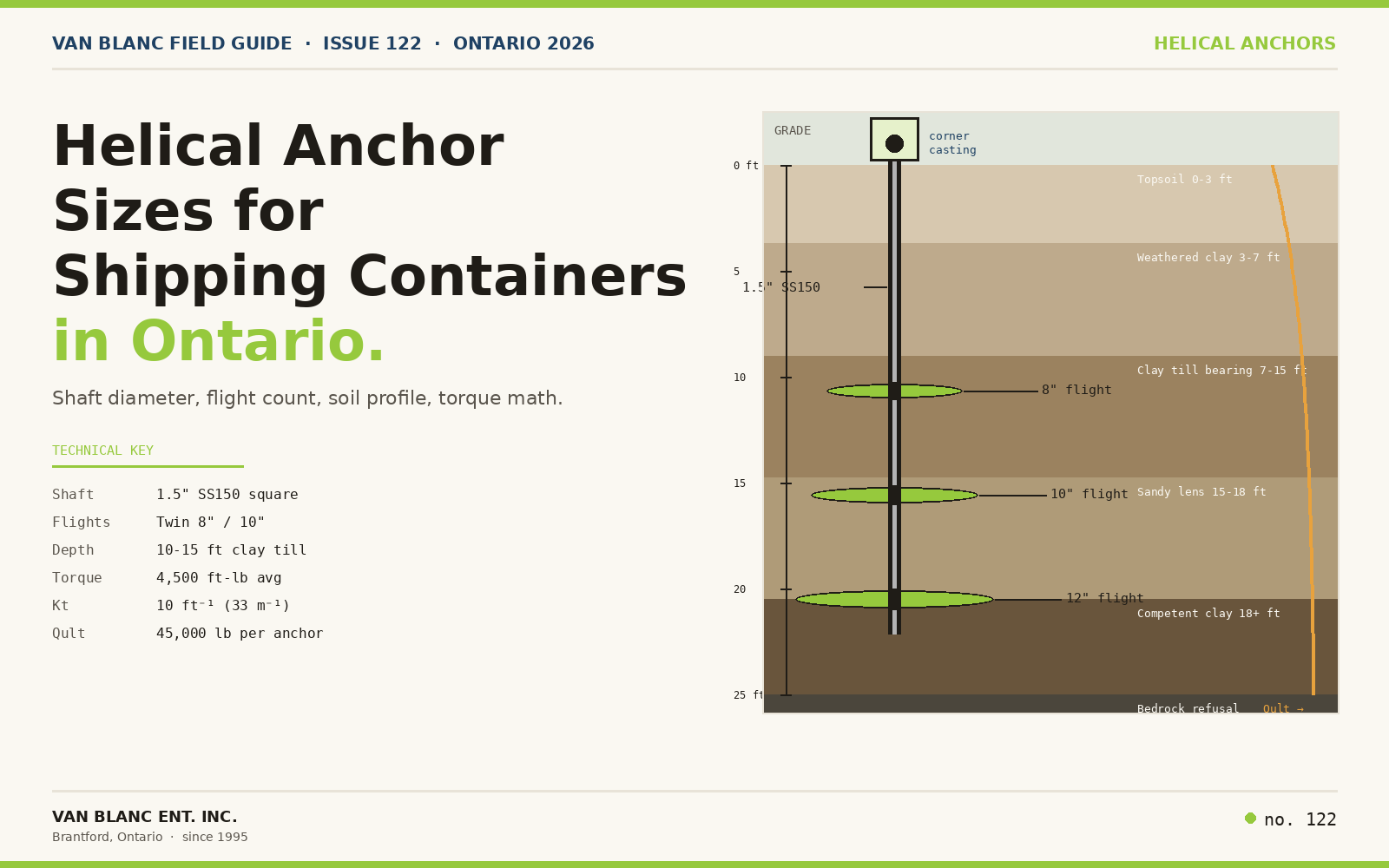
Quick Answer: Most Ontario shipping containers anchor on 1.5″ SS150 square shaft helicals with a single 8″ or twin 8″/10″ flight, installed 10 to 15 feet deep in clay till to a final torque of 3,500 to 5,500 ft-lb, giving roughly 35,000 to 55,000 lb ultimate capacity per anchor when paired with the four corner castings. Family-run Ontario shipping container supplier since 1995. 4.9 stars across 140+ Google reviews, 1-3 day delivery.
In This Guide
- Why Does Helical Anchor Size Matter on a Shipping Container?
- What Shaft Diameters Are Used for Container Anchors?
- How Many Helix Flights Does a Container Anchor Need?
- How Does Ontario Soil Change Anchor Sizing?
- How Do You Convert Anchor Torque to Capacity?
- Which Helical Anchor Size Fits Your Container and Soil?
- What Install Mistakes Wreck a Properly Sized Anchor?
- FAQs
Reading Time: 13 minutes
Why Does Helical Anchor Size Matter on a Shipping Container?
Helical anchor size matters on a shipping container because the anchor has to out-pull the wind. Most Ontario placements use a 1.5-inch SS150 square shaft with twin 8-inch and 10-inch flights, driven 10 to 15 feet into clay till to a final torque of 3,500 to 5,500 ft-lb, giving roughly 35,000 to 55,000 lb of hold per corner anchor.
A 20ft sea can weighs about 4,800 pounds empty. A 40ft high cube is closer to 8,800. Wind uplift on a flat-sided 40ft container in an Ontario gust can run to 12,000 pounds of vertical lift on the leeward side before you even count overturning moment. That is the load profile a properly sized helical anchor has to absorb on a bad weather day, multiplied by a safety factor of two.
Most buyers picture an anchor as a stake you screw into the dirt. Engineers picture it as a beam in tension and compression with a soil-bearing plate at the bottom. The shaft, the helix plate, and the depth all do different jobs, and undersizing any one of them is how you get a container that looks anchored and is not. We have learned this from three decades as Ontario’s container yard and from working with installers across the province who anchor everything from cottage Sea-Doo sheds to 40ft mining bunkhouses. If you are still choosing the bin you want to anchor down, settle that first, then read on, because the unit you pick drives the anchor recipe. For the system view of how every anchor part carries its share of the load, start with how container anchoring works from the ground up; this piece is the sizing chapter of that broader picture.
The Three Jobs an Anchor Does
Resist vertical uplift (wind on a tall flat side). Resist lateral shear (wind on the long broadside, ice push on a slab). Resist overturning moment (the bin trying to tip on its long axis). A 1.5″ square shaft handles uplift beautifully and lateral shear moderately. A 2.875″ round handles all three, including the lateral component you cannot ignore on tall stacked configurations or HC bins on exposed sites. Sizing is matching the anchor to the dominant load. Picking the biggest one on the truck is a different (and more expensive) decision.
What Shaft Diameters Are Used for Container Anchors?
Shaft diameters for container helical anchors fall into a narrow practical envelope in Ontario: a 1.5-inch square shaft for most placements, a 1.75-inch square shaft for heavier or softer-soil work, and a 2.875-inch round shaft when lateral load dominates. Helical anchors come in two families, square solid shafts and round hollow shafts, and each has its purpose.
Paul LeBlanc, owner: “After 19 years in containers I can tell you the size people guess at is almost never the size the soil wants. A buyer reads a forum, picks the biggest shaft on the list, and pays for capacity the clay was already giving him for free. We talk it through before they buy a single anchor.”
1.5-inch Square Shaft (Hubbell Chance SS150 / SS5)
The 1.5-inch square shaft is the workhorse: a square solid bar with helix plates welded to a 7ft lead section, extendable in 5ft or 10ft sections. It is rated to roughly 70,000 lb ultimate torsional capacity, with a default torque-to-capacity factor (Kt) of about 10 per foot, or 33 per metre. Square shafts move through soil with high efficiency because the corners do not bind. They are the go-to for residential and light commercial container placements on Ontario clay till, the soil type that sits under most of southern Ontario from Brantford east to Brockville.
1.75-inch Square Shaft
The 1.75-inch square shaft is the next step up when the bin sits on weaker soil or carries higher load. It buys you about 15 percent more torsional capacity than the 1.5 inch, and the additional shaft stiffness helps when the helix has to push through a hard layer to reach competent soil below. It keeps the high Kt of a square shaft, so the torque you read on the gauge still converts efficiently to capacity.
2.875-inch Round Shaft
The 2.875-inch round shaft is a 2-7/8-inch outside diameter pipe with helix plates welded on. Its hollow round shape has more bending resistance than any square bar, so when the container will face significant lateral load (think exposed lakefront on Lake Erie or Lake Huron, mining sites with snow drift loads, or stacked-bin configurations) the round shaft is the right call. Capacity ratings climb to 90,000-plus pounds in compression and tension, with Kt factors typically 9 ft^-1 and lower as the shaft diameter grows. The trade-off is that round shafts need more torque to install and the Kt is lower, so the torque you read on the gauge converts to less capacity per foot-pound than on a square shaft.
Money-Saving Note: Don’t Oversize
An installer will sometimes recommend 2.875″ round shafts for a standard 20ft residential placement because they look more substantial. On Ontario clay till that is overspec. The 1.5″ SS150 square shaft costs less, installs faster, and delivers more capacity per foot-pound of torque on cohesive soil. Use the round shaft where it is genuinely needed, not as default. The right anchor is the one that matches your load profile, not the biggest one on the truck.
How Many Helix Flights Does a Container Anchor Need?
A container anchor needs as many helix flights as its load demands, and for most Ontario placements that means twin 8-inch and 10-inch flights. The helix plates (also called flights) are the bearing surfaces, the parts that actually resist uplift and compression load. Choosing the right flight count and diameter is at least as important as the shaft size.
Single Flight
One helix plate, typically 8, 10, or 12 inches in diameter, welded near the tip. Adequate for light residential and most farm-storage placements where the bin is just resisting wind uplift on a flat side. Single-flight anchors install fastest because there is less friction. A 1.5″ square shaft with a single 10″ flight, installed to 12 feet in firm Brant County clay till, will typically reach 4,000 to 4,500 ft-lb of torque, which converts to about 40,000 to 45,000 lb of axial capacity per anchor.
Twin Flight (8″ / 10″)
Two helix plates of different diameters, with the smaller one at the tip and the larger one above it. The standard residential and commercial spec for container anchoring across Ontario. The smaller leading flight cuts cleanly through the upper soil, the larger trailing flight rides in the looser pre-cut path, and you get roughly 1.6 to 1.8 times the single-flight bearing area without doubling install effort. Most container placements you see across the province sit on twin-flight 8″/10″ leads. Ours included.
Triple Flight (8″ / 10″ / 12″) and Quad
Three or four helix plates stacked at engineered spacings. Used for high-capacity industrial applications, modified container offices with permanent occupancy load, and any installation where lateral capacity matters as much as uplift. Triple-flight anchors are common on 40ft HC reefer placements where the reefer unit, the insulated mass, and stored product can push gross load past 50,000 lb before you count wind. Quad-flight is overspec for almost any container application and is more often seen on permanent foundation work.
| Flight Configuration | Typical Use | Approx Bearing Area | Install Effort |
|---|---|---|---|
| Single 10″ | Residential shed, light farm | ~78 sq in | Low |
| Twin 8″/10″ | Standard 20ft / 40ft placement | ~128 sq in | Moderate |
| Twin 10″/12″ | 40ft HC, commercial yard | ~191 sq in | Moderate-high |
| Triple 8″/10″/12″ | Reefer, modified office, exposed site | ~241 sq in | High |
| Quad 8″/10″/12″/14″ | Permanent foundation, stacked bins | ~395 sq in | Very high |
How Does Ontario Soil Change Anchor Sizing?
Ontario soil changes anchor sizing because helical capacity comes from the soil gripping the bearing plates, and Ontario gives you four broad soil families that each want a different recipe. Helical anchor sizing therefore depends on what the bin sits on as much as on the bin itself. On the most exposed sites, the wind question gets its own answer in our guide to holding a container down in extreme Ontario wind.
Clay Till (Southern Ontario, Most Common)
The default soil from Windsor through Brantford to Brockville. Cohesive, dense once you get past the upper weathered metre, and forgiving for helical anchors because the cohesion holds the soil tight against the bearing plates. SPT blow counts typically run 15 to 35 in the bearing zone. A 1.5″ SS150 with twin 8″/10″ flights, installed to roughly 12 to 15 feet, hits torque targets without drama. Brant County, Norfolk, Haldimand, Oxford, Brant, Wellington, Waterloo, and Niagara all sit on variations of clay till.
Sand (Norfolk Sand Plain, Sandy River Terraces)
The Norfolk Sand Plain runs from Lake Erie north past Simcoe and Tillsonburg. Sandy fluvial deposits along major river valleys (Grand, Thames, Trent) behave similarly. Sand wants more depth because the bearing capacity per flight area is lower than clay. Plan for 15 to 25 feet, twin or triple flights, and a higher final-torque target because granular soils correlate to capacity differently. The Kt factor stays the same but the soil itself resists rotation less, so you need to drive deeper for the same hold.
Limestone Bedrock (Niagara Escarpment, Manitoulin, Bruce)
Helical anchors stop at rock. Once the lead section refuses, you either accept that depth or you switch to a different anchor system entirely (post-installed rock anchors, doweled into bedrock). On the escarpment and across the Bruce Peninsula, anchors often refuse at 8 to 12 feet. That can be enough capacity if the rock is sound, but the inspecting engineer needs to sign off on shallower depth.
Northern Ontario Glacial Outwash (Sudbury, Timmins, Thunder Bay)
Mixed glacial outwash with boulders and lenses of sand and clay. The boulders are the wildcard. An anchor that hits a buried granite boulder will refuse early, and you may have to move the anchor location by a metre or two and retry. Plan for 15 to 25 feet and budget extra time. Mining-site installers across the Sudbury basin know this terrain and build in route flexibility.
Brantford Yard Reality
Our 4 Brantford yards sit on classic southern Ontario clay till. When buyers visit and ask what soil they have at home, we ask which way they drove in. If they came from Norfolk we mention sand. If they came from the escarpment near Hamilton or up the Bruce we mention shallow rock. If they came from anywhere in the Grand River watershed, the answer is almost always clay till and the sizing conversation is easy. Worth the drive for unbeatable quality, family customer service with 30 years of experience.
How Do You Convert Anchor Torque to Capacity?
You convert helical anchor torque to capacity with one equation, Qult = Kt x T, where ultimate capacity equals the torque-to-capacity factor times the final installation torque. The single most important equation in helical anchor work was published by Sam Clemence and Bob Hoyt in 1989. It is elegant, and it has held up for nearly four decades of field testing.
Qult = Kt x T
Ultimate axial capacity (pounds) equals the torque-to-capacity factor (Kt, in ft^-1) multiplied by the average final installation torque (foot-pounds, averaged over the last three feet of installation).
For a Hubbell Chance SS5/SS150 square shaft system, the default Kt is 10 ft^-1 (or 33 m^-1). So a 1.5″ SS150 installed to a final-three-foot averaged torque of 4,500 ft-lb gives you Qult = 10 x 4,500 = 45,000 lb of ultimate capacity. Divide by a factor of safety (typically 2 for residential, 2.5 for commercial) and you have an allowable working capacity of 18,000 to 22,500 lb per anchor.
For round shafts the Kt drops as diameter grows. A 2.875″ round runs about 9 ft^-1. A 3.5″ round drops to 7 ft^-1. By 4.5″ you are at 6 ft^-1 or lower. This is why a final-torque comparison alone tells you very little. You have to know the shaft geometry to convert that torque reading to actual capacity.
The “Last Three Feet” Rule
Torque is averaged over the last three feet of installation, measured in one-foot increments. A single torque spike from a buried rock or root does not count. The installer reads torque at, say, depths of 12 ft, 13 ft, and 14 ft. The three readings get averaged and that average gets multiplied by Kt to get Qult. If one of those readings was a momentary spike caused by a stone, the installer pulls back and runs an additional foot to flush out the anomaly. Honest torque correlation requires honest torque reading.
Which Helical Anchor Size Fits Your Container and Soil?
The helical anchor size that fits your container and soil is whatever the table below points to once you match your bin, your site exposure, and your soil class. This working sizing table covers the majority of Ontario container placements. It is built from manufacturer specifications (Hubbell Chance Technical Design Manual, Magnum Piering specifications), the Hoyt-Clemence torque correlation, and real field experience installing across the province. Read it alongside the system-level walkthrough of choosing an anchoring method, which sits one level up and covers which anchoring system to choose, how many anchors per container, how to tie to the corner castings, and when an engineer’s stamp is required.
| Container & Placement | Shaft | Flights | Target Depth | Target Torque | Approx Qult / Anchor | Soil Class |
|---|---|---|---|---|---|---|
| 20ft, residential shed, sheltered | 1.5″ SS150 square | Single 10″ | 10-12 ft | 3,500 ft-lb | 35,000 lb | Clay till |
| 20ft, residential, exposed | 1.5″ SS150 square | Twin 8″/10″ | 12-15 ft | 4,500 ft-lb | 45,000 lb | Clay till |
| 40ft dry, farm storage | 1.5″ SS150 square | Twin 8″/10″ | 12-15 ft | 5,000 ft-lb | 50,000 lb | Clay till |
| 40ft HC, commercial yard | 1.75″ square | Twin 10″/12″ | 15-18 ft | 5,500 ft-lb | 55,000 lb | Clay till |
| 40ft HC reefer, food/pharma | 1.75″ square | Triple 8″/10″/12″ | 15-20 ft | 6,000 ft-lb | 60,000 lb | Clay till |
| 20ft, Norfolk sand | 1.5″ SS150 square | Twin 8″/10″ | 18-22 ft | 4,000 ft-lb | 40,000 lb | Sand |
| 40ft dry, Norfolk sand | 1.75″ square | Triple 8″/10″/12″ | 20-25 ft | 5,000 ft-lb | 50,000 lb | Sand |
| 20ft, escarpment / shallow rock | 1.5″ SS150 square | Single 10″ | 8-10 ft (refusal) | 4,500 ft-lb | 45,000 lb | Rock above |
| 40ft modified office, occupied | 2.875″ round | Triple 8″/10″/12″ | 15-18 ft | 6,500 ft-lb | ~58,500 lb (Kt 9) | Clay till |
| 40ft HC bunkhouse, mining site | 2.875″ round | Triple 10″/12″/14″ | 15-25 ft (varies) | 7,000 ft-lb | ~63,000 lb (Kt 9) | Glacial outwash |
| Lakefront cottage, exposed | 2.875″ round | Twin 10″/12″ | 15-20 ft | 6,000 ft-lb | ~54,000 lb (Kt 9) | Mixed clay/sand |
Capacity figures are ultimate (Qult). An engineer’s stamp is required for any modified-container occupied structure and for any placement where the wind exposure triggers Code Part 4 thresholds.
Case Worth Knowing: The Norfolk Greenhouse
A cannabis greenhouse operator in Norfolk County installed three 40ft HC reefers on sandy soil and used 1.5″ square anchors with single 10″ flights at 12 feet of depth, copying a friend’s residential spec. Within six months one anchor pulled out under wind load and the reefer settled 4 inches at the corner. The fix was a retrofit to triple-flight anchors at 22 feet, with the bin lifted off and re-set. The bigger flight count and the deeper bearing recovered the capacity the sand never gave them at 12 feet. Sand is not clay. Anchors that look identical on the truck deliver completely different capacity in different soils.
What Install Mistakes Wreck a Properly Sized Anchor?
The install mistakes that wreck a properly sized anchor come down to crowd pressure, spin-out, single-foot torque reads, skipped soil logs, and undersized brackets. Picking the right anchor size is half the job. Installing it correctly is the other half. Here are the most common errors we see, from working with installers across the province for 30 years.
The Five Real Install Mistakes
- Crowd pressure missing: Helical anchors install by rotation plus a small downward force called “crowd.” Without crowd the helix slips and the anchor does not advance. The torque reading climbs but the depth does not. Operators new to helicals often misread this as competent bearing and stop too shallow.
- Spin-out: If the helix plates hit a soil dense enough or a shaft too large for the soil, the anchor rotates without advancing and torque collapses. The fix is a smaller helix or a different shaft, not more torque. Spin-out is the soil telling you the math was wrong.
- Final torque read on a single foot: The Hoyt-Clemence correlation is averaged over three feet, not one. A single high reading at the end is not capacity. Three consistent readings averaged across the last three feet is.
- Skipping the soil log: Recording torque every foot from start to finish gives you a soil profile that proves the helix passed through what you expected. Skipping the log means you cannot verify the bearing layer, and if the inspecting engineer asks for evidence, you have none.
- Bracket undersize: The bracket that connects the anchor shaft to the container’s corner casting needs its own capacity rating, matched to the anchor. We have seen 50,000 lb anchors connected to 15,000 lb brackets. The bracket fails first and the anchor was wasted money.
Inspection and Documentation
Every helical anchor installation on a permanent container placement should produce a written record: anchor model, shaft size, flight configuration, final depth, final-three-foot averaged torque, calculated Qult, applied factor of safety, and allowable working capacity. For occupied modified containers (offices, dwellings, bunkhouses) this record gets signed by a Professional Engineer licensed in Ontario. For storage containers in agricultural or industrial settings the record stays with the property owner as proof of due diligence and a reference for insurance and resale.
Christian LeBlanc, second-generation operator: “We grew up watching customers either invest in the right anchor system or skip it entirely. The skip is what catches up with them after the first big November storm. Anchor sizing is not the place to save a hundred bucks per corner. Get the table right, get the soil right, get the torque math right, and the bin sits where you put it for the next 25 years.”
Frequently Asked Questions
What is the smallest helical anchor that works on a 20ft shipping container in Ontario?
A 1.5-inch SS150 square shaft with a single 10-inch helix flight, installed to roughly 10 to 12 feet in firm clay till, with a final-three-foot averaged torque of about 3,500 ft-lb. That gives you 35,000 lb of ultimate capacity per anchor. With four anchors at the corner castings that is more than enough for residential placements of a 20ft sea can on a sheltered site.
How many helical anchors does one shipping container need?
Four, one at each corner casting. Some exposed-site installations add a fifth and sixth anchor at the midspan of the long sides to absorb broadside wind load. Side anchors are also used when stacking containers, when modifying for occupancy, or when the bin sits on a slope. Four corner anchors are the floor; more anchors are added by engineering review when site conditions justify it.
How deep does a helical anchor go for a shipping container?
In southern Ontario clay till, 10 to 15 feet is typical for residential and light commercial placements, and 15 to 20 feet for high-load commercial work. In Norfolk sand or sandy river terraces, plan for 18 to 25 feet. On the Niagara Escarpment and across the Bruce, anchors often refuse at 8 to 12 feet on limestone. The final depth is whichever comes first: target torque achieved, or refusal on rock.
What torque do I need on a helical anchor for a 40ft container?
For a 40ft dry container on clay till in southern Ontario, target a final-three-foot averaged torque of about 5,000 to 5,500 ft-lb using a 1.5-inch or 1.75-inch square shaft. With a Kt factor of 10, that converts to 50,000 to 55,000 lb of ultimate capacity per anchor, well above what four corner anchors need to resist on a 40ft bin in standard wind exposure.
Can I install a helical anchor myself?
For decorative or light-duty residential use, yes, with rented equipment. For permanent shipping container placement, no. The torque math has to be verified, the soil profile recorded, and the brackets engineered to match the anchor capacity. The cost of a proper installer is small compared to a container that walks off its anchors in a storm.
What is the difference between Kt for square and round helical anchors?
Square shafts typically have a Kt of about 10 ft^-1 (33 m^-1) regardless of shaft size in the 1.25 to 2.25 inch range. Round shafts start around 9 ft^-1 for a 2.875-inch outside diameter and drop progressively to 6 ft^-1 or lower as diameter grows past 4 inches. The same final torque reading converts to different capacity depending on shaft geometry. Always confirm which Kt your installer is using.
How long do helical anchors last under a shipping container?
Galvanized helical anchors installed below the frost line in mineral soil have a published design life of 75 to 100 years. The galvanizing protects against soil corrosion, and the bearing capacity does not degrade unless the soil itself changes (rising water table, organic decay, frost heave in shallow installations). The anchor will outlast the container.
Do I need an engineer’s stamp on the anchor design?
For a temporary storage container on agricultural or industrial property, usually no. For any modified container with occupied use (office, dwelling, bunkhouse), yes, an Ontario-licensed Professional Engineer signs the anchor design and the installation record. For commercial yards with multiple bins or stacked configurations, engineering review is also standard practice. When in doubt, ask the inspecting authority before you buy the anchors.
Can helical anchors be removed and reused?
Yes. One of the strongest selling points of helical anchors over poured concrete piers. The anchor unscrews from the soil with the same drive head that installed it, leaves a small soil disturbance that backfills cleanly, and the galvanized anchor can be redeployed at a new site. This is why mining sites and construction laydown yards favour helicals: when the project ends, the anchors go with the bins to the next site.
Where can I learn more about anchoring a shipping container in Ontario?
Start with our overview of the four anchoring systems. It covers the full anchoring system: when anchoring is required, the four main system types (helical, ground screw, concrete pier, ballast block), how to tie anchors to corner castings, and how to choose the right system for your soil and load. This sizing piece zooms in on the helical-anchor chapter of that broader picture.
Sources
- Hubbell Power Systems. (2024). CHANCE Helical Pile / Anchor Technical Design Manual, Edition 4. helicaldrilling.com
- Clemence, S. P., & Hoyt, R. M. (1989). Uplift Capacity of Helical Anchors in Soil. Proceedings of the 12th International Conference on Soil Mechanics and Foundation Engineering. (Foundational torque-to-capacity correlation.)
- Hubbell Power Systems. (2024). Three Methods to Determine Helical Pile Capacity. blog.hubbell.com
- Magnum Piering. (2024). Helical Pile Specifications Table: System Ratings and Specifications. magnumpiering.com
- Lutenegger, A. J. (2009). Evaluating Installation Disturbance of Helical Anchors in Clay. helicalpileworld.com
- Government of Ontario. (2024). Building Code (O. Reg. 332/12), Part 4 Structural Design. ontario.ca/laws/regulation/120332
Reach Van Blanc in Brantford
We have been supplying shipping containers across Ontario since 1995. Our warehouse is at 90 Morton Avenue E in Brantford, and we deliver right across the province with real lead times and four Brantford yards behind every quote.
Van Blanc Ent. Inc. – 90 Morton Ave E Unit 1B, Brantford, ON N3R 7J7 – +1 888-509-6658
Buying a bin and want a straight answer on what anchor system fits your soil and your site? Call us or come to the yard. We will walk a real container with you and talk through anchoring before you pay a dollar.
Placement requirements vary by municipality. A quick call to your local planning office before delivery is the easiest way to confirm what works for your property.
Related Reading
Ready to price your container?
Tell us the size and your postal code and we’ll send back an honest, all-in number, container, delivery, and placement, usually within 1-3 days. No pressure, no mystery fees.
Family-run in Brantford since 1995 · 200+ containers in stock · 4.9★ across 140+ Google reviews · every box graded by a person, walk it before it lands.