
Quick Answer: BDC vs Bank vs Private Lender for Container Financing in Canada
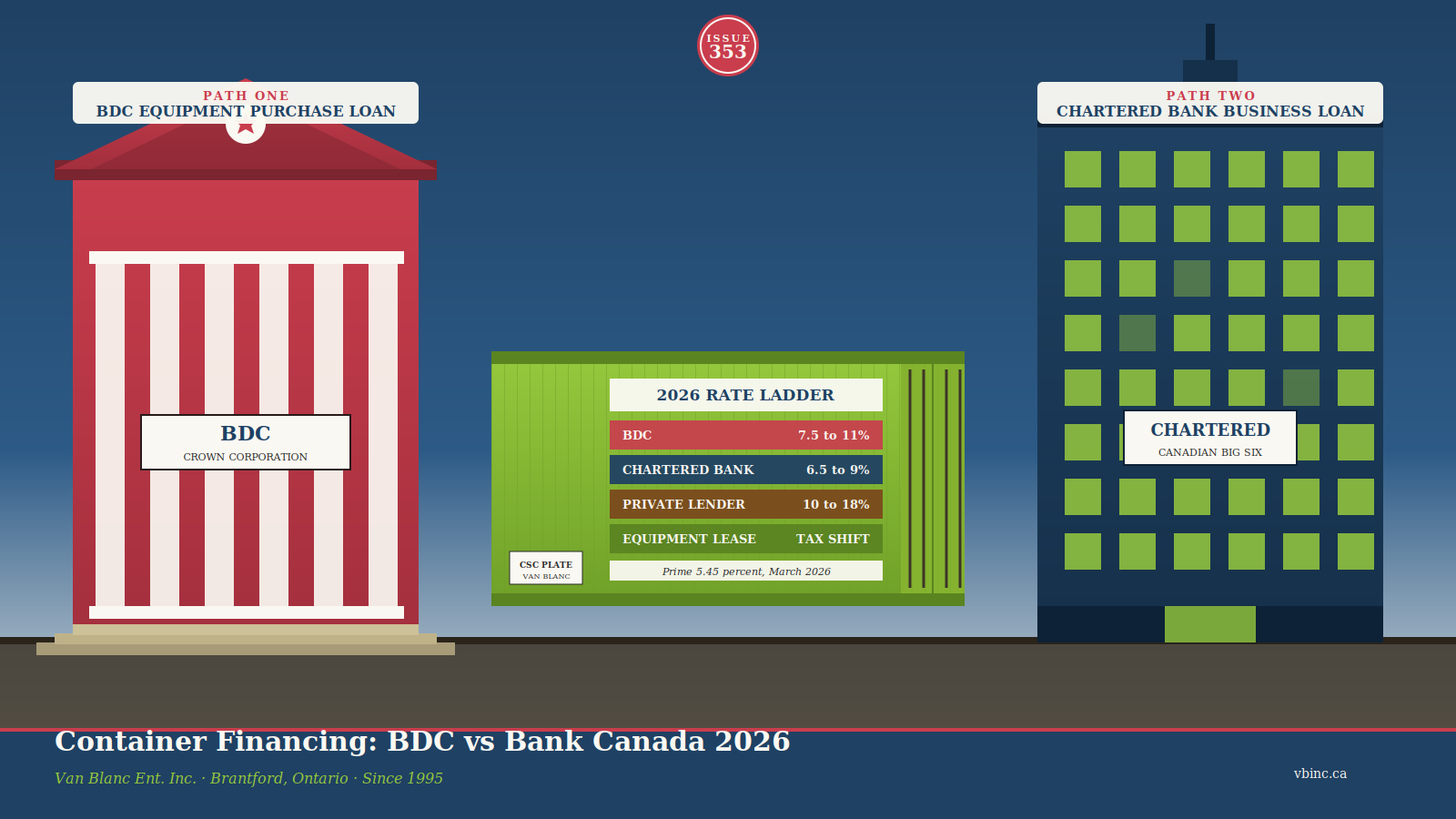
Container financing in Canada splits four ways. BDC equipment loans fit growth-stage businesses and approve in 2 to 4 weeks. Chartered banks offer the lowest rate for established firms in 1 to 2 weeks. Private lenders fund fastest, in 1 to 3 days. An equipment lease changes the tax treatment.
For a Canadian business buying a shipping container in 2026, the BDC (Business Development Bank of Canada) Equipment Purchase Loan is the right path for growth-stage operators who can wait 2 to 4 weeks for approval and want terms up to 12 years at 7.5 to 11 percent. A chartered bank business loan from RBC, TD, BMO, Scotia, CIBC, or National Bank is right for established businesses with two or three years of clean financials, 1 to 2 weeks to approve at 6.5 to 9 percent. A private equipment lender is right when speed matters more than rate: funding in 1-3 business days at 10 to 18 percent. An equipment lease shifts ownership and tax treatment to favour cash-flow-tight operators. Van Blanc supplies the container in 1 to 3 days from our four Brantford yards across 200+ in stock. Call 519-754-6844 to walk the row while your lender works the approval; the box ships 1 to 3 days after the order is placed. Pick up the phone and we will quote your real cost in 5 minutes, Christian or Paul, 519-754-6844.
The financing question lands on us most weeks, usually after a buyer has called four lenders, gotten four different answers, and wants a straight read on which path fits a container purchase. All four paths work for the right buyer. The wrong move is picking the lender that returned your call first without checking whether their rate, term, approval timeline, and personal-guarantee match what you are actually buying.
Van Blanc has sold containers out of Brantford since 1995. We are not a lender. We sell containers to businesses that have used every one of the financing paths below, and we hear back from those buyers about how the financing actually felt once the equipment was in the yard. As Christian LeBlanc, who runs the yard with his father Paul, puts it: “Most Ontario buyers do not need the cheapest rate. They need the lender who will say yes in the window they actually have. We have watched a great rate expire because the buyer spent two more weeks shopping for the box, so we tell people to walk the row first, know exactly what they are buying, and let the lender catch up.”
Before you choose a lender, it helps to settle the bigger purchase questions, and our guide to buying a container in Ontario walks through them in order. If you are still deciding whether to borrow at all, the math in paying cash versus financing the purchase shows when borrowing is the right tool. And because what you finance depends on what the box costs, the 2026 breakdown of container prices in Canada sizes the note before you apply.
Is a BDC Equipment Purchase Loan Right for a Container Purchase?
The BDC Equipment Purchase Loan fits growth-stage businesses that can wait 2 to 4 weeks for approval, want a term up to 12 years, and need more than the bare box financed. The Business Development Bank of Canada is a Crown corporation rather than a chartered bank. Its Equipment Purchase Loan funds new or used equipment well above the price range of any container purchase, covers up to 125 percent of equipment cost (so transport, installation, mods, and training roll into the same note), and amortizes up to 12 years. That 125 percent ceiling matters for container buyers in 2026 because BDC funds the box plus delivery plus pad plus mods. A chartered bank funds the box and stops.

Rate band as of March 2026 sits at BDC base rate plus a risk margin, landing most container deals in 7.45 to 11.45 percent (prime plus 2 to prime plus 6). That is higher than a chartered bank rate because BDC takes on risk profiles the chartered banks turn away. A two-year-old business with thin financials gets approved by BDC and declined by RBC. The premium rate is the price of that approval. For a buyer in years one through three with growth ahead of profit, BDC is often the only realistic path.
Approval runs 2 to 4 weeks for a clean application. The documentation pack is heavier than a chartered bank: two years of business financial statements, two years of personal tax returns for each owner above 20 percent, business plan, equipment quote (we supply same day), and projections showing debt-service capacity. The BDC account manager walks first-time applicants through the business-plan template; that advisory side is a real benefit.
The BDC trade-offs:
- Higher rate, longer term, lower monthly payment. A note at the BDC rate stretched over 10 years carries a smaller monthly payment than the same balance at a chartered bank rate amortized over 5 years. The longer BDC term costs more total interest but eases cash flow during growth years.
- Personal guarantee is standard. BDC takes the same personal guarantee from owners above 20 percent that any commercial lender takes.
- Pivot to Grow Loan rate is lower. For businesses hit by 2026 U.S. tariff impacts, BDC priced a special-rate program at BDC base rate minus 2 percent, currently around 4.55 percent. If your file ties to a tariff-impacted case, ask whether it qualifies for the lower-rate stream.
BDC publishes the Equipment Purchase Loan program page with current rates and the application portal.
When Does a Chartered Bank Business Loan Beat BDC for a Container?
A chartered bank business loan beats BDC when the buyer is an established business with clean financials and wants the lowest rate. For an established business with two to three years of clean financials, the chartered banks (RBC, TD, BMO, Scotia, CIBC, National Bank) are the cheapest path. A small business equipment loan or term loan against the container runs prime plus 1 to prime plus 3.5 in 2026, which lands in 6.5 to 9 percent. Approval for an existing business banking customer is 5 to 10 business days. A new bank customer migrating the business account at the same time runs 2 to 3 weeks because onboarding stretches the file.
The chartered bank pattern across all six is the same: two years of business financial statements, the most recent T2 corporate tax return, a current debt schedule, the personal credit bureau of every owner above 20 percent, and an equipment quote. The bank does not write a 125 percent loan; it writes 75 to 90 percent against equipment cost and expects 10 to 25 percent down. For a container, that is out of working capital. For a buyer with cash in the business, the down payment is not painful. For a buyer running tight, it is the reason BDC wins the file.
Where chartered banks shine:
- Lowest rate in the market for qualified borrowers. A clean small business in year four or beyond rides prime plus 1, currently around 6.45 percent. No other lender path matches that rate on a container note of any size.
- Existing relationship pull. If your business banking, payroll, and operating account live at the same bank, the credit adjudicator sees the cash-flow reality directly and the file moves faster.
- Predictable amortization. Banks default to 3 to 5 year amortization on equipment notes. Shorter than BDC, which keeps total interest lower but pushes monthly payments higher.
Where chartered banks fail: year-one and year-two businesses almost always get declined for separate equipment notes (the bank offers a personal line of credit or business credit card instead, neither right for a container). Used or refurbished equipment draws more questions than the smaller note size justifies. And approval at a new bank takes 2 to 3 weeks even on a clean application, which kills any project that needs the container on the pad inside 10 days.
Should You Lease or Buy a Shipping Container in Canada?
Whether you lease or buy a shipping container comes down to ownership and tax treatment rather than the rate. The lease-versus-loan decision is where most container buyers get the worst advice from people who never look at the CRA treatment. The headline difference is ownership. A loan means you own the container the day it lands; the lender holds a registered security interest under the Personal Property Security Act (PPSA), but the asset is yours. A lease means the leasing company owns the container; you rent it with a buyout option at the end (typically a nominal amount or 10 percent of original cost on a capital lease, or fair market value on an operating lease).
Tax treatment is where the real planning happens. Under Canada Revenue Agency rules, a loan-financed container is a depreciable asset. You claim Capital Cost Allowance (CCA) at the applicable rate (Class 8 for general equipment at 20 percent declining balance, depending on use case) and deduct the interest portion of each loan payment. You cannot deduct the principal portion. The CCA deduction is structurally smaller than the full payment in the early years, which makes the loan path less front-loaded on the tax return.
An operating lease lets you deduct the entire lease payment as a current business expense in the year it is paid. The leasing company is the owner and claims the CCA. You claim the rent. For a cash-flow-tight business in years one through three, the operating lease can deliver a meaningfully larger tax deduction in those exact years when every deduction matters. The MNP and Mehmi Group equipment-finance briefs confirm this pattern across container-class equipment in 2026.
The CRA caveats:
- The T2145 / T2146 election trap. For leases on equipment above the CRA fair-market-value threshold, the lessor and lessee can jointly elect to treat the arrangement as a financed purchase. In that case the deduction reverts to interest plus Capital Cost Allowance under the CRA rules, and the lease-payment deduction is lost. Read the lease contract for the election language.
- Capital lease vs operating lease. A lease with a buyout, or a buyout less than 10 percent of original cost, is functionally a financed purchase and CRA may reclassify it. Operating leases with a fair-market-value buyout are the cleanest path to full lease-payment deductibility. That buyout is priced off what a used container is worth at term end, which on a box that has held its value is no bargain.
- HST treatment. Lease payments include HST, which an ITC-eligible business reclaims. The loan path reclaims HST on the original purchase. Total HST paid is the same; the timing differs.
Buyers with strong financials and an eye on long-term asset value prefer the loan path. Buyers chasing a larger near-term deduction or keeping the asset off the balance sheet prefer the operating lease. Talk to your accountant; the right answer depends on your tax position rather than on a general rule.
How Fast Can a Private Equipment Lender Fund a Container?
A private equipment lender can pre-approve a container note in 24 to 48 hours and fund in 1 to 3 days, far faster than a bank or BDC, with rate as the trade-off. The Ontario private equipment finance market has matured significantly since 2020. Brokers like Mehmi Group, Equipment Finance Canada, and Fincap run wide networks of non-bank lenders that approve in 24 to 48 hours and fund in 1-3 days. The capability is real. The rate is the price of speed. Private equipment financing on a container note in 2026 runs 10 to 18 percent depending on credit profile, equipment type, and term. Bad-credit programs push that to 18 to 24 percent.
The buyer who needs the private path is almost always one of three patterns:
- Time-pressured. A signed client contract requires container storage on site by next Friday. The bank cannot move that fast. BDC cannot move that fast. The private lender can. The 8-percent rate premium is the cost of the contract not falling through.
- Newly incorporated. A six-month-old corporation fails the chartered-bank screen and is on the edge at BDC. Private lenders underwrite on personal credit plus equipment value, which fits the early-stage buyer.
- Recovering credit. A buyer with a past business failure or a recent credit blip gets approved through the private channel where the chartered bank will not open the file.
The private market also writes shorter terms (3 to 5 years typical, occasionally 7). The combination of shorter term plus higher rate means the monthly payment lands well above the BDC equivalent, which surprises buyers who anchor on rate alone. The same balance at a private 14 percent over 4 years carries a far heavier monthly payment than at the BDC rate over 10 years. Run the monthly-payment math before signing private.
Container as Collateral: Yes, but the Depreciation Math Matters
One of the better features of equipment financing is that the container itself is the collateral. The lender registers a security interest under the PPSA (Personal Property Security Act in Ontario) and, if the buyer defaults, repossesses and resells through the same channel that supplies our one-trip new containers from the Brantford yard. The collateral framing is what gets the rate down. Without collateral, the same buyer faces an unsecured small business loan at 12 to 16 percent, materially higher than the 7 to 9 percent equipment-finance rate.
The depreciation reality affects how lenders look at the file. The container holds about 60 to 70 percent of value at year five and 40 to 50 percent at year ten. That is a much slower depreciation curve than most equipment (a delivery van loses 60 percent in five years). Lenders price the slow depreciation in by writing longer amortization on container notes without much friction.
What lenders do not love about containers as collateral:
- Mobility and recovery risk. A container can be moved. If the borrower defaults and the box is no longer at the lease address, recovery cost is real. Some private lenders use GPS tracking as a loan covenant; chartered banks rarely do.
- Modification destroys collateral value. A converted office container with cutouts, electrical, plumbing, and HVAC mods is worth substantially less to the next buyer. Lenders that fund the full conversion (BDC at 125 percent) bake this into the file; lenders that fund only the bare container leave the buyer to cover mods from working capital.
- Yard versus permanent placement. A container on a customer site is harder to repossess than one in a fenced yard. Lenders increasingly want the final placement address before underwriting.
If you want to see how the slow depreciation curve translates into a current resale number, our grade-by-grade look at what containers are worth in 2026 tracks how the market has moved.
Personal Guarantee: Standard Across All Four Paths
Every commercial lender takes a personal guarantee from owners above 20 percent. BDC takes it. Every chartered bank takes it. Every private lender takes it. The leasing company takes it. The corporate veil does not protect against a properly signed personal guarantee. For buyers accustomed to limited-liability framing, this is a surprise. It should not be; it is the universal commercial finance standard in Canada in 2026, and it applies whether the note covers a single 20ft box or a multi-unit order for a yard.
What varies is size and structure. Some lenders take an unlimited personal guarantee on the entire note balance, joint and several across all owners above 20 percent. Some take a limited guarantee capped at a percentage (50 percent is common at BDC). Some take a personal indemnity rather than a guarantee, functionally similar but procedurally different on collection. A 100 percent unlimited joint-and-several guarantee on a note across three owners means each owner is personally on the hook for the full balance if the other two cannot pay. That is the standard structure on private paper; banks tend toward limited guarantees on clean borrowers.
Do not skip the legal review. A 30-minute conversation with a small-business lawyer before signing is modest relative to the note and catches the personal-guarantee gotchas, cross-default clauses, and prepayment penalties that surprise buyers a year in. The same review should cover the purchase side: the grade written on the quote and the delivery terms, both of which should match what you walked in the yard.
Approval Timeline Comparison
The approval timeline matters because container delivery is a real constraint. Van Blanc holds 200+ boxes in our four Brantford yards and delivers in 1 to 3 days once the order is placed. The lender timeline becomes the project timeline. The table below lines up the four paths on the attributes buyers compare first, none of them a posted dollar figure.
| Financing path | Approval to funding | Typical term | Up-front cash | Best-fit business stage | Personal guarantee |
|---|---|---|---|---|---|
| BDC Equipment Purchase Loan | 2 to 4 weeks | Up to 12 years | None (up to 125 percent financed) | Years 1 to 3, growth ahead of profit | Standard, often limited |
| Chartered bank business loan | 1 to 2 weeks (existing customer) | 3 to 5 years | 10 to 25 percent down | Year 3 plus, clean financials | Standard, often limited |
| Private equipment lender | 1 to 3 days | 3 to 5 years | None to 10 percent | New, credit-recovering, or deadline-driven | Standard, often unlimited |
| Equipment lease | 5 to 16 days | 2 to 5 years plus buyout | First, last, and deposit | Year 5 plus, tax-planning focus | Standard |
- Private equipment lender. Pre-approval in 24 to 48 hours, funding in 1-3 days. Total project time: 5 to 10 days.
- Chartered bank (existing customer). Approval in 5 to 10 business days, funding 1 to 3 days after. Total: 8 to 16 days.
- Chartered bank (new customer). Account onboarding plus credit adjudication in 2 to 3 weeks. Total: 18 to 28 days.
- BDC Equipment Purchase Loan. Package assembly 1-3 days, adjudication 10 to 14, documentation and funding 3 to 5. Total: 17 to 28 days.
- Equipment lease. Similar to private lender (5 to 10 days) or chartered bank (10 to 16) depending on the leasing company.
The buyer’s job is to start the financing application before shopping for the container, because stock turns over and the lender timeline is the slow part. Walk the row while the file is being adjudicated, and order the box the week the funds are confirmed; delivery follows in 1 to 3 days. The reverse pattern, approval first and then weeks of shopping, is how a good rate expires.
When Each Path Wins: Match the Lender to the Business Stage
The decision logic that holds in 90 percent of conversations:
- Year one to two, growth ahead of profit. BDC. Chartered banks decline on thin financials. Private is too expensive at this stage. BDC’s advisory side helps with the business plan; the longer term smooths cash flow.
- Year three to five, strong financials, established banking relationship. Chartered bank equipment loan, or the credit union equivalent if that is where the operating account lives. Lowest rate, fastest of the established-business paths.
- Year five plus, sophisticated tax planning. Equipment lease. Current-expense deduction simplifies tax planning; off-balance-sheet treatment helps new financing capacity.
- Hard deadline inside 14 days. Private equipment lender. Rate premium is the cost of the project not slipping. Refinance in 18 months when timeline pressure is gone.
- Newly incorporated or credit-recovering. Private equipment lender. Personal credit plus equipment value underwrite where chartered banks will not look.
- Strong cash position, no need to finance. Pay cash. See the cash vs financing breakdown.
Pattern that does not work: picking the lender by who returned your call first. Match the lender to the actual financial reality of your business; the wrong match costs real money in rate over the life of the note.
Where Van Blanc Fits in the Financing Conversation
Van Blanc is the container supplier rather than the lender. We supply the equipment quote lenders need for adjudication (usually the same business day), keep 200+ boxes on the ground so there is a box ready the week the funds land, and point buyers toward the financing path that matches their business stage, based on thirty years of watching the same patterns play out. We have customers who closed deals through BDC, through every chartered bank, through Mehmi Group and Fincap on the private side, and through equipment leasing companies. The advice does not change with the lender; the right answer depends on the buyer.

Our four Brantford yards hold 200+ containers in stock, every box visible and walkable before you sign. Two things buyers consistently tell us they wish they had known earlier: walk the row before paying, and ask about the scams. The latter is why we keep a running field guide to the container fraud we see in Ontario; we have customers who lost money to fake Facebook Marketplace listings demanding e-transfer for delivery on containers that never existed. A local family business, selling containers since 1995.
If your purchase is for a growing company, the lender conversation looks a little different, and our buying guide written for small-business owners covers the stage-by-stage reality. For the full purchase picture across grades, sizes, and delivery, start with the Ontario buyer’s guide that covers the whole purchase, and once the lender is sorted, you can see what we currently have for sale before you book a yard visit.
Frequently Asked Questions: BDC vs Bank vs Private Lender for Container Financing
What interest rate should I expect on a BDC equipment loan for a shipping container in 2026?
BDC Equipment Purchase Loan rates in 2026 land in the 7.45 to 11.45 percent range, structured as BDC base rate plus a risk margin of roughly prime plus 2 to prime plus 6. With the Bank of Canada prime rate around 5.45 percent in early 2026, most container deals price out between 7.5 and 9.5 percent for established borrowers and 9.5 to 11.5 percent for newer or higher-risk files. Businesses impacted by U.S. tariffs may qualify for the Pivot to Grow Loan at BDC base rate minus 2 percent, currently around 4.55 percent. The exact rate depends on your file; BDC publishes current rate ranges on their Equipment Purchase Loan program page.
Is BDC faster or slower than a chartered bank for container equipment financing?
Slower on most files. BDC application assembly and adjudication runs 2 to 4 weeks because the documentation pack is heavier (business plan, projections, multi-year financials) and the advisory review takes time. A chartered bank with an existing customer can approve and fund a clean file in 8 to 16 days. A new bank relationship runs 18 to 28 days because of account onboarding. For speed, the private equipment lender path beats both at 5 to 10 days total project time, with rate as the trade-off.
Should I lease or buy a shipping container in Canada for tax purposes?
It depends on your tax position. A loan-financed purchase lets you claim Capital Cost Allowance on the container plus the interest portion of each loan payment, which is structurally smaller in early years. An operating lease lets you deduct the full lease payment as a current business expense, which delivers a larger near-term deduction. For leases above the CRA fair-market-value threshold, the CRA T2145 / T2146 election can reclassify the lease as a financed purchase, so read the contract carefully. Talk to your accountant about your specific tax position before signing.
What is the difference between a capital lease and an operating lease for a container?
A capital lease functionally transfers ownership at the end of the term, typically through a nominal or 10-percent-of-original-cost buyout. CRA generally treats a capital lease as a financed purchase, which means you claim CCA plus interest rather than the full lease payment. An operating lease has a fair-market-value buyout at term end and lets you deduct the full lease payment as a current expense, with the leasing company keeping ownership and claiming the CCA. The operating-lease structure is the cleaner path to full lease-payment deductibility for container-class equipment.
Can I finance a used or refurbished shipping container through a Canadian bank?
It is harder. Chartered banks prefer to lend against new equipment with clear depreciation curves, and a used or refurbished container at half the price of a new one-trip box draws more questions than the smaller note size justifies for the credit team. BDC writes used-equipment paper more readily through the Equipment Purchase Loan because the program is structured for the full equipment market rather than just new. Private equipment lenders also fund used containers, often at a small rate premium versus new. For buyers focused on used grades, BDC or private is usually the path; the chartered banks are inconsistent.
How much down payment do I need on a container equipment loan in Canada?
BDC writes up to 125 percent of equipment cost, so no down payment is required and modification or delivery costs can roll into the note. Chartered banks typically require 10 to 25 percent down and lend 75 to 90 percent against the equipment cost. Private equipment lenders range from no down payment to 10 percent depending on credit profile. Equipment leases typically require first and last month plus a security deposit, functionally 5 to 15 percent of equipment value up front. For a container, plan for anywhere from nothing down to roughly 10 to 25 percent of the cost in up-front cash depending on the lender path.
Will I have to sign a personal guarantee for a container equipment loan?
Yes, on every commercial lender path. BDC takes a personal guarantee from owners above 20 percent. Every chartered bank does. Every private equipment lender does. Leasing companies do. What varies is the size and structure: unlimited versus limited, joint and several versus pro rata, full guarantee versus indemnity. The corporate veil does not protect against a properly signed personal guarantee. Get a 30-minute small-business legal review before signing any equipment paper; it is modest relative to the note and catches the guarantee language that surprises buyers a year into the note.
Can a new business with no financial history get a container equipment loan?
Yes, but not through the chartered banks. Banks require two to three years of clean business financials and decline most year-one and year-two files for equipment notes. BDC underwrites newer businesses through the Equipment Purchase Loan and provides the advisory support to write the business plan and projections the application requires. Private equipment lenders underwrite on the personal credit of the owner plus the equipment value, which fits brand-new corporations even with twelve months or less of revenue history. The trade-off across these paths is rate: BDC at 8 to 11 percent, private at 12 to 18 percent.
How fast can I get a private equipment loan for a shipping container in Ontario?
Pre-approval inside 24 to 48 hours, funding in 1-3 days. Total project time from first call to container on pad runs 5 to 10 days when the buyer has documentation ready and the lender has appetite for the file. The Ontario private equipment finance market is mature, with brokers like Mehmi Group, Equipment Finance Canada, and Fincap running networks of non-bank lenders that price for speed. The rate is 10 to 18 percent in 2026, versus 6.5 to 9 percent at a chartered bank, which is the cost of the faster approval. The private path makes sense when project deadlines do not allow for the bank or BDC timeline.
Does Van Blanc work with specific lenders or help arrange container financing?
We are the container supplier rather than a lender, and we do not earn referral fees from any lender. What we do is supply the equipment quote your lender needs (usually the same business day) and keep 200+ containers on the ground so there is a box ready the week your financing lands. Our customers have closed deals through BDC, through every chartered bank, through several Ontario private equipment lenders, and through equipment leasing companies. Based on thirty years of watching the patterns, we will point you to the path that matches your business stage. The choice is yours. Walk the row at one of our four Brantford yards, see 200+ containers in stock, and call 519-754-6844 to book the conversation.
Sources
- Business Development Bank of Canada, Equipment Purchase Loan program
- Government of Canada, 2026 BDC tariff response program announcement
- Bateman MacKay, BDC Tariff Support 2026 Pivot to Grow Loan brief
- MNP, financing equipment lease vs loan tax treatment analysis
- Mehmi Group, Canadian tax benefits of leasing vs financing equipment 2026
- Canada Revenue Agency, Capital Cost Allowance for business equipment
- Loans Canada, BDC reviews and rate analysis 2026
Related Reading
- Buy a Shipping Container in Canada: the Ontario buyer’s guide (parent hub)
- Shipping container financing in Ontario: loans, lines of credit, and equipment lenders
- Financing a container through an Ontario credit union
- What shipping containers cost in Canada in 2026
- Delivery lead times and truck access across Ontario
- Container modifications: doors, locks, vents, and custom builds
- Spotting and avoiding shipping container fraud
Ready to price your container?
Tell us the size and your postal code and we’ll send back an all-in number, container, delivery, and placement, usually within 1-3 days. No pressure, no mystery fees.
Family-run in Brantford since 1995 · 200+ containers in stock · 4.9★ across 140+ Google reviews · every box graded by a person, walk it before it lands.
Sources & References
Authoritative external sources cited or referenced in this guide:
- Equipment Purchase Loan program page
- Government of Canada, 2026 BDC tariff response program announcement
- Bateman MacKay, BDC Tariff Support 2026 Pivot to Grow Loan brief
- MNP, financing equipment lease vs loan tax treatment analysis
- Mehmi Group, Canadian tax benefits of leasing vs financing equipment 2026
- Canada Revenue Agency, Capital Cost Allowance for business equipment