
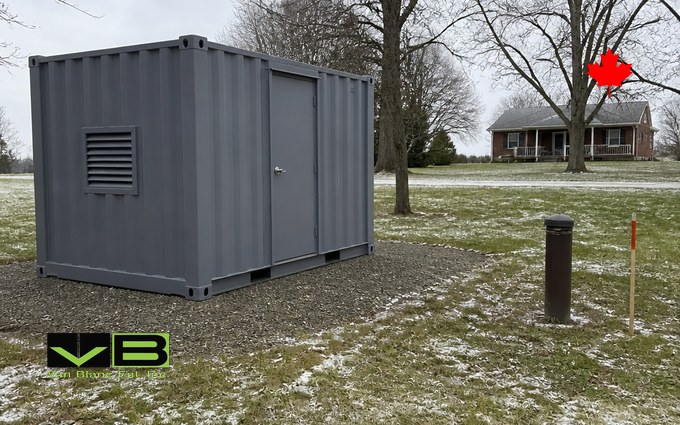
Quick Answer: A pump house is an insulated shelter that keeps a well’s pressure tank, switch, pump and treatment gear from freezing. Alberta Agriculture’s design calls for R-20 walls and a heater set at 4 to 6 °C. An insulated, heated 8ft to 10ft container from Van Blanc can be that shelter.
What This Pump House Guide Covers
- Pump house: what does it protect?
- Well house: same building, older meaning
- Basement, pit or separate building
- Freezing in an Ontario winter
- What Ontario winters ask of the building
- Pump house siting beside the wellhead
- A small insulated container as the pump house
- Stick-built, prefab or steel
- Pump houses at cottages and farms
- Pump house cost drivers
- Freeze-up checklist for the water system
- Pump house and well house FAQs
Reading Time: 15 minutes
Pump House: What Does It Protect?
A pump house is the small building that holds the parts of a private water system that do not live down the well. That means the pressure tank, the pressure switch, an above-ground jet pump on a shallow well, and any filters or treatment. PrivateWellClass is a well-owner course from RCAP and the University of Illinois. It says the shelter guards the pump and pipes from wind, rain and snow, and gives access to the equipment. In Ontario, the job that matters most is the cold one. Van Blanc sells a steel version from four yards in Brantford: a short container under 12 feet. The insulation and doors go on at our yards before it ships.
The pressure tank is the reason the pump does not start every time a tap opens. The Water Systems Council runs the wellcare hotline for well owners, and its sheet on sizing a pressure tank lists three functions for the tank. It protects and prolongs the life of the pump by preventing rapid cycling, and it delivers water under pressure between pump cycles. Its third job, extra stored water at peak demand, matters only when the pump or the well cannot keep up. The pressure switch sets the pressures the tank works between, and the low one, the cut-in, is where the pump starts. The tank’s air charge is set 2 psig below the cut-in. The council’s freeze sheet names the 1/4 inch by 3 inch nipple between the switch and the tank tee as a common place for ice. That is why frost protection in the plumbing of a heated steel box starts at its smallest pipe.
| Part in the pump house | What it does | Winter risk, per the sources |
|---|---|---|
| Pressure tank | Prevents rapid cycling of the pump and holds water under pressure between cycles | Vulnerable to freezing; belongs inside an insulated enclosure (Water Systems Council) |
| Pressure switch | Starts and stops the pump; tank air charge sits 2 psig below the cut-in | The 1/4 inch by 3 inch nipple to the tank tee is a common freeze point |
| Above-ground jet pump | Lifts water from a shallow well | Needs a space that stays above 40 °F, about 4.4 °C |
| Filters and treatment | Clean or condition the water before the house | Shares the room and the heat (PrivateWellClass lists filtration among well house gear) |
| Heater, panel and controls | Power the pump and keep the room above freezing | Thermostat at 4 to 6 °C on the Alberta design; see heating a small steel room |
Most well pumps sit down inside the well at depths that do not freeze, the Water Systems Council notes. An above-ground pump is different. It needs a space that stays above 40 degrees on the council’s Fahrenheit scale, about 4.4 °C. Wherever the temperature can drop below freezing, it belongs in an insulated enclosure. Its motor gives off some heat, which helps once the walls are insulated.
The stock list Paul and Christian LeBlanc sent out in September 2026 had 8ft and 9ft units with man doors and barred windows. It also had 10ft units with oversized man doors. Those are the sizes a pump house uses. The three kinds of insulated box we sell explain how the walls get their foam.
Well House: Same Building, Older Meaning
Well house and pump house now name the same building. PrivateWellClass defines a well house or a pump house as a small shelter built over a water well. Alberta Agriculture’s fact sheet uses pump house for the insulated building that holds the pressure system. That building does for water what an insulated steel box does for paint and seed over winter. The older meaning of well house was different. The Into the Woods blog at Acorn Abbey, showing a typical North Carolina example, describes the wellhouse as an outbuilding from before electricity. The well stood near its door, and milk jars sat in troughs of cool water inside. Some people still write it as one word, wellhouse.
A pump house is not a well, either. The well is the drilled or dug hole with its casing and cap. The pump house is the room beside it, or over it, that keeps the rest of the system dry and warm. Older rural lots add a third word: the well pit, a hole dug around the well head to hold the pressure system. On a working farm, the pump house sits among the feed, seed and equipment boxes of an Ontario farm yard.
Basement, Pit or Separate Building
A well’s pressure system can live in one of three places. They are the house basement, a pit, or a separate building such as a 10ft steel box on its own pad. Distance usually decides which. The basement is warm, dry and already wired. Alberta Agriculture’s Agdex 716 (C28), Pump Houses, calls it an alternative that is not always feasible. The well may simply be too far from the house. The pit is the second option, and the Alberta sheet is blunt about it. Pits dug around the well head often caused well contamination and safety hazards. The sheet adds that pits have not been allowed in Alberta since environmental regulations changed in 1993.
The separate pump house is the third. The Alberta sheet says it is often a more convenient point for distribution to other areas of the farm. Water for the stalls and run-in sheds on a horse property can run from it, and so can the line to any other barn. Ontario’s Wells on your property page gives owners a short upkeep list. Keep the well accessible for future repairs, keep the ground sloping away from it, and keep the casing at its minimum height, typically 40 cm above the surface. A building beside the well keeps all of that true, and a pit around it cannot. The walk from the casing to the house often crosses the lane a truck needs on a country property. Measure it once for both.
Freezing in an Ontario Winter
Freezing is the failure every Ontario pump house exists to prevent. The Water Systems Council’s freeze sheet sets out the chain. When pipes freeze, the flow of water is completely blocked. Water expands as it turns to ice, so the pipes are very likely to burst. The pump and other exposed well components can be ruined with them. The same sheet explains the buried part of the system. A pitless adapter attaches to the well casing below the frost line. Water is diverted sideways at the adapter, toward the house, so it leaves the casing where the ground does not freeze. How deep Ontario frost reaches is why the adapter sits where it does.
The adapter cannot protect anything that comes back above ground. The tank, the switch and its nipple, a jet pump, the filter housings and the first feet of pipe all sit in the air. The council lists quick fixes for a cold snap. Wrap an exposed wellhead or tank in insulation, blankets or towels. Put heating strips under pipe insulation in unheated spaces. For the pump and the tank, its lasting answer is an insulated enclosure. A short steel 8ft that opens from the end and the side, insulated at our yards, is one way to build it.
Snow is the other winter hazard. The same sheet tells owners to protect the wellhead from snow blowers and plows. It suggests a fibreglass driveway marker so a snow-covered casing can be found and cleared by hand. Steel boxes bring a winter problem of their own. The dew-point cycle inside a container from December to March belongs in the plan for a pump house too.
What Ontario Winters Ask of the Building
Alberta Agriculture’s Pump Houses sheet, revised in March 2008, is a public design for a cold-climate pump house, written for Alberta farms. Its requirements are the same list an Ontario owner works through. That holds whether the walls are studs, sandwich panels or a 9ft box with a side door. The table sets out what the sheet specifies.
| Item | What the Alberta sheet specifies |
|---|---|
| Size | 8 foot by 8 foot is ample for most farms, adjusted to suit |
| Walls | R-20 minimum, about 8 inches thick: 2 by 6 framing or a staggered double 2 by 4 wall, batts, plywood lining, 6 mil poly vapour barrier |
| Ceiling | R-30 attic insulation on the drawing |
| Floor | 6 inch reinforced concrete slab with a thickened edge over compacted gravel; no ponding |
| Heat | 500 watt thermostatically controlled electric heater, or a vented gas heater; thermostat at 4 to 6 °C |
| Door | Insulated and gasketed |
| Water line | Run through a larger sleeve for the first 7 to 10 feet |
| Well | Outside, offset with a pitless adapter (recommended); if inside, casing at least 8 inches above the floor |
| Use | Water facilities and equipment only; no chemicals or livestock feed |
Insulation and Heat Work as a Pair
Insulation slows the heat loss, and a thermostatic heater sized for the room replaces what leaks out. The Alberta sheet never relies on the walls alone. Its heating list, led by a 500 watt thermostatic electric heater with the thermostat at 4 to 6 °C, is part of the design. The Water Systems Council’s 40 °F line for an above-ground pump sits inside that band. Spray-foam sellers spend most of their words on insulation choice. Natural Resources Canada gives the figures to check them against. Table 3-1 of its Keeping the Heat In guide gives closed-cell polyurethane spray foam a range of R-5.2 to 6.5 per inch. A technical note on closed-cell foam caps the design value at RSI 0.90 per 25 mm, roughly R-5.1 per inch. The foam’s blowing gases escape over the years, and the cap allows for that. The long-term R-value of spray foam on steel is the figure to plan a winter on.
Air, drainage and power finish the list. Some wells release methane, carbon dioxide or nitrogen, the Alberta sheet warns. Those wells need venting outside and should not sit inside a building. The site must be well drained, preferably on higher ground, and the floor must not let water pond. Distance to power matters as well. A pump house too far from the yard pole may need an additional transformer. NRCan adds a note for anyone foaming a building. Closed-cell foam goes on in passes no more than 50 mm thick. It then needs a 24 hour curing and off-gassing period before the space is occupied.
Pump House Siting Beside the Wellhead
A pump house works best next to the well, not on top of it, on ground prepared for the base it sits on. Alberta’s sheet offsets the well from the pump house and uses a pitless adapter for the connection. That leaves room for a water well service rig to set up over the casing. The sheet adds that moving a pump house to give a rig access is very difficult. If the building must go over the well, the casing goes near one side rather than dead centre. The equipment goes on the other side. The drawing also shows an anchor and steel strap system, so the shed can come off for service.
From the pitless adapter, the water line comes up into the building inside a larger pipe sleeve. The Alberta sheet runs that sleeve for the first 7 to 10 feet. A new line can then be pulled through later without breaking the floor. Pick ground that sheds water. A slab works, and so does a gravel pad sized and levelled for a container. Keep the pump house out of the plow’s turning circle and away from snow sliding off a roof.
A Small Insulated Container as the Pump House
A small insulated container is the pump house on the Alberta drawing, built in steel instead of studs and delivered finished. Recent stock at Van Blanc runs from 5’7″ minis to 12ft units. For a pump house, the useful sizes are the 8ft, 9ft and 10ft. On footprint, the 8ft comes closest to Alberta’s 8 foot by 8 foot room. Our 8ft page puts its outside at 5.36 sq m (57.7 sq ft). Inside, before insulation, its floor is 4.83 sq m, about 52 sq ft. The 10ft gives a treatment train more room to spread out, and the 9ft sits between the two. Our 8ft and 10ft pages both put the insulation in at our yards before delivery, and our features page offers it on any container. A tilt-deck then brings the finished box from our 4 Brantford yards, in 1-3 days to most of Ontario.
Choosing 8ft, 9ft or 10ft
The sizes below come from Van Blanc’s own product pages, read the day this page was written. Inside figures are for the bare box. Insulation and liner take a few inches off every face. For every length and grade on one page, the sale list that sets small boxes beside the longer sizes is the place to compare.
| Size | Outside | Inside, bare box | Cargo door opening | Pump house fit |
|---|---|---|---|---|
| 8ft | 2,438 x 2,200 x 2,260 mm | 2,287 x 2,112 x 2,062 mm (7 ft 6 in by 6 ft 11 in by 6 ft 9 in); 4.83 sq m floor | 2,106 x 1,949 mm | Closest to the 8 foot by 8 foot design on footprint: tank, switch, filters, heater (see the new grey 8ft in recent stock) |
| 9ft | 9 ft (2.74 m) long; width and height vary by builder | One build rated 13 cu m (460 cu ft) on its doors | Cargo doors, plus a side man door and barred window on recent stock | One more foot for a softener or a second filter |
| 10ft | 2.99 m (9 ft 10 in) x 2.44 m x 2.59 m | 2,840 x 2,350 x 2,393 mm on the maker’s sheet our 10ft page quotes; about 560 cubic feet | 2,342 x 2,280 mm | Room for a full treatment train and spares; tens come factory-built or cut down from a 20 |
The door opening matters more here than in a storage box, because pressure tanks get replaced. A tank that comes in through the cargo doors goes out the same way, without taking a wall apart. On the 9ft units in recent stock, a man door and a barred window share one side wall. Recent 10ft stock has also arrived with an oversized man door or a roll-up door, and a framed steel man door can be fitted to order.
Foam, Vents and Heat in a Steel Box
Our insulated container page sets out the shop’s spray-foam retrofit. Closed-cell polyurethane goes on two to three inches deep across the walls and ceiling, and a liner of plywood, FRP or steel sheet covers it. The features page names rigid panel as the other option, picked to suit the job. At NRCan’s long-term R-5.1 per inch, two inches works out near R-10 on the flat. Three inches comes out near R-15. Both read lower at the ribs and posts, where bare steel bridges the foam. On paper that sits below Alberta’s R-20 stud wall, so the heater carries more of the load. The Alberta sheet pairs its walls with a thermostatic heater anyway, and a steel pump house gets the same thermostat at 4 to 6 °C. Ventilation goes on the same build sheet. A sealed, foamed box with no fresh air coming in will sweat around its doors. For a room that holds water all winter, read how still vents and a small exhaust fan compare before the build sheet is signed.
The grade under the foam matters, because foam hides the wall it covers. The insulated page names a one-trip box as the grade Van Blanc recommends under foam that will be lined and lived with. Its interior steel is clean, so the spray bonds to it. That is the case for buying the box new, and the small boxes in recent stock lean that way already. The 8ft is a new box, and so are three of the four 9ft units.
Christian LeBlanc, second-generation operator, Van Blanc Ent. Inc.: “With a pump house I ask people to picture the day something breaks. Put the man door on the side you walk up to in a snowstorm, keep the cargo doors clear so a new tank goes straight in, and leave the well outside the box, where the well truck can reach it.”
Where the Box Sits on the Property
Van Blanc sets the box where your pad is, so put the pad beside the well, never over it, on higher ground that drains. That follows the Alberta layout and keeps the casing open to the sky for the day a rig pulls the pump. A box this light sits on a gravel pad that is level in both directions. Point the cargo doors before the truck arrives, because which end faces the lane once the tilt-deck leaves is hard to change on a small box. Measure three runs: to the house, to the power, and the clear lane a tilt-deck needs. A pad that went in before the frost makes a tilt-deck visit after the yard has frozen the easy case.
What Goes Inside, and What Stays Out
- The pressure tank, on a level spot near the cargo doors.
- The pressure switch, gauge and the short pipe run to the tank tee, kept inside the heated air.
- A jet pump, if the well is shallow.
- Filters, a softener or other treatment, with spare cartridges on a shelf.
- The thermostatic heater and the electrical panel, placed by the electrician.
- Nothing else. Alberta’s sheet keeps chemicals and livestock feed out of a pump house, so pool chemicals, fuel and the mower go in a second small box of their own.
Who Handles the Well and the Wiring
Ontario’s guidance tells owners to hire a licensed well contractor for building, repairing, modifying or abandoning a well. The feed, panel and heater circuit go to a Licensed Electrical Contractor. ESA says those contractors are the only businesses in Ontario legally authorized to do electrical work in your home. Van Blanc’s part is the box: steel, insulation, liner, doors, vents and an electrical rough-in on the build sheet. Your own Licensed Electrical Contractor makes the site connection and its ESA inspection.
Stick-Built, Prefab or Steel
An Ontario owner putting up a pump house can choose among three builds. The stick-built version is the Alberta drawing: a framed, insulated room on a reinforced slab, built where it stands. The prefab well house arrives whole from a maker. Polar Sheds, an Oklahoma maker, builds wellhouses from sandwich panels 1.75 inches thick. The cores are polystyrene (R8) or polyurethane (R16), the buildings sell through dealers, and the maker recommends a heat source below freezing. The steel box is the third build: a small container given its insulation, liner and vents at our yards before it ships.
| Question | Stick-built (Alberta design) | Prefab well house | Insulated container |
|---|---|---|---|
| Walls | R-20 framed wall, R-30 ceiling | Sandwich panels, R8 or R16 on Polar Sheds’ line | Insulated at our yards with spray foam or rigid panel to suit the job; the shop’s spray retrofit is two to three inches of closed-cell foam, near R-10 to R-15 at R-5.1 per inch |
| Floor | 6 inch reinforced slab | Floorless; bolted to a concrete base | Plywood on steel cross members, foamed or built up where needed |
| Heat | 500 watt thermostatic heater | Heat source recommended below freezing | Thermostatic heater on the same 4 to 6 °C setting |
| Comes off for well service | Anchor and strap system on the drawing | Lifting eye offered as an add-on | Sits beside the well; corner castings for any future lift |
| Arrives | Framed and poured on site | Delivered whole through a dealer | Built at our yards, then delivered from our 4 Brantford yards, in 1-3 days to most of Ontario |
| Locks | Whatever door is hung | Maker’s door | Steel doors with locking bars; a hood of welded steel that shields the lock can be added |
Each build keeps a pressure tank above freezing once it is insulated and heated, and each has its strengths. Stick framing matches a house and takes any siding. A prefab arrives ready to bolt down. Van Blanc’s steel box arrives finished and sits on gravel without a slab. It closes with steel locking bars, which matters on a cottage lot that stands empty half the year. Padlocks and lockboxes for a box left alone covers that side.
Pump house in a box: which size?
Tell us what lives in the room: the tank, the switch, a jet pump, the filters. Add how far the box sits from the well and from power, and your postal code. We will tell you 8ft, 9ft or 10ft, the insulation, the doors and the vents, with one all-in number and a real lead time.
Family-run in Brantford since 1995 · 4.9★ across 140+ Google reviews · walk the box before it lands.
Pump Houses at Cottages and Farms
Pump houses at cottages face a choice the farm never does: heat all winter, or drain and lock. The Water Systems Council’s winterizing sheet is written for seasonal homes and cabins on private wells. It says a pump deep in a well needs no further action once the power is off. A shallow well with a jet pump has to be drained as well. A heated cottage pump house keeps the water on for a February weekend. A drained one still keeps snow, animals and visitors away from the tank. Lots from MacTier and the Georgian Bay side to Lake Bernard in the Almaguin Highlands are on Van Blanc’s delivery map.
On a farm, the lines to the barns can branch from the pump house, so its heater protects more than the house supply. Market gardens add irrigation headers and pumps that winter indoors. The wash-pack shell a market garden runs from shows the same steel doing a different job one field over.
Ontario Delivery Before Freeze-Up
Van Blanc delivers from our 4 Brantford yards in 1-3 days to most of Ontario. That window takes in the hobby farms just past Guelph’s city limits, the Wilmot and Wellesley farms outside Kitchener and the acreages close to Brantford. Eastern Ontario runs take 1-3 days too, an acreage past the Ottawa Greenbelt included. Longer northern routes are quoted trip by trip. October and November are the months to set a pump house, before the ground freezes.
Pump House Cost Drivers
A pump house’s cost depends on what it holds and how it is built, and Van Blanc does not post a price for one. A stick-built pump house is driven by the slab, framing, insulation, roof and door. The run of power and water from the yard adds to it. A prefab is driven by its panel, R-value and size, the dealer’s delivery and the base it bolts to. A container is driven by its size, its new or used grade, the insulation and liner, and the doors and vents. Delivery to your address goes on the same quote, so the box, the drop and the placement come back as one all-in number. The four grades of container, one-trip to as-is explain the grade line. The heater, the electrician and the well contractor are separate lines on any of the three. Send the size and your postal code, and that number comes back, usually the same day.
Freeze-Up Checklist for the Water System
Before the First Hard Frost
- List what lives in the pump house: tank, switch, jet pump, filters, treatment, heater, panel.
- Find the well, mark the casing, and keep the box beside it, not over it.
- Pick high, drained ground and get the blocks levelled and shimmed before the frost.
- Book the licensed well contractor for the line and the Licensed Electrical Contractor for the power.
- Choose the size, the insulation, the doors and the vents, then point the doors.
- Set the heater thermostat to 4 to 6 °C, insulate the switch nipple, and check it after the first cold night.
Permits are managed by your municipality, so check with your local building or planning department before you order. Then call 519-754-6844 with the list above, and we will tell you which small boxes are on the ground this week.
Frequently Asked Questions
What is the purpose of a pump house?
A pump house protects the parts of a well system that sit above ground. That means the pressure tank, the pressure switch, any jet pump and the treatment gear. It keeps them dry and gives access for service. With insulation and a thermostatic heater, it keeps them from freezing. Alberta Agriculture’s design sets the thermostat at 4 to 6 °C.
Is a pump house a well?
No. The well is the drilled or dug hole with its casing and cap. The pump house is the small building beside it, or over it, that holds the pressure system. Alberta Agriculture recommends keeping the well outside, joined by a pitless adapter. A service rig can then reach the casing without moving the pump house.
How much does a pump house cost?
It depends on the build. A stick-built pump house is priced on its slab, framing, insulation and roof. A prefab is priced on its panels and delivery. An insulated container is priced on size, grade, insulation and doors. Van Blanc quotes it with delivery and placement as one all-in number, usually the same day. The heater, electrician and well work sit on top.
How big does a well pump house need to be?
Alberta Agriculture’s fact sheet says 8 foot by 8 foot is ample for most farms, adjusted to suit. An 8ft container from Van Blanc is close to that room on footprint, at 5.36 sq m outside, with a 4.83 sq m bare floor inside. A 10ft gives more floor for a longer treatment train and spare parts.
How long do well pumps last?
The Water Systems Council’s tank sheet gives no number of years. It says the pressure tank’s first job is to protect and prolong the life of the pump by preventing rapid cycling. A tank kept above freezing, at the right air charge, is part of how long a pump lasts.
Does every house with a well have a pressure tank?
The common setup the Water Systems Council describes has one, and your well contractor can confirm what yours uses. In that setup a pressure switch controls the system pressure, and the tank delivers water under pressure between pump cycles. The tank’s air charge is set 2 psig below the pump’s cut-in pressure.
Should a pump house be insulated?
Yes, and heated. Alberta Agriculture’s sheet says a pump house must be well insulated to prevent freezing with minimum energy. It calls for R-20 walls and pairs them with a thermostatic heater. The Water Systems Council says water tanks belong inside an insulated enclosure.
Can a shipping container be used as a pump house?
Yes. A small container that is insulated, lined, vented and heated can hold a pressure tank, switch and treatment gear. Its cargo doors let a new tank in. Van Blanc adds the insulation at our yards before delivery and sets the box on your pad, which for a pump house goes beside the well.
Sources
- Alberta Agriculture and Rural Development. (2008). Alberta Agriculture, Pump Houses, Agdex 716 (C28), checked October 2026.
- Water Systems Council. Water Systems Council, Protecting Your Pipes and Well System From Freezing; Water Systems Council, Sizing a Pressure Tank; Water Systems Council, Winterizing and De-winterizing Your Well, checked October 2026.
- Government of Ontario. (2026). Government of Ontario, Wells on your property, checked October 2026.
- Natural Resources Canada. Natural Resources Canada, Keeping The Heat In, Section 3: Materials, Table 3-1 and the closed-cell technical note, checked October 2026.
- Electrical Safety Authority. Electrical Safety Authority, Finding the Right Contractor, checked October 2026.
- PrivateWellClass, RCAP and the University of Illinois. PrivateWellClass, What is a well house?, checked October 2026.
- Acorn Abbey, Into the Woods. Into the Woods, What’s a wellhouse, and what’s a pumphouse?, checked October 2026.
- Polar Sheds. Polar Sheds, Wellhouses and FAQ, checked October 2026.
Small Boxes From Four Brantford Yards
We have been supplying shipping containers across Ontario since 1995. Our office is at 90 Morton Avenue East in Brantford, the four yards are all in Brantford, and payment is on the day of delivery.
Van Blanc Ent. Inc., 90 Morton Ave E Unit 1B, Brantford, ON N3R 7J7, 519-754-6844.
If the well is in and the pressure system needs a warm room before January, call with what goes inside, the distance to the well and to power, and your postal code. We will tell you on the spot which 8ft, 9ft and 10ft boxes are on the ground and when an insulated one can land. Worth the drive for unbeatable quality, family customer service with 30 years of experience.