
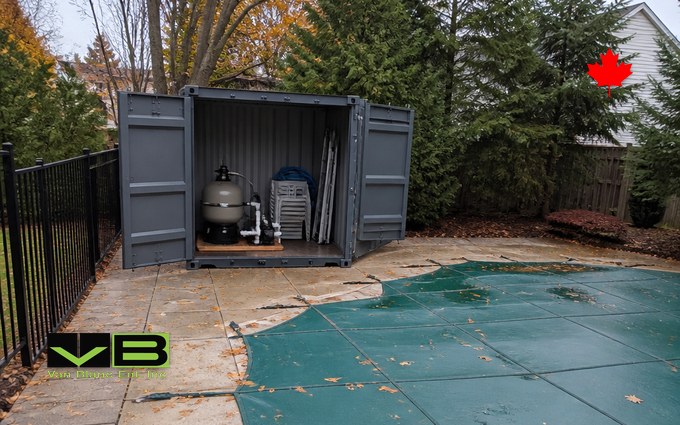
Quick Answer: Pool closing in Ontario starts once the water stays below 18°C. Balance and shock the water, lower it under the skimmer, blow out and plug every line, drain the pump, filter and heater, and fit the cover. The robot and chemicals need a locked, vented winter home kept above freezing.
What This Pool Closing Guide Covers
- Pool closing timing in Ontario
- Closing kit and supplies
- How do you properly close a pool?
- Water chemistry before the cover
- Lowering the water level
- Blowing out the lines
- Pump, filter, heater and salt cell
- Winter covers, water bags and air pillows
- Above-ground pool closing
- Where pool equipment spends winter
- Pool chemicals away from fuel
- Pool equipment box: 8ft or 10ft
- Insulated or plain steel
- Pool box layout, door to back wall
- Pool box delivery: GTA, Waterloo, Niagara
- Garage, basement, shed or steel box
- Buying the box from Van Blanc
- Pool closing FAQs
Reading Time: 24 minutes
Pool Closing Timing in Ontario
Pool closing is the fall routine that puts a backyard pool away for winter. The water is balanced and treated, the plumbing is cleared, and the pool is covered. Done well, it protects the pipes, the liner and the May opening. The water temperature sets the start. Leslie’s, the pool retailer, says pool water needs to be consistently below 65°F, about 18°C, before closing. Close too soon and the sanitizer gets used up quickly, which raises the risk of algae. Trevi, the Quebec pool chain, adds a simpler rule: close as late in the season as you can. A pool built inside a steel container goes through the same routine. The year-round care schedule for a container pool adds the checks on the shell.
Frost sets the other end of the window. Pentair’s MasterTemp heater manual says to shut the heater down and winterize it when the air is expected to drop below freezing, 0°C. Water trapped in the heat exchanger can freeze and damage it. Arm & Hammer tells owners to allow a few days for the whole job, since the chemicals need time to disperse between steps. So start early in the window and save the last frost-free weekend for the plumbing.
This guide comes from Van Blanc Ent. Inc., a Brantford container business that Paul LeBlanc started in 1995 and runs today with his son, Christian. Every closing leaves the same question on the deck: where the robot, the chemicals, the ladders and the loungers spend the next six months. Van Blanc’s answer is a small steel box just outside the pool fence, picked from the mini, 8, 9, 10 and 12 foot boxes in recent stock.
Closing Kit and Supplies
A closing kit and a few tools do most of the work, and most of that gear comes out once a year. It’s the snowblower’s summer twin, which is the thinking behind a two-fleet storage plan for summer and winter gear. Measure the pool and order the winter cover well ahead of closing day; Leslie’s warns against leaving it to the last minute. Trevi sells kits by pool volume and sanitizer, so know your litres and your system first.
- Winter chemicals, or a closing kit matched to chlorine or salt.
- A safety cover or a winter cover, plus water bags or cover blocks to hold a solid one down.
- Winterizing freeze plugs, one per return fitting, and a Skimguard winterizer for each skimmer.
- Non-toxic pool antifreeze. Leslie’s budgets 1 gallon per 10 feet of pipe, which is 3.8 litres for every 3 metres.
- A way to blow the lines: a liner vac, an air compressor or a wet/dry vac. Trevi specifies an industrial vacuum of at least 5.5 HP.
- A submersible pump to lower the water, and a cover pump for the winter.
- Air pillows and a cable and winch for an above-ground pool, plus o-ring lubricant.
A container pool uses the same kit, and the plumbing tie-in stage of a container pool install shows where its skimmer and returns sit.
How Do You Properly Close a Pool?
A proper pool closing follows a fixed order. Chemistry comes first because it needs time to circulate. Plumbing comes last because the pump has to keep moving water until the chemicals are mixed. Trevi says to keep the motor running until the very last moment. The pool makers and retailers in the sources agree on the sequence below. It holds for a container pool or a concrete in-ground pool alike.
- Skim, brush and vacuum the pool, then empty the skimmer and pump baskets.
- Test the water a few days ahead and balance it to the ranges in the next section.
- Shock the pool and let the water circulate. Arm & Hammer allows 24 hours before re-testing; Leslie’s minimum after the closing chemicals is one full pump cycle, about 4 to 12 hours.
- Add algaecide and a stain-and-scale treatment once the shock has done its work.
- Backwash a sand filter or clean the cartridges.
- Lower the water to suit your cover and the way the lines will be cleared.
- Turn off the heater first, then the pump, then the breaker.
- Drain the pump, filter, heater and chlorinator, and drop every drain plug in the pump basket.
- Blow out each line, plug it, and add pool antifreeze where your method calls for it.
- Pull the ladders, rails and cleaner, then fit and secure the cover.
Step seven protects the heater, whether it stands on an open pad or inside the equipment room of a pool house. Pentair’s manual says the filter pump should keep running for at least 5 minutes after the heater turns off. Where a time clock controls the pump, a low-voltage switch should cut the heater at least 15 minutes before the pump stops. Either way, water is still moving through the exchanger after the burner goes out.
Water Chemistry Before the Cover
Balanced water protects the liner and the plaster through months of standing still. Trevi notes that unbalanced winter water can promote wrinkles in a liner and wear on concrete. Test a few days before closing so there’s time to adjust, using the same kit as weekly chemistry checks on a container pool. Leslie’s and Arm & Hammer each publish closing targets, and they differ a little.
| Reading | Leslie’s closing target | Arm & Hammer closing target |
|---|---|---|
| Free chlorine | 2.0 to 4.0 ppm | 1.0 to 3.0 ppm after shock, before the algaecide |
| Total alkalinity | 80 to 120 ppm | 80 to 120 ppm |
| pH | 7.4 to 7.6 | 7.2 to 7.8 |
| Calcium hardness | 200 to 400 ppm | 180 to 220 ppm |
Water inside the overlap satisfies both charts, and for calcium hardness that means 200 to 220 ppm. Arm & Hammer also settles the order owners argue about. Shock goes in first and the water circulates for 24 hours. Re-shock if needed until chlorine reads 1.0 to 3.0 ppm, then add the algaecide; the guide says never to add the two at the same time. A closing kit’s printed order beats any chart.
Health Canada’s page on swimming pool and spa chemicals sets the handling rules for closing day. They apply to a hot tub built into a steel box as well. Wear gloves, goggles and proper footwear. Use a separate clean measuring cup for each chemical. Add the chemical to the pool water unless the label says otherwise, and never mix chemicals together. Whatever is left in the pails afterwards becomes a storage question. Open wire-deck shelving that lets air move past the pails comes into Van Blanc’s answer later.
Lowering the Water Level
The right winter level depends on the cover and on how the lines get cleared, so each source gives its own number. The cover maker’s instructions break any tie. Leslie’s adds one rule that applies to all of them: never drain a vinyl or fiberglass pool.
| Method or cover | Water level | Source |
|---|---|---|
| Lines blown out with a compressor or wet/dry vac | 4 to 6 inches (10 to 15 cm) below the skimmer inlet or tile line, whichever is lower | Leslie’s |
| Lines drained by gravity instead | Below the skimmer and every return, normally about 18 inches (46 cm) below the tile line | Leslie’s |
| Mesh safety cover | 12 to 18 inches (30 to 46 cm) below the skimmer | Arm & Hammer |
| Solid winter cover | 3 to 6 inches (8 to 15 cm) below the tile | Arm & Hammer |
| In-ground pool, Trevi method | 2 inches (5 cm) below the returns | Trevi |
| Pool with a sump well | Sump water kept under 18 inches | Trevi |
Lowering the water protects the skimmer, and how deep frost reaches into Ontario soil is why the buried plumbing gets cleared next. Trevi closes the skimmer at the three-way valve so the water leaves through the main drain. Once the level is right, it disconnects the equipment and turns off the breaker. After the plugs and antifreeze are in, Leslie’s refills a vinyl pool to 4 to 6 inches below the skimmer inlet. A gunite or plaster pool goes to the same distance below the tile line, to prevent ice damage to the tile.
Blowing Out the Lines
Blowing out the lines is the closing step an Ontario winter punishes hardest. Water left in a buried pipe freezes, expands and can split it, which is why Trevi ranks this above every other step. Its in-ground order starts at the skimmer.
Low Pressure Only
Pentair’s heater manual warns that purging a system with compressed air can make components explode. It allows only a low-pressure, high-volume blower, below 5 PSI (35 kPa), on the heater, pump, filter or piping. A compressor set up for air tools, like the one plumbed through a container workshop, runs far above that. Turn the regulator right down, or use a blower.
- Set the three-way valve so the skimmer is open and the main drain is closed.
- Put a sand filter on recirculate, or open a cartridge filter and close the backwash valve.
- Remove the return fittings and plug the closest returns.
- Attach the vacuum hose at the skimmer, unplug the farthest return, and blow until no water comes out.
- Pour pool antifreeze into that return, plug it, and move to the next farthest one.
- Blow the main drain line through the skimmer until bubbles show at the drain for several seconds.
- Pour half a gallon of antifreeze, about 1.9 litres, into the skimmer, then plug it and fit the foam insert.
Freeze plugs and skimmer guards tend to go missing between seasons, so give them a fixed home, such as a shelving layout with labelled bins. Leslie’s adds two details here. Use non-toxic swimming pool antifreeze, never the automotive kind. And a Skimguard or Gizzmo in the skimmer takes up the expansion of the ice, seals off the skimmer line and traps air in it.
Pump, Filter, Heater and Salt Cell
The equipment pad gets drained piece by piece. Leslie’s lists the drain plugs to pull: the pump strainer housing, the pump volute, the filter tank, any booster pump, the chlorinator and the heater. Every plug goes into the pump basket for spring. A multiport valve sits between two settings, or on its Winter setting where it has one.
The filter depends on its type. Trevi pours filter cleaner into a sand filter through the skimmer, lets it sit in the sand for 24 hours, then backwashes. Cartridges come out, soak in cleaner, get a thorough rinse and go into storage. A D.E. filter follows its own maker’s closing directions. A heat pump gets its hoses unclipped so the leftover water drains out, per Trevi.
A gas heater, the kind four-season container pools lean on, has its own sequence in Pentair’s manual for outdoor heaters in freezing climates.
- Turn off the power to the heater and the pump, and close the gas valves.
- Open the drain cock at the bottom of the manifold adapter and drain the heat exchanger completely.
- Help it along with low-pressure air through the pressure switch fitting.
- Remove the water pressure switch and plug its port against bugs and dirt.
- Drain the plastic inlet and outlet manifold through the outlet pipe.
- Cover the air inlet grate with a plastic bag to keep out leaves and insects.
Pentair is blunt about the stakes: freeze damage is specifically not covered by its warranty. A salt system adds one more part. Trevi unplugs the power and the flow sensor, disconnects the cell, cleans it with the recommended product and stores it for the winter. Pool lights come off their transformer, and the transformer and the lights go indoors. Those pieces are small and easy to lose. Van Blanc’s 8 foot box with a man door and a barred window has wall space for a shelf that holds every one.
Winter Covers, Water Bags and Air Pillows
A winter cover keeps leaves and debris out, which makes the spring opening easier. A mesh safety cover anchors into the deck. A solid winter cover is held down with water bags, water tubes or cover blocks. Rain and meltwater collect on top of it, so a cover pump has to clear it. Arm & Hammer’s rule for either type is a tight fit. Leslie’s warns against tenting, where the cover pulls away from the pool wall at an angle. As rain and snow land on a tented cover, they drag the water bags into the pool or rip the cover. In a hard-freeze area, or with the water lowered more than 12 inches (30 cm), Leslie’s adds 2 feet (61 cm) to each measurement.
The cover pump, a spare water tube and the test kit for Leslie’s monthly balance check are the pool gear that comes out between November and April. They belong nearest the door that faces the pool gate. Picking which way the doors face on delivery day settles that before the box lands. Trevi’s mesh-cover routine runs a rope around the pool, hooks a star of elastics to it, lays the cover over the elastics and tightens the frame. Trevi checks the tension through the winter, because ice can pull it too tight. Leslie’s suggests checking the chemical balance about once a month after closing and keeping the cover clear of water and debris.
Above-Ground Pool Closing
An above-ground pool closing uses the same cleaning and chemistry, simpler plumbing, and a bigger pile of equipment to carry away. Leslie’s disconnects the filter hoses from the skimmer fitting and the return fitting and plugs the openings. The pump and filter then go to a non-freezing location, such as a basement or an insulated box held above freezing. Arm & Hammer puts an air pillow in the centre of the pool, where it absorbs the expansion of freezing water and takes snow load off the cover.
Leslie’s ties the pillow to an anchor or to the cover. A large pool gets several pillows joined at their corner grommets. A cable runs through every grommet on the cover and is tightened until snug. Leslie’s warns against hanging weights on the grommets, which strains the cover until it tears. The above-ground owner ends the day holding a pump, a filter, hoses, a ladder and often a robot, and all of it needs a place above freezing. A basement works where there is room and a clear path to the stairs. A small box from the minis up to the 12 footer does the same job beside the pool.
Where Pool Equipment Spends Winter
Everything that comes out of a pool closing can be sorted by what its maker or retailer says about cold. The table lines up those sources and gives each item its winter home.
| Item | What the source says | Winter home |
|---|---|---|
| Robotic pool cleaner and its power supply | Maytronics: drain it, clean the filter basket, coil the cable, shield it from sun, rain and frost; best stored at 5 to 45°C (41 to 113°F) | Above freezing: the house, or foam plus a small thermostat heater |
| Pool chemicals | Leslie’s: even brief overnight freezing spells can ruin them. Health Canada: cool, dry, well ventilated, away from sunlight | Above freezing, vented, locked and away from heat |
| Above-ground pump and filter | Leslie’s: move them to a non-freezing location | Above freezing |
| Hoses | Leslie’s: lay them out straight in a non-freezing location | Above freezing |
| Salt cell, cartridges, light transformer | Trevi: cleaned and stored; transformer and lights indoors | Indoors and dry |
| Ladders, rails, over-the-top skimmer, cleaner | Leslie’s: remove them before the cover goes on | Any dry, locked space |
| Loungers, patio set, umbrella, floats | No cold limit in these sources; keep them dry | Any dry box, or a 20 footer for a big deck |
| In-ground pump, filter and gas heater | Drained, plugs in the pump basket, heater inlet bagged (Leslie’s, Pentair) | Stays on the pad |
Read down the last column and the winter asks for three kinds of space. One is a warm, locked corner for the robot and an above-ground pump. Another is a locked spot above freezing for leftover chemicals, away from any heater. The third is dry floor for gear that only has to stay out of the weather. A small Van Blanc box supplies the warm corner or the dry floor. An insulated unit covers both, and the right moisture absorber for a closed box keeps it dry inside.
Pool Chemicals Away From Fuel
Chlorine and shock are oxidizers, and dry acid and muriatic acid are acids (Leslie’s). Health Canada’s swimming pool and spa chemicals page sets out how to store them. Keep chemicals in their original containers, in a cool, dry, well ventilated place away from sunlight. Keep them away from food and drinks, and away from gasoline, fertilizers, pesticides, grease, paints, tile cleaners, turpentine and other flammable materials. Store liquids below powders and solids. Keep every chemical away from children and pets, which in practice means a lock small hands cannot open.
Chemical Shelf Rules
- Oxidizers such as chlorine and shock never sit near acids, which can release chlorine gas (CCOHS); Leslie’s also keeps trichlor tablets away from shock.
- Nothing on the floor and nothing above head height (CCOHS, Health Canada).
- No heater in the same box, and no electrical outlets, sparks or open flame nearby (Leslie’s, Health Canada, CCOHS).
- No gasoline in the same small space, so the mower and gas can go elsewhere (Health Canada).
- Most pool chemicals are good for about a year, most dry chlorines excepted, so clear the shelf every fall and never mix old product with new (Leslie’s).
The pool heater cares where the chemicals sit, too. Pentair’s manual says chemicals should not be stored near the heater installation, because corrosive fumes in its combustion air can void the warranty. It also says not to store gasoline, cleaning fluids, varnishes, paints or other volatile flammable liquids near the heater or in the same room. The mower and its gas can belong in the garage or in a second small box that trades the mower for the snowblower.
Leslie’s makes the point that matters for any closed space. Fumes from oxidizers and strong acids can corrode metal over time where air sits still, so an enclosed chemical store needs slots, gaps or holes for air. Van Blanc’s custom-features page says most containers ship with 2 to 4 vents, and more are added as the job needs. A chemical shelf is that kind of job, so put extra vents for a chemical shelf on the quote. The same Leslie’s article says a lockable, well-ventilated storage spot outside the home or attached garage is always preferred. It also says that isn’t always feasible in all climates, and an Ontario winter shows why: the chemicals must not freeze, and they must not sit beside a heater. Clearing the shelf every fall leaves little to carry over. Whatever stays needs a locked spot above freezing and away from heat, such as the child-proof cabinet indoors that Leslie’s allows.
Pool Equipment Box: 8ft or 10ft
A small shipping container a few steps outside the pool fence is that lockable, ventilated spot. Walls, roof and doors are steel. The cargo doors take a padlock tucked behind a welded lockbox, and the vents go in at our yards. The box stays on its pad all year, so the chemicals, the robot and the deck gear are a short walk from the water in May. Van Blanc’s list of small-box jobs already includes pool and lawn equipment. It says to keep pool chemicals and a gas mower out of the house and apart from each other, which squares with Health Canada’s list.
The two sizes compared here hold the pool gear from the winter table with room to walk in: the 8ft and a 10ft with floor to spare for the loungers. The figures below come from Van Blanc’s own product pages.
| Question | 8ft | 10ft |
|---|---|---|
| Inside | 7’6″ x 6’11” x 6’9″ (2,287 x 2,112 x 2,062 mm), about 52 sq ft of floor | 2,840 x 2,350 x 2,393 mm on the spec sheet our 10ft page quotes, about 16 m³ (560 ft³) |
| Outside | 8 ft (2,438 mm) long and 2,200 mm (7’2.6″) wide on the published sheet | 9’10” x 8’0″ x 8’6″ (2.99 x 2.44 x 2.59 m), half a parking stall, 8 ft by 10 ft |
| Doors in recent stock | Cargo doors with a 6’11” x 6’5″ opening, plus a side man door and a barred window | Cargo doors with a man door and window, an oversized man door, or a roll-up with a sill plate |
| Pool job | A walk-in equipment house: chemical shelf at one end, robot and pump on the floor, ladders along the wall | The same, plus loungers and a patio set, with daily summer trips through a roll-up |
As a rule of thumb, one box per pool holds that list. A second small box earns its place when the mower, the gas can and the snowblower also need a home, because they can’t share with the chemicals. The door decides how the box gets used. Cargo doors open the full end for a patio set or a pump on a dolly. A man door with a barred window suits the daily trip for a scoop of shock and puts daylight on the shelf. A roll-up coils into the top of the opening, so nothing swings into a narrow side yard. Van Blanc fits roll-ups in 6, 7, 8 and 10 foot widths. The 8 foot against 10 foot roll-up question has its own page. A busy summer deck suits the 10ft and its roll-up; a box that is mostly a winter store does well with cargo doors and a man door.
Christian LeBlanc, second-generation operator, Van Blanc Ent. Inc.: “When a buyer tells me the box is going next to a pool, the first thing I ask is what goes on the shelves. If chlorine is going in there, we talk about vents before we talk about colour, because a closed steel box holds fumes. Then I ask them to measure the gate, the path and how close the truck can get.”
New Steel for a Box in View
A box that sits in sight of the patio all summer is a fair case for buying new. The industry calls a new container one-trip, after its single loaded voyage from the factory. Van Blanc’s new container page says the paint is one uniform factory colour that looks right in a backyard. It adds that one-trip units hold their resale value better than any used grade. They can carry minor handling marks from cranes and forklifts, and we point those out in the rows. The grey 8ft in recent stock is new, and recent 10ft stock has included new true tens and new cut-downs made from a 20ft. Factory-built tens are scarce and go fast when a batch lands, so ask early about new steel for a box the whole patio looks at. Anyone weighing a small box against a full-size one can compare a 10ft with a 20ft or 40ft, grade by grade, before calling.
Minis, 9ft, 12ft and 20ft
- The 5’7″ mini, 5’7″ x 4’10” x 4’10” (1.70 x 1.47 x 1.47 m), with double cargo doors and a lockbox, makes a spring-to-fall chemical locker for an above-ground pool.
- The 6 1/2 ft mini is roughly 6 1/2 ft long and 5 1/2 ft wide, and just under 6 ft tall. Van Blanc’s small-container page puts this one beside the pool fence for a spare pump, the chemicals and the cleaning gear.
- Each 9ft in recent stock is 9 ft (2.74 m) long and adds a side man door and a barred window. One build is rated 13 cu m (460 cu ft) on its doors.
- The repainted 12ft with full cargo doors is 12 ft (3.66 m) long and covers 8.92 sq m (96 sq ft) of ground. It lays ladders and rails flat with a walkway beside them.
- A full-size 20ft, inside 19’4″ x 7’8″ x 7’10” and 33.2 m³, takes the whole deck plus the pool gear, with the chemicals at the vented end.
Stock rotates across our 4 Brantford yards, so treat each size as an example of what turns up, and call 519-754-6844 for this week’s list.
Insulated or Plain Steel
Insulation decides whether the box can keep the robot and an above-ground pump through January. A plain steel box keeps out rain, snow and hands, and the air inside follows the weather. That makes a plain box the year-round home for gear with no cold limit, and, in shade, the spring-to-fall home for the chemicals. An insulated box held above freezing takes the robot, the pump, the filter and the hoses all year. It’s the build to price for a pool with a robot.
Van Blanc frames and installs insulation as an option on any container. The spray-foam build on 20s and 40s uses two to three inches of closed-cell foam on the walls and ceiling of a one-trip or cargo worthy box. That works out near R-10 to R-15 on the flat, and less at the ribs. The insulated container page puts paint and chemical lots among the loads kept between roughly five and thirty degrees. A foamed box also needs vents and a heater sized for its cold ribs, the page adds. Pool chemicals are the exception, because Health Canada says not to expose chemicals to heat or flame: they stay out of any box with a heater in it.
| Question | Plain small box | Insulated small box, held above freezing |
|---|---|---|
| Chemicals | Spring to fall, in shade; over winter, a locked spot above freezing and away from heat | Never in a box with a heater |
| Robotic cleaner | Spring to fall, out of direct sun | All year |
| Above-ground pump, filter and hoses | Spring to fall | All year |
| Ladders, loungers, floats, cover pump | All year | All year |
| Power | None needed | A small thermostat heater on a circuit roughed in at our yards |
| Vents | Yes, for fumes and summer heat | Yes; foam does nothing about fumes |
Foam slows the temperature swing, and holding the inside above freezing through a cold week takes heat on a circuit wired to ESA rules. A small thermostat-controlled electric heater does it. Leslie’s keeps chemicals away from outlets and heat sources, and Health Canada says not to expose them to heat or flame. So a heated box holds the robot, the pump and the hoses, and the chemicals spend the winter somewhere else. Van Blanc does the foam, the liner, the vents and the electrical rough-in at our yards, and a licensed electrician makes the final connection on site.
Pool Box Layout, Door to Back Wall
A pool equipment box works best a few steps outside the pool fence, level, with its doors facing the gate. Gravel under the four corners keeps the steel off wet ground. Sizing and levelling a gravel pad for a small box takes a rake and a level. Keep the box clear of the gas heater, whose maker wants chemical fumes out of its combustion air. If chemicals live inside all summer, put the box in shade. Leslie’s says to keep chemicals out of storage containers placed in direct sunlight. The sun can make confined areas hot very quickly, and pool enzymes lose strength above 120°F (49°C).
Inside, lay it out from the door back.
- At the door end, under a louvre or a turbine vent overhead: the chemical shelf, liquids low and dry products above, oxidizers and acids on separate shelves.
- Along one wall: the robot upright on its caddy with the cable coiled, plus the cover pump and spare water tubes. Maytronics recommends the caddy partly to keep rodents and insects out.
- At the far end: an above-ground pump and filter, drained, with the hoses laid out straight.
- Behind the cargo doors: ladders, rails, floats and loungers.
- Nowhere in the box: the mower, the gas can or a propane tank.
If the box is insulated and heated for winter, empty the chemical shelf before the heater goes on.
Getting the box into a backyard is a delivery question. A tilt-deck truck sets it down wherever the truck can back in. Many pools sit behind the house and a fence, though. Where the truck can’t reach, a crane lift over the back fence is planned and quoted before the day. Marking the exact spot with paint or stakes saves a second attempt. The minis carry fork pockets, so a forklift rated for the weight can shift an empty one later. Any move after delivery is yours or a hauler’s to arrange.
Pricing a Pool Equipment Box
Tell us what goes in the box, whether it has to stay above freezing, which door suits your gate, and the delivery postal code. We’ll say which small boxes are on the ground, what vents and foam add, and send back one all-in number. Every quote comes with a real lead time, not a hopeful one. The fastest answer is a phone call.
Family-run in Brantford since 1995 · four Brantford yards · 4.9★ across 140+ Google reviews.
Pool Box Delivery: GTA, Waterloo, Niagara
Van Blanc delivers small boxes across Ontario from our 4 Brantford yards, and a box already on the ground reaches a backyard in 1 to 3 days. Pool decks across the Region of Waterloo, the GTA and the Niagara Peninsula all sit inside that window. The table gives the road distance and drive time from east Brantford to each city hall, so you can see where your street falls.
| Where the box lands | By road from east Brantford | Drive time | Delivery window |
|---|---|---|---|
| Kitchener City Hall | 49.1 km | 57 min | 1 to 3 days |
| Brampton City Hall | 94.9 km, Highway 403 and the 407 ETR | 77 min | 1 to 3 days |
| Niagara Falls City Hall | 110.6 km, Highway 403 and the QEW | 88 min | 1 to 3 days |
| Ajax Town Hall | 144.7 km, Highway 403, the 407 ETR and Highway 401 | 111 min | 1 to 3 days |
Peel pool owners can check what we sell into Brampton, from the 10ft up. On the Durham shore of Lake Ontario, the Ajax size table already lists a pool-equipment box. Pool owners on the Niagara side can see what lands in Niagara Falls. A box that needs vents, foam or a new door ships once the work at our yards is done, and the quote names that date.
Garage, Basement, Shed or Steel Box
Pool gear can winter in four places: the garage, the basement, a shed or a steel box. The garage is close, dry and already built. Leslie’s accepts a garage or a basement for chemicals only when they are locked in child-proof cabinets. A garage also needs enough air movement to stop fumes building up. A garage that holds the car, the mower and the gas can puts the chemicals beside fuel, which Health Canada rules out.
The basement stays above freezing, which suits the robot and an above-ground pump. Every pail and pump goes down the stairs in fall and back up in spring. A garden shed holds chemicals when it is weatherproof and ventilated, the two conditions Leslie’s sets for a storage shed. The steel box is the lockable, ventilated store outside the house that Leslie’s prefers. It arrives with its vents, foam and a roll-up fitted at our yards. It needs only a level pad, and it keeps the pool gear in one place by the fence.
Pool houses do the same job in wood, and a cabana with its own equipment room is the bigger build, for a yard that wants a change room as well. Van Blanc sells the box outright, so it stays on the property for as many seasons as the pool does. If the pool ever comes out, the box can be sold on. A vented box by the fence takes the chemicals out of the garage from spring to fall. An insulated one takes the robot out of the basement and the deck gear out of the shed.
Buying the Box From Van Blanc
Van Blanc Ent. Inc. sells every container outright. Our small boxes are new, used, or shortened from a longer box and closed off with a welded end wall. Each one is graded on the four-step ladder from new one-trip to as-is: new (one-trip), cargo worthy, wind and watertight, and as-is. A box headed for foam and a liner starts as a one-trip unit or a clean cargo worthy one.
A Van Blanc quote puts the box, its doors, any vents, foam or electrical rough-in, and the delivery to your backyard into one all-in figure. A box on the ground with no changes ships in 1 to 3 days. Small stock turns over quickly, so call 519-754-6844 for what is in the rows this week, then book a visit to walk them before the first hard frost.
Frequently Asked Questions
Can I just shock the pool to close it?
No. Shock is one step of a closing. Arm & Hammer follows it with algaecide and a stain-and-scale treatment. In a freezing climate the water level, the plumbing and the equipment still have to be winterized. Trevi ranks clearing the lines above every other step, because water left in a buried pipe can freeze and split it.
What chemicals should I put in my pool before closing it?
Balance the alkalinity, pH and calcium hardness first, then shock the pool, then add algaecide and a stain-and-scale treatment once the shock has worked. A closing kit matched to your sanitizer bundles the same products. Test a few days ahead so there is time to adjust, and follow the kit’s printed order where it has one.
Do you put algaecide or shock first when closing a pool?
Shock goes first. Arm & Hammer’s closing guide circulates the water for 24 hours after the shock, re-shocks if needed until chlorine reads 1.0 to 3.0 ppm, and only then adds algaecide. The guide says never to add the two at the same time. If your closing kit prints a different order, follow the kit.
How much would it cost to close a pool?
The price of a pool closing moves with the work in it. In-ground or above-ground, pool size and cover type all count, and so does who lowers the water and blows the lines. A heater or salt system adds winterizing work. Ask a pool company exactly what its closing includes before you compare quotes.
How do I close my inground pool for winter in Canada?
Wait for cool water, then balance, shock and add winter chemicals. Lower the water for your cover type, blow out and plug every line, and add pool antifreeze. Drain the pump, filter and heater, store the removable parts above freezing, and fit the cover tight with no tenting.
Where should pool chemicals be stored over the winter?
Somewhere above freezing, dry, ventilated, out of sunlight and locked, in the original containers. Keep liquids below dry products and oxidizers apart from acids. Health Canada says not to expose them to heat or flame, and to keep them away from gasoline, fertilizers, paints and other flammable materials. A heater and the mower’s fuel both stay out of their space.
Can a robotic pool cleaner stay in an unheated shed or container?
Maytronics, maker of Dolphin cleaners, gives a best storage range that starts above freezing and says to shield the robot from sun, rain and frost. An unheated shed or box follows the outdoor temperature through an Ontario winter, so keep the robot in the house or in an insulated box with a small heater. Drain it, clean the filter and coil the cable first.
What size container holds pool equipment?
An 8ft or a 10ft holds the robot, the pump, the ladders and the cover pump with room to walk in. From spring to fall, the chemicals share its vented shelves. Insulated and heated, it keeps the robot and pump above freezing through winter. A mini suits an above-ground pool’s cleaning gear and summer chemicals, and a 20ft takes the patio set as well. Van Blanc delivers every size from our 4 Brantford yards.
Sources
- Leslie’s. Pool Closing Guide and Checklist and How to Store Pool Chemicals the Right Way. Leslie’s Pool Closing Guide; Leslie’s How to Store Pool Chemicals. Checked October 2026.
- Trevi. In-Ground or Built-In Pool Closing Guide. Trevi In-Ground Pool Closing Guide. Checked October 2026.
- Arm & Hammer. Steps for Closing and Winterizing a Pool. Arm and Hammer Steps for Closing and Winterizing a Pool. Checked October 2026.
- Health Canada. (2024). Swimming pool and spa chemicals. Health Canada Swimming Pool and Spa Chemicals. Checked October 2026.
- Pentair. (2023). MasterTemp Pool and Spa Heater Installation and User’s Guide, P/N 472592 Rev. Q, safety, electrical and winter operation sections. Pentair MasterTemp Heater Manual (PDF). Checked October 2026.
- Canadian Centre for Occupational Health and Safety. (2025). Swimming Pool Products. CCOHS Swimming Pool Products. Checked October 2026.
- Maytronics. (2025). How Should I Store My Robotic Pool Cleaner During Winter? Maytronics Robotic Pool Cleaner Winter Storage. Checked October 2026.
- Project OSRM. Open Source Routing Machine, public driving router, routes from east Brantford to each city hall in the delivery table. OSRM Driving Route, Brantford to Brampton City Hall. Checked October 2026.
A Pool Box From the Brantford Yards
We have been supplying shipping containers across Ontario since 1995. Our office is at 90 Morton Avenue East in Brantford, all four of our yards are in Brantford, and every box is paid for on arrival.
Van Blanc Ent. Inc., 90 Morton Ave E Unit 1B, Brantford, ON N3R 7J7, 519-754-6844.
Bring a list of what comes off the deck this fall, what has to stay above freezing, and a photo of the path from the street to the pool. We’ll tell you on the call which box fits the gate and when it can land. Worth the drive for unbeatable quality, family customer service with 30 years of experience.