
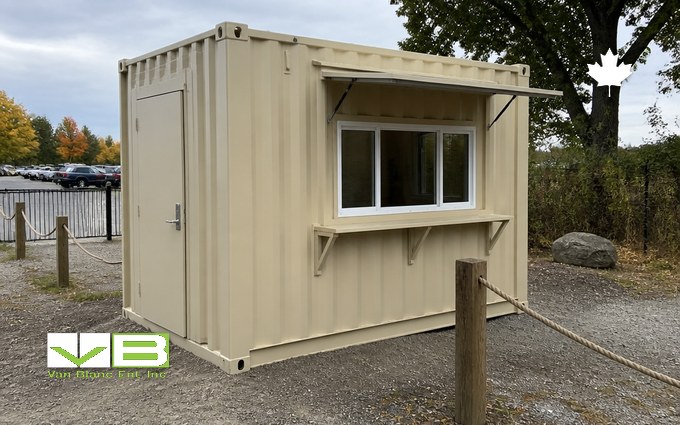
Quick Answer: A ticket booth is the staffed building where a venue sells entry, parking or passes. Buyers choose among three shells: a prefab aluminum booth, a welded steel kiosk, or a converted shipping container. Van Blanc cuts the service window and lockable man door into an 8ft or 10ft in Brantford.
Where This Ticket Booth Guide Goes
- What Is a Ticket Booth?
- Ticket Booth Jobs Across Ontario
- Parking Booth Basics
- Ticket Booth Options: Prefab, Kiosk, Container
- Ticket Booth Sizes Side by Side
- The Booth’s Working Kit
- The Ticket Window and Counter
- Cash, Keys and the Man Door
- Cold Shifts at the Window
- Container Ticket Booth: 8ft or 10ft
- Layouts for Five Kinds of Gate
- Selling Window or Security Gate
- Grade of the Base Box
- Lead Times for a Converted Booth
- Delivery to Fairgrounds and Lots
- Ticket Booth Quote Drivers
- Ticket booth FAQs
Reading Time: 15 minutes
What Is a Ticket Booth?
A ticket booth is a small, enclosed workstation where one or two people sell admission, check passes or take parking fees through a window. It shelters the seller from weather and keeps the cash on the far side of the counter. Most booths are freestanding. They sit on a pad at the edge of a lot, the mouth of a fairground or the foot of a ski hill.
The names change with the venue. Theatres call it the box office, and Canadian English also has the ticket wicket. A parking operator calls the same building an attendant booth, a highway authority calls it a toll booth, and a mall calls it a kiosk.
Van Blanc sells shipping containers from four yards in Brantford. The booth this guide ends on is a short steel box with a window and a door cut in. That is the in-yard window and door work we do before a truck is loaded. A gate manager comparing booths deserves the full picture first, though, so every shell gets a fair description below.
Booths are bought for one reason: the seller has to stay at the window for a whole shift. A folding table and a canopy manage that on a dry June afternoon. A booth manages it in sleet, at dusk and in February. Like a small steel box with a locking side door, it locks when the gate closes.
Christian LeBlanc, second-generation operator: “Before we talk size, I ask two things. Which side does the line stand on, and which way does the cash walk out at closing? The window goes on the line side and the man door on the quiet side. We cut both at our yards before the box leaves Brantford.”
Ticket Booth Jobs Across Ontario
Ticket booths in Ontario work more weekends than most people notice. The Ontario Association of Agricultural Societies lists more than 210 yearly fairs across the province. Nearly every one sells gate admission from a shed, a trailer or a booth at the entrance.
Then add the rest of the calendar. The attractions corridor around containers for sale near the Falls and Clifton Hill sells timed entry all summer. Ski hills sell lift tickets all winter. Outdoor rinks, Christmas markets, corn mazes and paid lots around arenas and hospitals each need a window too.
The buyers fall into a few groups.
- Agricultural societies and fair boards with a main gate and a second gate for the parking field.
- Attractions and tourist operators that sell timed entry, often with a separate window for groups.
- Parking operators running a lot by the shift, with an attendant at the entrance lane.
- Ski hills and tubing parks that sell lift tickets and rentals at the base of the hill.
- Winter festivals and markets that charge at the gate for a few weeks a year.
Most of them buy one to three booths at a time. A fair board might want a main gate booth and a parking field booth. A ski hill in the snow country north of Barrie might want a lift ticket booth plus a small box for snow school sign-in. With so few units, each one has to last: it is seen and used every open day for a decade or more.
Parking Booth Basics
A parking booth is a ticket booth turned to face cars. The attendant sits beside the entrance lane and takes payment or checks permits through a window at driver height. A barrier arm or gate controller is often wired inside. Van Blanc delivers booth boxes to city lots as well, including sites across Toronto and its event districts.
PortaFab, a booth maker, describes its standard parking booths as all-welded aluminum. It lists 360-degree visibility through safety glass, integrated climate control, and electrical and lighting equipped. That is a fair summary of what a lot operator expects from any shell.
Three details set a parking booth apart from a walk-up ticket booth.
- The window sits on the driver’s side of the lane, which fixes the booth’s orientation first, much like pointing a container’s doors before it lands.
- The attendant needs sightlines up the lane and back toward the exit, so glass goes on more than one wall.
- The booth sits beside moving vehicles all day, so a curb or bollards on the lane side are a common addition.
A Van Blanc container booth answers those needs with a window cut into the lane-side wall and a second window toward the exit. The man door goes on the wall away from traffic. Our notes on framing an office window into corrugated steel show how a cut opening keeps the wall square. For a lane where drivers pay without leaving the car, the drive-up window we cut for coffee containers works from the same driver height.
Parking lots also run longer hours than most gates. A hospital or downtown event lot can staff its booth from early morning into the night, in every season. That pushes heat, light and a dry floor up the list.
Ticket Booth Options: Prefab, Kiosk, Container
Ticket booth shells come in three families. Each is described below by what its makers publish. That way a buyer can line them up on the same questions: walls, size, how it moves and how long the build takes. For the container side in more depth, the 10ft market guide for Canadian buyers explains factory tens and cut-downs.
Prefab aluminum and panel booths
A prefab booth is factory-built from aluminum framing and insulated panels, glazed on most sides and shipped assembled. Industrie Fabco lists its FK1200 kiosk at 1248 mm x 1850 mm, a 4 by 6 foot footprint. The spec sheet gives a clear anodized aluminum structure, 6 mm grey tempered glazing and a two-layer elastomer roof membrane.
PortaFab offers 19 standard sizes, from 3′ x 4′ to 8′ x 20′ as one-piece units. It notes that larger sizes may need a two-piece design with some onsite construction. Panel walls are compared by R-value, the same yardstick used in an R-value table for container insulation. Prefab booths are light, bright and quick to ship in standard sizes, with air conditioning, ventilation and lighting added from an options list.
Welded steel and stainless kiosks
A steel kiosk trades some glass for a welded frame and a heavier skin. Par-Kut describes every ticket booth it builds as a solid welded galvanized steel framework with a factory-installed electrical system. Little Buildings lists up to eight windows per booth on its galvanized steel ticket booths. Its standard features include a steel work counter and a steel door with a lock and hydraulic closer.
Stainless is the heavy end. York Guard Shack’s stainless ticket booth measures 6.5 x 8 ft and is built from 304 stainless panels. The walls carry 2-inch insulation and the roof 6 inches. For custom sizes, the maker gives a lead time of 120 to 150 days, possibly longer. A container booth gets its hardened lock a different way, through the cargo-door lockbox and a shrouded puck lock sized for that lockbox.
The converted shipping container
A converted container starts as a short steel box with corner castings, cargo doors and a plywood floor on steel cross members. At Van Blanc the window, the steel man door, insulation and an electrical rough-in go in at our yards before delivery. The box then arrives as one finished unit on a tilt-deck truck.
The walls are corrugated container steel. The cargo doors stay on one end for storage. The whole booth lifts by its fork pockets or corner castings if the venue changes its layout. The ten-foot product page, with its kiosk and booth notes, makes a point worth repeating. It calls the 10ft the smallest container that converts into occupied space without feeling like a phone booth.
| Question | Prefab aluminum booth | Welded steel or stainless kiosk | Converted container |
|---|---|---|---|
| Walls | Aluminum frame, insulated panels, lots of glass | Welded galvanized or stainless frame and skin | Corrugated container steel with framed cut-ins |
| Typical footprint | 3′ x 4′ to 8′ x 20′ in one maker’s standard list | 6.5 x 8 ft for one stainless model; other sizes to order | 8ft or 10ft long; the 8ft about 7 ft wide, the 10ft 8 ft wide |
| Glass | Often 360 degrees | Several windows in the maker’s layout | Window cuts placed for your line and lanes |
| Storage | Cabinets inside the booth | Cabinets and counters | Cargo doors on one end for signs, floats and barriers |
| Moving it | Forklift slots, casters or skids | Forklift slots or casters | Fork pockets, tilt-deck or crane |
| Where it is built | Maker’s factory | Maker’s factory | Van Blanc’s yards in Brantford, before delivery |
Any of the three can run a gate well. A converted container earns its place where the booth also locks up gear overnight. It shrugs off a forklift nudge, and it still looks solid at the entrance ten winters later. When its seals wear, replacement door gaskets for a working box keep the booth dry.
Ticket Booth Sizes Side by Side
Ticket booth size starts with how many people work the window at once. A single seller with a card terminal and a cash drawer fits in about 4 by 6 feet. That is why the size turns up in so many maker lists. Two sellers at two windows want something closer to 6 by 8. As a rule of thumb, add floor for every job the booth does besides selling.
The two short containers Van Blanc sells sit right in that range. Our small container sizes under ten feet add shorter options when stock allows. Every figure below comes from our own product pages.
| Measurement | 8ft container | 10ft container |
|---|---|---|
| Outside length | 2,438 mm (8’0″) | 2.99 m (9’10”) |
| Outside width | 2,200 mm (7’2.6″) | 2.44 m (8’0″) |
| Outside height | 2,260 mm (7’5″) | 2.59 m (8’6″) |
| Inside length x width | 2,287 x 2,112 mm (7’6″ x 6’11”) | 2,840 x 2,350 mm |
| Inside height | 2,062 mm (6’9″) | 2,393 mm |
| Floor or volume | 4.83 sq m (about 52 sq ft) | approx. 16 m³ (560 ft³) |
| Empty weight | Read the unit’s plate | approx. 1,300 kg (2,870 lb) |
An 8ft gives one seller a room about the size of a large prefab booth. A 10ft is a full 8 feet wide, with room for two stations along one wall and a chair that can push back. The 8ft page’s measured inside dimensions also give the cargo door opening, 2,106 x 1,949 mm, which matters if the booth doubles as storage. The 10ft inside figures come from the spec sheet our 10ft page quotes. Sizes vary a little between factories, so ask Van Blanc for tape measurements of the actual unit.
The Booth’s Working Kit
Every ticket booth needs the same short list inside, whatever the shell. Par-Kut’s ticket booth page names the minimum features. They are a work counter, a storage or money drawer, an overhead light and electrical outlets. Add a weather-resistant roof and walls, a slip-resistant floor and climate control. It is a useful checklist to hold any quote against, ours included. On a container booth, climate control sized for a small box is a separate line.
Booth checklist before you order
- Count the selling positions, then the windows. One window per seller, plus any for sightlines alone.
- Decide the counter height inside and the ledge outside, and who stands or sits at each.
- Pick the door wall: away from the line and away from traffic.
- List the power loads: terminal, printer, light, heater, maybe a gate controller.
- Plan the cash path, from drawer to drop safe to the office at closing.
- Decide what else lives in the booth overnight: signs, floats, barriers, cones.
- Measure the pad and the route a delivery truck takes to reach it.
On a Van Blanc booth, the openings, insulation and electrical rough-in are ours. The counter, shelves and drawer go in after the box lands, often by a local carpenter. That split keeps the steel work in the yard. Our man door framing and placement walkthrough shows how the door frame is welded in so the door keeps closing square.
The Ticket Window and Counter
The ticket window is the part of the booth customers judge it by. On a prefab booth it is usually a sliding window. Par-Kut lists speaker tubes, intercoms, cashier windows, locking cash drawers and deal trays with transaction covers among its features.
On a container booth, the opening is cut and framed at our yards. Van Blanc’s list of steel-framed windows, security bars and other yard modifications describes windows in custom sizes, cut into any wall under engineered drawings. The steel bars stop glass-break entry without darkening the inside.
A second route suits venues selling to a crowd. A roll-up door in 6, 7, 8 and 10 foot widths can go on any face of a container. A side-facing 8 or 10 foot roll-up turns a plain box into a serving window that closes down at the end of the day. Our comparison of eight- and ten-foot roll-up doors on short boxes weighs the two widths. The page on service and display windows on retail containers shows a counter ledge under a cut opening.
Accessible service counters in Ontario
Ontario’s Integrated Accessibility Standards regulation, O. Reg. 191/11, sets rules for new service counters at section 80.41. It requires at least one counter that accommodates a mobility aid. That counter needs a countertop height usable by a seated person, knee clearance where a forward approach is needed, and clear floor space in front. Whether section 80.41 applies to your booth depends on the organization and the project, so ask your accessibility lead before the window height is set. A lower window is simple to cut in the yard, and framing a lower window opening follows the same steps as any other cut.
Cash, Keys and the Man Door
A ticket booth holds cash, and the seller often works alone at the edge of a lot. The Canadian Centre for Occupational Health and Safety (CCOHS) defines working alone as being on your own, unseen and unheard by another person.
Its fact sheet on handling money lists steps any booth operator can build in.
- Good visibility, so staff can see out and passers-by can see in.
- A counter high and deep enough to give the seller some distance.
- A cash control policy, with the minimum amount kept in the drawer.
- Electronic payment encouraged, and a locked drop safe.
CCOHS also advises against counting cash in public view, and against leaving by an exit into poorly lit, unobserved areas.
Several of those steps are shell decisions. Visibility depends on where the window cuts go, and counter depth is a fit-out decision. A drop safe needs a solid floor to bolt into. A container has plywood on steel cross members, covered in our notes on container floor plywood. A door that opens onto a lit path is a placement decision, made when you tell Van Blanc which wall the man door goes on.
The lock is the other half. On the 8ft in recent stock, the man door locks with its own handle. A 10ft with the same layout shows a keyed handle and a padlock hasp. The 10ft with an oversized man door carries a hasp as well. The cargo doors on the far end close with locking bars and a steel lockbox that shields the padlock from cutters. Our write-up on the steel hood that guards a booth’s back-door padlock explains why that hood matters on a box left alone overnight.
Cold Shifts at the Window
A ticket seller at a ski hill or a winter market spends hours almost still, beside a window open to the wind. CCOHS reports that the American Conference of Governmental Industrial Hygienists (ACGIH) suggests a work-warming regimen in continuous cold work. The trigger it gives is a wind chill of -7°C or below.
The same CCOHS page lists heated warming shelters, and shielding workstations from wind or drafts, among its engineering controls. For work at or below -12°C it adds arrangements to minimize sitting and standing for long periods. That describes a ticket shift exactly. It also lists gloves below 4°C for light work when fine dexterity is not required, and making change in gloves is slow.
Van Blanc insulates containers at our yards before delivery, with spray foam or rigid panel depending on the job. That includes foam that stops the ceiling sweating and leaking heat. Our custom features page calls insulation essential for occupied builds such as offices and shops, and a booth is occupied all shift. The guide to spray foam and panel insulation for Ontario boxes covers the choice. For the heat source, read heating a small container with a mini-split or a wall unit. Interior electrical work is roughed in to spec at the yard, and a licensed Ontario electrician makes the final connection at your site.
Container Ticket Booth: 8ft or 10ft
A container ticket booth from Van Blanc is an 8ft or a 10ft. It has a window cut on the line side and a steel man door on the quiet side. For winter work it also gets insulation and an electrical rough-in. All of it is done at our yards before the truck is loaded.
The cargo doors stay on the end wall. That end becomes the venue’s closet for barriers, signs and the float box, opened from the back while the window keeps selling. Recent stock has included both sizes already fitted with openings, which can shorten the build. One was a grey 8ft with a side man door and a barred window. Another was a ten with cargo doors, a man door and a window.
| Venue need | 8ft booth | 10ft booth |
|---|---|---|
| One seller, one window | Fits well; the most compact footprint | Room to spare for storage |
| Two sellers, two windows | Tight | Two stations on one long wall |
| Parking lane, driver-side window | Small enough for a lane island | Room for a gate controller and a chair |
| Booth plus overnight storage | Cargo doors take a mower or barriers | Cargo doors plus more floor behind the seller |
| Width for a forward-approach counter | About 7 ft outside | A full 8 ft outside |
Both sizes take the same modifications. Most containers ship with 2 to 4 vents, and Van Blanc adds more where a heater and a busy door raise the humidity inside. The vent placement guide for closed steel boxes covers where they go.
New units are called one-trip in the trade, because they made a single loaded voyage. They are listed on our page of new boxes with original paint. A booth the public sees every day is a natural home for one.
One, two or three boxes
Most venues that call about booths are buying one to three. These are the common sets.
- A ticket booth and a storage box at a fairground.
- Two booths at the in and out lanes of a parking lot.
- A lift ticket booth plus a 10ft for snow school gear at a ski hill.
Ordering them together means one site plan, one delivery day where the route allows, and matching paint along the gate. To compare every size and grade on the ground before choosing, see all the stock across our four yards, size by size.
Spec a booth for your gate
Tell us how many sellers, which side the line or the lane is on, what the booth stores overnight and where it will sit. We will tell you on the phone whether it is an 8ft or a 10ft and where the window and door go. Then we send one all-in number with a real lead time.
Family-run in Brantford since 1995 · 4.9★ across 140+ Google reviews · walk the actual box before it ships.
Layouts for Five Kinds of Gate
A booth layout is mostly a question of which wall faces what. These five are starting points, not fixed plans.
Fair gate and midway
The main gate booth faces the walk-up line, with one or two windows on the long wall. The man door opens toward the fair office side, so the cash walks inside the fence at closing. The cargo end holds barriers, wristband boxes and gate signs between fair weekends. Near Niagara, the Niagara Falls for-sale stock and its 110 km run serves festival grounds and attraction gates with the same layout.
A parking lot entrance turns the window to the driver’s side and adds a second window toward the exit. The man door goes on the curb side. City lots often want the smallest footprint that still heats properly, which points to the 8ft. Buyers looking at Toronto container stock and delivery usually start there, about 100 km from our yards to Union Station.
A ski hill booth sits at the base area, with windows facing the lift line and the parking walk. It needs insulation for the whole season, and the cargo end holds rental signage. The hills north of Barrie are a typical run. Containers for sale up the 400 in Barrie are 179 km by road from our yards.
Winter markets and festivals sell at the gate for a few weeks and store the booth the rest of the year. For them the cargo end matters more than usual. An attraction or museum courtyard often wants a single window and paint to match the buildings beside it, and a new box takes paint well. In the far southwest, Windsor’s for-sale containers and delivery route cover a run of about 274 km down the 401, within the standard 1-3 days.
Event organizers who also keep stages, tents and fencing between seasons often buy the booth and the store together. For that half of the job, read festival gear storage in a container yard.
Selling Window or Security Gate
Ticket booths and security booths look alike from the road, and many makers sell one shell as both. The jobs differ. A ticket booth faces a line of customers and handles money. A security booth faces a gate, watches trucks and holds monitors and logs, usually staffed by a licensed guard company.
Van Blanc covers that second build in the container guard shack at a site gate, with its sightline window cuts, heat and monitor wall. This page stays with selling tickets and taking fees. Here the window faces people, the cash leaves at closing, and the booth often doubles as the venue’s storage closet.
Grade of the Base Box
Every container Van Blanc sells is graded, and the grade of the base box sets how a booth looks on day one. There are four grades, listed here from the top.
| Grade | What it is | What it does well in a booth |
|---|---|---|
| New (one-trip) | One loaded voyage from the factory; original paint, minor handling marks possible | The base our custom features page names for anything people occupy or customers see |
| Cargo worthy (CW) | Used, inspected as structurally sound for shipping; surface rust and paint variance | Carries door and window cut-ins well at a working price; see used cargo-worthy and watertight stock |
| Wind and watertight (WWT) | Used, sealed against weather, visible wear | Suits storage-side builds such as vents, bars and lockboxes |
| As-Is | Older donor or scrap stock with structural questions | A shell for heavy custom cutting only |
The buyer picks the grade. Once steel is cut, the wall around the window and the door frame carry the load. That is why the base unit is agreed before any cutting starts. Paul or Christian will walk you through the actual units in the yard, rust spots and all, and you choose. Venues leaning toward factory paint can browse one-trip boxes that have carried a single load first.
Lead Times for a Converted Booth
Lead time for a converted booth has two parts: the build and the drive. Stocked containers without modifications deliver in 1-3 days across Ontario from our 4 Brantford yards. Eastern Ontario runs such as Ottawa or Kingston take the same 1-3 days.
A converted booth ships when the build is finished and inspected, on the date stated in your quote. The build-schedule answer on our modifications page sets that out. Security hardware and venting are quick jobs. Cut-ins, insulation and full interiors take real shop time, so the quote carries a build schedule and a delivery date. Every quote comes with a real lead time, not a hopeful one.
For a booth that opens with a season, work back from the first open day. A fair in late August, a winter market in mid-November and a ski hill in early December all need the booth on its pad early. The electrician and the fit-out both need time before the gates open. If the pad goes in late, our notes on getting a ticket booth placed once the ground has frozen cover a cold-weather delivery. A stocked 8ft or 10ft with a man door and window already fitted shortens the build. Van Blanc will tell you on the call which ones are on the ground.
Fit-out order on site
Booth on its pad and level first. Then the electrician makes the final connection to the rough-in, then the counter and shelves go in, then the terminal and printer. A booth that is level before the counter is built keeps its doors closing and its window sliding true.
Delivery to Fairgrounds and Lots
Delivery to a fairground, a lot or a ski base is usually a tilt-deck drop. The driver needs a clear, firm run to the pad and room to tilt the deck and pull away. Our page on the tilt-deck’s room to tilt and pull away walks through the clearances. A short box needs the shortest straight run of any container we place. The 10ft page puts it simply: if a pickup can reach the spot and back out, a ten can usually land there.
The pad under a ticket booth matters more than under a storage box. A door or window that binds is noticed by every customer. The goal is firm, level, drained ground with the weight on the four corners. A compacted gravel pad sized for a container does that job at most gates.
Decide which way the window faces before the truck backs in, because turning a booth after it lands takes a forklift. The guide to choosing a door direction before delivery day covers the angles. Your municipality handles permits, so ask the local building or planning office about your booth before ordering.
Walk a booth before it leaves Brantford
Fair boards and lot operators drive in from across Ontario to stand inside an 8ft and a 10ft before choosing. The box you walk is the one we build on. Paul and Christian LeBlanc run the Van Blanc yards together. Worth the drive for unbeatable quality, family customer service with 30 years of experience.
Ticket Booth Quote Drivers
Van Blanc does not post booth prices, because the inputs move with every order. These change a booth quote.
- Size and grade of the base box, 8ft or 10ft, new or used, priced against how container cost shifts with length.
- The cut-ins: how many windows, the man door, bars, a roll-up.
- Insulation, vents and the electrical rough-in.
- Distance from Brantford to your gate, and how the truck gets in.
- The steel market and how many short boxes are coming through.
Tell us the job, the size and your postal code. You get an all-in number with the build schedule attached, usually the same day.
Callers tell us now and then that a Facebook seller has the same bin for far less. Two weeks later, some of them call back after losing the deposit. A deposit by e-transfer for a box you cannot see is the pattern to walk away from. The Marketplace container scam in detail shows how it runs. Van Blanc has sold containers across Ontario since 1995, with 4.9 stars across 140+ Google reviews.
Frequently Asked Questions
What is a ticket booth called?
It depends on the venue. A theatre calls it the box office, a parking lot an attendant booth, a highway a toll booth and a mall a kiosk. Canadian English also says ticket wicket. All of them are a small staffed building with a window for selling entry or taking fees.
What is another word for ticket booth?
Common synonyms are box office, ticket office, ticket window, ticket kiosk, cashier booth and ticket wicket. For parking, people say attendant booth, pay booth or toll booth. At a site gate the same shell is called a guard shack or gatehouse, which is a security job rather than a selling job.
What is a parking booth?
A parking booth is a small building beside a lot entrance where an attendant takes payment or checks permits through a driver-side window. It usually has glass on more than one wall, heat and light for long shifts, and power for a terminal or gate controller. Van Blanc builds one from an 8ft or 10ft.
Can a shipping container work as a ticket booth?
Yes. Van Blanc cuts a framed window and a steel man door into an 8ft or 10ft at our Brantford yards. Where the booth will be heated, we add insulation and an electrical rough-in, and a licensed electrician makes the final connection on site. The cargo doors stay on the end for storage.
How big should a ticket booth be?
As a rule of thumb, one seller fits in about 4 by 6 feet and two sellers want closer to 6 by 8. An 8ft container gives about 52 sq ft of floor inside. A 10ft is a full 8 feet wide, with room for two stations or for storage behind the seller.
How long does a container ticket booth take?
A stocked container without changes delivers in 1-3 days across Ontario, Eastern Ontario runs included. A converted booth ships when the build is finished and inspected, on the date in your quote. Units already fitted with a man door and window shorten the build, so ask which are on the ground.
Sources
- Ontario Association of Agricultural Societies. (2026). OAAS, Our Fairs: Ontario’s more than 210 yearly fairs, checked October 2026.
- Canadian Centre for Occupational Health and Safety. (2025). CCOHS, Working Alone: Handling Money, checked October 2026.
- Canadian Centre for Occupational Health and Safety. CCOHS, Working Alone: General, checked October 2026.
- Canadian Centre for Occupational Health and Safety. (2025). CCOHS, Cold Environments: Working in the Cold, checked October 2026.
- Government of Ontario. e-Laws, O. Reg. 191/11 Integrated Accessibility Standards, section 80.41 Service counters, checked October 2026.
- PortaFab. PortaFab, Parking Booths and Parking Lot Attendant Booths, checked October 2026.
- Industrie Fabco. Industrie Fabco, Parking Booth Kiosk FK1200 4 x 6 specifications, checked October 2026.
- Par-Kut International. Par-Kut, Ticket Booths, checked October 2026.
- Little Buildings. (2020). Little Buildings, Ticket Booths and Why They Are Useful, checked October 2026.
- York Guard Shack. York Guard Shack, 6.5 x 8 ft Stainless Steel Ticket Booth, checked October 2026.
- Project OSRM. OSRM road routing from east Brantford to Niagara Falls, Toronto, Barrie and Windsor, checked October 2026.
Booth Quotes From Our Brantford Yards
We have been supplying shipping containers across Ontario since 1995, from four yards in Brantford, and we deliver across the province with payment on the day of delivery.
Van Blanc Ent. Inc., 90 Morton Ave E Unit 1B, Brantford, ON N3R 7J7, 519-754-6844.
Call with the number of sellers, the side the line stands on and your postal code. We will tell you on the spot which 8ft and 10ft boxes are on the ground and how long the window and door take to cut. Worth the drive for unbeatable quality, family customer service with 30 years of experience.