
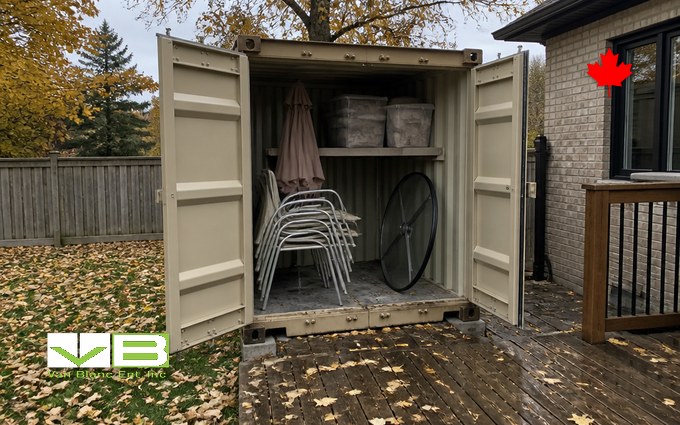
Quick Answer: How to store patio furniture in winter: clean and dry every piece and bring cushions and umbrellas inside. Fit snug covers over anything staying out, raised off wet ground. One 10ft or 12ft container from Van Blanc holds the patio set, BBQ, mower and December snowblower, with 1-3 day delivery.
What This Patio Winter Guide Covers
- How to Store Patio Furniture in Winter
- Cover It, Bring It In or Box It
- Patio Furniture Care by Material
- Cushions, Umbrellas and Rugs Come Inside
- Winter Patio Furniture Covers That Fit Snug
- The BBQ Body and the Propane Cylinder
- Gas Cans, Mowers and the October Swap
- Snowblower Storage Between Storms
- Patio Storage in One 10ft or 12ft
- Patio Furniture Storage Options Compared
- Delivery to Toronto, Brampton and Ajax Lots
- Patio Storage Checklist Before Freeze-Up
- FAQs
Reading Time: 22 minutes
How to Store Patio Furniture in Winter
Storing patio furniture in winter takes three jobs, finished before freeze-up. Clean and dry every frame and cushion. Sort the pieces that can sit out under a cover from the ones that have to come in. Then give the pieces that come in a dry, locked spot until May.
Winter patio furniture storage is the fall routine that keeps frames, fabric and finishes sound through an Ontario winter. Water that soaks into wood freezes and widens every crack. Bare steel rusts where the paint has chipped. Cushions packed damp grow mildew in the dark, the same moisture problem a closed steel box faces when its roof cools overnight. Each material fails its own way, so the routine changes with what the set is made of.
Van Blanc has sold shipping containers from 4 Brantford yards since 1995, so this guide goes one step past the usual patio advice. In a GTA house where the garage holds the car, the pieces that come in have nowhere obvious to go. The same garage is where the mower and the snowblower trade places every October. Our piece on one box for both seasons of equipment covers that rotation. The answer this guide builds toward is a single 10ft or 12ft container beside the garage, sized from our own product pages.
Cover It, Bring It In or Box It
Every piece on an Ontario patio spends the winter in one of four places. It stays out under a cover, comes into the house, goes into the garage, or moves into a separate building on the lot. The frame material settles the first split. Floor space settles the rest, and in a Toronto semi or a Durham subdivision home, floor space is what runs out.
| Where it winters | What it keeps off | What it leaves exposed | Suits |
|---|---|---|---|
| Outside, under a fitted cover | Sun, snow on the seats, bird droppings | Freeze and thaw under the cover, wind, theft | HDPE lumber, teak, plastic or resin, treated wood |
| In the house or basement | Weather of every kind | Living space, stairs and doorways | Cushions, umbrellas, glass tabletops |
| In the garage | Snow and most damp | The winter bay the family car would use | Frames, bagged cushions, the grill body |
| A separate building on the lot | Snow, damp and, once locked, theft | Depends on its walls, floor and door | The set, the grill, the mower and the snowblower together |
The fourth row is the one people improvise, usually as a tarp over stacked chairs behind the garage. A container is that fourth row with steel walls, a wood floor and a locking door, set a few steps from the patio. Christian LeBlanc, Paul’s son and the second generation at Van Blanc, has one rule for laying it out.
Christian LeBlanc, Van Blanc Ent. Inc.: “Point the doors at the driveway. In January you want the snowblower to roll straight out onto the path, and nobody wants to dig around the side of a box to reach it. The patio set can live at the back wall all winter. It is not going anywhere until May.”
Deciding which way the doors face before the truck arrives locks that layout in for every winter after the first.
Patio Furniture Care by Material
Patio furniture care by material starts with whether the frame was built to live outdoors all year. POLYWOOD, a maker of HDPE plastic lumber furniture, tells owners its frames can sit out all year with no cover at all. Home Hardware’s winter storage guide says most wood belongs in a garage or shed, though treated wood can stay out under a proper cover. Plastic or resin can stay out too, it says, and keeps its appearance longer covered. Whatever comes inside gets packed heavy and low, the way a steel box is loaded so nothing shifts or topples.
| Material | Outdoors all winter? | Prep before it is put away | Source |
|---|---|---|---|
| HDPE plastic lumber | Yes, frames uncovered year-round | Wash with mild dish soap and warm water | POLYWOOD |
| Teak and other hardwood | Handles wet and cold; teak needs no coating | Wash, check the joints | POLYWOOD |
| Softwood and other wood | Most goes in a shed or garage; treated wood can stay out covered | Replace soft or split pieces, fill dents, refinish | Home Hardware, POLYWOOD |
| Wrought iron | Covered or stored | Wire-brush rust, touch up the paint, wax | POLYWOOD |
| Aluminum | Covered or stored | Pull the foot caps to drain water; touch up scratches | POLYWOOD |
| Plastic or resin | Can stay out, better covered; POLYWOOD rates moulded plastic as more delicate | Wash, dry, wax | Home Hardware, POLYWOOD |
| Wicker | Under a water and sun-resistant tarp | Repair or replace broken fibres | Home Hardware, POLYWOOD |
| Glass tabletops | No: inside, with nothing stacked on top | Discard any cracked top | POLYWOOD |
| Cushions and fabric | No: indoors or in a garage, covered with airflow | Sew up tears, clean, dry completely, then shelve them well off the floor | Home Hardware, POLYWOOD |
| Umbrellas | No: inside a shed or the home | Clean, then dry fully | Home Hardware |
Wood and HDPE Lumber
Wood fails at its joints and end grain, where water soaks in, freezes and pushes a crack wider. POLYWOOD’s repair list for wood is short. Replace pieces with soft spots, holes, severe cracks or splinters, and fill minor dents and scratches with wood filler. Its protection step is to sand and reapply exterior paint, stain and sealant. Do that on a mild fall afternoon so the finish cures before the cold. Then cover the piece only once it is fully dry, since POLYWOOD warns that uncured coatings stick to covers and trapped moisture breeds mould. A set that comes inside should come in dry, the same rule that keeps a woodpile seasoned through to March. HDPE skips nearly all of this, so an HDPE dining set can stay on the patio while only its cushions come in.
Iron and Aluminum Frames
Wrought iron rusts wherever the paint is broken, and a winter of wet snow turns a scratch into a scab. POLYWOOD’s fix is a wire brush on the rust, then touch-up paint over the bare metal. Fine car wax or a silicone spray adds a protective coat. Aluminum does not rust the way iron does, but hollow aluminum legs hold water. POLYWOOD says to pull the foot caps so that water drains out. Road salt is the other enemy. Where rock salt goes down near the patio, POLYWOOD suggests rinsing nearby metal furniture with warm water and towelling it dry. A metal set that comes inside wants dry air as well as a dry floor. In a closed box, a pair of desiccant tubs refreshed each spring and fall helps through the damp shoulder seasons.
Wicker, Resin and Glass
Wicker, natural or resin, fails at the weave. POLYWOOD says to repair or replace broken fibres so they do not snag and unravel further. Home Hardware covers wicker that stays out with a water and sun-resistant tarp. Plain plastic and resin chairs split the two sources. Home Hardware lets them stay out, covered for looks. POLYWOOD rates injection-moulded plastic as more delicate and protects it with car wax or a silicone spray. Glass needs a closer look. POLYWOOD says to discard a cracked tabletop, because fluctuating temperatures make the crack spread until the glass breaks. A sound top goes inside with nothing stacked on it. Padded and stood on edge, it can lean against wire-deck shelves fixed along one steel wall for the season.
Cushions, Umbrellas and Rugs Come Inside
Patio cushions are the first thing in every fall. Home Hardware says to store them indoors or in a garage, covered but with enough airflow to prevent mould or mildew. It adds that a waterproof shed is acceptable but more likely to be infiltrated by rodents and other pests. POLYWOOD’s version is a heavy-duty plastic bag or a storage tote, kept on a shelf in the garage or shed. The two agree on what matters most: clean, completely dry and off the floor. Van Blanc’s accessories list carries 3-tier shelving brackets that hook into a container wall without drilling, which takes care of the off-the-floor part.
Umbrellas come in next. Home Hardware puts it bluntly: winter destroys the fabric and wrecks the ribs, so the umbrella goes inside a shed or the home. Clean the canopy, let it dry fully, then furl it and slide on its sleeve. Lay it flat or hang it, with nothing heavy on top. Outdoor rugs get the same wash and dry, then roll around a tube so they hold their shape. Fabric in a closed building wants moving air, which is what the vents on a container are for.
Retailers sell deck boxes as patio furniture storage: lidded plastic or resin chests that sit on the deck and hold cushions, pillows and small accessories. A deck box keeps the soft goods dry and close to where they are used, and it stays outside all winter. The frames, the grill and the two machines still need a home of their own. That is the job a small steel box set beside the garage picks up, cushions included.
Winter Patio Furniture Covers That Fit Snug
A winter patio furniture cover is a fitted, weatherproof shell that keeps snow, ice, rain and wind off a piece left outside. POLYWOOD’s advice is to measure each piece and buy a cover that fits snugly. It warns that a loose cover traps snow and ice in its folds, and the extra weight can tear the fabric. Cover only once the furniture is fully dry, because damp trapped under a cover turns into mould and mildew by spring. Covers protect what has to stay out, and a Van Blanc box with a welded lockbox on its doors holds everything that does not.
A heavy-duty vinyl tarp is POLYWOOD’s fallback when no fitted cover is on hand. It has to be breathable, UV-resistant and waterproof. Tie it tight with bungee cords, zip ties or ratchet straps so it cannot billow in a storm. Before the cover goes on, set an upturned pail on the middle of the table. The top then peaks and sheds snow instead of holding a pond. Check the ties after every big wind.
Under the cover, keep each piece upright and off the patio stones. POLYWOOD suggests pallets or blocks under the legs so meltwater cannot pool and freeze around them. A steel container sits on blocks or a stone pad for the same reason. POLYWOOD also says to anchor light pieces to heavier ones, and to brush away snow and knock off icicles through the winter. A chair left at an awkward angle collects snow and ice, and the load can crack joints or warp the frame.
The BBQ Body and the Propane Cylinder
BBQ winter storage splits in two, because the rules for the grill and the cylinder differ. Home Hardware says the BBQ can be stored indoors, or left outside under a correct-fitting cover if you plan to grill through the winter. On the tank it uses capitals: your propane tanks MUST be stored outside your home. So turn off the gas, disconnect the cylinder, and clean food and grease off the grill before it moves anywhere. The fire-safety basics for a closed container start with what never goes inside it.
TSSA’s Propane Storage Rules
The Technical Standards and Safety Authority (TSSA) regulates fuels in Ontario, propane included. Its SafetyInfo page tells owners to never store propane cylinders indoors or in a garage. Cylinders are stored upright and protected against tampering, dropping or impact. They stay at least one metre (three feet) from any building opening, sidewalk or air intake, and away from operating heaters. A closed container is a building with a door, and Van Blanc reads the garage rule as covering it. The grill body can winter inside the box. The cylinder stays outside it, upright, valve closed, at least one metre from the doors, the vents and any other building opening, sidewalk or air intake.
The grill body itself suits steel storage well, rolled in through cargo doors swung open in the right order. Scrape the grates, empty the grease tray and look over the burners while parts are easy to order. Weber lists its Spirit E-325, a three-burner gas grill, at 48.3 in (about 123 cm) wide with the lid closed. It is 26.6 in (about 68 cm) deep. That rolls upright through the cargo doors of a 10ft, whose opening is 2,342 x 2,280 mm on the sheet our 10ft page cites.
Gas Cans, Mowers and the October Swap
October is the fall half of the yearly mower-and-snowblower swap, and both machines run on small gas engines. Briggs and Stratton says gas begins to degrade in as little as 30 days, which can clog an engine’s fuel system. Its storage method is to top off the tank with fuel treated with an alcohol-free stabilizer. Then run the engine for a few minutes so the treated fuel circulates. Treated that way, it says, fuel stays fresh for up to 24 months.
Home Hardware takes the other route and removes all fuel before storage: drain the tank, flush the lines, then run the engine until it dies. Briggs and Stratton gives the same drain-and-run instruction for any engine stored without its stabilizer or on alcohol-blend fuel, such as gasohol. The owner’s manual for your engine settles which method applies. Change the oil while the engine is still warm. Pull the battery on an electric-start model and keep it somewhere cool and dry. Clear grass off the deck with a wooden stick, never your hands. Sleds, bikes and quads sharing one box through the year follow the same seasonal rhythm.
The gas can needs its own spot. TSSA’s first advice on gasoline is that it is safer to use it up than to store it. For gas you keep, it calls for a tightly sealed, certified container. Store it at room temperature in a detached shed or garage at least 15 metres (50 feet) from a heat or ignition source. It says never to keep gas in the basement, because the vapours are heavier than air and travel along the floor. Fill a can to about 90 percent to leave room for expansion. TSSA’s room-temperature and 15-metre conditions apply to a steel box like any other building. An unheated box in January is not at room temperature, so the gas can stays out of it.
One more rule covers both machines once they share a building, and it applies to parking anything with an engine in a container. Health Canada lists snowblowers and lawn mowers among the fuel-burning equipment behind carbon monoxide exposure. Its list of unventilated or poorly ventilated places where that risk rises includes garages or sheds. A container is a steel shed with a door. Start the snowblower outside it, never inside, and let a hot mower cool on the driveway before it rolls in.
Snowblower Storage Between Storms
Snowblower storage in season means a dry spot near the driveway, behind doors that open onto the plowed path. Ariens tells owners to wipe salt stains off with a wet cloth and mild soap, then wipe the machine thoroughly dry to prevent rust. That job is easy at the open doors of a dry box and miserable beside a snowbank. Park the machine on a rubber mat so meltwater from the auger housing has somewhere to go. Keep a shovel and the salt pail beside it. Staking out the drop spot before delivery day is how the doors end up facing that path.
Size decides how the machine gets in. Ariens lists its DELUXE 24, a two-stage machine with a 24-inch clearing width, at 149 cm (about 4 ft 11 in) long. It is 67 cm (about 26 in) wide and 117 cm tall, and it weighs 108 kg. At 67 cm wide it clears a 10ft’s cargo door opening with room on both sides. A machine that heavy wants a ramp over the door sill rather than two people lifting. Van Blanc’s accessories list includes a container ramp, 1,542 mm long and 2,000 mm wide, rated for 6.5 tonnes. It can go on the same quote as the box.
At the end of the season the machine flips to summer storage, and the makers differ. Ariens recommends completely draining the fuel system even if the gas was stabilized, then running the engine until it stops on its own. Briggs and Stratton’s stabilize-and-run method skips the draining, unless the fuel contains alcohol. Ariens also lists an oil change, grease on the axles and augers, and a cover. Follow the owner’s manual for your engine, since it is the maker’s word on that model.
Patio Storage in One 10ft or 12ft
Shipping containers are freight-sized steel boxes: corrugated walls, a wood floor, a cast fitting at every corner and cargo doors that lock. For one house, the patio set, grill, mower and snowblower make a one-box job, and two lengths suit it. The 10ft, built as a ten or cut down from a new 20ft, is the compact one. The repainted 12ft with cargo doors and a VB-stamped lockbox is the longest of the small sizes. It appeared on Paul and Christian LeBlanc’s September 2026 stock list. Every figure below comes from those two Van Blanc product pages.
| Measurement | 10ft | 12ft |
|---|---|---|
| Outside length | 2,991 mm (9 ft 10 in) | 3,658 mm (12 ft nominal); one unit taped at about 3,700 mm |
| Width and height | 2,438 mm (8 ft) wide, 2,591 mm (8 ft 6 in) tall | 2,438 mm (8 ft) wide; 8 ft 6 in tall from a standard box, 9 ft 6 in from a high cube |
| Doors in recent stock | Cargo doors; also tens with one wide man door, a roll-up, or a man door and barred window added | Cargo doors, a lockbox that takes a puck lock, forklift pockets |
| Ground covered | 8 ft by 10 ft, about half a parking stall | 96 sq ft (8.92 sq m) |
| Inside | 2,840 x 2,350 x 2,393 mm per the spec sheet quoted on our 10ft page; about 560 cubic feet | Not published; ask us to tape the unit |
| Cargo door opening | 2,342 x 2,280 mm on the same sheet | Not measured; ask |
| Longest piece lying flat | Up to 2,840 mm (about 9 ft 4 in) | 10 ft (3,048 mm) lengths, such as a 10 ft kayak |
The two lengths split on floor. Van Blanc’s 8ft page fits a push mower, a snowblower, two bikes and the garden tools into an 8ft. A factory 10ft is 553 mm (about 22 in) longer inside than that 8ft and 238 mm (about 9 in) wider. That extra floor is where the patio set and the grill go. The 12ft runs 667 mm longer than the ten, about 22% more floor, and takes anything up to 10 ft long lying flat. Every standard length from the 10ft to the 53ft is laid out in one guide.
| Item, from the maker’s page | Size | Through a 10ft’s 2,342 x 2,280 mm door opening? |
|---|---|---|
| Weber Spirit E-325 gas grill, lid closed | 48.3 in W x 26.6 in D x 46.2 in H (about 123 x 68 x 117 cm) | Yes, upright on its wheels |
| Ariens DELUXE 24 two-stage snowblower | 149 cm L x 67 cm W x 117 cm H (about 4 ft 11 in x 26 in x 46 in); 108 kg | Yes, rolled up a ramp |
Door Type, Airflow and Foam
Door choice follows how often the box opens. Cargo doors open the whole end, which is what the table, the grill and the snowblower need. Recent 10ft stock at Van Blanc has included units with a man door and a barred window for the daily trip to the salt pail. It has also included a ten with a roll-up framed into its steel end. With nothing swinging out, a roll-up lets the box sit tight to a fence. On a standard 8 ft 6 in box it leaves roughly 7 feet of clear height, because the coil sits inside above the opening.
For patio gear, airflow is the first thing to plan. A Van Blanc box usually arrives with 2 to 4 vents, according to our custom features page, and our yards can add more before delivery. Load everything dry, and the vents carry damp air out through a mild spell. Our page on foamed and insulated boxes rates both kinds as fine for tools, equipment and dry goods. Whether anyone will ever work in there is what tips the choice. A box that may become a potting shed or a workshop is worth insulating at our yards before delivery.
Where the Box Sits
Set the box on firm, level, drained ground. A compacted stone pad built ahead of the drop works, and so do solid blocks or timbers under the four corners. Level matters with cargo doors. A sunken corner twists the frame out of square, and the cams on the locking bars stop finding their keepers. Each door leaf is about 4 ft wide and opens outward, so keep a strip that deep free of fences and parked cars. Face the doors toward the driveway or the snowblower’s path, and keep them clear of the spot where the plow pile grows.
New or Used for a Backyard
Which of Van Blanc’s four grades fits depends mostly on who can see the box. A box in full view of the kitchen window can start as a new one-trip unit still wearing its factory coat. Any minor handling marks get pointed out before you commit. New true 10s arrive in batches and sell quickly. A box behind a fence or a hedge can be used steel. Cargo worthy is fit to go back into ocean service, and wind and watertight is dry and lockable with more panel wear. As-is units are sold with their defects listed, usually as the starting shell for a build. Each grade’s strengths, one-trip through as-is, are laid out in one place. The full list of units we have for sale across our 4 Brantford yards puts every size and grade side by side before you call.
Packing Order, Back to Front
- Back wall: the table on its side or with its legs off, chairs stacked only if the maker labels them stackable, and a padded glass top stood on edge.
- One long wall: shelving for cushions in bags or totes, the furled umbrella and the rolled rugs.
- Middle: the grill body with its cylinder left outside, then the mower with treated or drained fuel and the battery out.
- Door end: the snowblower facing out on a mat, with a shovel and the salt pail beside it.
- Last: a padlock inside the lockbox, and the propane cylinder upright outside, at least a metre from the doors, the vents and any other opening.
Two other sizes cover the edges of the range. Where a side yard is too tight for a ten, an 8ft with a man door in its side wall still opens two ways. A household with a sectional, a dining set and a lawn tractor is into the 20ft and its 1,172 cubic feet. Our 20ft page sizes that as a two-car garage’s worth of seasonal storage.
Patio Furniture Storage Options Compared
A homeowner with a patio set and no room for it has five places to weigh, and each does something well. The table sets them side by side for one winter of patio gear. Prices stay out, since Van Blanc quotes each container per order and the other options vary too widely to pin down. How the 10ft trades and gets priced across Canada covers the drivers behind a small-box quote.
| Option | What it holds | How it handles winter | What it asks of you |
|---|---|---|---|
| Garage | Whatever fits around the car | Dry and close to the house | The car moves outside, or the set shares its bay |
| Deck box | Cushions, pillows, small accessories | Keeps soft goods dry on the deck | A separate home for the frames, grill and machines |
| Garden shed | Frames, tools, the mower | Depends on the build; Home Hardware notes cushions in a shed are more likely to meet rodents | A kit to assemble, a floor, a lock, upkeep |
| Storage unit across town | Whatever fits the unit | Dry and locked | A drive every time you need something, and a monthly bill |
| Container on your lot | The set, cushions, grill, mower and snowblower together | Steel walls and roof, rubber gaskets sealing the cargo doors, vents | A level pad, a delivery route, one purchase |
The garage is the default because it is already there, and the car pays for that all winter. A Van Blanc container on the lot hands the bay back and keeps the snowblower a few steps from the driveway. Against a storage unit, the patio set waits beside the patio instead of a drive away. Against a shed, the box arrives finished, with no kit to build. Locks and theft hardware made for container doors finish the job.
Patio set, BBQ and snowblower in one box?
Tell us what comes in each fall, where the box will sit and your postal code. We will say whether a 10ft or a 12ft fits, which doors and how many vents. Then you get one all-in number with a real lead time.
Family-run in Brantford since 1995 · 4 Brantford yards · 4.9★ across 140+ Google reviews.
Delivery to Toronto, Brampton and Ajax Lots
Van Blanc delivers on a tilt-deck truck: the deck tips back and the container eases down onto the pad. The driver needs a straight run in and room to pull away. Stocked units with no changes get fast 1-3 day delivery to every region across Ontario, shipped from our 4 Brantford yards. A box that gets extra vents, a roll-up or a man door ships once that work is finished. How a tilt-deck drop runs on the day covers the truck side.
GTA and Durham Backyards
Our 10ft page lists Toronto laneway lots among the typical sites for a ten, and much of the old city sits on narrow lots. Containers for sale across Toronto, from the Junction to the Beach come off the same trucks as every other order. Northwest of the city, the 10ft and 12ft sizes Brampton homeowners can buy outright can land behind the garage or beside the drive. East along the 401, Ajax and the Durham lakeshore get the same 1-3 day window.
When the spot sits behind a fence or a garage, the tilt-deck may not reach it. Ways to land a box on a narrow drive or a tight backyard covers the choices. They run from setting it beside the driveway to lifting it over the obstacle on a HIAB crane truck. Send a phone photo of the spot and the path from the street with your quote request, and the call that follows settles which one your lot needs.
Order before freeze-up if you can, so the stone pad goes in on soft ground. Winter drops still work once the path is cleared, and a January drop onto frozen, snowy ground explains what changes. Permits are managed by your municipality, so check with your local building or planning department before you order.
A Van Blanc quote is built from the box, its grade, its doors and vents, and the steel market. Delivery to your address is priced by the kilometre. The quote comes back as one all-in number with the container and placement included, usually the same day. One warning belongs here too. Callers sometimes tell us about a bin listed a thousand dollars under ours on Facebook Marketplace. A couple of weeks later, some ring back after losing the deposit. The tells are a small box priced far below the rest and a seller who wants money before you have seen the steel. The Marketplace deposit scam, laid out start to finish, shows how it runs. Every quote comes with a real lead time, not a hopeful one.
Patio Storage Checklist Before Freeze-Up
- Clean and dry every frame, cushion, umbrella and rug. Nothing goes away damp.
- Sort by material: HDPE and teak can stay out, resin under a cover; wood and metal get repaired and touched up; glass tops come inside.
- Bag or tote the cushions and lift them onto open wire shelving off the floor.
- Fit snug covers over anything staying outside, with a peak on the table and the legs on blocks.
- Disconnect the propane cylinder and store it outside and upright, at least a metre from any building opening, sidewalk or air intake.
- Stabilize or drain the mower’s fuel per the manual, change the oil and pull the battery.
- Give the snowblower fresh fuel and a test start, outdoors.
- Pack the box back to front: patio set, shelves, grill, mower, snowblower at the doors.
Packed this way, the patio comes back out in May with dry cushions, sound frames and a mower ready for its first cut. If the garage cannot take another winter of it, measure the gap beside it and check how much open ground a delivery truck needs. Then call Van Blanc at 519-754-6844 with those numbers and the list of what comes in.
Frequently Asked Questions
Can I leave my patio furniture outside in the winter?
Some of it. POLYWOOD builds its HDPE frames to sit out all winter with no cover, and Home Hardware says plastic or resin can stay out but looks better longer covered. Treated wood can stay out under a proper cover. Cushions, umbrellas, glass tops and most other wood belong indoors, in a garage, or in a dry, locked building on the lot.
What kind of outdoor furniture can be left outside in winter?
HDPE plastic lumber and teak or other hardwoods handle it best. Plain plastic or resin and treated wood can stay out under a cover. Wrought iron and aluminum belong under a cover or inside, with rust brushed off and scratches touched up first. Wicker goes under a water and sun-resistant tarp.
Should you cover your patio furniture in the winter?
Yes, anything left outside. Use a snug, fitted cover, because a loose one traps snow and ice in its folds. Put it on only once the furniture is fully dry, and tie it down so it cannot billow. A pail under the table cover helps snow slide off.
What is the best bin to hold outdoor cushions?
Any bin that keeps them clean, dry and off the floor. Home Hardware wants cushions covered but with airflow, and POLYWOOD suggests a heavy-duty plastic bag or tote on a shelf. A deck box keeps them dry on the deck. For the cushions plus the frames, grill and mower, a vented container holds everything.
Can a snowblower be left outside in winter?
It can sit out, but salt and wet snow work on it every day. Ariens tells owners to wipe salt off with a wet cloth and mild soap and dry the machine thoroughly to prevent rust. A dry spot near the driveway, such as the door end of a small container, keeps it clean and ready. Start it outdoors, never inside a closed building.
How long can gas sit in a snowblower before it goes bad?
Briggs and Stratton says gas begins to degrade in as little as 30 days. With an alcohol-free stabilizer and a short run, it says fuel stays fresh for up to 24 months. Ariens drains the fuel system for summer storage even when the gas was stabilized, so follow your owner’s manual.
Can a propane tank go in a storage container for the winter?
No. TSSA says to never store propane cylinders indoors or in a garage. It says to keep them upright and at least one metre from any building opening, sidewalk or air intake. A closed container is a building with a door. The grill body can winter inside, and the cylinder stays outside with its valve closed.
What size container holds a patio set, a BBQ and a snowblower?
For one house, a 10ft or a 12ft from Van Blanc does the job. A factory 10ft is about 2,840 mm long inside, and a three-burner grill and a two-stage snowblower both clear its cargo door opening. The 12ft adds floor and takes 10 ft lengths lying flat. A sectional plus a lawn tractor points to a 20ft.
Sources
- Technical Standards and Safety Authority (TSSA). Transportation and Storage (propane cylinder and gasoline storage). TSSA SafetyInfo, Transportation and Storage, checked October 2026.
- Health Canada. Carbon monoxide: Overview. Health Canada, Carbon monoxide overview, checked October 2026.
- Home Hardware. Here’s How to Safely Store Your Outdoor Summer Gear for Winter. Home Hardware, Storing Summer Gear for Winter, checked October 2026.
- POLYWOOD, How to Winterize Patio Furniture in 4 Easy Steps by Caitlin Evans, last updated February 16, 2026: the POLYWOOD winterizing guide for HDPE and other patio furniture, checked October 2026.
- Briggs and Stratton. Storing Your Mower and Outdoor Power Equipment. Briggs and Stratton, Storing Your Mower and Outdoor Power Equipment, checked October 2026.
- Ariens. How to Store Your Snow Blower and DELUXE 24 specifications. Ariens, How to Store Your Snow Blower and Ariens, DELUXE 24 snow blower specifications, checked October 2026.
- Weber. Spirit E-325 Gas Grill (dimensions, lid closed). Weber, Spirit E-325 Gas Grill, checked October 2026.
See the Patio-Sized Boxes in Brantford
We have been supplying shipping containers across Ontario since 1995. Our public yard is at 90 Morton Avenue East, one of our 4 Brantford yards.
Van Blanc Ent. Inc., 90 Morton Ave E Unit 1B, Brantford, ON N3R 7J7, 519-754-6844.
Bring the measurements of the gap beside the garage and a list of what comes in each fall. Walk-in hours run Monday to Thursday 9:30 to 5 and Friday 9:30 to 4, no appointment needed. Paul or Christian can open whichever small boxes are on hand, so you can picture the patio set inside before you buy. Worth the drive for unbeatable quality, family customer service with 30 years of experience.