
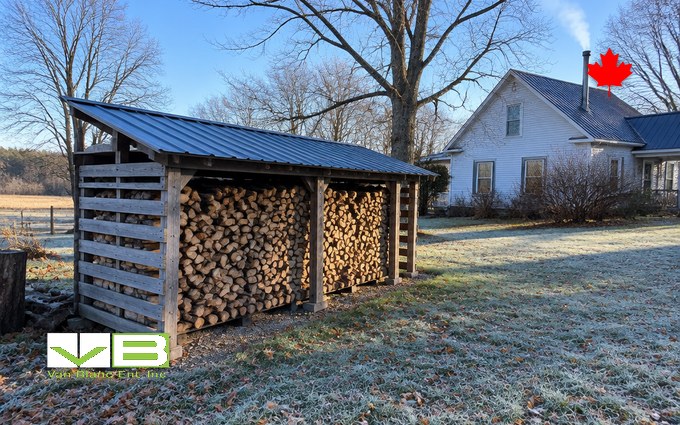
Quick Answer: Firewood stays dry in a three-sided shed with an open front, slatted walls, an overhanging roof and a floor off the ground: 64 square feet of covered floor per full cord, stacked four feet high. Seasoned means under 20 percent moisture, which Ontario hardwoods reach in six to eighteen months.
In This Guide
- How much firewood an Ontario winter takes
- Full cord, face cord, stove cord
- Seasoning: the 20 percent line
- The shed that dries wood, and the shed that rots it
- Racks, covers and the porch pile
- Sizing the shed to the cords
- The base, the wall and the wind
- Closed buildings, honestly
- The vented steel dry bank
- The firewood storage checklist
- Firewood storage FAQs
Reading Time: 13 minutes
How much firewood an Ontario winter takes
A rural Ontario home heated mainly with wood burns four to seven full cords a winter, according to Firewood Plus, a supplier in Marmora, and that range is the number every storage decision starts from. A small, well-insulated house with a modern stove sits at the low end; a drafty farmhouse with an older stove and a January in the Ottawa Valley sits at the top. The variables are the house, the insulation, the winter, the species and the appliance. A modern EPA-rated stove cuts wood use by roughly a quarter to a third against an older one, and an open fireplace burns about half again as much wood for the same heat because most of it goes up the flue. A cottage used on weekends, or a house that burns for the pleasure of it in November and March, is a one-cord-a-year household and stores accordingly. We sell steel boxes, and the honest part of this page comes late: a sealed container is the wrong place to season wood and the right place to keep the dry stock and the splitter, which is where the smokehouse guide’s seasoned-hardwood section and this one agree. A yard-mounted wood boiler burns from the same stacks, and where a furnace’s seasoned cords can sit near its loading door comes down to the clearance page in its manual.
| Household | Full cords a winter | Covered floor at 4 ft high | Note |
|---|---|---|---|
| Weekend cottage or ambience burner | 1 | About 80 sq ft with access | A rack on the porch plus a small lean-to covers it |
| Small house, modern stove, supplemental heat | 2 to 3 | 160 to 230 sq ft | An 8 by 12 open-front shed, two rows deep |
| Medium house, main heat, modern stove | 3 to 5 | 230 to 380 sq ft | A 10 by 20 or two 8 by 12s a year apart, so one seasons while one burns |
| Large or older house, main heat | 4 to 7 | 300 to 540 sq ft | Two seasons on hand; a sugar bush evaporator’s appetite runs higher again |
Full cord, face cord, stove cord
A full cord, called a bush cord in much of Ontario, is a stacked pile 4 feet high, 4 feet deep and 8 feet long: 128 cubic feet, roughly 600 to 800 pieces, weighing 3,000 to 5,000 pounds depending on species and dryness. A face cord is the same 4 by 8 face one piece deep, and since most firewood is cut to 16 inches, a face cord is about a third of a full cord. A stove cord is a face cord cut to 12 inches for compact stoves and is a quarter of a full cord. The units matter twice: once when you buy, because a seller quoting a low price per face cord is quoting a third of what a bush-cord seller is, and once when you build, because the shed is sized in full cords and the wood arrives in the seller’s unit. The wood shed guide’s chapter on what enters the shed makes the same point about the mower’s turning radius; with firewood the equivalent is the tractor or the dump trailer that brings a bush cord to the door of the shed rather than to the lawn beside it.
Seasoning: the 20 percent line
Seasoned firewood is wood with a moisture content under 20 percent, and the number is the whole reason storage matters. Green hardwood comes off the saw at 40 percent and more. Burned wet, it hisses, throws smoke, starves the fire of heat, and condenses tar in the flue as creosote, which is the leading cause of chimney fires and the reason a WETT-certified sweep looks at the chimney once a year. The same tar is why a stove in a small steel room, the kind the hunt camp build’s stove chapter describes, wants dry wood even more than a house does. Most Ontario species reach 20 percent in about six months of good drying; dense hardwoods take longer, and oak in particular wants a second summer. Ash is the exception that can be burned soon after cutting because it is dry on the stump. The tests are old and reliable: seasoned wood is grey rather than cream, the ends have opened into checks, two pieces knocked together ring rather than thud, and a pin moisture meter on a freshly split face reads below 20. Firewood Plus ranks the province’s species for the stove, with ironwood, rock elm, hickory, oak, sugar maple, beech and yellow birch in the top tier; ash, red elm, red maple, tamarack and white birch in the middle; and the softwoods, poplar, pine, spruce, hemlock and basswood, for kindling and shoulder-season fires. The drying happens in the stack, in moving air, under a roof, which is the specification for the building in the next section.
What actually dries the wood
Air moving through the stack, not heat, dries firewood. Sun helps; wind matters more; a roof matters most, because rain on a stack undoes a week of drying in an afternoon. A pile in a sealed shed with a tarp over it is a pile at 30 percent in October, growing mould. A pile under a roof with its sides open to the wind is a pile at 18 percent by the time the stove is lit. That is the entire design brief for a firewood shed, and it is the reason the ventilation guide’s account of condensation in a closed box reads like a warning to anyone planning to season wood behind a door.
The shed that dries wood, and the shed that rots it
A firewood shed is a roof on posts with a floor off the ground, one solid wall against the prevailing wind, and either no walls or slatted walls on the other three sides. The open front faces the house or the lane so the wood can be loaded and unloaded without a corner, and the roof overhangs the front stack by a foot or more so the rain that blows in lands on the ground rather than the top row. The slats, where they are used, are boards with 2- to 4-inch gaps, enough for wind to pass through the stack and not enough for the stack to spill. The solid wall goes on the northwest side in most of southern Ontario, because that is where the driving rain and the January wind come from, and the roof pitches away from the open front so the drip line is at the back. Depth is the decision that separates a shed that dries from a shed that stores: two rows of 16-inch pieces, about 3 feet, dry well from both sides; four rows deep in a shed with solid sides is a damp core that never seasons. The cost drivers on a built shed apply to the frame and the roof, and the rule that a shed is only as good as its base applies harder here, because a firewood floor carries two tons a cord.
| Design | Dries wood? | Keeps it dry once seasoned? | Where it fits |
|---|---|---|---|
| Open-front, slatted three-sided shed, roof overhang, floor on treated runners | Yes, the standard | Yes | The main stack; two rows deep |
| Lean-to against the garage or house wall | Yes if the open side faces the wind’s exit and the wall is not the wind’s side | Yes | The winter’s working stack near the door; keep the wood a hand’s width off the siding |
| Covered rack with a fitted top cover | Slowly; the sides are open but the stack is small | Yes | The porch or the deck; a week’s wood |
| Tarp over a pile on the ground | No; the tarp traps moisture and the ground feeds it | No | Nowhere, past the week it took to build a rack |
| Closed shed or garage bay, no vents | No; mould by October | Only if the wood went in dry and the room is vented | The dry bank, vented, never the seasoning stack; louvres at both ends are the minimum |
Racks, covers and the porch pile
The firewood rack is the most-searched item in this whole subject and the least understood. A rack is a steel or timber frame that holds a face cord or two off the ground with open sides and a fitted cover over the top few inches. It does not season wood at any speed worth planning around; it holds seasoned wood dry and within reach, which is why it belongs on the porch, under the eave, or beside the door of the shed. The rules for a rack are the rules for the shed in miniature: off the ground on its own feet, bark side up on the top row so the bark sheds water, cover the top and never the sides, and keep it a hand’s width away from any wall it sits beside so air moves behind it and the siding stays dry. Indoors, a rack by the stove holds a day or two; more than that and the wood brings its insects and its moisture into the house. A rack against a steel wall has the same rule as a rack against wood siding, and the rust page’s note on things stacked against a container explains why the gap matters there too.
Bark up, top only
Two habits do most of the work. Stack the top row bark side up, because bark sheds rain and the sapwood face soaks it. Cover only the top of the stack, with a roof, a lid or a strip of metal, and leave the sides bare to the wind. A tarp pulled to the ground is the most common mistake in Ontario back yards and it turns a good stack into a compost heap by spring.
Sizing the shed to the cords
A full cord stacked 4 feet high covers 32 square feet of floor; the trade rule is to plan 64 square feet of covered floor per cord, because a shed that is packed edge to edge cannot be loaded, picked from or dried, and a 20 percent margin on top of that pays for the aisle and the air. An 8 by 12 foot shed, 96 square feet, holds a comfortable cord and a half two rows deep and can be pushed to two and a half stacked high and deep. A 10 by 20, 200 square feet, a little more floor than a twenty-foot container’s 160, holds three to four cords the same way, which is a medium house’s winter. The better plan for a house that burns four cords or more is two sheds or one shed with a divider, so this winter’s wood comes out of one side while next winter’s seasons in the other and the two never mix. Height beyond 6 feet at the open front is wasted, because nobody stacks above their shoulders safely and the top rows are the ones that need the roof closest. The sizes hub’s cubic-metre table is a useful check for anyone converting cords into a building, since a cord is 3.6 cubic metres and a 20-foot container’s 33 cubic metres is, on paper, nine cords, a number that matters in the section on closed buildings below.
The base, the wall and the wind
The base of a firewood shed carries more weight per square foot than a garden shed ever will, and it has to breathe. The two answers that work are a compacted gravel pad, which drains and costs least, and pressure-treated runners or a pallet deck lifted 4 to 6 inches above grade so air moves under the bottom row. Bare ground is the one base that fails every time; the bottom row wicks water, rots, and takes the row above with it. On clay, which is most of Brant, Oxford and Waterloo counties, the gravel pad wants to be proud of the surrounding grade so meltwater leaves rather than pools, which is the same lesson a drained stone pad under a steel box teaches. The wall goes where the weather comes from. Face the solid side northwest, put the open front toward the house so the winter path is short and shovelled, and keep the shed where the plow’s windrow will not bury the front. The site-prep hub’s notes on frost and drainage cover the ground; the rest is orientation.
Christian LeBlanc, Van Blanc Ent. Inc.: “People ask me whether they can season wood in a container and the answer is no, and I say it before they buy one. What a vented box is good for is the dry stock, the splitter, the saws and the kindling, locked, off the ground, out of the snow. The seasoning happens outside under a roof.”
Closed buildings, honestly
A closed building, a garage bay, a sealed shed or a shipping container, does not season firewood, and any page that says otherwise has not stacked green maple in one. The wood gives up its water into a room that cannot shed it, the room’s air reaches saturation, the walls sweat, and the stack grows mould before it dries. A closed building with real ventilation is a different thing: with a low intake on one end and a high exhaust on the other, a room moves enough air to keep seasoned wood seasoned, to keep the dry bank dry through a wet November, and to stop the splitter and the saws rusting. That is the honest role of a container in a firewood operation. It is not the seasoning shed. It is the vault for the wood that is already dry, the equipment that cuts and splits it, and, for the household that heats with wood on a rural lot, a locked room for the two cords that have to stay dry no matter what the winter does. A container’s other virtue is that it is nine cords of volume on paper and a lockable steel floor in practice, which is more than a wooden shed can say when the wood inside it is worth stealing, a point the container security guide makes about anything with resale value.
Need the dry bank, not the shed?
If the seasoning shed is built and what you need is a locked, vented room for the dry cords, the splitter and the saws, tell us how many cords and where it would sit. We will tell you ten-foot or twenty, the grade, where the vents go, and one honest all-in number with a real lead time.
Family-run in Brantford since 1995 · 200+ containers in stock · 4.9★ across 140+ Google reviews · every box graded by a person, walk it before it lands.
The vented steel dry bank
The dry bank is a twenty-foot container with a louvred vent at each end, one low and one high on opposite walls, set on a stone pad with the doors toward the house, holding the winter’s seasoned wood on pallets, the splitter, the chainsaws, the fuel and the kindling. The wood goes in dry, in the fall, on pallets so air moves under it, stacked bark up with a gap at the walls. The vents keep the air moving through the winter so the box does not sweat on the first warm day in March; the roof-drip page explains what happens without them. A ten-foot box does the same for a cottage or a one-cord household, and the ten-foot unit’s footprint is close to the 8 by 12 shed most people build. The doors are the doors that crossed an ocean, the lock sits behind a shroud, and a bush cord of maple with a resale value stops being the easiest thing on the property to steal. For a hunt camp or an off-grid cabin, the dry bank is the same box the camp already uses for gear, and the hunting camp build and the off-grid cabin conversion both have a wood stove at the centre of them.
A Haliburton wood-heat household
Two open-front sheds at the tree line, 10 by 20 each, one seasoning and one burning, and a vented twenty-footer by the back door with three cords of dry maple on pallets, the splitter, two saws and the fuel. The sheds dry the wood; the box keeps November out of it and the saws out of the neighbour’s truck. The Haliburton Highlands deliveries are where we see this most, and the tilt-deck’s reach down a cottage lane decides where the box lands.
Grade for a dry bank is the easy call: wind-and-watertight, the grade the firewood box needs, is a sealed used unit with surface rust that a wood lot never minds; cargo-worthy is the upgrade if it will be lifted later. What moves the number is size, grade, the vents and the distance from Brantford, and the drivers on a small-box quote are the same on every quote we write. We sell outright, never rent, and the ten- and twenty-footers in the rows can be walked at the Brantford yard before the truck is booked. Worth the drive for unbeatable quality, family customer service with 30 years of experience.
The firewood storage checklist
Before you build or buy
- Count the cords by household, not by hope: four to seven for main heat in a rural house, one for a cottage.
- Plan 64 square feet of covered floor per cord at four feet high, plus a fifth again for the aisle and the air.
- Build the seasoning shed open-front, two rows deep, slatted, roof overhanging the front, solid wall to the northwest.
- Put it on gravel or runners 4 to 6 inches up, never on the ground, proud of the grade on clay.
- Stack bark up, cover the top only, and test with a meter before the first fire: under 20 percent or it waits.
- Keep the dry bank, the splitter and the saws in a vented, locked room; how steel and a built shed age over twenty years settles which room.
A stack managed that way is a warm house and a clean chimney, and the shed that made it possible cost a weekend and some posts. The container against every other building, compared, is the next read for the household that is also deciding where the tractor sleeps.
Frequently Asked Questions
How big should a firewood shed be for a winter of wood?
Plan 64 square feet of covered floor per full cord stacked 4 feet high, plus about 20 percent for access and airflow. A medium house heating mainly with wood burns 3 to 5 full cords, so a 10 by 20 foot open-front shed, or two 8 by 12s so one seasons while the other burns. A weekend cottage burning a cord needs a rack and a small lean-to.
What is the best way to store firewood outside?
Off the ground on gravel or runners, stacked bark side up, two rows deep, under a roof that overhangs the stack, with the sides open to the wind and one solid wall on the northwest side. Cover the top only; a tarp pulled to the ground traps moisture and rots the pile. Keep the winter’s working stack near the door and the rest at the tree line.
How long does firewood take to season in Ontario?
About six months of good drying for most species, and a second summer for dense hardwoods such as oak. Seasoned means under 20 percent moisture: grey colour, checked ends, a ring when two pieces are knocked together, and a meter reading below 20 on a fresh split. Ash is the exception that burns well soon after cutting.
Can you store firewood in a shed or a garage?
Seasoned wood, yes, in a vented room. Green wood, no: a closed shed, a garage bay or a sealed container has no way to shed the water the wood gives up, and the stack grows mould before it dries. Season outside under a roof, then move the dry cords into a vented, locked room if you want them out of the weather.
Can a shipping container be used for firewood?
As a dry bank and equipment room, yes: a ten- or twenty-foot box with a low vent at one end and a high vent at the other, wood on pallets, bark up, a gap at the walls, and the splitter and saws locked in with it. As a seasoning shed, no. A sealed steel box sweats, and green wood inside it moulds. Season under a roof outside first.
How many cords of wood do I need for a winter?
A rural Ontario home heated mainly with wood burns 4 to 7 full cords a winter, according to an Ontario supplier; a small, well-insulated house with a modern stove sits at 2 to 3, and supplemental or weekend burning is closer to one. A modern stove cuts consumption by about a quarter to a third; an open fireplace burns roughly half again as much for the same heat.
Sources
- Firewood Plus, Marmora, Ontario. (2026). Firewood Heating Guide: Cord Sizes, Seasoning and Wood-Stove Tips. firewoodplus.ca
- Timber Ridge Firewood. (2026). How Much Firewood Do I Need For A Season? timberridgefirewood.ca
- Firewood For Life. (2026). Firewood Storage Shed: The Best Way To Store Firewood. firewood-for-life.com
- Chimney Insight. (2026). Firewood Storage Ideas for Moisture Control and Ventilation. chimneyinsight.com
- Engineer Fix. (2026). How to Build a Wood Shed for Seasoning Firewood. engineerfix.com
- Modern Homesteading. (2026). Cord of Wood Explained: Size, BTUs, Cost and Storage Tips. modernhomesteading.ca
Reach Van Blanc in Brantford
We have been supplying shipping containers across Ontario since 1995. Our yard is at 90 Morton Avenue East in Brantford, and we deliver right across the province with payment on the day of delivery. No deposit, no upfront wires, no chase-the-paperwork.
Van Blanc Ent. Inc., 90 Morton Ave E Unit 1B, Brantford, ON N3R 7J7, 519-754-6844 (cell) or 1-888-509-6658 (toll-free).
If the shed is built and the dry cords, the splitter and the saws need a room that locks, call with the cord count and your postal code, and we will tell you on the spot which boxes are on the ground and when one can land. Worth the drive for unbeatable quality, family customer service with 30 years of experience.