
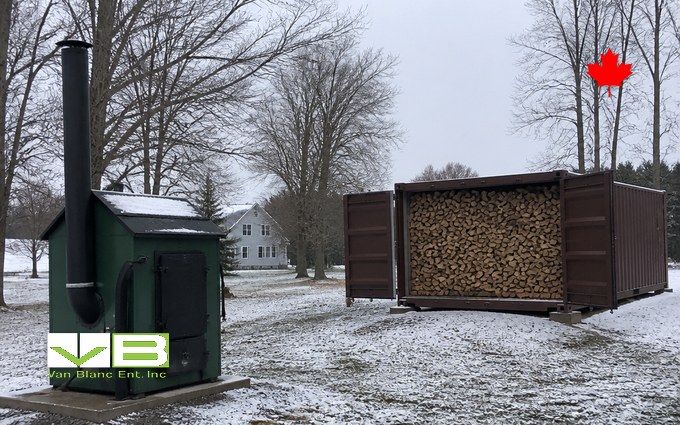
Quick Answer: An outdoor wood furnace burns split wood in a firebox wrapped in a water jacket and pumps hot water through buried lines to the house. Makers set the clearances to combustibles. A 20ft container from Van Blanc, parked outside those clearances, holds about six cords as a rule of thumb.
What This Outdoor Furnace Page Covers
- How Does an Outdoor Wood Furnace Work?
- Boiler, Furnace or Hydronic Heater
- Furnace Sizing Rules of Thumb
- Siting the Furnace on the Property
- Clearances to Combustibles, Maker by Maker
- Outdoor Furnace Fuel: Split, Seasoned, Untreated
- Daily Loading, Ash and Water Care
- Emission Limits Under CSA B415.1 and EPA
- A 20ft Wood Box Beside the Furnace
- Farms and Acreages Heating Several Buildings
- Delivery Around Guelph, Barrie and the Kawarthas
- Outdoor Wood Furnace Season Checklist
- FAQs
Reading Time: 18 minutes
How Does an Outdoor Wood Furnace Work?
An outdoor wood furnace is a wood-fired water heater that stands in the yard instead of the basement. The US Environmental Protection Agency says these units usually sit outside the buildings they heat, “in small sheds with short smokestacks”. Inside the shed, a firebox sits in a jacket of water. The fire heats the water, and a pump pushes it through insulated lines in a trench. The house draws the heat off at the far end.
Van Blanc doesn’t sell or install furnaces. We sell the steel box that keeps a furnace’s wood dry, from 4 Brantford yards. This page ends at a plain twenty-foot dry container parked by the wood path, but the furnace comes first. The EPA’s fact sheet says the liquid can be water or a mix of water and antifreeze. It lists homes, barns and greenhouses among the buildings these units heat.
Central Boiler’s start-up steps for its Classic Edge 865 bring the system water to 185°F (85°C) with the pumps running. HeatMaster recommends a trench 24 to 36 inches deep for the supply and return lines, sloped for drainage where possible.
Water Lines, Heat Exchangers and Hot Water
At the house, the hot water passes through a heat exchanger. Central Boiler describes the common hookup as a water-to-air heat exchanger mounted “in the plenum or duct work of the existing furnace”. The old furnace’s fan then pushes wood heat through the ducts already in the walls. A second exchanger on the water heater gives domestic hot water from the same loop. Radiant floors, a greenhouse or a detached shop with its own heat load can join it too.
Distance is the trade-off. Ecohome, a Canadian building publication, places the unit between 30 and 200 feet (9 to 61 metres) from the structure it heats. That keeps it far enough away to be safe and close enough that the buried lines don’t shed too much heat. The longer the run, the more insulated pipe and trench the installer prices. The same walk sets the daily wood haul, so the dry wood should live near the furnace door. Where a barndominium’s shop bay shares the loop with the house, pick the furnace spot between the buildings first, then the wood.
Boiler, Furnace or Hydronic Heater
Outdoor wood boiler, outdoor wood furnace, outside wood furnace and wood-burning hydronic heater are four names for one machine. The EPA fact sheet puts it plainly: wood-burning hydronic heaters are “also called outdoor wood boilers”. Dealers use whichever word their maker prints on the brochure. Buyers end up comparing a “boiler” from one lot with a “furnace” from the next.
The standards use the technical name. CSA B415.1:22, the fourth edition of the Canadian performance standard, sorts appliances into five types. Forced-air furnaces are Type 3 and hydronic heating appliances are Type 4. A yard unit that heats water and sends it through buried lines is a hydronic heater on the test bench, whatever the brochure says. Steel boxes have the same problem, since a 20ft sea can and a 20ft c-can are one box under two names.
Inside the category, two designs matter. Ecohome describes the high-efficiency units as gasification models. Wood burns with limited oxygen in a primary chamber and gives off combustible gases, and those gases burn in a secondary chamber. The same guide calls conventional units large fireboxes with a chimney, often cheaper to buy but significantly less efficient and far smokier. Central Boiler’s manual says the Classic Edge 865 meets the EPA’s 2020 cordwood limits for heaters sold after May 15, 2020. Either design ends up on the same kind of property, beside the sheds and boxes in our guide to storage on a working farm.
Furnace Sizing Rules of Thumb
Outdoor wood furnace sizing starts with the heat load, never with the yard. Makers rate each model by heat output in Btu per hour. Central Boiler rates the Classic Edge 865 at 245,000 Btu/hr, and its water jacket holds 360 gallons. The unit weighs 2,500 lb, so the pad gets planned before the plumbing. CSA B415.1:22 notes that units tested under it typically have outputs under 150 kW (500,000 BTU/h).
HeatMaster’s guide to wood use lists what moves the number. The size of the home, the type of wood and the winter weather come first. A shop or barn on the same loop, building insulation and water line insulation follow, then pools and hot tubs and the household’s habits. Its worked example is a home of roughly 3,000 square feet kept at 72 degrees. With radiant floor heat and hot water over 161 heating days, that house “may roughly use 9 cords of wood” in HeatMaster’s words.
Two rules of thumb fall out of that. Size the furnace from a heat-loss figure your installer works out. One model can suit a tight bungalow and fall short in a drafty farmhouse. Then size the wood storage from the cords, because the furnace only burns what stays dry. A cord is 128 cubic feet, which HeatMaster describes as a neat stack about 4 feet wide, 4 feet tall and 8 feet long. Van Blanc measures every box on this page against that unit, and full cords, face cords and stove cords are untangled in our firewood guide.
Siting the Furnace on the Property
Siting an outdoor wood furnace is a list of trade-offs the manuals spell out. HeatMaster’s G Series manual says to consider the prevailing wind direction, the distance from home and wood storage for refueling. It also asks owners to “give consideration to any effect on your neighbors”. Central Boiler says the foundation must be noncombustible. HeatMaster calls for a concrete pad 4 to 6 inches thick, a little bigger than the furnace. It suggests an extra 4 feet front and back as a working area.
Water is the other thing to plan around. Central Boiler’s manual tells owners not to drain the system water to any spot within 50 feet (15 metres) of a water well. On a rural lot with a drilled well, that line belongs on the site sketch. So do the trench, the chimney, the wood and the lane a delivery truck will use. Paul LeBlanc, who runs Van Blanc, puts the order of things simply.
Paul LeBlanc, owner, Van Blanc Ent. Inc.: “Bring the furnace manual when you call, or a photo of its clearance page. That page tells us where the box can’t go. The path you push the wheelbarrow along every morning tells us where it should go, and after that the size is the easy part.”
Chimney Height and the Fall Zone
Chimney height comes with rules of its own. Central Boiler ships the Classic Edge with the standard eight feet (2.4 m) of chimney, in 4-foot (1.2 m) sections. In more populated areas, its manual says to “extend the chimney to a height above the roofs of surrounding buildings”. A steel box nearby is one more roof to clear, and even a ten-foot box stands 8 ft 6 in tall. The chimney may need to go higher still if exhaust is forced down to low levels.
A taller chimney brings a fall zone. Central Boiler asks owners to keep anything that could be damaged out of it, or to add guy wires or braces when something can’t move. The same page recommends a spark arrestor where conditions are dry or combustible material sits near the unit, unless local rules prohibit one. A wood box counts as that material, and both points come back in the container section.
Clearances to Combustibles, Maker by Maker
Clearances to combustibles are set by each maker for each model and printed in its manual. Two current manuals show how far apart the numbers can be. Central Boiler’s figures are for the Classic Edge 865, built for outdoor installation only. HeatMaster’s are for its G Series, and its manual applies them whether the furnace stands inside a building or outside. Either way, the numbers decide where a used steel box full of split firewood can stand.
| Clearance or rule | Central Boiler Classic Edge 865 | HeatMaster G Series |
|---|---|---|
| Back | 44 in (112 cm) | 6 in (15.2 cm), sides and rear |
| Sides | 12 in (30.5 cm) | 6 in (15.2 cm) |
| Front, loading door | 48 in (122 cm) | 24 in (61 cm) |
| Chimney inspection cover | 18 in (46 cm) | Not listed separately |
| Base | Noncombustible foundation | Concrete pad 4 to 6 in thick; on a combustible floor, a noncombustible liner under the furnace and at least 16 in in front and 8 in each side of the doors |
| Fire-safety line | All combustible materials at least six feet (two metres) away, especially at the door | No fuel or other combustible material within the marked installation clearances |
| Wood storage | No wood within the clearances or the space used for fueling, ash removal and routine maintenance | No wood within the clearances or the space needed for charging and ash removal |
The six-foot line is the one to plan around. A box of firewood counts as combustible material under it, because steel resists fire without being fireproof. Central Boiler explains the rule. Chips and debris around the door “may be easily ignited if a hot coal is spilled out of the firebox and left unnoticed”. The listed clearances are the installation minimums. The six-foot line runs all the way around the furnace. It matters most at the loading door, where a spilled coal lands while someone loads wood or pulls ash in the dark. Keep that ground swept of bark and chips.
Both manuals sit on Canadian standards. Central Boiler lists the Classic Edge to UL 2523, to CAN/CSA B415.1-10 for performance testing and to CSA B366.1 for solid-fuel central heating appliances. HeatMaster’s G Series manual carries CAN/CSA B366.1. It points Canadian installers to CSA B365, the installation code for solid-fuel-burning appliances and equipment. The manual for the unit in your yard governs. Van Blanc plans the wood box, and any vents or doors we cut into it at our yards, around that page.
Outdoor Furnace Fuel: Split, Seasoned, Untreated
Outdoor furnace fuel is natural wood and nothing else. Central Boiler’s Classic Edge manual says the heater “is designed to burn natural wood only”. Its do-not-burn list covers unseasoned wood, treated wood, colored paper, cardboard, trash and garbage. Burning plastic or rubber, the manual adds, creates gases that mix with moisture from the wood and form acids that corrode the firebox.
Size matters to the fire. Central Boiler suggests pieces 4 to 8 inches (10 to 20 cm) across, about 60 to 70 percent of the firebox length. Wood that is too long can bridge. HeatMaster’s gasification manual sets a 6-inch ceiling on diameter and says bigger pieces should be split. Wood split this winter burns next winter, so plan the box that will hold it early. The season you buy a container in matters too.
Moisture is the other number. Central Boiler wants 20% or less. HeatMaster asks for dry seasoned wood at 15 to 25 percent moisture, seasoned 1 to 2 years under an open-ended shelter. A closed steel box takes the wood after that, and how Ontario cords dry under an open roof has its own guide.
Daily Loading, Ash and Water Care
Daily loading is the part of an outdoor wood furnace that never goes away. HeatMaster’s G Series manual says to load only enough wood to last 12 to 16 hours, to reduce condensation and creosote. In steady cold, that puts the owner at the loading door about twice a day.
Ash has its own rule. Central Boiler’s manual says to “ALWAYS store ash in a covered non-combustible container”. HeatMaster’s manual puts the closed container on a noncombustible floor or on the ground, well away from all combustible materials. A wood box is one of those materials. Twice a day, that walk crosses the snow between the furnace and the wood. Opening heavy cargo doors with gloves on is worth practising before January.
The water side needs care as well. Central Boiler calls for its MolyArmor 350 corrosion inhibitor at a minimum of 350 ppm of moly. One gallon (3.78 litres) treats 200 gallons of system water, and the manual asks for regular water tests.
Stainless or Mild Steel Fireboxes
Fireboxes are built from mild steel or stainless, and dealer sites argue the choice at length. Whatever the steel, both manuals tie the warranty to the water. Central Boiler calls the Classic Edge a stainless steel outdoor furnace. An owner who misses the water samples its warranty requires ends up with a one-year warranty. HeatMaster says the water must be tested at least once a year to qualify, with treatment added at a 1:200 ratio at first firing. Steel and water fight the same way under a box on wet ground, which is the case for undercoating a container’s underside.
Emission Limits Under CSA B415.1 and EPA
Emission limits for outdoor wood furnaces are set per unit of heat delivered. The EPA’s rule for wood-fired hydronic heaters came in two steps. It applies only to newly made heaters, not ones already installed. CSA B415.1:22 expresses forced-air furnace and hydronic heater limits in grams per megajoule of output.
| Rule | Particulate limit | Applies from |
|---|---|---|
| EPA Step 1, hydronic heaters | 0.32 lb per million Btu (weighted average), 18 grams per hour cap per run | 2015 |
| EPA Step 2, hydronic heaters | 0.10 lb per million Btu, each burn rate | 2020 |
| EPA Step 2, cordwood test option | 0.15 lb per million Btu, each burn rate | 2020 |
| CSA B415.1-10, outdoor wood hydronic heaters | 0.13 g/MJ | 2010 edition, per CCME |
| CSA B415.1-10, indoor boilers and furnaces | 0.4 g/MJ | 2010 edition, per CCME |
| CSA B415.1:22, hydronic heaters | Lowered and harmonized with the EPA | January 1, 2024 |
| CSA B415.1:22, forced-air furnaces | Lowered and harmonized with the EPA | January 1, 2025 |
Low exhaust matters to the wood box too. Smoke drifts into anything with an opening, including the vents a container needs to breathe. The wood box therefore belongs on the windward side of the stack.
The Canadian Council of Ministers of the Environment published a code of practice in 2012. It cites New York figures for conventional, uncertified units: wood-fired boilers averaged 72 g/hr of particulate, against 18 g/hr for wood stoves. When the rule came out in 2015, the EPA estimated that nearly 14,000 wood-fired hydronic heaters would be sold that year.
Ontario’s Rules for a Home Wood Boiler
The CCME code summarizes Ontario’s Environmental Protection Act this way. Equipment that may discharge a contaminant to air needs an environmental compliance approval, and the exemptions include residential wood burning appliances. The ministry’s Guideline A-14 covers small wood-fired combustors burning wood pellets, briquettes or chips. They are rated under 3 MW of heat input and over 50 kW of heat output. The guideline “does not apply to a combustor that burns ungraded wood fuel”. It defines ungraded wood as woody biomass not processed into a briquette, pellet or chip. By that definition, split cordwood stacked for the winter is ungraded wood.
A 20ft Wood Box Beside the Furnace
A 20ft wood box gives the furnace’s seasoned cords a dry, locked steel room a short walk from the loading door. The furnace keeps its clearance zone, and the box sits outside it with its doors toward the path. Inside is the wood that finished seasoning in open air. Van Blanc sells the box outright, new or used, delivered on a tilt-deck from our 4 Brantford yards.
The sizes come straight from Van Blanc’s product pages. On paper, the 20ft’s 1,172 cubic feet divided by a 128-cubic-foot cord gives just over 9 cords. Nobody stacks to the roof, though. As a planning rule of thumb, count on about two-thirds of the paper figure, roughly six cords. Pallets, a gap at each wall and working room inside the doors take the rest. The ten-foot box for a tighter corner of the yard does the same job at half the length.
| Box | Inside length, width, height | Volume | Cords on paper | Working rule of thumb | Fits (guidance) |
|---|---|---|---|---|---|
| 20ft dry, our most-sold size | 19 ft 4 in long, 7 ft 8 in wide, 7 ft 10 in high (5.898 x 2.352 x 2.385 m) | 1,172 cubic feet (33.2 m³) | Just over 9 | About 6 cords | Most of a winter for a mid-size house |
| 10ft dry | About 9 ft 4 in long, 7 ft 8 in wide, 7 ft 10 in high (2.84 x 2.35 x 2.39 m) | About 560 cubic feet (16 m³) | 4.4 | 2 to 3 cords | Spring and fall loads, a cottage, or a top-up beside a 20ft |
Against HeatMaster’s 9-cord example house, one 20ft holds about two-thirds of the winter. The last cords wait in the seasoning stacks until the box has room. A smaller house on a smaller furnace may fit its whole winter inside. The 20ft door opening is 7 ft 8 in wide and 7 ft 5 in high, so a loaded wheelbarrow fits through. To see every size and grade side by side before you pick, the full list of what we stock lays it out.
Grade, Doors and Vents for a Wood Box
Van Blanc sells four grades, and each does a different job well. New boxes made a single loaded voyage from the factory, which is why the industry calls them one-trip. They suit a box in plain view of the house. Cargo worthy boxes are used 8 to 15 years, with a valid CSC re-certification and doors that seal fully. Wind and watertight boxes are used 12+ years, sealed against weather and rodents for static storage. As-is units are donor and project stock, sold with every defect written down.
Our graded used rows and new boxes that made one trip stand in the same yards. Compare the grades side by side, then choose. Doors go where the wheelbarrow goes. Face the cargo doors toward the furnace path and keep the swing clear of the plow’s windrow. Decide which way the doors face before the truck arrives, because the direction a tilt-deck backs in sets it.
Vents matter more than insulation for wood. A sealed steel room sweats when the weather swings. A low vent at one end and a high one at the other keep the air moving. Van Blanc fits the vents before the box leaves our yards. Seasoned wood needs dry, moving air, and the vents provide it. Spray-foam insulation, which our yards can add before delivery, matters most when something inside has to stay warm.
How Far From the Furnace the Box Sits
The box sits outside every clearance in the furnace manual. It also sits at least six feet from the furnace, Central Boiler’s line for all combustible materials and wider than any clearance in either manual. Leave the fueling and ash space clear. A steel box is not fireproof. Its floor is plywood, its contents are firewood, and a box full of cords counts as combustible material for every clearance in the manual.
Keep the box out of the chimney’s fall zone if the stack has been extended. Central Boiler recommends a spark arrestor when combustible material sits near the unit, and a box of cords qualifies. Put the box on the side the prevailing wind blows from, so smoke and sparks drift away from it. Then keep the walk as short as those rules allow, since a level stone pad under the corners can go almost anywhere outside the lines.
Packing the Wood Box for Winter
The box holds seasoned wood on pallets, with the top row bark up and air at the walls. Kindling goes in too, with the small, dry pieces Central Boiler suggests keeping for relighting a fire that burned low. The ash rake, gloves and moisture meter hang inside the doors. Laying out pallets inside a container leaves an aisle for picking the oldest wood first.
Gasoline and propane stay out of the box. Central Boiler says to keep them away from an operating unit at all times, and a closed wood box is the wrong place for either. The ash can stays out too.
Wood box for the furnace?
Send the furnace model, a photo of the clearance page in its manual and a picture of the yard. We’ll tell you ten or twenty, which way the doors face and where the vents go. Then you get one all-in number with a real lead time.
Family-run in Brantford since 1995 · 4 Brantford yards · 4.9★ across 140+ Google reviews.
Farms and Acreages Heating Several Buildings
Farms and acreages often put more than the house on the loop, and the EPA’s mention of barns and greenhouses reflects that. A furnace that also heats a shop, a greenhouse or a barn office on a working farm burns more cords. The wood storage grows with it. As a rule of thumb, a loop that burns past six cords a winter usually suits two 20s side by side. Empty one before opening the other.
For the biggest loops, a 40ft holds 2,390 cubic feet on our used page, or over 18 cords on paper, in one footprint. Any of these sizes can take a hidden-shackle padlock on the cargo doors, useful where a winter of split hardwood sits near the road. Van Blanc sells all of them outright. A farm buying two boxes can see both in the rows before either one is booked.
Delivery Around Guelph, Barrie and the Kawarthas
Fast 1-3 day delivery reaches every region across Ontario, shipped from our 4 Brantford yards. Outdoor furnaces turn up wherever rural lots have room and a wood supply. Our map takes in farm lots on the Wellington side of Guelph and rural Simcoe County properties around Barrie. It also runs east to Peterborough County concession roads and wood-heated farms near Lindsay in Kawartha Lakes.
Van Blanc’s tilt-deck driver needs a 70-foot straight-line approach to the drop spot and a foot of clearance on either side. The pad has to be level enough that the box won’t rock. The way a tilt-deck sets a box down explains the approach. Land the box before the ground freezes if you can. If the order comes late, a late-season drop after freeze-up covers what changes once the frost is in.
Outdoor Wood Furnace Season Checklist
- Read the clearance page in your furnace’s manual and mark it on a site sketch, with Central Boiler’s six-foot line all the way around the furnace.
- Mark the chimney’s fall zone and any well within 50 feet (15 metres) of where the system would drain.
- Count last winter’s cords, or use your installer’s heat-loss figure, and size the box from about six cords per 20ft.
- Pick the spot: outside every clearance, upwind of the stack, doors toward the furnace path, on level gravel.
- Check the wood: seasoned outdoors first, then into the box on pallets, with the small relighting pieces near the doors.
- Keep the gas can, the propane and the ash can out of the box, and check the door gaskets on a used box before the snow.
Call Van Blanc when the sketch is done, and we’ll match the box to it.
Frequently Asked Questions
Is an outdoor wood furnace worth it?
It depends on your access to wood and your time. An outdoor wood furnace keeps the fire, smoke and ash out of the house. It can heat a house, a shop and hot water from one loop. In return it needs a load every 12 to 16 hours in steady cold, seasoned wood, treated water and somewhere dry to keep several cords.
Are outdoor wood boilers legal in Canada?
In Ontario, the CCME’s 2012 code lists residential wood burning appliances among the exemptions from provincial environmental compliance approvals. The same code says Canadian jurisdictions treat the CSA B415.1 and EPA emission standards as equivalent. Permits are managed by your municipality; check with your local building or planning department before you order.
Are outdoor wood boilers available in Canada?
Yes. HeatMaster’s G Series manual lists a Canadian office in Winkler, Manitoba, and CAN/CSA B366.1 certification. Central Boiler lists its Classic Edge to CAN/CSA B415.1-10 and CSA B366.1 and offers a French owner’s manual. HeatMaster’s manual points Canadian installations to CSA B365.
How often do you have to put wood in an outdoor wood furnace?
About every 12 to 16 hours in winter. HeatMaster’s G Series manual says to load only enough wood to last that long. Colder weather, wetter wood and more buildings on the loop all mean more trips to the door.
How much does it cost to install an outdoor wood furnace?
The installer’s quote moves with the model’s output and the length of trench and insulated line to each building. The heat exchangers, the pad and any chimney extension add to it, and so do plumbing and electrical connections by licensed trades. A wood box from Van Blanc is a separate quote, priced on size, grade, vents and delivery.
How far from an outdoor wood furnace should firewood be stored?
Outside every clearance in your furnace’s manual and outside the space used for loading and ash removal. Central Boiler also asks for six feet between the furnace and all combustible materials. A container full of wood counts as combustible, so it sits outside those lines too.
How many cords of wood fit in a 20ft container?
On paper, just over 9 cords: 1,172 cubic feet divided by 128. As a working rule of thumb, plan on about six cords once pallets, wall gaps and room inside the doors come out. A 10ft holds about 560 cubic feet, or 2 to 3 cords by the same rule of thumb.
Sources
- US Environmental Protection Agency. Fact Sheet: Summary of Requirements for Wood-fired Hydronic Heaters. EPA, Requirements for Wood-fired Hydronic Heaters, checked October 2026.
- CSA Group. (2022). CSA B415.1:22, Performance testing of solid-biofuel-burning heating appliances, preface and scope. CSA Group, CSA B415.1:22 product page, checked October 2026.
- Canadian Council of Ministers of the Environment. (2012). Code of Practice for Residential Wood Burning Appliances. CCME, Code of Practice for Residential Wood Burning Appliances, checked October 2026.
- Government of Ontario (MECP). Controlling air emissions from small wood-fired combustors (Guideline A-14). Ontario, Guideline A-14 small wood-fired combustors, checked October 2026.
- Central Boiler. Classic Edge 865 Titanium HDX Owner’s Manual (p/n 9001103, Rev. B). Central Boiler, Classic Edge 865 owner’s manual, checked October 2026.
- HeatMaster Furnaces Inc. G Series Operation and Maintenance Manual (2025). HeatMaster, G Series operating manual, checked October 2026.
- HeatMaster Furnaces Inc. Heating with Wood: Ins and Outs of an Outside Wood Burner. HeatMaster, Heating with Wood article, checked October 2026.
- Ecohome. (2025). Outdoor Wood Boilers Guide: Efficiency, EPA Rules and Pros and Cons. Ecohome, Outdoor wood burning boilers guide, checked October 2026.
Walk the Wood-Box Sizes in Brantford
We have been supplying shipping containers across Ontario since 1995. Our public yard is at 90 Morton Avenue East, one of our 4 Brantford yards.
Van Blanc Ent. Inc., 90 Morton Ave E Unit 1B, Brantford, ON N3R 7J7, 519-754-6844.
Bring the furnace manual and a rough sketch of the yard. The public yard opens 9:30 to 5 from Monday to Thursday and 9:30 to 4 on Friday, with no appointment needed. Paul or Christian can open whichever 10ft and 20ft boxes are on hand, so you can picture the cords inside. Every quote comes with a real lead time, not a hopeful one. Worth the drive for unbeatable quality, family customer service with 30 years of experience.