
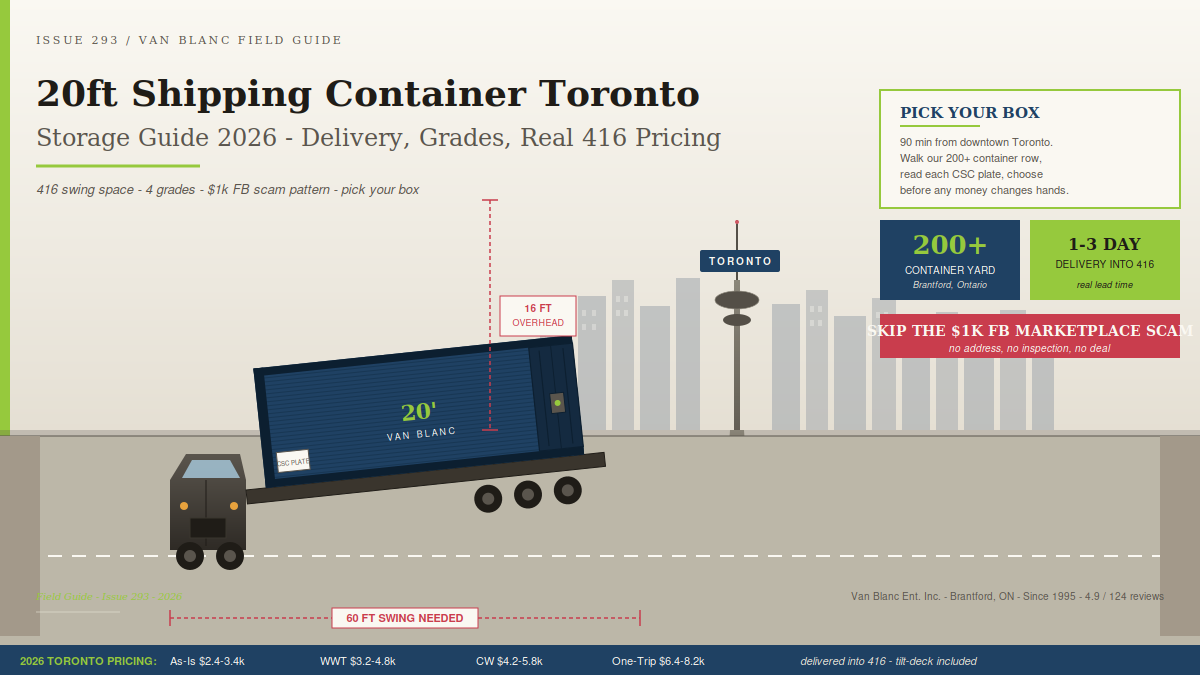
Quick Answer: A 20ft shipping container is the default size for Toronto buyers because it fits jobsite lanes, condo loading zones, and restaurant alleyways that a 40ft simply cannot reach. The delivered figure depends on four things: the grade you pick (As-Is, Wind-and-Watertight, Cargo-Worthy, or New One-Trip), the delivery method your site can receive, the 416 zone distance from our Brantford yards, and the season. Delivery into the 416 needs a 12 foot wide path and at least 14 feet of overhead clearance for a tilt-deck. Buyers walk our 200+ container inventory in Brantford and read the CSC plate before paying. Real 1-3 day lead time, not a hopeful one. Tell us the grade and your postal code and we send back one all-in number, usually the same day. Specs, plate weights and road distances from Brantford sit with our 20 foot shipping containers for sale in every grade.
In This Toronto Field Guide
- Why 20ft Is the Toronto Default Size
- Toronto Delivery Reality: Tilt-Deck Truck Swing Space and Lane Width
- The Four Grades in 20ft (One-Trip, CW, WWT, As-Is) With What Moves 2026 Pricing
- Toronto Buyer Profiles: Who Actually Buys a 20ft in 416
- Hidden Costs on a Toronto Delivery
- The Facebook Marketplace Toronto Scam Pattern
- Inspect at Our Brantford Yards Before You Pay (Pick Your Box)
- Real 1-3 Day Lead Time From Order to Delivery in 416/GTA
- Pre-Delivery Access Checklist Specific to Toronto
- Toronto-Specific FAQs (10)
Reading time: about 19 minutes. This guide covers the storage-grade 20ft for Toronto buyers. If your job needs more cube, we run the same numbers for the larger box in our look at when a 40ft makes sense for Toronto commercial storage, and our wider overview of what Van Blanc delivers across the 416 ties the whole Toronto picture together.
Why Is a 20ft Shipping Container the Default Size in Toronto?
A 20ft shipping container is the default size in Toronto because the city’s tight lots, short service lanes, and limited tilt-deck swing space rule out the 40ft footprint that dominates rural Ontario. Most 416 buyers store tools, cabinetry, or restaurant overflow, jobs built around 20 feet of secure steel.
In our 30 years selling containers across Ontario, no city skews more sharply toward the 20-foot footprint than Toronto. A 40-footer is the default in Brantford, Cambridge, and rural Wellington County because the lot is open and the driveway is long. In Toronto, geometry runs the other direction. The lot is constrained, the lane width is short, and the available swing space for a tilt-deck trailer almost never exceeds 75 feet. A 20-foot container is, in most 416 situations, the only steel box that fits.
The 20-foot dimensions are fixed by ISO 1496-1: 6.06 m long (19’10”), 2.44 m wide (8’0″), and 2.59 m tall (8’6″). Internal cube comes in at roughly 33 cubic metres, payload at 28,200 kg. A high-cube 20-footer adds a foot of vertical height, taking the exterior to 9’6″. Those numbers are not negotiable. The container that fits in a Liberty Village condo loading bay is the same container that ships through the Port of Montreal: it has to clear the same crane stacks and rail tunnels, so the dimensions are standardized worldwide.
What is negotiable is how that 20-footer gets onto your site. That is where Toronto eats most of the buyer time. A Toronto buyer who thinks the hard part is choosing the container is almost always wrong: the hard part is the last fifty feet, from the corner of their street to the final resting spot. We will walk through that geometry in the next section.
Christian LeBlanc, second-generation operator: “I get one or two calls a week from a Toronto buyer who picked a 40-foot off our website because it was the most popular page. By the end of the call, we are putting them on a 20-foot, because their service lane is 14 feet wide and their swing space is 55. The 40-footer would not have made it past their first turn. Picking the right length in Toronto is half about cargo and half about driveway geometry.”
The other reason 20ft dominates the Toronto market: most Toronto buyers are not stockpiling lumber for a barn build. They are storing tools on a small jobsite, staging cabinetry for a condo unit reno, holding back-of-house overflow at a restaurant, or running a downtown brand activation that needs lock-and-leave overnight security. Those use cases are built around 20 feet of secure, weather-tight steel that fits in the available footprint.
For the cube comparison between sizes, see our rundown of what fits inside a 20ft. For a fuller pricing-by-size overview see what containers actually cost in Canada. And for the size-up question (when is a 20-footer actually wrong) the 40ft pricing guide covers the math on cost-per-cubic-foot.
How Much Swing Space Does a 20ft Container Delivery Need in Toronto?
A 20ft container delivery in Toronto needs a 12 foot wide path along the approach and at least 14 feet of overhead clearance to swing in cleanly on a tilt-deck. For comparison, a 40-foot container needs a much longer straight run. That swing-space gap is the single biggest reason 20-foot units win in the 416, and it is the number every Toronto buyer should write down before anything else.
The tilt-deck process works like this: the trailer backs into position with the container loaded flat on the deck. The driver tilts the deck up hydraulically. Gravity slides the container off the back of the trailer onto the ground, and the truck pulls forward as the container settles. There is no crane lift and there is no assembly. The whole drop takes 8 to 15 minutes when access is clean. When access is wrong, it does not take longer; it does not happen at all, and the truck leaves with your container still on the deck.
If you want the mechanical detail, we explain how the deck tilts and gravity does the placing in its own write-up, and we cover the tight-site alternative in our look at lifting a container over a building line with a crane truck. A HIAB delivery runs higher than a standard tilt-deck because the truck is larger, the operator is rated, and the swing-arm reach is billed by the hour.
What goes wrong in Toronto specifically is rarely the math; it is the corner. Many 416 service lanes look adequate on Google Maps satellite view and turn out to have a parked Bell van, a hydro pole, or a recycling bin pinch at the entry that takes the effective lane width down to 11 feet. A tilt-deck cannot navigate 11 feet. Our delivery drivers will not even attempt it: the cost of a stuck truck with a 20-foot container on the deck blocks a residential street for four hours and triggers a tow.
Toronto Lane Width Check (Do This Before You Order)
Walk the delivery route at the same time of day the truck will arrive. Measure the narrowest point with a tape, not by eye. Look for: overhead wires below 14 feet, low-clearance archways into condo loading bays (very common in downtown core mid-rise builds), parked vehicles that block the only swing radius, and tight entry corners where a parked van or hydro pole pinches the lane. We will not deliver into a route that fails any of those four checks, because a stuck truck with a container on the deck blocks a street for hours and helps nobody.
Send us a few phone photos of the narrowest pinch, the overhead, and the final drop spot. Our dispatchers have routed 20-foot tilt-deck drops into King West, the Entertainment District, and Liberty Village for years, so we can usually tell you yes, no, or “this one needs the HIAB crane” the same day you send the pictures. The advantage of the shorter 20-foot tilt-deck is simple: it fits inside a 30-minute window on a busy downtown block where a 40-footer would still be inching back when the window closed.
What Are the Four 20ft Container Grades, and Which Fits a Toronto Job?
The four 20ft container grades are New One-Trip, Cargo-Worthy (CW), Wind-and-Watertight (WWT), and As-Is, in descending order of condition and price. Every shipping container in every Ontario yard falls into one of them. We sell all four and we will tell you which one fits your job before you drive out. The table below maps each grade to its best Toronto use and to what actually moves its price, so you know what you are paying for.
| Grade | What it is | Best use in Toronto | What moves the price |
|---|---|---|---|
| New One-Trip | Built overseas, shipped once with cargo to North America, then sold. Effectively new with a clean CSC plate. | Condo developer storage, branded retail activations, container conversions, anything that will be photographed | Highest tier: factory paint, longest service life, best resale, current CSC certification |
| Cargo-Worthy (CW) | Used unit that passed a structural inspection. CSC plate valid for further international transport. | Mid-life storage, jobsite tool crib, restaurant overflow, anything cargo-rated | Premium over WWT pays for the cargo re-certification and inspection |
| Wind-and-Watertight (WWT) | Used unit, no longer cargo-certified but verified weather-sealed. | Static yard storage, downtown construction staging, dry storage | The value sweet spot for static storage; cosmetic wear, no export cert |
| As-Is | Used unit sold without warranty. Cosmetic flaws, sometimes dents, sometimes patched rust. | Budget storage where appearance does not matter, agricultural use, demolition staging | Lowest tier: flaws drive the discount; condition varies unit to unit |
For the model-by-model breakdown of each grade, our deeper write-ups cover the full inspection criteria: what you get from a factory-fresh one-trip unit, how the cargo-worthy structural inspection works, and what to check on any used box in our guide to buying second-hand without getting stung. The used-buying guide in particular walks through the inspection checklist a Toronto buyer should run before paying for any pre-owned unit.
The grade that surprises most Toronto buyers is Wind-and-Watertight. It is the sweet spot for downtown storage: weather-sealed enough to keep cabinetry and dry goods safe through a Toronto winter, cheap enough not to feel like an investment, and almost always available from our yard in 1 to 3 days. Step up to Cargo-Worthy or one-trip and you add cleaner steel, a current CSC plate and more value at resale. If your unit will be photographed, branded, or converted, the longer service life and resale value of a new one-trip box from our current stock usually justify the step up.
The grade that does not surprise but does mislead: As-Is. We sell As-Is units as what they are: cheap because they have flaws. Buyers who walk our Brantford yards and read the CSC plates on As-Is units almost always pick a better one than a buyer who buys As-Is sight-unseen online. That is the value of being able to inspect a row of 20 As-Is candidates rather than accepting whichever one a pool supplier’s dispatcher assigns. Our checklist for inspecting a used 20ft in our yard walks through what to look at, in what order, in our yard.
If you want to see how the four grades stack up against the larger sizes before you choose, our breakdown of what drives container pricing across every size walks through the cost levers for 10ft through high-cube units. For the Toronto-specific delivery factors, the hidden costs section below covers what changes the 416 number.
Who Actually Buys a 20ft Container in Toronto?
The typical 20ft container buyer in Toronto falls into one of five profiles: condo construction storage, restaurant alley overflow, retail back-of-house, downtown brand activations, and condo reno staging. After three decades of selling containers, we can almost predict the Toronto buyer profile from the first sentence of the call. Five archetypes account for roughly 80 percent of our 416 20-foot orders. Knowing which one you fit usually predicts which grade and which delivery method.
Profile 1: Condo construction site storage. A general contractor or sub-trade running a low-to-mid-rise condo build in midtown or the West End needs a lock-and-leave tool crib that sits inside the hoarding for 18 to 36 months. WWT or CW. Roll-up door cut-in is common. The pad is gravel or compacted hardcore inside the construction perimeter. Tilt-deck access is usually fine because the site fence comes down for delivery. Lead time is the constraint: the GC wanted it yesterday. Our 1-3 day overnight delivery from our Brantford yards is exactly the use case.
Profile 2: Restaurant alley back-of-house. A King West, Ossington, or Queen East restaurant operator who lost basement storage to a sublet or is running an outdoor patio extension. Needs 20 feet of dry goods storage in the rear alley. Tilt-deck access through the alley is the question; most laneway widths in the older Toronto core run 9 to 12 feet, which is below tilt-deck minimum. HIAB crane delivery from the street with a swing arm into the laneway is the answer. Grade is usually WWT painted to look respectable. Roll-up door on the side, not the end, because the alley wall is in the way of the swing doors.
Profile 3: Retail back-of-house overflow. A retailer on Queen West, Yonge & Eglinton, or in a strip plaza that lost mezzanine storage to a build-out or never had it. Needs a 20-foot unit in the parking lot, secured, with electrical for a small heater and one LED. CW or WWT. Painted to match storefront if branded customer-facing. We deliver 40 to 60 of these a year into Toronto, every one sold outright.
Profile 4: Downtown event and brand activation. A marketing agency or brand activation team using a 20-footer as a pop-up venue at Yonge-Dundas Square, the Distillery District, or a CN Tower-adjacent event. Always new one-trip with custom paint, sometimes with windows cut, sometimes with one side wall flipped down. The 20-foot is preferred over 40-foot because the venue footprint is small and the unit has to ship back out within two weeks. Lead time is usually 6 to 10 weeks because the modifications take time. These activation units get cut, painted, and finished at our Brantford yards through the modification work we do at the Brantford yard before they ever roll into the 416.
Profile 5: Condo unit reno staging. A homeowner running a multi-unit condo reno or a personal floor-by-floor renovation who needs swing storage for cabinetry, appliances, and demolition spoils for 30 to 90 days. WWT is the standard pick. The container often sits on a driveway pad (single-family neighbourhoods like Roncesvalles or Riverdale) or on a leased lot. Our self-storage vs shipping container comparison walks through the math when this buyer is weighing a rented pod against a 20-foot purchase.
Each of those five profiles comes down to the right grade, the right delivery method, and a clear sense of access geometry before the truck rolls.
What Hidden Costs Change a Toronto 20ft Delivery Quote?
Several factors change a Toronto 20ft delivery quote beyond the container itself, and the right move is to name them before you order rather than after a deposit clears. Some supplier sites quote a clean drop into a wide-open driveway with 80 feet of swing room, a site that does not exist in the 416. Here are the six factors that actually move the number, all folded into our single all-in quote.
1. The 416 zone. Overland carriers price a Toronto route higher than the same kilometres into Cambridge or London, because a tilt-deck trip through city traffic and tight lanes simply takes longer. The zone is built into our quote by default; we do not bury it as a line item that appears later.
2. A return trip if access fails. If the truck arrives and the access turns out tighter than measured (a low overhead wire, parked vehicles blocking the swing, a lane narrower than the tape said), the driver cannot drop the container. The truck reloads or keeps the unit on the deck, and the delivery has to be rebooked, which adds a second trip’s distance to the cost. We head this off by getting access photos before booking and sending a checklist. The redo is on you only if you confirmed access and the access was wrong.
3. A weekend slot. Saturday delivery into Toronto costs more than a weekday because the carrier pays overtime, and Sunday is rare and quoted case by case. Most Toronto buyers book a weekday morning anyway, when traffic and downtown loading windows both cooperate.
4. A crane upgrade when tilt-deck cannot fit. If your site is too tight for a tilt-deck, the method switches to a HIAB crane, which is a larger truck with a rated operator and a billable swing arm, so it carries an upcharge. HIAB is effectively non-negotiable on most King West restaurant alley deliveries and most Cabbagetown laneway drops.
5. Pad prep we sometimes recommend. A 20-foot container weighs roughly 2,300 kg empty and will settle into soft soil. If your pad is grass, dirt, or unstable gravel, we recommend 4 inches of compacted crushed limestone (3/4″ minus) under each corner, or four 16×16 patio blocks at the corner-casting points. Most buyers handle this themselves; we can drop the blocks or a small load of crushed stone with the container.
6. Placement requirements. Placement rules vary by municipality, and a quick call to your local planning office before delivery is the easiest way to confirm what works for your property. We do not run permits; that step sits with the buyer. What we can promise is one all-in number for the container and the delivery, given once, rather than a teaser figure that climbs after a dispatcher books the trip.
How Does the Facebook Marketplace Container Scam Work in Toronto?
The Facebook Marketplace container scam in Toronto runs the same script every time: an underpriced 20-foot listing, stolen photos, a young seller profile, a demand for an e-transfer or wire before any inspection, and then silence. Every week, two or three Toronto buyers call us after losing to one. The pattern is identical every time, and the city of Toronto is the highest-volume market for this scam in Canada because the buyer density is high and the delivery distances are large enough that “the truck is coming from Mississauga tomorrow” sounds plausible. A real Mississauga drop comes up the 403 from Brantford, and our page on sea container delivery in Mississauga lists drive times from Clarkson to Malton.

The pattern: a listing appears on Facebook Marketplace priced well below the going market rate for a 20-foot WWT, often phrased as “estate sale” or “company downsizing.” The photos are pulled from a stock catalogue or a real Ontario yard’s website. The seller’s profile is three to nine months old with no public posts. The seller insists on e-transfer or wire deposit before any inspection, with the framing that “trucks are booked out, I need to confirm tomorrow’s delivery slot.” The buyer wires. The container never arrives. The Facebook profile vanishes within 48 hours. The buyer calls us because we are the first real Brantford yard that comes up in search.
We break this specific pattern down screenshot by screenshot in our writeup on how the Marketplace listings are staged. The wider version of the fraud, the wire transfers, the fake yards, and the sellers who vanish, is covered in our look at why a deposit before inspection is the warning sign that loses people money.
The Five-Signal Toronto Scam Test
If any one of these is true, walk away: (1) the price sits well under the going market rate with no plausible reason given, (2) the seller refuses to share a physical yard address you can drive to, (3) the seller insists on wire or e-transfer before inspection, (4) the seller’s photos reverse-image-search to another company’s website, (5) the seller’s Facebook profile is younger than six months with no public posting history. Real Ontario yards have addresses. Real Ontario yards let you inspect before paying. Real Ontario yards have been operating long enough to have a public footprint.
Our anti-scam framing in Toronto is simple: drive to Brantford, walk the row, read the CSC plate yourself, and hand over a deposit only after you have the unit number written down. We have been doing it that way since 1995. The money a Facebook listing seems to save you is the money that disappears with the seller. The money you save buying from a small family yard is real, and it stays in your pocket because there is no dispatch layer between you and the unit.
Can I Inspect a 20ft Container in Person Before Paying?
Yes. Inspecting a 20ft container in person before paying is the whole reason buyers drive to Brantford, and they do it across a 200+ unit inventory. Some yards sell sight-unseen off a tilt-deck truck, quoting a 20-footer from a generic dispatch pool without telling you which specific unit shows up at your driveway. We let you read the CSC plate on each candidate unit, push on the door gaskets, and turn the keys in the lockbox before any money changes hands. You can see what is currently on the lot and ready to walk before you make the trip.
That trip is 90 minutes from downtown Toronto on the 403 in normal traffic. Allow two hours each way during a Friday afternoon. The trip is worth it because the decision you make in our yard is unrecoverable once the truck leaves. A unit that looks fine in a photograph might have a roof patch that does not seal, a side-wall dent that hits the corner casting, a CSC plate with an expired Approved Continuous Examination Program date, or a door gasket that has compressed flat. Those are five-minute inspections in our yard. They are weeks of disputes after a sight-unseen delivery.
Per the Bureau International des Containers, every shipping container CSC plate carries the date of manufacture, the maximum gross weight, the safety approval reference, and (for Periodic Examination Scheme units) the next examination date. Inspection intervals are: first examination within five years of manufacture, then no more than 30 months between examinations. If a unit’s CSC plate shows a next examination date that has passed, it is no longer cargo-rated, and we will downgrade the grade and the price accordingly. That is what walking the yard buys you.
We walk Toronto buyers through the checks in a set order, and that same sequence is written up in our step-by-step Ontario inspection routine alongside a closer look at reading the dates stamped on a CSC plate. If you are weighing a used unit in general, the guide to buying a used container without getting burned covers the broader picture.
Christian LeBlanc, second-generation operator: “We pulled into our yard last October to meet a Toronto buyer who had driven up from Etobicoke. He was choosing between two CW 20-footers. The first one looked perfect at 30 feet. We walked up to it and the CSC plate showed a next-exam date that had passed in May. The second one looked rougher, but the CSC plate was current to 2027. We sold him the second one and downgraded the price on the first one to As-Is. He drove home with the right box. That is the inspection working.”
Our yard address: 90 Morton Ave E Unit 1B, Brantford, ON N3R 7J7. Open Monday to Thursday 9:30 a.m. to 5 p.m. and Friday 9:30 a.m. to 4 p.m. Call ahead so we can pull the inventory list for the grade you want and have the units ready to walk. +1 888-509-6658.
How Fast Can a 20ft Container Be Delivered to Toronto?
A 20ft container can be delivered into Toronto in 1 to 3 business days from order, shipped from our 4 Brantford yards, with WWT and As-Is units often landing in 1 to 2 days. The most common Toronto buyer complaint we hear is lead-time drift: the yard quotes 3 days, then it slides to 7, then to 14, while the construction site or restaurant operator burns money waiting for the storage solution that does not arrive. We work to a 1 to 3 business day window for 416/GTA delivery, shipped from our 4 Brantford yards, and we will tell you straight if a particular grade has a longer lead time.
The lead times that hold across our inventory in May 2026:
- WWT 20-foot: 1 to 2 business days from order to delivery into 416, weekday delivery, weather-permitting
- CW 20-foot: 2 to 3 business days from order to delivery, allowing time for our walk-around inspection before truck pickup
- New One-Trip 20-foot: 2 to 3 business days from order to delivery if we have the colour in stock; 2 to 4 weeks if a specific RAL paint code or factory roll-up is required
- As-Is 20-foot: 1 to 2 business days from order to delivery, almost always in stock
- Modified 20-foot (cut-ins, custom paint, electrical): 2 to 8 weeks depending on the modification scope
Those numbers are real because we ship from our 4 Brantford yards, which is geometrically the right distance for Toronto delivery on the 403. Yards farther west add half a day or more to the route. Dispatch that runs through several intermediaries before a truck is assigned is where the slide from 3 days to 14 happens. We dispatch directly: when you order, we walk to the unit, do the final inspection, and confirm the delivery slot.
Delivery outside the city follows the same logic, and our notes on getting a truck onto a hard-to-reach Ontario property apply to a tight Riverdale driveway as much as a back-forty farm gate. If a yard has ever left you waiting at the gate, our walkthrough of what to do after a delivery falls through is, unfortunately, a needed read for buyers burned by a no-show before they found us.
Ready to price your container?
Tell us the size and your postal code and we’ll send back an all-in number, container, delivery, and placement, usually within 1-3 days. No pressure, no mystery fees.
Family-run in Brantford since 1995 · 200+ containers in stock · 4.9★ across 140+ Google reviews · every box graded by a person, walk it before it lands.
Pre-Delivery Access Checklist Specific to Toronto
The following access checklist is what our dispatchers walk Toronto buyers through before booking the truck. Send us photos of each item and we will give you a yes-no decision the same day. The checklist is shorter than most because we have been delivering into the 416 for 30 years and we know the actual failure points, not the theoretical ones.
| Check | Minimum for tilt-deck | Minimum for HIAB crane |
|---|---|---|
| Straight-line clearance behind drop point | 60 feet | 35 feet |
| Lane width at narrowest point on the route | 14 feet | 12 feet |
| Overhead clearance (wires, archways, branches) | 16 feet | 22 feet (boom up) |
| Pad type (level, load-bearing) | Compacted gravel or paved | Compacted gravel or paved |
| Slope at drop point | Less than 5% | Less than 5% |
| Loading-zone window (commercial) | Two-hour window | One-hour window |
| Parking obstruction risk | None within swing path | None within boom radius |
If any one of those checks fails for tilt-deck, we shift to HIAB. If two or more fail for HIAB, we recommend the buyer rethink the placement spot. We will not deliver into a route that cannot support a safe drop: that is how driveway damage, container damage, and (worst case) a broken hydro line happens. The Toronto buyers who got that conversation in advance never regretted it.
Jobsite drops carry their own access quirks, and if your 20-footer is headed inside a hoarding line we cover the specifics in our piece on keeping tools secure on an active Ontario build site. The placement principles are the same whether the site is a downtown Toronto lot or a rural Wellington County yard; only the failure points differ.
Frequently Asked Questions
What is the actual delivered price of a 20ft shipping container in Toronto in 2026?
The delivered figure depends on the grade (As-Is is the budget tier, then Wind-and-Watertight, then Cargo-Worthy, then New One-Trip at the top), the delivery method your site can take, the 416 zone distance from our Brantford yards, and the season. A HIAB crane delivery costs more than a standard tilt-deck, and a Saturday slot costs more than a weekday. The box prices are on our 20ft price list, and we give one all-in price once we know your grade and postal code, usually the same day you ask.
How much swing space does a tilt-deck truck need to deliver a 20ft container in Toronto?
A 12 foot wide path at the narrowest pinch on the route and at least 14 feet of overhead clearance (no wires, archways, or low branches), plus a straight run behind the drop point. A 40-foot container needs a much longer straight run. Toronto sites that fail the tilt-deck access check usually still qualify for HIAB crane delivery, which costs more but needs less straight-line room because the swing arm reaches over obstacles.
Can a 20ft shipping container fit in a downtown Toronto restaurant alley?
The 20-foot container itself fits in most laneways (it is 8 feet wide and roughly 20 feet long), but the tilt-deck trailer that delivers it cannot turn into laneways narrower than 12 feet. Most King West, Ossington, and older downtown laneways measure 9 to 12 feet wide, which often forces a HIAB crane delivery from the street with the container lifted over the building line. Plan for HIAB pricing in those cases. A quick call to your local planning office before delivery is the easiest way to confirm what works for your property. We do not run permits as a third-party vendor; that step is on the buyer.
How long does it take to get a 20ft container delivered into Toronto from your Brantford yard?
Our standard lead time is 1 to 3 business days from order to delivery, shipped from our 4 Brantford yards. WWT and As-Is grade units are usually 1 to 2 days; CW takes 2 to 3 days because we re-inspect before truck pickup; New One-Trip is 2 to 3 days for in-stock colours or 2 to 4 weeks for custom paint codes. Modified units with cut-ins or electrical run 2 to 8 weeks. Those numbers are real because we dispatch directly without an intermediary, and we will tell you upfront if your specific request needs longer.
What’s the difference between Wind-and-Watertight and Cargo-Worthy for a Toronto static storage use case?
For static downtown storage (the container sits on a pad, never moves, never ships internationally again), WWT does the job. WWT means the unit is verified weather-sealed: no leaks, intact gaskets, sound roof. Cargo-Worthy adds international cargo certification, meaning the unit could be re-shipped by sea. CW costs more than WWT, and that premium buys the certification plus more value at resale. CW handling is also sturdier if you plan to move the container by truck multiple times.
How do I avoid the Facebook Marketplace shipping container scam?
Run the five-signal test: (1) the listing sits well below the going Toronto market rate with no plausible reason, (2) the seller refuses to share a physical yard address you can drive to, (3) the seller insists on wire or e-transfer before inspection, (4) the photos reverse-image-search to another company’s website, (5) the seller’s Facebook profile is younger than six months. If any one signal is true, walk away. Real Ontario yards have addresses, let you inspect before paying, and have a public footprint longer than six months. The money a Facebook listing seems to save you is the money that vanishes with the seller.
Can I inspect the actual container before I pay for it?
Yes, and we strongly recommend it. Buyers walk our 200+ container inventory in Brantford, read each unit’s CSC plate, push on the door gaskets, and turn the lockbox keys before any deposit changes hands. The trip is about 90 minutes from downtown Toronto on the 403 in normal traffic. The cost of a wrong unit (a passed CSC date, a non-sealing gasket, a side-wall dent at the corner casting) is too high to skip the yard visit on a purchase this size.
What size pad or foundation does a 20ft shipping container need?
A 20-foot container weighs roughly 2,300 kg empty and loads up to 28,200 kg gross. It sits on four corner castings, not on the bottom rails, so the load concentrates at the four corners. For static placement, four 16×16 patio blocks or 4 inches of compacted crushed limestone (3/4″ minus) under each corner is the practical minimum on most Toronto driveways and gravel pads. Bare grass or unstable soil will settle unevenly over a few months and stress the door frame. For permanent placement (multi-year), consider a concrete footing at each corner.
Why drive to Brantford instead of buying from a Toronto-based supplier?
Because most Toronto-listed suppliers do not own a Toronto yard. They dispatch from holding pools, which means the unit you see in photos is not necessarily the unit on the truck. Driving 90 minutes to walk our actual 200+ container inventory, read each CSC plate, and pick your specific box is the surest way to know what you are buying. We have been doing this since 1995. The drive is worth it for the same reason you would not buy a car off Facebook from a seller who refuses to show you the vehicle. The 4.9 across 140+ Google reviews is from Toronto buyers who made that drive.
Sources and Further Reading
- International Organization for Standardization. (2013, reconfirmed 2019). ISO 1496-1:2013, Series 1 freight containers – Specification and testing – Part 1: General cargo containers for general purposes. iso.org
- Bureau International des Containers et du Transport Intermodal. The Container CSC Combined Data Plate Explained. bic-code.org
- International Maritime Organization. Convention for Safe Containers (CSC), 1972, as amended. imo.org
Reach Van Blanc in Brantford
We have been supplying shipping containers across Ontario since 1995, with a 200+ container inventory at our Brantford yards. Toronto buyers are welcome to walk the row, read the CSC plates, and pick the exact 20-footer they want before any money changes hands. We deliver Ontario-wide in 1 to 3 business days on a cash-on-delivery basis: no surprise fees, no chase-the-paperwork.
Van Blanc Ent. Inc. 90 Morton Ave E Unit 1B, Brantford, ON N3R 7J7 +1 888-509-6658
If you are spec’ing a 20-foot container for a Toronto site in 2026, call us before you order anywhere else. We will tell you what is in stock today, what is available this week, and what your site geometry can actually receive. The most expensive 20-footer is the one that gets delivered to the wrong driveway and trucked back.
Placement requirements vary by municipality. A quick call to your local planning office before delivery is the easiest way to confirm what works for your property.
Related Toronto Reading
- 20ft and 40ft shipping containers in Vaughan
- Shipping Containers in Toronto (city hub)
- 20ft vs 40ft: Toronto Commercial Storage Decision
- Construction Storage Containers Ontario
- Tilt-Deck Delivery Mechanics
- HIAB Crane Delivery for Tight Sites
- Walk the 20-footers on our lot right now
- who Van Blanc is and the yard story