
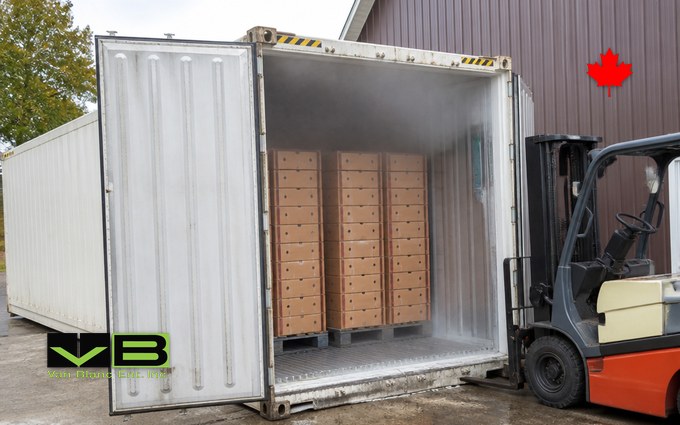
Quick Answer: A cold storage warehouse is a third-party building that holds your pallets at a set temperature and bills storage per period plus handling. When stock has to be at your door daily, Van Blanc’s 20ft or 40ft high cube reefer, delivered from Brantford, puts that cold room on your lot.
Inside This Cold Storage Comparison
- What is a cold storage warehouse?
- Cold storage facility temperature bands
- Who runs Ontario’s cold storage
- Cold storage warehouse requirements
- Handling in, handling out
- Trade-offs of a third-party cold store
- Stock that has to be at the door
- A reefer as on-site cold storage
- Warehouse and reefer, side by side
- Reefer sizes against your pallet count
- How many reefers a producer orders
- Three-phase power at the pad
- Where the reefer sits on your lot
- Deep stock out, working stock home
- Box age, unit hours and grade
- Reefer pricing factors
- Delivery from the Brantford rows
- Cold storage FAQs
Reading Time: 14 minutes
What Is a Cold Storage Warehouse?
A cold storage warehouse is an insulated building, run by a third party, that holds other businesses’ pallets at a set temperature. The trade calls it a public refrigerated warehouse. Van Blanc sells the other way to hold those temperatures: a twenty-foot reefer behind the packing room on your own property. A cold storage facility of the warehouse kind sells space and labour together. Its forklift crews unload your truck, rack the pallets in the right room, and pull them back out for the next truck. Federal rules set the floor for food. The Canadian Food Inspection Agency’s guidance under subsection 65(1) of the Safe Food for Canadians Regulations gives two examples. Its examples put refrigerated food at 4 °C or less and frozen food at -18 °C or less. This guide explains how the warehouse side works, then sets a reefer on your lot beside it, a box held to the same CFIA rules.
Christian LeBlanc, Van Blanc Ent. Inc.: “When a producer asks about a reefer, I ask how many times a week somebody drives to fetch a pallet. If it’s more than once, the cold belongs beside the loading door. We run the unit in the yard first, so they can watch the display pull down before it ships.”
Cold Storage Facility Temperature Bands
A cold storage facility splits its building into rooms held at different set points, because chilled dairy and frozen meat need different set points. Operators publish the bands they run. ShipCarte, a Toronto logistics operator, describes separate zones from -25 °C to +10 °C. Warehousing Toronto describes temperature-controlled storage from 0 to 18 °C. Frozen rooms sit at or below the CFIA’s -18 °C example, and chilled rooms at or below 4 °C. Anyone planning frozen product should read how a reefer runs on frozen duty first. The same guidance asks that product in cold storage be placed so it does not restrict air flow. That is why a warehouse leaves space around your pallets, and why a reefer floor has air channels underneath. A Van Blanc reefer covers the same ground in one box: both sizes are listed for -30 °C to +30 °C. One reefer holds one set point at a time, so a producer with chilled and frozen lines often sets one box to each.
| Product type | Set point named in the sources | Where it is stated |
|---|---|---|
| Food that requires refrigeration | 4 °C or less | CFIA guidance, SFCR 65(1) |
| Food that requires freezing | -18 °C or less | CFIA guidance, SFCR 65(1) |
| Multi-zone third-party storage | -25 °C to +10 °C | ShipCarte, Toronto |
| Temperature-controlled (not frozen) storage | 0 to 18 °C | Warehousing Toronto |
| Van Blanc 20ft and 40ft high cube reefers | -30 °C to +30 °C | Our reefer product pages and one-trip reefer listings |
Who Runs Ontario’s Cold Storage
Cold storage is run by global public companies and regional firms. The Global Cold Chain Alliance publishes a yearly list of its largest members by temperature-controlled space. Its 2026 list puts Lineage first at 2,981,000,000 cubic feet, ahead of Americold Logistics. The top 25 together run 7.76 billion cubic feet. Closer to home for Guelph agri-food processors, Conestoga Cold Storage runs warehouses in Kitchener, Mississauga and Halton Hills. Its six warehouses, including Calgary and Montreal, total over 64 million cubic feet. Trenton Cold Storage in Quinte West describes over 41 million cubic feet of warehouse and distribution services. Smaller independents fill in around the GTA, often near the plants they serve. For a box on a Halton Hills site, storage containers for Georgetown buyers come with drive times from Brantford.
For a producer, the owner’s name matters less than three things: the distance from your plant, the dock’s hours, and the cost of each pallet move. Those answers decide whether a Van Blanc reefer on your own lot belongs in the plan, and new reefers with units under 5,000 hours are one way in.
Cold Storage Warehouse Requirements
A cold storage warehouse sets rules for what it accepts, and they arrive before the first truck does. They fall into three groups: pallets, appointments and paperwork. Each rule suits a building serving many customers through one dock.
Pallets come first. Northland Cold Storage, a US operator, says in its customer FAQ that all transactions require even pallet exchange. It will not credit or exchange substandard pallets, meaning missing or broken boards or stringers. A plant that palletizes every day already works this way. A brewery or farm moving mixed cases may need to repack to suit the dock. On your own lot, mixed cases can stay on your own carts, in a 20ft reefer sized to a few pallets.
Appointments come second. Northland’s FAQ says shipping and receiving at most of its facilities runs 7 a.m. to 3:30 p.m. Monday through Friday. Appointments are typically required for all deliveries and shipments. After-hours service is possible there, with additional charges that may be billed to the customer or carrier. A 2024 Refrigerated & Frozen Foods guide tells buyers to ask about Saturday hours and how far ahead to book.
Paperwork comes third. The same guide notes that contracts are uncommon and that terms usually take the form of a rate agreement. The rate sheet lists every service and fee, including a monthly minimum that matters most to a small customer. Minimums vary: Amplify Logistics in Toronto says it has no fixed minimum, from a handful of pallets to several hundred. Northland adjusts rates no more than once per year unless needs change. Food in a box you own answers to the same CFIA rules, and food-grade fit-outs a fabricator handles cover that ground.
Handling In, Handling Out
Handling is the labour charge for moving a pallet across the warehouse dock, in and back out. A public refrigerated warehouse typically bills two lines. Storage is counted per pallet per billing period. Handling pays for the crew’s moves in and out. Northland’s FAQ quotes it as an up-front, one-time charge for receiving the pallet, placing it in storage and loading it out. It bills storage on monthly anniversary, daily, weekly, bi-weekly or split-month cycles. A box you own has no billing cycle at all: a chilled 20ft reefer you load yourself is paid for once.
The Refrigerated & Frozen Foods guide lists more lines. Loading and unloading rates sit on top of the typical handling rates. Lot release fees add up when a customer has many SKUs. Inventory-system onboarding fees are now standard. The guide also lists value-added services to ask about, such as case picking, pallet rework, tempering and blasting. None of this is hidden; it is how a shared building pays its crews. It does mean every pallet you fetch has already carried a handling charge. A reefer on your own lot has no handling line, because your own staff walk the pallet jack in. That is the line producers compare when a forty-foot high cube reefer with 38 feet of cold floor comes up.
Log the Trips Too
A cold storage invoice shows how many pallets sat in the building. It does not show the truck time, the fuel or the half-day a staff member spends fetching stock. Log one month of trips before comparing: pallets in, pallets out, and how often someone drove to get them. That log is the first number Van Blanc asks for on a reefer quote.
Trade-offs of a Third-Party Cold Store
The trade-offs of a cold storage warehouse come from distance and shared dock hours. Professional operators hold and log temperature well. What changes is how product reaches you. Every withdrawal needs an appointment and a truck, and every pallet carries a handling charge. A small producer can fall under a monthly minimum. For a frozen-food maker shipping full truckloads to a grocery chain, these matter little. For a craft brewery, an orchard with a farm store, or a meat processor filling daily orders, they matter every week. A Toronto food distributor’s back lot can run both: deep stock stays at the warehouse, and the week’s orders sit in a box out back.
Stock That Has to Be at the Door
Stock at the door means the pallets your staff touch this week, kept within walking distance of the packing line or the shop counter. Food producers, breweries, farms and distributors split inventory into two kinds. Deep stock is last fall’s frozen beef, the apples in long-term storage, or case pallets bought on a volume deal. Working stock ships on Tuesday and Friday, refills the taproom cooler, or goes to Saturday’s market. A warehouse handles deep stock well. Working stock is where trips, handling lines and appointment windows add up. A producer in this group typically plans one to three Van Blanc reefers for working stock, with deep stock left where it sits now. For a chilled line, the 20ft reefer set for chilled product suits a first box.
A brewery’s Thursday run
Take a brewery that keeps kegs and canned stock at a cold store forty minutes away. Every Thursday a staff member books the dock, drives over, loads the booked pallets and drives back before the taproom opens. A 20ft reefer at cellar temperature beside the brewhouse holds the week’s kegs instead. The warehouse keeps the seasonal overflow, and the Thursday run becomes a monthly one. Before the box lands, check what a reefer’s plug needs from the brewhouse panel.
A Reefer as On-Site Cold Storage
A reefer container is an insulated steel shipping container with its own refrigeration unit built into the front wall. It plugs into site power and holds a set temperature on its own. Van Blanc stocks two sizes across our 4 Brantford yards: the 20ft reefer and the 40ft high cube reefer. Both product pages list 80-100 mm of polyurethane foam insulation and an aluminium T-bar floor with air channels under the load. Once the box sits on its pad, the doors open at ground level and a pallet jack rolls straight in. The box is bought once and stays on your lot, with no storage line, no handling line and no appointment. Paul LeBlanc started Van Blanc in Brantford in 1995, and the yards keep a small standing stock of reefers beside the dry boxes. One-trip reefers on their first service life are listed with our new stock; ask on the call which grades are on the ground that week. A reefer works on your lot when it gets three things: a level pad, the right power and room for the doors to swing.
Warehouse and Reefer, Side by Side
A cold storage warehouse and a reefer container solve the same temperature problem from opposite ends. The warehouse brings scale, staff and a dock, and charges for each. The reefer brings the cold to your lot, and your own crew moves the pallets. The table runs question by question. To compare every reefer and dry box we have for sale, side by side, the full list sorts by size and grade.
| Question | Third-party cold storage warehouse | Reefer container on your lot |
|---|---|---|
| Where the product sits | At the operator’s building, a drive away | Beside your loading door or shop |
| Access hours | Booked appointments inside dock hours; after-hours may carry charges | Whenever your staff are on site |
| How it is billed | Storage per pallet per period, handling in and out, extra services | Bought once; you pay the hydro on a three-phase reefer circuit |
| Minimum volume | Varies by operator; some set a monthly minimum | One box, sized to your working stock |
| Pallet rules | The operator’s standard; even pallet exchange at some docks | Your own pallets, carts or cases |
| Temperature | Separate rooms for chilled and frozen | One set point per box, -30 °C to +30 °C |
| Who moves the pallets | The warehouse crew | Your crew, on foot or with a pallet jack |
| Best suited to | Deep stock and full truckloads | Working stock touched every week |
Reefer Sizes Against Your Pallet Count
A 20ft reefer suits a producer whose working stock fits on a handful of pallets. A 40ft high cube reefer suits one who moves a truck’s worth at a time. The figures below come from the 20ft reefer’s measured interior and its high cube sibling, taken inside the insulation. The pallet counts are our own rule-of-thumb arithmetic from those inside dimensions. They assume 48 by 40 inch pallets, single-high, two across with the 40 inch side spanning the box: 80 inches inside an 89 or 90 inch width. The 20ft’s 214 inches of floor take four 48 inch rows, so 4 x 2 = 8. The high cube reefer’s 456 inches of floor take nine rows, so 9 x 2 = 18. Other loading patterns change the count.
| Measure (inside) | 20ft reefer | 40ft high cube reefer |
|---|---|---|
| Length | 17 ft 10 in (5.440 m) | 38 ft (11.583 m) |
| Width | 7 ft 5 in (2.270 m) | 7 ft 6 in (2.294 m) |
| Height | 7 ft 4 in (2.240 m) | 8 ft 4 in (2.548 m) |
| Door opening | 7 ft 6 in x 7 ft 3 in | 7 ft 6 in x 8 ft 3 in |
| Volume | 27.7 m³ (978 cu ft) | 67.0 m³ (2,366 cu ft) |
| Pallets on the floor (rule of thumb) | about 8 pallet positions | about 18 pallet positions |
| Temperature range | -30 °C to +30 °C | -30 °C to +30 °C |
The 40ft high cube’s extra foot of inside height helps with tall pallets or two-high loads of short cases. The high cube reefer’s full spec sheet lists its weights and unit options. The 20ft fits a tighter lot and a shorter cable run to the panel. A producer with chilled and frozen lines can run one of each size.
How Many Reefers a Producer Orders
A producer moving working stock out of a cold storage warehouse typically plans one to three reefers, sized to the pallets touched in a week. The count follows the number of set points, chilled or held below freezing for meat and ice cream, and the volume at each. The table is rule-of-thumb guidance, not a fixed rule.
| Buyer | Typical order | What each box holds |
|---|---|---|
| Craft brewery or cidery | One 20ft reefer | Kegs and canned stock at cellar temperature for the taproom and weekly deliveries |
| Orchard or vegetable farm with a farm store | One or two 20ft reefers, or one 40ft high cube | Picked produce held chilled between field, packing shed and store |
| Meat or prepared-food processor | Two boxes, one chilled and one frozen | Daily order stock on each side of the freezing line |
| Regional food distributor | Two or three 40ft high cubes | A truck’s worth of chilled and frozen stock between deliveries |
Multi-box orders save on the trip: both reefer product pages list a per-box discount on delivery starting at three units. Van Blanc quotes the boxes together, with one delivery date for the set. A distributor ordering three might start with a set of forty-foot reefers for chilled and frozen lines.
Three-Phase Power at the Pad
A reefer’s refrigeration unit is built for the power that ships and terminals supply. Van Blanc’s reefer power guide states that a reefer container in Ontario needs 3-phase 460V power on a 32-amp circuit, through an IEC 60309 plug. Our freezer container guide lists the same class of supply, 3-phase 380-460V, for both the 20ft and the 40ft high cube. The exact voltage and plug depend on the make and model on your quote. A licensed electrician confirms the supply before the box ships. For a rural site without three-phase service, the guide describes a rotary phase converter sized 15 to 20 hp running from single-phase power. That converter and its install are the electrician’s scope, quoted against your panel and the cable run. The three-phase hookup a reefer expects covers the receptacle, the converter and the wire.
Photograph the panel first
Before you call, photograph your main electrical panel and the spot where the box would sit. Send both to your electrician and to Van Blanc. The electrician can say whether three-phase service is on site, and we can say which unit’s plug will meet it.
Where the Reefer Sits on Your Lot
A reefer belongs where the pallets already travel. On a farm that means beside the packing shed; at a brewery, beside the brewhouse door; at a processor, close to the shipping bay. The box needs a level, drained pad under its four corner castings. A level gravel pad under the castings covers most sites, with concrete piers for a permanent placement. Leave clear ground for the cargo doors to swing fully open and for a pallet jack to turn. Keep the refrigeration end where air moves freely around the condenser. Plan the cable run to the panel before the truck arrives, because the truck sets the box where the pad is.
Inside, load to keep air moving. The CFIA guidance asks that stored product not restrict air flow, and the T-bar floor carries cold air under the load. Keep pallets back from the doors and short of the ceiling so return air reaches the unit. Frozen loads need that air most, and what a frozen set point asks of the compressor explains why.
Deep Stock Out, Working Stock Home
A producer can keep both. The cold storage warehouse holds deep stock that moves by the truckload. The reefer holds working stock that moves by the pallet. The warehouse then sees fewer, larger withdrawals, and the reefer takes the daily touches. Toronto distribution yards with no spare dock door can run the same split. Brampton meat and beverage plants are a fair example. A processor there might keep frozen raw material at a public warehouse near the 410 and a chilled 40ft high cube beside its own shipping bay. An orchard might keep long-term apples in its own storage and a 20ft reefer at the farm store for the weekend. The split starts with the trip log, and the Van Blanc reefer count follows from it.
Pricing cold storage on your own lot?
Send us your weekly pallet count, the set point you need, a photo of your electrical panel, and where the box would sit. We will tell you 20ft or 40ft high cube, the grade, and one all-in number with a real lead time. The fastest answer is a call.
Family-run in Brantford since 1995 · 4.9★ across 140+ Google reviews.
Box Age, Unit Hours and Grade
A reefer’s grade describes two things at once: the steel box and the refrigeration unit in its front wall. Van Blanc’s reefer product pages list four grades. The buyer chooses by the job, the budget and how long the box will stay.
| Grade | What our product pages say |
|---|---|
| One-trip (new) | Essentially new, one voyage from Asia; refrigeration unit under 5,000 hours |
| Cargo worthy (CW) | Box used 8 to 15 years; unit serviced and CSC re-certified; unit hours typically 30,000 to 60,000 |
| Wind and watertight (WWT) | Older unit (15+ years); best use is above-zero duty at 4 to 12 °C |
| As-Is | Refrigeration unit may be non-functional or removed; insulated shell for custom cooling or donor use |
The “8 to 15 years” for cargo worthy is the age of the box, not a promise of how long it will run. The industry calls new units one-trip because they made exactly one loaded voyage before reaching Ontario. A one-trip reefer with its unit close to new suits a long stay on one pad. A cargo worthy reefer suits a producer who wants a working unit with a service record. Whatever the grade, Van Blanc discloses the make, model and approximate hours on the quote. We can start the unit for you in the yard, or on a video call, before it ships.
Reefer Pricing Factors
Van Blanc does not publish reefer prices, because the number depends on the unit and your site. Five things move a reefer quote: the size, the grade and machine hours, delivery distance and pad access, the number of boxes, and that month’s steel and reefer market. Grade and hours matter more on a reefer than on a dry box, and a set of boxes shares the trip. Your own licensed electrician quotes the electrical work separately, using the plug and circuit spec from our power guide. Tell us the set point, the pallet count and your postal code, and we will send one landed number, usually the same day. Every quote comes with a real lead time, not a hopeful one.
Reefers draw scammers too. Many people call us saying they can get a box for far less on Facebook, and two weeks later they call back scammed. The cheap Marketplace listing that wants a deposit first follows one pattern. Ask any seller to start the unit while you watch.
Delivery From the Brantford Rows
Van Blanc delivers in-stock reefers in 1-3 days to most of Ontario from our 4 Brantford yards, Eastern Ontario runs such as Ottawa and Kingston included. Units not on the ground are sourced to order, which the product pages put at 2 to 4 weeks. Payment happens on delivery. Come to Brantford and watch a unit start and its display begin to drop before you choose.
The Food Belt Around Brantford
Producers who weigh a reefer against a cold store sit across the food belt around Brantford. They include processors in Brampton and Mississauga, agri-food plants in Guelph and Kitchener, breweries along the 403, and orchards in Norfolk and Niagara. Every one of them is inside a day’s drive of Brantford, where a reefer can be started for you before it ships. Worth the drive for unbeatable quality, family customer service with 30 years of experience.
Frequently Asked Questions
What is the difference between a warehouse and cold storage?
A standard warehouse holds goods at whatever temperature the building runs. Cold storage holds them at a controlled set point, typically 4 °C or less for chilled food and -18 °C or less for frozen, per CFIA guidance. A cold storage warehouse adds insulated rooms, refrigeration plant and temperature records to the warehouse model.
What are the requirements for a cold storage warehouse?
For food, the Safe Food for Canadians Regulations require temperature and humidity suited to the food, and CFIA guidance gives storage that does not restrict air flow as an example. Instruments must control, indicate and record temperature where needed. Operators add customer rules: pallet standards, booked receiving appointments, and a rate agreement listing storage and handling charges.
What are the downsides of using a cold storage warehouse?
The product sits a drive away, withdrawals need booked appointments inside dock hours, and each pallet carries a handling charge covering its moves in and out. Small customers can fall under a monthly minimum. For deep stock moving by the truckload these matter little. For working stock fetched every week, a reefer on your own lot removes the trips.
Who is the largest cold storage company?
By the Global Cold Chain Alliance’s 2026 list, Lineage is the largest, with 2,981,000,000 cubic feet of temperature-controlled space, followed by Americold Logistics. In Ontario, regional operators such as Conestoga Cold Storage and Trenton Cold Storage run large facilities alongside smaller independents.
How much does it cost to build a cold storage facility?
The cost is driven by insulated panels, refrigeration plant, floor insulation and power. Energy is the long-term line: Lee & Associates puts a typical refrigerated facility at 40 to 60 kWh per square foot a year, against 6.1 kWh for a standard warehouse. A reefer container arrives with the insulation and refrigeration built in.
Can a shipping container be used as a cold storage facility?
Yes. A refrigerated container, or reefer, is an insulated container with its own refrigeration unit. Van Blanc’s 20ft and 40ft high cube reefers hold -30 °C to +30 °C and sit on a level pad beside your loading door. A licensed electrician confirms the three-phase supply.
How many pallets does a reefer container hold?
As a rule of thumb from the inside dimensions, a 20ft reefer takes about 8 pallet positions and a 40ft high cube reefer about 18. That assumes 48 by 40 inch pallets, single-high, with the 40 inch side spanning the box. Turned patterns, short loads stacked two high, or racking change the count.
Sources
- Canadian Food Inspection Agency. Regulatory requirements: Preventive controls for food businesses, SFCR subsections 65(1) and 65(2). CFIA preventive control requirements, checked October 2026.
- Frozen Foods Biz. (2026, April 29). GCCA’s Top 25 Cold Chain List Shows Global Response to Demand Increase, reporting the Global Cold Chain Alliance 2026 Global Top 25. Frozen Foods Biz on the GCCA Top 25, checked October 2026.
- Khait, M. (2024, April 1). Navigating Public Refrigerated Warehouses (PRWs) and Third-Party Logistics (3PL) Providers. Refrigerated & Frozen Foods. Refrigerated & Frozen Foods guide to public refrigerated warehouses, checked October 2026.
- Northland Cold Storage. Cold Storage Questions and Answers. Northland Cold Storage questions and answers, checked October 2026.
- Lee & Associates. (2025, March 6). Ontario’s Cold Storage Market in 2025: Trends, Challenges and Growth Drivers. Lee & Associates Ontario cold storage market, checked October 2026.
- Conestoga Cold Storage. Company home page. Conestoga Cold Storage home page, checked October 2026.
- Trenton Cold Storage. Company home page. Trenton Cold Storage home page, checked October 2026.
- ShipCarte. Cold Storage Toronto. ShipCarte cold storage Toronto, checked October 2026.
- Warehousing Toronto. Temperature-Controlled Warehousing. Warehousing Toronto temperature-controlled warehousing, checked October 2026.
- Amplify Logistics. Cold Storage Toronto. Amplify Logistics cold storage Toronto, checked October 2026.
Watch a Reefer Start in Brantford
We have been supplying shipping containers across Ontario since 1995. Our public yard is at 90 Morton Avenue East, one of our 4 Brantford yards.
Van Blanc Ent. Inc., 90 Morton Ave E Unit 1B, Brantford, ON N3R 7J7, 519-754-6844.
Bring your trip log and a photo of the panel, and we will start a reefer for you in the yard so you can watch the display begin to drop. If the drive does not suit, we will run one on a video call. Worth the drive for unbeatable quality, family customer service with 30 years of experience.