
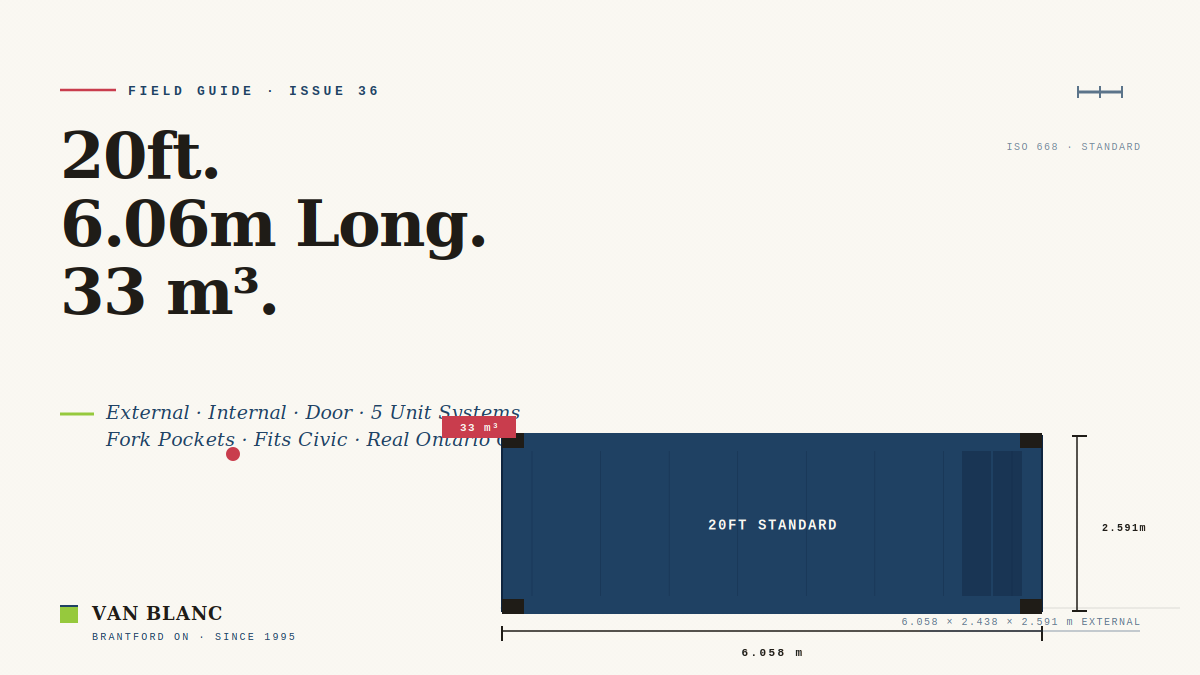
Quick Answer: Standard reference: ISO 1496-1:2013, General cargo containers. A 20ft shipping container measures 6.058m long, 2.438m wide, 2.591m tall externally (19’10.5″ x 8’0″ x 8’6″). Internal space is 5.898m x 2.352m x 2.393m = 33.2 cubic metres (1,172 cu ft) of usable volume. The empty container weighs about 2,250 kg and carries a max payload of 21,750 kg. Door opening is 2.340m wide and 2.292m tall. A 20ft High Cube adds 30 cm of interior height. In Ontario, 20ft container pricing climbs by grade, from Wind & Water Tight at the entry end up to One-Trip at the top, plus delivery scaled to distance. Van Blanc Brantford carries 200+ containers and lets buyers walk the row before paying. Real lead times and cash-on-delivery pricing, quoted to your specific address, call us at 519-754-6844.
In This Guide
- All five units in one table: feet, metres, cm, mm, inches
- Why interior is 16cm shorter than exterior (and what that costs you)
- Door opening dimensions: the loading constraint
- What actually fits inside a 20ft container (with real vehicles)
- Weight, payload, and what your driveway has to handle
- Standard vs High Cube: when 30 cm matters
- Site preparation: concrete, gravel, blocks, or grade?
- Real Ontario 2026 cost by grade
- Used vs new: which grade is worth it?
- 20ft vs 10ft vs 40ft: matching size to use case
- FAQs
Reading Time: about 16 minutes
Every shipping container project starts with the same question: “Will it actually fit my stuff, and will my stuff fit my space?” For a 20ft container in Ontario, the answer depends on five numbers in five different unit systems, the door opening (which is smaller than the interior), and the foundation you have prepared. This guide walks through all of it: the spec, the math, the cost, and the on-site reality of a 20ft container delivered from our Brantford yard.
Van Blanc has been delivering 20ft containers across Ontario since 1995, and what a delivered 20ft costs comes down to grade, distance and site access. The 20ft is our most-delivered size, by volume, every year, across every customer type from cottage country to industrial parks. Most buyers think the question is “what are the dimensions” but the real question is “do those dimensions match my use case.” This guide answers both.
All five units in one table: feet, metres, cm, mm, inches
Buyers ask for 20ft dimensions in different unit systems depending on who taught them measuring. Trades folks often default to feet and inches. Engineers and Europeans default to millimetres. Most homeowners use metres and feet interchangeably. Here is every dimension a 20ft Standard container has, in every common unit system, on one page. Once the size checks out, 20 foot containers for sale at Van Blanc come in one-trip, cargo worthy, wind and watertight and as-is grades.
| Measurement | Metres | Centimetres | Millimetres | Feet & Inches | Inches |
|---|---|---|---|---|---|
| External length | 6.058 m | 605.8 cm | 6,058 mm | 19′ 10.5″ | 238.5″ |
| External width | 2.438 m | 243.8 cm | 2,438 mm | 8′ 0″ | 96″ |
| External height (Standard) | 2.591 m | 259.1 cm | 2,591 mm | 8′ 6″ | 102″ |
| External height (High Cube) | 2.896 m | 289.6 cm | 2,896 mm | 9′ 6″ | 114″ |
| Internal length | 5.898 m | 589.8 cm | 5,898 mm | 19′ 4.25″ | 232.25″ |
| Internal width | 2.352 m | 235.2 cm | 2,352 mm | 7′ 8.5″ | 92.5″ |
| Internal height (Standard) | 2.393 m | 239.3 cm | 2,393 mm | 7′ 10.25″ | 94.25″ |
| Internal height (High Cube) | 2.698 m | 269.8 cm | 2,698 mm | 8′ 10.25″ | 106.25″ |
| Door width (opening) | 2.340 m | 234.0 cm | 2,340 mm | 7′ 8.1″ | 92.1″ |
| Door height (opening, Std) | 2.292 m | 229.2 cm | 2,292 mm | 7′ 6.2″ | 90.2″ |
| Floor area | 13.88 m² (149.4 sq ft) usable inside | ||||
| Internal volume (Standard) | 33.2 m³ (1,172 cu ft) | ||||
| Internal volume (High Cube) | 37.4 m³ (1,321 cu ft) | ||||
These dimensions are fixed by ISO 6346:2022 (Freight container coding, identification, marking) and ISO 668 (Freight containers, Classification, dimensions and ratings). Every manufacturer worldwide (CIMC, Singamas, Maersk Container Industry, Daikin, CXIC) builds to the same external numbers within a 5mm tolerance. Internal dimensions vary by 5-10mm between manufacturers depending on wall corrugation depth and floor thickness, but the external envelope is constant. This is what makes containers globally interchangeable on ships, trains, and trucks.
Why interior is 16cm shorter than exterior (and what that costs you)
The external length of a 20ft container is 6.058m. The internal length is 5.898m. That is 16 cm of length you lose to the steel structure. Specifically, the corrugated end walls and the door frame structure. Same story on the width: 2.438m external becomes 2.352m internal (an 8.6 cm loss to the corrugated side walls). And height: 2.591m external becomes 2.393m internal (19.8 cm lost to the corrugated roof and floor framing).

Why this matters operationally:
- Buying a 20ft to hold an exact-length object. A jet ski or small powerboat at 5.9m long fits inside the 5.898m internal length with literally no margin. Anything 6.0m+ does not fit a 20ft. You need a 40ft.
- Planning a conversion floor plan. The usable floor is 5.898m x 2.352m = 13.88 m². Drawings that use the external dimensions overestimate floor space by 14 percent. Always design from internal dimensions.
- Calculating loaded weight distribution. The 16cm of structure at each end is steel; the cargo only loads the internal length. Heavy cargo at the door end concentrates weight on the corner castings rather than across the floor.
Fork pocket dimensions: how forklifts and cranes lift the container
Every 20ft ISO container has two fork pockets built into the bottom side rails for forklift handling, plus four corner castings for crane and tilt-deck lifting. These are how the container physically moves between locations after delivery rather than optional features.
| Fork pocket spec | Dimension |
|---|---|
| Number of fork pockets per side | 2 (one per side rail, lift from either side) |
| Fork pocket opening width | 355 mm (14″) |
| Fork pocket opening height | 115 mm (4.5″) |
| Centre-to-centre spacing between fork pockets | 2,050 mm (80.7″) |
| Distance from end of container to centre of nearest pocket | 2,005 mm (78.9″) on a 20ft |
| Minimum forklift fork length required | 2.4 m (95″) to reach across the full width |
| Recommended forklift capacity (empty 20ft) | 5,000 kg (11,000 lb) |
| Recommended forklift capacity (loaded 20ft to ISO max) | 30,000 kg (66,000 lb) |
The fork pocket spacing is what determines which forklift can lift a 20ft container. A standard 8,000 lb warehouse forklift with 1.2m forks cannot reach the second pocket from the centre side. You need a heavy industrial forklift with 2.4m+ forks (typically 15,000 lb+ capacity rated machine) or a tilt-deck truck for delivery and relocation. This is why most Ontario buyers use tilt-deck for both delivery and any subsequent relocation rather than trying to find a forklift big enough.
The four corner castings (one at each top corner and one at each bottom corner) accept ISO twistlocks for crane lifting. Crane lifting requires a spreader bar that engages all four top corner castings simultaneously. Spreader bars are standard equipment at any crane operator in Ontario who handles containers, so the rental is usually bundled into the crane operator’s rate rather than billed separately.
Door opening dimensions: the loading constraint
The cargo door at the rear of every 20ft container is slightly smaller than the internal dimensions because the door frame is welded into the container shell with a seal lip around the perimeter.
| Door Opening | 20ft Standard | 20ft High Cube |
|---|---|---|
| Width | 2.340 m (7′ 8.1″) | 2.340 m (7′ 8.1″) |
| Height | 2.292 m (7′ 6.2″) | 2.597 m (8′ 6.2″) |
The door opening height is roughly 10 cm less than the internal height because of the top door frame seal. For loading equipment, that 10 cm decides what fits. A pallet of stacked drywall sheets at 2.0m loads through either size. A typical 2.1m tall industrial pallet still loads through Standard. A small forklift at 2.2m height needs the High Cube door clearance. Most ATVs and motorcycles clear easily. A full-size pickup needs a 40ft High Cube. A standard sedan or compact SUV fits the Standard.
What actually fits inside a 20ft container
The “what fits” question gets a different answer for every cargo type. Here is the practical Ontario buyer reality for the most common loads.
| Cargo | 20ft Standard capacity | 20ft High Cube capacity |
|---|---|---|
| EUR pallets (1.0 x 1.2 m), single layer | 11 pallets | 11 pallets |
| EUR pallets, 2-high (under 2.0m total) | 22 pallets | 22 pallets |
| North American pallets (1.0 x 1.2 m equivalent) | 10 pallets | 10 pallets |
| Round hay bales (4 x 5 ft) | 16-18 bales, 2-high | 20-22 bales, 2-high |
| Square hay bales (small, 35 lb class) | 120-140 bales | 140-160 bales |
| Mid-size sedan (Civic / Camry) | 1 vehicle with margin | 1 vehicle with margin |
| Full-size pickup (F-150 / Tundra / RAM) | Does NOT fit (too long) | Does NOT fit (too long) |
| Compact SUV (CR-V, RAV4, CX-5) | 1 with tight margin | 1 with tight margin |
| Sea-Doo on trailer | 1 with margin | 1 with margin |
| Snowmobile on trailer | 1-2 nose-to-tail | 1-2 nose-to-tail |
| ATVs / UTVs (Polaris RZR class) | 1 with workspace | 1 with workspace |
| 55-gallon industrial drums (standing) | 48 drums (4 wide x 12 long) | 48 drums |
| Stacked moving boxes (medium 18x18x16) | 600-700 boxes (full pack) | 700-800 boxes |
The vehicle-fit math you can do at the yard
For any vehicle, write down its length, width (mirrors folded), and height. Subtract 15 cm from the internal length (5.748m usable for clearance), subtract 20 cm from internal width (2.152m usable for mirror tolerance and side walking room), and compare height to 2.29m (Standard door opening). If all three margins clear, the vehicle fits. If any one fails, it does not. This 3-step test takes 30 seconds at the yard and is the most reliable way to confirm a fit before buying.
Weight, payload, and what your driveway has to handle
A 20ft container has three weight numbers stamped on its CSC plate:
- Tare (empty) weight: 2,200 to 2,300 kg (4,850 to 5,070 lb)
- Maximum payload: 21,750 kg (47,950 lb)
- Maximum gross weight: 24,000 kg (52,910 lb) per ISO 1496
For Ontario buyers using the container for storage or conversion, the operational number is the tilt-deck delivery weight: empty container at 2,250 kg plus the tilt-deck truck at about 11,500 kg = roughly 13,800 kg combined road weight on your driveway during the 20-30 minute delivery window. Most concrete and asphalt driveways handle this without issue. Soft topsoil, gravel without proper base, and uninspected wooden bridges on rural roads may not. Our deeper guide to shipping container weight and delivery weight handling covers all four sizes plus Ontario road-haul limits.
The 20ft is the easiest size to deliver in Ontario because of this lower combined weight. Tight residential lots, suburban driveways, and most cottage country access roads handle a 20ft delivery without site preparation beyond a level pad.
Standard vs High Cube: when 30 cm matters
The only spec difference between a 20ft Standard and a 20ft High Cube is height. Both share the same 6.058m length and 2.438m width. The Standard is 2.591m external (8’6″) and the High Cube is 2.896m external (9’6″). Internally that translates to 2.393m versus 2.698m, a 30 cm difference.
The 30 cm matters in three scenarios:
- Conversions with finished interior. A 3-inch closed-cell spray foam ceiling and a finished framing layer eat 8-10 cm of headroom. Standard at 2.393m drops to about 2.30m of usable headroom. High Cube at 2.698m drops to 2.60m. For office, workshop, or living conversions where tall residents need clearance, the High Cube is worth the premium.
- Stacked pallets with tall items. 1.3m to 1.5m pallets stacked 2-high need at least 2.60m of usable height. Standard at 2.39m forces single-layer loading on those pallets. High Cube enables 2-high.
- Reefer applications. Refrigeration units eat 15-20 cm of interior height. A reefer in Standard barely clears most cargo; a reefer in High Cube preserves usable volume.
For pure dry storage of household goods, equipment, or boxes under 1.5m tall per stack, the Standard is fine. Buyers should not pay the High Cube premium unless they have a specific use that needs the height. Our High Cube vs Standard breakdown covers when the upgrade pays for itself.
Site preparation: concrete, gravel, blocks, or grade?
This is one of the most-asked questions from first-time 20ft buyers, and it arrives three ways: “Do you need a concrete slab for a shipping container?”, “Should shipping containers be on the ground or blocks?”, and “What is the best base to put a shipping container on?”
The short answer: blocks, cribs, or piers on a stone pad rather than concrete or bare ground. Here is the longer answer.
Direct on grade (do not do this)
Setting a 20ft directly on grass or topsoil traps moisture against the underside steel. The container starts corroding from the underside within months. Plants grow into the corrugations. Freeze-thaw cycling shifts the corner castings unevenly. We have seen 20ft containers placed on grass in 2018 show significant underside corrosion by 2024. Always elevate.
Stone pad with corner blocking (the standard Ontario approach)
Excavate the footprint 15 cm deep, lay 10-15 cm of compacted 3/4-inch clear stone, set four concrete deck blocks or pressure-treated 6×6 timber cribs at the corner casting positions, and place the container on the cribs. This is the lowest-cost option, driven mostly by how much stone the site needs and whether you do the labour yourself, and it is what about 70 percent of Ontario 20ft deliveries land on. The container is removable (resaleable, relocatable) and the install survives Ontario freeze-thaw for decades.
Sono-tube piers (better for sloped or soft-soil sites)
Four to six 8-inch diameter concrete piers poured 1.2m deep (below the Southern Ontario frost line) with a steel pin and bearing plate on top. This costs more than a stone pad because of the concrete, the rebar, and the deeper excavation, but it is the right answer for sloped sites, soft topsoil, or any installation where the container will not be relocated.
Full concrete pad (only if you need it)
A poured concrete pad sized to the 20ft footprint with frost-protected footings. This is the most expensive base by a wide margin, since it adds formwork, rebar, and a full concrete pour, and it is best for permanent residential installations or any build where the container is becoming part of the home architecture. Rarely needed for storage.
Do you need a concrete slab?
No, you do not need a concrete slab for a 20ft shipping container in Ontario. A properly prepared stone pad with corner blocking handles the load and the freeze-thaw cycling for decades. Concrete pads are over-spec for storage uses and only make sense for permanent residential conversions. The single most important pad detail is drainage. Water must drain away from the container rather than pool under it.
Real Ontario 2026 cost by grade
20ft container pricing in Ontario splits by grade. The grade is what determines remaining service life, cosmetic condition, and how the container has lived its prior life.
| Grade | Relative price position | Condition you can expect | Typical age at purchase | Expected remaining service life |
|---|---|---|---|---|
| One-Trip (essentially new) | Highest | Clean steel, single ocean voyage, original paint | 0-2 years | 30-50 years |
| Cargo Worthy (CW) | Mid-to-high | Certified watertight, light surface wear, minor dents | 8-12 years | 20-35 years |
| Wind & Water Tight (WWT) | Mid (best value) | Dry inside, cosmetic rust patina, typical used condition | 10-15 years | 15-30 years |
| As-Is | Lowest | Sold without watertight guarantee, may need repair | 15+ years | 5-20 years |
Delivery from our Brantford yard is priced by distance: the shortest add-on is for nearby Southern Ontario addresses, more for cottage country, and the most for Northern Ontario routes. The turnkey number you pay (container plus delivery) is driven by the grade you choose and how far the tilt-deck has to travel, which is exactly why we quote delivery to your specific postal code on top of our posted 20ft container prices.
The question “How much should I pay for a 20 foot container?” has different right answers by use case:
- For general storage: Wind & Water Tight is the sweet spot, giving you a dry, sound box at the lowest sensible grade.
- For occupied conversion (office, workshop): One-Trip makes sense because you avoid prep work and start with clean steel.
- For long-term agricultural or industrial use: Cargo Worthy balances up-front cost against remaining service life.
Used vs new: which grade is worth it?
“Are used 20ft containers worth buying?” is the question that follows.
For most Ontario use cases, yes. A used 20ft Wind & Water Tight or Cargo Worthy container is built from the same Corten steel as a One-Trip, with the same structural envelope and the same ISO 6346 specs. The differences are cosmetic: paint chips, surface rust patina, minor dents from years of ocean shipping handling. Structurally, a 14-year-old Cargo Worthy container delivered to a Brantford farm has decades of remaining service life if it goes on a properly drained pad.
Three scenarios where new (One-Trip) is worth the premium:
- The container will be occupied space. Office, workshop, accessory dwelling. The interior steel should be clean, free of repair welds, and dry. One-Trip delivers this; used grades require prep work that often costs more than the price gap.
- The container is visible from the road or a customer-facing area. Restaurant kiosks, retail pop-ups, residential placements on a visible lot. Cosmetic condition matters and a One-Trip arrives looking new.
- The buyer plans to resell within 3-5 years. One-Trip containers retain 60-75 percent of purchase price at the 3-year mark; used grades retain 45-60 percent. For short-hold use cases, the One-Trip recovery offsets the premium.
For everything else (storage, farm, construction site, industrial laydown), used grades are the right answer. Our new vs used grade explainer walks through every grade in detail.
20ft vs 10ft vs 40ft: matching size to use case
The 20ft is the most-delivered single size in the Ontario market, but it is not always the right size for every job. Here is the sizing decision.

| If you need to store… | Right size | Why |
|---|---|---|
| 1-2 cubic metres of household items | 10ft | Fits the load in the smallest footprint |
| 5-20 cubic metres of household items, tools, seasonal gear | 20ft | Right-sized for residential |
| 1 vehicle plus shop or storage space | 20ft High Cube or 40ft | 20ft tight, 40ft comfortable |
| Farm equipment, hay, feed for a 100+ acre operation | 40ft | Volume requires the larger size |
| Contractor tools, materials, rotating job sites | 20ft Cargo Worthy | Mobile enough for tilt-deck moves |
| Restaurant kitchen build | 40ft High Cube | Need length and headroom |
| Construction site office | 20ft High Cube | Right-sized for 1-3 people working |
| Cottage seasonal storage | 20ft WWT | Volume + cost balance |
The 20ft is the size that works for the most common Ontario use cases because 33 cubic metres of secure dry storage covers the typical household, hobby, contractor, or cottage owner. Above that volume, the math shifts toward 40ft. Below that volume, the 10ft becomes the better size. Our 20ft vs 40ft cost-per-cubic-metre analysis covers the per-volume math in detail.
200+ container inventory at our Brantford yard, you pick your box
Van Blanc carries over 200 containers across our four Brantford yards at any given time, including a deep stock of 20ft Standard and 20ft High Cube containers across One-Trip, Cargo Worthy, and Wind & Water Tight grades. We let buyers walk the row, check the corner casts, look inside, run the light test, and pick the exact unit before paying. Other suppliers send stock photos and ship from depots you have never seen. When you are spending on something that should serve 25-plus years, come see the unit in person. Drive to 90 Morton Ave. East, Brantford, and walk the yard with Paul or Christian.
Frequently Asked Questions
Can a car fit in a 20 foot container?
Yes for most sedans and compact SUVs, no for full-size pickups. A Honda Civic, Toyota Camry, Mazda CX-5, or Honda CR-V fits a 20ft Standard with 1.0-1.4 metres of margin behind and adequate width clearance (mirrors folded). A Tesla Model Y or Toyota RAV4 fits with tighter clearance. A Ford F-150, RAM 1500, Toyota Tundra, or any full-size pickup is too long for a 20ft and needs a 40ft High Cube. The fit math: subtract 15 cm from the 5.898m internal length for safe loading margin, and confirm the vehicle width (mirrors folded) clears 2.15m. See our container garage guide for the full vehicle-clearance breakdown including F-150 and Tundra dimensions.
What are the dimensions of a standard 20ft shipping container?
External: 6.058m long, 2.438m wide, 2.591m tall (19′ 10.5″ x 8′ 0″ x 8′ 6″). Internal: 5.898m long, 2.352m wide, 2.393m tall. Door opening: 2.340m wide, 2.292m tall. Internal volume: 33.2 cubic metres (1,172 cubic feet). Floor area: 13.88 square metres (149.4 square feet).
What are the outside dimensions of a 20ft shipping container?
The outside (external) dimensions are 6.058m long by 2.438m wide by 2.591m tall for a Standard, or 2.896m tall for a High Cube. In feet: 19′ 10.5″ long by 8′ 0″ wide by 8′ 6″ tall (Standard) or 9′ 6″ tall (High Cube). External dimensions are fixed by ISO 6346 and vary by less than 5mm across global manufacturers.
What are the inside dimensions of a 20ft shipping container?
The inside (internal) dimensions are 5.898m long by 2.352m wide by 2.393m tall for a Standard, or 2.698m tall for a High Cube. In feet: 19′ 4.25″ long by 7′ 8.5″ wide by 7′ 10.25″ tall (Standard) or 8′ 10.25″ tall (High Cube). Internal floor area is 13.88 square metres, internal volume is 33.2 cubic metres (Standard) or 37.4 cubic metres (High Cube).
What are the fork pocket dimensions on a 20ft container?
Each fork pocket is 355mm wide and 115mm tall, with two pockets per side (one on each side rail). The centre-to-centre spacing between the two pockets on the same side is 2,050mm. To lift a 20ft container with a forklift, the machine needs forks at least 2.4m long and a capacity rating of at least 5,000 kg for an empty container or 30,000 kg for a fully loaded unit. Most Ontario buyers use tilt-deck trucks instead of forklifts for container handling.
Do you need a concrete slab for a shipping container?
No. A properly drained gravel pad with corner blocking handles a 20ft container for decades in Ontario. Concrete pads are over-spec for storage uses and only make sense for permanent residential conversions or multi-container stacked builds. The minimum site prep is 10-15 cm of compacted 3/4-inch clear stone with four concrete deck blocks or pressure-treated 6×6 cribs at the corner casting positions. The cost of that pad depends mainly on how much stone the footprint needs and whether you do the labour yourself, and it stays well below the cost of a full concrete pad.
Are used 20ft containers worth buying?
Yes for most Ontario use cases. Used Cargo Worthy and Wind & Water Tight containers are built from the same Corten steel as new One-Trip units, with the same ISO 6346 structural specs. Cosmetic wear (paint chips, surface rust patina) does not affect storage or structural performance. A 14-year-old Cargo Worthy delivered to a properly drained pad has 20-35 years of remaining service life. Used grades are the right answer for storage, farm, construction, and industrial uses. Buy One-Trip only when the container becomes occupied space or needs to look new.
Should shipping containers be on the ground or blocks?
Always on blocks (or cribs, or piers) on a properly drained stone pad. Direct on grade traps moisture against the underside steel and accelerates underside corrosion. The standard Ontario approach is 10-15 cm of compacted stone with four corner blocks under the corner castings. The container should be 10-15 cm off the ground at minimum so air circulates under the floor and moisture drains away rather than pooling.
What is the best base to put a shipping container on?
A compacted 3/4-inch clear stone pad with concrete deck blocks or pressure-treated 6×6 timber cribs at the four corner casting positions. This base drains water, distributes the corner load to the soil below, and survives Ontario freeze-thaw for decades. Concrete piers (sono-tubes 8 inches diameter, 1.2m deep) are the upgrade for sloped or soft-soil sites. Full concrete pads are over-spec unless the container is becoming permanent residential architecture.
How much should I pay for a 20 foot container?
What you pay depends on the grade and the delivery distance rather than a single sticker number. Wind & Water Tight sits at the bottom of the range and is the value pick, Cargo Worthy sits in the middle, and One-Trip sits at the top because it is essentially new. Delivery is added on top and scales with how far the tilt-deck travels from Brantford. The warning signs are at the edges: a 20ft offered far below the going market rate is usually As-Is (rusted, structurally compromised) or a scam, and a One-Trip priced well above the prevailing market is overcharging. The way to know your number is a quote to your exact postal code.
What is the difference between a 20ft Standard and a 20ft High Cube?
Only the height. Standard is 2.591m external (8′ 6″) and 2.393m internal. High Cube is 2.896m external (9′ 6″) and 2.698m internal. The 30 cm of additional headroom matters for finished interior conversions, tall stacked pallets, and reefer applications. For pure dry storage of items under 1.5m tall, Standard is fine. A High Cube carries a modest premium over the equivalent Standard, reflecting the extra steel in the taller envelope, so it is worth paying only when you actually need the added headroom.
What is the weight of an empty 20ft shipping container?
2,200 to 2,300 kg (4,850 to 5,070 lb) for a Standard. 2,350 to 2,450 kg for a High Cube. The slight difference is the additional steel in the taller envelope. Maximum gross weight (container plus cargo) is 24,000 kg per ISO 1496. Delivery tilt-deck combined weight (truck plus empty container) is roughly 13,800 kg on the access road during the 20-30 minute delivery window.
What is the volume of a 20ft shipping container in cubic metres?
33.2 cubic metres (1,172 cubic feet) for a 20ft Standard. 37.4 cubic metres (1,321 cubic feet) for a 20ft High Cube. Usable storage volume is slightly less after accounting for pallet stacking inefficiency and access aisles, typically 80-90 percent of the rated volume for boxed inventory, 65-75 percent for irregularly shaped cargo.
Pick your 20ft container in person at our Brantford yard
If you are about to commit to a container, you should see the container before you buy it. Van Blanc has been delivering 20ft containers across Ontario since 1995. Our four Brantford yards carry over 200 containers at any given time, including a deep stock of 20ft Standard and 20ft High Cube units across all grades. You walk the row, check the corner casts, look at the floor inside, knock on the panels, and pick the exact unit. We let buyers do this.
We deliver across Ontario in 1 to 3 business days from Brantford. Payment is cash on delivery by draft cheque, cash, wire transfer, or credit card authorization form, no deposits, no Facebook Marketplace games. Our pricing is quoted to your address, with no mystery fees added at the door. Our reviews are 4.9 stars across 140+ verified buyers. Come walk the yard.
Looking for a 20ft container in Ontario?
Call Paul or Christian at 519-754-6844 or come walk the yard at 90 Morton Ave. East, Brantford. We will help you pick the exact 20ft Standard or High Cube container with the right grade for your build and arrange 1 to 3 day delivery anywhere in southern Ontario.
For the full 20 ft versus 40 ft decision matrix with cost-per-cubic-foot math, site requirements, and use-case framework, see our 20ft vs 40ft container Ontario guide.
Ready to price your container?
Tell us the size and your postal code and we’ll send back an all-in number, container, delivery, and placement, usually within 1-3 days. No pressure, no mystery fees.
Family-run in Brantford since 1995 · 200+ containers in stock · 4.9★ across 140+ Google reviews · every box graded by a person, walk it before it lands.
Sources & References
Authoritative external sources cited or referenced in this guide: