
Quick Answer: Moving a shipping container from one property to another in Ontario means lifting an existing bin off Property A, transporting it, and setting it on Property B. The haul itself is a job for a third-party tilt-deck or float operator you arrange, not a service Van Blanc sells. Where Van Blanc fits: we supply and deliver the container you buy, and we often save buyers the relocation headache entirely by delivering a fresh bin straight to the new site. Family-run since 1995, cash on delivery, 140+ verified Google reviews at 4.9 stars, fast 1-3 day delivery across Ontario. Call for a same-day quote on a container to your site.
In This Guide
- What Property-to-Property Relocation Actually Is (And Why Buyers Get It Wrong)
- How a Second-Site Container Relocation Works Step by Step
- Origin Site: What To Check Before the Hauler Arrives
- Destination Site: The Pad That Survives the Next Decade
- Tilt-Deck, HIAB, or Roll-Off: Which Truck Suits the Move
- Chain of Custody, Bill of Lading, and Why Photos Matter
- Relocate the Old Bin, or Buy a Fresh One Delivered?
- What Can Go Wrong On Move Day (And How To Stop It)
- Insurance, Liability, and the Question Most Buyers Forget to Ask
- Buying From Van Blanc, Lead Time, and How To Get a Real Quote
- Frequently Asked Questions
Reading time: about 14 minutes.
What Property-to-Property Relocation Actually Is (And Why Buyers Get It Wrong)
Container relocation is not a delivery. A delivery moves a fresh bin out of our Brantford yard to your site, and that is the work Van Blanc does every day. A relocation lifts a container that is already sitting on a property, transports it, and places it on a second property. That distinction matters because every step of the work changes, and because the relocation haul itself is a job for a third-party tilt-deck or float operator you arrange, not something Van Blanc sells as a service.
On a delivery, the container is sitting on a chassis at our yard, the door seals are dry, the floor is empty, the corner castings are clean, and the weight is known to the kilogram. On a relocation, the container has been on a pad for two years or twelve, doors are sometimes blocked open by rust, the floor may have 600 kg of tools or feed inside, the corner castings might be bent from a forklift mishap during the last placement, and there is a 70 percent chance that water has pooled under one corner so the bin has settled into soft ground that no truck can drive across.
Most Ontario buyers searching for relocation pricing are working from a delivery quote in their head. That number is low by 30 to 60 percent. The work is harder, the equipment selection is more specific, the site prep is twice the job, and the insurance picture is different. Paul has watched these moves for thirty years in the container business, and the most common conversation is the one where the buyer realises that the cheap online quote they found was for a fresh-from-yard delivery, not a second-site relocation.
This piece walks through how a property-to-property relocation actually runs, the reasons each step exists, and where the line sits between what a hauler does and what Van Blanc does. We supply and deliver the container; the move of an already-placed bin is third-party. By the end you will know how to scope your own move, and you will know when buying a fresh container delivered to the new site beats paying to haul the old one. When you need a container, that part is ours, and a call to the Brantford yard is the fastest way to a real number. See how container delivery across Ontario works for the part we run.
Relocation versus delivery, in plain terms
A delivery is a Van Blanc transaction. We pick a container from yard stock, load it onto a tilt-deck or chassis, drive to your site, and place it. The bin has never sat on your land, and the delivery is our work. A relocation is a service-only haul that you arrange with a third-party carrier. The container is yours, sitting on Property A, and you want it on Property B. A hauler arrives with the truck, lifts the existing bin off its current pad, transports it, and sets it on the new pad. No yard stock changes hands. Two site visits, not one. Two pad prep questions, not one. Two access reviews, not one. It is roughly twice the planning for roughly the same drive time, which is exactly why so many buyers end up choosing a fresh container from us instead.
Who Moves Sea Cans in Ontario?
Two kinds of outfits move existing sea cans: independent float and towing operators running a tilt-deck or roll-off sea can trailer, and crane companies for the placements a trailer cannot reach. Where we sit in that list: nowhere. Van Blanc sells and delivers containers; we are not a mover for a box you already own. When buyers call us asking for sea can movers, we are happy to point them toward the haulers people around here use, and at the rest of this guide, because a well-prepped move is a boring move no matter who hauls it.
Before you book anyone, run the math in the relocate-or-buy section below. Moving sea cans an hour down the highway often costs close to what the old box would fetch sold where it sits, and that money put toward a fresh can delivered to the new property in 1 to 3 days buys newer steel with none of the lift risk. Our guide on selling a used container covers the first half of that trade; for the second half, tell us the destination postal code and the quote comes back, usually the same day: call 519-754-6844 or request a quote on a container to the new site.
How a Second-Site Container Relocation Works Step by Step
A lot of Ontario haulers will quote a relocation as a vague flat fee. A relocation is worth running as a documented workflow, because the work has measurable failure points and a buyer deserves to see them written down before the truck shows up. Paul and Christian have scoped enough of these moves to know where they go wrong, so here is the full sequence, whichever third-party carrier you hire to run the haul.
The full workflow has eight phases. Each phase has a question that determines whether the carrier should proceed or stop and re-quote.
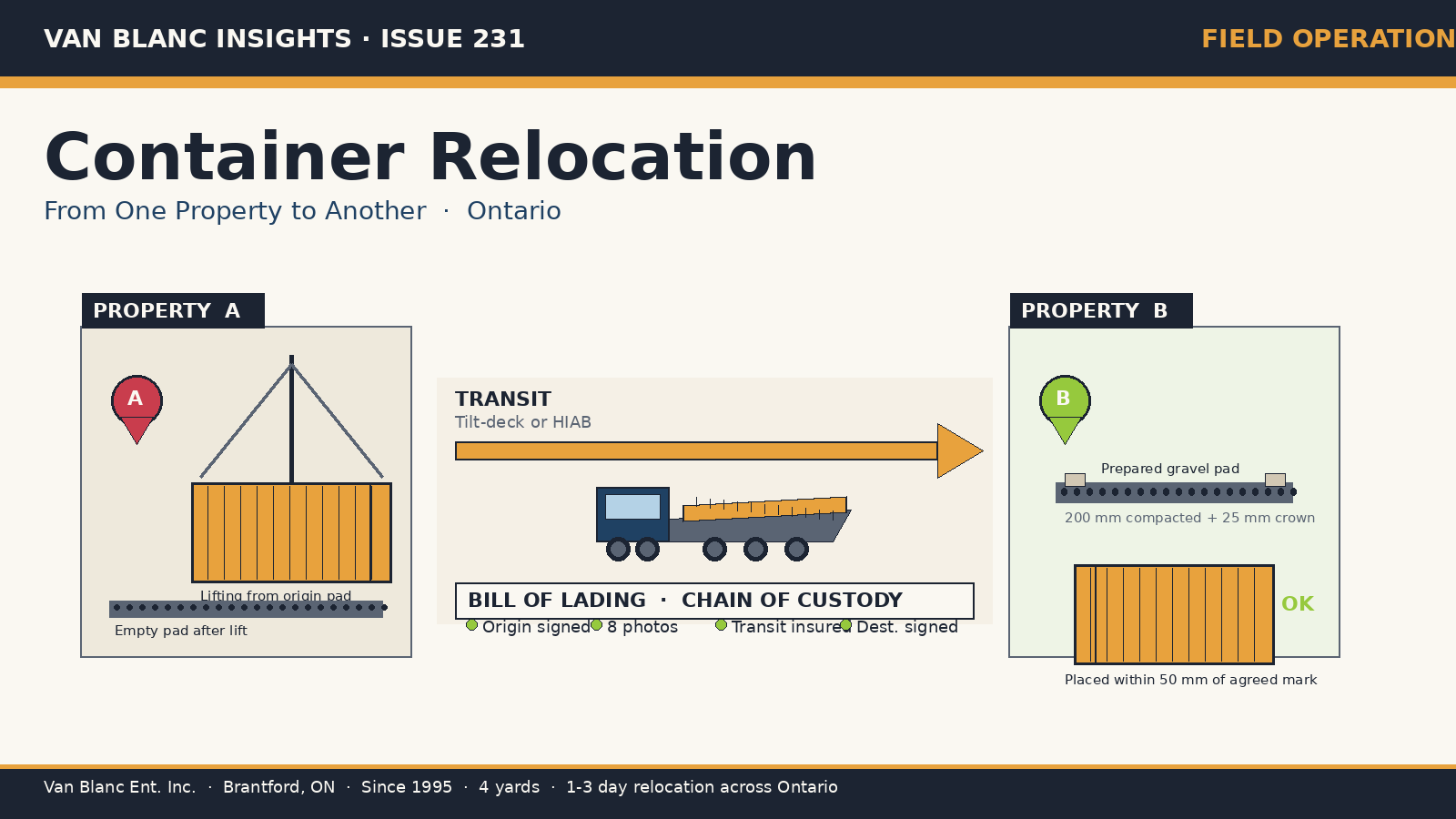
The eight phases of a property-to-property relocation
- Origin site assessment. Photos of the container in place. Access path measurements. Pad condition. Door condition. Contents weight estimate. The hauler needs this before quoting.
- Destination site assessment. Photos of the proposed pad. Pad material and dimensions. Overhead clearance to wires and tree limbs. Truck approach distance and turning radius.
- Quote with both ends factored. Mileage, lift type, time on site for both ends, fuel surcharge if applicable, insurance rider for the transit interval.
- Confirmation and booking. Deposit on file, day-of-move scheduled. Weather contingency if winter window.
- Origin pickup. Truck arrives, driver and owner do a joint walk-around, photographs taken of all four sides and corner castings, container lifted onto trailer.
- Transit. Bin is in the carrier’s chain of custody, insured under their transit rider. Bill of lading travels with the truck.
- Destination placement. Pad checked one more time before set-down. Bin lowered, positioned to within 50 mm of agreed position, set level. Door operation confirmed.
- Handoff and sign-off. Joint walk-around with the new property owner if different from the original owner. Photographs of all four sides at destination. Customer signs the bill of lading marked as delivered.
The reason for documenting every phase is plain. Relocations done sloppy by a one-truck operator are the ones where the bin shows up at the new site with a fresh dent that was not on it at pickup and nobody can prove when the damage happened. The photographs and the bill of lading prevent that argument. The buyer is protected, and so is the carrier. When you interview a hauler for the move, ask whether they run this paperwork. If they do not, that tells you something.
The origin site assessment should go back to you with a question list, and the destination site assessment the same. A careful carrier only quotes after both lists are answered, because pricing a relocation without the answers is the path to a surcharge phone call on move day. If you would rather skip the whole second-site dance, buying a fresh container delivered to the new property is often the cleaner path, and that delivery is ours.
Origin Site: What To Check Before the Hauler Arrives
The origin site is where most relocation failures start. The container has been sitting somewhere for years. Conditions around the bin have changed. The owner has stopped noticing them because everything looks normal from inside the property. Then the truck arrives and the driver finds three problems the owner forgot.
Paul has watched relocations go right and wrong across Ontario since the late 2000s, when second-site moves became a weekly question at the yard. He keeps a written checklist and shares it with any buyer thinking about a second-site move, because surprises on move day are billable surprises no matter who runs the haul.
Paul’s origin site checklist
- Ground bearing under the existing pad. Container settles into soft ground over time. A 20ft empty bin weighs 2,300 kg. A 40ft can weigh 3,800 kg empty. After two summers of rain cycles, soft soil under one corner can drop 60 mm and lock the bin in place. A track-loader is sometimes needed to break the suction before the lift.
- Truck approach distance. A tilt-deck truck needs roughly 18 metres of straight clear approach to slide a 20ft bin off. A 40ft needs about 24 metres. Driveways with a tight bend halfway down do not work. Plan B is a HIAB crane truck or a roll-off.
- Overhead clearance. Tree limbs, hydro wires, eaves trough at the house. A HIAB crane needs 9 metres of vertical clearance above the bin for the lift arc.
- Door swing. The doors must close and latch before the bin can be moved. Bins that have been used as garden sheds often have one door rusted open. Penetrating oil helps, but a fully seized hinge becomes a half-hour job before the lift.
- Contents weight. Empty bin is preferred. Up to 500 kg of light goods is acceptable. Over that, the road weight changes the truck axle ratings and the quote.
- Pad surface. Compacted gravel or concrete is best. Grass and soft soil double the time on site because the truck cannot reverse confidently.
- Snow and ice in winter. November to April relocations in Ontario need the pad cleared and the approach lane salted by the property owner before the truck arrives.
The phrase that comes up most when Paul walks an origin site with a buyer is “the bin has settled.” Containers that have lived on grass or gravel for five years will dig their corner castings into the ground 25 to 100 mm. The lift has to overcome that suction. That is a normal part of the job, but it is the reason a careful hauler quotes on time-on-site rather than a fixed lift fee.
If your container has sat on the same pad for more than three years
Walk around it with a metric tape. Measure the gap between the bottom of each corner casting and the original pad surface. If the bin has sunk by more than 50 mm in any corner, mention it when you call the hauler for a quote. A good carrier will add about 30 minutes to the on-site estimate and bring the equipment needed to break the bin free without damaging the corner castings. If the bin is too far gone to be worth the haul, call us and we will talk through whether a fresh container delivered makes more sense.
Destination Site: The Pad That Survives the Next Decade
The destination pad question is the one most buyers underestimate. A relocated container is going to live on the new site for years, often more than a decade. The pad you place it on determines whether the floor stays dry, the doors keep swinging true, and the steel keeps its life expectancy of 25 years rather than rusting through in eight. This is the same pad guidance we give every buyer when we place a container we deliver onto its site, because the physics do not care whether the bin is new or relocated.
Buyers ask if they need a concrete slab. The answer is no, in most Ontario applications, you do not. A compacted gravel pad with proper drainage is structurally equivalent to a slab for a non-modified storage container and a fraction of the cost. We have delivered bins to Brant County farm properties as far back as 2008 that are still square and dry in 2026, set on nothing more than 200 mm of compacted gravel with a 25 mm crown for water shedding.
What an Ontario destination pad needs to be
- Level within 25 mm corner to corner. Out-of-level bins twist their frames, eventually jam their doors, and pool water on the roof.
- 200 mm of compacted gravel minimum. Granular A or 19 mm crusher run works. Excavate the topsoil first, lay geotextile if drainage is poor, then compact in two lifts.
- Slight crown for drainage. 25 mm of fall from centre to edge across the long axis prevents water pooling under the door end.
- Larger footprint than the bin itself. Pad should extend 300 mm past each end and each side. A 20ft container needs a roughly 7.0 by 3.0 metre pad. A 40ft needs 12.8 by 3.0 metres.
- Truck access to within 24 metres. Same approach distance as the origin. If the new property has a narrow gate, plan a HIAB crane lift over the gate rather than a tilt-deck slide.
- Set the bin on concrete blocks at each corner. 200 mm thick patio blocks or four solid CMU at each casting. Lifts the steel off the ground, prevents wet-rot at the door sills, and lets you re-level easily after one frost cycle.
The patio block question matters more than it sounds. A bin set directly on gravel will draw moisture up into the corner casting and the door sill steel. A bin set on four corner blocks, one under each casting, has 200 mm of air gap, dries between rain cycles, and lasts the full 25 years the steel is good for. Paul started insisting on blocks during the wet 2018 fall season after we saw three bins from earlier deliveries with rust streaks at the corners. The block fix prevents that for the cost of a handful of patio blocks. Whether you are relocating an old bin or taking delivery of a new one from us, the pad rules are identical, and we will talk you through them when you call.
Tilt-Deck, HIAB, or Roll-Off: Which Truck Suits the Move
Ontario container relocations use one of three truck types, and the selection is dictated by site access, not preference. The right truck is decided during the origin and destination assessments. Getting it wrong means a wasted trip and a re-quote, which is why a good hauler scopes both ends before committing a truck.
| Truck Type | How It Works | Approach Needed | Best Used For |
|---|---|---|---|
| Tilt-deck | Trailer bed tilts hydraulically, container slides on or off the back. Standard for most Ontario relocations. | 18 to 24 m straight clear path | Open driveways, farm yards, industrial lots |
| HIAB crane truck | Truck-mounted crane lifts the bin over obstacles and places it precisely. Slower but more flexible. | 4 to 6 m clearance beside truck, 9 m vertical above bin | Tight residential lots, over-fence placements, sites with overhead trees |
| Roll-off | Container loads onto a hooklift chassis. Used when the bin is on roll-off skids or for very short hauls. | 15 m straight clear path | Bin already fitted with skids, urban short-distance moves |
The default for most Ontario relocations is the tilt-deck because it is the most economical and the province still has wide rural driveways where tilt-deck access is fine. A HIAB carries a premium over a tilt-deck for the same distance, and that premium is worth paying any time the site has a fence, a tight turn, low-hanging trees, or a back-of-property pad that cannot take an 18 metre approach.
Three Ontario regions consistently need HIAB rather than tilt-deck for relocations: GTA residential lots where the driveway is tight against the house, cottage country properties with mature tree canopy along the access road, and downtown Hamilton or Brantford backyards reached through a side gate. Every other region usually works on tilt-deck. The same truck logic applies when we deliver a fresh container, which is why we can tell you on the phone which truck your site needs.
Paul LeBlanc, owner: “The most expensive mistake a buyer makes is letting a one-truck operator quote them a flat fee without scoping the site. That operator shows up with a tilt-deck on a property that needed a HIAB, the bin will not come off the trailer at the destination, and the buyer is now paying for a second trip with the right equipment. Two trips cost more than the right truck the first time. Half the time, by the time someone has paid to haul a tired old bin twice, a fresh container delivered would have cost them less and lasted twice as long. Call us before you book the haul. Worth the drive, worth the planning.”
Chain of Custody, Bill of Lading, and Why Photos Matter
This is the part of relocation that one-truck operators skip and customers assume happens. It does not happen unless someone runs it. A reputable hauler runs it on every job because the documentation is what protects everyone if something does go sideways, and you should insist on it from whichever carrier you hire.
Chain of custody on a container relocation is straightforward. When the driver arrives at the origin, the owner and the driver walk the bin together. They photograph all four sides. They note any pre-existing damage, dents, rust streaks, door issues, paint flaking. They sign a short bill of lading marked as “picked up in this condition.” From that moment until set-down at the destination, the bin is in the carrier’s custody and on the carrier’s insurance rider. At the destination, the customer and the driver walk the bin again, photograph all four sides, note any new damage if visible, and sign the bill marked as “delivered.”
What the bill of lading captures
- Origin address and pickup time
- Destination address and set-down time
- Container size and serial number from the corner data plate
- Pre-existing condition notes from the origin walk-around
- Signed acceptance from owner at pickup
- Signed acceptance from receiver at destination
- Photo set: origin (eight angles), destination (eight angles)
The photographic record is the single most useful piece of paperwork in container relocation. The good carriers carry a tablet on every truck so the photos load to a cloud folder during the move. If a buyer notices a dent two weeks later that they think happened in transit, the driver can pull up the origin photo from the morning of the move and see if the dent was already there. Most of the time, it was. When it did happen in transit, the carrier’s insurance covers the repair. Either way nobody is arguing on the phone three weeks after the fact.
One-truck operators do not run this paperwork because it slows them down. Their day-rate model is built on speed. The carriers worth hiring build their model on the buyer getting the bin they handed over, in the condition they handed it over, on the pad where they want it. The half-hour of documentation is the differentiator, and it is part of any proper relocation quote.
Relocate the Old Bin, or Buy a Fresh One Delivered?
Here is the question Van Blanc can answer better than any hauler, because it is the part of the decision we actually sell into. A relocation is two site visits, a tired bin, settled corners, seized doors, and a carrier bill that is 30 to 60 percent above a straight delivery. Before you commit to that, run the comparison against simply buying a container and having us deliver it to the new property, and weigh it against what using a container for an Ontario move actually costs.
When relocating the existing bin usually wins: the container is in good shape, the move is short, the old bin has sentimental or modification value (you cut a door and wired it, say), and disposing of it would cost as much as the haul. When buying fresh usually wins: the old bin is rusted, the doors are seized, the haul is long, the destination access is awkward at the origin but easy at the destination, or you would rather start the 25-year clock over with a new one-trip unit. Many buyers who call us about relocating a 12-year-old bin across the province end up buying a fresh one delivered, because the math and the hassle both point that way.
The comparison we run on the phone
Tell us the age and grade of the existing bin, the distance of the proposed move, and the access at both ends. We will tell you, with no pressure, whether relocating the old bin or buying a fresh container delivered is the smarter spend. If a delivered container is the smarter buy, that part is ours, and we can have it on your new pad inside the 1-3 day window for most of Ontario.
What Can Go Wrong On Move Day (And How To Stop It)
Move day failures are predictable. We have seen each of them on jobs buyers have told us about. The fix is always in the planning before the truck rolls.
The first failure is access. A driveway that looked fine on Google Street View turns out to have a low-hanging tree branch the homeowner trimmed three years ago and forgot to trim again. A pre-move site photo request catches this 95 percent of the time. The other 5 percent are caught when the truck pulls up and the driver assesses with eyes before backing in.
The second failure is ground bearing. The pad at the destination is softer than it looked in the photos. The truck cannot back across it without sinking. Good haulers carry steel plates on the trailer for this exact case, and the plates let them bridge soft ground for a 12 metre stretch. If the soft ground extends further, the placement spot has to move to one the truck can reach, and the bin gets rolled into final position with a sleeper-and-pry-bar trick.
The third failure is door swing at origin. The bin’s doors have to close and latch before the lift. Doors that have been wedged open by years of rust take 20 to 45 minutes to free with penetrating oil and persuasion. That time gets billed at the agreed time-on-site rate.
The fourth failure is the bin being heavier than declared. A 20ft bin with 300 kg of tools is fine. A 20ft bin with 3,000 kg of compressor parts is a different conversation because the road weight crosses an axle threshold and the truck rating changes. If the contents weight is uncertain, the safe move is to empty the bin before move day.
A Brantford-area relocation story from 2024
A buyer near Brantford wanted a bin moved from a farm property to a commercial yard a few kilometres away on the same back road. Same-day urgency, level access at both ends, sounded simple on the phone. On site, the bin had been on a rotting pallet for nine years, the floor had absorbed the wood, and lifting it broke the pallet apart underneath. The driver waited 90 minutes while the owner scraped the pallet fragments off the casting. The bin lifted clean once cleared. The job ran 4.5 hours instead of 2.5, billed at the agreed hourly rate, with no surprise because the rate was on the quote. The lesson the buyer took away: scope the origin properly, or budget for the surprise. When they needed a second container the next spring, they bought it fresh from us and we delivered it in two days, no pallet drama.
Need a container, not just a move?
If buying a fresh container delivered beats hauling the old one, that part is ours. Tell us the size and your postal code and we will send back an all-in number for the container, delivery, and placement, usually within 1-3 days. No pressure, no mystery fees.
Family-run in Brantford since 1995 · 200+ containers in stock · 4.9★ across 140+ Google reviews · every box graded by a person, walk it before it lands.
Insurance, Liability, and the Question Most Buyers Forget to Ask
This is the question buyers should ask first and usually ask last, after the move is booked. On a relocation, who insures the container during the transit interval, and what does that insurance actually cover? Because the haul is a third-party job, this is a question for the carrier you hire, and it is worth pinning down in writing before you let a truck onto your property.
On a properly run relocation, the container sits under the carrier’s transit rider from the moment it lifts off the origin pad to the moment it sets down on the destination pad. The rider covers transit damage, collision, theft in transit, and the standard road risks a Transport Canada carrier carries. The cover does not extend to contents inside the bin during transit. Most buyers want the bin empty for relocation anyway, but if you are leaving tools, equipment, or stock inside, those goods are on your own property insurance, not the carrier’s.
What a carrier transit rider typically covers and does not cover
Covered: Damage to the container shell during loading, transit, and unloading. Theft of the container during transit. Collision-related damage during the road haul. Driver liability for negligence during the lift or set-down.
Not covered: Contents inside the bin during transit (those need your own property insurance or a cargo rider). Pre-existing damage documented on the bill of lading. Damage caused by structural failure of the container itself (a bin that fails mid-lift because its corner casting was already compromised is a different conversation, and the bill of lading photos prove the pre-existing state).
The rider covers the bin, not what is in it. Empty the bin for the move and the insurance picture is clean. Ask any hauler to show you their certificate before move day.
Property owners sometimes ask whether the relocation triggers their homeowner’s policy or commercial property policy. The answer is usually no for the transit phase because the bin is in the carrier’s custody, not theirs. The moment the bin sets down at the destination, it moves back onto the new property owner’s policy. If the new property does not have it listed, that is a conversation with their broker before move day rather than after.
Buying From Van Blanc, Lead Time, and How To Get a Real Quote
If your decision lands on buying a fresh container delivered to the new property rather than hauling the old one, that is where Van Blanc takes over and the process is simple. One phone call covers the basics: the size you need, the grade, your destination postal code, the access at the site, and your target date. A follow-up text with a couple of photos of the pad and the approach lets us confirm the right truck.
With those inputs we quote within 24 hours, usually the same day for sites within 200 km of Brantford. The quote names the container, the truck type, the price, the lead time, and the assumptions. If anything on site changes between quote and delivery day, we re-quote rather than running a surprise on you.
Lead time is fast. Standard 1-3 day delivery to every region across Ontario applies to the container we sell you. Every quote comes with a real lead time, not a hopeful one. Worth the drive for unbeatable quality, family customer service with 30 years of experience. If your situation calls for relocating the existing bin instead, we are happy to point you toward a reputable Ontario hauler for that haul, while the container side of any future purchase stays with us.
How to call us about your container
Phone 519-754-6844 or toll-free 1-888-509-6658. If you are weighing a relocation against a fresh delivery, have these ready: the age and grade of the existing bin, the proposed move distance, the access at both ends, the size you would buy instead, your destination postal code, and your target date. We will give you the comparison and quote the container and delivery. Drive to the Brantford yard if you want to walk the bins and meet the team before buying.
Frequently Asked Questions
Does Van Blanc relocate a container from one property to another?
Van Blanc sells and delivers containers. We deliver the bin you buy and place it on your pad, and that delivery is our work. Moving an existing, already-placed container from one property to another is a haul you arrange with a third-party tilt-deck or float operator, not a service we sell. What we will gladly do is run the comparison with you. Often a fresh container delivered to the new site costs less and lasts longer than hauling a tired old bin, and that delivery is ours.
Do I need to empty the container before relocation?
Yes, ideally. Empty bins lift cleanly, sit safer in transit, and stay covered by the carrier transit insurance. Up to 500 kg of light secured goods is acceptable. Over that, the road weight changes the truck axle ratings and the quote, and contents are not covered by the rider so any damage to the inside is on your own property insurance.
What is the difference between a delivery and a relocation?
A delivery moves a fresh container from yard stock to your site, and Van Blanc does that. A relocation lifts an existing container from one property and places it on a second property, and that haul is a third-party carrier you arrange. Relocations are roughly twice the planning, require site assessments at both ends, typically cost meaningfully more than the equivalent delivery, and should run on a chain-of-custody bill of lading.
How long does a property-to-property container move take?
Total time on site at both ends runs 1.5 to 3.5 hours depending on access, pad condition, and door swing. Drive time adds 2 to 8 hours round trip for most Ontario moves. A complete Brantford-area relocation under 150 km is typically a single business day. Longer hauls may split across two days.
Can an existing container that has sat on the same pad for ten years be relocated?
Yes. Bins that have settled into soft ground for years need 25 to 45 minutes of extra time on site to break free from the suction. A good hauler carries penetrating oil and a track loader where needed. The lift itself is unchanged once the bin is free of the ground. Make sure the carrier’s quote includes the extra time-on-site so there is no day-of surprise. If the bin is too far gone, call us and we will price a fresh one delivered instead.
What truck is needed for a relocation, tilt-deck or HIAB?
Tilt-deck is the default for sites with 18 to 24 metres of straight clear approach, like farm yards and open industrial lots. HIAB crane truck is the right call for tight residential sites, over-fence placements, sites with mature tree canopy, or destinations where the truck cannot reach the final placement spot directly. The same truck logic applies when Van Blanc delivers a container you buy.
Do I need a concrete slab at the destination?
No, in most Ontario applications. A 200 mm compacted gravel pad with a 25 mm drainage crown, set 300 mm larger than the bin in each direction, performs structurally equivalent to a slab for a non-modified storage container. Place the bin on patio blocks at each corner casting to lift the steel off the ground and prevent door sill rust. The same pad rules apply to any container we deliver.
Is the container insured during transit?
Yes, when the haul is run properly. From the moment the bin lifts off the origin pad to the moment it sets down at the destination, it should be on the carrier’s transit rider. The rider covers shell damage, collision, theft in transit, and driver liability. Contents inside the bin during transit are not covered and need your own property insurance or a separate cargo rider. Ask the hauler for their certificate before move day.
Can a container be relocated on the same property?
Yes. A same-property move under 50 metres on tilt-deck is faster because no real drive time is involved, though the lift, photographic documentation, and pad set-down work is the same as a long-distance relocation. Common reasons buyers do this include landscaping changes, building expansions, or moving the bin from a temporary spot to its permanent pad. It is still a third-party haul, not a Van Blanc service, but we are happy to talk you through the pad work.
How fast can Van Blanc deliver a container in Ontario?
Standard lead time is 1-3 days to every region across Ontario from our 4 Brantford yards for the container you buy. Same-day delivery is sometimes possible if a truck is available and the route is local. Every quote comes with a real lead time, not a hopeful one. If you are arranging a relocation of an existing bin, that timing is set by the third-party hauler you hire.
Sources
- International Organization for Standardization. (2022). ISO 6346:2022, Freight containers, Coding, identification and marking. iso.org
- Northbridge Insurance. (2024). Container Transportation Insurance, transit cover and bill of lading practice. northbridgeinsurance.ca
- Transport Canada. (2025). Cargo Securement Standard 10, Containerized Cargo road haulage. tc.canada.ca
- Bridging Distances. (2025). Shipping Container Transport Ontario, flatbed, tilt and HIAB equipment selection. bridgingdistances.ca
- Canadian Association of Movers. (2024). Understanding Moving Protection, transit insurance versus replacement value protection. mover.net
Reach Van Blanc in Brantford
We have been supplying and delivering shipping containers across Ontario since 1995. Our yard is at 90 Morton Avenue East in Brantford, and we run fast 1-3 day delivery across the province with every quote carrying a real lead time, not a hopeful one. If you are weighing whether to relocate an existing bin or buy a fresh container delivered to the new property, drive in and meet Paul, walk the bins, and get the comparison before you spend a dollar on a haul.
Van Blanc Ent. Inc., 90 Morton Ave E Unit 1B, Brantford, ON N3R 7J7, +1 888-509-6658
Paul or Christian will scope your container, quote the delivery, and tell you when buying fresh beats hauling the old bin. Worth the drive for unbeatable quality, family customer service with 30 years of experience.