
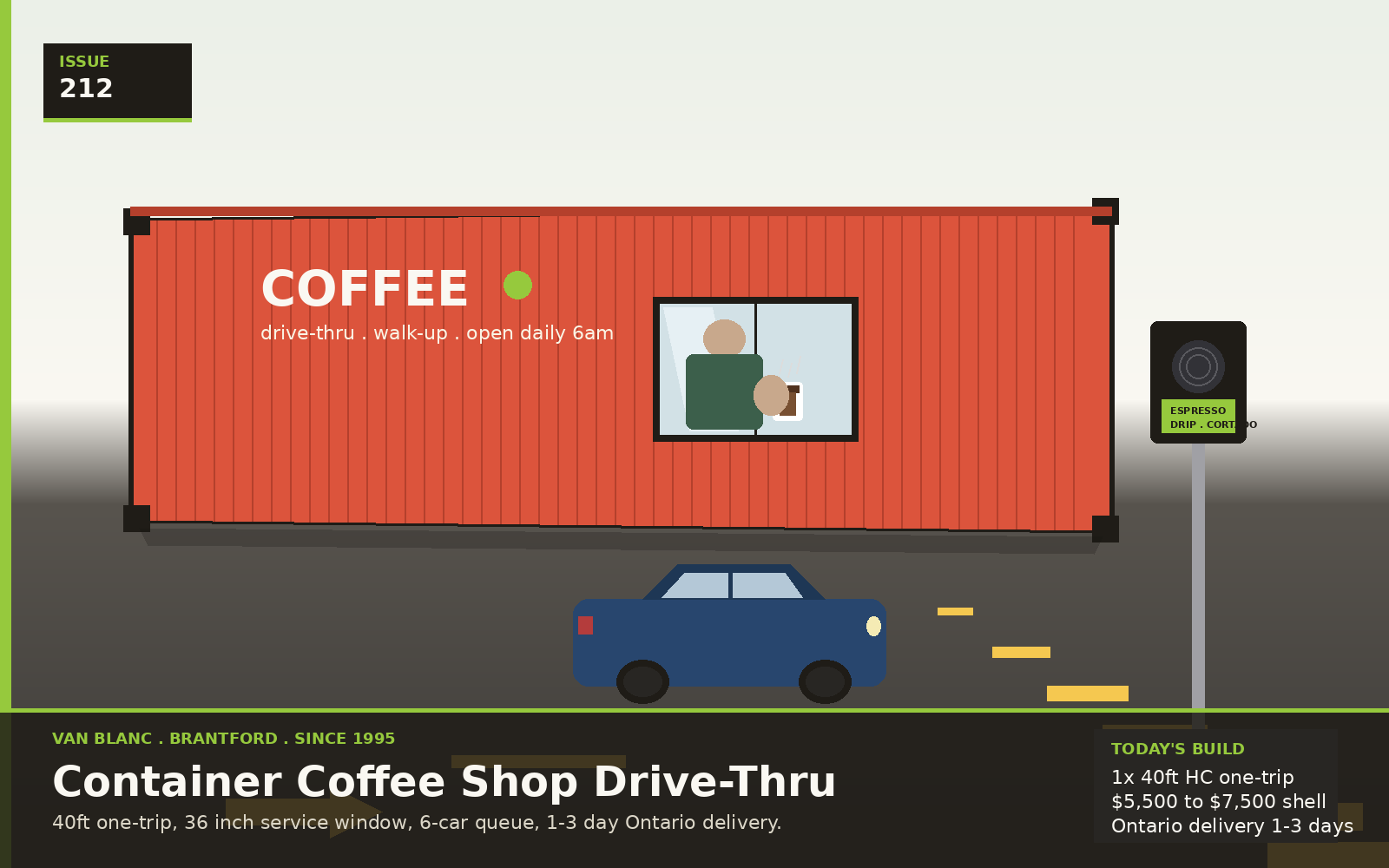
Quick Answer: A container coffee shop drive-thru window in Ontario starts with one 40ft one-trip shell, an 8×6 ft service cut, and a 6-car queue lane. Plan for the steel from Van Blanc, then add the cuts, wiring, and finishes a fabricator handles after delivery, from electrical to plumbing to the intercom. Delivery to your site runs 1 to 3 days. Tell us your delivery address and we will quote real costs. Real Brantford yards, real reviews (4.9 / 140+), real 1-3 day delivery. Family-operated since 1995.
In This Guide
- Why Does a Container Shell Fit a Coffee Shop?
- Which Shell Should You Choose: One-Trip, 40ft, or High Cube?
- How Do You Cut the Drive-Thru Service Window?
- How Long a Queue Lane Does a Container Drive-Thru Need?
- What Intercom, POS, and Workflow Run the Two-Person Build?
- What Do the Electrical, Water, and Ventilation Trades Cost You?
- How Does Van Blanc Deliver the Container to Your Ontario Site?
- What Drives the Cost of the Steel?
- Can You Combine a Walk-Up and a Drive-Thru?
- How Does a Container Drive-Thru Compete With the Big Chains?
- Frequently Asked Questions
Reading time: about 14 minutes.
Why Does a Container Shell Fit a Coffee Shop?
A shipping container fits a coffee shop because the structure is already finished. A 40ft one-trip arrives weather-tight with steel walls, roof, and floor in place, sits on four corner blocks in an afternoon, and is ready for trades to cut in a service window and run wiring. The operator pays for a shell, not a ground-up storefront.
A coffee shop built into a shipping container starts with one fact most operators only learn after they price out a build: the shell is the cheapest part. A 40ft one-trip container lands on your lot for the price of two months of rent on a strip-mall storefront. Walls, roof, and floor are already there. What you are buying is a weather-tight steel envelope that arrives in a single afternoon, sits on four corner blocks, and is ready for the trades to start cutting in the service window, the back door, and the wiring conduit.
That speed matters because the coffee economy has thinned out for everyone who is not Tim Hortons or Starbucks. An independent who signs a five-year retail lease in a Cambridge or Barrie plaza is locked into years of escalating rent before the first espresso pull. A container drive-thru sits on a leased gravel pad for a fraction of that, and if year two disappoints, the shell rolls onto a tilt-deck and goes to the next site. That portability is the difference between a coffee idea you can test and one you have to bet your house on.
Van Blanc has been delivering shipping containers across Ontario since 1995. Coffee shop conversions show up every spring. A husband-and-wife operator buys one 40ft one-trip in March, a fabricator cuts in the service window and a walk-up window through April, electrical and water are trenched in May, and the bin is open for business by Victoria Day with a queue lane painted on the asphalt and a sandwich-board sign on Highway 6 or Highway 24.
Paul LeBlanc, owner: “I have sold the steel for a lot of these coffee builds since the first one rolled out of our yard. The operators who do well are the ones who treat the container as the cheap, fast part and put their money into the trades and the cup. We have been delivering one-trip 40fts across Ontario since 1995, and a clean shell on a gravel pad beats a five-year lease every time you run the math.”
The Ontario container coffee shop landscape
Toronto has a container espresso bar in the core, an Edmonton operator runs out of a 15ft sea can, and several Ontario operators are now running drive-thru containers on highway approaches in Niagara, Halton, and the southwest. The pattern is the same: a one-trip 40ft, a service window cut into the long side, and a one-lane drive-thru wrapped around the back. The build pattern is portable, low-risk, and matches a coffee economy where independents survive by avoiding the storefront fit-out.
Which Shell Should You Choose: One-Trip, 40ft, or High Cube?
For a container coffee shop, the shell choice is straightforward: you want a one-trip 40ft high cube shell. The reasons are operational, not aesthetic. A one-trip is the freshest grade we sell, and our lineup of new builds straight off their single ocean voyage is where almost every retail conversion starts. The reasons are worth walking through.
A one-trip has made a single ocean journey from the manufacturer in Asia, loaded with cargo to offset shipping cost. Paint is original, floor is clean, doors operate without forcing, and there is no surface rust. When a coffee customer hands you a card through a service window cut into the side, the bin reads as new. Used Cargo Worthy or Wind & Watertight grades arrive with paint variance, surface rust, and the occasional dent. Solid workhorses for a farm shed rather than a retail front customers see every day. The cosmetic premium of one-trip is worth the difference.
The high cube spec gives you 9’6″ exterior height instead of 8’6″. That extra foot matters once you frame the interior, drop a finished ceiling for lighting and HVAC, and stand a barista on a fatigue mat behind a counter. Standard-height containers leave finished headroom around 7’4″. High cube leaves 8’4″. The difference is whether the space feels like a hallway or a kitchen.
The 40ft length fits a two-person crew running an espresso machine, a brewer, a small reach-in fridge, a sink, and a window counter. A 20ft bin works for a single-operator walk-up kiosk but does not have floor space to run drive-thru and walk-up at the same time. If the business plan needs both order points, plan for 40ft.
One-trip 40ft high cube specs
Exterior: 12.19m (40’0″) long, 2.44m (8’0″) wide, 2.90m (9’6″) tall. Interior volume around 76 m³. Tare weight approximately 4,000 kg. Floor: marine-grade plywood over steel cross-members, rated for 4-tonne loads. The bin meets ISO 6346 dimensional standards and carries a CSC plate from the manufacturer, valid five years for international shipping (irrelevant to your coffee shop, but a useful provenance signal for inspectors).
How Do You Cut the Drive-Thru Service Window?
The service window is the single most important cut on a coffee shop container. Get it wrong and the workflow fights you for every shift. Get it right and the bin disappears from the operator’s awareness, which is what good design feels like.
The standard opening is 36 to 42 inches wide and 30 to 36 inches tall. That sizing comes from real workflow constraints: the barista needs to hand over a 16oz coffee with one hand while the other is on the till, the customer needs vertical clearance for a tall iced drink, and the window needs to slide cleanly without binding when the rails get cold. A 36×30 cut is the conservative sweet spot.
The cut needs structural reinforcement. Container side walls are corrugated 14-gauge Corten steel. When you cut a 36-wide rectangle into a corrugated wall, the corrugation profiles on both sides lose their vertical load path. The fabricator welds in a steel header (usually 4×4 square tube) and steel jambs, then bolts a slider into the framed opening. We handle that framed cut as part of the conversion work we do at the Brantford yard before delivery, under engineered drawings, so the shell arrives on your pad already window-ready. ESA-certified electrical follows the same logic: a home-centre fix does not pass inspection on a structure occupied for retail.
The window itself is usually a horizontal slider. A double-pane unit with a security bar across the sash gives you the closing rigour an occupied retail counter needs after hours. Sill sits at counter height inside (around 36 inches) so the barista does not have to bend. Outside, the sill sits about 48 inches above the asphalt, the comfortable hand-off height for a passenger car. Pickup trucks and lifted SUVs sit higher; service from those vehicles still works.
How Long a Queue Lane Does a Container Drive-Thru Need?
A container drive-thru queue lane needs at least 96 linear feet of paved lane to stack six cars, and the queue is where most container coffee operators undersize the site and pay for it in lost peak-hour throughput. The math is simple: a car is roughly 16 feet long, so a six-car stack measured from the service window backwards needs that 96-foot minimum. Buffer 8 to 10 feet between cars and call it 130 to 150 feet of total queue.
The morning peak is roughly 7:00 to 9:30 a.m. A well-run two-person operation serves a car every 28 to 35 seconds during peak, which is 100 to 130 an hour. A three or four-car queue loses the fifth driver who pulls up, sees the line, and keeps driving to the Tim Hortons across the road. Six cars captures most of the lost-to-perception traffic.
The lane wraps around the bin in a horseshoe. Drivers turn in off the road, follow the lane along the long side of the container past the menu board and speaker post, pull up to the service window cut into the same long side, and exit back to the road at the other end. The bin sits perpendicular to the road with the service window facing the lane. A walk-up window (if you build one) faces the other long side, opening onto a small patio with bistro tables and bike racks.
Pavement marking matters more than operators expect. A yellow-painted queue stripe with directional arrows at the entrance and a stop bar at the speaker post is enough. The car coming in for a 6:45 a.m. coffee is moving on instinct; the visual cue needs to be obvious without thinking.
Build the queue, then the building
Operators who lease a gravel pad and start cutting steel before they have walked the queue lane in person usually find out the hard way that a parked customer car blocks the speaker post sightline, or that the exit lane dumps drivers onto an oncoming-traffic side of the road. Walk the lane on foot first. Stand where each car will stand. Confirm sightlines from the service window to the third car back. That ten-minute walk saves a lot of asphalt repaint money later.
What Intercom, POS, and Workflow Run the Two-Person Build?
The intercom is the conversational front of a container drive-thru. A bad one frustrates every customer; a good one disappears into the workflow. Both customer and barista need to hear each other clearly through wind, engine noise, and the rumble of an idling F-150 at the order point.
Wireless headset systems are affordable enough that a small operator can install a DIY kit for a fraction of the cost of a commercial install. The kit includes a base station inside the bin, two or three wireless headsets, an outdoor speaker-microphone unit on the speaker post, and a vehicle-detection loop that pings the headset when a car pulls up. The speaker post is usually a 4-inch galvanized steel post in a concrete footing about 25 feet back from the service window, which gives the barista 30 to 40 seconds to make the drink between order and hand-off.
The POS lives on the interior counter in line of sight of the service window. A tablet system from Square or Toast bolts to a stand with a cash drawer underneath. The card reader sits at the window on a short tether so the customer can tap or insert without the barista leaning out into the lane.
Christian on the two-person workflow inside a 40ft bin:
Christian LeBlanc, second-generation operator: “The bin is small enough that two people working inside it have to know each other’s body language. The good operations I have walked through have the order-taker stationed at the window and the barista stationed at the espresso machine, and they swap positions every two hours so neither one burns out. That is not a container problem, it is a workflow problem. The container just sets the floor plan to about 280 square feet, which is enough for two people if the layout is intentional.” Our parent build guide for cafe operators moves the espresso station to the back wall and keeps the window-side counter clear for cash and card.
What Do the Electrical, Water, and Ventilation Trades Cost You?
In a coffee container build, the trades, not the steel, are where the real money goes. The steel shell is straightforward. The wet and the electrical are where the budget gets eaten.

Electrical: a coffee shop draws roughly 60 to 100 amps depending on whether the espresso machine is single-group or double-group and whether the back-of-house fridge is undercounter or full reach-in. Plan for a 100-amp panel inside the bin, fed from the utility through a meter base on a utility post next to the bin. ESA inspection is non-negotiable for an occupied retail structure. A licensed electrician familiar with container conversions charges for the rough-in, panel, outlets, and sign-off.
Water: the bin needs a potable supply and a sanitary drain. With a municipal hookup, plan to trench in service lines, install backflow preventers, and run interior plumbing to a three-bay sink, a handwash sink, and an ice maker. The three-compartment wash setup has its own rules worth reading before you frame the wet wall, and we cover the wash-and-drain layout that keeps a food inspector happy in a companion guide. Well-and-septic sites cost more because the sewer line needs to tie into a holding tank or small leach field, and the well must deliver flow to run an espresso machine without pressure drop. Some rural operators use a freshwater tank inside the bin and a grey-water tank below the floor, both serviced weekly.
Ventilation: a coffee shop does not need a Type 1 commercial hood unless you are cooking. A small Type 2 hood over the espresso machine moves steam. A wall-mounted heat pump split (12,000 BTU) handles heat and cool for the 320 sq ft interior through a Canadian winter without strain. A small ERV on the back wall manages fresh air without burning heat in February.
How Does Van Blanc Deliver the Container to Your Ontario Site?
Van Blanc delivers your container on a tilt-deck trailer to your Ontario site in 1 to 3 days from our 4 Brantford yards once you have picked the shell. The trailer backs onto your lot, the operator winches the bin off the deck, and four corner blocks (concrete piers or steel screw-piles) take the load. The whole drop takes about an hour on a prepared pad.
The pad does not need to be a poured slab. Most coffee container operators set their bin on four corner concrete pier pads (24 inches square, 24 inches deep, with rebar) or on six helical screw piles. Corner castings carry the full weight of a loaded container (~30,000 kg), so bearing pressure on each corner is well within what a properly poured pier handles.
The lane around the bin can be asphalt, gravel, or concrete depending on traffic volume. Asphalt is most common for higher-volume sites because it forgives small settlement and resurfaces cheap. Gravel works for rural and seasonal sites. Concrete is the long-life answer if you plan to anchor the bin as a permanent structure.
Brantford yard pickup vs delivered to site
Some operators drive to our Brantford yard at 90 Morton Avenue East to walk the available one-trip 40fts before placing the order. That visit is encouraged. A coffee shop bin is a 15-year piece of capital equipment, and the difference between a clean one-trip and a slightly used cargo-worthy is visible in person in ways the photos do not capture. Worth the drive for unbeatable quality, family customer service with 30 years of experience.
What Drives the Cost of the Steel?
The cost of the steel for a coffee container is driven by shell size, grade, delivery distance, and the steel market, not by a fixed sticker price. Coffee operators ask us for steel pricing once they have a site under option and a business plan to show the bank. The same factors that set the going rate on a forty-footer in the Canadian market apply here; below is what actually drives the number for each shell choice from Van Blanc, so you know which way your quote will move before you call:
| Shell choice | What moves the quote up or down | Why it fits coffee |
|---|---|---|
| 20ft one-trip standard | Lowest entry point of the lineup; smaller footprint means less steel, but a single service cut and a tight pad are the cost levers | Walk-up kiosk only, not enough room for drive-thru workflow |
| 40ft one-trip high cube | Carries the cosmetic premium of a one-trip shell plus the extra foot of high-cube height; delivery distance from our Brantford yards and current steel-market pricing move it most | Best fit, two-person workflow plus drive-thru plus walk-up |
| 40ft one-trip standard | Sits below the high cube because it skips the extra foot of height; same one-trip cosmetic grade, so condition is not the variable, height is | Workable but tight headroom after framing and ceiling |
| 40ft Cargo Worthy used | Discounted against one-trip because of age and surface wear; how much it drops depends on paint condition, dent count, and how recently it came out of service | Solid workhorse, but cosmetic wear shows on a retail front |
| 40ft Wind & Watertight used | The lowest-cost 40ft option, traded off against the most cosmetic wear; rust and paint variance are why it prices below Cargo Worthy | Storage-grade, we rarely recommend for retail conversion |
The steel is one line item on the build. Total project budget for a turnkey container drive-thru coffee shop in Ontario, including the shell, fabrication, electrical, plumbing, HVAC, interior fit-out, drive-thru window hardware, intercom kit, POS, signage, and site work, swings most on whether the site has utilities at the lot line and how much custom millwork the operator wants inside. Those two factors, not the steel, are where the budget really lives.
Compare that to a five-year retail lease on a comparable storefront, where the rent alone over the term runs well past the entire turnkey container build before the lights are even on. The container build pays for itself before the lease comparator hits year three.
The cheaper bin on Facebook
Many operators call us saying they found a 40ft one-trip far below the market on Facebook Marketplace. Two weeks later they call back saying the seller stopped answering after the deposit cleared. Don’t fall for it. A coffee shop build is a serious capital commitment, and the bin that’s suspiciously cheaper on Facebook is the bin that never arrives: what you think you save evaporates the moment the seller goes silent and your contractor sits on a paid week with no steel to cut. Buy the bin from a real Brantford yard you can walk before you pay.
Can You Combine a Walk-Up and a Drive-Thru?
Yes, the strongest container coffee builds run a service window on each long side of the bin: a drive-thru window facing the queue lane, and a walk-up window facing a small patio. That doubles the order surface area and lets the operator serve two demand patterns from the same 280 square feet of interior.
The walk-up patio works because morning coffee customers split into two roughly equal pools: drivers who never get out of their cars, and walkers who want a five-minute break with a bench and an outlet. A patio with three or four bistro tables, bike racks, and an awning above the walk-up window converts the bin into both a drive-thru and a destination.
The trade-off is structural. Two windows in opposite long walls weaken the bin’s torsional rigidity slightly. The fabricator addresses that with a perimeter steel frame welded into the cuts and, on bigger openings, a roof-truss tie at the ceiling line. The cost is modest, just the added framing and a second slider, and the second order point usually pays it back in a single peak season.
The walk-up plus drive-thru combo is the dominant configuration for Ontario operators because it captures both the highway-pass-through commuter and the local walker. Most successful builds land within 10 percent of each other on shell choice, queue length, and service-window placement. When you are ready to lock in the shell that carries both windows, you can browse the 40ft stock we have ready to convert and tell us the configuration you are after.
How Does a Container Drive-Thru Compete With the Big Chains?
A container drive-thru competes with the big chains on the cup, the speed, and the operator’s name, not on signage budget. Tim Hortons holds roughly 62 percent of the Canadian coffee market. Starbucks holds about 7 percent. Together they own the convenience and the brand. A container drive-thru is not going to out-spend either on signage, loyalty programs, or AI-powered menu boards.
What a container drive-thru can do is be the place where the coffee is actually good. Tim Hortons and Starbucks are mass-market by design. The Tim Hortons espresso is calibrated for a customer who adds cream and three sugars; the Starbucks blonde roast is calibrated for portion-control consistency across 1,400 Canadian locations. Neither operation is trying to make the best cup in the neighbourhood, because the best cup in the neighbourhood does not scale.
An independent who buys a 2-group La Marzocco, sources beans from a Toronto or Hamilton roaster, and trains two baristas to pull a real shot can charge a specialty-cafe rate for a cortado and have customers happily pay it. The drive-thru container competes on the cup, the speed, and the fact that the regulars know the operator’s name. That is a defensible niche in 2026, especially in growth corridors where the morning commute used to belong to whoever opened a Tim Hortons drive-thru first.
Site selection matters. Locations that fail are tucked behind a strip mall or set up in a parking lot with no road frontage. The bin needs a sightline.
Highway 6 corridor, summer 2025
An operator we delivered to in the Caledonia/Hagersville area runs a 40ft one-trip with a drive-thru window facing the southbound lane of Highway 6 and a walk-up window facing the parking lot. Six cars stack at peak. The operator pulls 240 cups on a Saturday morning. The steel was a small fraction of the project, with the bulk of the spend going to the trades and site work, the way it does on every build. Two-year ROI on the build, by the operator’s own math. The Tim Hortons four kilometres up the highway has not noticed.
Ready to price your container?
Tell us the size and your postal code and we’ll send back an all-in number, container, delivery, and placement, usually within 1-3 days. No pressure, no mystery fees.
Family-run in Brantford since 1995 · 200+ containers in stock · 4.9★ across 140+ Google reviews · every box graded by a person, walk it before it lands.
Frequently Asked Questions
How much does the container itself cost for a coffee shop drive-thru?
A 40ft one-trip high cube is the right fit for a coffee shop conversion, and its price from our Brantford yard moves with delivery distance, the high-cube height, and current steel-market conditions. A used Cargo Worthy 40ft costs less, but the cosmetic wear shows on a retail front. We recommend one-trip for any occupied customer-facing build, and we will quote your exact shell once we have your delivery address.
What is the total build cost for a turnkey container coffee drive-thru in Ontario?
Plan for an all-in budget covering the shell, fabrication, ESA-certified electrical, plumbing, HVAC, interior fit-out, the drive-thru window hardware, intercom kit, POS, signage, and site preparation. The shell is the smallest line on that list; the trades and site work drive the total. Sites with utilities already at the lot line come in at the lower end, because there is no long service trench to dig.
How long is the queue lane I need to plan for?
Plan for 130 to 150 feet of paved queue lane to hold six cars with reasonable buffer spacing. A six-car queue captures most of the lost-to-perception traffic during peak morning hours. Operators who undersize the queue to three or four cars lose the fifth driver who pulls up, sees the line, and keeps driving.
Can I cut a drive-thru window into a used Wind & Watertight container?
Structurally yes, but we do not recommend it for an occupied retail conversion. A WWT container has surface rust, paint variance, and small dents that customers see when they roll up to the window. Whatever you save on the shell costs you more in lost first impressions over a five-year operating life.
What size service window opening works for drive-thru coffee?
The standard cut is 36 to 42 inches wide and 30 to 36 inches tall, set with the sill at 36 inches above the finished interior floor (counter height). The window is usually a horizontal slider with double-pane glass. The fabricator welds a steel header and jambs into the cut to restore the wall’s load path.
How fast can Van Blanc deliver a 40ft one-trip to my Ontario coffee shop site?
Fast 1-3 day delivery to every region across Ontario from our 4 Brantford yards. Most of southern Ontario, including the Highway 6 and Highway 24 corridors where these coffee builds cluster, lands inside that 1-3 day window. Northern Ontario routes (Sudbury, Sault, North Bay) run 5 to 10 days due to premium freight. Every quote comes with a real lead time, not a hopeful one, so you can line up your fabricator for the day the steel arrives.
How many cars can a container drive-thru serve per hour at peak?
A well-run two-person operation serves a car every 28 to 35 seconds during the 7:00 to 9:30 a.m. peak, which is 100 to 130 cars an hour. Throughput depends on the menu (espresso drinks are slower than drip), the POS workflow, and how cleanly the queue feeds the speaker post.
What intercom system do most container coffee operators choose?
Most choose wireless DIY kits with a base station inside the bin, two or three headsets, an outdoor speaker-microphone post, and a vehicle-detection loop. Commercial-grade systems from HME or 3M come with installer support and cost more. Either works for a small operation; the wireless kits handle the volume.
Should I put the bin on a concrete slab?
Not necessarily. Most coffee container operators set the bin on four corner concrete pier pads (24 inches square, 24 inches deep with rebar) or on six helical screw piles. The corner castings carry the load. A full slab is fine if you plan to anchor the bin permanently, but pier pads work for most sites and cost less.
Sources
- International Organization for Standardization. (2022). ISO 6346:2022, Freight containers: Coding, identification and marking. iso.org/standard/82754.html
- Government of Ontario. (2024). Building Code (O. Reg. 332/12), Part 3 Use and Occupancy Classification. ontario.ca/laws/regulation/120332
- Electrical Safety Authority (Ontario). (2025). ESA inspection requirements for commercial container conversions. esasafe.com
- Transport Canada. (2025). Cargo Securement Standard 10, Containerized Cargo Road Haulage. tc.canada.ca
- Restaurant Business Online. (2025). Canadian population growth is a boon for Tim Hortons: drive-thru market share analysis. restaurantbusinessonline.com
Reach Van Blanc in Brantford
We have been supplying shipping containers across Ontario since 1995. Our warehouse is at 90 Morton Avenue E in Brantford, and we deliver right across the province on a cash-on-delivery basis. No surprise fees, no chase-the-paperwork.
Van Blanc Ent. Inc., 90 Morton Ave E Unit 1B, Brantford, ON N3R 7J7. Call +1 888-509-6658
If you are scoping a container coffee shop with a drive-thru window, come walk a one-trip 40ft high cube at our Brantford yard before you commit to the build. Ten minutes inside the bin tells you more than ten hours of Pinterest research. Worth the drive for unbeatable quality, family customer service with 30 years of experience.
Tell us your delivery address and the lay of your lot when you call, and we will confirm tilt-deck access, the corner-block layout, and the road sightline your drive-thru window needs before the steel ships.