
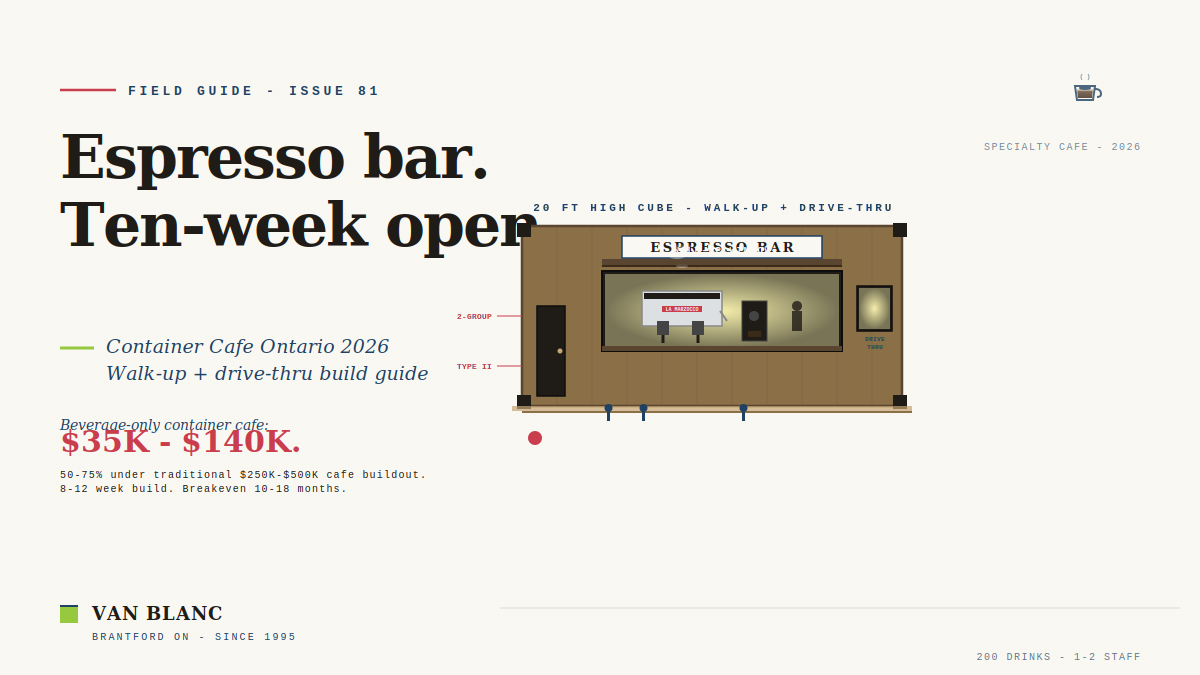
Quick answer. A container cafe in Ontario is a working coffee shop built inside a One-Trip shipping container, typically a beverage-only 20 ft espresso bar or a 40 ft full-kitchen cafe. It finishes in 8 to 12 weeks instead of the 4 to 9 months a leased fit-out takes, and most operators reach breakeven in 10 to 18 months at neighbourhood coffee revenue.
Still torn between wheels and walls for the concept itself? The food trailer versus container kiosk decision settles where the budget should actually go.
The full build breakdown, espresso equipment selection, Type II versus Type I exhaust, and two real Ontario operator scenarios sit below. Standard reference: Health Canada food safety. Every quote is real-address specific, so reach Paul or Christian for an honest delivered number. Three decades family-run, 140+ verified Google reviews, 1-3 day delivery from our 4 Brantford yards across Ontario.
Can you open a real coffee shop in a shipping container in Ontario?
Yes. A shipping container coffee shop in Ontario is a fully operational, health-unit-approved cafe built inside a steel container, most often a One-Trip 20 ft High Cube for a beverage-only espresso bar or a 40 ft High Cube for a full-kitchen cafe. Hundreds operate across Toronto, Hamilton, Kitchener-Waterloo, Niagara wine country, and Muskoka cottage country, serving the same espresso, drip, and cold-prep menus a conventional cafe does. A cafe sits in the same family of food and beverage container builds we supply across Ontario, alongside bars, kitchens, and drive-thru units.
This guide covers building the cafe yourself with our base container and local trades, turnkey container cafe manufacturers, La Marzocco and Rancilio equipment selection, Ontario health unit compliance, and the operational realities of running a container cafe across Ontario coffee markets.
“People ask me if a container cafe is a real cafe or a gimmick. It is a real cafe. The steel is just the building. I have watched operators walk our Brantford row, pick a One-Trip 20 ft, and have a licensed espresso bar pouring inside three months. What matters is the build inside the box, not the box.”
Paul LeBlanc, owner, Van Blanc Ent. Inc., Brantford. 19 years in the container industry, 40 years in Asian trade.
How much does a container cafe cost in Ontario in 2026?
A container cafe in Ontario costs far less than a conventional leased buildout, and the final number is driven by the build approach you choose, not by a fixed sticker price. The table below compares the five common approaches by what actually moves the budget: container size, menu type, finish level, and who does the build. Container cafes save roughly 50 to 75 percent on total project cost versus a traditional leased Ontario cafe.
| Build approach | Typical container | Menu scope | What drives the cost |
|---|---|---|---|
| Beverage-only 20 ft | One-Trip 20 ft High Cube | Espresso, drip, cold drinks, packaged pastries | Lowest. Type II exhaust only, no grease cooking, 1 to 2 staff |
| DIY full cafe (your local trades) | 20 ft or 40 ft High Cube | Full beverage plus cold-prep food | Moderate. You manage trades; labour and finish level set the spread |
| Custom contractor build (Ontario) | 40 ft High Cube | Full kitchen, breakfast and lunch | Higher. Type I exhaust, full electrical and plumbing, turnkey labour |
| Turnkey cafe manufacturer | 20 ft or 40 ft | Factory-built to spec | Higher. Factory margin plus freight, fastest to open |
| Premium flagship (architect-designed) | 40 ft or multi-container | Full kitchen plus seating | Highest. Design fees, premium finishes, custom glazing |
For Ontario operators planning a first container cafe, the beverage-only 20 ft configuration is the most capital-efficient entry point. It serves espresso, drip coffee, cold brew, tea, juice, smoothies, and packaged pastries from a single 8 ft by 20 ft footprint with 1 to 2 staff. Full-build 40 ft cafes with kitchen capacity for breakfast and lunch items make sense for operators with proven concept revenue who want to capture the food margin beyond beverages. The service window, customer door, insulation, and electrical rough-in are all part of the build-out work we handle at the Brantford yard before the container reaches your site. Tell us your size and postal code for an honest delivered number on the base container.
Why container cafes work in Ontario coffee markets
The container cafe category has expanded across Ontario since 2020 as coffee operators sought lower-cost entry points and faster deployment than traditional retail leases allow. The reasons are operational and strategic:
- Faster deployment to revenue. Container cafe builds finish in 8 to 12 weeks. Traditional cafe leasing and fit-out takes 4 to 9 months including landlord negotiations, approvals, and construction. Faster deployment means faster cash flow on a 9 to 18 month payback timeline.
- Lower capital deployment. A complete container cafe deploys for a fraction of the upfront capital a leased buildout demands, and it carries no monthly base rent stacked on top of construction the way a traditional Ontario cafe in leased space does. Container cafes unlock the operator class that cannot raise traditional retail capital.
- Distinctive brand presence. Container concept cafes stand out in dense Toronto, Hamilton, and Kitchener-Waterloo coffee corridors. The aesthetic supports premium positioning for specialty coffee concepts and third-wave brands.
- Drive-thru flexibility. Container cafes can include drive-thru service window configurations that conventional retail spaces cannot accommodate. Several Ontario container cafes operate dual walk-up and drive-thru service models from the same container footprint.
- Site portability. Container cafes relocate to follow customer demographics. Operators move the same cafe from one Ontario market to another (Toronto to Niagara, Niagara to Muskoka) without losing the build investment.
- Lower equipment risk for first-time operators. Container cafes operating beverage-only menus avoid Type I exhaust requirements, simplifying the regulatory burden and trimming a meaningful share of the build cost compared to full-kitchen cafes.
Pro tip from our delivery yard. Container cafe operators should plan the espresso machine placement and water filtration system from day one. A 2-group commercial espresso machine like the La Marzocco Linea Mini or Rancilio Classe 7 needs a dedicated 30 amp electrical circuit and direct plumbing connection. Operators who treat espresso placement as an afterthought routinely pay a steep premium in mid-build remediation to retrofit the proper electrical and plumbing.
Container cafe build cost breakdown for Ontario
| Build line item | Share of a 20 ft beverage-only budget | Share of a 40 ft full-kitchen budget |
|---|---|---|
| One-Trip High Cube container (delivered Brantford) | Small (roughly 4 to 7 percent) | Small (roughly 4 to 7 percent) |
| Site prep + foundation (pad or piers) | Low | Low to moderate |
| Window + door cutting (service window + customer door) | Low | Low |
| Closed-cell spray foam insulation | Low to moderate | Moderate |
| Commercial electrical (200A service) | Moderate | High |
| Plumbing (water filtration, drain, hot water) | Moderate | High |
| Type II exhaust (espresso, panini, cold prep) | Low | Low (Type I below if full kitchen) |
| Type I exhaust + Ansul (only if grease cooking) | n/a (beverage-only avoids this) | High |
| 2-group commercial espresso machine | High | High |
| Commercial coffee grinders (1 to 2 units) | Moderate | Moderate |
| Water filtration system | Low | Low |
| Refrigeration (under-counter + display) | Moderate | High |
| Service counter + back-bar (hardwood or stainless) | Moderate | Moderate to high |
| POS system + cash drawer | Low | Low |
| Interior finishing (drywall, paint, lighting, flooring) | Moderate | Moderate to high |
| HVAC for customer area (mini-split) | Low to moderate | Moderate |
| Signage + vinyl wrap + branding | Low | Low to moderate |
| Health unit + ESA + TSSA permits | Low | Low to moderate |
| Total container cafe build | Lowest entry point (beverage-only) | Highest of the cafe builds (full kitchen) |
The espresso machine, refrigeration, and service counter together drive about 25 to 35 percent of total build cost in a beverage-only cafe configuration. The Type I exhaust dominates if the cafe serves grease-cooking food items (eggs, sandwiches with hot meat fillings, fryer items). Many successful Ontario container cafes deliberately design menus around Type II equipment only (espresso, cold-prep sandwiches, packaged pastries) to avoid the Type I cost.
What espresso machine do I need for an Ontario container cafe?
The espresso machine is the technical and operational heart of any container cafe, and the right tier depends on your daily drink volume. A standard 20 ft container cafe is best served by a mid-range 2-group commercial machine; a high-volume drive-thru or flagship 40 ft cafe needs a 3-group. Equipment selection drives both build cost and beverage quality. The common tiers and where each fits:
| Espresso machine tier | Daily drink capacity | Container cafe fit |
|---|---|---|
| Entry-level single-group commercial (Rancilio Silvia Pro) | Under 50 drinks/day | Pop-up cafe, low-volume operations |
| Mid-range 2-group commercial (Rancilio Classe 7, Nuova Simonelli Appia) | 80 to 200 drinks/day | Standard 20 ft container cafe |
| Premium 2-group commercial (La Marzocco Linea Mini, Slayer Single) | 150 to 350 drinks/day | Specialty third-wave cafe |
| High-volume 3-group commercial (La Marzocco Linea PB, Synesso S Series) | 300 to 600+ drinks/day | 40 ft flagship or drive-thru cafe |
For most Ontario container cafe builds, the mid-range 2-group commercial machine is the sweet spot. It delivers enough capacity for 150 to 200 drinks per day comfortably, and pairs with a commercial espresso grinder (Mahlkönig E65S, Mazzer Super Jolly) and a separate bulk drip grinder. That three-piece package, machine plus two grinders, covers the equipment core of a standard 20 ft container cafe.
Specialty third-wave cafes serving premium pour-over and single-origin programs typically upgrade to La Marzocco Linea Mini or Slayer machines plus dedicated single-origin grinders. The premium tier costs more but supports higher per-drink pricing, which is why third-wave operators choose it.
Walk-up window vs drive-thru container cafe configurations
Container cafes in Ontario typically deploy in one of three service configurations:
- Walk-up window only. Customer service through a single front-facing window. 20 ft container with no interior customer seating. Lowest capital, simplest operations. Best for high-foot-traffic locations (downtown corridors, transit hubs, university campuses).
- Walk-up plus drive-thru. Dual service windows on opposite sides of the container. Drive-thru window adds to build cost but expands service capacity 30 to 60 percent. Best for suburban Ontario locations with parking and drive-by traffic.
- Sit-down container cafe. 40 ft container with interior or attached patio seating for 8 to 20 customers. Adds tables, chairs, washroom, expanded HVAC, and longer customer service flow. Adds to build cost vs walk-up only.
The walk-up plus drive-thru configuration is the most common for new Ontario container cafe operators because it captures both pedestrian and automobile customer demographics while keeping the build cost manageable. Sit-down container cafes work for locations with sufficient outdoor patio space for shoulder-season Ontario coffee service. When the patio season ends, those tables and heaters need a winter home, and storing cafe and restaurant patio furniture over winter covers the dates, the propane rule and the box.
Two Ontario container cafe scenarios
The Hamilton walk-up specialty cafe
Visited the yard last summer. Operator running a popup specialty coffee program at Hamilton farmers markets for two seasons wanted a permanent walk-up location near downtown Hamilton. Picked a One-Trip 20 ft High Cube and had it delivered. Beverage-only build with La Marzocco Linea Mini, Mahlkönig E65S grinder, under-counter refrigeration, and walk-up service window. Type II exhaust only (no hot food). The build came in well under what a comparable leased storefront would have cost, signage and POS included. Located on a small commercial pad with strong morning commuter foot traffic. Steady neighbourhood specialty coffee revenue carried it to breakeven in 13 months. Brand has built strong local Hamilton specialty coffee following.
The Muskoka cottage country drive-thru cafe
Walked our yard in spring last year. Two partners running a seasonal cafe concept targeting Highway 11 traffic through Muskoka cottage country between Bracebridge and Gravenhurst. Picked a One-Trip 40 ft High Cube and had it delivered. Drive-thru plus walk-up build with Rancilio Classe 7 2-group espresso, full breakfast sandwich menu (Type II only, panini grill and prep), and packaged baked goods program. The full outlay, drive-thru window, signage, and equipment included, stayed a fraction of a built-out leased location. Operates May through October. Seasonal cottage country tourism traffic drives the revenue. Pays back the build investment in roughly 22 months on the seasonal-only operating schedule. Now planning a second container cafe near Huntsville for next season.
Container cafe annual operating cost in Ontario
| Operating cost item | Cost behaviour | What drives it |
|---|---|---|
| Lease for container location | Fixed | Site location, lot size, and local commercial demand |
| Utilities (electricity, gas if applicable, water, internet) | Semi-variable | Hours open, equipment load, and season |
| Coffee beans and consumables (28 to 35 percent of revenue) | Variable with revenue | Cups sold and bean quality tier |
| Labour (1 operator + 1 to 3 baristas) | Largest fixed line | Staff count, hours, and shift coverage |
| Insurance (commercial general + product liability) | Fixed | Coverage limits and equipment value insured |
| Espresso machine maintenance + water filter changes | Recurring | Drink volume and local water hardness |
| POS + payment processing fees | Variable with revenue | Transaction count and average ticket |
| Marketing + social media + loyalty program | Discretionary | Growth stage and campaign cadence |
| Hood cleaning (Type I only, if applicable) | Recurring | Only applies to grease-cooking kitchens |
| Business licenses + health unit renewals | Fixed | Annual municipal and health-unit schedules |
| Annual fixed operating cost | Labour-led | Lease and staffing set the floor |
Container cafes in southern Ontario typically gross solid annual revenue at neighbourhood specialty coffee price points. Higher-volume drive-thru container cafes in Toronto suburbs and Ottawa gross considerably more. Net operating margin runs 12 to 22 percent after all costs in well-managed cafe operations.
Best Ontario regions for container cafe investment
Several Ontario corridors consistently outperform on container cafe economics:
- Toronto downtown and waterfront corridors for high foot-traffic walk-up cafes targeting commuter and tourism demographics.
- Hamilton waterfront and James Street North for specialty coffee concepts in revitalizing urban districts.
- Kitchener-Waterloo tech district for cafes serving the strong KW tech worker demographic during weekday morning rush hours.
- Niagara wine country and Niagara-on-the-Lake for tourism-driven seasonal cafes with strong May-October revenue.
- Muskoka cottage country Highway 11 corridor for drive-thru cafes serving the Toronto-to-cottage weekend traffic flow.
- Prince Edward County for wine tourism corridor cafes pairing with the established food and wine destination scene.
- Ottawa downtown and Westboro for specialty coffee concepts in established cafe demographics.
Common Ontario container cafe mistakes
After 30 years supplying containers to Ontario commercial buyers including a growing share of cafe operators, the predictable mistakes are clear. Avoiding these protects the operating margin and breakeven timeline.
- Underspeccing the espresso machine. Entry-level home or prosumer machines fail under commercial volume. Plan for proper 2-group commercial espresso from day one. Whatever you save by buying a Rancilio Silvia instead of a Classe 7 disappears in 8 to 12 months of lost revenue from machine downtime and slower service.
- Skipping water filtration. Ontario tap water hardness varies significantly by region. Hard water destroys espresso machine boilers and grinders within 12 to 24 months without proper filtration. A modest water filtration system protects your entire espresso equipment investment.
- Wrong front opening configuration. Walk-up cafe service requires a properly designed service window with proper height (42 to 44 inches counter height), depth, and weather protection. Operators who improvise service openings from standard windows lose service speed and customer satisfaction.
- Designing for Type I when Type II works. Type I exhaust is required only for grease cooking. Cafe menus designed around espresso, cold-prep sandwiches, and packaged pastries avoid Type I entirely. Many Ontario container cafe operators sink real money into a Type I exhaust system they never needed.
- Wrong container grade selection. Used or Cargo Worthy containers have rust, dents, and floor damage that ruin cafe aesthetics. Customer perception of cafe quality forms in the first few seconds of approach. Always use One-Trip 20 ft or 40 ft High Cube for the cleanest base.
- No POS and inventory system integration. Container cafes need cloud-based POS with inventory management from day one. Cash-only operations or basic register systems lose revenue tracking, inventory cost analysis, and customer loyalty data.
- Skipping the seasonal patio plan. Walk-up container cafes that fail to provide outdoor seating area lose significant May-September revenue. Even simple picnic table seating triples customer dwell time and average ticket size during patio season.
What VBinC provides for Ontario container cafe builds
We supply the base container for Ontario container cafe conversions. For cafe builds we recommend:
- One-Trip 20 ft High Cube. Clean interior steel for premium finish work, factory paint exterior for vinyl wrap and signage application, and the maximum service life that justifies the espresso equipment investment going inside it. See our our guide to one-trip and CW comparison for the grade breakdown.
- One-Trip 40 ft High Cube for flagship full-kitchen cafes with breakfast and lunch menus, delivered to your Ontario site.
- Delivery to your site from our four Brantford yards with proper tilt-deck or HIAB crane depending on commercial site access. 1 to 3 days from confirmation to most Ontario commercial addresses including Toronto, Hamilton, Kitchener-Waterloo, London, Niagara, Muskoka, Prince Edward County, and Ottawa.
- Vetted Ontario commercial contractor referrals for spray foam insulation, electrical, plumbing, espresso equipment installation, and POS system integration.
The container shell is roughly 4 to 7 percent of total container cafe build cost. The equipment and fixtures (espresso, refrigeration, service counter, signage) dominate the budget. See our container conversion work and keeping a container insulated for the full conversion specifications.
Operators planning a cafe with adjacent retail merchandise should also review our container retail Ontario guide. Operators expanding into bar service in evenings should see our container bar Ontario guide for AGCO Liquor Sales Licence requirements. Full-kitchen cafes should also review our container restaurant Ontario guide for Type I exhaust and Ontario Health Protection and Promotion Act compliance.
“Container cafe operators walking our yard tell us the same story every time. They priced a 200 grand leased Toronto cafe build and walked away. They walked our row, picked their One-Trip 20 ft, and a local contractor built it for 95 grand in ten weeks. The honest math wins. We never sell on hype. We deliver clean steel and let the operator build the cafe their neighbourhood actually needs.”
Christian LeBlanc, second-generation operator, Van Blanc Ent. Inc., Brantford
Go Deeper: Detailed Topic Guides
For more depth on specific aspects of this topic, see our spoke articles:
Frequently asked questions
How much does a shipping container coffee shop cost in Ontario?
A container cafe in Ontario costs far less than a conventional leased buildout, saving roughly 50 to 75 percent on total project cost. The final number depends on the build approach: a beverage-only 20 ft is the lowest entry point, a full-build 20 ft or basic 40 ft sits in the middle, and a premium 40 ft full-kitchen cafe is the top end. Tell us your size and postal code and we will send an honest delivered number on the base container.
How long does it take to build a container cafe in Ontario?
Turnkey manufacturer factory-built units finish in 8 to 10 weeks. DIY builds using a base container plus local Ontario trades take 10 to 14 weeks for cutting, insulation, electrical, plumbing, equipment installation, and finishing. Compare to 4 to 9 months for conventional cafe leasing and fit-out.
What size container is best for a coffee shop?
20 ft High Cube handles beverage-only espresso, drip, cold drinks, and packaged pastries with 1 to 2 staff serving 80 to 250 drinks per day. 40 ft High Cube supports full breakfast and lunch menus with 2 to 4 staff and 200 to 500 customers per day.
What grade of container is best for a cafe?
One-Trip is the only grade we recommend for cafe builds. Clean interior steel for premium finish work, factory paint exterior for vinyl wrap and signage. Used or Cargo Worthy containers have rust, dents, and floor damage that complicate the conversion and undermine cafe aesthetics.
What espresso machine do I need for a container cafe?
A mid-range 2-group commercial machine (Rancilio Classe 7, Nuova Simonelli Appia) suits 80 to 200 drinks per day in a 20 ft container cafe. A premium 2-group (La Marzocco Linea Mini) fits specialty third-wave concepts at 150 to 350 drinks per day. Pair either with matching commercial grinders, an espresso grinder plus a bulk drip grinder.
Do I need a Type I exhaust hood in a container cafe?
You need a Type I exhaust hood only if the menu includes grease cooking, meaning eggs cooked on a griddle, hot sandwich grills, or fryers. Beverage-only and cold-prep cafes use a much simpler and cheaper Type II exhaust instead. Most successful Ontario container cafes deliberately design their menus to stay Type II and avoid the Type I cost entirely.
Can I add a drive-thru to my container cafe?
Yes. Container cafes commonly add a drive-thru service window on the opposite side from the walk-up window. The drive-thru window adds to the build cost but expands service capacity by 30 to 60 percent. It is best for suburban Ontario locations with parking and steady drive-by traffic.
How does container cafe cost compare to traditional cafe construction?
A container cafe costs substantially less than a traditional Ontario cafe built out in leased retail space. Container cafes save 50 to 75 percent on total project cost and finish in 8 to 14 weeks, compared to 4 to 9 months for a conventional leased fit-out including landlord negotiations, approvals, and construction.
What Ontario health regulations apply to container cafes?
The Ontario Health Protection and Promotion Act (HPPA) and Ontario Regulation 493/17 apply identically to container and conventional cafes. Required: local public health unit notice and plan review, ESA electrical inspection, TSSA gas line certification, food handler certification for all staff, 3-bay warewashing or commercial dishwasher.
How long does it take to reach breakeven on an Ontario container cafe?
Most Ontario container cafes breakeven in 10 to 18 months at typical neighbourhood specialty coffee revenue. High-volume drive-thru container cafes in strong locations breakeven in 8 to 12 months. Seasonal cottage country cafes operating May through October typically breakeven on 18 to 30 month timelines accounting for the shorter operating window.
Can a container cafe operate year-round in Ontario?
Yes with proper insulation and HVAC. Closed-cell spray foam plus dedicated mini-split heat pump supports year-round operation. Container cafes in Toronto, Hamilton, Ottawa, Kitchener-Waterloo, and Niagara operate continuously through Ontario winters with appropriate climate envelope.
Can I relocate my container cafe to a new location?
Yes. Container cafes are designed for portability. Disconnect utilities, recertify at the new location with the local health unit, and the same cafe can reopen at a new Ontario site in 4 to 6 weeks. Conventional cafes cannot relocate this way, which is one of the primary container model advantages for Ontario operators.
Come pick your container cafe base
If you are planning a container coffee shop in Ontario, the starting point is selecting the right base container. We hold 200+ containers in stock at our Brantford yard. For cafe builds we recommend One-Trip High Cube units. You walk the row, read CSC plates, and pick your unit before you pay. Delivery to most Ontario commercial addresses in 1 to 3 days from confirmation.
Call Van Blanc, Brantford, Ontario, 519-754-6844
Van Blanc Ent. Inc. has supplied containers for Ontario cafe and coffee shop builds since 1995. 4.9-star rating across 140+ Google reviews. Brantford yards with 200+ containers in stock, and you pick your unit before you pay.
Ready to price your container?
Tell us the size and your postal code and we’ll send back an honest, all-in number, container, delivery, and placement, usually within 1-3 days. No pressure, no mystery fees.
Family-run in Brantford since 1995 · 200+ containers in stock · 4.9★ across 140+ Google reviews · every box graded by a person, walk it before it lands.
Sources & References
Authoritative external sources cited or referenced in this guide: