
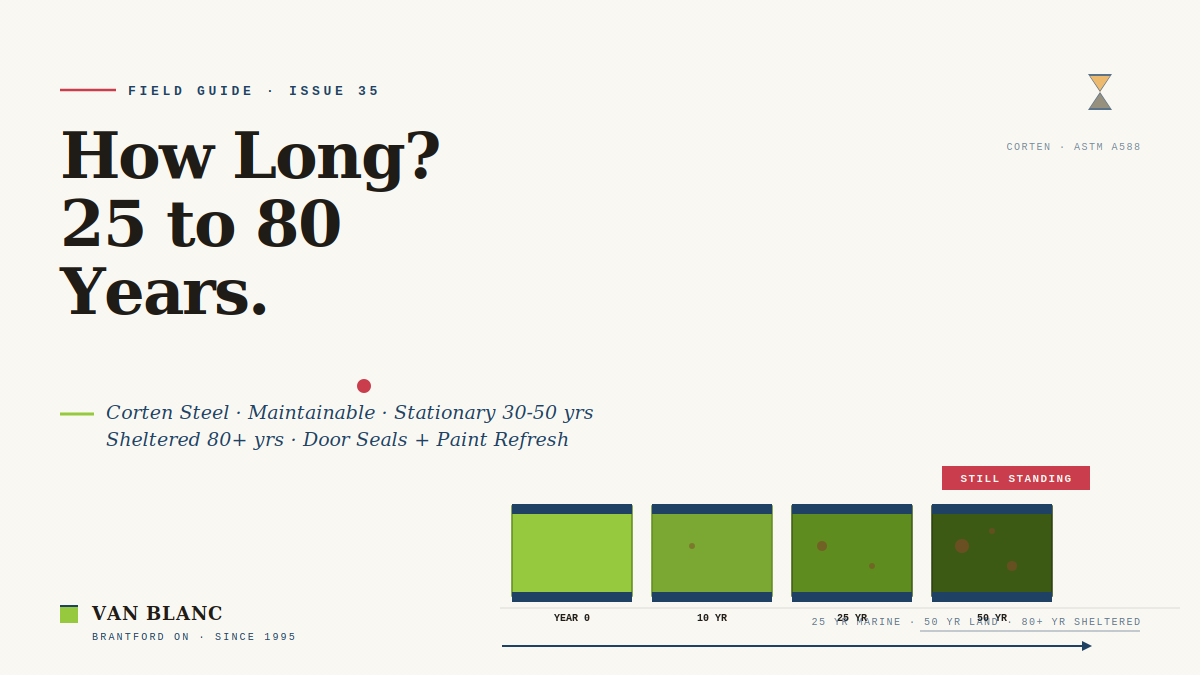
Quick Answer: A shipping container has three lifespans. In active ocean service it lasts 10 to 15 years. As a ground-level storage unit on dry ground, it lasts another 20 to 30 years with basic maintenance. Converted into a structure with proper drainage and interior climate control, it can serve 40 to 60 years. Total cradle-to-grave life of a Corten steel container is commonly 50 to 75 years. What kills a container is standing water, blocked drainage, soft ground, and chloride exposure rather than time alone. Lifespan is mostly a function of placement more than age.
In This Guide
- How long do shipping containers last?
- Why does Corten steel last so long?
- What actually makes a shipping container rust out?
- Does the Ontario climate shorten a container’s lifespan?
- How do you maintain a shipping container so it lasts 30+ years?
- What are the warning signs a container is wearing out?
- Do One-Trip, CW, and WWT containers age differently?
- FAQs
Reading Time: about 17 minutes
The answer to “how long will my container last” depends almost entirely on what you do with it after you buy it. The steel is not the limiting factor. The paint is not the limiting factor. The placement is. A container parked on a properly drained pad, with intact gaskets and a coat of marine paint every decade or so, will outlive most of the buildings on the same property. A container dropped onto wet grass in a low spot will start showing serious problems before its third Ontario winter.
Van Blanc has been delivering containers across Ontario since 1995. We have containers we sold in 1997 that are still in service in farmers’ fields, marina yards, and contractor laydowns. We have also seen 4-year-old containers fail in 6 years because the buyer parked them on grass with no drainage. This article walks through the three actual lifespans of a container, the Corten steel chemistry that makes them so durable, the four corrosion mechanisms that defeat that chemistry, the specific Ontario climate factors that matter, what you should be checking on a maintenance schedule, and the warning signs that tell you a container is approaching end of life.
How long do shipping containers last?
A shipping container lasts through three distinct lifespans. In active ocean service it runs 10 to 15 years. Re-tasked as a ground-level storage unit on dry, drained ground it serves another 20 to 30 years with light maintenance. Converted into a structure with drainage and climate control it can last 40 to 60 years. Total cradle-to-grave life is commonly 50 to 75 years.
Lifespan 1: Active ocean service (10 to 15 years)
A new shipping container enters service for one of the global shipping lines (Maersk, MSC, CMA CGM, ONE, Hapag-Lloyd). It crosses oceans, sits on container terminals in salt air, gets stacked nine high, gets dropped occasionally, gets sprayed with seawater, gets exposed to tropical humidity in one port and dry desert wind in the next, and accumulates dents, scratches, and corner-cast scuffs along the way.
Active sea life is governed by the CSC plate (Convention for Safe Containers). Every container must undergo formal safety inspection: first inspection within 5 years of manufacture, then every 30 months (2.5 years) for the rest of its operational life. The inspector checks corrosion, weathertightness, floor condition, door functionality, frame integrity, and corner casting condition. If the container fails any element, it gets repaired or pulled from service.
Carriers typically retire containers after 10 to 15 years of active sea service. The container is usually not failing; the economics of maintaining an older container simply do not work out against the price of a new one. The container gets sold off, often as a Wind & Water Tight (WWT) or Cargo Worthy (CW) grade unit, into the secondary market. Our weighing new against used explains One-Trip, CW, WWT, and As-Is in detail. That is where it enters its second lifespan.
Lifespan 2: Ground-level storage (20 to 30 years)
This is where most Ontario buyers encounter their first shipping container, and if you are weighing what to look for before you buy one, this is the stage that matters most to you. A retired 20ft or 40ft container becomes a farm storage unit, a contractor laydown, a marina seasonal store, a yard equipment shed, a barn extension. Our 12 storage container applications guide covers the most common Ontario use cases. It sits on a gravel pad, blocking, or sono-tube piers. Doors get opened a couple of times a week. The container is no longer being stacked, dropped, or rotated. The mechanical stress is gone.
In this stage, the limiting factor is corrosion. With basic maintenance (gasket touch-ups, hinge lubrication, a coat of marine paint or rust converter every 8 to 12 years, drainage kept clear) a Wind & Water Tight container will last 20 to 30 years on a properly drained Ontario pad. A One-Trip container starting this stage in near-new condition will last 30 to 40 years.
We have containers we delivered to farms in the Brant County and Norfolk areas in 1998 and 1999 that are still in active storage service. The steel is still sound. The doors still open. The roof still sheds water. They look weathered. They have not failed.
“People ask me how long their box will last like it is a warranty question. It is not. The container that fails early is the one somebody dropped on wet grass to save a weekend of pad work. The one that is still standing 28 years later is the one that went down on six inches of stone the day it was delivered. Same steel, two completely different lives.”
Paul LeBlanc, owner, Van Blanc Ent. Inc.
Lifespan 3: Converted use (40 to 60 years)
When a container becomes a structure (a workshop, a vehicle garage, a cabin, a restaurant kitchen, an office, or a container home), the lifespan extends dramatically. The range of builds a steel box can become is why so many owners take this route once a unit retires from storage duty. A converted container has interior climate control, a roof that sheds water actively, a drainage plan that the contractor designed in, and an owner who treats it like a building rather than a yard unit. Maintenance becomes routine because the container is part of a property that gets cared for.
Converted containers in the UK, Netherlands, and US have records going back 30+ years showing structural soundness. The oldest documented container conversions are now approaching 50 years. There is no failure mode being recorded that was not recorded earlier in the container’s storage life. With proper installation, a converted shipping container can credibly serve 40 to 60 years before needing structural attention, and longer with periodic re-paint and gasket cycles.
Cumulative lifespan: 50 to 75 years cradle to grave
Add the three stages together. A container manufactured in 2010 might cross oceans until 2024, serve as a farm storage unit until 2050, then get converted into a workshop or cabin and serve another 40 years until 2090. That is an 80-year service life from a single piece of Corten steel. This is the reason shipping containers have become so popular as a building material: the embodied energy is amortized across decades of use.
Why does Corten steel last so long?
Corten steel lasts because its rust seals itself instead of spreading. Shipping containers are not built from regular structural steel. They are built from Corten (sometimes spelled COR-TEN, sometimes called weathering steel or atmospheric-corrosion-resistant steel). The chemistry matters because it explains why a container that looks slightly rusty on the surface is structurally fine, while a container with a single deep pit might be approaching failure.
The deeper story of that chemistry, including the building that proved it and the one that famously did not, is in our Corten steel deep-dive.
Corten steel contains carefully measured amounts of copper, chromium, nickel, and phosphorus alloyed into the carbon steel matrix. When unprotected Corten steel is exposed to alternating wet and dry weather, a thin layer of rust forms on the surface. Normal carbon steel rust is loose and flaky and keeps spreading inward. Corten rust is different. The copper-chromium-phosphorus alloying causes the rust layer to form a tight, adherent, oxide film that bonds to the underlying steel and seals the surface from further oxygen and moisture penetration.
This protective rust layer is called the patina. It is a passive corrosion film. Once it forms (typically over 18 to 36 months of weather exposure), it dramatically slows further corrosion. This is why old shipping containers can look orange-brown and weathered on the outside while still being structurally sound. The colour is the patina doing its job, not failure.
Container manufacturers (CIMC, Maersk Container Industry, Singamas, Daikin) build to international standards including ISO 1496 for general specifications and ISO 668 for dimensions. Corrosion protection coatings are applied to a thickness of approximately 80 to 120 micrometres (0.08 to 0.12 mm), classified to C4 or C5-M coastal-marine corrosivity rating per ISO 12944. The combination of Corten substrate and high-spec coating is engineered for 20 to 25 years of weather exposure before the coating itself needs renewal. The steel underneath lasts much longer.
What actually makes a shipping container rust out?
Four things defeat the Corten patina and make a shipping container rust out early: standing water, chloride exposure, galvanic contact with dissimilar metals, and direct soil or vegetation contact. The patina protection assumes the container is in normal wet-dry atmospheric cycling. When something interrupts that cycle, the Corten loses its protective advantage and starts rusting like ordinary steel. There are exactly four things that defeat the patina in our experience.
Accelerant 1: Standing water
Water that sits in contact with the steel and never dries breaks the patina cycle. The protective oxide layer needs intermittent dry periods to form. Water pooling on a flat roof from blocked drainage, water trapped inside the corrugations of a sidewall because the container is on grade with no clearance, water pooling on the floor because the container is sitting in a depression and water comes in under the door, all these break the patina. We see this most commonly on container roofs where a buyer never thought to check that the drainage corrugations were clear.
Accelerant 2: Chloride exposure (road salt, marine salt, fertilizer salts)
Chloride ions break through the patina and attack the underlying steel directly. Containers parked beside busy salted roads in Ontario get chloride splashed onto their lower sidewalls and corner casts every winter. Containers used to store agricultural chemicals (especially fertilizer or salt-based de-icers) can get internal chloride exposure. Containers parked at coastal sites with salt fog also accelerate corrosion. We see Ontario-specific chloride damage most often on containers within 30 feet of regularly salted county roads.
Accelerant 3: Galvanic corrosion at dissimilar metal contacts
When Corten steel touches a different metal in the presence of moisture, the two metals form a galvanic cell and one of them corrodes preferentially. Buyers who bolt aluminum or stainless steel hardware directly onto the Corten without an isolation pad will see pitting around the fastener within a few years. The fix is simple (use a nylon or rubber isolator), but the damage is permanent once it starts.
Accelerant 4: Soil and vegetation contact
Containers placed directly on dirt, grass, or sod start corroding from the underside fast. The soil holds moisture against the steel 24 hours a day, with no drying cycle. Plants grow up between the corrugations and create constant damp contact points. We have seen containers placed on grass in 2018 with significant underside corrosion by 2024. The same container on a 6-inch gravel pad with proper drainage shows almost no underside corrosion at the same age.
The number-one thing that shortens container life in Ontario
Climate, road salt, and the container’s age when you bought it all matter less than one thing: placing the container directly on soil or grass instead of on a properly drained gravel pad with at least 6 inches of stone and at least 4-inch sleepers or rail-tie blocking under the corner casts. If you do one thing right when you take delivery of a container, do this.
Does the Ontario climate shorten a container’s lifespan?
The Ontario climate is moderately demanding on a shipping container but not extreme, so it shortens lifespan only when drainage is neglected. Ontario buyers often ask whether our climate is harder on containers than coastal or tropical climates. The short answer: Ontario is moderately demanding but not extreme. The two factors that matter for southern Ontario are freeze-thaw cycling and winter road salt exposure.
Freeze-thaw cycling. Southern Ontario experiences roughly 40 to 80 freeze-thaw cycles per year (each cycle being one day where the temperature crosses 0C in both directions). Northern Ontario sees fewer cycles but deeper freezes. Freeze-thaw matters for containers because water that sits in a corrugation or under a gasket and freezes will expand, then thaw and seep in further, then refreeze. Over a decade this can pry apart paint, gaskets, and even tight seams. The fix is drainage. Water that does not pool cannot freeze in damaging places.
Winter road salt. Ontario uses calcium chloride and sodium chloride on roads from November through March. Containers parked within 30 feet of a regularly salted road will see chloride splash, especially in the first 90 cm of the sidewall on the road-facing side. Buyers placing containers near county roads should either pull the unit back 50+ feet or plan to rinse the lower sidewalls in spring to remove accumulated salt.
Summer humidity and rapid temperature swings. Southern Ontario summers run 25 to 35C with high humidity. A sealed container in direct sun can hit interior temperatures of 50 to 60C. Then at night it cools rapidly. The temperature delta causes condensation on the interior steel surfaces (the phenomenon called “container rain”). For storage units holding non-sensitive contents this is a nuisance. For converted containers it is solved with insulation and vapour barrier. For storage, drying agents or container vents are the typical fix.
How do you maintain a shipping container so it lasts 30+ years?
Maintaining a shipping container for 30-plus years takes very little: keep its drainage clear, its gaskets sealing, and its rust spot-treated on a simple seasonal schedule. Most buyers do almost nothing to their container and it lasts 20 years anyway because Corten steel is forgiving. With light maintenance, that same container can do 30 to 40 years. Here is the realistic schedule.
Every spring (15 minutes)
Walk the perimeter. Check that the gravel pad drainage is clear of leaves and debris. Look for any new ground settlement under the corner casts. Clear any vegetation growing within 30 cm of the container walls. Rinse the lower sidewalls if the container is near a salted road.
Every fall (20 minutes)
Check the roof corrugations are clear of leaves so water can drain in winter. Lubricate door hinges and locking bars with a light marine grease. Check door gaskets for cracks or compression set; replace any gasket that no longer compresses to seal. Inspect the floor for any moisture stains that indicate roof or door leaks.
Every 3 to 5 years (half day)
Spot-treat any visible rust beyond surface patina with a wire brush and a coat of zinc-rich primer, then a marine-grade topcoat (Ontario buyers we recommend Sherwin-Williams Industrial DTM Acrylic, Endura, or International Paint marine line, available at industrial paint suppliers). Touch up any paint scrapes. Re-grease door mechanisms.
Every 8 to 12 years (one day)
Light pressure-wash the exterior (do not over-pressure on the corrugations, you can drive water under intact paint). Inspect the full container for new pitting or coating failure. Re-coat the roof if the original paint is failing. Replace any door gaskets that have hardened. Check the foundation pad still drains correctly. Our general container maintenance guide covers the routine refresh cycle in more depth.
“We delivered a 20ft container to a farmer near Burford in 1998. Twenty-eight years later it is still in his back field storing fencing material. The roof has been painted twice. The door gaskets were replaced once around 2015. The floor is original. The structure is sound. The reason it has lasted that long is the pad it went onto the day of delivery: six inches of crushed stone with two pressure-treated sleepers under the long-axis rails. That gravel pad is what is keeping that container alive.”
Paul LeBlanc, Van Blanc Ent. Inc., 30+ years in container sales
What are the warning signs a container is wearing out?
A shipping container shows clear warning signs years before it truly wears out: deep pitting through to bare steel, through-holes, floor rot, doors that no longer seal, and deformed corner casts. A shipping container does not die overnight. There are warning signs that show up years before structural failure. If a container you own (or are about to buy) shows any of these, take it seriously.
Deep pitting through the paint into bare steel. A few millimetres of pitting is cosmetic. Pitting deeper than 2 mm in any wall panel or roof panel is a structural concern. The original wall thickness is 2.0 to 2.4 mm in sidewalls and 1.8 to 2.0 mm in roof panels. Pitting through 50% of that thickness is repair territory.
Through-holes or daylight in the roof or walls. Self-evident. The container is no longer weathertight. Repair with welded steel patch (NOT bondo, NOT silicone, NOT roof tar over a hole). If multiple through-holes are showing up across the unit, the patina protection has failed broadly and the whole container needs assessment.
Floor delamination or rot. Container floors are typically tropical hardwood plywood (apitong, keruing, or birch) about 28 mm thick. The floor is treated with insecticide and sealed on both sides. If the floor is delaminating, soft, or showing visible rot, it has been exposed to long-term water intrusion. Replace before continuing to use.
Doors that no longer seal. If the cam locks no longer engage cleanly or the gasket no longer compresses, water gets in every rain. This is repairable (new gaskets, hinge adjustment, cam-lock service) but ignoring it accelerates floor and lower-wall corrosion.
Visible deformation at corner casts. The corner castings carry all the structural load. If a corner cast is bent, cracked, or pulled away from the wall, the container has been overstressed (usually by stacking or by being lifted incorrectly). This is end-of-life territory unless you are prepared to do major weld repair.
Do One-Trip, CW, and WWT containers age differently?
One-Trip, Cargo Worthy, and Wind & Water Tight containers age along the same curve but start at different points on it. Grade matters at purchase because it determines where the container is on its lifespan curve when you take delivery.
| Grade at purchase | Age at purchase | Expected service life from purchase | Total lifespan |
|---|---|---|---|
| One-Trip (New) | 0 to 2 years | 30 to 50 years | 30 to 50+ years |
| Cargo Worthy (CW) | 8 to 12 years | 20 to 35 years | 30 to 45 years |
| Wind & Water Tight (WWT) grade | 10 to 15 years | 15 to 30 years | 30 to 40 years |
| As-Is | 15+ years | 5 to 20 years | 20 to 35 years |
The remaining service life from purchase depends overwhelmingly on placement and maintenance. The grades above assume a properly drained pad and the basic maintenance schedule we outlined. Skip the pad and the maintenance and any grade will under-perform its expected life. If you want the longest runway on that curve, a box that starts its land life in near-new shape gives you the most years before any of this becomes a concern.
200+ container inventory at our Brantford yard, you pick your box
Van Blanc carries over 200 containers across our four Brantford yards at any given time. We let buyers walk the row, inspect the exact unit they are buying, check the corner casts, look at the floor, knock on the panels, and decide for themselves which grade and which specific container makes sense for their use case. Online resellers send stock photos and ship from depots you have never seen. When you are spending on something that should serve 25-plus years, see the unit before you buy. Come walk our yard at 90 Morton Ave. East, Brantford.
What happens to a container when it finally wears out?
When a shipping container finally wears out, it is still mostly Corten steel by mass. Containers that can no longer hold weathertight integrity get scrapped for steel value (at the prevailing scrap rate per long ton, which moves with the steel market) or get cut up for sub-assemblies (intact doors, intact roof panels, intact corner casts) that go back into other repair projects.
Containers retired from structural conversions (after 40 to 60 years of building service) often have intact walls and floors but failing seams or roof panels. These get used as parts containers, or get re-skinned for one more service cycle. The Corten steel itself is almost indestructible at the molecular level. What ages is the coatings, the gaskets, the seams, and the wood floor. Those are all repairable.
Frequently asked questions
How long does a shipping container last in Ontario specifically?
A properly placed shipping container in Ontario lasts 25 to 40 years for ground-level storage and 40 to 60 years when converted into a structure. Ontario climate is moderately demanding (freeze-thaw cycling, winter road salt) but not extreme. The two biggest variables are drainage quality at the foundation and distance from regularly salted roads. A container on a 6-inch gravel pad set back 50 feet from a salted road will outlast the same container on grass next to a county highway by 10 to 15 years.
How long does a used shipping container last?
A Wind & Water Tight (WWT) container coming off 10 to 15 years of sea service typically delivers another 15 to 30 years as ground-level storage with proper placement and maintenance. A Cargo Worthy (CW) container offers 20 to 35 additional years. A One-Trip container starting with near-new condition delivers 30 to 50+ years of service.
Will my container rust faster if I paint it a different colour?
No, provided you use marine-grade paint applied to clean, primed steel. Dark colours absorb more solar heat and may run interior temperatures slightly higher in summer, but this is a comfort factor not a corrosion factor. The paint itself is what protects the steel. A good marine-grade two-component topcoat over zinc-rich primer is excellent corrosion protection and will outperform the original factory coating in some cases.
Should I be worried about surface rust on my container?
Surface rust on Corten steel is normal patina formation and is structurally protective. The container is not failing. Worry about deep pitting (greater than 2 mm), through-holes, floor delamination, or door seal failure. Worry about anywhere standing water sits on or against the steel for extended periods. Do not worry about the orange-brown weathered look the patina produces.
Can a shipping container last 100 years?
Theoretically yes. The Corten steel itself, properly protected and properly maintained, has no known wear-out mechanism inside that timeframe. The first container conversions are now approaching 50 years and showing no signs of structural retirement. With periodic re-coating, gasket replacement, and floor replacement cycles, there is no engineering reason a converted container building cannot serve 75 to 100 years. The limits we know about are based on how long shipping containers have existed (since the late 1950s) rather than on observed failure modes.
What is the most important thing I can do to extend my container’s life?
Drainage. Set the container on a properly drained pad (at minimum 6 inches of crushed stone), keep vegetation 30 cm back from the walls, keep roof corrugations clear of leaves, and make sure water never pools inside the container or against the lower walls. Everything else is secondary. Good drainage is worth more than any paint job, any coating, or any climate consideration.
How can I tell if a used container has been well-maintained?
Check the floor first. A clean, dry, dent-free floor with intact original tropical hardwood is the strongest single indicator of careful past use. Check door gaskets next; clean, supple gaskets that compress when the door closes mean the container has been used and serviced. Check the corner casts for impact damage or pull-out. Walk the interior with a flashlight and look at the welded seams for any visible cracking. Last, look at the roof corrugations from outside for paint failure or pitting. Five minutes of inspection tells you most of what you need to know. We lay out the full checklist for sizing up a second-hand unit step by step. Come to our Brantford yard and we will walk this with you.
Walk our Brantford yard before you buy
Container lifespan is mostly determined by what you do with the container after you buy it. But it is also determined by which container you buy in the first place. A 14-year-old Cargo Worthy that has lived its sea service on a single Asia-Europe route will outlast a 10-year-old container that has been beaten in a Caribbean transhipment hub. The unit history matters. The corner cast condition matters. The floor condition matters. The seams matter.
Van Blanc has been delivering containers across Ontario since 1995. Paul and Christian LeBlanc walk our 200+ container Brantford yard with customers every week. We will show you what good condition looks like, what acceptable condition looks like, what end-of-life looks like, and how to tell the difference. We deliver across Ontario in 1 to 3 business days. Every transaction is cash on delivery.
Want a container that will last 30+ years?
Call Paul or Christian at 519-754-6844 or come walk the yard at 90 Morton Ave. East, Brantford. We will help you pick the exact container with the longest remaining service life for your budget, and we will show you the foundation prep that will make it last another generation.
Ready to price your container?
Tell us the size and your postal code and we’ll send back an all-in number, container, delivery, and placement, usually within 1-3 days. No pressure, no mystery fees.
Family-run in Brantford since 1995 · 200+ containers in stock · 4.9★ across 140+ Google reviews · every box graded by a person, walk it before it lands.
Sources & References
Authoritative external sources cited or referenced in this guide: