
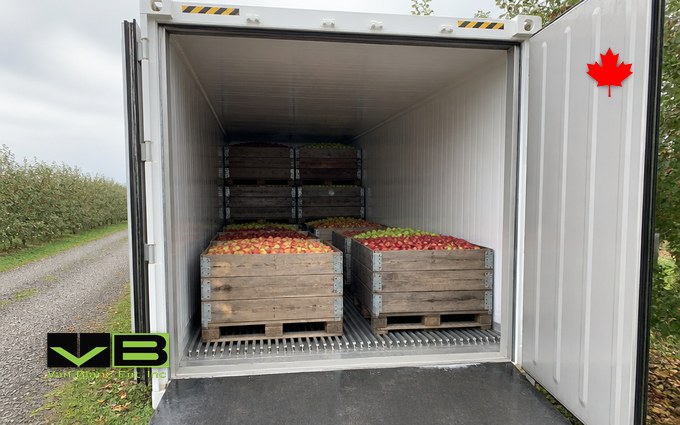
Quick Answer: To store apples, keep sound fruit at -1 to 4 °C and 90 to 95 percent humidity, apart from vegetables, in perforated bags or lined boxes. Most varieties keep 2 to 4 months at 0 °C. Ontario orchards and farm markets scale up with a refrigerated container from Van Blanc.
From Crisper Drawer to Farm Cold Room
- How to Store Apples at Home
- Apple Storage Temperature and Humidity
- Apple Varieties That Keep Longest
- Ethylene and the Vegetable Drawer
- Storing Apples in a Cellar or Garage
- Cardboard Boxes, Paper and Liners
- Freezing Uncooked Apples for Baking
- Cooling Apples the Day They’re Picked
- Honeycrisp, McIntosh and the Warmer Room
- Regular Air vs Controlled Atmosphere
- Apple Cold Storage for Orchards and Farm Markets
- 20ft or 40ft High Cube Reefer
- Power at the Packing Shed
- Set Points and Liners in a Reefer
- How Many Reefers an Orchard Orders
- Buying the Reefer: Grades and Hours
- Siting and Delivery in Apple Country
- Frequently Asked Questions
Reading Time: 20 minutes
How to Store Apples at Home
Apple storage is the job of slowing a living fruit down. A picked apple keeps breathing, and the warmer it sits, the faster it spends the sugar and acid that give it flavour. The USDA’s commercial storage handbook puts numbers on that. A fall apple gives off 2 to 4 milligrams of carbon dioxide per kilogram per hour at 0 °C, and 15 to 25 at 20 °C. Every method below keeps the fruit at the low end of that range.
For a bag from the market, the Ontario Apple Growers give the short version. Perforated plastic bags go in the refrigerator crisper, because cold, humid storage keeps the crunch. Iowa State University Extension agrees for small amounts. For larger ones it lists a second refrigerator, a cellar, an unheated outbuilding or a garage, with the fruit in perforated bags or plastic-lined boxes. On a rural property that cellar can be a bermed steel root cellar with shelving for a year of produce.
Sort before anything goes into storage. Bruised, cut or insect-damaged apples go to the kitchen first, because damaged fruit gives off ethylene and hurries the sound ones along. Leave the washing until you eat them; Oregon State University Extension says not to wash apples before storing.
The fridge suits a peck or a bushel. An orchard’s fall pick or a farm market’s winter stock is a different scale, and that is the part of the question Van Blanc answers. We sell refrigerated shipping containers, reefers for short, from our 4 Brantford yards, and the second half of this guide covers running one as an apple room.
Apple Storage Temperature and Humidity
Apple storage temperature for most varieties sits as close to 0 °C as the fruit tolerates. The USDA handbook’s commercial range is -1 °C to 4 °C at 90 to 95 percent relative humidity, chosen by variety. It says most apple varieties are not sensitive to chilling and belong as near 0 °C as possible. Iowa State University Extension puts a number on warmth: apples held at 10 °C spoil two to three times faster than apples held at 0 °C. That band is what any farm cold room has to hold, a walk-in or an insulated container fitted out as a cold room.
Christian LeBlanc, second-generation operator, Van Blanc Ent. Inc.: “Buy a thermometer you trust before you buy anything else. Apples want one steady number, close to zero for most of them, and they want it all winter. After that it’s packing and checking, whether the room is a crisper drawer or a forty-foot reefer behind the barn.”
Humidity is the half most kitchens ignore. An apple is mostly water, and dry air draws it out through the skin until the fruit shrivels. Iowa State names low humidity as the cause of shrivel in storage. The handbook adds a detail worth knowing before anyone sets a thermostat. It is easier to keep the air above 90 percent humidity at 1 °C than at 0 °C. Our notes on the produce set points a reefer can hold list apples at +1 °C.
The floor is freezing. Iowa State says apples freeze below about -1 °C (30 °F), and Oregon State gives -1.7 °C (29 °F), so plan around the warmer figure. The USDA handbook adds that fruit barely hurt by a few days just under freezing can be badly injured by a few hours at -7 to -10 °C.
Apple Varieties That Keep Longest
Keeping time is decided by the variety before anyone touches a thermostat. The Ontario Apple Growers count almost 16,000 acres of orchard in the province. Their top five varieties by acreage are Gala, Honeycrisp, Ambrosia, McIntosh and Red Delicious. The table below sets three sources side by side. “In Ontario stores” gives the growers’ months on the shelf. “Regular air at 0 °C” gives how long each variety keeps in plain cold air, per the USDA handbook. “CA room temperature” comes from an ONcore table posted on ONfruit, the blog OMAFRA’s fruit specialists write for. Cellar keepers can also compare the produce table in our container root cellar guide.
| Variety | In Ontario stores | Regular air at 0 °C | CA room temperature |
|---|---|---|---|
| Gala | September to June | 2 to 3 months | 0.5 to 2 °C |
| Honeycrisp | late September to June | Not listed | 3 °C after 7 days at 10 °C |
| Ambrosia | October to June | Not listed | 0.5 to 1 °C |
| McIntosh | September to June | 2 to 3 months | 3 °C |
| Red Delicious | October to July | 3 months | 0 to 0.5 °C |
| Empire | October to July | 2 to 3 months | 2 °C |
| Idared | October to July | 3 to 4 months | 0 to 1 °C |
| Northern Spy | October to May | Not listed | 0 to 0.5 °C |
| Spartan | October to April | 3 to 4 months | 0.5 to 1 °C |
| Golden Delicious | October to May | 3 to 4 months | 0 to 1 °C |
| Fuji | mid-late October to April | 4 months | 0 to 1 °C |
| Crispin (Mutsu) | October to April | 3 to 4 months | 0 to 0.5 °C |
| Cortland | October to April | 2 to 3 months | 0.5 to 2 °C |
A farm cold room in a 40ft reefer and a home cellar both run on regular air, so the regular-air column is the one to read for either. Fuji leads the USDA list at 4 months, with Idared, Spartan, Golden Delicious and Crispin close behind. The handbook also flags weak points. Gala loses flavour in storage, Golden Delicious shrivels easily, Spartan can shrivel at 2 to 3 °C, and McIntosh can go soft early. The store months run much longer because packers use controlled atmosphere, covered further down.
Those regular-air months also assume the temperature stays put. A room that swings a few degrees each day gives up part of that keeping time. Anyone storing a crop for months should know how a reefer’s controller and defrost cycle hold temperature.
Ethylene and the Vegetable Drawer
Ethylene is the ripening gas apples give off, and it is the reason apples and vegetables should not share a drawer. The USDA handbook classes the apple as a climacteric fruit, one whose ripening runs on a rise in ethylene. It notes that early-season varieties produce more of it than late ones. The Ontario Apple Growers put the household rule plainly: ethylene from apples speeds ripening in most produce, so keep apples apart from other fruits and vegetables.
Carrots show the cost most clearly. In the same handbook, ethylene at about 0.2 microlitres per litre makes carrots build up isocoumarin, the compound that turns them bitter. Whole or cut carrots should not share storage with it. A farm market selling carrots as well does better with two cold rooms. The fruit goes in a reefer, and the carrots in an insulated container set up as the vegetable room, with its own cooling unit fitted.
The same gas explains the old line about one bad apple. Damaged fruit gives off ethylene and spoils the sound fruit near it, Iowa State’s harvest guide says. Take the soft ones out the day you find them.
Storing Apples in a Cellar or Garage
Storing apples for winter without a refrigerator works in Ontario only while the space holds the right band. Oregon State University Extension says an unheated garage, cold basement or root cellar can work if it stays between -1 and 7 °C (30 and 45 °F). Above 7 °C, apples spoil faster. Iowa State’s warning is to move fruit out of unheated outbuildings and garages before extremely cold weather. A Van Blanc reefer on a farm avoids the scramble, because a reefer holding its set point through a cold snap heats as well as cools.
The Garage Freeze Line
Put a minimum and maximum thermometer on the apple boxes, not on the wall. An unheated building follows the outdoor air down on a cold Ontario night. The USDA handbook says a few hours at -7 to -10 °C does severe damage. When the overnight lows start dropping, the boxes move to the basement or the fridge.
A cold cellar beats a garage because the ground holds it steadier. Pick the coolest, dampest corner, away from the potatoes and carrots. Rural buyers who want that cellar without digging under the house can read up on an insulated reefer shell with the machinery removed.
Cardboard Boxes, Paper and Liners
A cardboard box works for apples if it is clean, ventilated and kept cold, and the two extension services are specific about what goes inside it. Oregon State says to use clean wooden or cardboard boxes with ventilation, and not to line the boxes with paper or wrap each fruit. Iowa State puts the fruit in perforated plastic bags or in plastic-lined boxes and crates. Wrapping each apple in newspaper, which several orchard and homestead guides recommend and Oregon State advises against, keeps a rotting apple from touching its neighbours but hides it from view.
Both universities agree on sound fruit only, kept cold and humid. Commercial packers use the bushel carton, which the USDA handbook puts at 40 lb (18.2 kg) of fruit. It is packed on four or five soft fibreboard trays made from recycled newspaper. A farm market planning its own cold room can start with a 20ft reefer’s inside measurements and lay the cartons out on paper first.
Packing matters more as the room gets bigger. For a few boxes in a basement, a liner is a small choice. For a refrigerated room holding the whole crop, the cooling coil dries the air, and the reefer section below explains why liners earn their place there.
Freezing Uncooked Apples for Baking
Uncooked apples freeze well in slices. The National Center for Home Food Preservation at the University of Georgia prefers a syrup pack for uncooked desserts and a sugar or dry pack for pie making. It says to choose crisp, firm apples, not mealy ones, then wash, peel and core them. Slice medium apples into twelfths and large ones into sixteenths.
Seconds from a farm market go the same way at a larger scale. The reefers Van Blanc sells are rated from -30 °C to +30 °C. The box that holds apples cold in November can run as a reefer kept below freezing for pie fruit once the fresh stock is sold.
The centre gives three packs. A syrup pack uses cold 40 percent syrup with 1/2 teaspoon (1500 mg) of ascorbic acid per quart to stop browning. A sugar pack sprinkles the same ascorbic acid, dissolved in 3 tablespoons of water, over the slices. Then 1/2 cup of sugar is mixed in per quart of fruit. A dry pack skips the sugar, and the slices can be frozen on a tray first. Steam blanching for 1½ to 2 minutes is the centre’s alternative to ascorbic acid.
Cooling Apples the Day They’re Picked
Cooling apples quickly after harvest protects their storage life, and each day of delay costs more than a day. The USDA handbook gives the McIntosh example: a 1-day delay at 21 °C before cooling costs 7 to 10 days of storage life. It adds that slow cooling often shows only late in storage, when the fruit misses its firmness standard. It is one more reason to put a reefer parked beside the packing shed, close to where the bins arrive.
Below 10 °C the ripening climacteric is held back, per the handbook, so the first job is getting the fruit under that line. In a cold room with limited refrigeration, it says to load only as much fruit each day as the system can cool. The other option is spreading the pick across several rooms to pre-cool. In a Van Blanc reefer, that means pre-cooling the empty box to its set point and filling it over several days. How fast a given unit pulls down is something you can see before you buy, since the timed pull-down test in a reefer inspection measures exactly that.
Honeycrisp, McIntosh and the Warmer Room
A few Ontario favourites do not want 0 °C. The USDA handbook says McIntosh can develop core browning, soft scald and internal browning when held below 3 °C for several months. It rates that risk as low for fruit kept only 2 to 3 months. Varieties prone to low-temperature disorders, it says, belong at 2 to 3 °C. Oregon State lists McIntosh and Honeycrisp among the apples to keep at about 3 °C (38 °F).
Honeycrisp needs a warm start as well. Oregon State’s instruction is one week at 10 °C (50 °F) before cold storage. The ONcore table agrees: Honeycrisp goes into storage at 3 °C after conditioning at 10 °C for 7 days. Empire, in the same table, runs at 2 °C.
At home, a fridge running at about 3 °C suits a bag of McIntosh well. For a grower, it means a second temperature group in the same harvest. A Van Blanc reefer kept for the Honeycrisp handles their timing, since a reefer’s set-point control spans the 10 °C conditioning week and the 3 °C hold that follows.
Regular Air vs Controlled Atmosphere
Controlled atmosphere storage is how Ontario Red Delicious stays in stores until July. A CA room is a sealed cold room where oxygen is lowered and carbon dioxide raised, so the fruit ripens far more slowly. The ONcore table runs McIntosh at 2.5 percent oxygen and Honeycrisp at 2 to 3 percent, against about 21 percent in normal air, per the USDA handbook. The handbook’s table shows the payoff: Red Delicious and Fuji at up to 12 months in CA, McIntosh at 5 to 7.
What a CA Room Needs That a Cold Room Does Not
The USDA handbook describes rooms sealed for gas, nitrogen flushing or generators to pull oxygen down, and automatic gas analysis to stop low-oxygen injury. It also warns that people working around air too low in oxygen must be thoroughly trained. That is packing-house equipment. Our reefer pages, for the new one-trip reefers we stock and the used ones alike, list a temperature range and a power supply, not an atmosphere system. Treat a reefer as a regular-air cold room.
Regular air fits a farm market’s selling season. Its apples move from the stand between picking and late winter. That lines up with the 2 to 4 months the USDA table gives most varieties in air at 0 °C. A Van Blanc reefer held at the right set point covers that window, and the room arrives insulated and refrigerated.
Apple Cold Storage for Orchards and Farm Markets
Apple cold storage on an Ontario farm comes down to how long the fruit has to sell after the last picking day. The Ontario Apple Growers represent about 200 commercial apple farmers. Their 2025 harvest release, quoting a chair who farms in Norfolk County, describes a decades-long shift toward pick-your-own farms, on-farm markets and agri-tourism. Every week of selling needs a cold, humid room, whether the farm sits among the apple growers south of us in Norfolk County or on another lakeshore.
A reefer is a shipping container with insulated walls and its own refrigeration unit at one end. It is built to hold a set temperature on a ship and works the same way on a farm. Van Blanc sells them outright. The use is simple. One box sits beside the packing shed or the market barn, set for the variety group inside, and runs from harvest until the bins are empty.
Ontario’s apple country sits along the shores the growers name: Lake Ontario, Lake Erie, Lake Huron and Georgian Bay. Norfolk is the Lake Erie side. On Lake Ontario, the fruit belt runs toward Niagara Falls and the fruit farms west of it. On Georgian Bay, the orchards share the shore with the Georgian Triangle around Collingwood.
A Farm Market’s Winter Apple Room
Take a pick-your-own orchard whose market barn stays open on weekends into December. On the growers’ calendar, Gala and McIntosh are in stores from September, Ambrosia and Northern Spy from October. McIntosh bins go from the wagon into a reefer at 3 °C, and the Spy goes into a second box near 0 °C. The market restocks from both every Friday. The walk-in stays free for the cider and the bakery shelf.
20ft or 40ft High Cube Reefer
As a rule of thumb, a 20ft reefer suits a farm stand or a single variety group. A 40ft high cube reefer suits an orchard holding most of its keeping apples. Every figure in the table below is copied from Van Blanc’s 20ft and 40ft high cube reefer pages. Both boxes also appear on the full sale list, reefers and dry boxes together. Inside dimensions are smaller than a dry container’s because insulation lines every wall and the refrigeration unit takes space at the front.
| Spec | 20ft reefer | 40ft high cube reefer |
|---|---|---|
| Inside length | 17 ft 10 in (5.44 m) | 38 ft (11.583 m) |
| Inside width | 7 ft 5 in (2.27 m) | 7 ft 6 in (2.294 m) |
| Inside height | 7 ft 4 in (2.24 m) | 8 ft 4 in (2.548 m) |
| Door opening | 7 ft 6 in wide, 7 ft 3 in high | 7 ft 6 in wide, 8 ft 3 in high |
| Inside volume | 978 cu ft (27.7 m³) | 2,366 cu ft (67.0 m³) |
| Temperature range | -30 °C to +30 °C | -30 °C to +30 °C |
| Power | 380/460 V three-phase, 32 A plug | 380/460 V three-phase, 32 A plug |
| Floor | T-bar aluminium air channels | T-bar aluminium air channels |
A grower holding several varieties for months will look first at the 40ft high cube reefer’s 67 cubic metres. It has a foot more inside height than the 20ft and a door 8 ft 3 in high. A farm stand with one variety group can usually work from the 20-foot reefer with its own Carrier or Thermo King unit. With apples, the limit is floor space and airflow rather than weight. The T-bar floor carries cold air under the load, so bins and cartons need gaps for it to rise through. Measure your bins and pallet jack against the inside width before choosing.
Power at the Packing Shed
A reefer needs a dedicated electrical supply, and the size of that supply is the first thing to check on a farm. Van Blanc’s 20ft reefer page lists 380/460-volt three-phase power through a 32-amp plug, and most homes and farms run single-phase service, so the site needs three-phase power or a phase converter. The 40ft high cube page lists the same 380/460-volt three-phase supply. On a farm, the panel at the packing shed or barn is the place to start.
The notes on three-phase hookups and phase converters are worth reading before you call an electrician. The circuit is installed by a licensed Ontario electrician, and an ESA inspection follows the hookup. Off-grid sites, or a field corner far from the barn, can run the unit on a diesel genset. Our 20ft page puts that at 15 to 20 kW.
Van Blanc talks through the power question on every reefer quote, because a box that arrives before its circuit sits idle. We also start the unit in the yard, or on a video call, so you see it running before it ships.
Set Points and Liners in a Reefer
Setting a reefer for apples means choosing one temperature per box from the variety’s needs. For most varieties in regular air, the USDA handbook puts that near 0 °C. For McIntosh, and for Empire, Idared and Cortland, which its table marks temperature sensitive, it is 2 to 3 °C. For Honeycrisp, it is a week at 10 °C first, per the ONcore table and Oregon State.
Humidity is the harder part in any refrigerated room, and monitoring humidity in a container cooler starts with a hygrometer beside the temperature probes. Small coil surface areas and frequent defrosting are the main causes of fruit drying in storage, according to the USDA handbook. It notes that plastic bins, or poly liners inside wooden bins, reduced shrivel in Golden Delicious. In a Van Blanc reefer, line the bins or use perforated bags in the cartons. The box holds the temperature, and the liners keep the moisture in the fruit.
Readying the Reefer for Harvest Bins
- Run the reefer empty with the doors shut until it reaches the set point, the pre-cool any produce load should get.
- Put temperature probes in the middle of the load and near the doors; the handbook warns against trusting one thermometer at the door.
- Load only what the unit can pull down overnight, and keep bins off the walls so air moves.
- Keep culls, carrots and squash out of the apple box.
- Pull a sample of each variety at least monthly, the interval the handbook sets for CA rooms.
Price a Reefer for Your Apples
Tell us the varieties, roughly how many bins, what the panel at the barn can feed and where the box will sit. We will tell you which reefer fits, 20ft or 40ft high cube, with the grade and the hours on the unit. Then you get one all-in number with a real lead time.
Family-run in Brantford since 1995 · 4 Brantford yards · 4.9★ across 140+ Google reviews.
How Many Reefers an Orchard Orders
An orchard’s reefer count comes from its set points, and our advice is one box per temperature the crop needs at once. A grower with only Gala, Ambrosia, Fuji and Northern Spy can run one box near 0 °C. McIntosh and Honeycrisp form a second group at about 3 °C. Honeycrisp also need a 10 °C first week before they settle at 3 °C. We would size that orchard for three set points: 0 °C, 3 °C, and a Honeycrisp box that drops to 3 °C after its warm week. Holding the whole crop at 3 °C instead would cost the cold-tolerant varieties some keeping time.
One more box earns its place where a market also sells vegetables, for the ethylene reasons covered earlier. Cideries are a different case. A cidery that ages its own product may want a container set up as a barrel room alongside the apple reefer. That keeps two temperatures and two jobs in separate boxes. A farm adding dry storage for empty bins, crates and equipment can put a plain box beside the reefer on the same delivery.
Buying the Reefer: Grades and Hours
A reefer has two ages, the steel box and the refrigeration unit, and the unit matters more. Van Blanc’s 20ft reefer page describes a one-trip reefer as essentially new, with the unit under 5,000 hours. A cargo worthy reefer is a box used 8 to 15 years, with its unit serviced and typically showing 30,000 to 60,000 hours. Both hold an apple set point. The difference is wear on the compressor, which is why we disclose the make, model and approximate hours on every reefer quote.
A cargo worthy reefer comes in at a lower landed cost than a one-trip unit. Its box sits on the same grade ladder as the used dry containers in our rows. The grade table on the 20ft reefer page gives the unit hours for each step. Either way, a refrigeration technician’s look at the unit is time well spent, and the inspection post linked above walks through it.
One warning applies at any grade. A reefer listed far below every Ontario yard, by a seller with no yard to visit, matches the pattern of marketplace scams. Walk the box and see the unit run before any money changes hands.
Siting and Delivery in Apple Country
Siting a reefer on a farm comes down to three distances: from the trees, from the panel and from the truck. Put the box close to where bins come off the wagon, so fruit cools the day it is picked. Keep the power run short. Set it level on a drained gravel pad under the corner castings, with the refrigeration end clear so the unit can move air.
The delivery truck needs a straight approach to the spot, and the notes on the clear run a tilt-deck truck needs cover the space to leave. We offer fast 1-3 day delivery to every region across Ontario from our 4 Brantford yards, which reaches Norfolk, Niagara and the Georgian Bay orchards. Every quote comes with a real lead time, not a hopeful one. For a reefer wanted before the late varieties come off, October is the month to call.
Growers are welcome to see a reefer run before they buy, at one of our 4 Brantford yards or on a video call. Our public yard at 90 Morton Avenue East in Brantford is open Monday to Thursday 9:30 to 5 and Friday 9:30 to 4, with no appointment needed. Van Blanc holds a small standing stock of reefers, so bring your bin measurements.
Frequently Asked Questions
Which apple stays crisp the longest?
Firm, late varieties keep their crunch longest. In the USDA handbook’s regular-air table, Fuji keeps 4 months at 0 °C, ahead of Idared, Spartan, Golden Delicious and Crispin at 3 to 4. Gala, McIntosh and Empire fall in the 2 to 3 month group, and McIntosh can soften early. Northern Spy, an Ontario late keeper, stays on store shelves from October to May.
Do apples stay fresh longer in the refrigerator?
Yes. Iowa State University Extension says apples at 10 °C spoil two to three times faster than apples at 0 °C. The USDA handbook shows a fall apple respiring several times faster at 20 °C than at 0 °C. The Ontario Apple Growers recommend perforated plastic bags in the crisper, which holds both the cold and the humidity.
Can you freeze uncooked apples?
Yes. The National Center for Home Food Preservation says to peel, core and slice firm apples into twelfths or sixteenths. Treat the slices with ascorbic acid or steam blanch them for 1½ to 2 minutes, then freeze them in syrup, sugar or a dry pack. The centre prefers the syrup pack for uncooked desserts and the sugar or dry pack for pies.
How do I store apples in a cardboard box?
Use a clean, ventilated box of sound, unwashed fruit in a cold, humid spot between -1 and 7 °C. Oregon State advises against lining the box with paper or wrapping each apple. Iowa State uses perforated plastic bags or a plastic-lined box to hold moisture. Check the box often and remove any soft apples straight away.
How long will apples keep in cold storage?
In regular cold air at 0 °C, the USDA handbook gives most varieties 2 to 4 months, with Fuji at the top. Controlled-atmosphere storage, with lowered oxygen, stretches that much further: up to 12 months for Red Delicious and Fuji and 5 to 7 for McIntosh. That is why Ontario apples reach stores into June and July.
What is the best way to store apples during winter?
Keep sound fruit at -1 to 4 °C and 90 to 95 percent humidity, away from vegetables, and check it often. A fridge or a cold cellar does this for a household. A garage works only until the cold arrives, because apples freeze below about -1 °C. Farms holding a crop use a cold room or a reefer sized to the harvest, one-trip or used and graded like our dry stock.
How to keep apples fresh without refrigeration?
Use the coldest damp space you have. Oregon State says a cold basement, root cellar or unheated garage works if it holds between -1 and 7 °C, and apples spoil faster above that. Keep them in ventilated boxes or perforated bags, away from potatoes and carrots, and bring them in before a hard freeze.
What temperature should a reefer be set to for apples?
Set it by variety group. The USDA handbook puts most varieties near 0 °C in regular air and chilling-sensitive ones such as McIntosh at 2 to 3 °C. Honeycrisp gets a week at 10 °C before going down to 3 °C. Van Blanc reefers are rated from -30 °C to +30 °C, so every one of those settings is in range.
Sources
- Watkins, C.B., E. Kupferman and D.A. Rosenberger. (2016). Apple. In The Commercial Storage of Fruits, Vegetables, and Florist and Nursery Stocks, Agriculture Handbook 66, USDA Agricultural Research Service. USDA ARS Agriculture Handbook 66, checked October 2026.
- ONfruit, the fruit blog with OMAFRA specialist contributors. (2024). Common Controlled Atmosphere Storage Regimes for Apples, ONcore summer issue, adapted from DeEll 2020. ONfruit CA storage regimes for apples, checked October 2026.
- Ontario Apple Growers. (2026). Ontario Apple Varieties, Care and Handling of Apples, Apple Facts and the 2025 harvest release. Ontario Apple Growers variety guide, checked October 2026.
- Iowa State University Extension and Outreach. What are the best storage conditions for apples? and How to Harvest and Store Apples. Iowa State Yard and Garden apple storage, checked October 2026.
- Oregon State University Extension Service. Picking and Storing Apples and Pears (FS 147). Oregon State picking and storing apples and pears, checked October 2026.
- National Center for Home Food Preservation, University of Georgia. Freezing Apples. NCHFP freezing apples instructions, checked October 2026.
See a Reefer Run Before You Buy
We have been supplying shipping containers across Ontario since 1995. The public yard is at 90 Morton Avenue East in Brantford, one of our 4 Brantford yards, and we deliver reefers and dry boxes to farms across the province.
Van Blanc Ent. Inc., 90 Morton Ave E Unit 1B, Brantford, ON N3R 7J7, 519-754-6844.
Bring your variety list and a photo of the barn panel, and we will start a reefer for you and match the box to your harvest. Worth the drive for unbeatable quality, family customer service with 30 years of experience.