
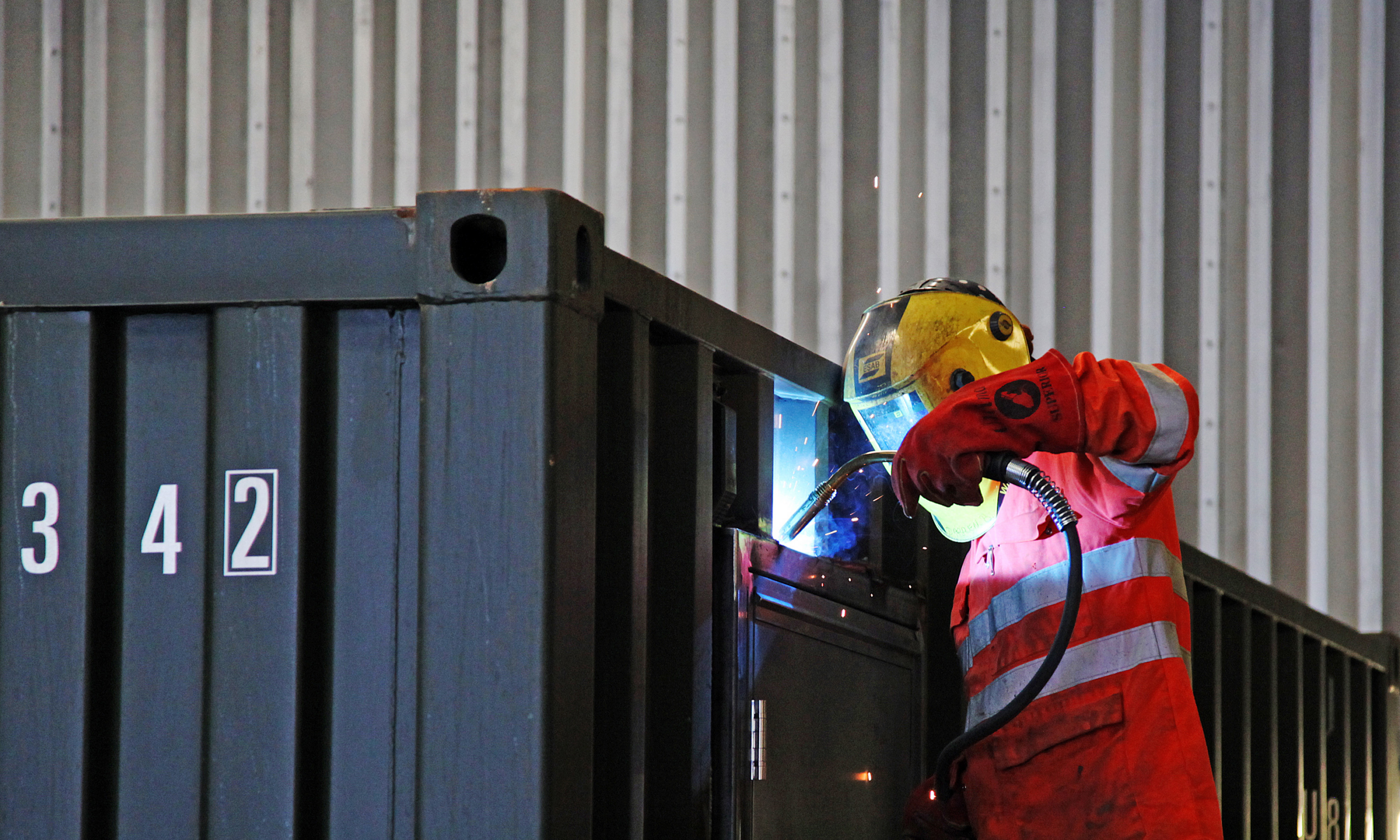
Quick Answer: A 20ft One-Trip shipping container converts into a serious backyard art studio or maker space with three modifications: north-facing window cutouts for steady artist daylight, closed-cell spray foam at R-6 per inch to protect canvas and paint, and dedicated 20A circuits for kilns, lasers, or 3D printers. Any new electrical work is filed and inspected by the Electrical Safety Authority (ESA) in Ontario.
In This Guide
- Why Are Artists and Makers Choosing Shipping Containers?
- How Do You Cut North-Facing Windows for Artist Daylight?
- Which Skylight Holds Up on a Container Studio Roof?
- How Does Spray Foam Protect Canvas and Paint?
- How Do You Ventilate Solvents, Glaze Dust, and Wood Stain?
- How Much Electrical Does a Container Maker Space Need?
- How Do You Fit a Workbench, Sink, and Plumbing Into 20ft?
- What Studio Configurations Does Van Blanc Actually Deliver?
- Why Does One-Trip Win for Studios?
- FAQs
Reading Time: 14 minutes
Why Are Artists and Makers Choosing Shipping Containers?
Artists and makers choose shipping containers because the box arrives as a finished, weathertight steel shell ready for cuts. A 20ft One-Trip container gives a painter, potter, or woodworker a structure whose corner posts and steel floor already carry kiln weight and tool vibration. Windows, insulation, and wiring get added on top of a frame that exists on day one.
Artistic buyers are the most particular customers who walk our Brantford yard. They show up with a folder, a measuring tape, and a list of paint codes. A painter wants to know whether the original Corten weathering steel will read warm or cold against the studio’s interior wall colour. A potter wants the floor flat enough that a kiln base will sit true without wedging shims under the foot. A photographer with a backdrop wall in mind wants to confirm the door gasket actually seals so dust doesn’t drift in mid-shoot. They take their time and they should.
A backyard art studio or maker space in a 20ft One-Trip container gives the maker something a stick-built shed cannot. The frame arrives engineered, weathertight, and ready for cuts. The four corner posts and steel floor tolerate kiln weight, drill-press vibration, and the bouncy footwork of a person at a lathe. It sits on the ground on blocks or a simple pad, with none of the foundation-footing work a built-on-grade studio brings. The roof is the roof. The walls are the walls. The build-out adds windows, insulation, electrical, and plumbing on top of a structure that already exists, the same sequence we follow on every box we convert before it ships.
Van Blanc has supplied containers to makers across Ontario since 1995. We have watched the backyard-studio trend climb steadily through every cycle since the early 2010s, when the first painters and ceramicists started ordering 20ft bins instead of building from scratch. The buyer profile is picky in a way most container orders are not. The box itself becomes part of the studio’s aesthetic. A ding on the cargo doors that a contractor would shrug off becomes a deal-breaker for a painter planning gallery photographs of the finished space. That picky-buyer reality drives every recommendation on this page.
Christian LeBlanc, second-generation operator: “Artistic buyers are some of the pickiest customers we have, and rightly so. They want tight cargo doors that seal flat, paint that reads true under daylight, and a clean exterior because the box itself ends up in the photographs of their finished studio. We walk a One-Trip with them in the yard, look at every panel under the sun, and let them pick the unit that fits the aesthetic they have in their head.”
How Do You Cut North-Facing Windows for Artist Daylight?
North-facing window cutouts give an art studio steady daylight, and the rule traces back centuries. Every classical painting studio from the Renaissance forward orients its main window to the north. The reason is steady, indirect, blue-shifted daylight that does not move dramatically across the working surface during a session. South light shifts colour temperature hour by hour and casts hot direct beams that flatten form. North light holds steady. For a painter mixing colours on a palette, that consistency is the difference between a session that finishes the canvas and a session that has to be redone because the green you mixed at 10 a.m. read olive by 2 p.m.
When a maker orders a 20ft container for a studio build, we ask which direction the long side will face once it is placed. The framing and sealing detail behind each opening is the same work we describe in our walkthrough on framing a window into corrugated steel. North-facing long side is the prize position. A single tall window cutout in the centre of the north wall, or a paired set of two narrower windows flanking a studio easel, gives the painter a consistent overhead-quadrant daylight from morning to late afternoon. The cutout dimensions matter. A window roughly five feet wide and four feet tall, set with the sill at desk height (about thirty-eight inches off the floor), lights a standing easel without putting glare directly on the canvas surface.
Window Cutout Engineering Basics
Every cutout through container wall steel requires reinforcement. The corrugation acts as a structural rib. Cutting it weakens the wall unless the perimeter is framed with welded angle iron or square tube to redistribute load back into the corner posts. Standard practice is a 2×2 inch steel angle frame welded around the opening, then a thermally-broken aluminum or vinyl window frame installed inside the steel frame with closed-cell sealant. Without the steel frame, the wall flexes and the window glass cracks within a season of thermal cycling. We do this in-house at our Brantford yard before the container leaves for your site.
For a maker who works in three dimensions rather than two (woodworker, jeweller, sculptor), north light still matters but the calculus shifts. You want enough overall room brightness that you can see grain, joinery, and fine metalwork clearly without specular glare bouncing off a single hot light source. A north-wall band of three smaller windows distributes the daylight more evenly across the workbench than a single large opening does. We design the cutout pattern around the actual workbench location the buyer is planning, not a generic template.
What if your site only allows a south-facing or east-facing orientation? Two options. Either deepen the eyebrow over the window (an overhanging steel awning that shades the direct beam in summer but lets winter sun in low under the brim), or use diffusing glass instead of clear glass. Diffuse laminated glass scatters the direct beam into something closer to north-light quality, at the cost of losing the view out the window. Painters often accept that trade. Photographers usually do not because they want to see the weather coming.
Which Skylight Holds Up on a Container Studio Roof?
A welded steel curb skylight is the one that holds up on a container studio roof in Ontario, and a roof skylight transforms the space. The eight-and-a-half-foot ceiling on a standard 20ft container can feel low when you are working at an upright easel. Cut a thirty-by-forty-inch skylight into the roof above the easel and the perceived ceiling height doubles. Light pours straight down onto the working surface from the brightest part of the sky. Most container studios we have built in the last decade ship with at least one roof skylight and many ship with two.
There are two skylight installation approaches and they are not interchangeable.
Welded steel curb skylight. A box of steel angle is welded directly to the corrugated roof panel around the cutout. The skylight unit then sits on top of the curb with a flexible gasket and is held down by clamp brackets. This is the engineered solution. It tolerates Ontario snow load, ice damming, and the thermal flex that happens every time a January day climbs from minus fifteen to plus three. Lifespan is fifteen to twenty years on the seal, the steel curb itself lasts the life of the container.
Framed self-flashing skylight. A residential-grade flashing kit is cut to fit the container roof corrugation and lapped under a tar-and-fabric membrane. Cheaper, faster, and usable for very mild climates. Not recommended for Ontario. The container roof is a load-bearing structural panel, not a residential shingled roof, and the differential expansion between the steel and the residential flashing pulls the seam apart within four to six winters. We have seen the failure pattern repeatedly when buyers cheap out on skylight installation and come back to us for repair.
Skylight Glass Choice for Studios
Triple-glazed low-emissivity skylights cost about 35 percent more than double-glazed but cut summer heat gain dramatically. A south-facing painter who installs a clear double-glazed skylight will be cooking the studio in July. Triple-glazed with a low-E coating keeps interior temperature manageable without an oversized air conditioner. If the studio runs a kiln, a 3D printer, or a laser cutter (each of which dumps additional heat), the upgrade pays itself back in cooling costs the first summer.
One additional consideration for pottery and ceramic studios: clay dust drifts upward on warm air and settles on horizontal surfaces. A flat skylight glass collects clay dust on the exterior over time and the interior surface gets a faint glaze deposit from the kiln vent plume. Dome-profile skylights (the polycarbonate domed acrylic style) shed both more easily because the surface is curved. Painters usually prefer flat glass for cleaner light geometry. Potters lean toward domed for the cleaning practicality. Both are correct for their use case.
How Does Spray Foam Protect Canvas and Paint?
Spray foam protects canvas and paint by holding the studio at a stable humidity and temperature so the materials do not move. Closed-cell spray polyurethane foam is the climate-control workhorse of a serious container studio. Three inches of closed-cell foam delivers roughly R-18 on the walls and ceiling, with a continuous vapour barrier baked in because the foam itself is vapour-impermeable when applied at that thickness. We cover the gauge and coverage trade-offs in more depth in our note on how thick to spray a steel box. For an artist storing canvases, oil paints, finished works, or any material that responds to humidity swings, that vapour barrier is the unsung hero of the whole conversion.
Canvas stretched on wooden bars expands and contracts with relative humidity. A finished oil painting on linen, stored at fluctuating humidity, will eventually show stress cracks in the paint film as the substrate moves underneath. Watercolour paper warps. Wood-panel substrates cup. Even fresh stretcher bars warp if the storage environment swings between thirty percent humidity in February and seventy percent in August. Closed-cell foam, combined with a small dehumidifier in summer and a humidifier in winter, holds a backyard container studio within ten percentage points of relative humidity year round. That stability protects the work.
For paint storage specifically, the climate concern is freezing. Latex and acrylic paints separate permanently if they freeze even once. Oil paints handle cold better but the linseed-oil binder thickens to the point of unusability below about minus five Celsius. A spray-foamed container with a small baseboard heater on a thermostat set to maintain a five-degree minimum keeps every paint can usable through the worst Ontario winter. Without that heat-and-insulation combination, the studio becomes seasonal: half the year you cannot use the materials you stored there.
The R-Value Breakdown for a Container Studio
Closed-cell spray polyurethane foam: approximately R-6 per inch. Mineral wool batt in a framed wall (the cheaper alternative): R-3.5 per inch, no vapour barrier, requires a separate poly sheet and tape job that often fails at penetrations. Rigid foam board: similar R-value to closed-cell spray but requires meticulous taping at every seam to act as a vapour barrier. Spray foam wins for a studio because of the continuous vapour seal and the way it conforms to corrugation valleys without leaving thermal bridges.
A mini-split heat pump is the climate-control complement to spray foam. A single twelve-thousand-BTU mini-split handles heating and cooling for a 20ft container with insulation in place. The indoor head mounts high on the end wall, the outdoor compressor sits on a small concrete pad outside, and a single condensate drain handles the dehumidification load. Mini-splits are quiet enough that they will not interfere with a recording or photography session. They are also efficient enough that the monthly hydro cost on a fully insulated 20ft is modest, even running year-round.
How Do You Ventilate Solvents, Glaze Dust, and Wood Stain?
You ventilate a studio with a dedicated exhaust fan paired to a balanced make-up air inlet, sized to the fumes you actually produce. Solvent ventilation is the section most container-studio articles skip. The fume profile of a painting studio is not the same as a workshop. Oil painters use mineral spirits, odourless thinners, dammar varnish, and occasionally turpentine. Each of those evaporates volatile organic compounds (VOCs) at room temperature and the VOCs accumulate in an unvented sealed space within hours. The same is true of polyurethane and water-based varnish for finishers, of oil-based wood stains for woodworkers, and of certain ceramic glaze components for potters firing reduction atmospheres.
The right answer is a dedicated exhaust fan tied to a balanced make-up air inlet. A four-to-six-inch in-line fan installed near the work area, ducted through the wall to an exterior hood with a louvre damper, moves enough air to keep the breathing zone well below VOC accumulation thresholds. The make-up air inlet (a simple passive louvre on the opposite end of the container) prevents the fan from pulling the studio into negative pressure and back-drafting other ventilation paths.
Ventilation Sizing Rule of Thumb
A 20ft container interior is approximately 1,170 cubic feet. ASHRAE guidance for studios with intermittent solvent use is six air changes per hour, which works out to about 117 CFM continuous or about 200 CFM intermittent during active work. A four-inch in-line duct fan moves roughly 200 CFM. A six-inch fan moves about 400 CFM and is the better choice for a serious oil painter, a finisher, or anyone running a kiln vent at the same time. Wire the fan to a wall switch beside the door so it runs whenever the studio is in use.
Pottery studios add a second ventilation concern: clay dust. Silica dust from dried clay and from glaze chemicals is a long-term lung-health issue, not a smell issue. The protective approach is a HEPA-grade dust collector positioned near the wheel and the glazing station, plus a kiln vent system that pulls combustion gasses and glaze off-gas directly from the kiln chamber through a dedicated duct to the exterior. The kiln vent fan runs whenever the kiln is firing. Without it, the studio fills with a faint sulphur-and-sodium fume profile during glaze firings that is uncomfortable in the short term and damaging over years.
Woodworkers running a planer, jointer, or table saw add dust extraction. A small cyclone dust collector tied to flexible duct at each tool collects shavings at source. Without it, fine wood dust drifts everywhere in the studio, settles on every horizontal surface, and creates a fire hazard around the electrical panel and any motor. The cyclone unit sits in one corner, draws about ten amps when running, and pays itself back in a single year of not breathing the dust. Buyers fitting out a heavier shop often pair this with the fume-extraction approach we lay out for pulling shop air out at the source.
How Much Electrical Does a Container Maker Space Need?
A serious container maker space needs a 60-amp sub-panel feeding several dedicated circuits, not a single household run. Studio electrical is where buyers most often under-spec the build. A standard 15A residential circuit handles lights and a few outlets. It does not handle a small electric kiln, a CO2 laser cutter, a resin 3D printer with heated build plate, a photographic strobe pack at full power, or any combination of those running at the same time.

The minimum specification for a serious maker space is a 60-amp sub-panel fed from the main house panel, with the following dedicated circuits:
- One 20A circuit for general outlets and lighting distributed at three locations along the long walls.
- One 20A circuit for the workbench for laptop, soldering station, small power tools, and photo monitor.
- One dedicated 20A or 30A circuit for the kiln, laser, or 3D printer. A small ceramic kiln (cone 6, twenty-four cubic inches) typically pulls 15A continuous and needs a 20A dedicated circuit. A larger kiln or a kiln with a controller may need 30A and 240V; check the nameplate.
- One 15A circuit for the mini-split head unit.
- One 20A circuit for the ventilation fan and dust collector, wired so they can both run simultaneously without nuisance trips.
That comes out to a 60-amp sub-panel with five circuits and headroom for one or two future additions. The feed from the main house panel is typically a single 6-3 NMD90 cable buried in conduit under the lawn, terminating at the container sub-panel. Total parts cost is modest; the labour cost is where the variation lives, and the variation depends entirely on the distance from the house panel to the container site.
Ontario ESA Inspection Reality
Any new electrical installation in Ontario requires notification to the Electrical Safety Authority (ESA) and inspection before energization. For a container studio, that means filing a notification when the work starts, having ESA inspect the sub-panel and feed connection, and posting the inspection sticker on the panel. The fee is small relative to the project but the inspection itself is non-optional. We recommend a licensed Ontario electrician for the sub-panel install. They file the ESA notification, do the work to Ontario Electrical Safety Code, and arrange the inspection. Skip the inspection and your home insurance may not cover a future electrical fire originating in the studio.
For a photographer running studio strobes, the consideration shifts slightly. Strobes do not draw heavy continuous power, but the inrush current when a pack recycles can momentarily spike. Run strobes on a dedicated 20A circuit, not on the same outlet as a computer or backup-drive setup, because the inrush can occasionally trigger sensitive electronics to reboot. Photographers learn this the hard way once and never repeat the mistake.
Lighting inside the studio matters as much as the outlet plan. For a painter, the goal is overhead diffused light at five thousand to fifty-five hundred Kelvin colour temperature (daylight-balanced) with a high colour-rendering index (CRI 95 or higher). LED panel fixtures rated for CRI 95+ now cost a reasonable amount per fixture and produce light that renders pigments accurately. Two or three of those panels mounted overhead, combined with the north-light cutout and the skylight, give the painter consistent working light at any hour. For a maker doing precision work (jewellery, electronics, fine woodworking), add a tasklight at the bench with the same colour-rendering quality. Cheap warm-white shop fluorescents are the wrong choice for studio work.
How Do You Fit a Workbench, Sink, and Plumbing Into 20ft?
You fit a workbench, sink, and plumbing into a 20ft studio with fold-down surfaces, shallow wall storage, and a self-contained water setup. Floor space is the constraint in a 20ft container studio. Interior dimensions are roughly nineteen feet eight inches long by seven feet eight inches wide, which gives you about 150 square feet to work with. Smart layout reclaims a surprising amount of that.
A fold-down workbench mounted to the long wall on heavy-duty piano hinges drops to a working surface (typically thirty-six inches deep by six feet long) when needed and folds back flat when not. That gains you about eighteen square feet of floor space when the studio is not in active bench work. For a maker who alternates between a wheel-and-floor activity and a bench activity (a potter who works at the wheel most days but glazes at the bench occasionally, or a sculptor who works on a floor stand but finishes at the bench), the fold-down is the single best space optimization.
The Sink Question
Painters, potters, printmakers, and woodworkers all benefit from a small sink in the studio. The plumbing question is whether you tie into the house water and drain, or run a self-contained system. A self-contained setup uses a six-gallon water tank with a manual hand pump or small 12V pump, drains into a five-gallon holding tank under the sink, and gets emptied periodically. No frost concerns, no buried lines, nothing to trench. A tied-in system runs PEX water lines and an ABS drain in a buried, insulated trench from the house, terminating at the container floor. That works year-round and calls for proper backflow prevention done by a licensed plumber. For seasonal use, the self-contained system is what most studio owners actually install. For full-year heavy use (a ceramic studio with daily clay-throwing), the tied-in system pays back.
Storage on the long walls is the other space-multiplier. Shallow open shelving (eight to twelve inches deep) on the wall opposite the bench keeps tools, paints, brushes, jars, and small materials visible and reachable. Closed cabinets at floor level hide solvents, finishes, and anything that should be locked. The shallow-depth open shelving is the move; deep storage on a 20ft container wall makes the room feel cramped and the materials at the back disappear from active use.
What Studio Configurations Does Van Blanc Actually Deliver?
Van Blanc actually delivers five common art-studio and maker-space configurations out of our Brantford yards. Each is a real build we have shipped, not a generic possibility list. The table below maps each one to its container grade, daylight plan, and the circuit it leans on hardest.
Five Studio Builds at a Glance
| Studio type | Typical grade | Daylight plan | Heaviest circuit |
|---|---|---|---|
| Backyard painter | One-Trip | North window plus one skylight | Outlet and bench circuits |
| Ceramic studio | One-Trip | Flat skylight plus domed vent | 240V kiln circuit (in kiln shed) |
| Woodworking shop | One-Trip | Two windows plus skylight | Dedicated circuit per major tool |
| Jewellery and silversmith | One-Trip or 10ft | Bench task lighting | Annealing kiln circuit |
| Photography studio | One-Trip | Blackout, controlled light | Strobe circuit |
1. Backyard Painter Studio
20ft One-Trip. North-facing long side. Single five-by-four window centred on the north wall, sill at thirty-eight inches. One thirty-by-forty roof skylight above where the easel will sit. Three inches of closed-cell spray foam on walls and ceiling. Mini-split heat pump. Four-inch ventilation fan with passive make-up louvre. Sub-panel with one outlet circuit and one bench circuit. CRI-95 LED panels overhead. Fold-down workbench on the long wall opposite the easel. Self-contained sink with hand pump. Total useful floor space after layout: roughly 130 square feet, which is comparable to a generously-sized urban apartment studio.
2. Ceramic Studio with Kiln Shed
20ft One-Trip plus a separate small kiln shed (often a smaller insulated container or stick-built lean-to) because kilns prefer their own ventilated structure for safety. Inside the 20ft: wheel area near the door for clay-truck access, glazing bench mid-room, drying shelves on the back wall, sink with tied-in water for clay rinsing. Closed-cell spray foam everywhere because clay storage cares about humidity. Domed acrylic roof vent in addition to one flat skylight. Six-inch ventilation fan tied to kiln vent. Dedicated 30A 240V circuit for the kiln (which lives in the shed, not the main container). Dust collector in the corner.
3. Woodworking Maker Space
20ft One-Trip. Two windows on the long wall plus a roof skylight for daylight at the bench. Heavy-duty plywood subfloor over the steel container floor to soften foot fatigue and dampen tool vibration. Cyclone dust collector in one corner ducted to each tool. Bench along one long wall with a fold-down extension. Mitre saw station at the door end for long-stock infeed and outfeed through the open cargo doors. Dedicated 20A circuit per major tool (table saw, planer, jointer) so two can run simultaneously. Closed-cell spray foam keeps the steel from sweating onto stored hardwood lumber.
4. Jewellery and Silversmith Studio
20ft One-Trip or smaller 10ft if floor space matters less. Bench along the wall with a jeweller’s pin and lap wheel station. Soldering area at the bench end with a dedicated exhaust hood (small four-inch fan ducted straight up and out) for flux fumes. Small kiln (electric, low amperage) for annealing on a dedicated 20A circuit. Excellent CRI-95+ LED task lighting at the bench because metalwork needs colour accuracy. Climate-controlled because precious metal storage and small electronics (rolling mills, ultrasonic cleaners) prefer stable humidity. Small floor safe bolted to the steel floor for finished work.
5. Photography Studio with Backdrop Wall
20ft One-Trip preferred for the clean exterior and tight cargo door seal. Cargo doors removed entirely or fitted with blackout curtains because controlled darkness matters more than natural light for studio photography. One end wall painted matte black or grey, with a coved backdrop curve at the floor for seamless background paper. Studio strobes on dedicated 20A circuit. Computer workstation along the long wall with monitor and tethering setup. Spray foam insulation because temperature stability protects digital sensors and stored photo paper. Light-trap entry at the cargo-door end so the photographer can come and go without spilling daylight onto an active set.
Ready to price your container?
Tell us the size and your postal code and we’ll send back an all-in number, container, delivery, and placement, usually within 1-3 days. No pressure, no mystery fees.
Family-run in Brantford since 1995 · 200+ containers in stock · 4.9★ across 140+ Google reviews · every box graded by a person, walk it before it lands.
Why Does One-Trip Win for Studios?
One-Trip wins for studios because the box itself becomes part of the finished space, so the clean exterior and tight door seal matter as much as the structure. Almost every studio order we ship leaves the yard as a One-Trip unit. The reasons are aesthetic and operational. The industry calls these units one-trip because they made exactly one loaded voyage from the factory, and most studio buyers want that factory-clean steel a new build delivers.
Container Grades for a Studio, Side by Side
| Grade | Exterior condition | Best studio fit |
|---|---|---|
| One-Trip (new) | Factory paint, no rust, doors seal flat | Any studio that ends up in photographs or faces the yard |
| Cargo Worthy (CW) | Surface rust, paint variance, small dents, frame inspected | Utility storage, or a deliberate weathered look |
| Wind and Watertight (WWT) | Visible wear, faded paint, doors still seal | Stationary storage where appearance does not matter |
A One-Trip container has made a single journey from the manufacturer (typically Asia) to North America, loaded with cargo to offset shipping cost. It arrives in essentially new condition: original factory paint coat, no rust, doors operate cleanly, gaskets seal flat. The exterior reads as a clean steel box, which matters when the box itself becomes part of the studio’s outdoor presence in the buyer’s yard. A painter planning to photograph the finished studio for a portfolio cares about how the container looks from the driveway. A potter who hosts the occasional open studio cares about the same thing. One-Trip is the grade that delivers that aesthetic without extra prep work.
Cargo Worthy (CW) and Wind & Watertight (WWT) grades are working used containers with surface rust, paint variance, occasional dents, and gaskets that have done their share of work. Those grades are right for farm storage, construction site offices, or industrial yard use where cosmetic wear does not matter. For a studio that the buyer will look at every day and that visitors will see, the up-front cost difference between a CW unit and a One-Trip unit is paid back many times over in not having to repaint, not having to replace seals, and not having to apologize for the aesthetic.
The exception is a buyer who specifically wants the weathered industrial look. Some sculptors and mixed-media artists choose CW or WWT precisely because the patina becomes part of the aesthetic statement. That is a legitimate choice and we will walk those units with you in the yard the same way we walk the One-Trips. Just go in with eyes open about what surface rust will do over a few Ontario winters if left unsealed.
Many people call us saying they can get a bin less on Facebook. Two weeks later they call back saying they got scammed. Don’t fall for it. The bin that is suspiciously cheap is the bin that never arrives. We have taken that panicked call-back too many times to count over thirty years. A real One-Trip container with a paint quality good enough for a studio carries a real price because the supplier actually has the unit on the ground and is going to deliver it.
Worth the Drive to Brantford
For an artistic buyer, walking the container in person before purchase is worth the drive. We let you read the CSC plate, walk every panel under daylight, open and close the doors to check the seal, and pick the specific unit that fits your eye. Buyers come from Toronto, Hamilton, London, and across Southern Ontario to do exactly that. Our Brantford yard at 90 Morton Avenue East is the destination, not a constraint. Fast 1-3 day delivery to every region across Ontario once you have picked your unit. Shipped from our 4 Brantford yards. Every quote comes with a real lead time, not a hopeful one.
Frequently Asked Questions
Can I put an electric kiln in a shipping container art studio?
Yes, with proper ventilation and a dedicated electrical circuit. Small ceramic kilns (cone 6, twenty-four cubic inches) typically need a 20A dedicated circuit. Larger kilns may need 30A and 240V. The kiln must have a powered vent ducted to the exterior to remove combustion gases and glaze fumes. Many potters house the kiln in a separate small shed adjacent to the main studio container for safety and air-quality reasons.
How much electrical does a container maker space actually need?
A 60-amp sub-panel fed from the main house panel is the practical minimum for a serious maker. That supports one general outlet circuit, one workbench circuit, one dedicated tool or kiln circuit, one mini-split circuit, and one ventilation circuit. A 100-amp sub-panel gives more headroom if you plan to run a 240V kiln, a CNC, and air conditioning simultaneously. A licensed Ontario electrician sizes the actual feed and files the ESA notification.
Will my canvases and paint survive a Canadian winter in a container studio?
With closed-cell spray foam insulation and a thermostat-controlled heater holding the interior above five Celsius, yes. The vapour barrier baked into the spray foam keeps humidity stable, which protects stretched canvas from warping. Without insulation and supplemental heat, latex and acrylic paints will freeze and separate permanently, and a winter container studio becomes seasonal storage at best.
What is the best skylight for a container studio in Ontario?
Triple-glazed low-emissivity glass on a welded steel curb. The curb installation tolerates Ontario snow load, ice damming, and seasonal thermal flex. The triple-glazed low-E glass cuts summer heat gain dramatically, which matters if the studio also runs a kiln or laser. Domed acrylic skylights are second-best and a sensible choice for pottery studios where clay dust drifts onto the glass.
Why is north-facing window orientation important for a painting studio?
North light is steady, indirect, and blue-shifted. It does not move dramatically across the working surface during a session, which means colours mixed at 10 a.m. still read the same at 2 p.m. South light shifts colour temperature hour by hour and casts hot direct beams that flatten form. Every classical painting studio from the Renaissance forward orients to the north for this reason.
Do I need a One-Trip container or will a used Cargo Worthy work for a studio?
One-Trip is what most studio buyers choose because the original factory paint, tight cargo door seal, and clean exterior become part of the studio’s aesthetic. The box itself ends up in the photographs of the finished space. Cargo Worthy and Wind & Watertight are used grades with cosmetic wear (surface rust, paint variance) and work fine for utilitarian storage but rarely fit the artistic-buyer aesthetic. Some sculptors specifically prefer the weathered look of CW units.
Sources
- International Organization for Standardization. (2022). ISO 6346:2022 Freight containers: Coding, identification and marking. iso.org/standard/82754.html
- Electrical Safety Authority (Ontario). (2025). Ontario Electrical Safety Code and Notifications and Inspections. esasafe.com/notifications-and-inspections/
- Canadian Conservation Institute. (2017). Agent of Deterioration: Incorrect Relative Humidity. Government of Canada. canada.ca/conservation-institute/agents-deterioration/humidity
- ASHRAE. (2022). ANSI/ASHRAE Standard 62.1-2022: Ventilation for Acceptable Indoor Air Quality. ashrae.org/standards-62-1-62-2
- Health Canada. (2023). Volatile Organic Compounds (VOCs) in Indoor Air. canada.ca/health-canada/air-quality/volatile-organic-compounds
Reach Van Blanc in Brantford
We have been supplying shipping containers across Ontario since 1995. Our warehouse is at 90 Morton Avenue E in Brantford, and we deliver right across the province on a cash-on-delivery basis. No surprise fees, no chase-the-paperwork.
Van Blanc Ent. Inc. 90 Morton Ave E Unit 1B, Brantford, ON N3R 7J7. Call 519-754-6844 or toll-free 1-888-509-6658.
Bring your studio layout sketch when you visit. Christian or Paul will walk a One-Trip with you in the yard, check every panel under daylight, and let you pick the unit whose paint and cargo door seal fit the studio you have in your head.