
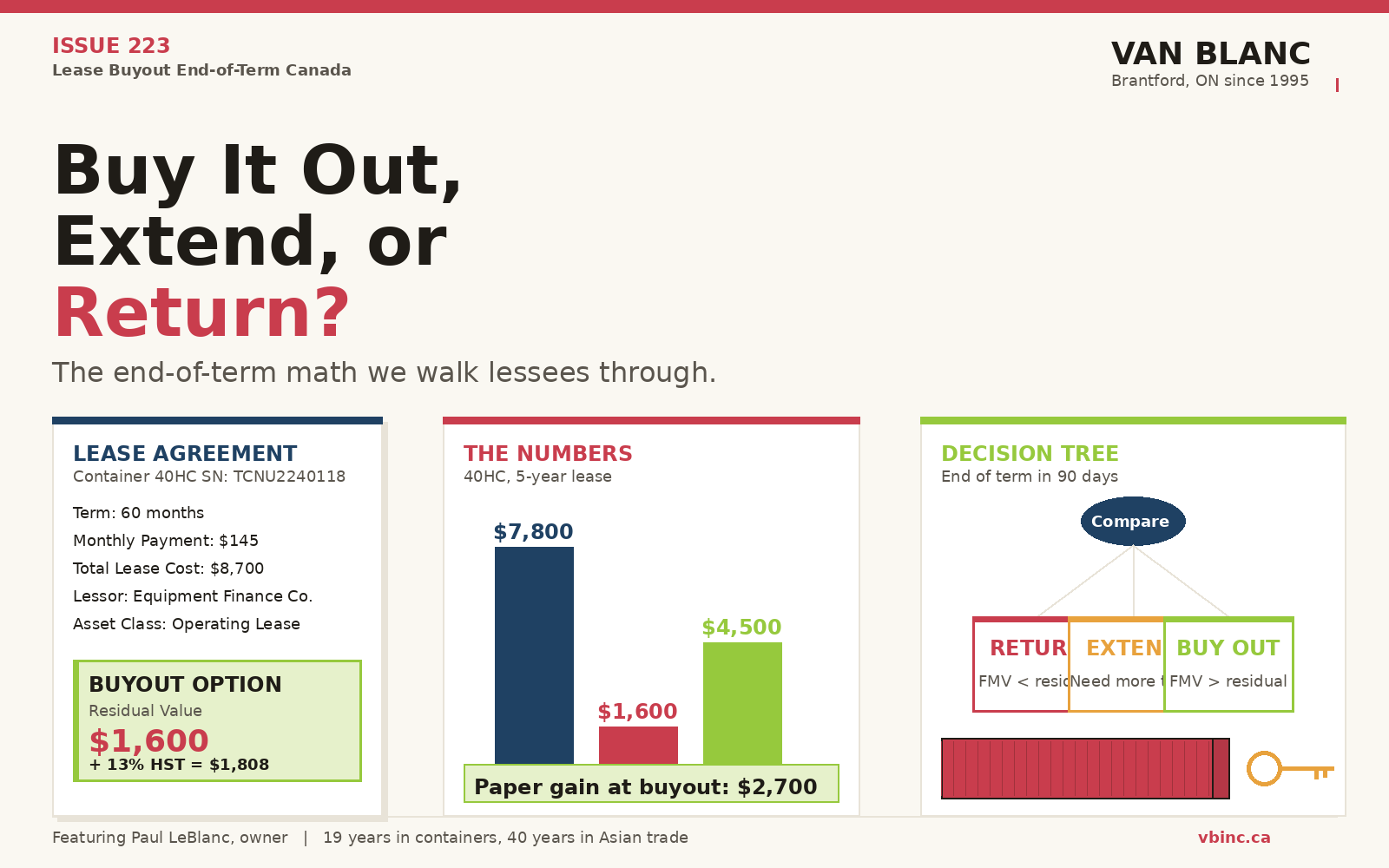
We sell containers. We do not rent.
Van Blanc sells shipping containers outright. We do not rent, we do not lease, and we do not offer rent-to-own. Renting comes up on this page because buyers compare it against owning, and that comparison is worth reading, but purchase is the only arrangement we offer. Stocked units deliver from our Brantford yards in 1 to 3 days. Request a sale quote or call the yard at 519-754-6844.
Quick Answer: A lease buyout shipping container end-of-term Canada decision comes down to three numbers: the residual buyout price in your contract, the fair-market value of the actual bin in your yard today, and the HST you owe on the buyout amount. If fair-market value beats the residual by more than 10 percent plus HST, exercise the buyout. The LeBlanc family has run Van Blanc Ent. Inc. since 1995. 140+ verified Google reviews at 4.9 stars, 1-3 day delivery across Ontario.
In This Guide
- What are the three shipping container lease buyout types?
- How do I compare my residual value to today’s market?
- Should I return, extend, or buy out at term end?
- HST and the accounting flip from lease expense to owned asset
- Should I inspect the container before signing the buyout?
- Early termination math and when it pencils out
- How can I finance a container buyout without draining cash?
- A real Brantford-yard walkthrough of buyout math
- Paul on what thirty years of end-of-term conversations have taught us
- Frequently asked questions
Reading time: about 13 minutes.
What are the three shipping container lease buyout types?
Shipping container lease buyouts in Canada come in three shapes: a token buyout (capital lease) where the bin is effectively yours for a nominal final payment, a fair-market-value buyout (operating lease) priced at term end, and a fixed-residual buyout named in the contract at signing. The shape decides whether end-of-term is a formality or a real decision.
The three buyout types matter before any number does, because the type your contract gives you is what determines whether the end of your term is a paperwork formality or a real decision. Equipment leases in Canada usually fall into one of these three shapes. Knowing which one you signed tells you whether you even have a choice to make.
The token-buyout lease, sometimes called a capital lease or dollar buyout, treats the container as effectively yours from day one. You make slightly higher monthly payments through the term, and at the end you write a token cheque (one dollar, ten dollars, occasionally a hundred) and the title transfers. There is no decision at end of term. The container was always going to be yours. That accounting split, where the bin sits on your books from the start, is exactly what separates a capital lease from an operating one, and it is set by the buyout type rather than the monthly figure.
The fair-market-value (FMV) buyout is the operating-lease version. Your monthly payments through the term are lower because the lessor still owns the residual value at the end. When the term closes, the lessor offers you the container at fair-market value as estimated for that vintage and grade today. You can pay it, walk away, or in some contracts negotiate a renewal. Most Canadian shipping-container leases written for under five years are FMV leases, because the steel still has decades of life and the lessor wants the optionality.
The fixed residual buyout (sometimes written as 10 percent buyout, PUT buyout, or stated residual) sits between the two. The contract names a specific buyout figure at signing, say a stated residual on a 20-foot container carried alongside fixed monthly payments over 36 months. That number is set in ink. You exercise it or you do not, but the price is not market-driven. This is the version that creates the most interesting end-of-term decisions because the contract residual and the real-world market can diverge significantly over three or five years.
Why the contract type matters more than the monthly
Buyers compare leases by monthly payment. Lessors structure leases by buyout type. A token-buyout lease and an FMV lease can carry similar monthly payments, so the FMV looks like the winner, until you total up the payments plus the fair-market value owed at term and realise the token-buyout was cheaper overall. The distinction sits at the heart of how container leasing actually works in Ontario, which is the framework worth running through before signing rather than after.
Paul LeBlanc, owner: “I have had this conversation for thirty years. The customer always knows their monthly payment and almost never knows their buyout type. That one number on page two of the contract is the whole game at term end. Read it before you sign rather than when the letter arrives.”
How do I compare my residual value to today’s market?
Comparing your residual value to today’s market is the single most important calculation at end of term. You put your contract residual next to what the same container actually trades for in Ontario today, and the gap between those two numbers tells you whether you have a good deal in your hand or a bad one.
Residual values are set by the lessor at the start of the lease using depreciation models that assume containers lose value steadily through the term. A typical 36-month lease on a one-trip 20-foot bin might carry a residual of 60 to 70 percent of original cost. A 60-month lease on the same container would carry a residual of 40 to 50 percent. The lessor’s math is conservative on purpose, because the lessor would rather have a low residual that customers exercise than a high one that comes back to them at re-marketing time.
What actually happens to shipping container market values over a lease term depends on three things: container availability in Canada, the Canadian-dollar to US-dollar exchange rate (most new builds price in USD), and the steel-scrap floor. Over the past decade, used containers have generally held value better than residuals predicted, because Canadian supply has been tight relative to demand. Containers bought new in 2019 are often selling used in 2026 well above the typical 60-month residual their leases assumed.
That market reality is what makes the FMV and fixed-residual buyouts interesting at term end. If your contract residual sits below what the same grade and size currently retails for on our Brantford sales lot, you have a paper gain by exercising the buyout. If your contract residual sits above what the same bin sells for, you have a loss and should return it instead.
How to value your bin today without guessing
Three quick ways to anchor a number before you decide. Pull three current Ontario listings for the same size, grade, and approximate age. Call two suppliers (we are one of them; ask for a verbal market quote with no obligation) and ask what they would price a similar unit at retail. Check the steel-scrap floor through any local metal recycler so you know the absolute bottom number. Average the three and compare to your residual.
Should I return, extend, or buy out at term end?
Returning, extending, or buying out is the three-way decision every lease reaches at term end. Once you have your residual number and your market number in hand, the choice splits into those three branches, and each branch carries its own math and its own non-financial trade-offs.
Return the container if your contract residual is higher than current market value, or if you simply do not need the container anymore. Returning is the cleanest end of term. You schedule the pickup, the lessor inspects, you pay any wear-and-tear charges (more on those below), and the relationship closes. The downside is that you have spent two to five years paying for the use of an asset you now have nothing to show for. That is fine if the use covered the cost, but worth acknowledging.
Extend the lease if you still need the container, the buyout pencils out badly, and you do not want the capital outlay of a purchase right now. Extensions on FMV leases are typically month-to-month or short-term renewals at the same payment rate or slightly higher. The advantage is no decision pressure. The disadvantage is you keep paying lease cost on an asset whose original purchase would have been paid off if you had bought outright at signing.
Exercise the buyout if market value comfortably exceeds residual after tax, you intend to keep using the container, and you want the asset on your balance sheet. This is the right move in most cases where the lessee still has a use for the bin, because the buyout converts five years of operating expense into a depreciating capital asset you can resell whenever it stops earning its keep.
The pencil-and-paper test
- Step 1: Find your contract residual or buyout-option price.
- Step 2: Get three current Ontario quotes for the same size and grade.
- Step 3: Add 13 percent HST to the buyout (residual times 1.13).
- Step 4: Subtract that total from the average market value.
- Step 5: If the gap is clearly positive by a comfortable margin, buy it out. If neutral, decide based on whether you still need the bin. If negative, return or extend.
HST and the accounting flip from lease expense to owned asset
The Canada Revenue Agency treats a lease buyout as a taxable supply at the moment of exercise. That means you owe HST on the buyout amount alone, the cash you hand over at term end, rather than on the residual minus prior payments. In Ontario that is 13 percent on top of the buyout price, so the cash you actually pay at term end is the buyout figure plus that tax.
For a GST/HST-registered business, that HST is recoverable as an input tax credit. You pay it at the moment of buyout, then claim it back on your next return, and the net cost of the container is the pre-tax buyout amount. For non-registered buyers (homeowners, hobby farms, small operations under the small-supplier threshold) the HST is a real cost and needs to be in the decision math.
The accounting treatment also flips at buyout. Through the lease term, the monthly payments were 100 percent deductible as a lease expense in the period they were paid. After buyout, the container moves to your balance sheet as a capital asset and you depreciate it through the Canadian capital cost allowance system. For commercial containers, most accountants slot the bin into CCA Class 8 (20 percent declining balance), though specific cases vary. The shift from full-expense to declining-balance depreciation usually slows the deduction, which matters less for cash flow than for year-end tax planning.
The half-year rule and end-of-fiscal-year timing
The Canada Revenue Agency applies the half-year rule to most capital additions, meaning the year you acquire the container you can only claim half of the normal CCA rate. That makes the timing of a buyout matter. Exercising the buyout in December captures only the half-year on that fiscal year and the full rate the following year. Exercising in January gives you the half-year that whole year. Talk to your accountant about whether shifting the buyout date six weeks would meaningfully change your tax position.
Should I inspect the container before signing the buyout?
Inspecting the container before you sign the buyout is the step 30 years in Ontario container supply tells us most lessees skip, and it is the one that protects them. The same checks that matter when you are sizing up any used bin before you pay for it apply here too. Inspect the actual steel rather than the photo on the original lease document: the unit sitting on your property or at the lessor’s yard right now.
Containers age unevenly. A bin that lived on a paved industrial yard in Hamilton for five years looks very different from the same bin that lived on a wet farm in Norfolk. Roof rust, door-seal degradation, floor wear, and minor frame impact damage can all happen during the lease without anyone formally documenting them. You are about to buy this container at a price set five years ago for a hypothetical condition rather than the real one.
What to check before you sign: roof for standing-water pooling or rust-through, door gaskets for cracking or flattening (the doors should still seal weather-tight), floor for soft spots or rot under any tools or pallets that have been parked there for years, frame corners for impact damage from forklift contact, paint for new graffiti or branding that needs removal, and any modifications (electrical, vents, shelving) for ESA compliance or safe disconnection. None of these are buyout-killers on their own. Together they tell you whether the contract residual is still a fair price for the bin you would actually own.
If you find significant degradation, that is a negotiation lever with the lessor. Most lessors would rather adjust the residual down a notch than have the container come back to them with documented condition issues that they would have to remediate before re-marketing. Bring photos, bring a written list, and ask for an adjustment.
Comparing a buyout bin against the Brantford yard
Walk the leased bin where it sits, then come see what the same size and grade looks like on the ground: our yard at 90 Morton Avenue East in Brantford has hundreds of used bins across every grade, and a side-by-side against a cargo-worthy row tells you quickly whether the residual is fair. Buyers from across Ontario drive here for that second opinion before they sign. Call 519-754-6844 to set up a yard visit.
Early termination math and when it pencils out
Most Canadian equipment leases include early-termination provisions, but they are rarely a good deal for the lessee. Operating leases on shipping containers typically require the lessee to pay the present value of all remaining payments plus a termination fee, which usually adds up to more than just continuing through term end and exercising whatever buyout option exists.

The exceptions are worth knowing. If your business is selling or restructuring and the lease cannot transfer to the new entity, early termination is sometimes the only legal path. If the container is irreparably damaged and your insurance is paying out, the insurer typically negotiates the early termination as part of the settlement. If the lessor is in financial distress and would rather close out leases for cash today than collect monthly through term, you sometimes have unexpected negotiating leverage.
The math: take the remaining months on the lease, multiply by the monthly payment, add any contract-specified termination fee (often two to four months of additional payment), and that is your termination cost. Compare to the all-in cost of continuing: remaining payments through term plus the buyout if you would have exercised it. In almost every case the continue-and-buyout path is cheaper unless you can put the released capital to higher-return use immediately.
When early termination actually saves money
If you have 18 months left on a lease, add up the 18 remaining payments, then add the contract residual plus 13 percent HST on that residual: that is the all-in cost of finishing the term and owning the bin. Terminating early usually means paying the present value of those same remaining payments plus a termination fee and walking away with no asset to show. In most cases the finish-and-buy path leaves you ahead. Run the numbers before you call the lessor.
How can I finance a container buyout without draining cash?
Financing a container buyout matters because the lump-sum amount can be uncomfortable even when the math says exercise. A buyout on a 20-foot bin is manageable for most businesses. A buyout on a 40-foot high-cube reefer at the end of a 60-month lease is not pocket change, and how you fund it is part of the end-of-term decision.
Several Canadian financing paths handle this without you draining operating cash. A traditional equipment loan from a chartered bank or credit union, secured against the container itself, typically funds at 60 to 80 percent of appraised value over 24 to 60 months. A line of credit drawn for the buyout converts the operating-lease cash flow into a slightly different operating cash flow. Some lessors offer to roll the buyout into a new lease on the same container, essentially refinancing the bin at the residual price with you as both new lessor and existing lessee.
The most overlooked option is asking the original lessor for a payment plan on the buyout itself. Lessors would rather extend payment terms on a buyout than have the container come back to them. A six-month buyout-payment-plan at zero interest is a request that often gets approved with no resistance. Ask before you arrange external financing.
A real Brantford-yard walkthrough of buyout math
A Brantford-yard walkthrough of the buyout math is the clearest way to see how the decision plays out, using realistic numbers from the current Ontario market. Two scenarios follow, both ending in different decisions.
Scenario A: 20-foot one-trip on a 36-month FMV lease. At term end the lessor sends an FMV quote for the three-year-old one-trip 20-foot bin. You pull three current Ontario listings for the same size, grade, and age (our guide to what containers cost in Canada walks through how to read those numbers), then add 13 percent HST to the lessor’s quote to get your all-in buyout. Here the FMV sits within the current market range and the bin still earns its keep operationally, so the all-in cost is fair. Decision: buy out.
Scenario B: 40-foot high-cube on a 60-month fixed-residual lease. The contract names a fixed residual set five years ago. The current Ontario market for a five-year-old 40-foot high-cube in cargo-worthy condition has held up better than that residual assumed. Add 13 percent HST to the residual for your all-in buyout, and it still lands comfortably under what the same bin trades for today. Decision: absolutely buy out. The gap is found money.
The second scenario is the one lessees miss when they let term-end paperwork run on autopilot. The lessor sends a return-the-container letter, the lessee schedules pickup, and a paper gain evaporates. Read the contract, do the market check, and exercise the buyout when the numbers say so.
| Lease type | Typical residual | Decision driver | Common outcome |
|---|---|---|---|
| Token buyout (capital) | Nominal, a token amount at term end | None, automatic transfer | Container becomes yours |
| FMV buyout (operating) | Market-set at term end | FMV vs current Ontario market | Buy out, extend, or return |
| Fixed-residual buyout | 10 to 40 percent of original | Residual vs current Ontario market | Buy out if residual below market |
| Rent-to-own | Pre-paid in monthly payments | Automatic transfer, usually a token final payment | Container becomes yours |
Paul on what thirty years of end-of-term conversations have taught us
Paul LeBlanc, owner: “Most of the lease-buyout calls we get start the same way. The customer reads the term-end letter from their lessor, panics about the lump sum, and assumes they have to return the container. Then they call us asking what their bin is actually worth in the Ontario market right now. Nine times out of ten the bin is worth more than the contract residual, and they should be exercising the buyout rather than handing the keys back. The other one time, the bin has aged hard and the residual is generous to the lessor, and the right move is return. The reason we know is thirty years of watching the same conversation play out. Read the contract. Walk the bin. Do the math. The right answer becomes obvious in about 20 minutes.”
That conversation happens often enough at our Brantford yard that it is part of why we wrote this article. Lessees with end-of-term decisions ahead of them benefit from a second opinion on how the bin has aged from someone with no skin in the lessor’s revenue. We sell containers; we do not write the lease contracts. That neutrality is part of what 30 years of operating in Ontario container supply lets us offer for free.
Frequently asked questions
How is the residual value of a shipping container lease calculated in Canada?
Lessors typically set the residual at signing as a percentage of original container value, usually 60 to 70 percent for a 36-month lease and 40 to 50 percent for a 60-month lease on a one-trip bin. The percentage reflects projected depreciation, the lessor’s internal cost of capital, and a conservative buffer so the residual is exercised more often than the container is returned and re-marketed.
Do I pay HST on a shipping container lease buyout in Ontario?
Yes. The Canada Revenue Agency treats the buyout as a taxable supply, so you pay 13 percent HST on the buyout amount at the moment of exercise. The tax adds 13 percent on top of whatever the buyout figure is. If your business is GST/HST-registered, you recover the HST as an input tax credit on your next return. If you are not registered, the HST is a real cost in the decision math.
What is the difference between a token buyout and an FMV buyout container lease?
A token buyout treats the container as effectively yours from day one, with slightly higher monthly payments and an automatic title transfer at term end for a nominal amount. An FMV buyout has lower monthly payments because the lessor retains residual value, and at term end the lessor offers you the container at fair-market value. The token-buyout version is cheaper overall if you intend to keep the bin; the FMV is cheaper if you might walk away.
Can I buy out my container lease early without a penalty?
Usually not. Most operating leases on shipping containers require the lessee to pay the present value of all remaining payments plus a termination fee if they want to close out early. The exception is if the lessor is willing to negotiate, which sometimes happens when the lessor is in financial distress, when the lease cannot transfer to a new business entity, or when an insurance settlement triggers the buyout. Run the math before you call.
Should I exercise the buyout or return the container at term end?
The pencil test is: take the contract residual or FMV buyout price, add 13 percent HST, and compare to the average current Ontario market value for the same size and grade. If market value exceeds total buyout cost by a comfortable margin and you still have a use for the bin, exercise the buyout. If the gap is neutral or negative and you do not need the container, return it.
What happens if I damage the container during the lease?
Operating leases include wear-and-tear provisions, and significant damage (frame impact, floor rot, roof rust-through, modifications without lessor approval) results in chargeback at term end. The chargeback can range from a modest figure for cosmetic remediation to a much larger figure for structural repair. If you have damage you know about, factor the chargeback into the buy-out-or-return decision; exercising the buyout sometimes makes more sense than returning and paying the chargeback.
How does the half-year rule affect my buyout timing in Canada?
The CRA applies the half-year rule to most capital additions, so the year you buy out the container you can only claim half of the normal capital cost allowance rate. A December buyout captures the half-year for that fiscal year and the full rate next year. A January buyout starts the half-year fresh in the new year. Talk to your accountant about whether shifting the date six weeks would improve your tax position.
Can I finance the buyout amount through a bank or credit union?
Yes. Chartered banks, credit unions, and equipment finance companies offer secured equipment loans against the container itself, typically funding at 60 to 80 percent of appraised value over 24 to 60 months. Some lessors also offer to roll the buyout into a new lease on the same container, effectively refinancing the residual. The most overlooked option is asking the original lessor for a six-month interest-free buyout payment plan.
What CCA class does a bought-out container fall into for tax purposes?
For most commercial containers used as storage on a business property, accountants slot the bin into CCA Class 8, which depreciates at 20 percent declining balance per year. Containers used for specific purposes (refrigerated storage, mobile offices with ESA-certified electrical, container homes) sometimes fit other CCA classes. Confirm the classification with your accountant before filing because the wrong class triggers reassessment.
How do I get a fair-market-value quote on my leased container in Ontario?
Pull three current Ontario retail listings for the same size, grade, and approximate age, and average them. Then call two used-container suppliers and ask for a verbal market quote with no obligation. Van Blanc is one of them; call 519-754-6844 for a no-pressure number. Cross-check against the steel-scrap floor through any local metal recycler so you know the absolute bottom. The average of those data points is your FMV anchor.
Ready to price your container?
Tell us the size and your postal code and we’ll send back an all-in number, container, delivery, and placement, usually within 1-3 days. No pressure, no mystery fees.
Family-run in Brantford since 1995 · 200+ containers in stock · 4.9★ across 140+ Google reviews · every box graded by a person, walk it before it lands.
Sources
- Canada Revenue Agency. (2024). GST/HST and the place-of-supply rules. Government of Canada. canada.ca
- International Organization for Standardization. (2022). ISO 6346:2022, Freight containers, Coding, identification and marking. iso.org. iso.org/standard/82754
- Institute of International Container Lessors. (2024). IICL inspection criteria for cargo-worthy and wind-and-watertight container grades. iicl.org. iicl.org
- Mehmi Financial Group. (2025). HST and GST on equipment leases in Canada. mehmigroup.com. mehmigroup.com
- Canada Revenue Agency. (2024). Classes of depreciable property, capital cost allowance (CCA). Government of Canada. canada.ca
Reach Van Blanc in Brantford
We have been supplying shipping containers across Ontario since 1995. Our warehouse is at 90 Morton Avenue East in Brantford, and we deliver right across the province on a cash-on-delivery basis. No surprise fees, no chase-the-paperwork.
Van Blanc Ent. Inc., 90 Morton Ave E Unit 1B, Brantford, ON N3R 7J7. Call +1 888-509-6658.
If you have an end-of-term decision coming up and want a no-pressure market quote on what your leased container would sell for in Ontario today, call us. We see hundreds of bins a year. We can give you a number in about ten minutes.