
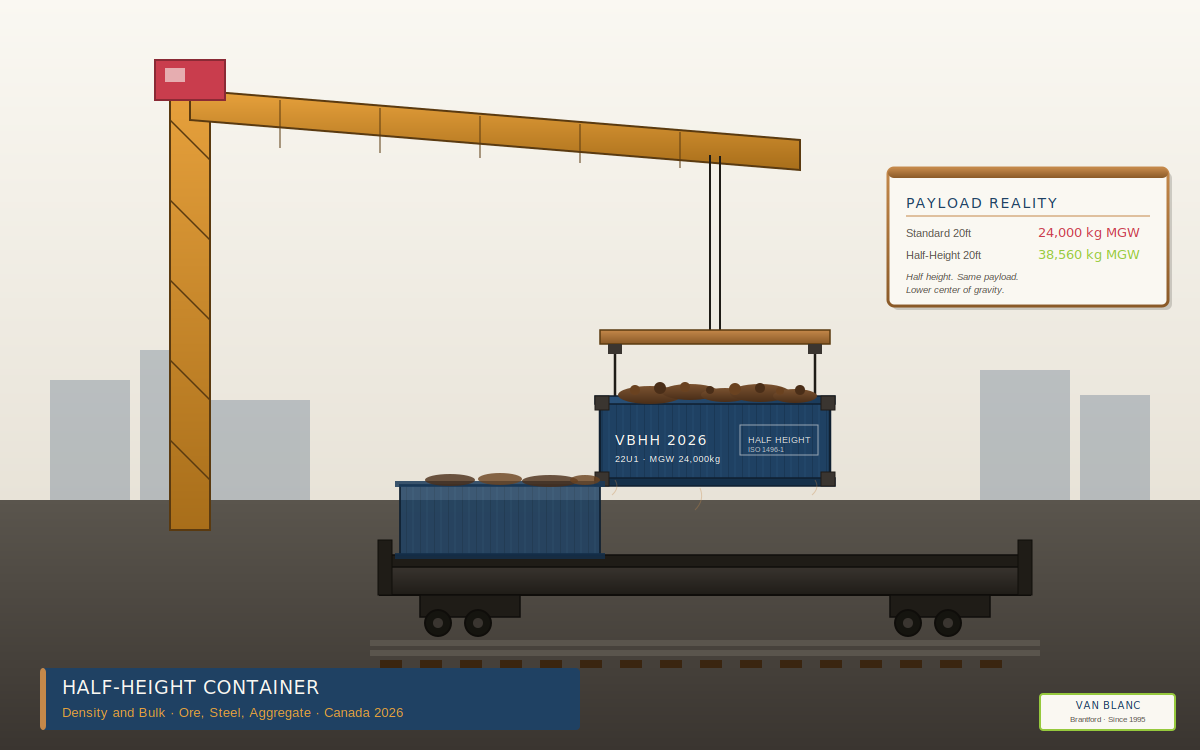
Quick Answer: A half-height container is 1.45 m tall instead of 2.59 m, sized for high-density loads like iron ore, scrap steel, and aggregate. A standard 20ft container hits its 24,000 kg payload limit before the box is full of dense material. Half-height fits the same payload with a lower center of gravity, safer for crane lifts and railcar transport.
In This Guide
- Why does dense cargo hit the weight limit before the container is full?
- What is the ISO spec for a half-height container?
- What is a half-height container used for?
- Why are half-heights better for crane lifts and railcar transport?
- How does a lower center of gravity help on delivery and stacking?
- What drives half-height container pricing in Canada in 2026?
- Why are used half-height containers so rare?
- What is the lead time to source a half-height from Brantford?
- Frequently asked questions
- Reach Van Blanc in Brantford
Reading Time: 13 minutes
If you have ever tried to fill a standard dry box with iron ore concentrate, crushed slag, or no. 1 heavy melt scrap, you already know the problem. The box has 33.2 cubic metres of interior volume. The math says you should be able to load close to 30 tonnes inside. Then the floor scale tells a different story. The container is half full and you are already at the 24,000 kg maximum gross weight stamped on the CSC plate. Anything more and the lift cannot legally leave the yard.
That is the density problem. Iron ore concentrate runs roughly 2,400 kg per cubic metre. Scrap steel runs 1,500 to 2,500 kg per cubic metre depending on cut size and density grade. Loose gravel runs around 1,600 kg per cubic metre. Crushed sulphide ore, mineral sands, foundry sand, copper concentrate, and lead concentrate all run heavier still. None of these cargoes fit the cube of a standard container. They fit the floor and then they stop.
The half-height container exists because of this. Same footprint as a standard 20ft (6.06 m by 2.44 m corner to corner). Same corner castings, same ISO twistlock pattern. But the box is roughly half the height (1.45 m instead of 2.59 m), and the payload rating is engineered for what density actually demands. Below we walk through the spec, the operational logic for crane and rail, the Canadian use cases, what they cost in 2026, and why the resale market for them is thin enough that most have to be sourced to order.
Why does dense cargo hit the weight limit before the container is full?
Dense cargo hits the weight limit early because a standard 20ft container is rated for about 24,000 kg gross, and material denser than roughly 1,800 kg per cubic metre reaches that weight while the box is still half empty. Iron ore, scrap steel, and aggregate fill the floor, not the cube, so the load stops well short of the ceiling.
The CSC plate (Container Safety Convention, IMO 1972) on every certified container lists a Maximum Gross Weight (MGW), a tare weight, and a maximum payload. For a standard 20ft dry container, the numbers run roughly:
| Spec | Standard 20ft Dry | 20ft Half-Height (bulk) |
|---|---|---|
| External height | 2.59 m (8’6″) | 1.45 m (4’9″) |
| External length | 6.06 m (19’10”) | 6.06 m |
| External width | 2.44 m (8’0″) | 2.44 m |
| Tare weight | ~2,300 kg | ~2,550 kg |
| Maximum gross weight (MGW) | 24,000 kg (52,910 lb) | up to 38,560 kg (85,010 lb) |
| Maximum payload | ~21,700 kg | ~36,010 kg |
| Interior volume | 33.2 m³ | 13.4 m³ |
Read that table twice. The half-height container, despite being roughly half the cube, is rated for a payload close to 70 percent heavier than a full-height standard 20ft. That is not an accident of engineering. The base frame, side rails, and floor are reinforced specifically because half-height containers are expected to take loads that would buckle a normal container floor. Ore-carrying variants from specialty fabricators push the payload to 42,000 kg, which is above what most rail jurisdictions will accept on a single TEU footprint, so 36,000-38,000 kg is the operational ceiling for road and rail in Canada.
The math that matters: if your cargo density is above about 1,800 kg per cubic metre, a standard container cannot legally hold a cubic-volume-full load. You will hit MGW first. Anything denser than that is a half-height candidate by default.
Density rule of thumb
If your bulk cargo density is below 700 kg/m³ (wood chips, dry hay, light insulation), a standard 40ft High Cube wins on cube. Between 700 and 1,800 kg/m³, a standard 20ft is fine. Above 1,800 kg/m³, you are paying to ship air with every standard container you load. Half-height containers move the economics back to weight-based pricing, which is what bulk freight actually charges.
What is the ISO spec for a half-height container?
Half-height containers are covered under ISO 1496-1, the international standard for testing series 1 freight containers for general cargo. The container size code in the ISO 6346 marking system is typically 22U1 or 2EU1, where the “U” indicates a hard-top open container and the trailing “1” indicates a half-height configuration. Some operators see them stencilled as HH (half-height) or OS (open-side hard-top) depending on the door configuration.
Christian fields most of the early questions on these at the yard. “Buyers think a half-height is some exotic thing that won’t fit their existing handling gear,” he says. “It fits everything a regular 20ft fits. The spreader, the chassis, the well-car, the stacking cell. The only thing that changes is the height and the floor rating. Once people hear that, the conversation moves straight to spec.” Christian grew up around the Brantford yard and works it alongside Paul.
The critical thing about ISO compliance is what does not change. Corner castings sit in the same eight positions as a standard 20ft. Twistlock pattern, spreader bar fit, cell guide compatibility, railcar well-car fit, truck chassis pin layout: all identical to a full-height 20ft. A half-height container can be lifted by any 20ft spreader, stacked in any standard container terminal cell, and locked into any standard intermodal chassis. The bulk-handling industry adopted the half-height precisely so it could ride the same logistics rails as everything else.
What changes is the lid configuration. Half-heights ship with one of three top options:
Half-height top configurations
- Open-top with tarpaulin: Tubular bows arch over the open box, secured by a tarp lashed to perimeter cleats. Cheapest, most common, fastest to load with a clamshell grab or top-loading conveyor. Vulnerable to water ingress in heavy rain unless tarp is properly sealed.
- Hinged hard-top: Steel lids hinge open along the long side, locked closed with twistlocks. Better weather protection, more expensive, slower to load because the lid must be cycled.
- Removable hard-top: Lids lift off entirely via crane. Best protection, slowest cycle time, used for high-value concentrate where moisture matters.
The doors at the end of the container vary too. Some half-heights ship with no end doors at all (loaded and unloaded entirely from above). Others have single or double cargo doors on the short end for tipping discharge. Ore-carrying variants often skip end doors entirely to maximize structural integrity at the corners. If you are buying for a specific application, the door spec is one of the first questions to clarify before sourcing.
What is a half-height container used for?
The three Canadian industries that buy half-height containers regularly are mining concentrate transport, scrap steel recycling, and aggregate movement. Each has a slightly different reason for choosing the format.
Mining ore and concentrate
Sudbury nickel-copper concentrate, Timmins gold ore, northwestern Ontario iron ore feed: these are the obvious Canadian mining flows. A 20ft half-height with hard-top lid loaded with nickel concentrate at roughly 2,400 kg/m³ hits 32,000 kg in the box, which is exactly inside the rail-friendly payload envelope. Loading is done at the mill with a front-end loader or conveyor; the lid closes and twistlocks; the box rides out on a rail well-car. Same container that arrived empty leaves loaded, no intermediate transfer to a gondola or hopper car. That single-handling efficiency is the real economic case for mining half-heights.
Scrap steel recycling
Hamilton and the broader Golden Horseshoe scrap industry move heavy melt, shredded scrap, turnings, and prepared cuts in bulk. SSAB and similar steel producers report that dedicated scrap containers can deliver meaningful annual savings in handling costs compared to open gondola transfers, because the container can be loaded at the scrap yard, transported sealed, and discharged directly into the EAF (electric arc furnace) charging bucket without a yard-to-bucket intermediate transfer. The half-height fits the density of shredded auto scrap (roughly 1,800-2,200 kg/m³) without leaving 60 percent of the box empty.
Gravel, slag, and aggregate
Aggregate producers in southwestern Ontario, particularly those tied into rail-served pits and quarries, use half-heights for specialty fill (granite chip, asphalt slag aggregate, foundry sand, sandblast media). For commodity gravel the economics usually favour open dump trucks, but for branded or specialty aggregates that need to stay sealed in transit, half-height containers are common.
A fourth use case worth mentioning: contaminated soil and remediation waste from environmental cleanups. Half-heights with sealed lids are the standard transport mode for impacted soil moving from a remediation site to a licensed disposal facility, because the sealed lid satisfies dust and runoff containment requirements while the high payload rating lets a single container hold a meaningful tonnage. Brownfield work across the GTA and Hamilton ports moves significant volume in this format.
What half-heights are NOT good for: lightweight cargo, anything that needs vertical loading height (lumber bundles, racked components, palletized goods), and anything that benefits from interior tie-down points. If you need to strap a load down inside the box, a standard 20ft or 40ft container is the right call. Half-heights are pure bulk vessels.
Why are half-heights better for crane lifts and railcar transport?
Two operational reasons drive the half-height preference for crane and rail handling that a full-height container cannot match.
The first is the railcar fit. North American intermodal well-cars are designed to accept stacked 20ft and 40ft containers with specific clearance for tunnel and bridge envelopes. A standard 20ft container sits 2.59 m above the well floor; with the well-car floor sitting roughly 0.4 m above the rail, total height of a single-stacked standard 20ft is about 3 m above the rail. A half-height in the same well sits at 1.85 m above the rail. That additional clearance opens up routing options on light-rail spurs, mine-mouth tracks, and older industrial spurs where overhead clearance is restricted.
For double-stack moves, the difference becomes structural. Two half-heights stacked in the same footprint give the railcar 77,000+ kg of payload on a single TEU slot, compared to roughly 43,000 kg for a stacked standard-with-empty configuration. On the right route (mine-to-port, mill-to-yard), this turns the railcar economics upside down. The car earns its keep on the weight, not the cube.
The second reason is the crane lift. Ports, mills, and major yards lift containers with either rail-mounted gantry cranes, mobile harbour cranes, or top-handler reach stackers. The handling rating on these machines is constrained by both the weight and the height of the load. A reach stacker rated for 45 tonnes at full lift height can typically handle the same 45 tonnes with significantly better stability when the load is lower to the ground. Half-height containers stay below the boom-tip danger zone for almost every standard handler in operation, which is one reason why bulk yards specify half-heights when the load mix runs heavy.
Tip: railcar versus truck math
If you are moving more than 300 tonnes per month between two fixed points, ask your rail freight forwarder for a half-height container quote alongside the gondola and pneumatic tank options. Containers can move on the same TEU pricing as a standard 20ft, but the loaded payload is closer to a gondola’s. For dense cargo, that single quote comparison often saves more than the entire delivery cost of the containers themselves.
How does a lower center of gravity help on delivery and stacking?
A half-height container carries a third advantage that is less obvious but operationally significant: a lower center of gravity. A standard 20ft loaded to 24,000 kg has its CG roughly 1.3 m above the corner casting floor. A half-height loaded to 32,000 kg has its CG roughly 0.7 m above. That difference matters in three operational moments:
Where low CG shows up
- Tilt-bed delivery on uneven ground: A loaded half-height tilts onto a yard pad far more predictably than a full-height. The load shifts less when the tilt-deck angles up, which means the trailer suspension takes less abuse and the operator has more margin on lateral roll.
- Crane positioning on the railcar: A half-height seated in a well-car sits low enough that the crane operator has direct sightline over the top of the load. A standard container blocks the line of sight on the far side of the railcar deck.
- Wind and seismic loading on stockpiled stacks: A yard with stacked half-heights has roughly half the wind-load moment of an equivalent stack of full-height containers. For coastal yards in BC and the maritimes where 100+ km/h gusts are seasonal, this reduces tip-over risk meaningfully.
Paul has watched these tradeoffs play out across the industry for thirty years. “The crane operator never wants to lift something tall and heavy. Tall and light is fine because the wind moves it but it doesn’t kill anyone. Heavy and low is fine because the weight is right under the spreader. Tall and heavy is where you get injuries. Half-heights take the dangerous combination off the table for bulk operators.” Paul has thirty years in containers.
What drives half-height container pricing in Canada in 2026?
Half-height container pricing in 2026 is driven by the same levers as any container quote, but two of them push harder on this format. First, the heavier-gauge steel and reinforced floor add roughly 250 kg of material weight per unit, which shows in the manufactured cost. Second, the production volume is a small fraction of standard containers (most fabricators build half-heights only on confirmed order, not for resale stock), so a half-height never gets the economy of scale that makes a plain 20ft the cheapest box in the yard. Grade, top configuration, certification, and delivery distance move the number from there, which is why we quote each build rather than post a figure that would be wrong by the time you read it.
| Grade | 20ft half-height (CAD) | Application |
|---|---|---|
| One-trip with open-top tarp | By quote | General bulk, scrap, aggregate |
| One-trip with hinged hard-top | By quote | Mining concentrate, weather-sensitive bulk |
| One-trip ore-rated (DNV or equivalent) | By quote | Heavy concentrate, marine transport certified |
| Used cargo-worthy half-height | By quote when available | Scrap yard, aggregate, non-export use |
| Used wind and watertight half-height | By quote when available | Stationary bulk storage |
The used market is the catch. Half-heights do not cycle through resale the way standard 20fts do. A mining contract that retired a fleet of 200 half-heights five years ago resold them as a fleet to another mining contract, not piecemeal through container resellers. The standard resale channel for Canadian containers (the buying-guide grades of one-trip, cargo-worthy, and wind-and-watertight) rarely has half-heights in stock. Buying used half-heights usually means waiting for a specific industrial divestiture rather than walking a yard.
Many people call us saying they can get a half-height bin far cheaper on Facebook
Two weeks later they call back saying they got scammed. The same Facebook trap that runs across the standard 20ft market runs harder on specialty containers, because buyers cannot easily verify what they are getting. A real half-height has a CSC plate, an ISO 6346 stencil, and a verifiable manufacturer. A photo of one on a marketplace listing is meaningless. If you are quoting a half-height, ask for the container number, the manufacturer, the rated MGW, and a current photo of the CSC plate before any money moves.
Why are used half-height containers so rare?
Used half-height containers are rare because they never entered the resale pipeline that standard boxes flow through. Standard 20ft and 40ft containers cycle out of ocean shipping after roughly 10-12 years, hit the resale market in volume, and form the supply pool that storage buyers pick from when they shop the grades a yard actually keeps in stock. Half-heights do not follow that cycle, and the structural reasons are worth understanding before you start sourcing one.
Three reasons. First, half-heights are not used in international ocean shipping the way standard containers are. They serve specific industrial routes (mine-to-port, mill-to-yard, scrap-to-furnace) rather than the general global container fleet. There is no equivalent of a 10-year ocean retirement schedule because they were not built to that pattern.
Second, the industrial owners of half-heights (mining companies, steel mills, recycling operations) tend to use them until they are structurally finished, not until they are cosmetically rough. A half-height that has spent fifteen years moving iron ore concentrate is dented, scraped, and patched, but the floor is still rated for the load. The owner runs it to actual end-of-life rather than rotating it out for a fresher unit.
Third, when industrial operators do retire half-height fleets, the transactions are usually fleet-level (200+ units sold as a single block to another industrial buyer), not individual sales through resellers. The economics of consolidating, repainting, and re-marketing a single used half-height through a standard container yard are usually negative.
The net effect: most buyers of half-height containers in Canada in 2026 end up ordering a factory-built unit to their exact bulk spec rather than hunting the used market. The container is built to the spec, sent on the next ocean lift, and delivered to the buyer’s yard. That source-to-order model is normal for the format and not a sign of unusual supply problems.
What is the lead time to source a half-height from Brantford?
From a Van Blanc perspective, half-height containers are a sourced product rather than yard-stock. We do not maintain inventory of half-heights at our 4 Brantford yards the way we keep standard 20fts and 40fts ready for 1-3 day delivery. A half-height order typically follows this sequence:
Half-height sourcing sequence
- Spec confirmation: Top configuration (tarp, hinged hard-top, removable), end-door requirement, MGW rating, and any class certifications (DNV for marine, ABS for offshore, specific mining standards) needed for your operation.
- Quote and order: With spec locked, we source from fabricators on either current production runs (faster) or confirmed-order new builds (longer lead but exact spec). Payment runs on the same cash-on-delivery basis as the rest of the yard.
- Production or sourcing window: For current-production units already on water, lead time runs roughly 6-12 weeks from order to Brantford. For confirmed-order new builds, lead time runs 12-20 weeks depending on the fabricator’s queue.
- Final delivery: Once units arrive at our yard, standard 1-3 day delivery applies for Ontario destinations. For multi-unit orders going straight to a mine site or mill from port of arrival, we can arrange direct-deliver routing that bypasses the Brantford yard.
Every quote we issue comes with a real lead time. For a half-height, that means we tell you the actual port-of-arrival date the fabricator has committed to before we take the order. If the fabricator’s queue says 14 weeks, we tell you 14 weeks. We have watched too many bulk operations get burned by suppliers who quote 6 weeks on a custom-build container and deliver 22 weeks later. Real lead times are how we have built the family business over thirty years, and they apply harder on specialty units than on standard yard stock.
Paul LeBlanc, owner: “On a standard 20ft I can tell you the bin will be on your site Wednesday. On a half-height I am telling you the bin will be on the ocean in eight weeks. Those are different conversations and the buyer deserves the second one as clearly as the first.”
For Canadian mining operators evaluating container storage for mining sites, the half-height is one piece of a broader specialty container picture. For aggregate operators integrating with construction logistics, half-heights complement the standard aggregate stockpile containers that handle the larger volume flows. And for buyers comparing across the full specialty container category (flat racks, open-tops, tunnel containers, half-heights), the right choice depends entirely on what the load actually does.
Ready to price your container?
Tell us the size and your postal code and we’ll send back an all-in number, container, delivery, and placement, usually within 1-3 days. No pressure, no mystery fees.
Family-run in Brantford since 1995 · 200+ containers in stock · 4.9★ across 140+ Google reviews · every box graded by a person, walk it before it lands.
Frequently Asked Questions
What is a half-height container?
A half-height container is a freight container with a footprint identical to a standard 20ft or 40ft (same length, width, and corner castings) but roughly half the height. The 20ft half-height stands 1.45 m tall instead of the standard 2.59 m. It is built with reinforced floor and side rails to carry up to 36,010 kg of dense bulk cargo such as iron ore, scrap steel, or aggregate.
How much weight can a half-height container hold?
A 20ft half-height container has a tare weight of about 2,550 kg and a maximum payload of up to 36,010 kg, for a total maximum gross weight of 38,560 kg. Ore-specific variants can be rated for up to 42,000 kg payload, though most road and rail jurisdictions cap operational use closer to 36,000 kg per TEU footprint.
Why are half-height containers used for bulk cargo?
Dense bulk cargo (iron ore, scrap steel, mineral concentrates, aggregate) exceeds the maximum gross weight of a standard container long before the box is full. A half-height matches its interior volume to what the payload rating can actually hold, eliminating the cost of shipping empty cube on every load. The lower center of gravity also makes crane lifts and railcar transport safer.
Are half-height containers ISO certified?
Yes. Half-height containers are covered under ISO 1496-1 and identified in the ISO 6346 size and type code system, typically as 22U1 or 2EU1. The corner castings sit in the same eight positions as a standard 20ft container, which means they fit any standard 20ft spreader bar, chassis, well-car, or stacking cell.
Can a half-height container be stacked?
Yes. Half-heights can be stacked using the same corner castings and twistlocks as standard containers. Two half-heights stacked in a single TEU footprint give the railcar or yard slot roughly the same total payload as a stacked full-height plus empty configuration, which is a significant advantage for dense cargo flows.
What is the difference between a half-height container and an open-top container?
An open-top container is full height (2.59 m) with a removable lid for cargo that exceeds standard door clearance (machinery, tall equipment). A half-height container is roughly half the height (1.45 m) for cargo that is too dense to fill a full-height box. Open-tops are sized for cube; half-heights are sized for weight.
How much does a half-height container cost in Canada?
Half-height containers are priced by grade, top configuration, and availability rather than a fixed list, so the answer is to ask for a quote. One-trip units with an open-top tarp sit at the entry point, hinged hard-top and ore-rated marine-certified variants cost more, and used cargo-worthy half-heights are cheaper when they can be found. Tell us your spec and we will quote the exact build.
Are half-height containers available used in Canada?
Used half-heights are rare in the Canadian resale market. They do not cycle through ocean shipping the way standard containers do, and industrial owners tend to retire them as fleet-level transactions rather than individual resale. Most Canadian buyers of half-heights in 2026 are buying new on a source-to-order basis.
How long is the lead time for a half-height container from Van Blanc?
Lead time runs 6-12 weeks for current-production units already in transit, and 12-20 weeks for confirmed-order new builds. Once units arrive at our Brantford yards, standard 1-3 day delivery applies to Ontario destinations. We can also arrange direct-deliver routing from port of arrival to mine or mill sites for multi-unit orders.
What industries in Canada use half-height containers most?
The three largest Canadian buyer industries are mining concentrate (Sudbury nickel-copper, Timmins gold, northwestern Ontario iron ore), scrap steel recycling (the Hamilton and Golden Horseshoe steel corridor), and specialty aggregate or contaminated-soil remediation. Each industry buys half-heights for the same core reason: density of cargo exceeds what a standard container can legally hold.
Sources
- International Organization for Standardization. (2013). ISO 1496-1:2013, Series 1 freight containers, Specification and testing, Part 1: General cargo containers for general purposes. iso.org/standard/52469.html
- International Maritime Organization. (1972, amended). International Convention for Safe Containers (CSC). imo.org
- SSAB. (2024). New scrap steel containers save time and operating costs. ssab.com
- Transport Canada. (2025). Cargo Securement Standard 10, Containerized Cargo. tc.canada.ca
Reach Van Blanc in Brantford
We have been supplying shipping containers across Ontario since 1995. Our warehouse is at 90 Morton Avenue E in Brantford, and we deliver right across the province on a cash-on-delivery basis. No surprise fees, no chase-the-paperwork.
Van Blanc Ent. Inc., 90 Morton Ave E Unit 1B, Brantford, ON N3R 7J7. Call 1-888-509-6658 or 519-754-6844.
If you need a half-height container for a mining concentrate flow, a scrap steel operation, or an aggregate or remediation project, call us with your density and tonnage targets. We will source the right spec rather than push you onto a standard container that will hit MGW at half load. Every quote comes with a real lead time.