
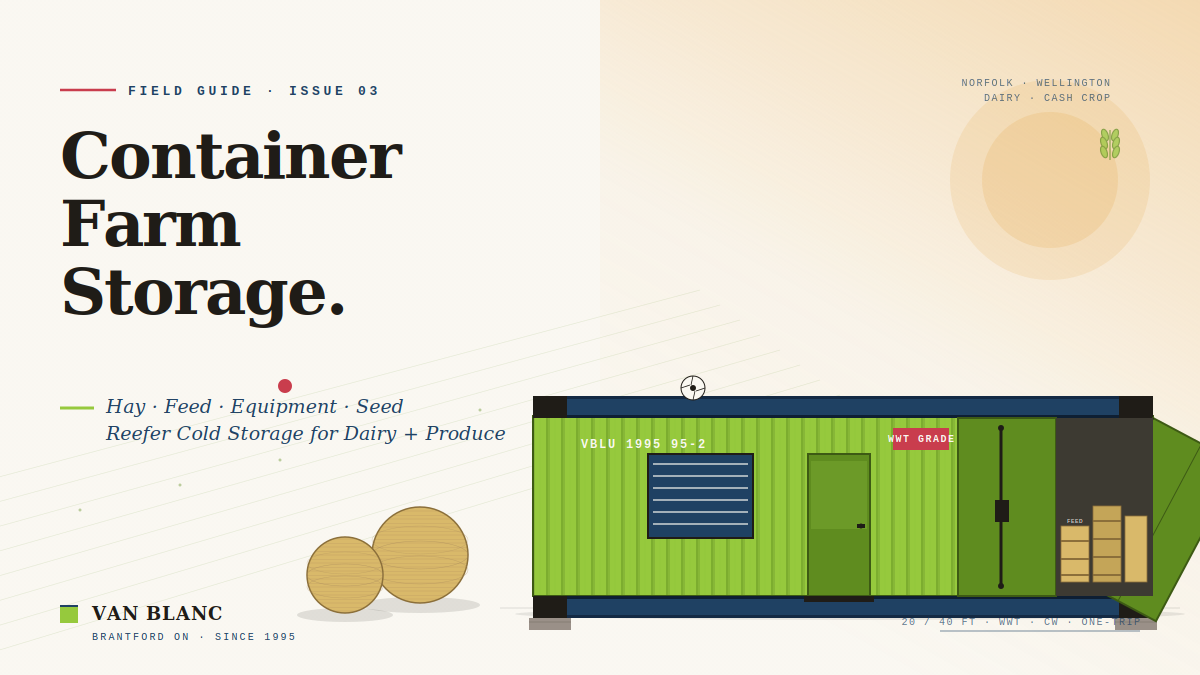
Quick Answer: A shipping container for Ontario farm storage is priced by size (20ft versus 40ft), grade (Wind & Watertight versus Cargo Worthy versus refrigerated), the modifications you add, and delivery distance, plus the season and the steel market on the day you order. The right bin handles hay, feed, equipment, seed, chemicals, or refrigerated dairy storage. Van Blanc delivers to working farms across Ontario in 1-3 days from our 4 Brantford yards. Tell us your delivery address and we will quote real costs: real costs you can hold us to.
Vegetable operations scaling past the laundry-tub era should see the wash-pack and CSA staging pattern, built for harvest mornings.
The grounds-trade cousin of farm storage has its own playbook: the landscaper’s yard depot, including the salt lesson every winter operator should read.
Horse properties have their own version of this playbook: container tack rooms and feed storage, with the animal-welfare line drawn where it belongs.
In This Guide
- What kind of farm storage container do you actually need?
- Which container grade fits a working farm?
- How do you store hay in a container without it heating?
- How do you keep rodents out of grain, seed, and feed?
- What does an equipment and parts storage container look like?
- Do you need a refrigerated container for dairy and produce?
- What drives the cost of a farm storage container?
- How does delivery to a farm and the back forty work?
- FAQs
Reading Time: about 13 minutes
What Kind of Farm Storage Container Do You Actually Need?
A farm storage container is a steel shipping container used on a working farm to hold hay, feed, seed, chemicals, equipment, or refrigerated stock. Most Ontario operations choose a 20ft or 40ft Wind and Watertight bin for dry storage, and a Cargo Worthy bin for chemicals or a refrigerated reefer for dairy and produce.
Farm container calls split into two clear buyer profiles. The first is the Wellington or Oxford dairy operator with 100 to 250 cows who needs a clean dry box for feed supplements, calf milk replacer, vaccine storage, and the gear that does not fit inside the parlour or the equipment shed. The second is the Norfolk or Haldimand cash-crop grower with 600 to 2,000 acres who needs secure, weatherproof storage for chemical totes, seed bags, generator parts, and the spare implement components that get pulled out of the snow at planting. The small-farm version, where the box is the feed and medicine room beside a run-in, is written up in livestock shelters in Ontario, species by species.
Both buyers end up with a 20ft or 40ft Corten steel container placed near the working centre of the farm or out on the back forty. The grade, the floor treatment, the door modifications, and whether the bin needs a refrigeration unit look different depending on which farm you are running. This guide walks the operational reality of both: what fits a dairy operation that gets walked through every morning at 5 a.m., versus what fits a cash-crop operation that needs the bin only during planting and harvest windows.
Paul LeBlanc has been delivering containers to Ontario farms since 1995. He has watched the Norfolk County tobacco belt shift to cannabis greenhouses, watched the Wellington dairy industry consolidate from family operations into 200-cow herds, and watched feed-supply patterns change with every commodity cycle. Farms have been the steady buyer through all 30 years.
Why Ontario farms picked containers over pole barns and grain bins
Through the 1990s the standard farm storage solution was a pole barn or a steel-sided utility shed, framed on site, built around the existing yard, and finished as cash flow allowed. The math swung against that model around 2010 as used 20ft shipping containers became markedly cheaper per square foot of dry storage than a framed structure, while pole-barn material and labour kept climbing. A container arrives on a tilt-deck in one afternoon, sits on stone cribbing without a poured foundation, and is rodent-proof and weather-tight from the first hour. For seed storage, chemical storage, and high-value spare parts, the container also locks down to the chassis through the corner castings in a way no pole barn can match for security. What that menu looks like today, from the fabric span to the dealer-lot barn, is set out in the guide to storage buildings for sale in Ontario.
Which Container Grade Fits a Working Farm?
Farm storage is one of the few use cases where Wind & Watertight grade is the right answer. Office service requires One-Trip because the cosmetic wear, seal compression, and rust bleed of a WWT container cause real problems for an occupied space. Farm storage does not have those problems. A working farm container sits in the yard or out on a fence line, gets opened twice a day at most, and holds dry goods that do not care what the exterior steel looks like.
The four grades, ranked for fit on a working Ontario farm:
| Grade | Cosmetic | Fit for farm | Relative cost |
|---|---|---|---|
| Wind & Watertight (WWT) | Surface rust, paint variance, occasional dents, seals intact | Best fit for hay, feed, equipment, parts | Lowest cost for a watertight bin; the value pick for stationary farm storage |
| Cargo Worthy (CW) | Multiple ocean crossings, sound structure, with a current safety plate you can verify in the yard before you pay | Right for chemical storage or anything getting moved between farms | A step up from WWT, reflecting the certified structure and seals |
| One-Trip (New) | Factory paint, new seals, essentially new | Right for refrigerated container conversions or a roadside install where the steel is on display, which is where a box that left the factory on a single loaded voyage earns its keep | Highest cost of the used grades, near-new condition |
| As-Is | Older units, structural questions | Avoid for any storage where contents matter | Cheapest on paper, but seal and floor issues often erase the saving |
The WWT recommendation for farm use comes with one operational caveat: door seal condition matters more than panel rust. A WWT bin with worn cargo-door gaskets will leak air, dust, and occasionally moisture under heavy rain. The fix is to check the gasket compression on every WWT bin before purchase. The standard test is to close both cargo doors, walk inside, close the personnel door (or use a light from outside), and look for visible light leaks at the door seals. A bin with light leaks has tired gaskets; budget for fresh gaskets if you want that bin.
Christian LeBlanc, second-generation operator: “On a farm bin I tell people to stop staring at the panel rust and go check the door gaskets. I grew up walking this yard with my dad, and the seals are what keep mice and rain out, not how shiny the steel looks from the road. Close the doors, step inside, and look for daylight. That one test tells you more than the price ever will.”
For chemicals (pesticides, fertilizer concentrates, fuel additives), CW grade is the better choice. OMAFRA’s farm pesticide storage factsheet, written to O. Reg. 63/09, calls for a locked storage area, ventilation to the outside for Class 2 and 3 products, warning signs at the entrances, a curbed floor that contains spills, and no contact with food or feed. A CW container with intact seals, a clean dry floor, and a properly fitting personnel door is the shell; the buyer adds the ventilation, a containment curb, and the signage. Most insurance carriers will inspect the chemical storage area annually and want to see a CW or better bin for that use.
Reading the CSC plate before you buy
Every shipping container carries a CSC (Container Safety Convention) plate riveted to the cargo doors. The plate lists the build date, manufacturer, owner code, and the periodic re-inspection date. A WWT bin with a CSC plate dated within the last 5 years is typically still in re-inspectable condition. A bin with an expired or missing CSC plate has likely been retired from international shipping service for cosmetic or seal reasons; still fine for stationary farm storage but expect more visible rust. Walking the yard and reading the plates before you pay is the simplest verification any buyer can do.
How Do You Store Hay in a Shipping Container Without It Heating?
Hay is the single most challenging storage use case on an Ontario farm because of summer humidity. The Ontario Ministry of Agriculture, Food and Rural Affairs (OMAFRA) recommends baling hay at 18 to 20 percent moisture for small square bales and 15 to 17 percent for round and large square bales destined for storage. Above those numbers, the bale heats internally, breaks down, can lose feeding value, and in extreme cases can ignite by spontaneous combustion. Below 15 percent the leaf shatter loses crude protein during baling. The storage container has to maintain those moisture numbers through Ontario summers that routinely run 75 to 95 percent relative humidity.
The right container approach for hay storage on a working farm:
- Ventilation is mandatory. A sealed shipping container in 80 percent August humidity will sweat condensation on the interior steel ceiling, drip onto the top bales, and start a mould bloom within 10 days. The standard fix is to cut and install 2 to 4 passive turbine vents on the roof and 2 louvre vents on the door end of the bin. Venting cost is driven by the number of vents and whether you cut them yourself or have the yard do it before delivery.
- Floor moisture barrier. The original marine plywood deck of a shipping container is treated against moisture but will absorb humidity if hay is loaded directly onto it. A layer of 4-mil poly sheeting plus 2-inch thick pallets keeps the bales 4 to 5 inches off the deck and gives airflow underneath.
- Stack height. Round bales (1,400 lb class) stack 2 high inside a 20ft container. Large squares stack 3 high. Small squares stack 8 to 10 high. Always leave 12 to 18 inches of clearance between the top of the stack and the container ceiling so warm moist air can move out through the roof vents.
- Side-by-side bin arrangement. For operations storing more than 50 round bales, a row of three to five 40ft containers (each holds 40 to 48 round bales) is more economical than a steel-sided pole barn at the equivalent volume.
A 40ft container holds approximately 48 round bales (4 by 5 ft, 1,400 lb class) stacked 2 high in a 12 by 4 arrangement. For a Wellington dairy operation putting up 600 round bales for winter feeding, that is 13 to 15 containers worth of storage, set in a single row along a fence line with a graded laneway between the row and the feed bunk. Cost comparison to a 60 by 100 foot pole barn at the same volume: container approach typically lands 35 to 50 percent below pole-barn build cost, and the containers can be sold off or repurposed if the operation changes scale.
How Do You Keep Rodents Out of Grain, Seed, and Feed Storage?
Shipping containers are not the right answer for loose bulk grain at scale. That use case belongs to steel grain bins with aeration systems. Containers are excellent for bagged seed, bagged feed, packaged supplements, mineral blocks, and small-volume specialty crop storage where rodent and moisture exclusion are the priorities.
The standard rodent-protection package on a farm storage container:
- Door seal inspection and replacement. The cargo-door gaskets are the primary rodent entry point. Fresh marine-grade EPDM gaskets seal the doors against mice and rats. Cost depends on whether one or both cargo doors need new gasket runs.
- Floor cross-member sealing. The original container floor has small gaps where the marine plywood meets the steel cross-members at the rails. A bead of polyurethane sealant along each cross-member closes those gaps. The job is mostly a half-day of labour plus a few tubes of sealant.
- Vent screening. Roof vents and louvre vents get 1/4-inch hardware cloth screens fitted to the inside face. Mice cannot pass 1/4-inch mesh.
- Pallet storage off the floor. Bagged feed and seed sit on plastic or wooden pallets, 4 inches above the floor. Mice climbing into the container have nothing to nest in if the bags are not directly on the deck.
For seed storage specifically, the Canadian Grain Commission moisture standards for commercial seed call for storage at less than 14 percent moisture for soy, corn, and small grains. Sealed bags or totes inside a container will hold those numbers through an Ontario winter without additional dehumidification. For higher-value treated seed (canola, hybrid corn), some operations add a low-wattage dehumidifier set to 50 to 55 percent relative humidity, drawing 30 to 50 watts continuous off a 15-amp outlet powered by the farm’s main service.
Why farmers separate chemical storage from feed storage
One container, two uses, one regret call later. The most common farm storage mistake we see is mixing pesticide totes and bagged livestock feed in the same container. Pesticide vapours, even from sealed totes, can accumulate in the container headspace over months and contaminate adjacent feed bags. Standard practice on a working Ontario farm is a dedicated chemical storage container (CW grade, on a stone pad, with ventilation, away from livestock) and a separate feed and supply container. The second container pays itself back in the first audit by the milk processor or the first feed test that comes back clean.
What Does an Equipment and Parts Storage Container Look Like?
Tractor parts, ATV and UTV spares, chainsaws, post drivers, fencing supplies, sprayer nozzles, and the dozens of small items that disappear when the back gate is open all belong in a locked container instead of stacked under a tarp by the implement shed. A working farm storage container for equipment becomes the operations cabinet for the operation, organised once and used every week. The tractors and loaders that also clear a container door, checked against the makers’ spec sheets, are listed in the machine shed and container door comparison.
Common equipment storage container layouts for Ontario farms:
- 20ft as a parts cage. Bin shelving along both long walls (8 to 12 ft of shelving per side), workbench across the rear, locked rifle or chainsaw cabinet at the personnel door end. Standard footprint for a 200 to 500 acre cash-crop operation. The interior fit-out budget scales with how much shelving and how heavy a workbench you specify.
- 40ft as combined parts cage plus ATV storage. Front 20 feet is parts and tool storage. Rear 20 feet rolls out an ATV, UTV, or small trailer. Cargo doors stay in the rear for vehicle access; personnel door cut into the side at the parts end. Fit-out cost runs higher than the parts-cage build because of the side door cut and the shared layout.
- 40ft as drive-through. Cargo doors at both ends (the original end and a second set cut into the front wall) lets an ATV or small implement drive through. Less common but useful for operations that want a mobile equipment bay. The additional set of doors is the main cost driver here, since cutting and framing a second cargo opening is the kind of steel work we scope at the yard before delivery.
Electrical service to a farm equipment container is straightforward when the bin sits within 100 ft of an existing farm panel. A 60-amp sub-feed run through buried conduit gets the bin a few lights, a couple of outlets, and a workbench-mounted vise or grinder. Electrical install cost is driven mainly by the trench distance from the panel and the number of circuits. ESA-certified installation is required for any commercial agricultural setting in Ontario.
Do You Need a Refrigerated Container for Dairy and Produce?
Refrigerated containers (reefers) on Ontario dairy and produce farms cover four real use cases: milk replacer storage between deliveries, vaccine and medication storage, packaged produce buffer between harvest and pickup, and farm-gate retail cold display. Reefers run on 380/460-volt three-phase electrical service, or single-phase through a phase converter, hold internal temperatures from minus 25 to plus 25 degrees Celsius on a precision setpoint, and deliver consistent humidity control through the active refrigeration cycle.
Refrigerated container sizing for Ontario farm use breaks down by the temperature job each bin has to do:
- 20ft reefer for vaccine and medication storage. Operates at 2 to 8 degrees Celsius (Health Canada pharmaceutical storage range). Holds 2,000 to 3,000 vials plus syringe and supply stock. Power draw: 8 to 12 kWh per day at standard outdoor temperatures. Right fit for a single-farm operation with regular vaccine cycles.
- 40ft HC reefer for produce buffer. Operates at 4 to 10 degrees for vegetables, 0 to 2 for berries, minus 18 for frozen production. Holds 18 to 22 pallets of produce. Power draw: 18 to 28 kWh per day. Right fit for a 50 to 200 acre vegetable or berry operation.
- 40ft HC reefer for farm-gate cold sales. Modified with a side service door, interior shelving, and a temperature gauge visible from outside. The customer-facing front cools meats, dairy, eggs, and produce for direct retail. Power draw similar to the buffer use case.
A refurbished 40ft HC reefer carries a meaningful premium over a refurbished 20ft reefer, reflecting the larger box and the bigger refrigeration unit, and new reefer units run 30 to 50 percent above the refurbished equivalent. Running cost is the electricity the unit draws at Ontario commercial rates, which depends on outdoor temperature, target setpoint, and how often the doors get opened. For more on reefer specs and Canadian power requirements, see our dedicated refrigerated container guide for Canadian farms.
What Drives the Cost of a Farm Storage Container in Ontario?
Two scenarios, both 40ft, both Ontario. The first is a Wellington dairy operation adding feed and parts storage to a 200-cow herd. The second is a Norfolk cash-crop grower adding bagged seed and chemical storage for a 700-acre rotation.
Scenario A: Wellington dairy farm, 200 cows, feed + parts storage
| Component | What drives this part of the quote |
|---|---|
| 40ft Wind & Watertight container (feed and supply) | Largest single line; moves with the steel market, grade, and 40ft availability that week |
| Fresh door gasket replacement | Needed only if the gaskets test worn; one door or both changes the labour |
| Roof turbine vents (4) plus louvre vents (2) | Set by the number of cuts and whether the yard pre-installs before delivery |
| 1/4-inch hardware cloth screening (rodent) | Small line; scales with the number of vents being screened |
| Interior shelving and workbench | Scales with linear feet of shelving and how heavy a workbench you specify |
| 60-amp ESA-certified electrical sub-feed, 4 outlets, 2 LED fixtures | Driven mainly by trench distance from the farm panel and circuit count |
| Stone pad and corner cribbing (40ft footprint) | Depends on grading needed and how much aggregate the site takes |
| Delivery (Brantford to Wellington County) | Set by road distance and how accessible the drop point is for a tilt-deck |
Scenario B: Norfolk cash-crop farm, 700 acres, seed + chemical storage
| Component | What drives this part of the quote |
|---|---|
| 40ft Cargo Worthy container (chemical storage, dedicated) | CW grade carries a premium over WWT for the certified structure and seals |
| Door gasket inspection (CW gaskets typically in good shape, no replacement) | Usually inspection only; replacement is the exception on a CW bin |
| Ventilation system (chemical class-rated, explosion-proof fan) | The class-rated, explosion-proof fan is the cost driver, not the cuts |
| Containment berm interior (curbed sealed flooring for tote spills) | Scales with floor area sealed and the spill volume you need to contain |
| 30-amp ESA-certified electrical (lighting only) | Lighting-only keeps this modest; trench distance is the main variable |
| 20ft WWT companion container (seed storage) | A second, smaller bin; priced as a standard 20ft WWT purchase |
| 20ft seed container door gasket replacement | Needed only if the WWT seed bin tests with worn gaskets |
| Dehumidifier and humidistat for seed container | Small line; off-the-shelf unit sized to the bin volume |
| Stone pads (both containers) | Two footprints, so roughly double a single-bin pad depending on grading |
| Delivery (Brantford to Norfolk, both bins) | Two bins on the route; set by distance and drop-point access |
The Wellington dairy scenario replaces a pole-barn build for the equivalent feed and parts storage volume, typically landing well below the framed-structure cost. The Norfolk cash-crop scenario covers chemical storage set up to OMAFRA’s farm pesticide storage requirements, separate seed storage with moisture control, and the kind of compartmentalised operation a 700-acre rotation actually needs. Both scenarios reflect real 2026 Ontario pricing on components from Ontario-licensed installers.
Paul LeBlanc, owner: “We have delivered bins to working farms in Norfolk, Haldimand, Wellington, Oxford, and Brant County for 30 years. Some of those same families are on their second container now. The first one is still standing in the back forty where they put it 20 years ago. That is the answer to anyone asking how long a shipping container lasts on a farm. Long enough that the kids inherit it.”
Farm storage shares its components with every other working build, laid out in our guide to container setups by trade.
Ready to price your container?
Tell us the size and your postal code and we’ll send back an all-in number, container, delivery, and placement, usually within 1-3 days. No pressure, no mystery fees.
Family-run in Brantford since 1995 · 200+ containers in stock · 4.9★ across 140+ Google reviews · every box graded by a person, walk it before it lands.
How Does Delivery to a Working Farm and the Back Forty Work?
Tilt-deck delivery to a working Ontario farm is straightforward when the bin lands in the main yard near the house or barn. The driver pulls in, positions on the gravel laneway, lowers the deck, slides the container into the prepared position, and rolls clear. Total contact time on the farm: 30 to 45 minutes. Most main-yard farm deliveries from our Brantford yard run 1 to 2 days.
Back-forty deliveries (containers placed at the far end of a working field, along a fence line, or out at the woodlot) are more involved. The tilt-deck truck cannot drive across a planted field; it needs a graded laneway or a pre-existing two-track that can handle the loaded truck weight. The standard pattern is:
- Pre-grade the access laneway. Most farms already have a tractor laneway that runs from the main yard to the back forty. The driver needs 12 ft of clear width and reasonable drainage so the truck does not bog down.
- Plan the drop in spring or fall. Summer deliveries on a cash-crop farm risk crop damage if the laneway crosses planted ground. October through November and late April through May are the standard windows.
- Pre-stage the cribbing. Four to six pressure-treated 6×6 timbers or eight patio stones positioned at the corner casting points. The driver lands the container directly onto the cribbing.
Back-forty delivery from our Brantford yard adds to the standard main-yard rate depending on access distance and laneway condition. For farms in the Hamilton, Brantford, Norfolk, Haldimand, Brant, Oxford, Wellington, Waterloo, and Niagara service area, total delivery from order to bin-on-the-pad runs 1 to 3 business days. Eastern Ontario adds 2 days; Northern Ontario routes are quoted per route. Every quote we issue includes a real lead time, not a hopeful one. If you are still deciding between a 20ft and a 40ft for the operation, you can see what we have on the lot right now and pick the exact bin before it ships.
Frequently Asked Questions
How much does a shipping container for farm storage cost in Ontario?
The cost depends on size, grade, modifications, and delivery distance. A 20ft Wind & Watertight container is the entry point for general farm storage, with fresh door gaskets added only if the seals test worn. A 40ft WWT costs more for the larger box, and Cargo Worthy grade carries a premium over WWT for the certified structure and seals. Refrigerated containers for dairy or produce are the most expensive option, even refurbished. Delivery from our Brantford yard is set by road distance and drop-point access within Southwestern and Central Ontario. Tell us your size and postal code and we will quote the real all-in number.
Are shipping containers really rodent-proof for grain and feed?
Yes, with proper preparation. Fresh marine-grade door gaskets, sealed floor cross-members, screened roof and louvre vents, and storage on pallets rather than directly on the floor produce a container that mice and rats cannot enter. The most common failure mode is worn cargo-door gaskets on a bargain WWT bin; the fix is a fresh set of gaskets. With that done, the container holds bagged grain, seed, and feed cleaner than a wood-floored grain bin.
Can I store hay in a shipping container without it heating?
Yes, if you ventilate and bale at correct moisture. OMAFRA recommends 15 to 20 percent moisture at baling for storage hay. The container needs 2 to 4 roof turbine vents plus 2 louvre vents on the door end to move warm humid air out. Stack bales on pallets to allow airflow underneath. Leave 12 to 18 inches of clearance at the top of the stack. With those steps, a 40ft container holds 40 to 48 round bales through an Ontario summer without overheating.
What is the right container for chemical and pesticide storage on a farm?
Cargo Worthy grade on a stone pad, with a class-rated ventilation fan, sealed interior containment berm, and a personnel door for routine access. OMAFRA’s farm pesticide storage factsheet, written to O. Reg. 63/09, calls for a locked storage area, ventilation to the outside for Class 2 and 3 products, warning signs at the entrances, a curbed floor that contains spills, and no contact with food or feed. Most Ontario crop insurers want to see a CW or better container, separated from feed and livestock areas, with documented spill containment.
Can you deliver to a back-forty location on a working farm?
Yes, with a graded laneway. Tilt-deck trucks need a 12 ft wide access route that can handle the loaded weight, and ideally a pre-staged cribbing layout at the drop point. Spring and fall windows work best for cash-crop farms to avoid crop damage in the laneway. Back-forty delivery typically adds to the standard main-yard delivery rate from our Brantford yard.
Sources
- Ontario Ministry of Agriculture, Food and Rural Affairs. (2025). Hay and Forage Storage and Moisture Standards. ontario.ca
- Canadian Grain Commission. (2025). Grain Storage Moisture Standards for Commercial Seed. grainscanada.gc.ca
- International Organization for Standardization. (2022). ISO 6346:2022, Freight containers – Coding, identification and marking. iso.org
- Government of Ontario, OMAFRA. Farm pesticide storage facility (O. Reg. 63/09). ontario.ca
- National Farm Animal Care Council. (2023). Code of Practice for the Care and Handling of Dairy Cattle – Storage and Handling Standards. nfacc.ca
Reach Van Blanc in Brantford
We have been supplying shipping containers to Ontario farms since 1995. Our warehouse is at 90 Morton Avenue E in Brantford, and we deliver right across the province on a cash-on-delivery basis. No surprise fees, no chase-the-paperwork. Farm storage containers, refrigerated reefers for dairy and produce, custom modifications, and tilt-deck delivery to the main yard or the back forty.
Van Blanc Ent. Inc. – 90 Morton Ave E Unit 1B, Brantford, ON N3R 7J7 – +1 888-509-6658
Adding storage for next planting season? Call Paul or Christian, walk the yard at our Brantford location, and have the bin on the pad within 3 days. We carry over 200 containers in inventory at any given time and you pick your specific bin before paying. Norfolk growers, Wellington dairy operators, Haldimand cash-crop farmers: they all drive to Brantford because we let you walk the row, inspect door seals, and choose the bin that matches your operation.
Related Reading
- How reefer units hold a precise setpoint for dairy and produce
- Doors, vents, insulation, and other yard modifications
- What to inspect on a used bin before you pay
- What moves the price on a 40ft box for a big-volume operation
- Every size and grade we keep on the lot
- Vents, doors, shelving, and reefer fit-outs done before delivery
- Cold storage for wineries and small-batch producers
- Turning a spare bin into a heated farm workshop