
Quick Answer: More than fifteen thousand Canadian farms run an on-site farm stand, most on the honour system: stocked shelves, a cash box, an e-transfer sign. Theft and weather are the model’s two taxes, and structure choice decides both. Converted containers now anchor the serviced, lockable end of farm-gate retail in Ontario.
In This Guide
- The Laneway Economy, Counted
- The Honour System, Audited Honestly
- The Stand Ladder: Cart to Store
- Siting a Stand That Sells
- The Stand’s Year, August to Pumpkins
- Payments: The Cash Box Grows Up
- The Two Taxes: Weather and Walk-Offs
- The Container Farm Store
- The Pop-Up Circuit Beyond the Gate
- The Logistics Behind the Shelves
- Farm Stand FAQs
Reading Time: 13 minutes
The Laneway Economy, Counted
The farm stand looks like nostalgia and counts like an industry. Statistics Canada’s census of agriculture found more than fifteen thousand farms, about one in twelve nationally, running an on-site stand, and anyone driving Ontario’s concession roads in August knows the census undersells the feeling of it: sweet corn tables, egg fridges, flower buckets, and pumpkin ramparts, most of them unattended, all of them selling. Farm-gate retail is the shortest supply chain that exists, field to table with one lawn between them, and it has boomed for reasons both warm and cold, the warm being what customers feel buying tomatoes from the family that grew them, the cold being that direct sales keep margins the wholesale chain would otherwise eat.
We enter this story where steel usually enters farming: as the structure question. A stand is a tiny retail business, and like every retail business it eventually asks what kind of building it deserves, a question that runs from a card table to a converted container with a serving window, which happens to be a thing our shop builds. The ladder gets climbed rung by rung below.
Christian LeBlanc, Van Blanc: “The farm-stand call always comes in two versions. Spring version: the stand did so well last year they want something bigger and weatherproof. Fall version: somebody walked off with the cash box, the coolers, or the whole stand, and now they want steel and a lock. I prefer the spring calls, and the advice is the same either way: build for the season you are growing into.”
The Honour System, Audited Honestly
The honour stand is rural Canada’s favourite social contract: the farmer stocks fresh-picked goods, the customer takes what they want and leaves payment, nobody watches. Operators who run them, and the press that periodically checks in on them, tell a consistent story with two halves. The system mostly works, which is quietly remarkable, and the losses are real, short weekends that sting less in dollars than in morale, the operator’s own words in one Ontario account being that the missing money was enough to mess with them about what people are doing. The honest audit: honour retail trades a known percentage of loss for zero labour, and the trade is worth it right up until the stand’s volume, or its neighbourhood, changes the percentage.
The operators who keep the faith longest manage the temptation rather than the customer: cash boxes fixed down and emptied often, sightlines from the house, a camera where morale demands it, and high-value goods, the meat, the maple, the honey flats, kept out of the unattended inventory entirely. Which is the honour system’s real lesson for this page: the model does not fail all at once, it fails product line by product line, and each line that outgrows the card table is asking for the next rung of structure.
The stand also carries a job no ledger records: it is the farm’s front door. Customers who stop for corn learn the farm’s name, follow the winter meat drops, book the fall wagon rides, and become the direct-sales base every diversifying operation is trying to build. Operators who see the stand as marketing infrastructure rather than a produce shelf make different structure decisions, better signage, a build that photographs well, a window worth posting, and the difference shows up everywhere except the stand’s own till.
The Stand Ladder: Cart to Store
| Rung | What it is | What it honestly handles |
|---|---|---|
| The cart | Wagon, table, shade tent | Seasonal surplus, honour payment, sunny days |
| The built stand | Roofed wooden roadside stand | A real season, weather shrugged, still unattended |
| The serviced store | Powered, coolable, lockable building | Eggs, meat, dairy, staffed weekends, year-round hours |
| The pop-up circuit | Markets and events off the farm | Volume the laneway will never see |
Most farms live happily on the first two rungs forever, and should. The climb call comes from the products, refrigerated goods demand power, meat demands cold chain and the food-handling standards mapped in what food-grade conversion actually asks, and from the arithmetic, since a stand doing real weekly volume is a shop wearing a costume. The third rung is where structure gets serious and where the rest of this page concentrates, because it is the rung where weather, theft, and inspection all arrive at once.
The built wooden stand, rung two, deserves its own respect before anyone sells past it: a roofed 8-by-10 with a counter, built from a weekend of lumber, is the workhorse of the whole laneway economy, and it fixes the weather tax for the honour tier completely. Its limits are the ones wood always carries at a road, no real lock, no cold, and a lifespan set by how faithfully somebody paints it, and its owners tend to know exactly which limit will eventually promote them.
Siting a Stand That Sells
Farm-stand siting is retail site selection at tractor speed, and the rules are the same ones plazas pay consultants for. Visibility at driving speed: a stand seen four hundred metres out gets the brake lights a stand behind the hedge never earns. Safe pull-in: gravel enough for three cars, clear of the road, with a turnaround that does not involve reversing onto a highway, because customers who feel unsafe once do not return. Signage that reads at speed with the two words that matter biggest, what and fresh. And the homestead geometry the honour model depends on: close enough to the house for sightlines and restocking, far enough that customers do not feel they are shopping in someone’s kitchen. Permits are managed by your municipality, so check with your local building or planning department before you order.
The Stand’s Year, August to Pumpkins
A stand’s calendar is really three businesses wearing one sign. High summer is the volume business, corn and berries moving daily, restocking twice a day, the honour model at its best because the goods are cheap, abundant, and gone by dusk. Fall is the margin business, pumpkins, squash, preserves, and the agritourism gravity that turns a laneway into a destination for six golden weekends; it is also when weather begins collecting its tax and when the serviced rung earns its keep, holding the season open past the first hard frosts. Winter is the quiet business almost nobody runs and the serviced stand makes possible: eggs, frozen meat, and preserves on reduced hours, kept alive by a building that heats a little and locks a lot. Operators who map their year this way stop buying structure for July, the month that needs it least, and start buying it for the shoulder months where the actual growth lives.
Payments: The Cash Box Grows Up
The cash box has quietly modernized, and the stands that thrive run both rails: cash for the tradition, a laminated e-transfer sign for the reality that nobody carries twenties anymore. The digital rail solves more than convenience, since an empty cash box tempts nobody, and it extends what an unattended stand can sell, higher-value goods moving on e-transfer receipts the wagon era could never have carried. The operators’ craft details are small and learned: auto-deposit so payments clear without questions, the stand’s name in the transfer field so the bookkeeping survives August, and prices in round numbers because roadside arithmetic is nobody’s hobby. None of it needs a terminal until the stand is staffed, and by then the stand is a store and shopping for the rung above.
Building the Serviced Rung?
The lockable farm store is our bench’s work: a container fitted with a serving window and counter, lined interior, and rough-ins placed under engineered drawings at our Brantford yard, your licensed trades finishing power and cold on site. It locks like a vault every night and moves if the laneway ever does. Every quote carries a real lead time, not a hopeful one. Fast 1-3 day delivery across Ontario from our Brantford yards.
Van Blanc Ent. Inc. · Brantford, Ontario · Since 1995 · 4.9 stars across 140+ Google reviews · Cash on delivery
The display craft deserves a paragraph of its own, because the census counts stands and customers count abundance. The roadside rule every veteran repeats: pile it high and keep it fresh, since a half-empty table reads as leftovers at sixty kilometres an hour. Height sells, tiered crates beating flat tables; colour blocks sell, the tomato mass beside the flower buckets; and the hand-lettered price sign outsells the printed one for reasons nobody needs a study to believe. Ten minutes of merchandising at restock is worth more than any upgrade money can buy below the serviced rung.
The Two Taxes: Weather and Walk-Offs
Every stand pays two taxes, and structure is the rate-setter for both. Weather first: sun wilts greens by ten, rain ends the day, and wind redistributes the tent, which is why the built rungs exist and why the roof is the first upgrade every operator makes. Theft second, and honestly: beyond the cash-box skimming, the growing problem the rural press documents is the harder kind, coolers emptied at night, equipment lifted, and at the miserable end, stands themselves damaged or taken. The unattended model’s whole inventory strategy is keeping the stealable value low, which caps what the business can become. The serviced rung inverts the logic: when the building locks like it means it, behind hardware built for the argument, the stand can hold the freezer, the terminal, and the weekend’s float, and the business stops being sized by its worst visitor.
Power at the laneway deserves its practical note: the serviced rung’s cooler and lights want a real buried feed installed and certified by a licensed electrician, and the distance from the panel to the road is a line every quote should include early. Solar-and-battery setups increasingly carry the lighter loads at remote gates, a small system running LED lighting and a modest cooler through the selling season, and the same trades rule applies the moment anything ambitious joins the circuit.
Insurance closes the risk chapter quietly: an unattended stand full of low-value produce barely registers on a farm policy, while a serviced store holding freezers, a terminal, and weekend floats is a named structure worth a conversation with the broker. The serviced rung’s lockability is exactly what that conversation wants to hear, and more than one operator has reported the steel build paying part of its way in the premium line.
The Container Farm Store
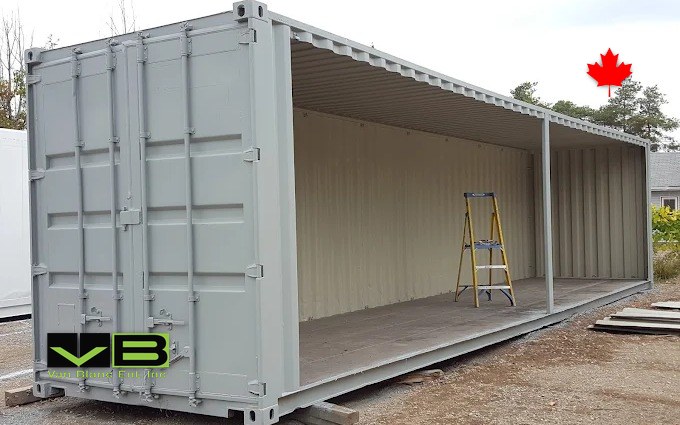
Which is the honest case for the top rung our shop builds. A container farm store arrives as a finished retail shell: serving window with a fold-down counter cut and framed at the yard, lined and insulated interior, lighting and cooler circuits roughed in under engineered drawings for the licensed trades to finish and certify on site, painted to the farm’s own signage. Open the window and it is a store; close it and it is a steel box with nothing to discuss. It shrugs at the weather tax entirely, retires the theft tax nightly, holds the cold chain the census’s egg-and-meat sellers need, and, unlike every stick-built stand on the ladder, it moves, when the laneway changes, when the farm expands, or when the operation graduates and the store becomes the wash-pack line’s next room.
The window itself repays one design hour: sized so one person can serve and restock without leaving the counter, sill at true counter height, and an awning line that shades the goods at four in the afternoon, when August does its worst to lettuce. Small choices, made once, worked every selling day after.
The build questions are the familiar retail ones and worth deciding before the quote: window on the long side or the end, cooler load and its power path, counter depth for the honour off-hours versus the staffed weekends, and the pad-and-approach geometry every delivery on this site preaches. The neighbouring formats get their fair hearing in trailer against kiosk against container, and the wider program the store belongs to, from cafes to retail floors, lives at the hospitality and retail bench. Maple operations will recognize the whole pattern from the sugar-side economy in the sugar bush’s spring storefront, and egg-forward gates from the coop economics next door.
The Pop-Up Circuit Beyond the Gate
The fourth rung leaves the laneway entirely: farmers markets, fairs, and the event circuit, where the same inventory meets crowds the concession road never carries. The circuit’s structure question splits by cadence. Weekly-market operations live out of vans and tents and store the kit between; event-heavy operations increasingly run the container play in reverse, a converted unit delivered to a seasonal pitch, a vineyard’s lot, a festival ground, a fall-season farm-experience field, serving for the run and trucking home after. That pattern is ordinary retail economics now rather than novelty, and it shares every mechanical answer with the farm store above, plus one: the unit that pops up somewhere all season still spends winter as the farm’s locked storage, which is the kind of double duty farm capital is supposed to do.
One circuit-craft note from the operations that run it well: the pop-up unit earns most when its interior is fitted for the turnaround, shelving that travels loaded, a checklist taped inside the door, and the market kit packed as a system rather than a pile. The farms that treat load-out as part of the build brief spend their market mornings selling instead of assembling.
The Logistics Behind the Shelves
Behind every good stand is the unglamorous supply room, and farms feel it the first season a stand succeeds: crates and baskets by the dozen, signage, bags, the flower buckets, the pumpkin-season infrastructure, plus the wash-and-sort line between field and shelf. That backbone is plain container work, the same rodent-proof dry room mapped across the working farm’s steel, sited on the restocking path between field, wash, and stand. Farm businesses building the serviced rung without the single cheque put the purchase on seasonal financing from the farm’s bank; we do not rent, which suits a stand that intends to be here next season too.
Many people call us saying they can get a bin for $1,000 less on Facebook. Two weeks later some of them call back to say they got scammed. Farm-gate operators, visible from the road by definition, deserve the reminder more than most: buy the steel the way your customers buy the corn, from someone whose field you can see.
The farm stand is the province’s most trusting business model, and it earns that trust one restocked morning at a time. Keep the honour rungs simple and the temptation small, climb only when the products demand it, and when the stand becomes a store, build the store like it holds a season’s work, because it does. The corn sells itself. The structure’s job is making sure the season’s earnings are still there in the morning.
And a stocking rhythm the successful stands share: restock small and often rather than big and rarely, because freshness is the entire brand and yesterday’s corn is a reputation event. The wash-sort-stock loop wants its stations within a wagon’s pull of each other, which is a siting note for every building in this story, the stand included.
Sold outright. Delivered in 1 to 3 days.
Van Blanc sells new and used shipping containers outright from our 4 Brantford yards, with delivery in 1 to 3 days and payment on delivery. We do not rent, lease or offer rent-to-own. Request a sale quote or call the yard at 519-754-6844.
Farm Stand FAQs
Do honour-system farm stands actually work?
Mostly, remarkably. Operators report the system holding across decades, with real but limited losses, short weekends that sting morale more than margins. The craft is managing temptation: fixed cash boxes emptied often, sightlines from the house, and high-value goods kept out of unattended inventory. The model fails product line by product line, never all at once.
How common are farm stands in Canada?
Statistics Canada’s census of agriculture counted more than fifteen thousand farms, roughly one in twelve nationally, reporting an on-site farm stand, and the concession-road reality in Ontario feels denser every season. Farm-gate retail is the shortest supply chain in food, and both its economics and its charm keep growing it.
What payment methods should a farm stand take?
Both rails: cash for tradition, a laminated e-transfer sign for everyone who stopped carrying it. Auto-deposit keeps transfers frictionless, the stand’s name in the transfer field saves the bookkeeping, and round-number pricing spares roadside arithmetic. Terminals wait until the stand is staffed, by which point it is a store.
When should a farm stand become a real building?
When the products or the arithmetic say so: refrigerated goods demand power and cold chain, meat and dairy bring food-handling standards, and consistent weekly volume means the card table is a shop in costume. The serviced rung adds weatherproofing, lockable security, and year-round hours, and it changes what the business can carry.
Can a shipping container be a farm stand?
The serviced version, yes: a serving window and counter cut and framed under engineered drawings, lined interior, cooler and lighting circuits roughed in for licensed trades to finish and certify. It locks completely overnight, ignores weather, holds cold chain, and relocates if the laneway or the business changes.
Sources
- CBC News. (2017, updated). Farm Gate Stands Offer Fresh Produce and Nostalgia. cbc.ca. The honour-stand contract as Ontario operators describe it
- Statistics Canada. (2022). Census of Agriculture, 2021. statcan.gc.ca. The census release behind the national farm-stand count
- Growing the Good Life. (2024). A Roadside Farm Stand on the Honor System: Does It Work? growingthegoodlife.net. An operator’s own accounting of the unattended model
- Prince Albert Daily Herald. (2025). Is the Honour System Alive and Well? Ontario Farm Stand Owners Talk Truth. paherald.sk.ca. The documented shortages and morale costs quoted above
Reach Van Blanc in Brantford
We have supplied farm country with containers since 1995, and the farm-store conversions are some of the happiest work the bench does: serving windows that open on August mornings and lock against November nights. If your stand is climbing the ladder, walk a build in progress at 90 Morton Avenue East.
Van Blanc Ent. Inc., 90 Morton Ave E Unit 1B, Brantford, ON N3R 7J7, 519-754-6844
Stand outgrowing its table? Call with what you sell and what walks away. For the serviced rung, we will spec the window with you on the phone.