
We sell containers. We do not rent.
Van Blanc sells shipping containers outright. We do not rent, we do not lease, and we do not offer rent-to-own. Renting comes up on this page because buyers compare it against owning, and that comparison is worth reading, but purchase is the only arrangement we offer. Stocked units deliver from our Brantford yards in 1 to 3 days. Request a sale quote or call the yard at 519-754-6844.
Quick Answer: Ajax 3PL and e-commerce operators handle Q4 warehouse overflow with 5 to 30 shipping containers, owned outright instead of leased by the square foot. Most fleets mix 40-foot high cubes for palletised inventory with 20-foot units for staged kitting. Van Blanc delivers from Brantford in 1 to 3 days.
In This Guide
- Where does Ajax fit in the Durham logistics belt?
- Why do 40-foot high cubes carry palletised overflow best?
- Side-opening or double-door: which suits forklift work?
- How do you lay out a multi-container fleet in a Durham yard?
- What drives the price of an Ajax overflow container in 2026?
- What does delivery into an Ajax industrial park involve?
- What is the Q4 e-commerce surge pattern in Ajax?
- How does the too-cheap Facebook scam hit industrial buyers?
- FAQs
- Reach Van Blanc
Reading Time: 13 minutes
Where does Ajax fit in the Durham logistics belt?
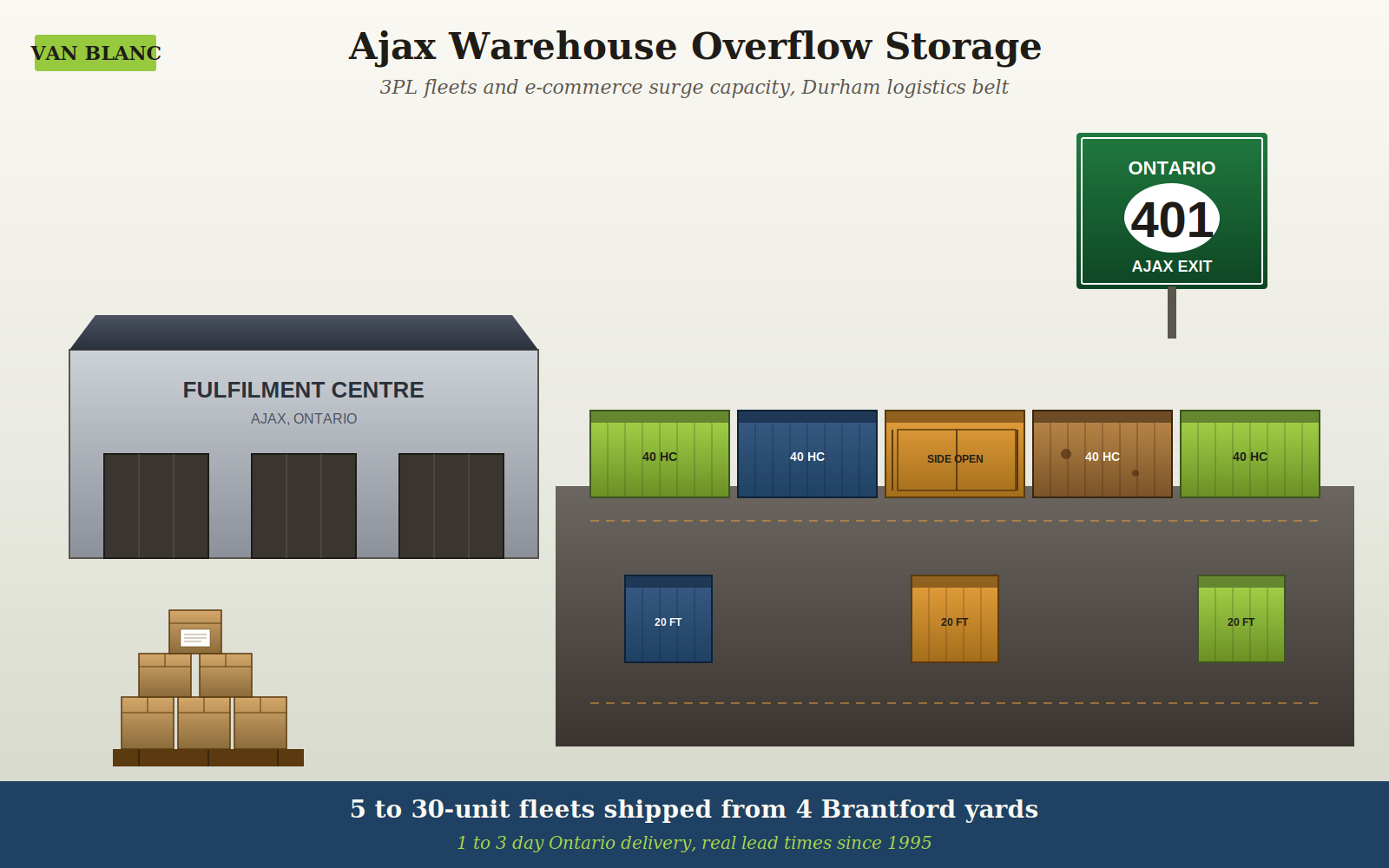
Ajax sits on the Pickering-Ajax-Whitby logistics belt along Highway 401, a Durham distribution corridor where 3PL and e-commerce operators buy shipping containers for warehouse overflow. A fleet of 5 to 30 units gives dry, lockable, weather-tight square footage the lease market cannot supply at small footprints. The bins arrive in days and are owned outright.
This is the tactical fix for seasonal lift that a five-to-ten-year Class A lease was never designed to cover. Ajax is not Toronto. That sounds obvious until you watch a Toronto-based operations manager try to sign a warehouse lease in Durham and learn that the math, the access, and the labour market all behave differently. Ajax sits on that industrial corridor, which has absorbed close to a million square feet of new Class A logistics space in the last twelve months according to Q1 2026 GTA East market reports. The market vacancy fell to 6.6 percent in Q1 2026, down 230 basis points year over year. That is a tightening market, not an expanding one.
What that tightening means for an Ajax 3PL operator or e-commerce fulfilment buyer is concrete. Permanent square footage is harder to lease than it was two years ago. Lease terms run five to ten years on the new builds. Speculative overflow space at small footprints (under 20,000 square feet) barely exists. The Salem and Kerrison Industrial Park, the Lakeridge Logistics Centre, the new Geodis-anchored building near the 401 interchange are all 200,000-plus square foot buildings leased to national operators. The mid-sized buyer who needs 4,000 square feet of seasonal lift cannot find it on the lease market at any price.
This is the gap a container fleet fills. Five 40-foot high cubes give you roughly 11,000 cubic feet of dry, weather-tight, lockable storage at a fraction of the cost of leasing space you cannot find. Twenty units gives you the equivalent of a 6,000 square foot satellite warehouse. The bins arrive in days, not quarters. They sit on your existing yard or laydown area, behind your fence, on your time.
Christian LeBlanc, second-generation operator at Van Blanc, sees the pattern repeat every fall. “Ajax callers split into two groups. One group is a 3PL adding seasonal lift for a client launching a peak campaign. The other is a smaller e-commerce brand whose inventory tripled inside six months and needs somewhere to put it that is not their main floor. Both are looking at the same answer in different packaging.”
The Town of Ajax itself has been publicly courting the logistics sector since the late 2010s, with the Highway 401 and Salem/Church corridor positioned as a focal point for Class A development. Corporate neighbours in the Salem and Kerrison park include Amazon, H&M, and Gordon Food Service. The market is healthy, the buildings are large, and the gap between what those buildings serve and what a mid-market 3PL needs in October is real.
Why do 40-foot high cubes carry palletised overflow best?
The 40-foot high cube is the right unit for Ajax palletised overflow almost every time, and the reason is the cube. It is the single most common overflow question we get from Ajax callers, and the answer rarely changes.
The math is in the cube. A standard 40-foot dry container holds about 67.7 cubic metres of usable space at an internal height of 2.59 metres (8 feet 6 inches). A 40-foot high cube holds about 76.3 cubic metres at an internal height of 2.90 metres (9 feet 6 inches). That extra foot of headroom does not sound dramatic on paper. In a warehouse overflow context, it is the difference between two-high pallet stacking and three-high pallet stacking on the same footprint. According to standard pallet calculations, a 40-foot container fits 20 to 25 standard CHEP or GMA pallets at floor level, and the high cube version lets you double-stack a meaningful fraction of those pallets, which can lift effective capacity by 30 to 50 percent depending on case weight and stacking discipline.
40-foot high cube container specs (ISO 6346 compliant)
External dimensions are 12.19 metres long by 2.44 metres wide by 2.90 metres tall (40 feet by 8 feet by 9 feet 6 inches). Internal volume is approximately 76.3 cubic metres (2,694 cubic feet). Maximum payload is roughly 26,500 to 28,200 kilograms (58,000 to 62,000 pounds) depending on tare weight. Tare weight is typically 3,900 to 4,200 kilograms. The CSC plate verifies the unit meets ISO 668, ISO 1496-1, and ISO 6346 standards for stacking, racking, and load distribution. Standard high cubes from our Brantford yard are Cargo Worthy or One-Trip grade with valid CSC plates and re-inspection schedules where applicable.
For 3PL overflow, the operational benefit goes beyond raw cube. A high cube lets you store taller goods like racked SKUs, oversized retail displays, and stacked corrugate without compromising aisle clearance. It also handles palletised flow-rack inserts and modular shelving better, which matters when your overflow is functioning as a satellite picking face during peak weeks rather than dead storage.
The 20-foot unit still has its place. Ajax 3PL operators often pair four or five 40-foot HCs against one or two 20-foot units used for staged kitting, returns processing, or lockable high-value SKU separation. The 20-footer also sits cleaner against a building wall when your yard layout is tight. We see the 70/30 split in roughly two-thirds of multi-unit Ajax orders: 40-foot HCs for the volumetric base, 20-foot units for the operationally specific lifts.
If you want the deeper economics of the size choice, our breakdown of how 20, 40, and 45-foot footprints actually compare walks through external and internal measurements for each, so you can match the box to the pallet count before you order.
Side-opening or double-door: which suits forklift work?
Door configuration is the second sizing decision after the cube question, and for forklift work it changes your handling time more than buyers expect. Most Ajax overflow buyers default to the standard rear double doors and find them workable. A meaningful fraction would have been better served by the side-opening configuration if anyone had walked them through the trade-off.
A standard 40-foot container has double swing doors at one short end. To load a pallet halfway down the container, your forklift has to enter the door, drop the pallet, back out, and start over. A skilled operator can do this efficiently but the time per pallet adds up. Industry comparisons suggest forklift loading from a side-opening configuration can cut handling time by up to 70 percent on dense palletised loads because the forklift stays outside the container and places each pallet directly into its final row position.
When the side-opening premium is worth it
An open-side 40-foot high cube is a modified unit and carries a higher price than a standard double-door 40-foot HC at our yard. That premium is justified when your overflow turns over frequently (weekly or daily pallet movement during peak) or when you need a forklift to reach the middle of the load without driving the forklift inside the unit. For static stored overflow, the standard double-door wins on value every time. Walk the use case before paying the premium.
The decision factor is turnover. If the container is going to sit full of staged Q4 inventory and only get touched twice during the season (initial load, end-of-season unload), the standard double-door 40-foot HC is the right pick. If you are using the container as an active picking face or a staging zone where pallets cycle in and out daily, the side-opening configuration earns its premium back inside a single peak season through reduced forklift hours and faster cycle times.
We carry both at the Brantford yard. The standard double-door 40-foot HCs are in greater supply because they are the workhorse configuration. Side-opening units come in smaller quantities and benefit from being ordered 4 to 6 weeks ahead of your peak window so we can confirm inventory and route the unit to your site without a rush surcharge.
How do you lay out a multi-container fleet in a Durham yard?
A multi-container fleet in a Durham yard is laid out around three proven geometries, and the right one depends on how often forklifts cross between the bins and the main warehouse. Once you cross from a single overflow unit into a fleet of five to thirty, the layout itself becomes a planning question. Ajax industrial parks have a fairly consistent geometry: a paved laydown area or rear yard behind the main building, fenced or gated, with a truck court that handles 53-foot trailer access for the main warehouse loading docks. The container fleet usually parks in the laydown area, but how you orient them changes how the operation flows.
Three layouts work in most Ajax sites. The first is the linear row: containers placed end-to-end along the property fence line, doors facing inward toward the laydown area. This is the cleanest layout for sites with a long narrow yard and works well when the containers are static stored overflow. The second is the U-shape: two parallel rows with a working corridor between them. This is the layout we recommend for active overflow where forklifts cycle pallets between the containers and the main warehouse. The third is the cluster: groups of three to five containers arranged perpendicular to a central truck-turn area. The fleet sits in a U-shape behind the main building, on existing asphalt, with a 25-foot working corridor between rows for forklift cross-traffic. Total footprint is roughly 4,800 square feet of paved surface, less than a tenth of what an equivalent satellite warehouse lease would consume.
Stack height matters too. Two-high stacking of 40-foot high cubes gives you 19 feet of total height, which is well within most Ajax industrial-park building heights but may interact with rooftop sightlines from the neighbouring building. Ground-level placement (single-high) avoids that question entirely and remains the most common layout we see in Durham. If you need two-high stacking to fit your fleet on the available yard, the containers have to be Cargo Worthy or One-Trip grade with valid CSC plates because the corner castings and structural integrity have to be inspected for the stacking load. Wind & Watertight grade is single-high only. We work through the geometry, the corridor widths, and the stack-height trade-offs in our guide to planning a fleet footprint on a working Ontario yard.
What drives the price of an Ajax overflow container in 2026?
The price of an Ajax overflow container in 2026 is driven by grade, size, configuration, fleet quantity, and delivery distance, not a single posted sticker. The 2026 Canadian container market has stabilised after a few volatile years, and the cleanest way to talk a quote is by those drivers, with delivery quoted separately. Tell us the size, grade, unit count, and your Ajax postal code and we send back an all-in number, usually the same day.

| Configuration | One-Trip | Cargo Worthy | Wind & Watertight |
|---|---|---|---|
| 20-foot dry standard | near-new, single-owner, premium of the three grades | certified watertight, light surface wear, mid-grade | dry storage grade, cosmetic wear, most budget-friendly |
| 40-foot dry standard | near-new, single-owner, premium of the three grades | certified watertight, light surface wear, mid-grade | dry storage grade, cosmetic wear, most budget-friendly |
| 40-foot high cube | near-new, single-owner, premium of the three grades | certified watertight, light surface wear, mid-grade | dry storage grade, cosmetic wear, most budget-friendly |
| 40-foot side-opening HC | modified unit, carries the highest premium | limited supply | not stocked |
Those grade tiers describe condition, not a number. Two more drivers move an Ajax quote. Fleet quantity matters: a multi-unit overflow order earns better per-unit pricing than a single bin, and the band keeps improving as the order grows from a handful of units toward fifty. Delivery is the other driver. Brantford to Ajax is roughly 130 kilometres door to door, 1.5 to 2 hours via the 403 and 401, and we quote it per unit, scaled by access difficulty and whether you want tilt-deck placement or a chassis drop. Loading two units on the same truck lowers the per-unit delivery cost compared with single-unit runs, so batching your fleet into shared trips is the easiest way to keep delivery lean.
The math is that an Ajax 3PL adding ten 40-foot HCs of Cargo Worthy overflow in 2026 is making a one-time capital purchase, containers plus delivery, that it owns outright. The same overflow leased as 4,000 square feet of Class A warehouse space carries net rent plus operating costs every month, typically on a five-year minimum lease, so the recurring lease bill keeps climbing while the owned containers do not, and that assumes the space exists, which often it does not. If you are sizing a fleet to buy rather than rent, our in-stock buying options for Ontario fleets lay out the sizes and grades we keep ready at the yard.
Buyers who want the longest service life and the best resale value at the end usually weigh the One-Trip tier, the near-new grade that has made a single loaded voyage. The industry calls these one-trip units because they completed exactly one cargo trip from the manufacturer. Our page on ordering near-new units for a fleet build covers what to expect from that tier, including the note that one-trip is not showroom-perfect and we point out any handling marks in the yard. For the full grade taxonomy behind the table, our walkthrough of every condition tier from near-new down to as-is covers what each grade includes.
What does delivery into an Ajax industrial park involve?
Delivery into an Ajax industrial park is straightforward most of the time, and the three things that complicate it are gate timing, overhead obstructions, and the surface under the container. The 401 access is good, the truck courts are sized for tractor trailers, and the typical industrial-park access is municipally maintained and wide enough for a tilt-deck truck delivering a 40-foot container. The complications come from three predictable places.
The first is gate timing. Many Ajax industrial parks gate their truck courts overnight and on weekends. A container delivery scheduled for 7am Tuesday usually works fine. A delivery scheduled for late Friday afternoon may run into a gate that has already closed for the weekend. We coordinate gate timing with the site manager during the quote, but if your facility manager keeps short Friday hours, book the drop for earlier in the week.
The second is overhead obstructions. Ajax industrial parks generally have clear overhead clearance in the truck courts, but the laydown areas behind buildings sometimes have overhead utility lines, building eaves, or canopy roofs that affect tilt-deck placement of a 40-foot container. A tilt-deck truck tilts the container off the back of the trailer onto the ground at a 30-to-45 degree angle, which means you need roughly 65 feet of clear lateral length and 25 feet of clear overhead height during the tilt. Most yards have this; some do not. We have you walk the site and photograph it from four angles before delivery if there is any doubt.
The third is asphalt versus gravel. Ajax industrial laydown areas are usually paved asphalt, which is fine for a 40-foot container at the loaded weight of 4 to 28 tonnes depending on what is inside. Gravel surfaces handle the load too but compress unevenly over time. If you are placing a container on gravel, we recommend cribbing the four corners with treated wood blocks or concrete sleeper blocks to distribute the load on the corner castings.
Every quote we send includes a real lead time. The standard window from order confirmation to delivery in Ajax is 1 to 3 business days for stock units. Custom configurations (side-opening, refrigerated, modified) run 2 to 4 weeks depending on the modification scope.
What is the Q4 e-commerce surge pattern in Ajax?
The Q4 e-commerce surge pattern in Ajax is the compression of roughly half of a year’s online sales into a 14-week window from mid-October to late January, which triples or quadruples a 3PL’s inventory from its September baseline and drives most of our fall callers. For a 3PL serving multiple retail clients, volumes stay elevated through the Boxing Day return wave well into the new year.
The strategic question is whether to lease permanent overflow capacity (expensive year-round for two months of usable demand) or solve the surge tactically. Containers are the tactical answer. The pattern we see at Van Blanc is the Ajax 3PL placing an order in mid-August for delivery in early September, holding the containers through January.
The August order rule for Q4 overflow
Order your overflow fleet by mid-August at the latest. Ajax buyers who call us in late October looking for ten 40-foot HCs for November delivery often run into a tighter supply window because the same week sees demand from other GTA East 3PLs hitting the same surge. We hold inventory at our Brantford yards and can usually accommodate late orders, but the buyer who locks in August gets cleaner grade selection, better delivery windows, and the full volume-pricing band.
The surge does not just hit on the inbound side. The Boxing Day to mid-January returns wave fills containers as fast as the November outbound emptied them. A 3PL planning for surge should plan for the returns half too, which often means keeping the fleet positioned at the facility through the end of January rather than de-mobilising in early December when outbound peaks.
Some operators price a monthly rental from a fleet operator before they call us. Our comparison of renting a bin by the month against buying one outright walks through where the rental math stops winning; for a single-season surge the crossover usually lands by month four or five, and anything past six months of holding favours purchase. Van Blanc sells outright, so the quote you get from us is the purchase side of that comparison. If your overflow doubles as a kitting bay or a width-sensitive pallet operation, our notes on fitting Euro pallets inside a standard box are worth a read before you lock in the size mix.
How does the too-cheap Facebook scam hit industrial buyers?
The too-cheap Facebook scam hits industrial buyers the same way it hits homeowners, except the deposit losses scale with the fleet size. Christian LeBlanc has watched the industrial version play out enough times to know the shape. “It hits 3PLs the same way it hits homeowners. A buyer needs ten containers fast, sees a Facebook Marketplace listing offering them at below market, sends a deposit on a dozen units, and never sees the containers or the deposit again. Two weeks later they call us in panic looking for the same ten containers we could have delivered on the original timeline if they had called us first. We have taken those calls more times than I can count.”
The scam scales up for industrial buyers because the deposit amounts scale up. A homeowner gets taken on a single bin. A 3PL operator placing what looks like a fleet order on a Facebook listing can lose a large deposit on a dozen units before the supplier goes silent. The pattern is the same in shape: too-cheap pricing, a domain name that does not match the seller name, a wire transfer or e-transfer demand before any in-person inspection, and a refusal to provide a real warehouse address or invite the buyer to a yard walk.
The defence is in the basics. Buy from a supplier with a real yard you can drive to, a phone number with a person who answers it, a Google Business profile with verified reviews accumulated over years, and a written quote on the supplier’s own letterhead before money moves. Our review history of 4.9 stars across 140+ Google reviews is the version of that signal we offer; check our competitors against the same criteria. The cheapest container is the one that arrives. The most expensive container is the one that never does.
For the broader scam pattern, including the deposit-and-disappear playbook, the fake-supplier signals, and the red flags that catch most Ajax buyers before they wire money, our rundown of how fake suppliers separate buyers from a deposit is the long-form version.
Ready to price your container?
Tell us the size and your postal code and we’ll send back an all-in number, container, delivery, and placement, usually within 1-3 days. No pressure, no mystery fees.
Family-run in Brantford since 1995 · 200+ containers in stock · 4.9★ across 140+ Google reviews · every box graded by a person, walk it before it lands.
Frequently Asked Questions
How many pallets fit in a 40-foot high cube container for Ajax 3PL overflow?
A 40-foot high cube fits 20 to 25 standard 48 by 40 inch GMA pallets at floor level. The extra foot of headroom over a standard 40-foot allows partial double-stacking, lifting effective capacity to 30 to 40 pallets depending on case weight and stacking discipline. Heavy goods may cap at floor level for load distribution.
What is the delivery lead time from Brantford to Ajax for a multi-container order?
Standard delivery is 1 to 3 business days per unit from our 4 Brantford yards to Ajax. A 10-unit order to a single Ajax site typically completes over 1-3 days running two trucks. Mid-August booking for September delivery is the recommended timeline for Q4 overflow fleets.
Should I rent or buy containers for Ajax warehouse overflow?
For a single-season surge under six months, a monthly rental from a fleet operator can pencil out. For two or more peak seasons of expected use, purchase wins on total cost, and Van Blanc sells outright rather than renting. Ajax 3PLs we work with typically buy once the first peak season proves the use case.
Can I stack containers two-high in an Ajax industrial park?
Yes, with Cargo Worthy or One-Trip grade containers that have valid CSC plates and inspected corner castings. Two-high stacking gives you 19 feet of total height, which suits most Ajax industrial sites. Wind & Watertight grade containers are single-high only because their structural inspection does not certify stacking loads.
How much does a 40-foot high cube container cost in Ajax in 2026?
The cost of a 40-foot high cube in Ajax is driven by grade, not a single sticker. One-Trip high cubes are the premium near-new tier, Cargo Worthy sits in the middle, and Wind & Watertight is the budget dry-storage tier. Delivery from Brantford to Ajax is quoted separately per unit and scales with access difficulty, and fleet orders of several units earn better per-unit pricing than a single bin. Tell us the size, grade, and unit count with your postal code and we send back an all-in number, usually the same day.
What is the difference between a side-opening and a double-door container for forklift access?
Side-opening containers have a full-length opening along one long wall, allowing forklift placement at any point along the container. Double-door containers open at one short end, requiring the forklift to enter and exit for mid-load placement. Side-opening units carry a higher price as a modified unit but cut forklift cycle time by up to 70 percent on high-turnover use.
Can Van Blanc deliver containers to Ajax early or late in the day?
Deliveries run on weekdays, and an early-morning or late-afternoon drop is workable with advance scheduling. Most Ajax industrial parks gate their truck courts outside business hours, so the carrier needs coordination with your facility manager to ensure gate access. Weekday deliveries inside standard business hours need 1 to 3 days.
How do I choose between 20-foot and 40-foot containers for Q4 overflow?
Use 40-foot high cubes for the volumetric base of your overflow (palletised inventory, slow-moving SKUs). Use 20-foot units for operationally specific lifts like kitting stations, returns processing, or high-value SKU separation. Most Ajax 3PL fleets we deliver run a 70/30 split favouring 40-foot HCs by unit count.
Is there a difference in container quality between Van Blanc and an online reseller serving Ajax?
The grade taxonomy is industry-standard across suppliers. The difference is at the yard. Van Blanc operates 4 Brantford yards with inventory you can walk before buying. Online resellers typically ship sight-unseen from a regional pool. Our 4.9-star rating across 140+ Google reviews reflects the difference real yard access makes for industrial buyers.
Reach Van Blanc in Brantford
We have been supplying shipping containers across Ontario since 1995. Our warehouse is at 90 Morton Avenue E in Brantford, and we deliver right across the province from our 4 Brantford yards. Ajax 3PL and e-commerce overflow is one of the markets we see expand every fall, and we hold the inventory depth to serve fleets of 5 to 50 or more units with real delivery windows.
Van Blanc Ent. Inc. at 90 Morton Ave E Unit 1B, Brantford, ON N3R 7J7. Call 519-754-6844 or 1-888-509-6658
If you are planning Q4 overflow for an Ajax facility, call by mid-August for cleanest grade selection and delivery windows. Worth the drive for the quality, family customer service with thirty years of experience. We will walk the size mix, the door configuration, the layout, and the delivery sequence before you sign anything.
Sources
- Goran Brelih. (2026). Q1 2026 Insight: GTA East Markets. Goran Brelih Industrial Real Estate. goranbrelih.com
- Town of Ajax. (2026). Logistics, Warehousing and Storage. Town of Ajax Economic Development. ajax.ca
- International Organization for Standardization. (2022). ISO 6346:2022 Freight containers Coding, identification and marking. ISO. iso.org
- International Maritime Organization. (1972, amended). International Convention for Safe Containers (CSC). IMO. imo.org
- Hapag-Lloyd. (2025). 40 Standard High Cube Container Specifications. Hapag-Lloyd Cargo Fleet. hapag-lloyd.com
Placement requirements vary by municipality. A quick call to your local planning office before delivery is the easiest way to confirm what works for your property.