
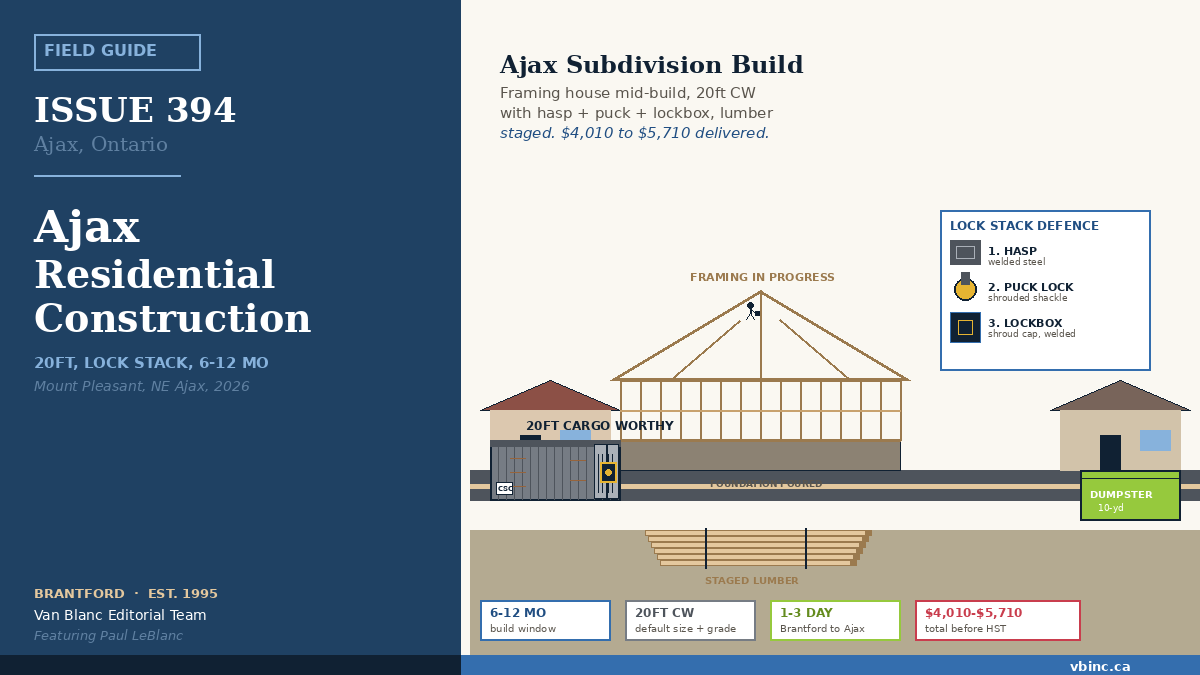
Quick Answer: Ajax custom-home builds follow the Tarion New Home Warranty registration framework. Ajax residential builders running 6 to 12 month custom-home or full-renovation projects use a 20ft Cargo Worthy shipping container with a hasp-puck-lockbox defence stack for tools, lumber, and finishes. Brantford to Ajax delivery runs 1 to 3 days. The quote covers the CW-grade bin plus tilt-deck delivery from our 4 Brantford yards. Pricing depends on your site, your grade choice, and your freight zone, so call for a real quote.
In This Guide
- Why do Ajax custom-home builds need a container?
- What size container do Ajax builders use?
- How do you lock a container against jobsite theft?
- CW or WWT for a 6 to 12 month build?
- What drives the price of a delivered Ajax container?
- How does tilt-deck delivery work on an Ajax lot?
- What happens to the container when the build ends?
- How do you spot a Facebook container scam?
- FAQs
- Reach Van Blanc in Brantford
Reading Time: 13 minutes
Why do Ajax custom-home builds need a container?
An Ajax custom-home build needs a container because the structure is not lockable for most of the schedule. A 20ft Cargo Worthy shipping container gives the general contractor 160 square feet of secure steel for tools and finishes from foundation pour through to the homeowner walk-through. Brantford to Ajax delivery runs 1 to 3 days.
Ajax sits between Pickering and Whitby in Durham Region, about 134 km east of our Brantford yards along Highway 401. The Northeast Ajax growth corridor and the Mount Pleasant Village node have been some of the busiest custom-home and infill-renovation pockets in the GTA East for the last few years. New subdivision phases keep going up along Rossland Road East, Salem Road North, and around the Audley Recreation Centre, and the older neighbourhoods near Bayly and Westney are seeing teardown-and-rebuild renovations on lots that have been quiet since the 1970s.
The buyer pattern we see on Ajax residential builds is consistent. A custom-home builder or full-renovation general contractor wins the project. They mobilise on site for somewhere between 6 and 12 months, depending on whether it is a ground-up build or a strip-to-studs renovation. Tools, finishes, and second-fix materials arrive on the lot in waves, and nothing inside the partially-framed structure is secure until siding, doors, and locks go on. That gap is what the shipping container fills.
Most Ajax GCs we deliver to are running between three and seven active sites at once. They keep a rolling pair of bins dedicated to live projects, plus a yard or shop bin for slower-moving stock, and the same 20ft steel box ends up doing a dozen different jobs across a single build year. The container on the active subdivision lot stays put from foundation pour until the finished home is locked up and ready for the homeowner walk-through.
Christian LeBlanc, second-generation operator: “The Ajax builders who call us are usually mid-framing with no doors on yet. They have copper, nailers, and a millwork delivery booked, and nowhere to lock any of it. We get them a graded 20ft on site in a day or two so the schedule never stops for a stolen tool order.”
Why Ajax draws so many container orders right now
Three factors stacked in the same neighbourhoods. Lakeshore-adjacent infill teardowns south of Bayly. Mount Pleasant Village and Northeast Ajax new-build phases approaching final closing. Plus a steady run of full second-storey additions and back-to-the-studs renovations on the 1970s-era stock between Westney and Salem. Almost every active GC in the corridor needs at least one secure bin on site for the 6 to 12 month build window.
What size container do Ajax builders use for tools and materials?
Ajax custom-home builders use a 20ft container for tools and materials, and the choice comes down to one thing first: it fits. Most subdivision lots in Northeast Ajax run somewhere between 38 and 50 feet of frontage and 100 to 120 feet deep. Once the footprint is staked and the foundation forms go in, the buildable surface in the side and rear yards is tight. A 20ft sits cleanly in the side yard or at the rear corner of the driveway, leaves room for the dumpster bin and the framing-crew portable, and still gives you 160 square feet of locked steel for everything you do not want walking off the site.
What goes inside on a typical residential build looks roughly like this:
- Hand tools and power tools: mitre saw, table saw, framing nailers, finish nailers, impact drivers, circular saw, compressors, levels, layout gear. On a single-family build, the framing-crew tool spread alone represents a serious replacement cost if it walks off the lot.
- Second-fix material that arrives before lockup: millwork bundles, finished trim packs, prefinished interior doors, hardware boxes, cabinet hardware, plumbing rough-in fittings, electrical rough-in materials, light-fixture boxes.
- Finishes staged for late-stage install: tile pallets, hardwood flooring bundles, vanity tops, mirrors, paint, faucets, range-hood, appliance hardware.
- Safety, jobsite admin, and PPE: harnesses, fall-arrest gear, hard hats, first-aid kits, jobsite paperwork, electronic test gear.
The reason a residential GC almost always lands on the 20ft instead of a 10ft is volume. A 10ft holds maybe 60 square feet of floor space minus the door swing. Once you put two framing-crew tool chests inside and a few pallets of millwork, you are out of room. The 20ft lets the framing crew, the finishing carpenter, the electrician, and the plumber all keep their own bay inside the same bin without piling gear on top of each other.
The 20ft on a tight Ajax lot
External dimensions per ISO 6346:2022: 6.06 m long, 2.44 m wide, 2.59 m tall (19’10” by 8’0″ by 8’6″). Interior floor: roughly 150 square feet. Tare weight around 2,300 kg. Door swing requires about 7 feet of clear arc in front of the cargo doors. On a 40-foot frontage Ajax lot, that means the container sits long-axis parallel to the side property line with the doors facing the driveway, so the framing crew can swing them open without hitting the neighbour’s fence.
How do you lock a shipping container against jobsite theft?
You lock a shipping container on an Ajax jobsite with a three-piece stack: a welded steel hasp, a puck lock, and a lockbox shroud. Theft is the number one driver behind the residential-build container order in Ajax. Insurance Bureau of Canada data has shown construction-site theft running into the hundreds of millions annually across the country, with Ontario carrying a disproportionate share because of the volume of active GTA builds. The stuff that goes missing on a residential site is almost always portable, high-resale, and hard to replace mid-build: framing nailers, copper pipe coils, finish tools, appliance boxes staged for delivery, cabinet hardware. When a build is shut down for two weeks waiting on a replacement nailer, the schedule slips and the carrying cost on the construction loan keeps ticking.
The defence we recommend is a three-piece lock stack. None of these are exotic, but stacked together they push the container from “soft target” to “go find an easier one.”
- Heavy-duty welded steel hasp on the right-hand cargo door. The factory door handles on a shipping container are not locks. They are cam-operated latches with two bullet seals that any thief with a pair of bolt cutters can be through in under a minute. A welded hasp is a 6 mm plate of hardened steel that bolts the right door to the door frame independently of the cam mechanism. We can have this welded on at the yard before delivery.
- Puck lock through the hasp. A puck lock (also called a hockey-puck lock or shrouded-shackle lock) is a hardened-steel cylinder lock where the shackle is hidden inside the body so bolt cutters cannot get a bite. It bolts through the welded hasp. A good ABUS or Master M736 puck at the trades counter.
- Lockbox shroud over the puck. The lockbox is a hinged steel cap that drops over the puck lock and the hasp together, so even a thief who knows what a puck lock looks like cannot get an angle grinder onto the shackle. The lockbox itself is keyed or padlocked. We can weld this on at the yard.
The combination matters more than any one piece. A bare puck on a factory cam handle is bolt-cutter bait. A bare hasp without a shroud takes about twenty seconds with a battery angle-grinder. A hasp plus puck plus lockbox forces a determined thief into multiple stages of work, in the open, on a residential street with neighbours watching. Most walk past and try the next site.
Tip: have the hasp and lockbox welded at the yard, not on site
If you ask the GC to retrofit the lock stack on site after delivery, you are paying labour and the work happens once the build crew is already mobilised. If we weld the hasp and lockbox at our Brantford yard before the tilt-deck loads up, the container arrives in Ajax already hardened and the keys go straight from our team to the GC’s site lead. No retrofit downtime, no missing screws.
Should you buy a CW or WWT container for a 6 to 12 month build?
For a 6 to 12 month Ajax build, a Cargo Worthy (CW) container is the right call over a Wind and Watertight (WWT) unit nine times out of ten. The grade question is the one that most residential GCs ask first because it drives the price gap. There are four grades a buyer is going to hear. We carry all four at our Brantford yards.
- One-Trip / New Build. Manufactured in Asia, made one ocean crossing with cargo to offset shipping cost, essentially new condition. Original factory paint, no rust, clean interior. Right bin if the container will be visible from the street, branded with company decals, or eventually converted into something permanent. It carries the highest price of the four grades because it is the newest steel on the lot.
- Cargo Worthy (CW) tier. Used containers that have been re-inspected for international shipping certification. Multiple ocean crossings, surface rust spots, paint variance, occasional small dents, but the structural frame and floor are inspected for load capacity and the CSC plate is valid. It sits well below One-Trip on price while still passing structural inspection, which is what makes it the sweet spot for most Ajax residential builds.
- Wind & Watertight (WWT) grade. Used containers guaranteed to keep weather and rodents out but no longer re-certified for international export. Visible cosmetic wear, surface rust on panels, faded paint. Doors close and seal. It comes in under Cargo Worthy on price because it has lost its export re-certification. Fine for an open-air rural farm storage application; tighter call on a residential lot where the bin sits in view of the neighbours and the homeowner for a year.
- As-Is. Older units with structural questions: floor damage, frame issues, door problems. It is the cheapest tier precisely because those structural questions are unresolved. We rarely recommend As-Is for an active residential build because the doors and seals are exactly what the GC needs working properly. Listed here so you know the four-tier reality.
For a 6 to 12 month build on an Ajax subdivision lot we recommend Cargo Worthy nine times out of ten. The grade matters because a CW container has been re-inspected for structural integrity, the doors close cleanly, the rubber gaskets seal against weather, and the cosmetic wear is at a level that does not give the homeowner pause when they drive by their build on a Sunday. A new One-Trip is a nicer-looking bin but it carries a premium that you cannot recover at end of build, because by the time the home is finished the One-Trip has the same scuffs and scratches as a CW that has been on site for the same year.
The WWT grade pencils on price but the seals and doors on a WWT are a step rougher. On a build where the container is going to sit through an Ontario winter with finish materials inside, a CW gives the GC one less thing to worry. The cost gap between WWT and CW is modest, and we have seen GCs lose more than that gap on a single seized WWT door in February when the framing crew could not get tools out for half a day.
If you want the four grades laid out side by side before you decide, our walkthrough of what to inspect on a second-hand bin covers what to look for at the yard. Builders who would rather start with factory-fresh steel for a street-visible lot can price a unit on our freshly imported one-trip inventory instead.
What drives the price of a delivered container in Ajax?
The price of a delivered container in Ajax is built from the line items below: the bin itself, the lock hardware, and the tilt-deck run from Brantford. Rather than quote a number that drifts with the spring 2026 steel market, here is what each line covers and what moves it up or down on your quote.

| Line item | What moves it up or down | Note |
|---|---|---|
| Container itself, Cargo Worthy 20ft | Grade (One-Trip down to As-Is) and the steel market on the day you buy | Walk the bin at the yard before you pay |
| Welded steel hasp install | Flat shop labour; same on every bin | At the yard before delivery |
| Lockbox shroud install | Flat shop labour; same on every bin | At the yard before delivery |
| Puck lock (ABUS / Master M736 grade) | Hardware only; the lock grade you choose | GC supplies key set |
| Tilt-deck delivery Brantford to Ajax | Distance from our terminal, fuel, and site access; the 134 km run is the main driver | Per km from terminal, fully insured carrier |
| HST (Ontario, 13%) | 13% of the pre-tax subtotal | Applied at quote |
| Realistic total before HST | The bin plus the lock stack plus the delivery run, quoted as one number on the call | Cash on delivery |
The number that throws most GCs is the delivery line because it is the variable they have least control over. Brantford to Ajax is 134 km along the 401. Our tilt-deck rate is calculated per kilometre from our Brantford terminal, with full insurance on the trailer and the bin in transit. That per-km rate covers fuel, driver time, the run back to Brantford, and the in-transit insurance. You will see lower delivery numbers quoted online from suppliers further east, but those numbers usually exclude the return-leg cost, which means the customer eats it as a fee surprise on invoice day.
We quote a real number up front. Every quote comes with a real lead time, not a hopeful one. If your build needs the bin on site by a specific Tuesday, we say yes or no on the call, not on delivery day. You can also see which sizes and grades we have ready to ship before you phone in your postal code.
Paul LeBlanc, owner: “Most of the Ajax GCs we deal with have been burned once on a delivery surprise from somewhere else. They come to us because we walk them through the actual cost on the phone before they sign anything. No surprise fees, no chase-the-paperwork. After 30 years operating Van Blanc, I have learned that a real number on the front end is the only way the second build and the third build come back to us.”
How does tilt-deck delivery work on an Ajax subdivision lot?
Tilt-deck delivery on an Ajax subdivision lot works by sliding the container off a hydraulic flatbed and lowering it onto your prepared corners. It is the standard delivery method for residential lots in the area. The truck is a flatbed tractor-trailer with a hydraulic deck that tilts up at the back, slides the container off the rear, and lowers it into final position with the container’s own corner blocks bearing the load on whatever surface the GC has prepared. The whole offload takes about 15 to 25 minutes once the truck is in position. Knock-out factors:
- Approach. The tilt-deck rig is about 75 feet long with the trailer fully extended. The driver needs a straight shot at the final position from the street. On a 40-foot wide Northeast Ajax lot, that usually means parking the rig along the curb in front of the lot and offloading down the side yard or across the driveway apron. Tight cul-de-sac lots sometimes need the rig to come in early before the dumpster bin and the framing-crew portable are on site.
- Surface. The container will sit on whatever is under its four corner blocks. On a typical Ajax build, the GC stages a row of four 6×6 pressure-treated sleepers or four solid concrete blocks at the corner points. This keeps the bin off the dirt, gives air gap underneath so the floor does not rot, and stops the corners from sinking into wet ground when the spring melt comes. We cannot deliver a container onto bare wet topsoil and walk away in good conscience; the bin will tilt within a week.
- Power lines and trees. The container clears 8’6″ on a flatbed plus another 5 to 6 feet of trailer deck height during the tilt. Total clearance through the tilt phase is around 14 to 16 feet. Most Northeast Ajax subdivision streets are wired with above-ground service drops to the houses. The driver scouts the line-of-approach before backing in. If a line is too low, we shift the offload point.
- Driveway protection. Once the driveway has been poured, the GC almost always wants the bin off the new concrete. The tilt-deck delivery places the bin in the side yard or on a stone-and-sleeper pad behind the foundation, not on finished hardscape. We confirm the final spot with the GC’s site lead on the call before the truck rolls.
Brantford to Ajax, 1 to 3 days
Ajax falls inside our standard 1 to 3 day window from the Brantford yards. The drive is 134 km, almost all Highway 401 east. A morning load-out from Brantford lands at an Ajax site by mid-afternoon. We schedule deliveries Monday through Friday, with the odd Saturday slot depending on the carrier. Every quote comes with a real lead time, not a hopeful one. If you also need bins for other crews working the Durham corridor, the rest of what we supply around town sits on our local overview.
What happens to the container when the build is finished?
When an Ajax build is finished, the general contractor has three good options for the container: roll it to the next job, resell it on the used market, or sell it to the homeowner. None of them leave the bin sitting idle. The neighbouring Pickering builds run the same playbook, and our notes on choosing a bin for a Seaton subdivision lot and on storage along the 401 industrial corridor go deeper on the resell economics.
- Rotate to the next build. The most common path. Once the GC’s next project is ready, the bin goes from the finished Ajax lot to the next active site, usually with the GC’s own hauler or a flatbed service they arrange. The container is theirs to keep on the road between jobs, and there is no requirement that it come back to Brantford. If you are weighing how a once-placed bin gets shifted later, our guide to shifting an already-placed bin between sites walks through what that takes.
- Resell on the secondary market. A 20ft CW that came onto site fresh, did one 6 to 12 month residential job, and exits with the same seals and doors working will typically resell at 70 to 85 percent of the original purchase price. That recovery is roughly equivalent to a rental over the same window with the additional benefit that the GC owned the asset outright through the build and never had a monthly bill ticking.
- Repurpose into a permanent storage building. Some Ajax custom-home clients buy the container from the GC at end of build and turn it into a backyard storage or workshop unit. That usually means a re-paint or wood-cladding wrap, a man door, and sometimes a small ramp at the cargo doors. We handle work like venting, doors, windows, and insulation as part of our at-the-yard build-out program before the bin ships, so the homeowner gets a finished unit rather than a bare box.
The economics on the GC’s side over a multi-build year usually favour owning two or three rolling bins outright rather than renting. The break-even between rent-versus-own on a 20ft Cargo Worthy lands somewhere around the 14 to 18 month total-deployment mark, depending on rental rate. Most Ajax-area builders we deal with cross that break-even before their second project is half complete.
How do you spot a Facebook Marketplace container scam?
You spot a Facebook Marketplace container scam by the pattern: a 20ft Cargo Worthy priced below every real quote, a 30 to 50 percent e-transfer deposit to a personal account, and then a bin that never arrives. Every couple of weeks an Ajax GC calls us with the same story. They found a listing on Facebook Marketplace, sometimes in a buy-and-sell group, sometimes in a shipping container group, where a 20ft Cargo Worthy is priced below our quote. The seller is responsive at first, takes an e-transfer deposit of 30 to 50 percent, and then either stops replying or the bin never arrives on the agreed date. Two weeks later that GC is calling us back asking how fast we can get a real one delivered, because their framing crew is sitting on a half-built site with nowhere to lock the tools.
The pattern is consistent enough that we tell every new Ajax customer about it on the first call. If a Facebook listing is cheaper than our quote, it is the trap. Real Ontario container suppliers have real Brantford yards you can drive to and walk before you pay. Real suppliers do not require a 50 percent deposit by e-transfer to a personal account. Real suppliers can give you a delivery driver’s name and rig number before you commit.
How to verify a real Ontario container supplier
- They have a physical yard address you can visit and walk before you pay.
- They accept cash, draft cheque, wire transfer, or credit card with proper authorization; not e-transfer to a personal account.
- They give you the CSC plate number on the specific bin before delivery.
- They have Google reviews on a Google Business Profile, not Facebook-only testimonials.
- They quote delivery as cash-on-delivery once the bin lands and you have inspected it.
Van Blanc has been operating since 1995 and runs 4 Brantford yards you can walk. The full pattern is covered in our rundown of container scam patterns.
Ready to price your container?
Tell us the size and your postal code and we’ll send back an all-in number, container, delivery, and placement, usually within 1-3 days. No pressure, no mystery fees.
Family-run in Brantford since 1995 · 200+ containers in stock · 4.9★ across 140+ Google reviews · every box graded by a person, walk it before it lands.
Frequently Asked Questions
How long does delivery take from Brantford to Ajax?
Standard window is 1 to 3 business days from order confirmation. The drive itself is about 134 km along Highway 401 east, roughly 1.5 to 2 hours one-way for the tilt-deck rig. Most Ajax orders we confirm by Monday afternoon land on site by Wednesday morning at the latest. Every quote comes with a real lead time, not a hopeful one.
What size container do most Ajax custom-home builders use?
The 20ft container is the default on a residential subdivision lot in Ajax. It holds about 150 square feet of locked floor space, fits cleanly along a side yard or rear lot line on a 38 to 50 foot frontage lot, and leaves room for the dumpster bin and framing-crew portable. The CW has been re-inspected for structural integrity, the doors and seals work, and it carries a lower price tag than One-Trip. One-Trip is only worth the premium if the container will be visible from the street and you care about pristine factory paint for the homeowner walk-through.
Will a hasp and puck lock really stop theft on a residential job site?
The three-piece stack (welded hasp, puck lock, lockbox shroud) does not make the container theft-proof, but it pushes the attack time from under a minute (factory cam handle plus bolt cutters) to several minutes of grinder work in plain view. On a residential street with neighbours, most opportunistic thieves move on to a softer target. Insurance Bureau of Canada data shows construction-site theft is dominated by quick-snatch opportunism, not patient breach work.
Can the tilt-deck truck fit on a Northeast Ajax subdivision lot?
Yes, in most cases. The tilt-deck rig is about 75 feet long fully extended. The driver scouts the line-of-approach before backing in. On tight cul-de-sac lots we sometimes need to deliver before the dumpster bin and framing-crew portable mobilise. Power-line clearance is the most common variable; the driver will shift the offload point if a service drop is too low.
How much does a shipping container cost delivered to Ajax in 2026?
The all-in quote for a 20ft Cargo Worthy with welded hasp, lockbox, puck lock, and tilt-deck delivery from Brantford to an Ajax site comes back before HST as one number on the call. The two biggest movers are the grade of the bin you choose and the delivery run, which scales with the 134 km distance and your site access. For the wider picture on what sets a quote, our breakdown of what sets a container quote line by line goes line by line.
What happens to the container when the build finishes?
Three common paths. Rotate it to your next active build, usually with your own hauler or a flatbed service you arrange. Resell on the secondary market at typically 70 to 85 percent of purchase price for a single-build CW. Or sell it to your homeowner client if they want to repurpose it into a backyard storage or workshop. Most multi-build Ajax GCs run a rolling two or three bin fleet.
Do I need a concrete pad for the container on the lot?
No, concrete is not required. The standard prep is four pressure-treated 6×6 sleepers or four solid concrete blocks placed at the four corner-block points. This keeps the bin off the soil, gives air gap for floor drying, and stops the corners from sinking into wet ground during spring melt. Tell us your site surface on the call and we will confirm the prep that works before the tilt-deck rolls.
Can you weld the lock hardware on before delivery?
Yes, and we recommend it. We weld the hasp and the lockbox shroud at our Brantford yard before the tilt-deck loads up, so the bin arrives in Ajax already hardened. The puck lock and keys go from our team to the GC’s site lead at offload. Doing the welding on site after delivery means paying labour while the build crew is mobilised; the yard install is cleaner.
Why do Facebook Marketplace listings price containers so much lower than Van Blanc?
Because most of those listings are scams. The pattern is consistent: a 20ft CW priced below market, a responsive seller, a 30 to 50 percent e-transfer deposit, and then either silence or a bin that never arrives. We get the panicked call-back two weeks later from Ajax GCs who are now down both the deposit and the framing-week schedule. Walk the yard before you pay, every time.
Sources
- International Organization for Standardization. (2022). ISO 6346:2022, Freight containers: Coding, identification and marking. iso.org/standard/82754.html
- International Maritime Organization. (1972, amended). International Convention for Safe Containers (CSC). imo.org
- Transport Canada. (2025). Cargo Securement Standard 10: Containerized Cargo. tc.canada.ca
- Insurance Bureau of Canada. (2024). Construction site theft and contractor equipment loss in Ontario. ibc.ca
- Town of Ajax. (2025). Planning & Development: New subdivision growth and residential construction. ajax.ca
- Ontario Construction Secretariat. (2025). Residential construction activity in GTA East. iciconstruction.com
Reach Van Blanc in Brantford
We have been supplying shipping containers across Ontario since 1995. Our warehouse is at 90 Morton Avenue E in Brantford, and we deliver right across the province on a cash-on-delivery basis. No surprise fees, no chase-the-paperwork. For an Ajax residential build, call us, walk us through your lot dimensions and your lockup window, and we will quote the bin plus the lock stack plus tilt-deck delivery in one number on the phone.
Van Blanc Ent. Inc. · 90 Morton Ave E Unit 1B, Brantford, ON N3R 7J7 · 1-888-509-6658 or 519-754-6844
Worth the drive for unbeatable quality, family customer service with 30 years of experience. Walk the yard, pick your bin, watch the hasp get welded before it ships east on the 401 to your Ajax lot.
Tell us your lot dimensions and the surface you have staged on the call, and we will confirm the prep and the offload spot before the tilt-deck rolls.
Related Reading
- Ajax Shipping Containers, service-area overview
- Ajax Warehouse Overflow Container Storage
- Container Accessories Canada, hub guide
- Container Buying in Canada, hub guide
- Container Types in Canada, hub guide
- inspecting a second-hand bin at the yard
- how container pricing is built
- Shipping Container Scams: What to Watch For