
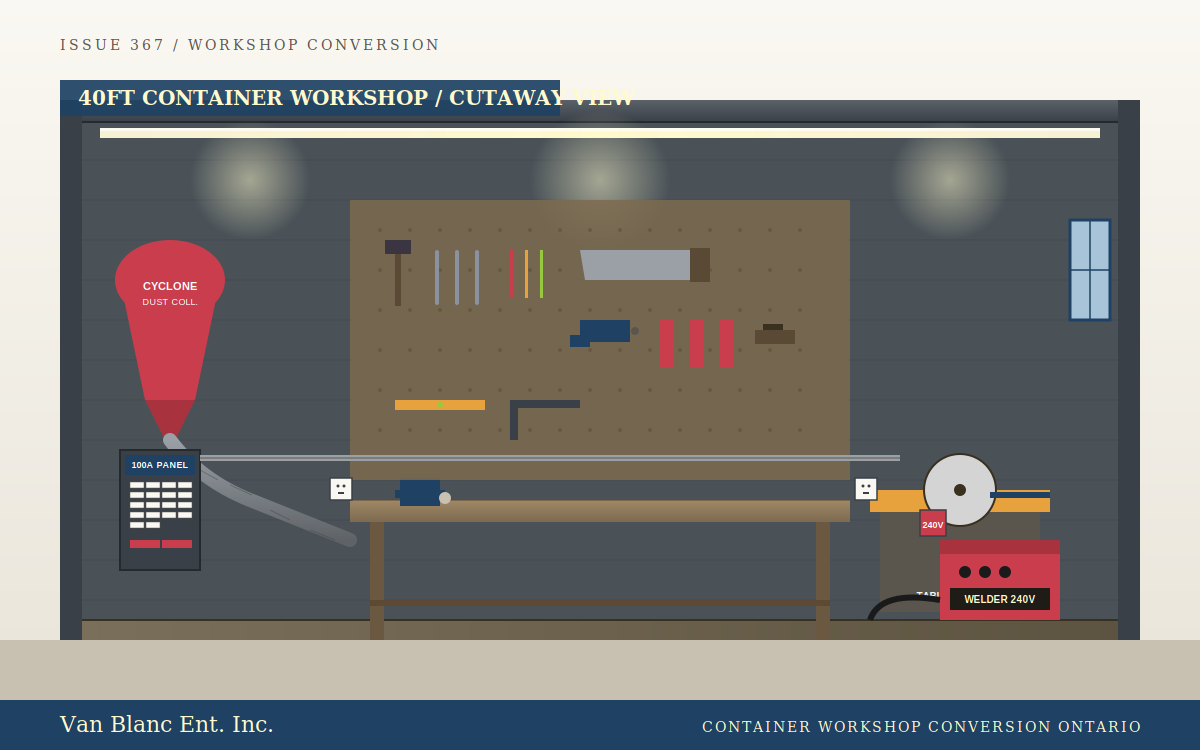
Quick Answer: A container workshop conversion in Ontario spans a wide range, from a bare-bones functional DIY build to a fully kitted shop with a 100A subpanel, 240V welder and saw circuits, LED lighting, cyclone dust collection, insulation, and a heat pump or wood stove. What you spend depends on container size and grade, how much of the build you do yourself, and how far you push the electrical, insulation, and HVAC. Any new subpanel work is wired by a licensed electrician and signed off through the Electrical Safety Authority. Van Blanc supplies the container in 1-3 days from our 4 Brantford yards. Delivered pricing is confirmed before payment; get a real quote from Paul or Christian.
In This Guide
Reading Time: 13 minutes
Which Workshop Type Are You Building: Wood, Metal, Auto, or Studio?
A container workshop is built around one decision: whether it is a woodworking shop, a welding bay, an automotive bay, or an art studio. Each type drives a different mix of electrical circuits, passive or mechanical ventilation, and dust control. A woodworker fights dust, a welder fights fumes, an auto bay fights exhaust, a studio chases light. Pick the type first. The decision before that one, which of five buildings the shop should live in, is worked through in our guide to workshop buildings in Ontario.
A container workshop conversion starts with one decision that drives the whole bill of materials: which of four shop types you are actually building. The container is the same 8-foot-wide Corten box no matter what you do with it, but a woodworking shop, a welding bay, an automotive bay, and an art studio each pull the electrical, ventilation, and dust requirements in different directions. Write down your workshop type before you pay for a single circuit or breaker.
The four workshop types we deliver bins for, every week, from our Brantford yards, split cleanly by their biggest design constraint:
Woodworking Shop
Table saw, mitre saw, planer, bandsaw, drill press, router table. The big problem is dust. Wood dust is fine, flammable, and gets into every motor and bearing if you do not handle it from day one. You want a 20ft or 40ft standard-height container, two 240V circuits (table saw and planer), 4-6 standard 120V outlets, LED lighting, and a cyclone dust collector vented outside or to a sealed drum. Most woodworkers buy a single-voyage box with clean factory paint when they want a near-new shell that seals dust out, or a Wind & Watertight 40ft when the budget is tight and a few rust spots will not bother them.
Metalworking and Welding Shop
Welder, chop saw, drill press, grinder, bench vise, sometimes a small mill or lathe. The big problem is fumes and fire. Steel sparks travel and so does grinding swarf. You want a steel floor (the container floor is plywood from the factory, so you cover it with steel sheet or a poured concrete pad if you are welding heavy) and proper ventilation. A 240V welder circuit is non-negotiable. For the box itself, we break down what a 40-footer actually runs in Canada and the grades that move that number. The shop-side questions that come before the box, from the 11-metre hot-work radius to the cylinder separation rule, are laid out in the welding shop guide.
Automotive Bay
One car, a creeper, a transmission jack, an air compressor, a parts wall, maybe a small welder. A 40ft fits one full-size truck with bench space at the back. You need a wider double-door cutout at the front (factory cargo doors stay) plus walk-through side door, 240V compressor circuit, and seriously good ventilation because internal combustion plus enclosed steel box is a CO problem. If you are weighing a single-vehicle build, we cover fitting a vehicle inside a container garage in detail.
Art or Pottery Studio
Easels, a wheel, a kiln, a flat-file storage cabinet, good north-facing light. The kiln is the operational issue: a 240V circuit for the kiln, dedicated, plus separated ventilation because pottery glazes off-gas at firing temperature. Most art studios are 20ft because the buyer wants something they can heat affordably and the work is bench-scale. Window cutouts matter here more than any other workshop type because painters need natural light.
Pick one. Build for that one. A “general workshop that does everything” usually ends up doing nothing well, because the electrical, dust, and ventilation requirements are different enough that compromising on all of them produces a shop you fight rather than enjoy.
Christian LeBlanc, second-generation operator: “Most of the workshop conversions we deliver are 40-footers. The buyer thinks they want a 20ft because it’s cheaper, then they call us back six months later asking what we have in a 40ft. The extra ten feet is where the bench goes that lets you actually work.”
Why Does a Container Workshop Need a 100A Panel and 240V Circuits?
A container workshop needs a 100A subpanel because real shop tools draw real power, and the electrical is the part buyers underestimate most. A 15-amp extension cord run from the house is what most people start with, and it is also what burns out the welder after three months. If you are doing real work in this box, you need a dedicated subpanel, and our walkthrough on wiring a shop subpanel and passing the ESA inspection covers the steps and the sign-off.
Why 100A and not 60A or 200A
A 60A subpanel will run lights, outlets, and one big tool at a time. The minute you fire the dust collector while the table saw is running while the compressor cycles on for the air nailer, you are tripping breakers. A 100A subpanel handles two 240V tools simultaneously plus auxiliary load and gives you headroom for adding an EV charger or a mini-split later. A 200A panel suits a multi-bay commercial shop, and it costs more in wire and breaker hardware.
Canadian Electrical Code, Section 42 (Welders)
Section 42 of the Canadian Electrical Code (CEC) covers welder installations and has a Section 42-specific rule that surprises most DIY builders: welder supply conductor sizing can be as low as 70% of the welder primary current ampacity, and overcurrent protection sits at up to 300% of that primary current. That sounds backwards, until you understand that welders have a low duty cycle. They pull big amps for short bursts. Sizing wire to peak draw is wasteful. Sizing OCP to peak draw blows breakers every weld. The Code accommodates the realistic load pattern. In practice, a 240V stick welder at 50A primary often runs on a 6 AWG copper feed with a 60A breaker (verify with your electrician). New subpanel work in Ontario is wired by a licensed electrician and inspected by the Electrical Safety Authority (ESA) before it is energized.
The circuit list that fits a real workshop
Here is what a 100A subpanel typically feeds in a working container shop, with the loads laid out so you can talk to your electrician without guessing:
| Circuit | Voltage | Amperage | Wire (typical) | Use |
|---|---|---|---|---|
| Table saw / planer | 240V | 30A | 10 AWG | Big stationary woodworking tool |
| Welder | 240V | 50-60A | 6 AWG | MIG, TIG, or stick welder |
| Air compressor | 240V | 20-30A | 10 AWG | 5 HP+ shop compressor |
| General outlets | 120V | 20A (split) | 12 AWG | 4-6 receptacles around bench |
| Lighting | 120V | 15A | 14 AWG | LED strip or panel array |
| Dust collector | 120V or 240V | 15-20A | 12 AWG | Cyclone or shop vac |
| HVAC (mini-split or heater) | 240V | 20A | 12 AWG | Heat pump head unit |
Eight circuits on a 100A panel leaves you breaker room without nightmare load math. Note the lights and dust collector are deliberately split off the big-tool circuits so a saw stall does not plunge you into darkness with a spinning blade still coasting down.
How Do You Lay Out a Workbench in a 20ft vs a 40ft Container?
Workbench layout in a container workshop comes down to interior dimensions, which is what matters once you start placing tools. The ISO standard sizes the working numbers like this: a 20ft has roughly 19 feet 4 inches of usable interior length and 7 feet 8 inches of width. A 40ft High Cube doubles the length to 39 feet 6 inches and adds an extra foot of headroom (8 feet 10 inches inside). The width is the same in both, so the bench plan changes mostly along the length.
The 20ft layout
A 20ft is a one-bench shop. You put a 6-foot to 8-foot main workbench along one long wall, leaving 16-20 inches of walking space on the other side. The far end (away from the cargo doors) becomes your stationary tool zone: table saw or chop saw against the back wall facing in, so you have rip length running toward the open doors. The near end (cargo door end) is for material in and finished work out. Storage rises vertically: pegboard above the bench, overhead shelves at the back end where you do not stand up under them.
The 40ft layout
A 40ft is a real shop. The same bench runs longer (12-16 feet), and you get a second zone: machines on one side and bench on the other, with a 4-foot center aisle that lets two people work without colliding. The back third becomes finished-goods storage or a separate metalwork bay if you are mixing wood and metal. The cargo door end can stay open in summer for cross-ventilation and natural light.
Sea Can Dimension Quick Reference
For the full interior measurements on every box we carry, see our complete dimensions reference. The single number that matters most for workshops is interior width: 7 feet 8 inches. That is just under 2.34 metres. Bench depth of 24 inches plus walking space of 28 inches plus tool depth at the wall of 20 inches puts you at 72 inches total, leaving 20 inches of breathing room. Plan the bench depth around that constraint or you will be turning sideways to walk past your own work.
What Lighting Does a Windowless Container Workshop Need?
A container workshop needs layered lighting because the container ships with zero windows from the factory. The first thing every shop builder does is wonder if the box will feel like a tomb. The fix is three layers working together: bright overhead ceiling light, focused task light at the bench, and optional natural light from cut windows. No single source does the whole job.
Ceiling lighting
Two options. LED strip lights mounted continuously down the centre of the ceiling give you bright, shadowless illumination at a low cost per 8-foot fixture, and they tuck up against the ceiling so they do not clip your head with long lumber. LED panel arrays (the 2-by-2 dropped-style fixtures or the flush square panels) give a more “office” feel and slightly better colour rendering for finish work or photography. For a 20ft you want 12,000-15,000 lumens total. For a 40ft, double it.
Task lighting at the bench
Overhead lights leave shadows when you lean over your work. A magnetic task light on a flexible arm or a swing-arm bench lamp adds the direct fill light that prevents eye strain on detail work. Plan on one dedicated task light per bench station.
Natural light: cut windows or not
A 24-by-36-inch window cutout adds cost per opening (cutting, framing, the window unit, and sealing) and dramatically changes how the shop feels. For a 40ft workshop, two windows along one side give you natural light without compromising wall storage too much. For a 20ft, one window on the side opposite your bench is often enough. The trade-off is wall space and security: every window is a square foot of pegboard you do not have, and a potential entry point if the shop holds expensive tools. The cutting and framing for window openings is finished at the yard before delivery, alongside the rest of the build-outs available on the box.
Shop Vac or Cyclone: Which Dust Collection Does a Container Shop Need?
Dust collection in a container workshop scales with how hard you run the saws. Wood dust is the silent damage to a shop: it dulls blades, clogs bearings, settles on every surface, and in fine concentrations is a respiratory hazard and a fire risk inside a sealed steel box. There are three levels of solution, in ascending cost and effectiveness, and the right one depends on weekly hours at the tools.

Three Dust Collection Tiers
- Shop Vac (entry level): A 5-gallon shop vac with a fine-dust filter and a hose that follows you from tool to tool. Fine for occasional weekend use. Loud. Fills fast. Filter clogs with fine dust. Not adequate if you are doing daily woodworking.
- Single-stage dust collector (mid level): Mounted in a corner with flexible hose to each major tool. Better suction, larger collection drum, removable bag for emptying. Good for a hobbyist who runs the saw 5-10 hours a week.
- Cyclone dust collector (top tier): Two-stage separation: a cyclone drops heavy chips into a sealed drum, then a fine filter catches the dust. Quieter, much longer filter life, drum empties cleanly without making a mess. The right answer for a serious shop. Mount the cyclone outside the container (covered shed against the back wall) or in a dedicated corner with vented exhaust. Some builders park a 10ft box beside the shop for the cyclone and the compressor together, which keeps the noise and the fine dust out of the working space.
For metalwork, you do not need woodshop-style dust collection but you do need swarf and grinding-dust extraction at the bench, plus a fume extractor at the welding station. A separate articulated fume arm running to an outside vent is the standard solution and pays for itself in cleaner air and a longer tool life.
How Do You Heat a Container Workshop Through an Ontario Winter?
Heating a container workshop through an Ontario winter means insulating first, then sizing a heat source to the build. Ontario winters take a Corten steel box from “cold” to “miserable” by mid-November if you have not planned heat. The container’s steel walls conduct cold straight through, and without insulation the interior tracks within a few degrees of the outside air. There are three approaches in the field, depending on budget and how often you use the shop: a mini-split heat pump, a wood stove, or electric resistance heat.
Mini-split heat pump (best year-round)
A 9,000-12,000 BTU ductless mini-split sized for the container’s interior volume gives you heat in winter, AC in summer, and dehumidification in shoulder seasons (which matters in any shop that runs steel tools). Cold-climate units like the Mitsubishi Hyper-Heat or Fujitsu Halcyon perform down to minus-25 Celsius. The installed cost covers the unit itself plus the dedicated 240V circuit it needs. This is the most-used HVAC solution for daily-use workshops.
Wood stove (cheap to install, work to feed)
A small certified wood stove (Drolet, True North, or Vermont Castings shop-grade) plus an insulated stainless chimney through the roof. Heating cost is whatever you pay for firewood. Trade-off is you have to be there to feed it. Not ideal for a shop you do not check on overnight, and an obvious fire hazard if combined with wood dust. Most metalworking shops can run a wood stove safely; most woodworking shops should not.
Electric resistance heater (budget, expensive to run)
A 240V baseboard or fan-forced unit heater is cheap to buy and install, but the operating cost runs 3-5x that of a heat pump. Fine for occasional-use shops, brutal as a daily-driver heat source.
Brantford-Area Reality Check
Ontario’s heating-degree-day data puts Brantford and southwestern Ontario in roughly the 4,000-degree-day range, meaning a workshop with 2 inches of closed-cell spray foam in the walls plus a 9,000 BTU heat pump stays affordable to heat over a season if you only use the shop 8-15 hours a week. Northern Ontario shops (Sudbury, North Bay, Timmins) sit in a colder degree-day band, push the seasonal heating load higher, and benefit from upsizing to a 12,000-15,000 BTU unit. Real numbers depend on your insulation choice, which is the next section.
What Is the Best Way to Insulate and Soundproof a Container Workshop?
The best way to insulate a container workshop is closed-cell spray foam, which handles both thermal performance and vapour control in one step. Container conversions live or die on insulation. The factory floor is plywood, the walls and ceiling are bare Corten steel, and condensation forms on the interior surface whenever interior air is warmer than the steel, which is most of the heating season. Without insulation, you get water dripping on your tools. Soundproofing is a separate layer added on top.
Closed-cell spray foam (the standard answer)
Two inches of closed-cell polyurethane spray foam on walls and ceiling delivers an R-value of around R-13 to R-14, blocks moisture (closed-cell foam is its own vapour barrier), and stiffens the container walls noticeably. In Ontario it is priced by the square foot when installed by a licensed applicator, so a 40ft costs roughly double a 20ft because there is twice the surface area to spray. This is the most-installed solution because it solves insulation and vapour management in one step.
Rigid foam panels (DIY, slower)
Two layers of 1-inch XPS foam board (R-10 total) glued and screwed to the steel, taped at the seams, gets you most of the thermal performance for less money in materials than spray foam, especially on a 20ft. The trade-off is labour: every panel has to be cut to fit around the corrugations, the gaps sealed individually, and the result is less seamless than spray foam. A weekend job per wall if you are competent with a utility knife and adhesive.
Fibreglass batt insulation (do not)
Skip this. Batt insulation needs a stud wall to live in, which steals interior space, and the assembly creates a condensation plane between the batt and the steel that will rot anything organic touching it. Container conversions are spray-foam territory.
Soundproofing
Steel walls are thin and reflective. Sound bounces hard inside an empty container. Adding insulation cuts most of the echo, and a layer of 5/8-inch drywall on furring strips over the foam adds mass that dampens neighbour-annoying frequencies (table saws, planers, compressors). If you are running a metalworking shop in a residential area, plan to add a layer of mass-loaded vinyl (priced by the square foot) before the drywall.
What Does a Container Workshop Conversion Cost in Ontario in 2026?
A container workshop conversion in Ontario is priced by build tier, not by a single number, and the cost ladder below shows three real builds at three levels of ambition. The table maps what each tier actually includes, line by line, so you can see where each feature you add moves the total as you go from a bare DIY 20ft to a fully kitted 40ft High Cube. It assumes Ontario delivery from our 4 Brantford yards and a competent DIY builder hiring out only the licensed electrical work. The biggest cost drivers are container size and grade, how much labour you do yourself, and how far you push the electrical, insulation, and HVAC.
| Line item | DIY Basic 20ft | Mid 40ft | Fully Kitted 40ft HC |
|---|---|---|---|
| Container (delivered) | Wind & Watertight 20ft | Cargo Worthy 40ft | One-trip 40ft High Cube |
| Foundation (concrete piers or slab) | 4-6 concrete piers | 6-8 concrete piers | Full poured slab |
| 100A subpanel + circuits (licensed) | 100A subpanel, core circuits | 100A subpanel, full circuit list | 100A subpanel, full circuits plus spare ways |
| Insulation (rigid foam DIY vs spray foam) | DIY rigid XPS board (R-10) | Closed-cell spray foam (R-13 to R-14) | Closed-cell spray foam (R-13 to R-14) |
| Lighting (LED strip) | LED strip, 12,000-15,000 lumens | LED strip plus task lights | LED panels plus task lights |
| HVAC | Electric resistance heater | 9,000-12,000 BTU mini-split | Cold-climate mini-split |
| Dust collection | Shop vac | Single-stage collector | Two-stage cyclone |
| Workbench + storage | DIY 2×4 bench | Bench plus shelving | Custom bench and storage wall |
| Windows + walk-through door | None (cargo doors only) | One window, side door | Two windows, side door |
| Drywall + finish | Bare foam, no drywall | Partial drywall | Full drywall and finish |
| Build scope | Functional, single-purpose | Year-round working shop | Turnkey, stick-built equivalent |
The DIY 20ft stays at the bottom of the ladder if you are doing the labour yourself and hiring only the licensed electrical work. The mid 40ft sits in the middle, which is where most working hobby shops settle. The fully-kitted 40ft HC version (insulated, windowed, mini-split, cyclone, custom bench) sits at the top and competes head-on with a stick-built workshop that would cost considerably more and take six to twelve months to design and finish. The container goes from yard to operational in 4-8 weeks, and if you want to see how the whole conversion sequences out, we lay out how a shop build comes together step by step. A workshop is one of many directions a steel box can go, and the full rundown of what a container can become covers the rest.
Christian LeBlanc, second-generation operator: “We see a lot of buyers who price out a stick-built workshop, then come back and price a container, then call us. The container math wins when you value getting started fast and you do not want to hire a general contractor for a 200-square-foot project. The only customers who regret a container build are the ones who underspent on the electrical.”
Ready to price your container?
Tell us the size and your postal code and we’ll send back an all-in number, container, delivery, and placement, usually within 1-3 days. No pressure, no mystery fees.
Family-run in Brantford since 1995 · 200+ containers in stock · 4.9★ across 140+ Google reviews · every box graded by a person, walk it before it lands.
Frequently Asked Questions
How much does a container workshop conversion cost in Ontario in 2026?
It depends on the build tier. A DIY 20ft workshop covers the container (a Wind & Watertight unit), a 100A electrical subpanel (licensed), basic rigid-foam insulation, LED lighting, and a workbench. A mid-build 40ft steps up to spray-foam insulation, a mini-split heat pump, and cyclone dust collection. A fully-kitted 40ft High Cube adds windows, a drywall finish, a custom bench, and full HVAC. The biggest cost drivers are container size and grade, how much labour you do yourself, and how far you push the electrical, insulation, and HVAC.
What size container is best for a one-person workshop?
A 40ft is the most common choice for a serious workshop because the extra ten feet of length lets you run a real bench along one wall and still have a center aisle. A 20ft works for a focused single-purpose shop (just woodworking, just welding) but feels cramped the moment you add a second major tool. The price difference between a used 20ft and a used 40ft is usually modest, a smaller share of the total build cost than most buyers expect.
Do I need a 100A subpanel for a container workshop, or will 60A do?
A 60A subpanel handles lights, outlets, and one big 240V tool at a time. A 100A subpanel runs two 240V tools simultaneously plus auxiliary loads and gives headroom for adding an EV charger or expanded HVAC later. For any workshop running a welder plus a table saw plus a dust collector, 100A is the practical floor. The cost difference between a 60A and 100A install comes down to slightly heavier wire and breakers, which is small relative to the workshop budget.
Can a welder run on the same circuit as a table saw?
No. Both are 240V tools but they have very different load profiles and different breaker sizing requirements. A welder gets its own dedicated 240V circuit (typically 50-60A, sized per Canadian Electrical Code Section 42), and the table saw gets its own 30A 240V circuit. Sharing a circuit would either undersize the welder feed or oversize the saw breaker, leaving the saw unprotected against motor stalls.
How long does it take to convert a shipping container into a workshop?
From container delivery to operational shop, 4-8 weeks is typical for a self-managed build. The electrical work (licensed, with ESA inspection) takes 1-2 weeks. Insulation (spray foam by a licensed applicator) is a one-day job. DIY rigid-foam insulation is a weekend per wall. Drywall and finish are another 1-2 weekends. The bottleneck is usually scheduling the licensed electrician and the ESA inspection.
Does a container workshop need a concrete foundation?
Not always. Concrete piers under each corner (4-6 piers for a 20ft, 6-8 for a 40ft) work for most workshops and keep the foundation cost down. A full slab costs more but gives you a steel-floor weldable base and prevents moisture wicking from the ground. Heavy automotive shops with vehicle traffic benefit from the slab; light woodworking or art studios do fine on piers.
Can you insulate a container without losing too much interior space?
Two inches of closed-cell spray foam on the walls and ceiling cost you 2 inches of width on each side and 2 inches of headroom. In a 20ft (interior 7 ft 8 in wide, 7 ft 10 in tall after factory floor), you end up with about 7 ft 4 in wide and 7 ft 8 in tall after foam. In a 40ft High Cube (interior 7 ft 8 in wide, 8 ft 10 in tall), you finish at 7 ft 4 in wide and 8 ft 8 in tall, still tall enough for any standard tool. Rigid foam at 2 inches costs the same width but is less seamless than spray.
Is a container workshop a good investment compared to a stick-built shed?
For most Ontario property owners, yes. A 40ft container workshop fully kitted typically comes in well under a comparable stick-built shop. A stick-built equivalent (200-320 square feet of finished shop space) costs more and takes 4-6 months to design and build versus 4-8 weeks for the container. The container also holds its resale value better than a custom shed, since a steel box stays a sellable asset long after a framed shed has aged out.
How do I handle ventilation for a welding shop in a container?
A welding shop needs three layers of ventilation: a powered fume arm at the welding station (vented through a roof or wall penetration), cross-ventilation through a window or vent on the opposite wall, and a CO and CO2 alarm. For TIG and stick welding, the fume arm handles most of the load. For MIG with shielding gas, you also want a slight positive-pressure intake to keep the gas envelope stable around the work.
Where do you buy a shipping container for a workshop in Ontario?
Van Blanc has been delivering shipping containers across Ontario from our Brantford yards since 1995. We carry one-trip (essentially new), Cargo Worthy (used, export-grade), Wind & Watertight (used, storage-grade), and As-Is units. Delivery to most of southwestern Ontario, the GTA, Niagara, Waterloo, and Wellington is 1-3 days. Eastern and Northern Ontario routes run 3-10 days depending on freight. Visit our yard at 90 Morton Avenue East in Brantford to walk a container before you buy. Every quote comes with a real lead time.
Sources
- Canadian Standards Association. (2024). CSA C22.1-21, Canadian Electrical Code, Part 1, Section 42 (Electric Welders). csagroup.org
- Electrical Safety Authority (Ontario). (2025). ESA Bulletin 42-1-0: Welder Installation Guidance. esasafe.com
- International Organization for Standardization. (2022). ISO 6346:2022, Freight containers: Coding, identification and marking. iso.org
- Natural Resources Canada. (2024). Heating and Cooling with a Heat Pump. Office of Energy Efficiency. natural-resources.canada.ca
- Metal Buildings. (2026). Shipping Container Prices: Complete Cost Guide 2026. metal-buildings.org
Reach Van Blanc in Brantford
Van Blanc Ent. Inc. has been supplying shipping containers across Ontario since 1995. Our warehouse is at 90 Morton Avenue East in Brantford, and we deliver right across the province on a cash-on-delivery basis. Workshop builders make up a steady share of our weekly deliveries, and we can walk you through the grades we keep on the ground so you pick the right starting box before you pay a dollar.
Van Blanc Ent. Inc. · 90 Morton Ave E Unit 1B, Brantford, ON N3R 7J7 · 519-754-6844 or toll-free 1-888-509-6658
Come walk the yard. Pick the container that fits your shop. We will deliver it within 1-3 days from our 4 Brantford yards, with a real lead time.