
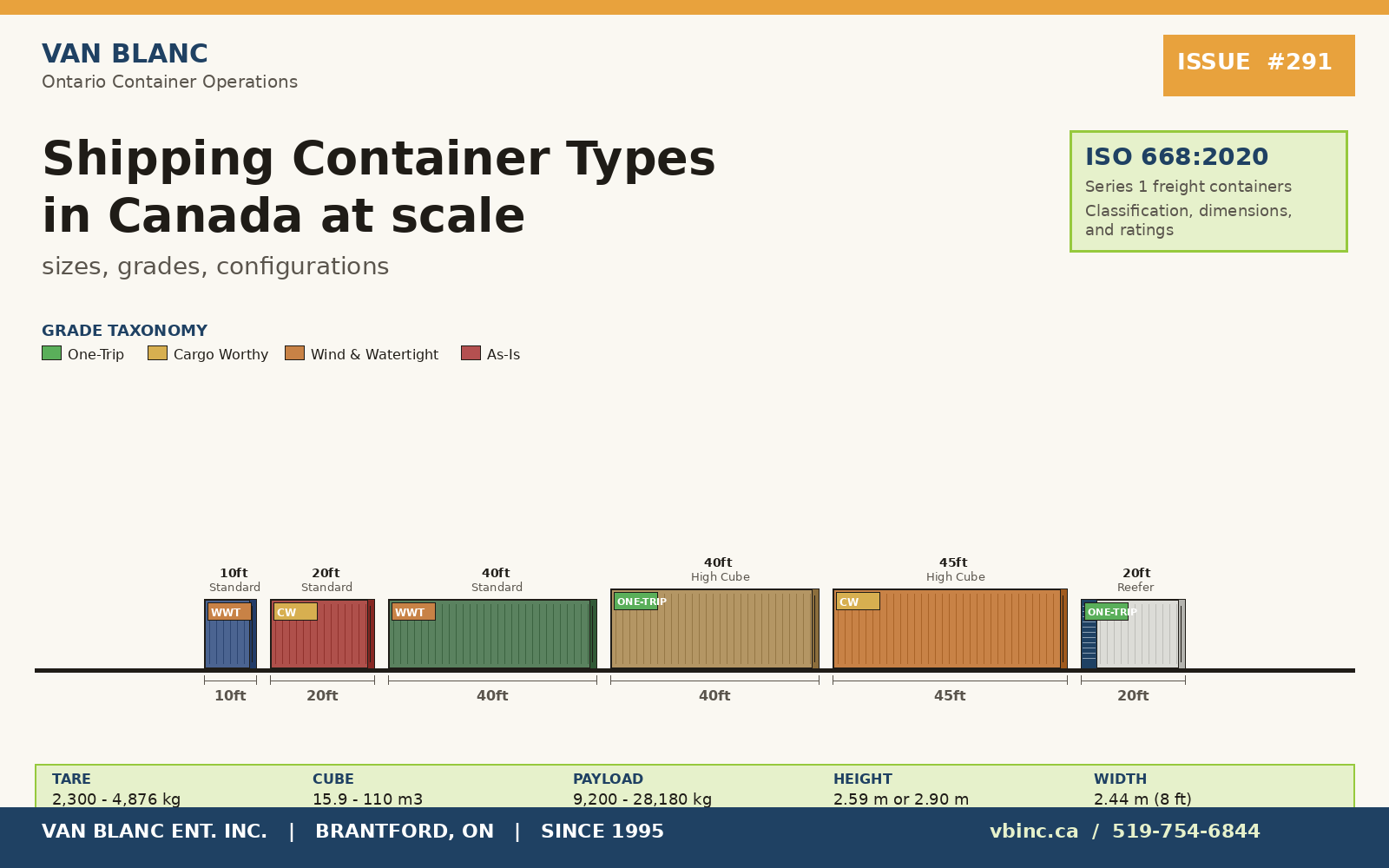
Quick Answer: Canada uses six container length variants (10ft, 20ft, 40ft, 40HC, 45ft, 53ft), two height variants (8’6″ standard and 9’6″ high cube), and nine specialty configurations (open-top, flat rack (the platform variant), tunnel, side-opening (full-side access), reefer, insulated, tank, offshore, half-height). The grade taxonomy runs one-trip, cargo worthy, wind and watertight, and as-is. The LeBlanc family has run Van Blanc Ent. Inc. in Brantford since 1995, with 140+ verified Google reviews at 4.9 stars and 1-3 day delivery across Ontario.
In This Guide
- What is the ISO 668 container standard?
- What container lengths are available in Canada?
- What is the difference between standard and high cube height?
- What specialty container configurations can you buy?
- What are the shipping container grades?
- What are the payload and cube specs for each type?
- Which container type should you buy for your use?
- What container types actually land in Brantford?
- How does Paul think about the size-and-grade choice?
- What do Canadians call shipping containers?
- Detailed topic guides for every container type
- How do you work through a container decision?
- What do you see when you walk our Brantford yard?
- FAQs
Reading time: about 22 minutes.
What Is the ISO 668 Container Standard?
ISO 668 is the international standard that fixes the external dimensions, maximum gross mass, and structural geometry of every Series 1 freight container worldwide. First published in 1968, it is why container sizes are predictable: a 20ft is 20ft long, a high cube is 9’6″ tall, and a chassis built for one fits the next.
Every shipping container that moves through a Canadian port, rail yard, or Highway 401 corridor is governed by this single international standard. It defines the external dimensions, the maximum gross mass, and the structural geometry of every Series 1 freight container in global circulation. When you walk our Brantford yard and look at a row of bins, you are looking at the physical expression of one document written more than half a century ago.
What that standard actually decides is corner-casting geometry, length classifications, and the maximum weight a container can carry without splitting under crane lift. The corner castings are the eight steel boxes at the corners of every container. They are why a twist-lock on a chassis works, why a crane spreader engages, and why a forty-foot bin in Vancouver can be unloaded onto the same chassis in Brantford twelve days later. The casting geometry is identical worldwide.
For Canadian buyers, the practical effect of ISO 668 is that container size names are predictable. A 20ft container is 20ft long. A 40ft is 40ft long. A high cube is 9’6″ tall instead of the standard 8’6″. A 45ft is 45ft long, but only when it is built to the high-cube height because the rules for the longer Series 1 variants require it. None of these dimensions are guesses or trade jargon. They are bolt-tight specifications.
Why ISO 668 matters when you are buying for your property
The standard is the reason a chassis built for one container will fit another, the reason a forklift trained on 20ft bins handles every 20ft bin you will ever see, and the reason our Brantford yard can stage forty different containers in a single row without measuring each one separately. Trust the standard. The variation you actually need to worry about is grade and condition, not size.
The companion standard, ISO 6346, governs the alphanumeric identification stencil on every container. The first three letters identify the owner. The fourth letter is the equipment category, almost always a U for freight unit. The six digits are the serial number. The seventh digit is the ISO check digit. If you have ever seen a stencil that reads MSCU 451938 7 22G1, you have read an ISO 6346 marking and an ISO 6346 size-type code in one line. The 22G1 says 20ft general cargo. That is the standard at work.
Paul LeBlanc, owner: “After thirty years in containers, I tell every buyer the same thing. The standard already settled the size for you. A 20ft is a 20ft anywhere on earth. What you actually have to decide is the grade and the condition, and that is the part we walk you through in the Brantford yard before any deposit changes hands.”
What Container Lengths Are Available in Canada?
Six container length variants account for nearly every container that lands in Canada: 10ft, 20ft, 40ft, 40HC, 45ft, and 53ft. Some are rare. Some are everywhere. We see all of them at some point through our Brantford yards.
10ft containers
The 10ft is half a 20ft, fabricated either as a purpose-built unit or cut down from a 20ft donor. External dimensions are 10ft long by 8ft wide by 8’6″ tall. Tare weight is roughly 1,300 kg. Internal volume comes in around 15.9 m³. Canadian demand for 10ft is concentrated in urban yards where space is tight, in driveway storage in dense GTA neighbourhoods where a 20ft will not fit, and in modified portable buildings where a small footprint matters. We source 10ft units rather than stock them in volume. They are not part of the international cargo fleet.
20ft standard dry containers
The 20ft is the Canadian workhorse. External dimensions are 6.06 m long by 2.44 m wide by 2.59 m tall, which is 19’10” by 8’0″ by 8’6″ in working language. Internal volume is about 33.2 cubic metres or 1,172 cubic feet. Tare weight is roughly 2,300 kg. Maximum gross weight under the CSC plate is 30,480 kg. That allows for a payload up to about 28,180 kg, though Ontario road rules typically cap practical payload below that ceiling.
The 20ft is the size most farms, garages, construction sites, and backyard buyers want. It fits on a small lot, lifts onto a tilt-deck truck cleanly, and gives enough internal volume to store a sit-down lawn tractor, a snowmobile, or a season’s worth of hand tools. For the operational reality of 20ft shipping container dimensions and weight in Ontario, our dedicated guide walks the numbers in metric and imperial both, with road weight implications worked through.
40ft standard dry containers
The 40ft is double the length of a 20ft and is the international shipping default. External length is 12.19 m or 40ft exactly. Width and height match the 20ft standard at 2.44 m and 2.59 m. Internal volume runs about 67.8 cubic metres or 2,395 cubic feet. Tare weight is roughly 3,800 kg. Maximum gross weight under the CSC plate is the same 30,480 kg as the 20ft, which means a 40ft has a slightly lower payload ceiling than the 20ft once you subtract its heavier tare.
Buyers choosing 40ft over 20ft usually need the floor space rather than the cube. A 40ft holds two pickup trucks bumper to bumper with room to walk around them. It holds a complete machine shop floor plan, a small warehouse run, or a 320 square foot tiny-home conversion. The trade-off is delivery: a 40ft needs roughly 80 feet of clearance to tilt off the chassis cleanly, where a 20ft can land in tighter spots.
40ft high cube containers (40HC)
The 40ft high cube shares the 40ft footprint but adds 30 cm of height. External dimensions are 12.19 m by 2.44 m by 2.90 m, which is 40ft by 8ft by 9’6″ in working numbers. That extra foot of headroom matters more than buyers expect. Internal volume jumps from 67.8 cubic metres to roughly 76.1 cubic metres, a 12 percent gain on the same footprint. Tare weight is about 4,000 kg.
For container conversions, the 40HC is the standard choice. Once you spray-foam insulation to R-25 onto the ceiling, you lose roughly 10 cm of interior height. A standard 40ft drops to 2.49 m interior height after insulation, which is uncomfortable for a six-foot tradesperson. A 40HC drops to 2.80 m, which feels like a normal room. For the operational walkthrough of the 40ft high cube versus standard cube tradeoff in Ontario, see our deep dive on which one fits which build.
45ft high cube containers
The 45ft high cube is the longest internationally tradable container that fits within ISO 668. External length is 13.71 m or 45ft exactly. Width is the standard 2.44 m. Height is the high cube 2.90 m. The 45ft is built only as high cube. Internal volume runs about 86.0 cubic metres or 3,040 cubic feet. Tare weight is approximately 4,800 kg. Maximum gross weight under the CSC plate climbs to 30,480 kg, the same ceiling as the 40ft.
The 45ft is less common in Canadian residential and farm use because the extra five feet rarely fits the lot. It is more common in commercial yard storage where the longest possible footprint matters, and in some intermodal moves where the 45ft adds 13 percent volume on the same chassis the 40ft uses. Our Brantford yard stocks 45HC selectively rather than as a standard line item.
53ft domestic intermodal containers
The 53ft is a North American domestic standard rather than an international one. It is 53ft long, 8’6″ wide, and 9’6″ tall. Internal capacity reaches roughly 3,901 cubic feet. Tare weight runs around 5,020 kg without chassis. CN and CP both operate 53ft fleets for domestic rail intermodal across Canada. The 53ft is built to the same corner-casting geometry as Series 1 ISO containers but at a length that ISO 668 does not formally classify, which is why you will not see CSC plates on most 53ft units.
Canadian buyers occasionally ask about 53ft for storage. We can source them, but they have downsides for residential use: they are too long for most lots, they are weaker structurally than ISO units because they are designed for rail and trailer service rather than ocean stacking, and they are not internationally certified. The 53ft makes sense for buyers who need maximum cube on a single footprint and have the lot to host it. For most Ontario buyers, a 40HC plus a separate 20ft is the better answer than one 53ft.
What Is the Difference Between Standard and High Cube Height?
Container heights come in two flavours: standard 8’6″ and high cube 9’6″. Standard is 8’6″ external, which gives roughly 7’10” interior after the floor and roof structure. High cube is 9’6″ external, which gives roughly 8’10” interior. Width is always 8ft external and just under 7’8″ interior. That width is fixed by the standard. Nothing on the international fleet is wider.
The extra foot on a high cube is the single most useful upgrade most container buyers will make. It changes how the box feels inside. It changes what conversions are possible. It changes how forklifts and pallet jacks operate when stacking inside the bin. A standard 8’6″ container can hold a single layer of standard 48 by 40 inch pallets stacked four tiers high before the top tier touches the ceiling. A high cube holds the same pallets stacked five tiers high. That is a 25 percent storage gain on identical floor space for identical box cost.
The high-cube rule of thumb after thirty years of buying these
If your bin is doubling as anything other than dead storage, buy the high cube. Office, workshop, shop, gym, studio, cabin conversion, tall machinery storage, vertical pallet racking, all of them work better at 9’6″. If it is strictly dead storage for cardboard boxes, lumber, or low pallets, the standard 8’6″ saves a bit of cost and lifts a bit easier. That is the only case where standard wins on a working property.
The price gap between standard and high cube is real but modest. Across Canadian markets, a 40HC one-trip carries a small premium over a 40ft standard one-trip because the extra steel and the higher demand both push the quote up. On used cargo worthy and wind and watertight stock, that premium narrows further, since the cosmetic wear levels the two grades. For the value of the conversion options the extra foot opens, the gap is small enough that we recommend HC on almost every consult.
What Specialty Container Configurations Can You Buy?
Beyond the standard dry box, the international fleet includes nine specialty container configurations that solve specific cargo or use-case problems. Some land in our Brantford yard regularly. Some we source on order. Knowing the full range helps buyers understand what is possible when a standard dry will not fit the brief.
Open-top containers
Open-top containers replace the rigid steel roof with a removable tarpaulin stretched over removable roof bows. The tarp seals to the side rails with rope or strap. Open-tops exist because some cargo is too tall to fit through the cargo doors but fits inside the side walls. Tall machinery, structural steel sections, glass plate, and bulk industrial goods load through the top with a crane or rolling bridge.
Internal volume on a 20ft open-top is roughly 32.5 cubic metres, slightly less than a standard 20ft because of the bow structure. Tare weight is around 2,400 kg. Open-tops are available in 20ft and 40ft. For storage use, the open-top configuration is rarely the right choice because the tarp seals less reliably against weather than a steel roof and because the resale value of the unit declines once the tarp condition is questionable. We stock them on order for buyers who need top-load access for a project.
Flat rack containers
Flat racks are the platform variant. They have a rigid steel floor, two collapsible or fixed end walls, and no side walls or roof. Cargo loads from the sides or the top. Flat racks carry heavy industrial machinery, transformers, large-diameter steel pipe, tracked vehicles, and prefabricated structural assemblies. Maximum gross weight on a 20ft flat rack can reach 45,000 kg, which is well above the standard 20ft ceiling because the structure is rated for concentrated heavy loads rather than distributed cargo.
Flat racks are common in cross-border freight to Western Canada for mining, oil sands, and heavy industrial moves. They are not a storage product. We source them on order for buyers who need a flat-rack platform for a specific transport project, not for general yard use.
Tunnel and double-door containers
Tunnel containers have full cargo doors at both ends instead of just the standard one end. The two-door configuration enables drive-through loading. A forklift can enter from one end, deposit cargo, and exit from the other without reversing. For long cargo like steel bars, pipe sections, or lumber, tunnel containers reduce handling time dramatically. They are also useful for retail and warehouse buyers who want walk-through access in a permanent installation.
The trade-off is structural. Adding a second door reduces the rigidity of the box because the second end wall is not solid steel. Tunnel containers cost roughly 15 to 25 percent more than equivalent standard units. They are available in 20ft, 40ft, and 40HC. Tunnel configuration is one of the most useful specialty types for non-export buyers in Ontario, and we keep new 20ft and 40ft high cube tunnels in stock for workshop, retail, and modular building conversions.
Side-opening containers
Side-opening containers, sometimes called full-side-access or open-side, have cargo doors that span the entire length of one or both side walls instead of just one end. The doors open in panels that fold or slide along the length of the bin. Internal access becomes total. A forklift can address any pallet without working through other cargo. For high-density warehouse use, retail conversions, and any application where loading from the long side matters, side-opening containers solve a problem standard end-door units cannot.
Common sizes are 20ft and 40ft. Tare weight runs 15 to 20 percent heavier than equivalent standard units because the panel hardware adds steel. We keep new side-opening containers in stock for commercial buyers and for retail pop-up conversions where the side wall becomes a serving window.
Refrigerated containers (reefers)
Reefer containers are insulated boxes with a built-in refrigeration unit at one end. The unit is typically a Carrier or Thermo King, with the Thermo King Magnum Plus the workhorse for full cold-chain control. Temperature range on a current-generation reefer runs from minus 40 degrees Celsius to plus 30 degrees Celsius. The unit runs on three-phase electrical power, typically 460V in North America or 380V in Europe.
Internal volume on a 20ft reefer is roughly 28 cubic metres, lower than a standard 20ft because of the insulation thickness and the equipment well. A 40HC reefer runs about 67 cubic metres internal. Tare weight is significantly higher than the dry equivalent, around 3,000 kg for a 20ft and 4,500 kg for a 40HC. We cover how to spec the refrigeration unit and three-phase power in our walkthrough of buying a refrigerated unit, and how the reefer temperature range and cold chain works for Ontario buyers explains setpoints and the cold-chain logic.
Insulated containers
Insulated containers, sometimes called passive reefers or non-operating reefers, are reefer boxes with the refrigeration unit removed or never installed. They retain the polyurethane foam insulation but rely on the cargo’s own thermal mass or on external climate control to hold temperature. For some buyers, the insulation alone is the value: a workshop in an insulated bin needs less HVAC capacity to hold a working temperature in February than the same workshop in a bare-steel dry container.
Insulated container pricing falls between dry and reefer because the box is the reefer hull without the operating cost of the cooling unit. We stock insulated units selectively, mostly for buyers converting to workshops, gyms, or studios where the wall insulation is the goal.
Tank containers
Tank containers are stainless steel pressure vessels mounted inside an ISO frame. They carry bulk liquids: chemicals, food-grade ingredients, fuels, gases. The frame is built to standard 20ft external dimensions so the unit handles like a dry container on chassis, in a yard, or in a vessel. Tanks are rated for specific products and have detailed inspection requirements under transport regulations. Maximum gross weight runs around 36,000 kg, higher than a 20ft dry because the tank is rated for liquid cargo dynamics.
Tank containers are not a storage product. We do not stock them. Buyers who need bulk liquid handling at a fixed site usually go with a dedicated storage tank rather than an ISO tank container. The exception is small-batch craft food and beverage operations occasionally repurposing a tank for cellar storage, but those are rare in Ontario.
Offshore containers (DNV 2.7-1)
Offshore containers are built to a different standard from cargo containers. DNV 2.7-1 governs containers used on offshore oil and gas platforms, where the lift is from a vessel crane in heaving seas and the cargo is rated for impact and shock loading the standard ISO fleet does not face. The frame is overbuilt, the corner castings are reinforced, and the inspection regime is stricter.
Offshore containers occasionally show up in Canadian decommissioning markets after a North Sea or East Coast project winds down. They make excellent dry storage for buyers who can absorb the higher unit cost, because the overbuilt frame outlasts standard ISO containers by years. We source them when stock lands. They are not a regular line item.
Half-height and platform containers
Half-height containers are 20ft or 40ft units built to roughly half the height of standard, around 4’3″ external. They carry dense bulk cargo where weight matters more than volume: ore, aggregates, scrap metal. The half-height profile keeps the centre of gravity low for crane handling. They are rare outside mining and bulk material handling.
Platform containers are flat racks with the end walls removed entirely. They are pure decks for cargo that cannot be contained by walls, like wind turbine blades or oversized structural sections. Both half-height and platform configurations are specialty industrial products and not a storage line. We mention them so the taxonomy is complete.
What Are the Shipping Container Grades?
Shipping containers are sold in four grades that describe condition, not geometry: one-trip, cargo worthy, wind and watertight, and as-is. Container type tells you geometry. Container grade tells you condition. The four grades run in price-descending order and Canadian buyers should learn all four before they shop. Confusion between the grades is where most container scams begin.
The grade order, price-descending
- One-trip / new build. Single ocean crossing with cargo to offset shipping cost. Essentially new condition. Factory paint, no rust, doors operate cleanly. 25+ year functional life. Right grade for offices, retail, residential conversion. This is the top of the Ontario price range, with a 40HC costing more than a 20ft because of the added length and headroom.
- IICL (Institute of International Container Lessors). Inspected and repaired to IICL-6 standard. Suitable for further international shipping under lease. Higher condition than cargo worthy but lower than new. Less common in retail sales because the leasing market keeps most IICL stock in service.
- Cargo worthy (CW). Inspected by a licensed maritime surveyor and certified for ongoing international shipping. Multiple ocean crossings of cosmetic wear. Surface rust spots, paint variance, occasional small dents. Structural frame and floor inspected. In the Ontario range this grade sits below one-trip and above wind and watertight, with the 40HC priced above the 20ft on size alone.
- Wind and watertight (WWT). Guaranteed weather-resistant and rodent-proof but not re-certified for further international shipping. Visible cosmetic wear, surface rust on panels, faded paint. Doors close and seal. Right grade for stationary storage on land. Most common used grade in Ontario residential and farm markets. It is the most affordable certified used grade, well under one-trip, with the 40HC carrying the usual size premium over the 20ft.
- As-is. Older units with structural questions: floor damage, frame issues, door problems. Sold cheap for cladding, scrap metal value, structural reuse, or donor units for custom modification. This grade sits at the bottom of the price range, below even wind and watertight. We carry as-is units but rarely recommend them unless the buyer knows what they need it for.
For the full operational breakdown of the shipping container condition grading system in Canada, the inspection criteria each grade meets, and how IICL-6 sits between cargo worthy and one-trip, our dedicated guide walks the certification logic. For the lifespan-by-grade question many buyers ask, the shipping container lifespan by grade in Ontario piece tracks how each grade ages once it lands on a Canadian property.
One of the most common buyer questions is whether a one-trip is worth the premium over a cargo worthy. The answer is application-dependent. For pure storage where cosmetic appearance does not matter, a wind and watertight saves you 30 to 45 percent over a one-trip and lasts 15 to 20 years in Ontario climate before serious rust intervention is needed. For a conversion, an office, or anything visible from the road, the one-trip premium is worth it because the starting paint, the door operation, and the seal quality are all in better shape. When that crisp factory finish is the point, you can see what we keep ready to deliver on our the single-voyage stock we keep ready to deliver. The one-trip shipping container cost in Ontario guide walks the price math on each size, and the refurbished shipping container versus new in Ontario piece compares the third option, which is a wind and watertight that has been sandblasted, painted, and sometimes door-rebuilt to look one-trip.
What Are the Payload and Cube Specs for Each Container Type?
The payload and cube figures for each container type are summarized below. For buyers comparing options at our yard, the quick reference table pulls the working numbers together. All figures are typical industry averages and vary by manufacturer.
| Container type | External L × W × H | Internal volume | Tare weight | Max payload |
|---|---|---|---|---|
| 10ft standard dry | 3.05 × 2.44 × 2.59 m | 15.9 m³ (562 ft³) | 1,300 kg | 9,200 kg |
| 20ft standard dry | 6.06 × 2.44 × 2.59 m | 33.2 m³ (1,172 ft³) | 2,300 kg | 28,180 kg |
| 20ft high cube | 6.06 × 2.44 × 2.90 m | 37.4 m³ (1,320 ft³) | 2,400 kg | 28,080 kg |
| 40ft standard dry | 12.19 × 2.44 × 2.59 m | 67.8 m³ (2,395 ft³) | 3,800 kg | 26,680 kg |
| 40ft high cube | 12.19 × 2.44 × 2.90 m | 76.1 m³ (2,689 ft³) | 4,000 kg | 26,480 kg |
| 45ft high cube | 13.71 × 2.44 × 2.90 m | 86.0 m³ (3,040 ft³) | 4,800 kg | 25,680 kg |
| 53ft domestic high cube | 16.15 × 2.59 × 2.90 m | 110.5 m³ (3,901 ft³) | 5,020 kg | 25,460 kg |
| 20ft reefer | 6.06 × 2.44 × 2.59 m | 28 m³ (988 ft³) | 3,000 kg | 27,480 kg |
| 40HC reefer | 12.19 × 2.44 × 2.90 m | 67 m³ (2,365 ft³) | 4,500 kg | 25,980 kg |
| 20ft open-top | 6.06 × 2.44 × 2.59 m | 32.5 m³ (1,148 ft³) | 2,400 kg | 28,080 kg |
| 20ft flat rack | 6.06 × 2.44 × 2.59 m | n/a (platform) | 2,700 kg | up to 42,300 kg |
| 20ft tank | 6.06 × 2.44 × 2.59 m | 24,000-26,000 L | 4,000 kg | 26,480 kg |
The right-hand max-payload column lists CSC plate ceilings. Ontario road transport rules under Regulation 413/05 generally cap practical payload lower than these international ceilings because axle group limits become binding before the CSC ceiling does. For a working delivery you can usually carry 18,000 to 22,000 kg of cargo inside a 40ft within standard Ontario axle-group road limits, well below the 26,480 kg plate maximum.
Which Container Type Should You Buy for Your Use?
The right container type follows directly from the job. The taxonomy collapses into a decision matrix once you know what you are doing with the bin. Below are the working pairings we walk buyers through at our Brantford yard.
Farm storage and equipment shelter
For a working farm the answer is almost always a 40ft wind and watertight. The standard 8’6″ height is plenty for hay, feed, equipment, and tool storage. The 40ft footprint lines up alongside an existing barn or pole-shed without dominating the layout. WWT grade costs noticeably less than one-trip and the cosmetic wear is invisible behind a tree line or in the back forty. We have delivered hundreds of these into Norfolk, Haldimand, Wellington, and Brant farm operations.
Construction site office and tool storage
For a job-site office the answer is a 20ft or 40ft high cube one-trip with ESA-certified electrical, modified with a personnel door, window, and HVAC. The high cube matters because the conversion will lose 4 to 6 inches of headroom to insulation and finished ceiling. For job-site tool storage a 20ft cargo worthy or wind and watertight with a heavy padlock and lockbox is the right cost-balanced choice. The 20ft footprint also stays portable, so a crew that hauls its own equipment between sites can keep relocating it as the project moves.
Retail pop-up and food kiosk
For pop-up retail the right container is a 20ft or 40ft high cube one-trip, often configured as a side-opening or tunnel unit so the retail face becomes a serving window or walk-through. Branding, paint, and ESA-certified electrical matter because the conversion will be customer-facing. The doors, windows, serving hatches, and electrical rough-in for builds like this are cut and fitted at our yard before delivery under engineered drawings. High cube is non-negotiable because the conversion loses headroom to insulation, finished flooring, and ceiling lighting.
Cold storage and food service
For active cold chain the answer is a 20ft reefer or 40HC reefer, depending on volume. Temperature setpoint depends on the cargo. Restaurants and small food service typically run reefers at plus 2 to plus 5 Celsius for produce or minus 18 to minus 20 Celsius for frozen. Craft breweries often run insulated containers without active refrigeration for cellar temperature work around 12 to 14 Celsius. Greenhouse and cannabis operations sometimes run reefers for drying-room temperature control.
Residential storage and workshop conversions
For backyard and residential use the answer varies by lot, budget, and conversion goal. A pure storage bin behind a garage is best served by a 20ft wind and watertight. A workshop or home gym is best served by a 40HC one-trip with full insulation and electrical. A backyard ADU or short-term studio conversion is best served by a 40HC one-trip with windows, plumbing, and full HVAC. The one-trip premium pays back in conversion quality and resale value.
Mining, forestry, and Northern Ontario
For Northern Ontario site operations the answer is usually a 40HC insulated container fitted as a bunkhouse, parts cage, first-aid station, or site office. Spray-foam to R-25 minimum. ESA-certified electrical for occupied conversions. Often multiple bins in modular configurations supporting a single project. Cargo worthy grade is fine because the unit will live on a remote site, not on a customer-facing site. We deliver fleets of 5 to 10 bins to Northern Ontario projects regularly.
What Container Types Actually Land in Brantford?
The container types that actually land in Brantford are a subset of the global fleet. The textbook taxonomy is one thing. The Canadian supply chain reality is another. Not every type listed in this guide arrives in Canadian ports in volume. Knowing what actually lands here saves buyers from quoting a unit nobody can deliver in 1 to 3 days.
Standard 20ft and 40ft dry containers are the supply backbone. They arrive in Vancouver, Prince Rupert, Halifax, Montreal, and the smaller ports continuously. Rail feeds them inland on CN and CP. They are the easiest grade to source at any Canadian inland yard. We stock both in volume at our 4 Brantford yards, and you can see what is staged and ready to leave the yard when you are choosing a size.
40ft high cubes are also abundant. The international fleet has rotated heavily toward high cubes over the last fifteen years because the volume gain on the same footprint matters in trade economics. Our yards run roughly 60 percent 40HC and 40 percent 40ft standard on incoming used stock now, where the ratio was reversed two decades ago.
45ft high cubes are less abundant. Canadian rail intermodal favours 53ft for domestic moves, which displaces 45ft demand. We source 45HC on order rather than stocking volumes.
53ft containers move on CN and CP rail constantly but rarely enter the retail used market in good condition. They wear hard in domestic service and are usually sold off only after they fall below cargo worthy. Buyers wanting a 53ft for storage often end up with a wind and watertight or as-is unit, which limits the use cases they support.
Reefers arrive in Canadian ports continuously because the cold-chain trade is large. We stock 20ft and 40HC reefers and source the rest on order. Tank containers, flat racks and open-tops are sourced on order rather than stocked in volume. New tunnel doubles are the exception, and we hold those in stock.
What our 4 Brantford yards look like on any given week
If you walk our yard on a Tuesday morning, you will see roughly 60 to 80 containers staged across the four locations. The mix is heavy on 20ft and 40HC wind and watertight, with one-trip stock in both sizes on hand. You will see 4 to 8 reefers at any time, a handful of 40ft standard dry, a few cargo worthy IICL units in rotation, the occasional 45HC waiting for a specific buyer, and new tunnel double-doors ready to go. We let buyers walk the row before they pay a dollar. Every kind of Ontario buyer ends up here because we deliver every container type from real Brantford yards in 1 to 3 days.
Ready to price your container?
Tell us the size and your postal code and we’ll send back an honest, all-in number, container, delivery, and placement, usually within 1-3 days. No pressure, no mystery fees.
Family-run in Brantford since 1995 · 200+ containers in stock · 4.9★ across 140+ Google reviews · every box graded by a person, walk it before it lands.
How Does Paul Think About the Size-and-Grade Choice?
Paul LeBlanc, owner: “The size-and-grade choice comes down to honest answers, not catalogue pages. A farmer needs a 40ft wind and watertight. A retail builder needs a 40HC one-trip. A craft brewer needs an insulated 20ft. A construction site needs a 20ft cargo worthy with a lockbox. The taxonomy in the textbooks is global. What we sell in Brantford is the subset that actually fits Ontario lots and Ontario budgets, and we match the buyer to the box in plain language.”
What Do Canadians Call Shipping Containers?
Canadians call shipping containers by several regional names: sea can, c-can, conex, and intermodal. Most do not say “shipping container” in conversation at all. The Norfolk farmer calls it a sea can. The Brampton contractor calls it a c-can. The Sudbury mining engineer logs it as an intermodal container. The Ottawa veteran calls it a conex from his service days. They are all the same 8-foot-wide steel box that ocean ships move around the world, governed by the same ISO 668 standard, identified by the same ISO 6346 stencil.
The vocabulary matters because it tells you who the buyer is. If you arrive at our yard asking for a sea can, you are probably from rural Ontario and you probably want a 40ft wind and watertight for farm storage. If you ask for a c-can, you are probably a contractor and you probably want a 20ft for a job site. If you ask for an intermodal, you are probably in procurement at a mining or forestry operation. If you ask for a conex, you have probably served. We adjust the consult to the language because the words tell us what the buyer actually needs before they describe the use.
Detailed topic guides for every container type
This hub is the encyclopedia. The detailed guides below take each branch of the taxonomy deeper. Use them when you need the operational numbers for the specific size, grade, or configuration you are considering.
- Size deep-dives. The numbers behind the 20ft workhorse walk the metric and imperial figures, road weight implications, and tilt-deck delivery clearances. The extra foot on a 40ft conversion guide compares the two heights on conversion suitability, internal volume, and cost gap.
- Reefer and cold storage. Our guide to refrigerated container supply covers unit selection, electrical requirements, and lead time. The setpoints-by-cargo breakdown tracks operating temperatures by product and walks the failure modes you want to plan against.
- Grade and condition. The inspection criteria for each grade are detailed in our grading guide. A separate piece on how grades age through Ontario winters tracks what happens to each one once it lands on a Canadian property.
- One-trip and refurbished. The guide on what drives the price of a single-voyage unit walks the cost factors by size and configuration. A companion piece weighs a sandblasted-and-repainted bin against new, the third option that sits between wind and watertight and one-trip.
Working through the detailed guides in sequence gives you the operational depth most national chains will never publish. The size-and-grade taxonomy we use at the yard is laid out across all of them, with the Ontario context layered in.
How Do You Work Through a Container Decision?
You work through a container decision by answering five questions in order. For buyers approaching the decision for the first time, the order of questions matters as much as the answers. Most online container content runs through specifications first and use cases second. We walk it the other way at the yard because the use case decides the specifications.
First question: what will the bin do for you? Storage, conversion, transport, mobile retail, cold chain, jobsite office. The answer narrows the type list immediately. Storage points at standard dry. Conversion points at high cube. Cold chain points at reefer or insulated. Transport points at flat rack or tank.
Second question: how long do you need it to last? A two-year jobsite tool storage is a wind and watertight conversation. A 20-year backyard workshop is a one-trip conversation. The grade follows the time horizon, not the other way.
Third question: what does your lot allow? A 40ft footprint needs roughly 80 feet of tilt-deck clearance, a 20ft needs about 50 feet. A high cube clears roof obstructions a standard might miss. Some lots will only accept a 10ft or 20ft. Some lots have the space for a 40HC plus a separate 20ft, which is the better answer than a single 45HC or 53ft for almost every Ontario buyer.
Fourth question: what does the cargo or use weigh? A 20ft loaded with seasonal tools moves fine on a tilt-deck. A 20ft loaded with 18,000 kg of dense cargo needs careful planning under Ontario Regulation 413/05 axle group rules. Most container deliveries fall well inside the road weight envelope, but a few need engineering.
Fifth question: what is the budget? This is where the grade ladder earns its keep. A wind and watertight 20ft costs less than a one-trip of the same size. A wind and watertight 40HC costs less than a one-trip 40HC. The savings are real if the use accepts the cosmetic wear. If the use needs the polish of new paint and crisp door seals, the one-trip premium pays back through the life of the conversion.
The Facebook trap
Many people call us saying they can get a bin far cheaper on Facebook. Two weeks later they call back saying they got scammed. The bin priced well below the market on Facebook is the one that never arrives. Walking our Brantford yard, seeing the row of containers staged, talking through the size-and-grade decision with Paul or Christian directly, that is the antidote. Every quote comes with a real lead time, not a hopeful one.
What Do You See When You Walk Our Brantford Yard?
When you walk our Brantford yard, you see the taxonomy in this guide turned into real steel. The list of types is what arrives. The yard is where it lives between purchase and delivery. Buyers from across Ontario regularly drive to view bins because it is worth the drive for unbeatable quality, family customer service with 30 years of experience. We stage our four Brantford yards so that the available stock is visible without forklift moves. You walk the row, you read the CSC plates, you check the door seals, you pick the bin you want.
Most buyers tell us afterward that the yard walk is what closed the decision. The textbook taxonomy makes one container look like another on paper. The yard shows you the variation: the one-trip with crisp factory paint next to a wind and watertight with surface rust streaks, the 40HC towering above the 40ft standard, the reefer humming on shore power with its temperature display reading minus 18, the side-opening unit with its panel pulled back to show the full interior. Walking that variation in person is what every kind of Ontario buyer does before they pay, because the paper says one thing and the steel says another.
Paul or Christian usually walks new buyers through the first time. The size-and-grade taxonomy we use at the yard is verbal at that point: which use case, which footprint, which grade, which budget. By the end of the walk, the textbook collapses into one specific bin you can touch.
Frequently Asked Questions
What are the main types of shipping containers in Canada?
Canadian buyers see six common length variants (10ft, 20ft, 40ft, 40HC, 45ft, 53ft), two height variants (standard 8’6″ and high cube 9’6″), and nine specialty configurations (open-top, flat rack, tunnel, side-opening, reefer, insulated, tank, offshore, half-height). The standard 20ft and 40HC dry container account for roughly 80 percent of Canadian retail sales.
What is the difference between a standard and a high cube shipping container?
The external height. A standard container is 8’6″ tall, a high cube is 9’6″ tall. Everything else is identical. The extra foot adds roughly 12 percent internal volume on the same floor footprint. For conversions, workshops, offices, and any use where ceiling height matters after insulation, the high cube is the right choice.
What does the ISO 668 standard cover?
ISO 668 specifies the external dimensions, maximum gross mass, and structural geometry of Series 1 freight containers. It defines the length classifications, the corner casting positions, and the load ratings. It is the reason a chassis built for one 20ft container fits every 20ft container worldwide. The companion ISO 6346 covers the identification stencil.
What is a one-trip shipping container?
A one-trip container made a single ocean crossing from the manufacturer (typically China or Vietnam) to North America, loaded with cargo to offset the shipping cost. Once unloaded it is sold in the aftermarket as essentially new condition: factory paint, no rust, clean door operation. Functional life is 25 years or more for storage and conversion.
What is the difference between cargo worthy and wind and watertight grade?
Cargo worthy containers are inspected by a licensed maritime surveyor and certified for ongoing international shipping. They have cosmetic wear but pass structural and CSC tests. Wind and watertight containers seal against weather and rodents but are not re-certified for shipping. WWT is the most common used grade in Ontario residential and farm markets.
What is the difference between a reefer and an insulated container?
A reefer has an active refrigeration unit at one end powered by three-phase electrical, and can hold temperatures from minus 40 to plus 30 Celsius. An insulated container has the same polyurethane foam wall insulation but no refrigeration unit. Insulated containers rely on cargo thermal mass or external climate control to hold temperature.
Are 53ft containers used in Canada?
Yes. Both CN and CP rail operate 53ft fleets for domestic intermodal across Canada. The 53ft is 8’6″ wide and 9’6″ tall like a 40HC but 13 feet longer. It does not carry a CSC plate because it is not classified under ISO 668. The 53ft is rare in Canadian residential and farm storage use because the footprint is large and the unit is built for rail rather than ocean stacking.
What is an open-top container used for?
Open-top containers have a removable tarpaulin roof instead of a fixed steel roof. They carry tall cargo that loads through the top with a crane: industrial machinery, structural steel, glass plate, oversized industrial goods. For storage use the open-top is rarely the right choice because the tarp seals less reliably than steel and resale value declines with tarp wear.
What is a tunnel or double-door container?
Tunnel containers have full cargo doors at both ends instead of just one. This enables drive-through loading where a forklift enters from one end, deposits cargo, and exits from the other. Tunnels are common for long cargo like steel bars and pipe sections, and useful in workshop conversions where walk-through access matters. They cost 15 to 25 percent more than standard end-door units.
What does CSC plate mean on a shipping container?
The CSC plate certifies the container under the 1972 International Convention for Safe Containers. It carries a 5-year initial validity then requires periodic re-inspection. CSC plates are required for international shipping. Wind and watertight containers may have expired CSC plates, which is acceptable for storage but not for export. As-is containers typically have no valid plate.
How much does each container type cost in Ontario?
Cost runs lowest for a 20ft wind and watertight and climbs from there: a 20ft one-trip sits above it, a 40HC wind and watertight above that on size, a 40HC one-trip higher again, and a 20ft reefer at the top because of the refrigeration unit. The figure that matters is what drives your quote, which is size, grade, any specialty configuration, delivery distance, and current supply. For a number tailored to your size and postal code, contact our Brantford yard and every quote comes with a real lead time, not a hopeful one.
Which container type should I buy for backyard storage in Ontario?
For pure backyard storage a 20ft wind and watertight is the right balance. The 20ft footprint fits most lots, the WWT grade saves you 30 to 45 percent over one-trip, and the cosmetic wear sits invisibly behind a fence or shed. For a workshop or convertible space a 40HC one-trip is the better answer because the conversion and headroom matter long term.
Sources
- International Organization for Standardization. (2020). ISO 668:2020 Series 1 freight containers Classification, dimensions and ratings. iso.org/standard/76912.html
- International Organization for Standardization. (2022). ISO 6346:2022 Freight containers Coding, identification and marking. iso.org/standard/82754.html
- Canadian National Railway. (2024). Domestic Equipment Intermodal 53-foot Container Specifications. cn.ca intermodal 53ft container spec sheet
- Thermo King Global Solutions. (2025). Container Refrigeration Magnum Plus Specifications. thermoking-globalsolutions.com/reefers
- Boxhub. (2025). Specialty Shipping Container Guide: Open-Side, Side-Door, Tunnel and Double-Door Containers. boxhub.com specialty container guide
- International Maritime Organization. (1972, amended). International Convention for Safe Containers (CSC). imo.org
- BIC (Bureau International des Containers). (2024). Shipping Container Sizes and BoxTech Equipment Database. bic-boxtech.org shipping container sizes
- Government of Ontario. (2024). Ontario Regulation 413/05: Vehicle Weights and Dimensions For Safe, Productive and Infrastructure-Friendly Vehicles. ontario.ca/laws/regulation/050413
Reach Van Blanc in Brantford
We have been supplying shipping containers across Ontario since 1995. Our warehouse is at 90 Morton Avenue E in Brantford, and we deliver right across the province from our 4 Brantford yards on a real lead time, not a hopeful one. No surprise fees, no chase-the-paperwork.
Van Blanc Ent. Inc. 90 Morton Ave E Unit 1B, Brantford, ON N3R 7J7 +1 888-509-6658
If you are working through the container-type decision and want to walk the row at our Brantford yard before booking, call Paul or Christian direct. We will walk the size-and-grade taxonomy we use at the yard with you in plain language, point out the bins on hand, and quote a real lead time before any deposit changes hands.