
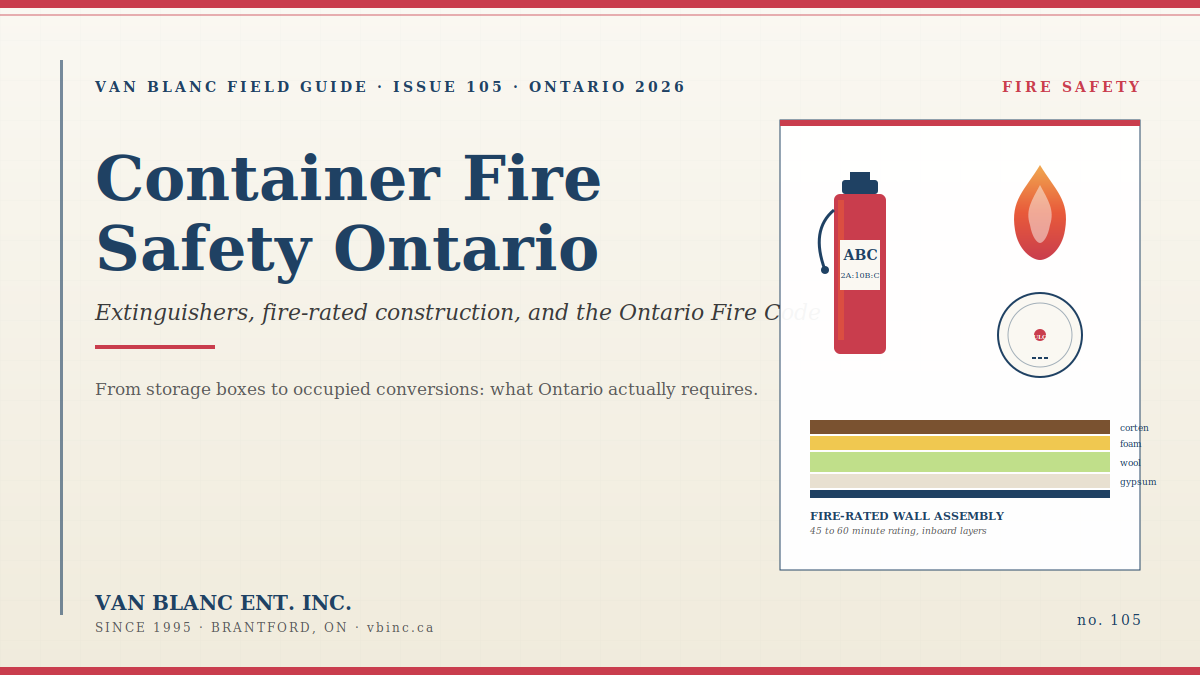
Quick Answer: Container fire safety in Ontario depends entirely on use. An unoccupied storage container needs almost nothing. An occupied conversion (office, ADU, or retail) triggers the Ontario Fire Code O. Reg. 213/07 and the Ontario Building Code, which means ULC-listed smoke alarms, a fire-rated gypsum barrier (15.9 mm Type X) under the 2026 OBC update, and at least one 5 lb ABC portable extinguisher. Van Blanc has supplied containers across Ontario since 1995, with 4.9-star service and 1-3 day delivery from four Brantford yards.
In This Guide
- Do Storage Containers and Occupied Conversions Follow the Same Fire Rules?
- How Does Corten Steel Actually Behave in a Fire?
- What Does Ontario Fire Code O. Reg. 213/07 Require for Containers?
- Which 2026 Ontario Building Code Changes Affect Container Builds?
- What Size Fire Extinguisher Does a Container Office or Workshop Need?
- What Smoke Alarm, CO Alarm, and ULC Rules Apply to Containers?
- How Do You Build a Fire-Rated Wall Inside a Container?
- Which Insulation Is Safest in a Container Fire?
- Why Is Electrical Work the Top Fire Risk in a Container?
- Can You Store Fuel, Solvents, and Dangerous Goods in a Container?
- How Does Site Placement Affect Fire Department Access?
- What Does It Take to Add Fire Safety to a Container Build?
- What Are the Five Most Common Container Fire-Safety Mistakes?
- What Has Christian Learned About Fire Safety Around the Yard?
- Frequently Asked Questions
- Reach Van Blanc in Brantford
Reading time: about 13 minutes.
Do Storage Containers and Occupied Conversions Follow the Same Fire Rules?
Storage containers and occupied conversions follow two different fire rule sets. An unoccupied storage container in a fenced yard needs no interior extinguisher, smoke alarm, or wall fire rating under the Ontario Fire Code. The moment a person works, sleeps, or runs a heater inside, the box becomes a building and full alarm, extinguisher, and fire-rated separation rules apply.
Container fire safety in Ontario splits sharply at the door of occupancy. A sealed 20 ft or 40 ft steel box sitting in a fenced yard, holding pallets of inventory or tools, is regulated almost the same as a tool shed. The Ontario Fire Code applies to the site (housekeeping, fire department access, hot work nearby) but no extinguisher must be mounted inside, no smoke alarm must be installed, and no fire rating is demanded of the walls.
Paul LeBlanc has sold containers for both jobs since he founded Van Blanc in 1995. “People call expecting the fire gear to come bolted inside the box,” he says. “It does not, because for a storage container nothing is required. The day you put a desk and a heater in it, you have built a small building, and the building rules show up whether you invited them or not.” If your project is heading toward an interior fit-out, the fire scope is part of the conversation when you bring a fully fitted-out conversion into your quote.
The moment that container is converted into a place where a person spends meaningful time, the picture changes. Smoke alarms, carbon monoxide alarms, fire-rated separations, portable extinguishers, and an exit plan all become non-optional.
We say this up front because customers regularly call asking what fire equipment “comes with the container.” Nothing comes with a storage box because nothing is required. Everything comes with a conversion because a conversion is a building. That distinction shapes every paragraph that follows, and it is the first thing we cover when a customer brings Van Blanc modification work into scope.
Practical rule of thumb: if a heater, a person, or a sleeping arrangement is inside the box for more than an hour at a time, treat it as occupied. Storage-only containers that nobody enters except briefly to load or unload are governed by yard rules, not building rules.
How Does Corten Steel Actually Behave in a Fire?
Corten steel does not burn, but it does fail under fire heat. Shipping containers are built from Corten weathering steel that does not burn but does soften. Corten has a melting point above 1,370 degrees Celsius (around 2,500 Fahrenheit), which sounds reassuring until you read the next number. Structural steel begins to lose strength at roughly 540 degrees Celsius, and by 700 degrees the load-bearing capacity is well below design. A typical residential fire flashover is in that 600 to 1,000 degree range. Steel does not “burn” in the way wood does, but it warps, sags, and conducts heat efficiently.
This matters in three ways for container fire safety:
- Conduction. A fire on the outside of the container will heat the inside skin within minutes. Anything flammable resting against the wall, including foam insulation or wood blocking, can ignite from radiated heat without an open flame ever entering the box.
- Containment. Once a fire starts inside a sealed container, the steel walls keep heat in. Temperatures climb fast. Interior finishes that would have a 30 second escape window in a stick-built room may have far less in a steel one.
- Deformation. Steel that has been heated past 700 degrees will not return to original strength even after it cools. A container that has been through a yard fire should never be repurposed for occupancy, even if it looks intact.
None of this means containers are unsafe. It means they are different from wood-frame buildings, and the fire-safety details have to respect that difference. The corten shell is excellent at resisting an external grass fire or a vehicle fire next door. It is unforgiving once a fire is loose inside.
What Does Ontario Fire Code O. Reg. 213/07 Require for Containers?
Ontario Regulation 213/07, the Fire Code, is enforced by municipal fire prevention divisions across the province. The Fire Code is the operating rulebook once a building exists, and its requirements apply by occupancy classification (business and personal services, residential, mercantile) regardless of whether the building is steel, brick, or timber. That is a relief. Container projects do not face a special, harder rulebook. They face the same rulebook as a small wood-frame office of the same square footage.
Documentation tip: a one-page fire safety plan covering exit routes, extinguisher locations, alarm test schedule, and emergency contacts is required for most non-residential occupancies. Keep it laminated near the main entry. Inspectors look for it within the first minute of a walk-through.
Which 2026 Ontario Building Code Changes Affect Container Builds?
The 2026 Ontario Building Code update changes how container conversions are built. The previous 45-minute fire rating between primary and secondary suites has been replaced with a requirement for a continuous smoke-tight barrier of 15.9 mm Type X gypsum board. For a container ADU on the same lot as a primary residence, this language is what your designer will be working from.
Other relevant updates:
- Carbon monoxide alarms are now required on every storey of any dwelling with a fuel-burning appliance, an attached garage, or a shared wall with one. For a container ADU heated by a propane wall furnace, that means a CO alarm in the bedroom area and another in the living area, not just one near the heater.
- Smoke alarms in dwelling units must be interconnected and meet CAN/ULC-S531 for residential smoke alarms or CAN/ULC-S529 for system smoke detectors, depending on the install type.
- Hardwired-with-battery-backup is the default for new construction. Battery-only units are still permitted in retrofits in many cases, but new container ADUs and office conversions are new construction in the eyes of the inspector.
If you are budgeting a 2026 container conversion, build the interconnected smoke and CO alarm system into the line items from day one. Adding it after drywall is up costs about three times what it costs during rough-in.
What Size Fire Extinguisher Does a Container Office or Workshop Need?
A container office or workshop is sized for extinguishers the same way any small occupancy is. The Ontario Fire Code defers to NFPA 10, the U.S. standard for portable fire extinguishers, for sizing and placement. For a typical container conversion the calculation is mercifully simple.
A 20 ft container has about 160 square feet of floor area. A 40 ft container has about 320. Both fall well below the 1,000 square feet of light-hazard area that one 2A:10B:C extinguisher (commonly a 5 lb ABC dry chemical unit) is rated to cover. So for the vast majority of single-container offices, one extinguisher is enough.
Two situations push it up to two units:
- If the container is used as a workshop with welding, grinding, or open flame, the hazard classification is ordinary or even extra. Travel distance to an extinguisher must not exceed 15 metres, and a Class K may also be required if there is cooking.
- If the container is paired with a second container in an L or U configuration, each box should have its own extinguisher because the connecting door may not always be open.
| Container Use | Minimum Extinguisher | Mounting Height | Inspection Cadence |
|---|---|---|---|
| Storage only, unoccupied | Not required by Fire Code (recommended one 5 lb ABC near door) | 1.0 to 1.5 m from floor | Annual visual check |
| Office, light hazard | One 5 lb ABC (2A:10B:C) | 1.0 to 1.5 m from floor | Monthly visual, annual certified service |
| Workshop, ordinary hazard | One 10 lb ABC plus 5 lb near electrical panel | 1.0 to 1.5 m from floor | Monthly visual, annual certified service |
| Container ADU dwelling | One 5 lb ABC in kitchen, smoke alarm in every bedroom | 1.0 to 1.5 m from floor | Monthly visual, annual certified service, 6-year teardown for dry chemical |
Make sure every extinguisher carries a ULC label. A unit without ULC marking will be tagged as non-compliant by a fire inspector even if the agent inside is identical to a listed unit.
What Smoke Alarm, CO Alarm, and ULC Rules Apply to Containers?
Occupied container builds need ULC-listed, interconnected smoke alarms, and any container with a fuel-burning heat source also needs a CO alarm. For occupied container builds, smoke alarms are the single most important fire-safety device installed. NFPA data has held steady for two decades: working smoke alarms cut the risk of dying in a home fire by roughly half.
For Ontario installs, the requirements are:
- One smoke alarm on every storey, including any sleeping area.
- One inside every bedroom.
- Interconnected so when one sounds, all sound.
- ULC-listed (look for the CAN/ULC-S531 mark on the back).
- 10-year sealed lithium units are allowed but hardwired with battery backup is now the default for new construction.
Carbon monoxide alarms follow a similar logic. Any container with a propane, natural gas, kerosene, or wood-burning heat source needs a CO alarm in the sleeping area and outside it. Combination smoke and CO alarms in one housing are widely available and cut the device count in half. Pick units that meet CSA 6.19 (Canadian standard for residential CO alarms) along with ULC for the smoke side.
Wiring note: interconnecting alarms requires a third conductor (the “interconnect” leg) running between every unit. This is best done during electrical rough-in, before the interior wall sheathing goes up. The conductor sizing for that interconnect leg is laid out step by step in our ESA-permitted wiring walkthrough.
How Do You Build a Fire-Rated Wall Inside a Container?
A fire-rated wall inside a container is built as a layered inboard assembly, because the corten shell carries no fire rating on its own. The rating comes from what you build against the steel.
A typical fire-rated wall buildup inside a converted container, working from the corten shell inward, looks like this:
- Closed-cell spray foam against the inside of the steel (vapour barrier and primary insulation).
- Steel or wood strapping creating a service cavity.
- Mineral wool batt insulation (Rockwool or equivalent), rated A1 non-combustible, in the service cavity.
- One or two layers of 15.9 mm Type X gypsum board.
- Finish: paint, tile, or fibre-cement panel.
This buildup delivers roughly a 45- to 60-minute fire rating, depending on whether one or two layers of gypsum are used and how carefully the joints are taped. For a single-occupancy container office with no shared walls, a single layer is usually adequate. For a container ADU sharing a wall with another structure, or for a container split into two rentable suites, two layers are common.
The reason mineral wool keeps appearing in this list and not fibreglass is that mineral wool is rated A1 non-combustible under CAN/ULC-S102. Fibreglass batts have a paper facing that will burn. Inside a steel box where heat conducts fast, that distinction matters more than it does in a stick-built wall.
Which Insulation Is Safest in a Container Fire?
Mineral wool is the safest insulation in a container fire because it is rated A1 non-combustible, while any foam plastic must be covered by a gypsum thermal barrier. Insulation is the single biggest fire-safety variable in a container conversion. Any foam plastic insulation in an occupied space must be separated from the interior by a thermal barrier (typically 12.7 or 15.9 mm gypsum) that delays ignition for at least 15 minutes during a standard fire test. Skip the gypsum and you have a slow-burn fuse waiting for a spark. If you are weighing spray foam against mineral wool, the R-value math behind each insulation method is worth reading before you commit.
Why Is Electrical Work the Top Fire Risk in a Container?
Electrical work is the top fire risk in a container because the steel shell is itself a conductor, and the number-one cause of fire in Ontario container conversions is amateur electrical work. We hear about it from customers at least monthly. Someone wires a 240 V dryer outlet to a 14-gauge feeder, overloads a single circuit with a portable heater, or connects romex directly to a corner casting because “it is steel anyway.”
Container electrical fires are particularly nasty because the steel shell is itself a conductor. A short to the wall can energize the entire box. That is why the Ontario Electrical Safety Authority (ESA) requires every container that will be occupied or that runs more than a couple of receptacles to have:
- A licensed electrical contractor (LEC) doing the work.
- An ESA permit pulled before the work starts.
- Bonding of the steel shell to the grounding system at a minimum of two points for any single-container build.
- GFCI protection on every receptacle within 1.5 m of a sink or outside.
- AFCI protection in any sleeping or dwelling space.
None of this is optional for occupied work. It is not optional even for “just one outlet” if that outlet is intended for permanent use. Electrical is one piece of a larger compliance picture, and our overview of the rules that govern a container build ties the wiring, fire, and inspection steps together.
Can You Store Fuel, Solvents, and Dangerous Goods in a Container?
You can store fuel, solvents, and most dangerous goods in a shipping container, with conditions, and never in the same container as anything occupied. Many customers ask whether a shipping container is a safe place to store gasoline, propane cylinders, paint thinner, or other dangerous goods. The answer is mostly yes, with conditions, and never in the same container as anything occupied.
For Class B flammable liquids (gasoline, solvents, alcohol-based fuels):
- Use a ULC- or CSA-rated fuel cabinet inside the container, not loose jerry cans on the floor.
- Limit total quantity to under 235 litres in a single non-fire-rated container, per NFPA 30 small-business thresholds.
- Ventilate the container with passive louvres at high and low levels (a single 100 mm louvre at each end is the common spec for storage-only boxes).
- Post a clear “no smoking, no open flame” placard outside.
For propane cylinders, the situation is stricter. TSSA (Technical Standards and Safety Authority) rules require propane storage in containers to have specific ventilation and separation from ignition sources. For more than a few small cylinders, a purpose-built propane cage is required rather than a sea can.
For automotive parts, machine oil, or general workshop chemistry, a standard container is fine, with the same housekeeping rules that apply to any shop: lids closed, rags in covered cans, no smoking inside.
Brantford insight: the Brantford Fire Department prevention division has been responsive when we have called on behalf of a customer planning a fuel-storage container. Calling them at the planning stage, rather than after the box is on site, has saved customers a great deal of re-work. They are at 60 Erie Avenue.
How Does Site Placement Affect Fire Department Access?
Site placement affects fire safety in two practical ways: whether a fire crew can reach the container, and whether anything combustible sits close enough to carry a fire to it. Two placement considerations come up in almost every placement conversation:
- Fire department access. A pumper truck needs to be able to get within 45 m of any side of an occupied container. For a container ADU, sitting too close to a neighbour’s garage may push the spec from a single layer of gypsum to two, or require a fire-rated cladding outside the steel.
- Vegetation clearance. The 1.5 m clearance from grass and brush that fire-prevention agencies (including FireSmart Canada) recommend for any storage container in a wildland-urban interface area is worth following even for urban Brantford yards. Dry leaves trapped under a container have started fires before.
For a workshop-grade container with a propane or wood heat source, increase the vegetation clearance to 3 m. Park nothing combustible directly against the corten shell, on any side. A box of firewood parked beside an outdoor wood furnace is the opposite case, and the gap between a wood boiler and a container of cords comes from the furnace maker’s own manual.
What Does It Take to Add Fire Safety to a Container Build?
Adding fire safety to a container build comes down to a short list of line items, most of them small. Most customers find that fire-safety compliance adds less to the total project than they expected, and often less than a single appliance.
| Item | What Drives the Cost | Required? |
|---|---|---|
| 5 lb ABC portable extinguisher, ULC-listed | Lowest line item; agent weight and the ULC certification tag drive the price | Yes for occupied |
| 10 lb ABC portable extinguisher, ULC-listed | Larger agent charge for higher hazard work, so it runs above the 5 lb unit | Workshop only |
| Hardwired interconnected smoke + CO combo, 2 units | Hardware plus the licensed electrician time to run the interconnect leg during rough-in | Yes for ADU and dwelling |
| 15.9 mm Type X gypsum, 20 ft container interior | Board count, taping labour, and number of layers (one versus two) set the total | Yes for occupied |
| Mineral wool batt R-22 walls, 20 ft container | Square footage of wall and ceiling cavity plus install labour | Code-driven for occupied |
| Class A spray foam against steel shell | Spray thickness for the target R-value and the linear footage of steel covered | Practical for occupied |
| Fire safety plan (laminated, posted) | Effectively free if you draft it yourself; mostly your own time | Yes for non-residential |
| Annual extinguisher service | Per-unit certified tag-and-test charge; rises with the number of extinguishers on site | Yes ongoing |
For a complete 20 ft container office finished to Ontario Fire Code, the fire-safety scope (extinguisher, alarms, gypsum thermal barrier, mineral wool) is usually one of the smaller slices of the total build, on par with what you would spend on the door and lock hardware. It is a budget item that pays for itself the first time a coffee maker shorts out at 2 a.m.
What Are the Five Most Common Container Fire-Safety Mistakes?
The five most common container fire-safety mistakes are the ones Van Blanc hears about again and again. After thirty years of selling containers in Ontario, the same errors come up repeatedly in customer calls.
- Foam straight to steel, no thermal barrier. Spray foam over the inside of the corten and then leaving it bare, painted, or covered with thin plywood. Plywood does not count.
- Extinguisher behind the door. An extinguisher that has to be hunted for in a panic is no extinguisher. NFPA 10 calls for the unit to be clearly visible and accessible. Mount it at hinge-side eye level near the main exit, not behind boxes.
- Battery-only smoke alarm on a propane-heated build. This is the most common single failure we tag. Propane appliances mean a CO alarm is required, and ULC-listed hardwired with battery backup is the new-build standard.
- No bonding of the steel shell. Electrical bonding sounds like an electrical issue but it is also a fire issue. An unbonded container shell can hold a stray voltage that ignites combustibles in contact with the wall during a fault.
- Combustible storage against the outside of the container. Stacked pallets, dry brush, or stored lumber leaning against the wall. The wall will not burn but anything next to it will, and a vehicle fire in a parking lot can radiate through the corten and ignite contents inside.
Fixing any of these five on an existing build is a one-day job for two people. Avoiding them at design stage costs nothing. This is the cheapest part of the project to get right.
What Has Christian Learned About Fire Safety Around the Yard?
“The hardest conversation I have all year is the one where someone wants to skip the gypsum and just paint the foam. They want it to look industrial, they want to save the money, and I get it. But I have seen what happens when a heater shorts in a container with bare spray foam on the walls. The foam goes up in seconds. By the time the smoke alarm sounds you have ten or fifteen seconds to be out the door, and that is only if there is a smoke alarm. Two layers of gypsum and a ULC-listed alarm costs less than a weekend at the cottage. I am asking customers not to skip the thing that gives them a chance.”
Christian LeBlanc, Van Blanc Ent. Inc.
Christian’s view comes from second-generation operator experience: he grew up around the yard watching his father Paul handle customer questions. He sees what walks back through the gate as a return or a complaint, which is the most direct fire-safety education available. The rest of the build sequence for a workspace fit-out is covered in our guide to turning a box into a working office, and the same fire-safety logic carried into a living space appears in our residential conversion walkthrough.
Frequently Asked Questions
Are shipping containers fireproof?
No. They are fire-resistant, not fireproof. The corten steel shell will not burn but it will warp at around 700 degrees Celsius and will conduct heat aggressively. Treat a raw container the same way you would treat a steel shed: tough against external fire, vulnerable to internal fire.
Do I need a fire extinguisher in my storage container?
The Ontario Fire Code does not require an extinguisher inside an unoccupied storage container. We still recommend one 5 lb ABC unit near the door. For occupied containers at least one ULC-listed unit is required.
What size extinguisher do I need for a 40 ft container office?
One 5 lb ABC dry chemical extinguisher rated 2A:10B:C is sufficient for a single-occupant 40 ft container office under light hazard classification. Travel distance must never exceed 15 metres.
Does spray foam insulation meet Ontario Fire Code?
Closed-cell spray foam can meet code in an occupied container but only when it is covered by a thermal barrier such as 15.9 mm Type X gypsum that delays ignition for 15 minutes.
Are smoke alarms required in a container office?
Yes for any occupied space classified as a business, mercantile, or residential occupancy. Smoke alarms must be ULC-listed, interconnected, and hardwired with battery backup for new construction.
Can I store gasoline in a shipping container in Ontario?
Yes in small quantities (under 235 litres) using a ULC or CSA-rated fuel cabinet, passive ventilation, and clear signage. For commercial-scale fuel storage, work with a fire safety engineer before you fill the container.
Does a container ADU need a fire-rated wall to the main house?
If the container ADU sits within the limiting distance threshold, yes. The raw corten container shell carries no fire-resistance rating. The rating comes from the inboard assembly of mineral wool plus Type X gypsum.
What is the difference between ULC and UL listings?
UL is the U.S. body, ULC tests to Canadian standards. For Ontario projects look for a ULC mark or dual UL/ULC mark.
How often does a portable extinguisher need to be inspected?
Visual monthly by the owner, full certified service annually, internal teardown every 6 years for dry chemical units, hydrostatic testing every 12.
What about HVAC fire safety in a container build?
Ductless mini-splits avoid most fire-spread risk because there are no through-wall ducts. Ducted systems require fire-rated mastic and dampers at every penetration.
Do I need a fire safety plan for a container office?
Most non-residential occupancies in Ontario need a one-page laminated plan covering exits, alarms, extinguishers, contacts, and supervisory staff responsibilities.
Sources and References
- Ontario Regulation 213/07 (Fire Code), Ontario e-Laws, ontario.ca/laws/regulation/r07213.
- CAN/ULC-S531 Standard for Smoke Alarms; CAN/ULC-S102 Standard Method of Test for Surface Burning Characteristics, Underwriters Laboratories of Canada, canada.ul.com.
- NFPA 10 Standard for Portable Fire Extinguishers and NFPA 72 National Fire Alarm and Signaling Code, National Fire Protection Association, nfpa.org.
- FireSmart Canada, “The Fire Risk of Shipping Containers (Sea Cans),” firesmartcanada.ca.
- Classic Fire + Life Safety, “Ontario Fire Code Changes Take Effect January 1, 2026,” classicfls.com.
Go Deeper: Detailed Topic Guides
For more depth on two pieces of the fire-safety picture, see:
Reach Van Blanc in Brantford
We have been supplying shipping containers across Ontario since 1995. Our warehouse is at 90 Morton Avenue East in Brantford, and we deliver across Ontario in 1 to 3 days from our four Brantford yards. No surprise fees, no chase-the-paperwork. Every quote comes with a real lead time.
Van Blanc Ent. Inc. 90 Morton Ave E Unit 1B, Brantford, ON N3R 7J7. +1 888-509-6658
Worth the drive to Brantford if fire-safety details matter to your build. With 200 plus containers in inventory and our pick-your-box approach, you can walk the row, choose the cleanest unit for your conversion, and start the fire-rated work from the best possible base. Walk the row and choose; that is how we have always done it. Have questions before you visit? Reach out before you visit and we will get a quote and a real lead time back to you the same day.
Placement requirements vary by municipality. A quick call to your local planning office before delivery is the easiest way to confirm what works for your property.
Related Reading
Ready to price your container?
Tell us the size and your postal code and we’ll send back an honest, all-in number, container, delivery, and placement, usually within 1-3 days. No pressure, no mystery fees.
Family-run in Brantford since 1995 · 200+ containers in stock · 4.9★ across 140+ Google reviews · every box graded by a person, walk it before it lands.
Sources & References
Authoritative external sources cited or referenced in this guide: