
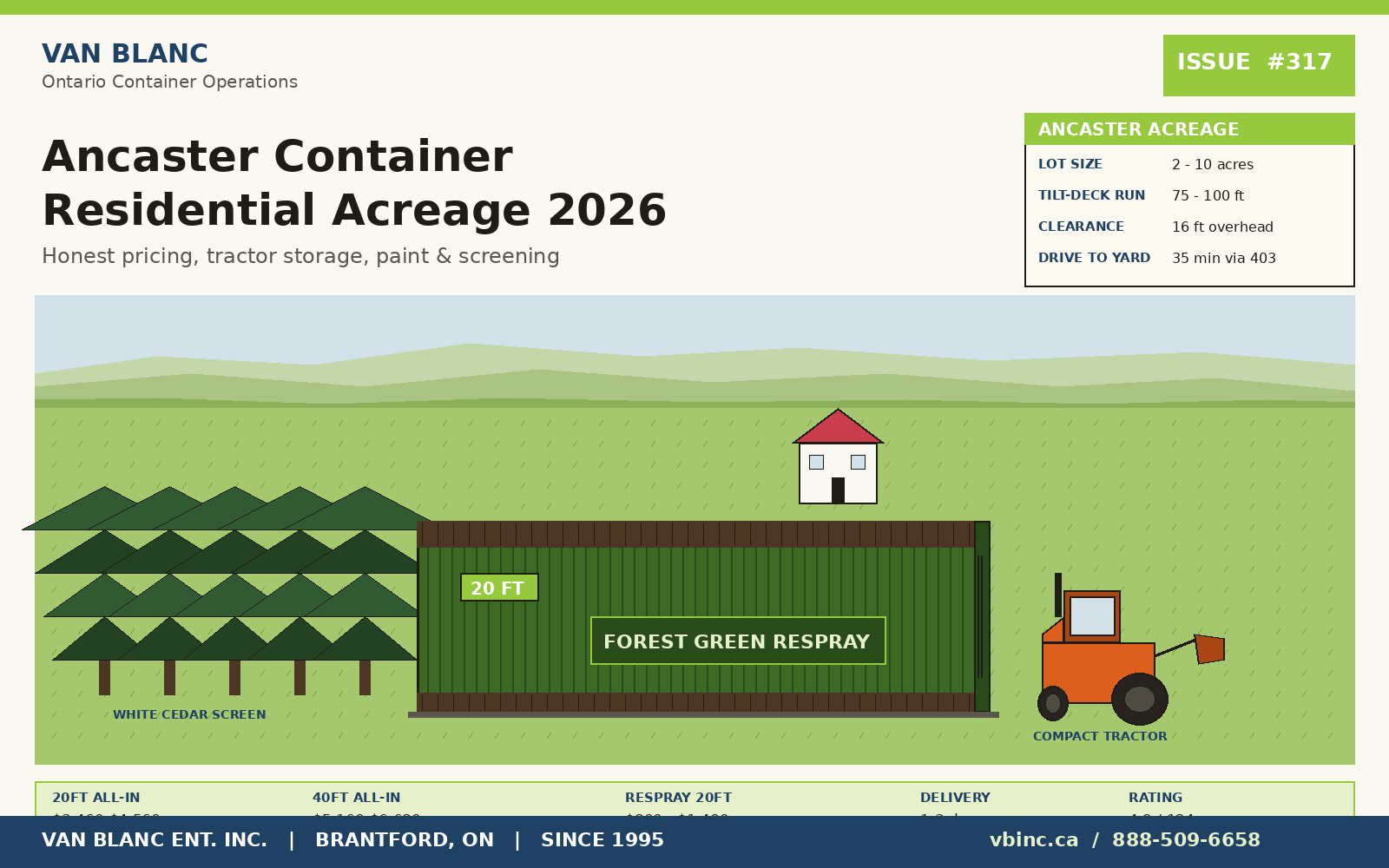
Quick Answer: Ancaster residential acreage owners on the Hamilton Mountain (typically 2 to 10 acres west and south of Wilson Street East) buy 20ft and 40ft shipping containers from our 4 Brantford yards for tractor housing, lawn equipment storage, and seasonal landscaping gear. Acreage lots usually have plenty of tilt-deck swing space (75 to 100 feet of straight run is rarely a problem on 2-plus acres), and most Ancaster buyers choose a paint respray plus cedar-slat screening to keep the container visually quiet against the rural-residential setting. Book by mid-March if you want spring delivery before the landscaping rush. What you pay depends on your site, your grade choice, and your freight zone, so call for a real quote. Brantford-based since 1995, family-operated, 4.9-star verified (140+ Google reviews). 1-3 day delivery Ontario-wide.
In This Field Guide
- Why do Ancaster acreage owners buy shipping containers?
- Should you buy a 20ft or 40ft container on a 2-plus acre lot?
- How can you make a shipping container look good on acreage?
- How do you lay out tractor and lawn equipment inside a container?
- How do you store a snowblower and mower in one container?
- What does a shipping container cost in Ancaster in 2026?
- How much tilt-deck swing space do you need on Ancaster acreage?
- What is the Facebook scam that targets acreage owners?
- Where can you walk our Brantford yards and pick your box?
- Frequently asked questions
Reading time: about 14 minutes. This guide sits under our main Ancaster service page and works alongside the acreage-farm storage companion guide. For how the numbers are built, see our breakdown of how a quote is built; to compare the sizes and grades in one place, the size and grade comparison covers every option.
Why Do Ancaster Acreage Owners Buy Shipping Containers?
Ancaster acreage owners buy shipping containers because a steel box absorbs the equipment overflow a house garage cannot: a compact tractor, a riding mower, a snowblower, and a season of landscaping gear. A used 20ft or 40ft unit lands within days, costs a fraction of a pole barn, and tucks out of sight behind the house line.
Ancaster sits on the Hamilton Mountain southwest of the city centre, and the residential footprint widens dramatically once you head past Wilson Street East. Lots run from a half acre on the older streets near Meadowbrook Drive to ten-plus acres along Powerline Road, Old Mohawk, and the rural stretches near Mineral Springs. The buyer profile we see most often: a homeowner on 2 to 6 acres, a compact diesel tractor in the 25 to 45 horsepower range, a riding mower, a snowblower, a UTV or quad, and a season’s worth of landscaping gear that lives outdoors from May to October and needs to go somewhere from November to April.
Attached garages on Ancaster acreage homes are not built for that load. A two-and-a-half-car garage holds two cars and a workbench. Add a Kubota with a front loader, a Toro Z-master, a Honda track-drive snowblower, a fifteen-foot trailer, and three rolling toolboxes and you are already a garage short. A 20ft or 40ft shipping container on a discreet corner of the back five acres absorbs the overflow without anyone seeing it from Wilson Street East.
The other driver is timing. A new outbuilding (pole barn, prefab metal shed, drive-in garage) in Hamilton-Wentworth carries a cost that swings widely with size and finish, and the lead time from the first quote to the first usable square foot stretches across most of a season. A used 20ft Wind & Water Tight container delivered to Ancaster is on site within our standard 1-3 day Ontario delivery window once stock is selected, at a fraction of the outbuilding timeline. Order-of-magnitude difference. The container does not replace a pole barn for every use case, but it covers the storage half of the problem inside a week.
Christian LeBlanc, Van Blanc Ent. Inc., second-generation operator: “Ancaster acreage owners are the easiest delivery we run all month. The lots are wide, the driveways are long, the tilt-deck has plenty of swing, and the buyer almost always knows where the box is going before we leave the yard. What takes the conversation is the aesthetic question. They want it on the property, but they do not want their neighbours to know it is there. We spend more time talking about cedar slat screening than about CSC plates.”
Should You Buy a 20ft or 40ft Container on a 2-Plus Acre Lot?
On a 2-plus acre Ancaster lot, the choice between a 20ft and a 40ft container comes down to the equipment list, not the footprint. Acreage solves the footprint question for a 40-footer that suburban Ancaster lots cannot. A 40ft container measures 40 feet long by 8 feet wide by 8 feet 6 inches tall, roughly 2,350 cubic feet of usable interior. A 20ft container is 20 feet long by 8 feet wide by 8 feet 6 inches tall, roughly 1,170 cubic feet. On a half-acre suburban lot the 40-footer looks oversized and the tilt-deck swing space is tight. On 2 acres, the 40-footer disappears behind a hedge with room to spare.
The right size pick depends on what the container will hold. A homeowner with one compact tractor, a riding mower, and a snowblower fits inside a 20-footer with room left over for seasonal landscaping gear. A homeowner with a larger tractor (50 horsepower plus, three-point implements, brush hog, log splitter, post-hole auger) typically needs a 40-footer or accepts that the 20-footer will be tight. Couples who are accumulating equipment over time often buy a 20-footer first and a second 20-footer two or three years later, side by side with a four-foot gap for ventilation. That gap pattern is common across Ancaster acreage and works as well as one 40-footer for most layouts.
| Ancaster Acreage Use | Lot Size | Best Pick | What Drives the Quote |
|---|---|---|---|
| Compact tractor + mower + snowblower | 2-3 acres | 20ft Wind & Water Tight | Lowest cost: smallest box, shortest freight, used grade |
| Larger tractor + multiple implements | 3-6 acres | 40ft Wind & Water Tight | Steps up with the larger box and a longer tilt-deck swing |
| Tractor + UTV + landscaping company gear | 4-10 acres | 40ft Cargo-Worthy | Cleaner grade adds to the 40ft base |
| Two-stage build (start small, add later) | 2-5 acres | 20ft now, second 20ft later | Cost spread across two deliveries, two years apart |
| Equipment plus seasonal patio furniture | 2-4 acres | 20ft with passive vents | 20ft base plus a modest vent-install add-on |
| Home-business landscape contractor | 3-10 acres | 40ft High Cube | Highest of the line: extra height plus 40ft footprint |
The two-stage pattern (one 20-footer now, a second 20-footer two or three years later) is the quiet favourite among Ancaster acreage owners we have worked with for the past decade. It spreads the cost, lets the layout settle, and avoids buying capacity that sits empty for the first two years. The cost gap between two 20-footers and one 40-footer is real (typically in favour of one 40-footer) but the flexibility of two boxes on different parts of the property is often worth the difference.
How Can You Make a Shipping Container Look Good on Acreage?
You make a shipping container look good on residential acreage with three inexpensive upgrades: a matched paint respray, cedar slat or steel skirting over the corrugation, and a row of fast-growing white cedars for a four-season screen. The single most-asked question we get from Ancaster acreage buyers: “Can it look like something other than a shipping container?” The answer is yes, easily, and the upgrades are inexpensive relative to the box itself. The three common patterns:
The paint and venting work happens at the yard before the box ever reaches your driveway, alongside the rest of the on-site finishing work we do before delivery, so the container arrives looking the way you want it from the first day.
Paint respray. A fresh coat of marine-grade automotive paint in a colour matched to the house trim, the barn red of nearby outbuildings, or a deep forest green that disappears into a treeline transforms the visual weight of the container. A full respray of a 20-footer takes two coats from a professional applicator and is a small add-on relative to the box itself. Ancaster buyers most often pick deep forest green, barn red, or a warm cream that matches the cottage-style trim common on Hamilton Mountain homes. The factory blue or rust colour of a used container stands out; a matched-respray container reads as a small outbuilding from twenty feet.
Cedar slat or steel skirting. A wood or steel skirt that covers the top eighteen inches and the bottom twelve inches of the container’s corrugation hides the visual signature that says “shipping container” most loudly. The corrugated steel ribs are the giveaway. A vertical cedar slat frame mounted on simple brackets, with two-inch gaps for ventilation behind, hides the ribs entirely and can be stained to match the house trim. Material cost for a 20-footer is modest, plus a weekend of labour for a competent homeowner.
Landscaping screen. A row of cedars, lilacs, or rhododendrons planted ten feet off the container on the side facing the house or the road creates a four-season visual screen within three growing seasons. White cedar (Thuja occidentalis) is the Ontario favourite: fast growing, dense, drought-tolerant after the first year, and forms a solid wall by year five. We have Ancaster buyers who planted a cedar row in May, took delivery in August, and report that by year three the container is invisible from their kitchen window.
Aesthetic guidelines in many jurisdictions across North America require containers on residential property to be painted uniform colours and screened with landscaping that provides an opaque sight barrier at least equal to the container’s height. Earth-tone paint plus a cedar row meets that standard easily and is the visual default we recommend to every Ancaster acreage buyer regardless of whether local rules require it. The practical guidance consistently lands in the same place: paint, screen, and place behind the house line rather than between the house and the road.
How Do You Lay Out Tractor and Lawn Equipment Inside a Container?
You lay out tractor and lawn equipment inside a container in three zones: the tractor reverses into the door end, mowers and implements line the long wall in the middle, and the far end holds the workbench, tools, and off-season gear. The interior layout of a 20ft or 40ft container holding a tractor plus accessories follows a predictable pattern. We have walked enough Ancaster acreage buyers through this conversation to know the layout before they describe their equipment list.
For a 20-footer holding a compact tractor (25-45 HP, roughly 9 to 11 feet long including front loader) plus a riding mower plus a snowblower:
- Door end (first 12 feet): Tractor reverses in. The front loader bucket lifts to clear the doorframe (a standard 20ft container interior is 7’10” tall, so a typical compact tractor with the loader at midheight clears with two to six inches of margin, depending on cab vs roll-bar setup).
- Middle section (12 to 16 feet): Riding mower parks beside the tractor along the long wall. Width of an 8ft interior fits a compact tractor (4.5 to 5 feet wide) plus a riding mower (4 to 5 feet wide) snugly. The aisle for walking access shrinks.
- Far end (16 to 20 feet): Snowblower, gas cans (in a vented gas-can cabinet), hand tools on wall hooks, smaller landscaping items stacked.
- Walls: Welded steel rails for hanging trimmers, blowers, leaf rakes, shovels. Pegboard on plywood furring strips for hand tools.
For a 40-footer with a larger tractor (50-plus HP with cab) plus multiple implements (brush hog, post-hole auger, three-point box blade, snow plow, log splitter):
- Door end (first 16 feet): Tractor parks. Higher cab clearance often requires a High Cube (9’6″ exterior height, 8’10” interior) instead of a standard 8’6″ container. The High Cube carries a modest premium but solves the headroom problem for full-cab tractors.
- Middle section (16 to 30 feet): Implements line the long wall on heavy-duty caster carts or simple wooden skids for easy roll-out. The brush hog, box blade, and post-hole auger live on caster carts so the homeowner can swap them solo without a second tractor.
- Far end (30 to 40 feet): Workbench, vise, parts shelving, oil and grease storage in a vented cabinet, log splitter wheeled in for winter use.
The High Cube versus standard-height decision is the most common spec error we see Ancaster acreage buyers make on their own. A standard 8’6″ container has 7’10” of interior clearance after the wooden floor thickness. A modern compact tractor with roll-bar folded clears that. A full-cab tractor in working position usually does not. We break down the exact interior and door-opening clearances in our full 40-footer measurements, which is worth a look before you commit to a standard-height box.
How Do You Store a Snowblower and Mower in One Container?
You store a snowblower and a mower in one container with a twice-a-year seasonal swap: the off-season machine goes deep, the in-season machine comes to the door, and two passive vents keep both dry. The Ancaster seasonal rhythm is sharp. The riding mower runs from late April to mid-October. The snowblower runs from late November to early April. The tractor runs year-round (front loader for snow in winter, brush hog and three-point implements in summer). The seasonal swap is the quietest reason an Ancaster acreage owner finds a 20-footer useful: there is always equipment in storage and always equipment in use, and the swap happens twice a year.
The simple swap rhythm: in October, the riding mower goes deep into the container, the snowblower comes to the front. In April, the snowblower goes deep, the riding mower comes to the front. Tools follow the same pattern (rakes deep in October, deep in April; shovels and pruning gear at the door year-round).
The container holds an off-season half of the equipment without ever seeing daylight for six months. The reason this matters: a snowblower stored outdoors in summer (or a mower stored outdoors in winter) loses 30 to 50 percent of its operating lifespan compared with the same machine indoors. We have customers on their fourth Honda track-drive snowblower because the previous three were stored outdoors. The ones who switched to container storage are still on the original machine ten years in.
The ventilation discipline matters for the swap. A container holding off-season equipment with a half-tank of fuel and grease on all the linkages needs two passive louver vents (one low on the door end, one high on the back wall) to drive convection and dump the moisture that condenses on cold steel walls overnight. Without ventilation, you get spring rust on every bare-metal surface. With ventilation, you open the door in April and the equipment looks the way it did in October. Our guide to container condensation in Ontario walks through the vent geometry that works in this climate.
What Does a Shipping Container Cost in Ancaster in 2026?
What a shipping container costs in Ancaster in 2026 depends on four things: the size (20ft or 40ft), the grade (Wind & Water Tight, Cargo-Worthy, or near-new One-Trip), the round-trip freight from our Brantford yards, and any visual-quiet upgrades you add. Ancaster delivery from our 4 Brantford yards travels Highway 403 east, exits at Wilson Street East or Garner Road, and reaches most Ancaster acreage addresses inside 50 minutes once the truck is loaded. The pricing model is the same as every Ontario delivery: no zone surcharges, no rural delivery fee, no premium for the Hamilton Mountain.

| Container Grade and Size | Usable Interior | Condition | Relative Cost Tier |
|---|---|---|---|
| 20ft Wind & Water Tight (used) | about 1,170 cubic feet | Watertight, plain surface wear | Entry: lowest in the line |
| 20ft Cargo-Worthy (cleaner used) | about 1,170 cubic feet | Cleaner walls, certified cargo-worthy | Adds a step over W&WT |
| 20ft One-Trip (near-new) | about 1,170 cubic feet | Single voyage, near-new finish | Top of the 20ft range |
| 40ft Wind & Water Tight (used) | about 2,350 cubic feet | Watertight, plain surface wear | Mid: double the volume of a 20ft |
| 40ft Cargo-Worthy (cleaner used) | about 2,350 cubic feet | Cleaner walls, certified cargo-worthy | Adds a step over 40ft W&WT |
| 40ft High Cube Wind & Water Tight | about 2,700 cubic feet (extra foot of height) | Watertight, 9’6″ exterior height | Highest: most volume and headroom |
Add-on costs for Ancaster acreage buyers who want the visual-quiet package:
- Marine-grade paint respray, 20ft: two-coat professional finish, smallest of the upgrades.
- Marine-grade paint respray, 40ft: more surface area than the 20ft, so it scales up with the larger box.
- Cedar slat skirting (materials, 20ft): modest material cost plus a weekend of homeowner labour.
- Cedar slat skirting (materials, 40ft): more linear feet of slat, so materials run higher than the 20ft.
- Vent installation (two passive louvers): a small flat add-on, the same on either size.
- Hardened-steel puck lock plus welded lockbox: a low one-time hardware add-on.
A typical Ancaster acreage buyer landing the full visual-quiet package on a 20-footer pays the box plus paint, skirting, vents, and lock hardware, with the 40-footer running higher across each line because of its larger surface area. Compare those upgrades to a prefab outbuilding and the math is straightforward. If you want to see exactly what moves a quote up or down before you call, our walk-through of what drives the final number lays it out line by line.
How Much Tilt-Deck Swing Space Do You Need on Ancaster Acreage?
Tilt-deck swing space on Ancaster acreage is rarely a constraint: a 20-footer needs about 75 feet of straight run and a 40-footer about 100 feet, with 12 feet of width and 16 feet of overhead clearance, and most 2-plus acre driveways offer far more than that. Tilt-deck delivery is the standard method for residential container drops in Ancaster. The tractor pulls a 40-foot tilt-deck trailer onto the property, hydraulically lifts the front of the trailer, and slides the container off the back onto the ground while the truck rolls forward. The container lands roughly twelve feet behind where the back of the truck started. We cover the full method in our tilt-deck delivery guide.
The swing space requirement is straightforward:
- For a 20-footer: 75 feet of straight run from the gate to the drop point, with 12 feet of width and 16 feet of overhead clearance.
- For a 40-footer: 100 feet of straight run from the gate to the drop point, same width and overhead clearance.
- Turnaround: The truck needs a turning circle roughly 40 feet in diameter to leave the property after dropping. Acreage driveways with a loop at the house solve this; long straight driveways may require backing out.
The good news for Ancaster acreage owners: these dimensions are rarely a problem on 2-plus acre lots. Driveways are typically 200 to 600 feet long, often gravel or asphalt sufficient for a loaded tilt-deck, and the drop points sit far enough back from the house that the truck can manoeuvre with margin. Compare with the suburban half-acre lot where a 20-footer drop requires careful curb-to-fence measuring; on Ancaster acreage the question is usually “where does the box look best” not “can the truck physically reach.”
The two pinch points we do see:
- Overhead branches. Old maples and oaks along driveways often hang below 16 feet. A pre-delivery walkthrough with an extended tape and a willingness to prune is the fix.
- Soft spring ground. March and April delivery onto wet clay subsoil can leave deep ruts. Most Ancaster buyers schedule delivery for late April or wait until June if spring is wet.
HIAB crane delivery is the alternative if tilt-deck access fails (limited driveway, severe overhead, or drop point behind a building). Crane delivery adds to the round-trip cost depending on reach. Reference: HIAB crane delivery guide.
What Is the Facebook Scam That Targets Acreage Owners?
The Facebook scam that targets acreage owners works by listing a 20ft container far below market with a polished profile, a fabricated urgency story, and an e-transfer deposit demand; the buyer pays, the seller vanishes, and the container never arrives. Ancaster acreage owners are a specific target for the Facebook Marketplace shipping container scam. The pattern, refined over the past four years, works like this:
A polished Facebook profile (often with a name that sounds plausibly local) lists a 20ft container at a price far below the market, with photos of a clean used container in a generic gravel yard. The pitch: “Owner-relocating, must sell this week, can deliver to Ancaster, e-transfer deposit holds the unit.” The price is 65 to 75 percent below the going market. The urgency is fabricated. The deposit demand is the scam’s entire purpose.
The buyer transfers in e-transfer. The seller goes quiet for a week, surfaces with one delay excuse, then disappears. The container never arrives. We have heard the aftermath from more than a few Ancaster-area homeowners in the past three years.
The pattern is consistent enough to read at a glance:
- Price 60 to 75 percent below the going market (an Ontario 20ft Wind & Water Tight quoted well under the going rate is suspicious; a figure a fraction of market is a near-certain scam)
- E-transfer deposit demanded before any yard visit
- Seller refuses to share a yard address or CSC plate serial
- Facebook profile less than 12 months old or no Hamilton-area check-ins
- Photos reverse-image-search to other listings or stock sites
- Urgency manufactured (“must sell by Friday”, “owner relocating”, “discount for cash”)
The protection is simple. Walk a real Ontario yard, read a real CSC plate, watch the container load on the delivery truck, and pay cash on delivery. That is what “pick your box” means: a 200+ container inventory at our 4 Brantford yards, in person, before any money changes hands. Short version: in person, or no deal. Reporting and fraud resources: Canadian Anti-Fraud Centre.
Local Tip: Cash on Delivery, Not E-Transfer Deposit
Our standard Ancaster delivery is cash on delivery once the container is set on your property. You do not pre-pay. You inspect the container at our 4 Brantford yards beforehand (a 35-minute drive west on Highway 403), sign the purchase paperwork at delivery, and pay when the box is at rest on your acreage. Any Ancaster seller asking for an e-transfer deposit before you can see the box at a real yard is running the scam pattern above.
Where Can You Walk Our Brantford Yards and Pick Your Box?
You can walk our 4 Brantford yards at 90 Morton Avenue East, a 35-minute drive west of Ancaster on Highway 403, and pick the exact container that will sit on your acreage. Our 4 Brantford yards hold 200+ containers across mixed grades, sizes, and pre-modification states. Ancaster acreage owners drive 35 minutes west on Highway 403, walk the row, push door seals, read CSC plates, photograph interior surface condition, and pick the box that will sit on their property for the next ten to twenty years. The drive is short. The decision is consequential. The two should match.
Pool suppliers do not work this way. They ship whichever box the depot releases. The buyer picks a grade on a website, pays online, and accepts whatever the truck brings. Sometimes that container is clean; sometimes it has a 4-inch dent in the rear corner that only surfaces when the driver leaves. We have spent thirty years watching that sight-unseen model fail buyers. We have spent thirty years offering the alternative: walk the yard first, pay second, take delivery third. You can browse what we currently have ready to buy on our ready-to-deliver inventory page, then come walk the row in person. Before you do, our checklist for inspecting a used 20-footer covers exactly what to look for at the yard.
Christian LeBlanc, Van Blanc Ent. Inc.: “An Ancaster customer drove out last fall, walked four 20-footers, picked the one with the cleanest interior plywood floor because he was storing a Kubota that he had owned for fifteen years and was not putting it on a beat-up floor. We respray-painted it deep forest green, installed two vents, and delivered three days later. He met us on the property, watched the tilt-deck unload, paid cash on delivery. That is how this works. Same model since 1995.”
If you own acreage in Ancaster and need on-property storage for tractors, lawn equipment, and seasonal landscaping gear, the conversation should start with a walk-through of our yards. Call, tell us the equipment list and the property layout, and we will tell you the right size pick, the real price, and which of our 4 Brantford yards holds the cleanest container for your job. The model has held since 1995.
Ready to price your container?
Tell us the size and your postal code and we’ll send back an all-in number, container, delivery, and placement, usually within 1-3 days. No pressure, no mystery fees.
Family-run in Brantford since 1995 · 200+ containers in stock · 4.9★ across 140+ Google reviews · every box graded by a person, walk it before it lands.
Frequently Asked Questions
How much does a 20ft shipping container cost delivered to Ancaster acreage in 2026?
The all-in cost is a used 20ft Wind & Water Tight container from our 4 Brantford yards plus round-trip tilt-deck delivery to Ancaster. A cleaner Cargo-Worthy 20-footer steps up from there, and a near-new One-Trip 20ft container sits at the top of the 20ft range. There are no zone surcharges or rural delivery fees for the Hamilton Mountain. Add-on costs (paint respray, cedar skirting, vents, lock hardware) are quoted separately and are optional. Call with your grade choice and postal code for a real number.
Should I buy a 20ft or 40ft container for my Ancaster acreage property?
If your equipment is a compact tractor (25-45 HP), a riding mower, and a snowblower, a 20-footer holds the load with room for landscaping gear. If you have a larger tractor (50-plus HP with cab), multiple three-point implements, a UTV, and home-business landscaping equipment, a 40-footer or 40ft High Cube is the answer. A common Ancaster pattern is to buy a 20-footer now and a second 20-footer two or three years later: it spreads the cost and lets the layout settle before committing to the bigger box.
Can a shipping container look good on a residential Ancaster property?
Yes. The three-step visual-quiet package transforms a container into something that reads as a small outbuilding from twenty feet. Step one: marine-grade paint respray in a colour matched to the house trim, barn red, or deep forest green. Step two: cedar slat skirting that covers the corrugation ribs (the visual signature most associated with shipping containers). Step three: a row of white cedars planted ten feet off the container forms a four-season screen by year three. The full upgrade on a 20-footer is a small add-on relative to the container, plus the price of the cedars.
Do I have enough room on my Ancaster acreage for tilt-deck delivery?
Almost certainly. A 20-footer needs 75 feet of straight run, 12 feet of width, 16 feet of overhead clearance, and a 40-foot turning circle for the truck to leave. A 40-footer needs 100 feet of straight run. On 2-plus acre lots in Ancaster these dimensions are rarely a problem. The pinch points we do see are overhead branches (old maples and oaks often hang below 16 feet) and soft spring ground (clay subsoil can rut in March and April). HIAB crane delivery is the alternative if tilt-deck access fails, for an added cost.
Will a compact tractor fit inside a standard 20ft shipping container?
A compact tractor in the 25 to 45 horsepower range, with the front loader at midheight and the roll-bar folded, typically clears the 7’10” interior height of a standard 8’6″ container with two to six inches of margin. A full-cab tractor usually does not clear and needs a 40ft High Cube (9’6″ exterior, 8’10” interior). Width is rarely an issue: most compact tractors are 4.5 to 5 feet wide and the container interior is 7’8″. Length matters for the door-end manoeuvre: a 9-foot tractor reverses in cleanly; an 11-foot tractor with the loader extended starts to feel tight.
How do I store a snowblower and a riding mower in the same container?
The seasonal swap pattern is the standard answer. In October, the riding mower goes deep into the container and the snowblower comes to the front. In April, the swap reverses. Both machines live indoors year-round, which extends their operating lifespan by 30 to 50 percent compared with outdoor storage. The container needs two passive louver vents (one low on the door end, one high on the back wall) to manage condensation on the cold steel walls overnight, otherwise you get spring rust on bare-metal surfaces.
What is the Facebook scam targeting Ancaster acreage owners?
Scammers list 20ft containers on Facebook Marketplace at a price far below the market, with a polished profile, a fabricated urgency story, and an e-transfer deposit demand. The price is 65 to 75 percent below the going market. The buyer transfers a deposit, the seller disappears, the container never arrives. Acreage owners are a target because they often want a container quickly for a specific project. The protection is simple: any Ontario 20-footer quoted a fraction of the going rate by a Facebook seller demanding a pre-paid deposit before a yard visit is almost certainly a scam. The bin that is suspiciously cheap on Facebook is the bin that never arrives, so walk a real yard, read a real CSC plate, and pay cash on delivery.
How long does container delivery to Ancaster take from your Brantford yards?
1 to 3 days once booked, in line with our standard Ontario-wide delivery promise. Ancaster sits 35 minutes east of our 4 Brantford yards via Highway 403. Most deliveries land within 48 hours of the inspection visit. Spring delivery in the second half of March through April fills up quickly because landscaping season starts; book by mid-March for first-week-of-April delivery if you want clean inventory. Cottage-season Augusts and pre-snow Novembers are the other busy weeks. June, July, and September are usually wide-open scheduling.
Do I need to insulate a container if it is only storing equipment?
No. Empty equipment storage does not benefit meaningfully from insulation. The two passive louver vents and a small amount of seasonal ventilation discipline handle the moisture question without insulation. Insulation matters if you are using the container as a workshop, an office, or a year-round occupied space, because then you need to manage interior temperature against the cold steel walls. Equipment storage tolerates Ontario temperature swings without issue. Reference: container roof insulation guide.
Why drive to Brantford to inspect a container instead of having one delivered sight-unseen?
Because trust is built before the truck rolls. Buyers walk a 200+ container inventory at our 4 Brantford yards, read the CSC plate, push the door seals, and pick the exact box that will sit on their acreage for the next ten to twenty years. Pool suppliers ship from a generic pool and you take what the truck brings. The 35-minute Ancaster-to-Brantford drive pays for itself the first time you would otherwise have accepted a dented box from a sight-unseen ordering process.
Sources and Further Reading
- International Organization for Standardization. (2013). ISO 1496-1:2013, Series 1 freight containers – Specification and testing. iso.org
- Bureau International des Containers et du Transport Intermodal. The Container CSC Combined Data Plate Explained. bic-code.org
- Canadian Anti-Fraud Centre. Online purchase scam reporting and prevention guide. antifraudcentre-centreantifraude.ca
- Ontario Provincial Police. Reporting fraud and online marketplace scams. opp.ca
Reach Van Blanc in Brantford
We have been supplying shipping containers across Ontario since 1995, with a 200+ container inventory at our 4 Brantford yards and 1-3 day delivery into Ancaster and the Hamilton Mountain. You are welcome to walk the row, read the CSC plates, and pick the exact 20ft or 40ft container that will sit on your acreage before any money changes hands. We deliver cash on delivery: no surprise fees, no e-transfer deposits.
Van Blanc Ent. Inc. 90 Morton Ave E Unit 1B, Brantford, ON N3R 7J7 +1 888-509-6658
If you own residential acreage in Ancaster and need on-property storage for tractors, lawn equipment, and seasonal landscaping gear in 2026, the conversation should start with a yard walk-through. Spring delivery slots fill by mid-March.