
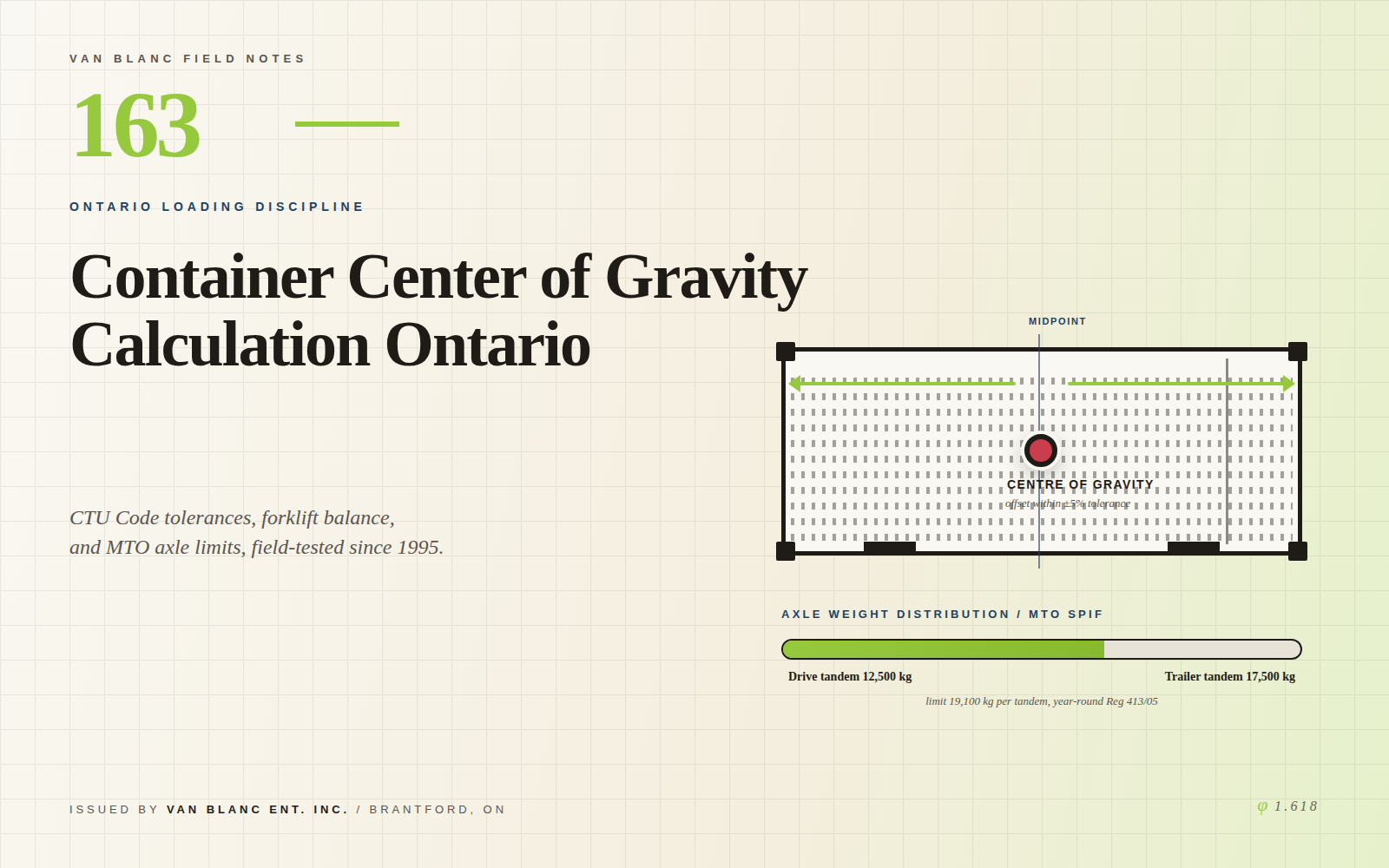
Quick Answer: Container center of gravity calculation Ontario follows the CTU Code rule: the cargo centre must sit within ±5% of the container’s longitudinal midpoint (±15 cm on a 20ft, ±30 cm on a 40ft), with no more than 60% of the mass in either half of the length. That balance protects MTO axle weights, lift safety, and on-road handling. Van Blanc is a family-run Ontario shipping container supplier since 1995, 4.9 stars across 140+ Google reviews, with fast 1-3 day delivery from our Brantford yards.
In This Guide
- Why does container centre of gravity matter in Ontario?
- How do you calculate a container’s longitudinal centre of gravity?
- What is the CTU Code centre-of-gravity tolerance?
- What are the vertical and lateral CG axes?
- How does CG affect forklift balance and tine reach?
- How do crane spreaders correct an offset CG?
- How does CG affect Ontario MTO axle weights?
- Why does a bad CG damage a tilt-deck chassis?
- What do real CG calculations look like?
- What field checks catch CG problems before you seal the doors?
- FAQs
Reading Time: 14 minutes
Why Does Container Centre of Gravity Matter in Ontario?
Container centre of gravity matters in Ontario because the cargo’s balance point decides how the load rides a tilt-deck trailer, lifts under a forklift or crane, and splits weight across the truck’s axles at an MTO scale. A load with its centre of gravity at the wrong end skews axle weights past legal limits and makes the lift unstable.
A loaded 40ft container leaves our Brantford yard at roughly 30,000 kg gross. The empty steel box accounts for about 3,800 kg of that mass. Everything else (the cargo) sits inside an 8-foot wide steel envelope that has to ride a tilt-deck trailer down Highway 403, get craned or forked into position at the buyer’s site, and stay structurally sound for the next 25 years. If the cargo’s centre of gravity is parked at the wrong end of that envelope, three problems happen at once: the trailer’s axle weights skew past MTO limits, the lift gets squirrelly under the spreader, and the floor of the container itself starts to deflect in places it was never engineered to hold.
Paul has watched it play out hundreds of times since 1995. A contractor packs the front third of a 20ft with tile saws, masonry blades, and a portable generator. The back two-thirds carries lighter items: tarps, lumber stickers, a pallet of bagged grout. On the lift onto our tilt-deck, the forklift operator notices the load wants to twist. On the highway, the steering axle reads heavy. At the drop site, the container sets down with a half-second lean before the rear corner castings settle. That whole chain of small problems traces back to one missed step: nobody calculated the cargo’s longitudinal centre of gravity before sealing the doors.
The calculation is not hard. The discipline is what’s hard. This guide walks through the math, the international tolerances, the forklift and crane mechanics, the Ontario MTO axle weight implications, and how we teach buyers to inspect their own loads before we hook up. It sits alongside our broader Ontario loading framework that covers strapping, blocking, dunnage, and lashing-point integrity. Most container suppliers will deliver a sealed box and never ask how the cargo inside is arranged. We ask, because we’ve seen what an out-of-balance bin does to a chassis at 100 km/h.
Christian LeBlanc, second-generation operator: “People think centre of gravity is a math problem. On our yard it’s a delivery problem. I grew up watching my dad route a tilt-deck around how a load actually sits inside the box, and the buyers who ask us about it up front are the ones whose containers land clean every single time.”
What “centre of gravity” actually means on a freight container
Centre of gravity (CG) is the single imaginary point where the entire mass of the loaded container behaves as if it were concentrated. For an empty 40ft ISO container, the CG sits almost exactly at the geometric centre: 6.095 m back from the door header, 1.22 m off either side wall, and roughly 1.30 m up from the floor (close to half the internal height). Load anything inside and the CG shifts toward whatever you loaded first. The whole math of safe container loading is a process of keeping that shifted point within tolerances that the trailer, the lift equipment, and the road can absorb.
How Do You Calculate a Container’s Longitudinal Centre of Gravity?
To calculate a container’s longitudinal centre of gravity, you work out the weighted-average position of all the cargo from a fixed reference point. The international standard for this calculation comes from Appendix 4 of the IMO/ILO/UNECE Code of Practice for Packing of Cargo Transport Units (the CTU Code). The formula reads as a weighted-average position. Pick a reference point (we use the rear door sill on most loads). For every piece of cargo, measure how far back the centre of that piece sits from your reference. Multiply the distance by the piece’s mass. Add those products together. Divide by the total cargo mass.
In plain Brantford-yard English: distance × weight for each item, sum it all up, divide by the total weight. The answer is how many metres your loaded CG sits from the door sill. Subtract that from half the container’s internal length (3.029 m on a 20ft, 6.058 m on a 40ft) and you have your offset from centre, positive toward the doors, negative toward the blind end.
| Container size | Internal length | Half length (centre point) | ±5% CG tolerance | ±10% CG tolerance |
|---|---|---|---|---|
| 20ft Standard | 5.898 m (19.36 ft) | 2.949 m | ±0.147 m (±15 cm) | ±0.295 m (±30 cm) |
| 40ft Standard | 12.032 m (39.48 ft) | 6.016 m | ±0.301 m (±30 cm) | ±0.602 m (±60 cm) |
| 40ft High Cube | 12.032 m | 6.016 m | ±0.301 m | ±0.602 m |
| 45ft High Cube | 13.556 m (44.48 ft) | 6.778 m | ±0.339 m | ±0.678 m |
| 20ft Reefer | 5.454 m (after insulation) | 2.727 m | ±0.136 m | ±0.273 m |
Two practical notes. First, the CTU Code measures longitudinal length from the inside face of the rear door to the inside face of the blind-end wall. Use internal dimensions, not external (the 20ft external length of 6.06 m includes the corner castings and door framing). Second, the offset tolerance is symmetric: the CG can sit forward of centre or aft of centre by the same margin. A 20ft container with the CG 12 cm forward of centre passes the ±5% rule. The same container with CG 18 cm forward fails the ±5% but still passes the relaxed ±10% (which most spreader-equipped terminals can correct for).
Paul LeBlanc, owner: “Buyers ask me if they really need to do the math. The answer is: no, you don’t need a calculator if the load is light and roughly balanced. But the moment you’re stacking dense things (steel, concrete, machinery, packed pallets of bottled liquid) you need to know within 30 cm where the centre sits. I’ve watched a tilt-deck pivot wrong because somebody packed a hydraulic press against the door wall of a 20ft and the back was full of pillows. Thirty years in containers and that pattern repeats every season.”
What Is the CTU Code Centre-of-Gravity Tolerance?
The CTU Code centre-of-gravity tolerance is ±5% of the container’s longitudinal length as the target and ±10% as the absolute upper bound, with the 60/40 mass split serving as the dockside backstop. The CTU Code (and most marine surveyors who certify export loads) treats ±5% as the universal target and ±10% as the absolute upper bound. Beyond ±10% the load is non-compliant and a marine surveyor will refuse to seal it. For domestic Ontario delivery the surveyor isn’t involved, but the physics still apply: a container with CG offset beyond ±10% will skew axle weights, stress the chassis twist locks unevenly, and present a real risk of cargo shift during emergency braking.
The 60/40 rule is the field shorthand. If you can’t do the math at the dock, weigh each half of the load and confirm one half holds no more than 60% of the total mass while the other holds at least 40%. That arrangement keeps the CG within ±10% by definition. The rule isn’t as precise as the CTU formula but it’s the version a yard hand can apply with a forklift scale and a tape measure. Most container handbooks and the German rigging association Rothschenk both cite 60/40 as the practical backstop.
The three layers of tolerance, in order of strictness
- ±5% longitudinal offset: the CTU Code ideal. Required for ocean export loads, marine insurance compliance, and any cargo subject to extended sea voyages. On a 20ft this is ±15 cm; on a 40ft it’s ±30 cm.
- ±10% longitudinal offset: the spreader-correctable bound. Terminal cranes with hydraulic spreader-bar adjustment can lift containers in this range, but the lift is slower and the operator earns it. ±30 cm on a 20ft, ±60 cm on a 40ft.
- 60/40 mass split: the dockside shortcut. If 60% of cargo mass sits in one half of the container length and 40% sits in the other, you’re inside ±10% by geometry. Confirmable with a pallet scale.
What Are the Vertical and Lateral Centre-of-Gravity Axes?
The vertical and lateral centre-of-gravity axes describe how a loaded container’s mass distributes up-and-down (vertical) and side-to-side (lateral), the two axes beyond the main longitudinal one. The longitudinal axis (door-to-blind-end) is the one that matters most for trailer loading and tilt-deck delivery. But every loaded container also has a vertical CG (how high the mass sits above the floor) and a lateral CG (how the mass distributes side-to-side). Both matter for crane lift safety and for over-the-road stability on cornering.
Vertical CG. An empty 40ft container has its CG at roughly 1.30 m off the floor (half of the 2.59 m internal height). Load heavy items low (pallets on the floor, dense bagged material at deck level) and the CG drops. Load light items high (stacked cardboard, foam-packed components on the upper tier of a double-decked load) and the CG stays low even as the absolute weight climbs. The opposite arrangement (heavy stacked on top of light, the classic mistake) raises the CG and turns the container into a top-heavy pendulum on corners. Most container roof structures are NOT load-bearing; they’re rated for snow and water shedding, not stacked weight. Load heavy on the floor first, always.
Lateral CG. The CTU Code allows a lateral offset of up to ±5% of container width before the load is considered laterally unbalanced. On a 2.35 m internal width that’s ±12 cm. In practice, lateral imbalance is rare because most cargo gets packed against both side walls and bracing fills the gaps. But on partial loads (think: a single transformer at the centre of a 40ft) the lateral check matters. A transformer biased 30 cm off centre on a 40ft will tip during a sharp corner, and even if the side walls hold, the lashing points will fatigue unevenly over the trip.
The three CG axes summarised
Longitudinal (X-axis): door-to-blind-end. Most consequential for trailer axle weights and tilt-deck safety. CTU tolerance ±5%, absolute max ±10%.
Lateral (Y-axis): side wall to side wall. Tolerance ±5% (~12 cm on a standard ISO width). Matters most on corners and partial loads.
Vertical (Z-axis): floor to roof. No strict CTU tolerance, but heavier mass should sit lower. Top-heavy loads compromise cornering and reduce the safety margin during emergency braking on Ontario highways.
How Does Centre of Gravity Affect Forklift Balance and Tine Reach?
Centre of gravity affects forklift balance because a shifted load throws extra weight onto the front of the tines, and tine reach decides whether the forks cross the container’s centreline cleanly. Most 20ft containers ship from the factory with forklift pockets cut into the underframe near the corner castings. The pockets are 35 cm wide, 11.5 cm tall, and spaced 2.05 m apart on a standard 20ft. They exist because the original 1960s container architecture assumed depot handling by forklift, and the pocket spacing matches a standard heavy-duty forklift’s tine spread. 40ft and 45ft containers do NOT have forklift pockets as a rule; the international convention is to lift these with cranes or specialist top-pick container handlers.
If your cargo CG is centred (±5%) the forklift operator can pick the loaded 20ft cleanly: tines all the way through to full pocket depth, mast tipped slightly back, load comes off the deck balanced. If your CG is shifted, the operator has to compensate. A CG biased 30 cm toward the doors (just inside the ±10% tolerance) shifts perceptible weight onto the front of the forks, and a tired operator on a long shift can over-correct, lift one side fractionally, and stress the corner casting weld. We’ve seen casting cracks from exactly this pattern, mostly on 20fts that travelled for two decades getting picked unbalanced every time. A brand-new one-trip build with a factory-flat floor starts that 25-year clock with sound castings and a deck that holds a balanced load predictably, which is part of why buyers staging heavy or repeated loads lean toward new steel.
Tine length matters
Standard 6-foot forklift tines work fine on an empty 20ft. On a loaded 20ft with CG even slightly off-centre, the 6-foot tines barely cross the longitudinal centreline and the lift becomes top-heavy. 8-foot tines (or longer, on dedicated container handlers) cross the full underframe span and stabilise the lift even when CG is borderline. If you’re shopping forklift capacity for container work, prioritise tine reach over raw lift capacity. A 15,000 lb forklift with 8-foot tines handles a loaded 20ft more safely than a 25,000 lb forklift with 6-foot tines.
How Do Crane Spreaders Correct an Offset Centre of Gravity?
Crane spreaders correct an offset centre of gravity by adjusting the lift geometry so the container hangs level even when the mass inside it is not centred. Cranes lift containers by the four top corner castings (ISO 1161 fittings) using a spreader bar that locks twistlocks into the casting holes. The spreader is the equalising device: even if the CG inside the container is offset, a hydraulic spreader can adjust the lift geometry so the container hangs level. That’s the engineering reason ±10% CG offset is tolerable in international logistics. Terminal cranes can correct it.
For Ontario delivery, the equivalent equipment is a tilt-deck trailer with rear winch and tilting hydraulics. The trailer doesn’t have a spreader; it simply slides the container off the deck onto the ground using gravity and a controlled rope payout, the controlled slide we run on every ground-level drop across the province. A balanced container slides off cleanly. An unbalanced container (CG biased toward the doors, for instance) can slip too fast in the first phase of the tilt and slam the front corner castings against the ground. We have yet to break a casting that way, but we’ve gouged enough delivery sites and bent enough rear bumpers on our trailers to know it’s a real risk worth pricing into how you load.
Why we ask about your load before we deliver
When you book a delivery from our 4 Brantford yards, we ask two questions most container suppliers skip: how heavy is the cargo, and where is it concentrated inside the bin? The questions aren’t bureaucracy. They tell us whether the tilt-deck will need a slower rope payout, whether we should pre-position the trailer to drop the heavy end first, and whether the site needs a longer run-out for the slide. 30 years operating across Ontario and most of our delivery damage stories trace back to a sealed container with surprise CG. Worth the drive for unbeatable quality, family customer service with 30 years of experience.
How Does Container Centre of Gravity Affect Ontario MTO Axle Weights?
Container centre of gravity affects Ontario MTO axle weights by shifting mass toward whichever axle group sits under the heavy end of the load, which can push a single axle past its legal cap even when the total weight is compliant. Container delivery in Ontario operates under Ministry of Transportation Regulation 413/05, the Safe Productive and Infrastructure Friendly (SPIF) framework. SPIF caps axle weights based on configuration. A standard tractor-trailer hauling a single container runs three axles in play: the steering axle, the drive tandem, and the trailer tandem. SPIF limits are 10,000 kg on the steering axle, 19,100 kg on each tandem, and 36,300 kg gross for a five-axle combination. Spring thaw season (typically March through June on King’s Highways) reduces the limits by roughly 50% on designated routes to protect roadways during the freeze-thaw cycle.
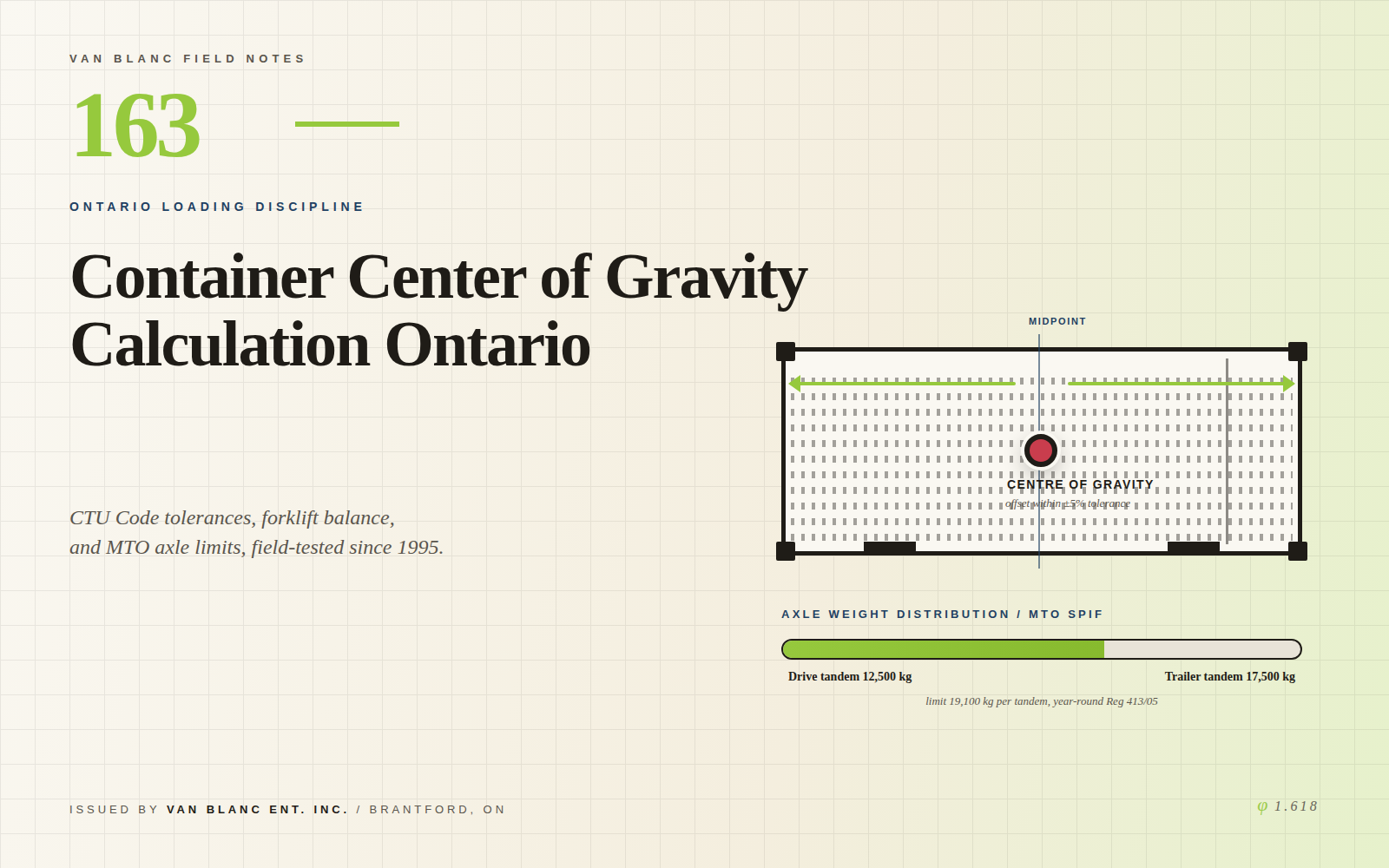
Here’s where centre of gravity meets the MTO scale. The container sits on the trailer tandem (rear of the trailer). If the cargo CG inside the container sits aft of centre (toward the doors, which is the trailer rear), more mass loads onto the trailer tandem. Past 19,100 kg on that tandem and the load is over-axle. If the cargo CG sits forward of centre (toward the blind end, which is the trailer front near the fifth wheel), more mass loads onto the drive tandem and steering axle. Past 10,000 kg on the steering axle and the load is over-axle on the front. Either failure mode triggers a fine at a Ministry inspection station, and the truck can be ordered to redistribute or partially offload before continuing.
| MTO SPIF axle limit (year-round) | Weight cap | Spring thaw cap (designated routes) |
|---|---|---|
| Single steering axle | 10,000 kg | ~5,000 kg |
| Tandem drive axle | 19,100 kg | ~9,550 kg |
| Tandem trailer axle | 19,100 kg | ~9,550 kg |
| Total 5-axle GVW | 36,300 kg | ~25,000 kg (route-dependent) |
The practical implication: a 40HC at 30,000 kg gross is well inside total GVW, but the distribution still matters. A 40ft with cargo CG at +60 cm aft of centre (the ±10% upper bound) loads roughly 17,500 kg onto the trailer tandem and 12,500 kg onto the drive tandem. That’s compliant. A 40ft with CG at +90 cm aft of centre (past the ±10% rule, near a 70/30 mass split) can push the trailer tandem to 21,000 kg, over-axle by nearly 2,000 kg. The truck driver can’t see inside the sealed container. The MTO scale will see it instantly.
The freight savings argument for proper CG
Most Ontario buyers pay for container delivery on a flat-route basis, not on weight. But over-axle violations trigger fines (commonly per violation) and delay the trip while the load is rebalanced. We have yet to be ticketed for over-axle on a Van Blanc delivery because we ask about CG up front. Buyers who load the container themselves and arrange their own haulage take on that risk directly. The 30-minute calculation before sealing the doors is cheaper than a Ministry redirect on the way to your site.
Why Does a Bad Centre of Gravity Damage a Tilt-Deck Chassis?
A bad centre of gravity damages a tilt-deck chassis through accumulated stress: every unbalanced load that stalls or runs away during the slide torques the pivot pins, the cable spool brake, and the trailer frame a little further out of true. Our tilt-deck trailers are the standard delivery rig for ground-level placement in Ontario. The trailer flatbed pivots from horizontal to roughly 30 degrees rear-down, a rope or winch cable lets the container slide off the back onto the ground, and the driver controls the slide speed with the cable payout. Done with a balanced load, the slide takes 45 to 60 seconds end-to-end. Done with a badly unbalanced load, the slide either stalls (CG too far forward, the container won’t release from the deck) or runs away (CG too far aft, the container accelerates beyond what the cable can safely brake).
The chassis damage isn’t dramatic in any single event. It’s accumulated stress. Repeated unbalanced loads bend the trailer’s pivot pins, wear the cable spool brake faster than spec, and over years can torque the trailer frame out of true. Most container suppliers don’t track this; they replace trailers on a schedule. We track it because we run a four-yard operation and the trailers are working assets. Buyers who load their containers carefully extend the life of every tilt-deck they ride on, including ours.
What Do Real Centre-of-Gravity Calculations Look Like?
Real centre-of-gravity calculations look like a short weighted-average sum worked through for each load, and the math is easier to absorb in worked cases. Here are four loads we see often, with the CG calculation worked through.
Example 1: 20ft with three pallets of equipment
Reference point: rear door sill. Pallet 1 (machinery, 1,200 kg) sits centred at 1.5 m from the door. Pallet 2 (lighter parts, 600 kg) sits centred at 3.0 m. Pallet 3 (light packaging, 200 kg) sits centred at 4.5 m.
Total mass: 1,200 + 600 + 200 = 2,000 kg. Weighted distance: (1,200 × 1.5) + (600 × 3.0) + (200 × 4.5) = 1,800 + 1,800 + 900 = 4,500 kg·m. CG position = 4,500 ÷ 2,000 = 2.25 m from the door sill. Container midpoint = 2.949 m from the door, so the CG sits 0.699 m door-side of the midpoint. That is an offset of 0.699 m on a 20ft, well past ±10% (which would be ±0.295 m). This load fails CTU. Solution: move Pallet 1 from 1.5 m to 3.5 m (deeper into the container) and Pallet 3 from 4.5 m to 2.0 m. Rerun: (1,200 × 3.5) + (600 × 3.0) + (200 × 2.0) = 4,200 + 1,800 + 400 = 6,400 ÷ 2,000 = 3.2 m. New offset = 3.2 − 2.949 = +0.251 m, inside ±10%. Better but still tight on ±5%; adjust the 200 kg pallet again if marine export.
Example 2: 40ft with a single concrete block
A 4,000 kg poured-concrete utility block sits centred 2.0 m from the door. Container midpoint = 6.016 m. Offset = 6.016 − 2.0 = +4.016 m (centre is 4 metres back from where the block actually sits). This is wildly past ±10% (±0.602 m). The load is unshippable as configured. Solution: position the block at the midpoint (6.0 m from the door) or split it with another 4,000 kg counterweight at 10 m from the door.
Example 3: 40HC with mixed retail inventory
20 pallets of clothing at 250 kg each, distributed evenly. 5 pallets in metres 1-3, 5 pallets in metres 3.5-6, 5 pallets in metres 6.5-9, 5 pallets in metres 9.5-12. Symmetric distribution. CG sits at the midpoint by inspection. No calculation needed. ±5% pass by default.
Example 4: 20ft reefer with cold-chain pallets
Reefer wall insulation reduces internal length to 5.454 m, so midpoint = 2.727 m. Pallet 1 (frozen product, 800 kg) at 1.2 m. Pallet 2 (frozen product, 800 kg) at 4.2 m. Total 1,600 kg, weighted distance (800 × 1.2) + (800 × 4.2) = 960 + 3,360 = 4,320 ÷ 1,600 = 2.7 m. Offset = 2.727 − 2.7 = +0.027 m. Effectively centred. Pass.
Ready to price your container?
Tell us the size and your postal code and we’ll send back an all-in number, container, delivery, and placement, usually within 1-3 days. No pressure, no mystery fees.
Family-run in Brantford since 1995 · 200+ containers in stock · 4.9★ across 140+ Google reviews · every box graded by a person, walk it before it lands.
What Field Checks Catch Centre-of-Gravity Problems Before You Seal the Doors?
Three quick field checks catch most centre-of-gravity problems before you seal the doors: an eyeball heavy/light split, a forklift balance lift, and a mass-half weigh. Most buyers don’t have a pallet-scale calibration capability or the patience for the full CTU formula. Three field checks catch 90% of CG problems without math.
The three field checks
- Eyeball the heavy/light split. If you can see at a glance that the front half of the loaded container holds substantially more or fewer pallets than the back half, you have a CG problem. Goal: pallet count balanced, with heavier pallets toward centre.
- The forklift balance check. Lift the loaded container 5 cm off the deck on a centred forklift. If the load tips noticeably toward one end, your CG is off in that direction. Set it down and rebalance before the carrier arrives.
- The mass-half rule. If you have any kind of scale (a pallet scale, a vehicle weighbridge), weigh roughly half the cargo at a time. If one half exceeds 60% of total mass, you’re past the 60/40 rule and likely past ±10% CG offset.
None of these substitute for the formula on critical loads (heavy machinery, dense aggregates, anything destined for international shipping where a surveyor will inspect). But for routine Ontario deliveries (farm equipment storage, contractor tool transfers, retail inventory shifts) the field checks are enough.
Frequently Asked Questions
What is the CTU Code tolerance for container centre of gravity?
The CTU Code (IMO/ILO/UNECE Code of Practice for Packing of Cargo Transport Units) sets the longitudinal CG tolerance at ±5% of internal container length, with an absolute maximum of ±10% under spreader-correction conditions. On a 20ft that’s ±15 cm to ±30 cm; on a 40ft it’s ±30 cm to ±60 cm. Lateral tolerance is ±5% of container width (about ±12 cm).
How do I calculate the centre of gravity of cargo inside my container?
Pick a reference point (we use the rear door sill). For each cargo piece, multiply its mass by the distance from that piece’s centre to your reference point. Sum the products. Divide the total by the total cargo mass. The result is your loaded CG position in metres from the reference. Compare to the container’s midpoint (2.949 m on a 20ft, 6.016 m on a 40ft) to find the offset.
What is the 60/40 rule for container loading?
The 60/40 rule is the field shortcut for the CTU formula. If no more than 60% of cargo mass sits in one half of the container length and no less than 40% sits in the other, the longitudinal CG is automatically inside ±10% by geometry. It’s the dockside equivalent of the longer calculation and good enough for most Ontario domestic deliveries.
Why does centre of gravity matter for tilt-deck container delivery?
Tilt-deck trailers slide the container off the rear at roughly 30 degrees, with a winch cable controlling the slide speed. A balanced load slides cleanly. An aft-biased CG runs away from the cable; a forward-biased CG stalls and won’t release. Both failure modes damage the trailer chassis over time and can damage the container’s corner castings or the delivery site itself.
What are the Ontario MTO axle weight limits for container delivery?
Under Regulation 413/05 (SPIF), the year-round limits are 10,000 kg on the steering axle, 19,100 kg on each tandem, and 36,300 kg gross vehicle weight on a five-axle tractor-trailer. Spring thaw season (March-June on King’s Highways) reduces those limits by roughly 50% on designated routes. Container CG offset directly affects which axle carries which share of the load.
Where are the forklift pockets on a shipping container?
20ft containers have two forklift pockets cut into the underframe near the corner castings, 35 cm wide and 11.5 cm tall, spaced about 2.05 m apart. 40ft and 45ft containers generally do NOT have forklift pockets; the international convention is to lift those sizes with cranes or specialist top-pick container handlers using the four ISO 1161 top corner castings.
Can a forklift safely lift an unbalanced container?
It can, within limits. A loaded 20ft with CG inside ±10% lifts cleanly on a 15,000 lb forklift with 8-foot tines through the underframe pockets. Past ±10% the lift gets squirrelly: the operator has to compensate, the casting welds take uneven load, and the chance of cargo shift increases. Long-tine forklifts (8 ft or longer) handle borderline loads better than higher-capacity forklifts with shorter tines.
What is the vertical centre of gravity of a loaded shipping container?
An empty 40ft container has a vertical CG of about 1.30 m above the floor (half its internal 2.59 m height). Loading heavy items on the floor first keeps the vertical CG low and improves cornering stability. Stacking heavy on top of light raises the CG and turns the container into a top-heavy pendulum, which is the most common cause of cargo shift on Ontario highway curves.
Does centre of gravity matter for empty container delivery?
For an empty container the CG sits at the geometric centre by definition, so the calculation is trivial. The empty 20ft weighs about 2,300 kg, the empty 40ft about 3,800 kg, both well inside any MTO axle limit on a properly configured trailer. The CG math becomes relevant the moment cargo enters the box. Empty deliveries from our 4 Brantford yards are inherently balanced.
How does Van Blanc handle CG questions before delivery?
When you book a delivery, we ask about your load type and approximate mass distribution. Most Ontario buyers ship empty containers (storage, retrofit, off-season use) so the CG question is moot. For buyers who pre-load before pickup or who arrange their own onward haulage, we walk through the ±5% and 60/40 rules in plain language and flag any obvious red flags before the truck arrives. It’s part of how we earned the 4.9 stars across 140+ verified Google reviews over 30 years.
Sources
- International Maritime Organization, International Labour Organization, United Nations Economic Commission for Europe. (2014, amended 2025). Code of Practice for Packing of Cargo Transport Units (CTU Code), Appendix 4: Calculation of cargo centre of gravity. UNECE. unece.org
- Container Handbook (German Insurance Association GDV). (2024). Section 4.2.1.3 Stowage planning and longitudinal weight distribution. containerhandbuch.de
- Government of Ontario. (2024). Regulation 413/05 under the Highway Traffic Act: Vehicles on Controlled-Access Highways (SPIF Vehicle Weights and Dimensions). ontario.ca/laws/regulation/050413
- Ontario Trucking Association. (2024). 2024 Ontario Vehicle Weight and Dimension (VW&D) Guidebook. ctea.ca
- International Organization for Standardization. (2013). ISO 1161:2016 Series 1 freight containers, corner and intermediate fittings, specifications. iso.org
Reach Van Blanc in Brantford
We have been supplying shipping containers across Ontario since 1995. Our warehouse is at 90 Morton Avenue E in Brantford, and we deliver right across the province on a cash-on-delivery basis. No surprise fees, no chase-the-paperwork.
Van Blanc Ent. Inc. 90 Morton Ave E Unit 1B, Brantford, ON N3R 7J7 +1 888-509-6658
If you’re loading a container for over-the-road delivery, call us before you seal the doors. We will walk through the centre-of-gravity check with you in plain language, calibrate the field rules to your specific cargo, and route the tilt-deck arrival to match how the load actually sits. Getting the strapping, blocking, and weight distribution right protects your chassis, your cargo, and your Ministry compliance.