
Quick Answer: ATV and UTV winter storage in Ontario follows the maker’s checklist. Wash and dry the machine, stabilize the fuel, test coolant strength, move the battery somewhere above freezing and set tire pressure. Then park it indoors in a dry, ventilated, locked space, like a Van Blanc 20ft or 40ft container.
What This Quad and Side-by-Side Guide Covers
- How Should I Store My ATV for Winter?
- Polaris, Can-Am and Honda Steps Compared
- Washing and Greasing a Quad Before Storage
- ATV Fuel: Stabilize the Tank or Drain It
- ATV Battery Storage Through a Cold Winter
- UTV Coolant Strength and Antifreeze
- Oil, Air Filter and Engine Fogging
- Quad Tire Pressure and Flat Spots
- Mice, Machine Covers and Damp
- Does a Side by Side Need to Be Winterized?
- ATV Storage Shed Options in Ontario
- UTV Storage in a 20ft or 40ft Container
- Vents, Tie-Downs and Locks for a Quad Box
- Machine Shed Grades: New or Used Steel
- Delivery to Sudbury, Peterborough and Woodstock
- Spring Start-Up After ATV Storage
- FAQs
Reading Time: 16 minutes
How Should I Store My ATV for Winter?
ATV winter storage is the routine that parks a quad or side-by-side for the cold months and keeps it ready to start in spring. The makers agree on the outline. Clean the machine, treat the fuel, check the fluids, deal with the battery and the tires, then put it somewhere dry and covered. The details differ by brand, so the owner’s manual for your model wins any argument.
A steel box is one answer to that last step, and Van Blanc Ent. Inc. sells them from 4 Brantford yards. Paul LeBlanc and his son Christian run the company, which dates from 1995. Car owners work through a similar list, and laying up a summer car before the salt covers that one. This guide does the machine first and the ATV storage shed question after it.
- Wash the machine, dry it, and grease or spray the moving parts.
- Fill the tank and add stabilizer, or drain the fuel, as your manual says.
- Change the oil and filter and check the air filter.
- Test the coolant strength and top it up on a liquid-cooled engine.
- Take the battery out and keep it charged somewhere it will not freeze.
- Set the tire pressure, then lift the machine or plan to roll it now and then.
- Park it in a dry, ventilated, locked space under a breathable cover.
Every step above comes from a maker’s own storage guidance, set out side by side below. Polaris adds one rule that shapes where the work happens. Its manuals say to keep the storage area well ventilated, and never to start the engine or let it run in an enclosed area. So any step that runs the engine happens outside, before the machine rolls in.
“Engine exhaust fumes are poisonous and can cause loss of consciousness or death in a short time.”
Polaris, 2020 RANGER XP 1000 Owner’s Manual: Exposure to Exhaust
Polaris, Can-Am and Honda Steps Compared
Three major makers publish storage steps for their machines, and they differ in useful ways. Polaris prints its steps in each owner’s manual, here the 2020 RANGER XP 1000 side-by-side and the 2022 Phoenix 200 quad. Can-Am publishes a winter storage guide for ATVs and SxS models. Honda Canada keeps a seasonal tips page for its powersports owners. The table quotes each one as closely as a table allows. Camper owners will know the shape of it, since putting an RV or travel trailer away for an Ontario winter runs a similar list.
| Step | Polaris owner’s manuals | Can-Am storage guide | Honda Canada seasonal tips |
|---|---|---|---|
| Fuel | Fill the tank, add stabilizer, run the engine 15-20 minutes | Add stabilizer and run a few minutes, or drain the tank and carburetor | A stabilizer can help prevent moisture buildup in a full tank |
| Battery | Out if unused for three months or more, fully charged, cool and dry, voltage checked monthly | Remove it and store it away from freezing; a basement or heated garage is ideal | Remove, fully charge, store in a well-ventilated, dark place |
| Coolant | Test strength and fill; 50/50 premix, not diluted | Not covered | Make sure coolant is topped up |
The other four rows cover the months the machine sits, which is where a ramp, vents and tie-down hardware start to matter.
| While it sits | Polaris owner’s manuals | Can-Am storage guide | Honda Canada seasonal tips |
|---|---|---|---|
| Tires | Set pressure; support the quad with tires slightly off the ground | Add a few PSI; use stands or blocks | Move the machine periodically |
| Engine runs in storage | Never start the engine during storage after fogging | Not covered | Run it regularly to stop parts sticking and clear moisture |
| Cover | A genuine Polaris cover; no plastic or coated materials | A breathable cover | Take care with waterproof covers, which tend to be poorly ventilated |
| Storage place | Well ventilated | Indoors is ideal: garage, shed or basement | Indoors and secure is preferable |
The engine row is the real disagreement, and it matters most for a machine parked in a steel box fitted out as a shop. Polaris fogs the cylinders and says a start during storage disturbs that film. Honda suggests running the machine regularly. Both can be right for their own engines, which is why the manual for your model settles it. If you do run it midwinter, roll it outside first. The exhaust warning applies in a garage, a shed or a container alike.
Washing and Greasing a Quad Before Storage
A quad goes into storage clean because mud and road grime hold water against steel. Can-Am’s guide says to pressure-wash the body and undercarriage, then dry the machine completely. It suggests a microfiber towel or an air compressor for the drying. Then it applies a rust inhibitor or anti-corrosion spray to the metal parts. Boat owners do the same wash before haul-out, and laying up a boat for an Ontario winter follows a parallel routine.
The same guide then works through the moving parts. It lists the chain, sprockets, cables, suspension joints and axles for lubricant, and suspension components for grease. A quad that winters dry and greased usually needs little more than a wipe in April. Wash it a day before it goes in, so it is dry when the doors close. A wet machine in a closed steel box or a wooden shed brings its water in with it.
Polaris adds a step that is easy to skip: make any repairs first. A torn seat, a weeping seal or a worn belt is easier to fix in November than in the first warm week of riding.
ATV Fuel: Stabilize the Tank or Drain It
Fuel is the part of ATV storage that causes the most spring trouble. Honda Canada’s seasonal tips warn that fuel left for an extended period may go stale and turn into a residue that can plug fuel lines. There are two accepted ways to stop that.
“Fuel can degrade and cause problems in your off-road vehicle’s engine if it sits for extended periods.”
BRP Can-Am Off-Road, How to Winterize an ATV or SxS
The first is a stabilizer. Polaris’s stabilize-the-fuel step says to fill the tank, add a fuel stabilizer, and follow the instructions on the container for the amount. It then runs the engine for 15-20 minutes, so the treated fuel reaches the whole fuel delivery system. Can-Am gives the same idea in shorter form: add stabilizer, then run the engine a few minutes. Do that run in the open yard, never inside the storage building. Park the box so its doors face open ground where the machine can idle.
The second is draining. Can-Am says owners who prefer not to use a stabilizer can drain the fuel tank and carburetor. Polaris’s RANGER manual says that without a Polaris fuel additive, the tank, fuel lines and injectors should be completely drained. Follow whichever your own manual describes, and use the amount printed on the stabilizer bottle. A standby generator faces the same stale fuel, and a generator’s shed and fuel routine covers that machine.
“If you must store gasoline, keep the container tightly sealed and handle the container gently to avoid spills.”
Technical Standards and Safety Authority (TSSA), SafetyInfo: How to Transport and Store Fuel
Where Spare Gasoline Belongs
The Technical Standards and Safety Authority (TSSA), which regulates fuels in Ontario, puts using gas up ahead of storing it. For gas that must be kept, its fuel storage page calls for a container certified by an accredited certification organization. Fill that can to about 90 percent of capacity, leaving room for expansion. The can belongs at room temperature in a detached shed or garage. TSSA sets that building at least 15 metres (50 feet) from heat or ignition sources, naming direct sunlight and a pilot light. Basements are out, because gasoline vapours are heavier than air and can reach an ignition source along the floor. TSSA asks people to store all fuels in well-ventilated places. A shipping container with its doors shut is not that kind of place, so spare jerry cans stay out of the box. Keep a BC-rated extinguisher nearby, as TSSA advises, and check the tag and rating on the extinguisher before winter.
“Before I leave a quad box on a farm lot, I tell the owner the jerry cans stay out of it. Spare gas goes in the detached shed TSSA describes, and the steel box keeps the machine, the helmets and the plow blade.”
Christian LeBlanc, second-generation operator, Van Blanc
ATV Battery Storage Through a Cold Winter
An ATV battery left on its own all winter is the usual reason a machine will not start in April. Yuasa, the battery maker, says cold temperatures make batteries lose charge more quickly. A battery whose charge drops too low can freeze, and a frozen battery can be permanently damaged. Sitting idle without charging also leads to sulfation, which reduces its ability to hold a charge.
Polaris says that when the vehicle sits for three months or more, the battery comes out. Make sure it is fully charged, then store it out of the sun in a cool, dry place. Check its voltage each month and recharge as needed, or leave a battery tender connected. Can-Am says to store the battery away from freezing temperatures, with a basement or heated garage as the ideal spot. Yuasa adds a number to watch: if the battery drops below 12.4 volts, charge it back up.
That matters because an uninsulated storage building tracks the outdoor weather. Spray foam or panels inside a steel box slow the swings, but an unheated box still gets cold. Environment and Climate Change Canada’s 1991-2020 normals for Sudbury Airport give a January daily average of -12.7 °C. The January daily minimum averages -17.5 °C. A quad wintering in an unheated shed or container near Sudbury spends weeks well below freezing. The battery does better in the basement on a maintainer, as Can-Am and Yuasa describe.
“Consistent room temperature conditions prevent charge loss and freezing, especially for vehicles that are stored for long periods.”
Yuasa Battery, Essential Winter Storage Guide for Powersports Batteries
Honda Canada gives the fallback. If the battery stays in the vehicle, disconnect the negative terminal, and be mindful of battery acid. Yuasa adds a cleaning step: clean any buildup off the terminals before storage and apply a terminal protectant. Camper owners follow the same habit, and an RV’s winter storage routine takes the batteries out and stores them warm.
UTV Coolant Strength and Antifreeze
Many side-by-sides and larger quads have liquid-cooled engines, and the coolant is what protects the block from a hard frost. Polaris’s RANGER XP 1000 manual lists coolant among the fluid checks before storage, with the note “test strength/fill”. The same manual recommends Polaris Antifreeze 50/50 Premix, which comes ready to use. It says not to dilute it with water. Polaris also recommends draining the cooling system completely every five years and refilling with fresh 50/50 premix. Honda Canada’s list is shorter: make sure coolant is topped up for the first ride after winter.
A cheap antifreeze tester answers the strength question in a minute. If the reading is weak, have the coolant replaced with the type your manual names before the cold comes. Owners near Sudbury, where January nights average well below -15 °C, should not skip the test. Neither should a UTV that pushes snow for a small plowing outfit all winter. The Phoenix 200 manual’s storage list, for a small quad, has no coolant step at all.
Oil, Air Filter and Engine Fogging
Oil comes next in Polaris’s storage steps: change the oil and filter, then inspect and clean or replace the air filter and pre-cleaner. Honda Canada explains why fresh oil matters. Small amounts of old oil left in the engine can create corrosive byproducts during storage. Honda also says to change the oil again if the vehicle has been stored for more than four months. None of this needs the engine running, so the oil change can happen inside, on the floor of a box whose door gaskets still seal.
Polaris then fogs the engine. On the RANGER XP 1000, the manual has the owner treat the fuel and idle the engine for several minutes. Then the owner removes the spark plugs and adds 1-1.5 oz (29.5-44 cc) of engine oil through the plug holes. Turning the engine over coats the cylinders. Fogging is model-specific, so follow your own manual or let the dealer do it. Book the dealer early, and ask us for a delivery date that lands the box the same week. After fogging, Polaris is clear that the engine is not started again until spring.
Brake fluid is on the same Polaris list. It says to change brake fluid every two years, and any time the fluid looks dark or contaminated. The front and rear gearcase and transmission fluids get checked against the maintenance chart.
Quad Tire Pressure and Flat Spots
ATV tires carry low pressure and soft sidewalls, so a quad parked for months can develop flat spots where the rubber meets the floor. Can-Am suggests adding a few PSI to keep the tires round. For a storage of several months, it adds tire stands or blocks to take the weight off. Polaris’s Phoenix 200 manual says to set the tire pressure and safely support the quad with the tires slightly off the ground. Honda Canada suggests moving the ATV or SxS periodically to help prevent tire deformation.
“Flat spots on your SxS tires or ATV tires can form when the vehicle is sitting in one position for too long.”
BRP Can-Am Off-Road, How to Winterize an ATV or SxS
A Van Blanc container floor makes either approach easy. Graded used boxes, cargo worthy or wind and watertight, carry a marine plywood floor fastened to steel cross-members. Stands sit on it without sinking, and a machine can be rolled a metre each way on a winter visit. Check the pressure again in spring, because cold air reads lower than warm air.
Mice, Machine Covers and Damp
Mice and other vermin are the quiet cost of ATV storage. Can-Am says mice and other rodents can damage wiring and components, and suggests rodent repellents and sealing any openings where they might enter. A clean machine with no food crumbs in the cargo box gives them less reason to move in. Keep bird seed and pet food out of the same building. On a farm, the feed and seed often live in a separate steel box for farm storage, away from the machine.
Covers come with a warning from two makers. Polaris says not to use plastic or coated materials. They do not allow enough ventilation to prevent condensation, and may promote corrosion and oxidation. Honda Canada says to take special care with waterproof covers, because they tend to be poorly ventilated. Can-Am recommends a breathable ATV or SxS cover, and a dehumidifier to keep moisture low in an enclosed storage space. Honda’s reason for a cover indoors is dust and theft. So a cover still earns its place inside a box closed with a puck lock.
Does a Side by Side Need to Be Winterized?
A side-by-side that will sit for months needs the same routine as a quad, scaled up. Polaris, Can-Am’s winter storage guide and Honda all write their storage steps for both ATVs and SxS models. A side-by-side often has a bigger liquid-cooled engine, a cab or roof, and a dump box that collects water and leaves. Washing and coolant matter more.
Some owners never fully put one away. Yuasa notes that many riders keep using their ATVs and UTVs in the colder months. It suggests checking the battery’s charge periodically, especially after long rides in freezing weather, and using a maintainer as needed. A machine that plows the lane all winter still needs a dry, locked place between jobs. That is where an open-sided carport or a closed building becomes the real decision. Park it where it can be pushed out in neutral, then start it in the open.
ATV Storage Shed Options in Ontario
An ATV storage shed is any covered building that keeps a quad or side-by-side out of the snow, the sun and the reach of passers-by. Can-Am names a garage, a shed or a basement as the ideal indoor spots. Honda Canada wants the space indoors, secure, and free of excessive humidity, snow, dirt and dust. Six broad options come up, each with its own checks. Road salt for the lane is a separate problem, and a dry home for the lane’s salt and sand deals with it.
| Option | What it is | What to check before the machine goes in |
|---|---|---|
| Shed kit (wood, metal or resin) | A small building assembled on site on a base or floor | Door width and height against the machine, floor strength, a ramp, anchoring, and the lock |
| Garage, attached or detached | A full building with a slab and an overhead door | Room beside the car, and fuel kept where TSSA says |
| Carport or fabric shelter | A roof on posts, or fabric on a steel frame | Blowing snow from the sides, snow load, and how the machine is locked |
| Self-storage unit | A rented indoor unit or outdoor stall, paid by the month | Whether the facility accepts vehicles with fuel, and the drive to reach it |
| Outdoor cover or tarp | A fitted cover over the parked machine | Breathability, a dry base, and a chain or cable lock |
| Shipping container | A steel box with a sealed roof, cargo doors and a plywood floor | Door height, a ramp over the sill, vents, a level pad and room for the tilt-deck truck that drops it |
Each option does a job. A garage keeps the machine beside the house, if there is room next to the car. A carport is quick to put up and keeps the snow off the seat. A shed kit can match the house. A storage unit suits an owner with no room on the lot. For an owner weighing wood against steel, a backyard shed set beside a shipping container runs the comparison line by line. The rest of this guide covers the container, because that is the box Van Blanc sells.
UTV Storage in a 20ft or 40ft Container
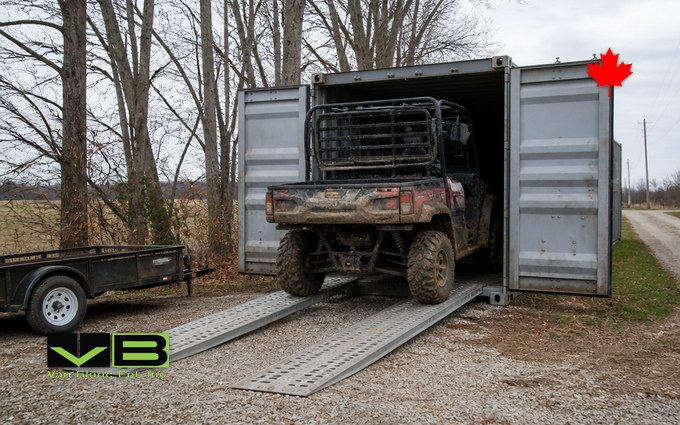
Built to ISO size codes, a shipping container is a welded steel box. It has corrugated walls, a sealed roof, cargo doors on one end and a plywood deck over cross-members. As UTV storage, it is a locked machine shed that arrives built. The truck sets it on a pad, the ramp goes against the sill, and the machine rolls in the same afternoon.
The two lengths answer two common needs. A 20ft usually suits one machine and its gear. A 40ft usually suits the machine and the trailer it rides on. Every figure in this table is taken from Van Blanc’s product pages, beginning with the 20-footer’s measurements in metric and imperial.
| Container | Floor length inside | Width inside | Height inside | Cargo door, wide x high |
|---|---|---|---|---|
| 20ft standard | 5.898 m (19 ft 4 in) | 2.352 m (7 ft 8 in) | 2.385 m (7 ft 10 in) | 2.340 x 2.292 m |
| 40ft standard | 39 ft 6 in (12.040 m) | 2.337 m (92 in) | 2.388 m (94 in) | 2.340 x 2.292 m |
| 20ft or 40ft high cube | Same as standard | Same as standard | About one foot more | 2.340 x 2.597 m |
20ft for One Machine and Its Gear
A 20ft gives a quad or a compact side-by-side 5.898 m of floor. As a rule of thumb, that leaves room behind the machine for a wall of helmets, a plow blade, spare tires and the cargo boxes. Back the machine in so it sits nose out near the doors, and spring starts with a short push down the ramp. Shelving hooked to the back wall keeps the small parts off the floor and out of the mice’s reach.
A 20ft new high cube is on Van Blanc’s stock list too, and its door opening stands 2.597 m high. That extra height helps a side-by-side with a tall roll cage or a roof rack.
40ft for the Machine Plus Its Trailer
A 40ft runs 12.040 m inside, which is the length to consider when the trailer comes too. Measure the trailer’s overall length with the tongue, then add the machine if it stays on the deck. Check the trailer’s width at the fenders against the 2.340 m door opening. The 40ft dry box’s floor and lashing figures are on its product page, and they matter for a loaded trailer. Owners who winter more than one trailer can read how Ontario trailers spend the cold months for the tires, bearings and battery on that side.
Door Height, the Sill and a Loading Ramp
Height is the measurement to take first on a side-by-side. Take the overall height from your owner’s manual or a tape, including any roof, light bar or mirror. Compare it with the 2.292 m standard door. If it is close, a high cube’s 2.597 m door gives the extra margin. Van Blanc’s 40ft page puts the floor 170 mm (6.7 in) above the ground, so a machine climbs a step to get in.
“After 19 years sourcing containers, I know side-by-side owners measure the length and forget the height. A cab with a light bar can miss a standard door by an inch, and that’s the buyer I point to a high cube.”
Paul LeBlanc, owner, Van Blanc
A ramp turns that step into a slope. Van Blanc stocks a container ramp rated for 6.5 tonnes. It runs 1,542 mm deep, stands 145 mm high and spans 2,000 mm across. Choosing a rated ramp for the machine that rolls in covers the alternatives, from steel to heavy poly. Put the ramp on the same order as the box.
Double Doors, Open Sides and Roll-Ups
The standard cargo doors suit most owners. Van Blanc also stocks a 20ft new double door, with cargo doors at both ends. A machine drives in one end and out the other, so nothing has to back down a ramp. The tunnel box with doors at each end explains how that layout loads. A new full open side 20ft opens along its long wall, and the open side container’s spec page sets out the panels. For a single wide opening on any face, the modifications built at our yards include a roll-up door 6, 7, 8 or 10 feet wide.
Vents, Tie-Downs and Locks for a Quad Box
A quad box needs air, anchor points and a lock that resists bolt cutters. Each one follows from the makers’ rules above. Polaris wants a well-ventilated storage area and Can-Am warns about moisture buildup. Van Blanc’s large metal air vent measures 330 by 330 mm and can be installed before the box ships.
Lashing points are already built into the steel of a Van Blanc box. Van Blanc’s 40ft page, citing Hapag-Lloyd figures, rates each lashing point on the rails and corner posts at 1,000 kg. A machine strapped to them cannot roll into the doors on a frosty morning. Owners who move gear in and out often can add rails, and e-track and ratchet straps inside a steel box shows how that is done.
Security is where steel earns its keep. A quad has a resale market, which makes it a target on a quiet rural lot. A lockbox welded over the padlock leaves bolt cutters nothing to grip, and how a welded lockbox shields the padlock explains the hardware. A camera on the doors adds a record, and cameras watching a container on a rural lot covers power and placement. Tell your insurer the machine and the box are on the property.
Measure the Machine, Then Call
Tell us the machine, its overall height, and whether the trailer comes too. The fastest answer is a call. We will tell you twenty or forty, standard or high cube, the door and the ramp, with one all-in number and a real lead time.
Family-run in Brantford since 1995 · 4.9★ across 140+ Google reviews
Machine Shed Grades: New or Used Steel
Van Blanc sells four grades, and which one fits is the owner’s call. A new box, which the trade calls one-trip because it made a single loaded voyage, has factory paint and the longest service life. Cargo worthy boxes are used units, 8 to 15 years old, with a re-certified plate and surface rust. Wind and watertight boxes are 12+ years old, with a sealed roof and floor and heavier surface rust. As-is units are donor shells for heavy custom builds.
For a machine shed, the doors and gaskets matter most, because they keep out mice and blown snow. Walk the box before you pay and work both door handles. New boxes with factory paint and tight seals suit a shed that sits in view of the house. A used box suits a back-forty spot behind the barn. To see every size and grade together, the full lineup across our yards lists them. What each size and grade sells for is posted publicly.
“For a quad shed out behind the barn, I’ll pull a wind and watertight unit off my list. It’s done its years at sea, but the roof and floor still keep a machine and its spare tires dry through an Ontario winter.”
Paul LeBlanc, owner, Van Blanc
Every Van Blanc box is sold outright. To spread the cost, an owner can arrange an equipment loan or a line of credit at their own bank. We supply the invoice and the container number the lender asks for. Payment happens when the box arrives: draft cheque, cash, wire transfer, or a credit card through our authorization form.
Delivery to Sudbury, Peterborough and Woodstock
A machine shed needs a level, firm spot and room for the truck. A compacted gravel base under the corner castings holds the frame level. A level frame keeps the cargo doors swinging shut after a frost heave. Van Blanc’s new container page lists the straight run: 75 to 100 feet when dropping a 20ft, and 120 to 130 feet for a 40ft. The truck also wants about 12 feet of width and 14 feet clear overhead, or 16 feet for a high cube.
“On a quad drop, I ask which way the lane runs before the truck tilts. With the doors toward it, spring means pushing the machine down the ramp in neutral and starting it out on the gravel, clear of the steel.”
Christian LeBlanc, second-generation operator, Van Blanc
Rural lots raise their own questions, from a soft laneway to a sagging hydro line, and what a concession-road drop needs works through them. Booking before freeze-up is easiest. A December order is still delivered, and a drop onto frozen ground walks through how.
From our 4 Brantford yards, a Van Blanc box reaches any Ontario address in 1 to 3 days. Quad owners around Greater Sudbury and the Nickel Belt get the same window. So do riders near Peterborough and the Kawartha trail country, and machine owners on farms around Woodstock in Oxford County. Permits are managed by your municipality, so check with your local building or planning department before you order.
Spring Start-Up After ATV Storage
Spring start-up undoes the storage steps in reverse, outside the building. Can-Am’s spring checklist starts with an inspection for damage, paying attention to the tires, battery and fuel system. Then it reinstalls the battery and fills the tank with fresh fuel. It runs a full safety check on the brakes, tires and lights, and reapplies lubricant to moving parts that dried out.
Honda Canada adds two jobs. Change the oil if the machine was stored for more than four months. Clean the battery terminals with a wire brush and coat them with dielectric grease. Check the battery’s voltage before it goes in, and charge it if it reads under Yuasa’s 12.4 volt mark. Then roll the machine down the ramp and into the yard before you start it.
The box does not sit empty all summer, and some owners keep it as a steel garage all year. The plow blade, the winter tires and the snowblower can move in when the machine moves out. If the summer pile outgrows a twenty, the size chart that sets each length side by side shows the step up. Call Van Blanc at 519-754-6844 with the machine, its height and the trailer length. We will send back a size, a door and a delivery date.
Frequently Asked Questions
How do you winterize a UTV?
Wash and dry it, grease the moving parts, fill the tank and add stabilizer, then run the engine outdoors as your manual directs. Change the oil and filter, test coolant strength, and fog the engine if the manual calls for it. Take the battery somewhere above freezing on a maintainer. Set tire pressure, and store the UTV in a dry, ventilated, locked space under a breathable cover.
Can you store an ATV upright?
None of the maker storage guides we checked, from Polaris, Can-Am and Honda Canada, describe storing an ATV on its end. All of them store the machine on its wheels or on stands. Polaris supports a quad with its tires slightly off the ground, and Can-Am suggests stands or blocks. Ask your dealer before trying anything else.
Can you use regular antifreeze in an ATV?
Use the coolant your owner’s manual names. Polaris recommends its own Antifreeze 50/50 Premix, which comes ready to use, and says not to dilute it with water. It also recommends draining the system every five years and refilling with fresh premix. If you are unsure what is in the machine now, have the dealer test and replace it.
How do you start an ATV that has been sitting a long time?
Inspect it first for damage to the tires, battery and fuel system, as Can-Am suggests. Charge and reinstall the battery, add fresh fuel, and change the oil if it sat more than four months, per Honda Canada. Roll it outside before starting, because Polaris warns never to run the engine in an enclosed area.
Is it okay to store an ATV outside in winter?
It can be done. Can-Am describes it for owners with no other choice: a high-quality, weatherproof cover, in a dry, well-ventilated spot. The makers prefer indoors: Can-Am calls indoor storage ideal, and Honda Canada prefers an indoor, secure space. Indoors also keeps the machine out of sight and harder to steal.
What size container fits an ATV and a trailer?
A 40ft container, at 12.040 m inside, usually fits a machine and its trailer, while a 20ft suits one machine and its gear. Measure the trailer’s overall length with the tongue and its width at the fenders against the 2.340 m door. Check a side-by-side’s height against the 2.292 m standard door.
Sources
- Polaris Inc. 2020 RANGER XP 1000 Owner’s Manual: Storage Tips, with its Battery Storage, Fluid Levels, Adding or Changing Coolant and Exposure to Exhaust pages. Also the 2022 Phoenix 200 Owner’s Manual: Storage Tips. Checked November 2026.
- BRP. Can-Am Off-Road: How to Winterize an ATV or SxS for Winter? Checked November 2026.
- Honda Canada. Honda Powersports Canada: Seasonal Tips. Checked November 2026.
- Fuel safety in Ontario, from the TSSA (Technical Standards and Safety Authority): SafetyInfo, how to transport and store fuel, checked November 2026.
- GS Yuasa. Yuasa: Essential Winter Storage Guide for Powersports Batteries. Checked November 2026.
- Sudbury winter temperatures from Environment and Climate Change Canada: 1991-2020 normals for the Sudbury A station, checked November 2026.
Measure a Machine Shed at Morton Avenue
We have been supplying shipping containers across Ontario since 1995. Of our 4 Brantford yards, the one at 90 Morton Avenue East is open to visitors.
Van Blanc Ent. Inc., 90 Morton Ave E Unit 1B, Brantford, ON N3R 7J7, 519-754-6844.
Hours there run 9:30 to 5 from Monday to Thursday and 9:30 to 4 on Friday, and nobody needs an appointment. Bring the machine’s height and the trailer’s length, then stand in a twenty and a forty before you choose. Worth the drive for unbeatable quality, family customer service with 30 years of experience.