
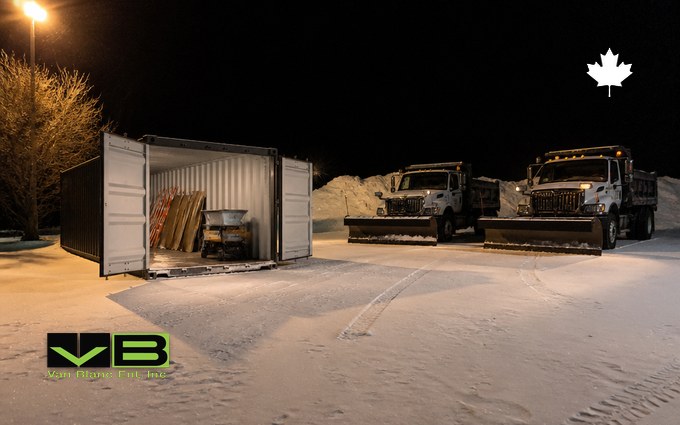
Quick Answer: To start a snow removal business in Ontario, choose residential or commercial routes and register any trade name. Buy commercial insurance, check CVOR and WSIB rules, and sign written seasonal or per-push contracts by November. Then a Van Blanc 20ft usually holds the depot’s blades, parts, stakes and bagged salt.
From Paperwork to Plow Depot
- How to Start a Snow Removal Business in Ontario
- Snow Routes: Driveways, Lots or Subcontracting
- Registering a Snow Plow Business
- Snow Removal Business Insurance
- WSIB Before the First Hire
- Plow Trucks, CVOR and Licence Class
- Snow Removal Equipment by Route
- Snow Contracts: Seasonal, Per Push or Hourly
- The 60-Day Notice for Slip and Fall Claims
- Cash Flow Through an Ontario Winter
- Selling Contracts Before November
- Snow Plow Depot Storage in a Container
- Placing a Depot Box Before Freeze-Up
- Plow Contractor Checklist, August to November
- FAQs
Reading Time: 17 minutes
How to Start a Snow Removal Business in Ontario
A snow removal business is a contractor that clears snow and ice from driveways, lots and walkways for paying clients. The work usually runs under a written contract signed before the first storm. Van Blanc Ent. Inc. has sold shipping containers from 4 Brantford yards since 1995. Our guides already show how trades fit one out, such as an electrician’s wire-and-parts room. This guide covers the snow business first and the storage last.
In Ontario the work is simple to describe and slower to set up. The filings and the contracts both need to be done by November. The first heavy snowfall does not wait for a business name to clear. This order keeps the paperwork ahead of the snow.
- Pick the work: driveways, commercial lots, walkways, or subcontracting to a bigger outfit.
- Register any trade name you will work under, and get a CRA business number.
- Buy commercial insurance and tell the insurer about the plow.
- Check whether the truck needs a CVOR certificate and whether your licence class covers the trailer.
- Ask WSIB whether your business must register; if it must, the deadline is 10 calendar days after you hire your first employee.
- Buy the machines and the spare parts that keep them running.
- Write contracts that name the trigger depth, the fee structure and who decides on ice melt.
- Set up a depot where the gear and stakes wait between storms, with e-track rails on the walls to hang it from.
The last step is where a container earns its keep, as a locked, dry room for everything not bolted to a truck. Paul LeBlanc, who runs Van Blanc with his son Christian, puts the depot question this way.
Paul LeBlanc, owner, Van Blanc Ent. Inc.: “Plow contractors tend to tell me about the trucks first. I ask about everything that is not bolted to a truck: the spare cutting edges, the shoes, the hoses, the stakes, the pallets of bags. Pile it all on a shop floor in September and it tells you whether the depot wants a twenty or a forty.”
Snow Routes: Driveways, Lots or Subcontracting
Snow removal routes come in a few shapes. A landscaping company that adds snow already owns trailers, a yard and a customer list. Town works yards plow the same storms on public roads, and how a town works yard stores its winter kit shows that kind of depot at a larger scale. Residential routes are driveways and front walks, sold door to door or by word of mouth. They pay for many short stops in one night. Commercial routes are plazas, offices, condo lots, churches and industrial yards. Owners and property managers buy them, and they expect a written contract and a certificate of insurance before the season.
Snow Wolf, a plow maker, advises new owners to start small. It notes that larger companies tend to hold the mall, hospital and government contracts. It also suggests subcontracting as a way to learn the trade with lower overhead. Most companies, it says, only ask a subcontractor for a truck with a plow. Whichever route you pick decides what you buy and what you insure. A crew with a summer trade has two fleets to store, and wire deck shelving that keeps summer gear off the floor frees room for the winter kit.
Registering a Snow Plow Business
Business Name Registration in Ontario
Ontario’s Business Names Act says no individual may carry on business under a name other than their own unless that name is registered. Partners must register the partnership’s firm name. A trade name on the truck door goes through the Ontario Business Registry. The same name can go on the depot box, with paint and lettering added at our yards before delivery. Plowing under your own name does not trigger the rule. Section 4 of the Act makes a registration effective for five years. Sole proprietor or corporation is a liability and tax decision for an accountant.
CRA Business Number and HST
The Canada Revenue Agency issues the business number a business needs before it can open a GST/HST or payroll account. File every equipment invoice with its serial number from day one. Before any big purchase, a depot box included, run the paper checks to make before money changes hands. HST registration turns on the CRA’s small supplier test. A business that stays under the threshold over four consecutive calendar quarters is a small supplier and need not register. One that passes it in a single calendar quarter must register, effective no later than the day of the sale that crossed it. Small suppliers can also register voluntarily, and the CRA’s page carries the current figures.
Snow Removal Business Insurance
Snow removal business insurance starts with commercial general liability. That is the policy that answers when someone slips on a lot you cleared, or a blade clips a curb. Zensurance, an online broker, describes snow removal insurance as cover for third-party bodily injury and property damage claims. It adds damage to equipment and property. Commercial clients will ask for proof. Landscape Ontario’s standard form snow contract has the contractor show proof of its liability insurance and workers’ compensation compliance when the owner asks.
Theft of tools is a claim a locked depot can prevent, and Van Blanc’s padlock-against-lockbox comparison covers the hardware. The Insurance Bureau of Canada lists the other common commercial policies, including commercial auto, commercial property and business interruption. IBC says commercial property insurance protects a business’s physical assets against loss from causes such as severe weather and vandalism. Plant and equipment are on its list, and so are tools used off-site for the business. A camera watching the depot box keeps an eye on them between storms.
Business interruption cover replaces revenue or lost profit when a covered peril shuts the business down. Auto insurance is mandatory across Canada. A pickup that plows for paying clients belongs on a policy written for that use. Tell the broker about the blade, the spreader and the trailer.
WSIB Before the First Hire
WSIB registration comes with a deadline. The Workplace Safety and Insurance Board says most Ontario businesses with employees must register, family members and sub-contractors included. A business has 10 calendar days from the day it hires its first employee. WSIB also says coverage is not mandatory for every business, because the Government of Ontario decides which industries and employees must be covered. Owners, partners, sole proprietors and independent operators can apply for their own coverage, as long as their employees are covered. A solo operator should still call WSIB before the season, since one paid helper on shovels can change the answer. Safety gear belongs at the depot too, starting with a properly rated extinguisher inside the steel box.
Plow Trucks, CVOR and Licence Class
A plow truck can bring a snow business under Ontario’s commercial vehicle rules. The province requires a Commercial Vehicle Operator’s Registration (CVOR) certificate for trucks over 4,500 kg, by registered gross weight or actual weight. Pickups are exempt only when all four of these conditions hold.
- a manufacturer’s gross vehicle weight rating of 6,500 kg or less;
- use for personal purposes without compensation;
- the original box, or an unmodified replacement;
- no trailer carrying commercial cargo, tools or equipment.
A pickup plowing for paying clients fails the second condition, so check its registered weight against the 4,500 kg line before the first contract. The driver’s licence is the next check. Ontario’s Class G covers a vehicle and towed vehicle together up to 11,000 kilograms. The towed vehicle itself cannot be over 4,600 kilograms. Weigh the loaded equipment trailer, not the brochure number. Plan the depot around the trucks, too. Point the box’s doors where a plow truck can back straight up. Leave the lane clear for the tilt-deck truck that sets the box down.
Snow Removal Equipment by Route
Snow removal equipment follows the route, and the wrong machine costs money twice. Finning’s startup checklist makes the point with a mall. A skid steer’s large plow could damage the sidewalks and entrances there. A UTV with a front plow and a rear salt spreader fits down the walk. The checklist also warns that a metal blade on a rooftop can do serious damage. Match each machine to the surfaces in the contract. Then stage its spares the way a volunteer search team stages its callout cache, ready for a 3 a.m. start.
| Route | Main machine | Support gear | Spares to stock |
|---|---|---|---|
| Residential driveways | Pickup with a plow, walk-behind snowblowers | Shovels, push spreader, driveway markers | Cutting edges, plow shoes, shear pins, belts |
| Small commercial lots | One-ton truck with a plow and tailgate spreader | Snowblower for entrances, shovels | Cutting edges, hydraulic hoses, spreader parts |
| Large lots and plazas | Skid steer or loader with a pusher box | Plow trucks for laneways | Edges, hoses, fittings, filters, work lights |
| Walkways and entrances | UTV with a plow and spreader | Walk-behinds, shovels, bagged ice melt | Shear pins, belts, spark plugs |
Behind every machine sits a pile of spares. Long, flat stock like cutting edges stores best on cantilever arms that keep long stock off the floor. Finning tells new owners to plan for breakdowns, since a broken part mid-storm can still cost a contract penalty. The usual list runs to cutting edges, plow shoes, pins, hydraulic hoses, and the bulbs and wiring in the light bar. Snow stakes mark curbs and islands so the plow can find them under a drift. They go in before the ground freezes and come out in spring.
Snow Contracts: Seasonal, Per Push or Hourly
A snow contract has to say what the contractor does, when the crew shows up, and how it gets paid. Start with the site map: plow lanes, priority entrances, snow piles, and any storage box, with the open ground a delivery truck needs marked out. The Snow and Ice Management Association (SIMA), a US-based trade association for snow contractors, defines the common fee structures in its glossary. These are industry terms from a US trade body, so an Ontario contract still has to spell out what each one means.
| Fee structure | How it bills, per SIMA | Who carries a heavy winter |
|---|---|---|
| Per season (seasonal, lump sum) | A standard fee, typically monthly, over the contract period | The contractor |
| Per event | A fee each time an event, as the contract defines it, occurs | Shared, by the event terms |
| Per service (per push, per salt) | A fee each time a salt application or a clearing is completed | The client |
| Time and materials (hourly) | Labour and equipment time plus materials such as deicers, sand and stakes | The client |
Two more SIMA terms belong in every contract, spelled out the way Van Blanc’s written container quotes state size, grade and lead time. Trigger depth is the agreed, measurable amount of snow or ice that sends the crew out. Level of service describes the surface condition the client can expect at set times. SIMA notes that a label like zero tolerance does not set a level of service by itself. Put real depths and completion times behind it. Every quote comes with a real lead time, not a hopeful one.
Ontario contractors also have a local template. Landscape Ontario’s standard form snow and ice maintenance contract, offered to its members, has two parts. General Conditions apply to every job, and a Schedule A sets out the work and the payment. Robert Kennaley, the construction lawyer who led the drafting, wrote a guide to the form. He says a site map should be attached as a drawing. If a depot box will sit on that site, mark the overhead and side clearance its delivery needs on the map. Kennaley’s guide describes the contractor clearing once, then returning within 24 hours of the end of the snowfall to clean up. The parties can cap how many snowfalls the fixed price covers. The form’s indemnity clause asks the owner to give notice of a claim within 48 hours of first learning of it. His guide also has the parties pick who decides on ice melting products: the contractor, or the owner by written request. Either way the bags have to stay dry until they are spread, and keeping road salt and sand dry through a winter covers that side.
The 60-Day Notice for Slip and Fall Claims
Ontario’s Occupiers’ Liability Act carries a deadline every snow contractor should know. Section 6.1, added by a 2020 amendment, covers personal injury caused by snow or ice. No action can be brought against an occupier, or the independent contractor it hired to remove snow or ice, without written notice. Within 60 days of the injury, the notice has to be served personally on, or sent by registered mail to, at least one of them. It must give the date, time and location.
The section reaches contractors directly. An occupier that receives the notice must pass a copy to any snow contractor it hired for that period. A contractor that receives one must pass it to the occupier. Missing the 60 days does not bar a claim if the injured person dies as a result of the injury. Nor does it bar one when a judge finds a reasonable excuse and no prejudice to the defence. What protects a contractor then is the paper trail, kept on wall shelving bolted inside a container rather than loose in a truck cab.
In a Landscape Ontario article on slip and fall claims, Kennaley tells contractors to open mail from clients and insurers promptly. He also says never to discuss a claim with the claimant before telling the insurer. The file he wants handed to the insurer holds the contract, records of the work performed, training programs and the policies staff have signed.
Cash Flow Through an Ontario Winter
Seasonal cash flow is the part of a snow business the equipment list hides. Snow arrives unevenly by month and by city. Environment and Climate Change Canada’s 1991-2020 climate normals show it, station by station. Ottawa’s airport averages 231.9 cm a year, while Toronto Pearson averages 114.5 cm. An Ottawa route sees about twice the snow of a route near Pearson. Booking does not differ, since depot boxes for Ottawa plow contractors come on the same 1-3 day schedule.
| Month | Ottawa Airport, average snowfall | Toronto Pearson, average snowfall |
|---|---|---|
| November | 20.7 cm | 9.3 cm |
| December | 49.6 cm | 24.1 cm |
| January | 59.2 cm | 31.5 cm |
| February | 48.5 cm | 27.7 cm |
| March | 38.8 cm | 17.2 cm |
| April | 12.2 cm | 4.5 cm |
| Year | 231.9 cm | 114.5 cm |
Averages smooth over the swing from one winter to the next, and the fee structure decides who absorbs it. Per-push and hourly work pay more in a heavy winter and less in a light one. A seasonal contract gives the contractor even income, and the contractor carries the big year. A book that mixes the two spreads the risk. Seasonal contracts cover the truck payments and the insurance, and per-push work adds income in heavy months. Container stock moves through the year too, and the month-by-month view of container demand helps time the depot purchase.
The Business Development Bank of Canada offers seasonal businesses three moves that suit plowing. Ask the lender for terms that put more principal into the high season and less into the low one. Use a line of credit to bridge payables and receivables until a cash buffer exists. And ask clients to pay sooner. BDC notes that a client given 45 days may pay in exactly 45 days. Asked, the same client might be just as happy to pay in 30. A depot box can go on the same bank loan as the plow. The 20ft page’s answer on spreading the cost lists what a lender asks for.
Selling Contracts Before November
Selling snow contracts starts in late summer. Snow Wolf calls door-to-door selling the best way to sign residential clients. In a snow belt, it says, August and September are not too early, while evenings are still light. For commercial work it suggests starting local, with small businesses, the township and community centres. Property managers buy on paper, so bring a one-page proposal. Put the trigger depth, the fee structure, a certificate of insurance and a site map sketch on it.
Finning’s checklist closes on partners: legal, accounting, insurance, financing, equipment and software, plus groups such as SIMA and the local landscape association. It also asks owners to write down how they want customers to see them, such as fast, reliable or family-run. Carry that through every truck, every invoice and the depot itself. Other trades set up depots the same way, and the HVAC and plumbing crew’s container layout shows racking and parts bins laid out for a crew.
Snow Plow Depot Storage in a Container
A snow plow depot is the yard where the trucks park, the crews meet, and the season’s spares wait between storms. The trucks can sit outside; the rest should not. Cutting edges rust in a pile, and bagged ice melt under a tarp takes on water. A spare hose left in a truck bed tends to disappear. A shipping container from Van Blanc gives that pile a steel room, closed with a puck lock that leaves bolt cutters nothing to grip. It sits on a gravel pad with the doors set toward the trucks.
What the Depot Box Holds
- Spare cutting edges, plow shoes, pins and hydraulic hoses, on racks along one wall.
- Snow stakes and curb markers, bundled for the fall install and the spring pickup.
- Bagged salt and ice melt on pallets, off the floor.
- Walk-behind snowblowers, shovels and scrapers for the walkway crew.
- Spreader parts, a spare light bar and the bulbs that fail at three in the morning.
- Site maps, signed contracts and work logs in a dry file box.
20ft or 40ft at the Plow Depot
The 20ft and the 40ft share the same width, height and door, so length is the choice. The figures below come from Van Blanc’s product pages, starting with the 20ft’s full spec page.
| Measurement | 20ft dry container | 40ft dry container |
|---|---|---|
| Inside length | 19 ft 4 in (5.898 m) | 39 ft 6 in (12.040 m) |
| Inside width | 7 ft 8 in (2.352 m) | 7 ft 8 in (2.337 m) |
| Inside height | 7 ft 10 in (2.385 m) | 7 ft 10 in (2.388 m) |
| Door opening | 7 ft 8 in by 7 ft 5 in (2.343 by 2.280 m) | 7 ft 6 in by 7 ft 8 in (2.286 by 2.337 m) |
| Volume | 1,172 cu ft (33.2 m³) | 2,395 cu ft (67.8 m³) |
| Standard 48 by 40 inch pallets | 10 | 20 |
As a rule of thumb, a 20ft suits a depot running a handful of trucks. Racks go down one wall for edges and stakes, pallets of bagged product down the other, and the blowers sit by the doors. A 40ft suits a contractor who stocks a whole season of bagged product at once, or parks walkway machines inside. Check any UTV or sidewalk machine against the 7 ft 5 in door height first. The 40-footer’s weights and floor ratings matter for heavier loads. Drawing the pallet layout before the box arrives settles the size faster than a guess.
One Box per Depot, More as Routes Grow
Start with one 20ft at the main depot. Add a second box where the work concentrates, such as a hospital, plaza or condo lot on contract. The walkway crew there can keep its blowers and bagged ice melt on site, once the owner gives a written okay for the spot. Each satellite depot a growing route adds usually takes its own box. Van Blanc’s product pages list a per-box discount on delivery for multi-bin orders starting at three units. To weigh a twenty against a forty in each grade, see the complete lineup we sell, size by size and grade by grade.
Call With the Pile List
Tell us the depot address, how many trucks run from it, and what sits in the pile. The fastest answer is a call. We will tell you twenty or forty, the grade, the door and the vents, with one all-in number and a real lead time.
Family-run in Brantford since 1995 · 4.9★ across 140+ Google reviews
Grade, Doors and Vents for Plow Gear
Grade is the buyer’s choice, and Van Blanc sells four: one-trip, cargo worthy, wind and watertight, and as-is. Van Blanc’s graded used boxes, cargo worthy and wind and watertight, are dry and lockable and show their years in rust spots and paint. A new container with factory paint has the longest service life and holds its resale value best. That counts on a client lot that tenants and shoppers pass daily. The trade calls these one-trip boxes because they made a single loaded voyage before reaching us. As-is units are donor stock for builds.
The standard cargo doors open the full 7 ft 8 in width. A crew that opens the box many times a night may prefer a roll-up door, fitted at our yards. Check whether the walkway UTV wants an 8 or a 10 foot roll-up before you order. Wet gear brought into a cold box will sweat, so add a pair of vents high on the walls and keep pallets off the floor. Steel parts and bagged product sit fine in an uninsulated box. Insulation is worth adding when the box doubles as a warm-up room for the crew.
Placing a Depot Box Before Freeze-Up
A depot box needs a flat, firm spot and room for the delivery truck. A level base of compacted stone keeps the box square, so the doors keep closing through freeze and thaw. Order before freeze-up if you can. A winter order still lands, and what a delivery onto frozen ground involves is covered step by step.
Van Blanc boxes leave our 4 Brantford yards and reach most Ontario depots in 1-3 days, Eastern Ontario runs included. Plow contractors in Barrie and the Simcoe County towns around it sit inside that window. So do depots across Kitchener, Waterloo and Cambridge and contractor yards along Brampton’s industrial roads. Ottawa orders are worth booking first. Permits are managed by your municipality, so check with your local building or planning department before you order.
Buy from a yard you can walk, or see the box on a video call with its container number in frame. A listing far below every Ontario yard that wants a deposit first is the scam pattern. Walking a yard against buying online sets out why.
Plow Contractor Checklist, August to November
- August: choose the routes, register the business name if it differs from yours, and get the CRA business number.
- August and September: knock on doors, call property managers, and get insurance quotes that name the plow and the trailer.
- September: check each truck’s registered weight against the CVOR line and each trailer against the Class G towed limit.
- September: pile the spares, stakes and bagged product on a floor, then compare the pile with inside dimensions for every standard container size.
- October: sign contracts with the trigger depth, the fee structure, the ice melt decision and a site map.
- October: put the depot box on its pad, then install racks, vents and the lock.
- October: before the first hire, ask WSIB whether snow removal work must be covered, and if so, register within 10 calendar days of hiring.
- November: set stakes before the ground freezes, test every truck, and start the work logs.
Call Van Blanc at 519-754-6844 with the depot address and the pile list. We will send back a size, a grade and a delivery date.
Frequently Asked Questions
Do you need a licence for snow removal in Ontario?
Ontario’s rules for a snow removal business come in pieces. Register a business name that differs from your own under the Business Names Act. Get a CVOR certificate if a truck’s registered or actual weight tops 4,500 kg, and hold a licence class that covers the truck and trailer. Once you hire, check with WSIB, since most Ontario businesses with employees must register within 10 calendar days. Ask your municipality whether it licenses snow plowing locally.
What do you need to start a snow removal company?
Start with a route plan, a registered trade name if you use one, and a CRA business number. Add commercial liability and auto insurance, a machine sized to the route, spare parts, stakes, written contracts and a depot. Finning’s checklist adds a plan for breakdowns and a network of legal, accounting, insurance, financing and equipment partners. A 20ft container from Van Blanc gives the depot a locked room for the spares.
Is snow plowing a good side hustle in Ontario?
It can be, if the day job allows overnight and early-morning work. Snow Wolf suggests subcontracting as a low-overhead start, since most companies only ask a subcontractor for a truck with a plow. Before taking pay, check the CVOR rules for the truck, tell your insurer about the plow, and register the business name if you use one.
Is a snow removal business profitable?
It depends on the winters and the contracts. Seasonal contracts give steady monthly income but leave the contractor carrying a heavy winter, while per-push and hourly work earn more when it snows more. The same terms play out differently in Ottawa, which averages about twice Toronto Pearson’s snowfall. Plan for breakdowns, insurance, and machines that sit idle in a light winter.
Where should a snow removal business store its equipment?
Trucks and loaders can park outside at the depot. Spare cutting edges, hoses, stakes, walk-behind snowblowers and bagged ice melt belong in a locked, dry room on a gravel pad. A shipping container from Van Blanc does that job, with vents for wet gear and racks for long stock. A second box can sit on a large client lot with the owner’s written okay.
What size container does a snow plow depot need?
A 20ft usually suits a depot with a handful of trucks, with racks on one wall and pallets of bagged product on the other. A 40ft suits a contractor stocking a whole season of bagged product or parking walkway machines inside. Both share the same door, so measure any machine against its height before you choose.
Sources
- Government of Ontario. Occupiers’ Liability Act, section 6.1; Business Names Act, sections 2 and 4; Commercial vehicle operator’s registration (CVOR); MTO Driver’s Handbook, Getting your driver’s licence. Checked October 2026.
- Workplace Safety and Insurance Board. WSIB, How to register your business and WSIB, Can I choose to have WSIB insurance? Checked October 2026.
- Canada Revenue Agency. CRA, When to register for and start charging the GST/HST and CRA, When you need a business number or program account. Checked October 2026.
- Environment and Climate Change Canada. Canadian Climate Normals 1991-2020, Ottawa Airport and Canadian Climate Normals 1991-2020, Toronto Pearson Airport. Checked October 2026.
- Landscape Ontario. Robert Kennaley, Using the Standard Form Snow and Ice Maintenance Contract and Winter maintenance contracts: Managing slip and fall claims. Checked October 2026.
- Snow and Ice Management Association. SIMA, Snow and Ice Management Standard Glossary of Terms. Checked October 2026.
- Business Development Bank of Canada. BDC, Managing cash flow in a seasonal business. Checked October 2026.
- Insurance Bureau of Canada. IBC, Types of business coverage. Checked October 2026.
- Equipment and broker guides: Finning, Checklist: How to start a snow removal company in Canada; Snow Wolf, How to start a seasonal snow removal business; Zensurance, How to start a snow removal business in Canada. Checked October 2026.
See Depot-Sized Boxes in Brantford
We have been supplying shipping containers across Ontario since 1995. Our public yard at 90 Morton Avenue East is one of our 4 Brantford yards, and it is the one to visit in person.
Van Blanc Ent. Inc., 90 Morton Ave E Unit 1B, Brantford, ON N3R 7J7, 519-754-6844.
Come Monday to Thursday from 9:30 to 5, or Friday from 9:30 to 4, with no appointment. Bring the pile list and the depot measurements, and ask to stand inside a twenty and a forty before you choose. Worth the drive for unbeatable quality, family customer service with 30 years of experience.