
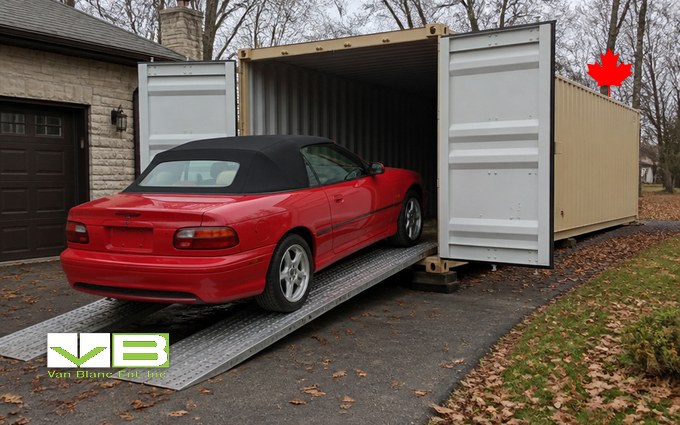
Quick Answer: Storing a car for winter in Ontario takes six steps before salt season. Clean it, stabilize a full tank, maintain the battery, plug openings against mice, set the tires and call your insurer. Van Blanc delivers an indoor spot, a 20ft or 40ft high cube, in 1 to 3 days.
The Winter Lay-Up, Section by Section
- Storing a Car for Winter in Ontario, Step by Step
- Wash, Wax and Dry It Before November
- Fuel Stabilizer and a Full Tank
- Battery Tender or Battery Out?
- Tires, Jack Stands and Flat Spots
- Mice, Exhaust Covers and Baking Soda
- Car Insurance in Storage: OPCF 16
- Indoor Car Storage Options in Ontario
- Winter Car Storage in a Container You Own
- Door Width, Ramps and the Sill
- Vents, Damp and a Steel Roof
- Car Box Grades: New or Used
- Delivery to Toronto, Mississauga and Hamilton
- Taking the Car Out in Spring
- Frequently Asked Questions
Reading Time: 15 minutes
Storing a Car for Winter in Ontario, Step by Step
Winter car storage is the stretch from late fall to spring when a car comes off the road and sits, prepared, somewhere dry. In Ontario the trigger is usually salt. The City of Toronto alone typically spreads between 130,000 and 150,000 tonnes of road salt on its streets each winter. A convertible, a summer car or a classic with good paint has every reason to miss that season. Auto shops pull summer tires off the road for the same reason. The tire hotels they run out of steel boxes fill up every November.
Storing a car for winter well comes down to six jobs, done in roughly this order.
- Wash, wax and dry the car, inside and out.
- Fill the tank and treat the fuel with a stabilizer.
- Look after the battery: a maintainer, or out of the car to a place where it will not freeze.
- Set the tires up for months of standing.
- Close the openings mice use and pull damp out of the cabin.
- Call your insurer about the change in use.
The steps below follow the product makers, a fuel safety regulator and a collector-car insurer. After the steps comes the question most owners hit next: where does the car physically spend the winter? Van Blanc Ent. Inc. is a family container business in Brantford, Ontario, run by Paul LeBlanc and his son Christian. The company dates from 1995, and the family runs it from 4 Brantford yards. The second half of this guide covers a steel box on your own driveway, sized to the car. A collector’s container beside the house shows the same idea from a classic owner’s side.
Wash, Wax and Dry It Before November
Dirt holds water against paint and steel, so the car goes into storage clean. Wash the body, then get under it: wheel wells, rocker panels and the underside where fall road grime collects. Hagerty, the collector-car insurer, says a wash and wax matter most when a cover is going on, and it calls a cover advisable. Dry the car fully before it goes in. A damp car parked in a closed space puts its own water into the air around it. That holds under any roof, including a portable garage on the driveway.
“When a buyer tells me a summer car is going in the box, I ask if it will go in dry. A car rolled in wet from the wash puts that water on the steel roof the first cold night.”
Christian LeBlanc, second-generation operator, Van Blanc
The inside matters as much as the paint. Vacuum out every crumb and wrapper, because food is what draws mice into a cabin. Hagerty suggests some boxes of baking soda in the trunk and the interior to pull lingering moisture out of the air. Inside a closed box, moving damp air out through vents does the rest. Leather and vinyl do better with a conditioner before a long sit. Lift the wiper arms off the glass, or lay a cloth under the blades, so the rubber does not set against the windshield.
Change the oil and filter too. Hagerty’s storage guide recommends doing it before storage, with a corrosion-resistant, rust-preventive oil.
Fuel Stabilizer and a Full Tank
Hagerty’s advice is to make sure the gas tank is full, preferably with non-ethanol fuel, and then add a stabilizer. The stabilizer slows the fuel’s breakdown over the months it sits.
Follow the dose on the bottle. Gold Eagle, the maker of STA-BIL Storage, gives the rate as 30 mL to treat up to 9.5 L of fuel. It tells owners to run the engine for 5 minutes after adding it, so the treated fuel reaches the whole system. The company says the product keeps fuel fresh for up to 24 months of storage. Add it at the pump, and the drive home covers the run time. A trailer parked beside the car has its own list. Winter care for a trailer on your lot covers bearings, tires and the coupler lock.
Gas Cans Stay Out of the Box
Fill the car’s tank at the station and leave spare fuel out of the storage space entirely. The Technical Standards and Safety Authority (TSSA) says it’s safer to use gas up than to store it. If you must store it, TSSA says to keep it at room temperature in a detached shed or garage. That building should sit at least 15 metres (50 feet) from a heat or ignition source, such as direct sunlight or a pilot light. TSSA also says to fill a portable container to about 90 percent of its capacity to leave room for expansion.
Battery Tender or Battery Out?
A battery left on its own slowly loses charge over a winter, and a cold, flat battery is the hardest start in April. There are two choices. The first is a battery maintainer, often called a tender, which holds the battery at full charge. A maintainer needs an outlet, and a panel and circuits wired into a container is how a box gets one. Hagerty calls maintainers relatively inexpensive and worth the investment. The second is to take the battery out. Hagerty says an owner storing the car on site can disconnect the battery and move it to a place where it won’t freeze.
Battery Tender’s own manual sets the safety rules. They apply wherever the charger sits, including a container set up with its own power.
- Batteries generate explosive gases during normal battery operation, so never smoke or allow a spark or flame in the vicinity of the battery or engine.
- Be sure the area around the battery is well ventilated while it is being charged.
- If the battery has to come out of the car to charge, always remove the grounded terminal first, with every accessory switched off.
- Never charge a frozen battery.
A container has no power of its own. Wiring for a maintainer is roughed in at the Van Blanc yard, and a licensed Ontario electrician makes the final connection on site. Side doors, vents and wiring added at the yard all go on the same quote as the box. A battery that came out without a maintainer needs a full charge before it goes back. Hagerty’s spring advice is to charge it for a good 24 hours before returning it to the car.
Tires, Jack Stands and Flat Spots
Tires that stand in one place for months can take a set at the contact patch. Hagerty’s guide says radial tires don’t need to worry so much about flat spots from a long stay in one place. It recommends a little extra air, because cold temperatures naturally drop tire pressure. Stay within the range on the door-jamb placard and the tire sidewall, and write down what you added so it comes back out in spring.
Jack stands are optional for most lay-ups. Hagerty says they are needed only when the car will be off the road for half a year or longer. An Ontario lay-up from November to April sits right at that line. On the marine plywood floor of a twenty, stands put their load on a small area, so set a square of board under each foot.
The surface under the tires counts too. A concrete or plywood floor is dry. Hagerty says a car kept on dirt or gravel should be rolled onto a tarp or a plastic barrier. That keeps ground moisture off the undercarriage. That is one reason a car under a fabric roof on bare ground has a harder winter. What fabric car shelters go through in February covers the snow-load side of that choice.
Mice, Exhaust Covers and Baking Soda
Mice look for a dry, quiet cavity with nesting material, and a parked car has plenty. Air boxes, heater ducts and trunk liners all suit them. Hagerty’s guide says to cover the exhaust pipe and the air inlet so critters can’t crawl in. Use something bright, and hang a tag on the steering wheel listing every opening you plugged. It is easy to start a car in April with a rag still in the tailpipe.
Keep the storage space itself bare. Bird seed, grass seed, pet food and cardboard boxes draw mice to whatever building they sit in. A shipping container has sealed walls, a gasketed door and a plywood floor on steel cross-members. Mice have far fewer ways into it than into a wood-framed shed. Keep the doors shut between visits and check the gaskets each fall. A container kept as a full-time garage gets the same check.
“When I grade a box for someone storing a car over winter, I stand inside with the doors shut and look for daylight. Any light at a door corner is a gap a mouse will find by January.”
Paul LeBlanc, owner, Van Blanc
Car Insurance in Storage: OPCF 16
Insurance is the step owners most often leave until spring. Ontario auto policies change through standard forms published by the Financial Services Regulatory Authority of Ontario (FSRA). The form for a car going into storage is OPCF 16, Suspension of Coverage, numbered AF-140 on FSRA’s form list. Coverage comes back in spring with OPCF 17, Reinstatement of Coverage, form AF-141.
Insurers apply the suspension form in different ways, so ask your broker plainly which coverages stay on while the car sits, fire and theft included. Ask too whether the insurer needs the storage address. Hagerty notes that if a car is stored offsite, you may need to update your coverage. A car on your own driveway, inside a box you own, keeps the address the same. How a container shows up on a home policy covers the steel box itself, on the home side.
Indoor Car Storage Options in Ontario
Indoor car storage in Ontario comes in four common forms. Hagerty calls a temperature-controlled garage with a dry concrete floor the ideal. Most owners’ choices sit somewhere around it.
| Where the car winters | How it works | What the owner manages |
|---|---|---|
| Your own garage | The car stays home, on a concrete floor | Space: the summer car takes the bay the daily driver needs |
| A storage facility or a farm barn | A space or a bay is booked each fall, indoors or under cover | Access hours, the drive there, and whether a maintainer can plug in |
| A fabric shelter on the driveway | A steel frame with a fabric cover, usually on gravel or pavement | Snow load on the roof, and ground moisture under the car |
| A container you own | A 20ft or 40ft high cube set on a level pad beside the house | A ramp, vents and a plan for the battery |
A second garage solves the space problem for good, but it is a building project with a foundation and trades. What a detached garage build involves lays out the cost drivers and timelines. A facility suits owners who are happy to visit by appointment. A container is the option that arrives finished, on a truck, in 1 to 3 days.
Winter Car Storage in a Container You Own
A shipping container is a steel box built to an ISO size code. It has a sealed roof, cargo doors at one end and a plywood floor on steel cross-members. It rests on four corner castings, so a level gravel pad, a slab poured beside the house or a paved driveway carries it. For a car, two sizes do the work. Both are in stock and ready for your order in new condition, on Van Blanc’s posted price list. The 20ft and the 40ft high cube also come used.
20ft for One Car
Van Blanc’s 20ft product page gives the inside of the box as 5.898 m long, 2.352 m wide and 2.385 m high. The cargo door opening is 2.340 m wide and 2.292 m high. Length is rarely the problem for a sports car or a mid-size sedan. Width is where the arithmetic starts, because the driver has to get out once the car is in. The twenty and its inside measurements are on its own page.
Take the car’s width from the owner’s manual, with the mirrors folded. The table works through two example widths. Each assumes the car sits 10 cm off the passenger-side wall to leave the driver as much room as possible.
| Example car width, mirrors folded | Spare width in a 20ft (2.352 m inside) | Room on the driver’s side |
|---|---|---|
| 1.75 m | 0.602 m | about 0.50 m |
| 1.95 m | 0.402 m | about 0.30 m |
Both example widths also clear the 2.340 m door opening, by 0.59 m and 0.39 m. Half a metre lets most drivers swing a door partway and step out sideways. At 30 cm it gets tight, and a wide coupe with long doors may not open enough. An open side 20ft, also on the price list, answers that. It replaces one long wall with doors, so with that wall open the car’s door swings out past the box. Pickups and long sedans need a tape measure first. A long-box crew cab can run past 5.898 m of floor.
“Owners measure a car’s length for a 20ft and forget its width. Send me the number with the mirrors folded, because a car that fits through the cargo doors still has to let you open its own door once it’s inside.”
Christian LeBlanc, second-generation operator, Van Blanc
40ft High Cube for Two Cars
Two summer cars, or one car plus a winter’s worth of tires, patio furniture and the lawn tractor, usually fit the longer box. The 40ft high cube runs 39 ft 6 in (12.040 m) inside, at the same 2.340 m door width. Its door opening is a foot taller, at 2.597 m. Two cars parked nose to tail leave the front one boxed in behind the rear one until spring. A 40ft high cube double door fixes that, with a set of cargo doors at each end and each car parked facing its own exit. Doors at both ends of the box is the layout the trade calls a tunnel container. A 40ft high cube for two cars shows the full specification. Anyone comparing every option can see all the sizes and grades in our rows today.
Door Width, Ramps and the Sill
A container floor stands above the ground on its bottom rails. Van Blanc’s 40ft spec page puts the floor at 170 mm (6.7 in) for a box sitting on its own rails on flat ground. Corner pads or cribbing lift it further. Our recycled-plastic corner pads are 5 cm thick, so a box on four pads has a floor about 5 cm higher again. Measure from the ground to the top of the floor at both door corners after the drop.
A car needs a ramp to climb that step without catching its front lip. The container ramp on Van Blanc’s accessories list is 1,542 mm long, 2,000 mm wide and 145 mm high, rated for 6.5 tonnes. At 2 m wide, it should span both wheel tracks of a passenger car. A low car with a long front overhang may still scrape on a short slope. A pair of boards ahead of the ramp lengthens the approach. The ramp and corner pads on our accessories list can go on the quote with the box. For planning the pad, outside measurements for each size are on one chart.
Drive in slowly with a spotter at the door, and never idle the car inside the box. Honda’s owner’s manual warns that an enclosed area such as a garage can quickly fill up with carbon monoxide gas. It says not to run the engine with the garage door closed, and to drive out immediately after starting even when the door is open. A container is a smaller room than any garage. Start the car only when it can roll straight out.
“Always remove a vehicle from inside the garage immediately after starting it.”
Government of Ontario, Carbon monoxide safety
Vents, Damp and a Steel Roof
Steel follows the air temperature closely, and a cold steel roof is where moisture condenses. On a mild February afternoon, warm air inside the box picks up water. When the night turns cold, that water beads on the underside of the roof. A car stored dry, with the box vented, sits through that cycle without trouble. A car parked wet, in a sealed box, does not. Door gaskets matter here too, and the factory seals on a container that has made one ocean trip are the newest of any grade.
Four habits keep a car box dry. Put the car in clean and fully dry. Leave the factory vents clear, and add vents if the box will hold a car and stored gear together. Keep the doors closed in wet weather and open them on dry, sunny days. Put baking soda or desiccant in the cabin, as Hagerty suggests. Passive vents against a small fan compares the two ways to move air through a box. Van Blanc fits extra vents at the yard before delivery.
A cover is the owner’s call. Hagerty calls a cover advisable. If you use one, pick a breathable fabric. Make sure the paint is clean and dry underneath, since a cover over a dirty car rubs grit into the clear coat.
Sizing a Box for Your Car?
Tell us the car, its width with the mirrors folded, and your postal code. We will tell you whether a 20ft, an open side or a 40ft high cube double door suits it. Then we send one all-in number with the ramp and delivery included. A call to the yard gets that answer quickest.
Family-run in Brantford since 1995 · four Brantford yards · 4.9★ across 140+ Google reviews.
Car Box Grades: New or Used
Van Blanc sells four container grades, and each suits a different spot on the property. A new box with its factory paint has made one loaded voyage, which is why the trade calls it one-trip. It has straight doors and a clean floor, and it looks right beside the house. Handling on that one trip can leave a small mark, and we point out any on the unit before you commit. Used boxes graded cargo worthy are 8 to 15 years old, with a current CSC plate and doors that close on a full seal. Wind and watertight boxes are used 12+ years, with heavier surface rust, and they still keep the weather out. As-is boxes are sold with every defect written down, and they suit donor and project work rather than a car.
For a car, the doors and gaskets matter most, since they keep out mice and blown snow. Car owners usually pick a new box or a cargo worthy one. The used rows by container number show what each grade looks like. Every Van Blanc unit carries its own container number, and you can walk it in person or on a video call before you pay. Payment happens on delivery, once the box is on your ground.
“On my list, the units I steer car owners toward are the one-trip boxes and the cargo worthy ones with tight doors. Rust on a side panel won’t hurt a parked car, but a tired door seal lets blown snow in all winter.”
Paul LeBlanc, owner, Van Blanc
Van Blanc sells containers outright. Owners who want the cost spread out can use an equipment loan or line of credit from their own bank. The lender gets our invoice and the container number for its file. One warning applies to every buyer. Be wary of a listing far under every Ontario yard that wants a deposit before you see the box. That is the classic scam pattern the guide to container scams walks through.
Delivery to Toronto, Mississauga and Hamilton
Van Blanc delivers in 1 to 3 days anywhere in Ontario from our 4 Brantford yards. Car boxes usually arrive on a tilt-deck truck. The deck tilts, the box slides onto its spot, and the truck pulls away. The approach needs a straight path at least 12 ft wide and 14 ft of clear height overhead. The truck that tilts and slides the box off explains the turning room behind that.
“When we drop a box that will hold a car, the doors face the driveway so the car rolls straight up the ramp off the pavement. Point the doors at the fence and there’s no room left for the ramp or the turn.”
Christian LeBlanc, second-generation operator, Van Blanc
Road distances from our east Brantford yards to three city centres were measured with the OSRM route planner on OpenStreetMap data, at free-flow car times.
| City centre | Road distance | Car time, free flow |
|---|---|---|
| Hamilton City Hall | 36.6 km | 31 min |
| Mississauga Celebration Square | 80.0 km | 64 min |
| Toronto City Hall | 100.9 km | 80 min |
A loaded tilt-deck runs slower than those car times, and every Van Blanc quote books the drop for a named day. Hamilton, the shortest run of the three, sits about half an hour away by car. A Mississauga driveway drop is mostly a Highway 403 run. Boxes trucked into Toronto driveways need the overhead wires and tree limbs checked first. Where clearance or the approach is unclear, we send a Google Earth pre-check before booking.
Set the box before the car comes off the road. A late-October drop leaves time to level the pad, place the ramp and test the door swing with the car. Some owners also store a car they plan to sell or ship abroad. Loading a car to ship it overseas is a different job, with tie-downs and export paperwork.
Taking the Car Out in Spring
Hagerty’s guide has a clear view on midwinter starts: don’t bother. It says a start that never brings the engine up to temperature might do more harm than good. A car prepared for storage can stay put until the roads are washed clean in spring. Owners can still open the doors and look, the way owners with a classic in a backyard box check theirs, without turning a key.
“Just letting the engine run does nothing to help maintain the car and only contaminates the engine oil.”
AAA Club Alliance, The dos and don’ts of winter car storage
The spring order follows the fall one in reverse.
- Pull every plug from the exhaust and air inlet, and clear out the baking soda.
- Look under the hood and the car for chewed wires, nests and leaks.
- Refit or reconnect the battery; if it sat without a maintainer, Hagerty says to charge it for a good 24 hours first.
- Set the tires back to the placard pressure.
- Open the box doors wide, roll the car out, then start it outside.
- Let it run until it is warm, and Hagerty puts that at least ten minutes at temperature.
- Check the horn, lights, signals and gauges, drive gently for about a mile (1.6 km), as Hagerty suggests, then wash it.
- Call the insurer about the OPCF 17 reinstatement before the first real drive.
“Check for any damage from critters and check under the vehicle to see if there’s anything pooling or condensing under the car.”
Hagerty, How to: Classic Car Winterization and Storage
The box doesn’t sit empty in summer. The winter tires, the snowblower and the patio cushions move in once the car moves out. A steel box kept as a year-round garage follows that use through every season.
Frequently Asked Questions
What is the best way to store a car during winter?
Indoors, on a dry floor, after a full prep. Wash and dry the car, change the oil, and fill the tank with stabilizer added. Put the battery on a maintainer or take it out, and add a little tire pressure. Plug the exhaust and air inlet against mice, and call your insurer. Hagerty calls a temperature-controlled garage with a dry concrete floor the ideal spot.
Is it better to keep your car in the garage or outside?
Inside is better. A garage or another closed building keeps salt, snow and ground moisture off the car. A car left outside on gravel or dirt should, in Hagerty’s words, be rolled onto a tarp or a plastic barrier first. Owners without garage space can set a 20ft container on the driveway as a second bay.
Is it okay to leave a car for a month?
Yes, with some care. A month is short storage, and a few steps cover it. Fill the tank, put the battery on a maintainer, and park on a clean, dry floor. For a full Ontario winter of four or five months, do every step in the storage checklist.
How often should you drive a car that is in storage?
Hagerty advises against midwinter starts, because a short idle that never reaches full temperature can do more harm than good. If you do start it, roll it outside first. Honda’s manual warns that a garage can quickly fill up with carbon monoxide gas, and says to drive out immediately after starting the engine.
How much does indoor car storage cost in Ontario?
Facilities price by the season or the month, with heated and unheated spaces at different rates. A container is a one-time purchase: the size, the grade, any side or double doors, and the delivery distance set the number. Van Blanc posts its container prices online and quotes delivery and the ramp per order.
Can two cars share one shipping container?
Yes, in a 40ft high cube, which runs 12.040 m inside. Parked nose to tail, the front car stays boxed in until spring. A 40ft high cube double door has cargo doors at both ends, so each car faces its own exit and either one can come out first.
Sources
- Hagerty. Hagerty: How to: Classic Car Winterization and Storage, checked November 2026.
- Gold Eagle Co. and Deltran Battery Tender. Gold Eagle: STA-BIL Storage Fuel Stabilizer and Battery Tender: On-Board Chargers Manual 392-0449-R0, checked November 2026.
- Technical Standards and Safety Authority. TSSA SafetyInfo: Transportation and Storage, checked November 2026.
- Honda Canada. Honda Owner’s Manual: Carbon Monoxide Gas, checked November 2026.
- Financial Services Regulatory Authority of Ontario and City of Toronto. FSRA: Auto Insurance Forms and City of Toronto: Winter Road Operations Fact Sheet, checked November 2026.
- OpenStreetMap. OSRM Route Planner on OpenStreetMap Data, checked November 2026.
- Government of Ontario. Ontario: Carbon Monoxide Safety, checked November 2026.
- AAA Club Alliance. AAA: The Dos and Don’ts of Winter Car Storage, checked November 2026.
Call Before the First Salt Run
We have been supplying shipping containers across Ontario since 1995. Our office and public yard are at 90 Morton Avenue East, one of our 4 Brantford yards. You pay for the box when it lands on your driveway.
Van Blanc Ent. Inc., 90 Morton Ave E Unit 1B, Brantford, ON N3R 7J7, 519-754-6844.
Have the car’s width and length in front of you when you call, and we will size the box on the phone. Worth the drive for unbeatable quality, family customer service with 30 years of experience.