
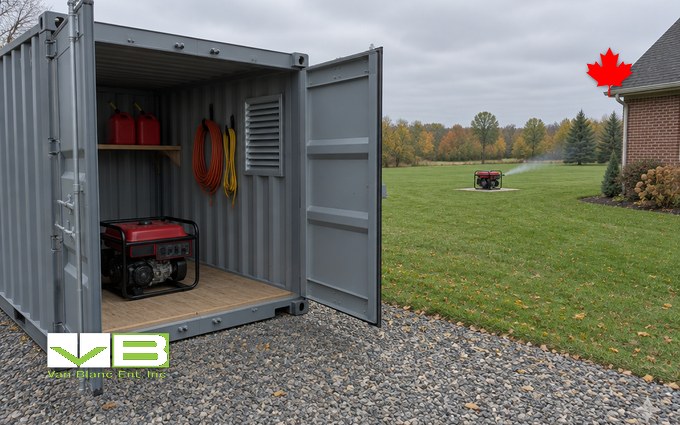
Quick Answer: A generator shed is three things: a cover over a running portable, a locked shed storing it and its fuel, or a vented enclosure for a standby unit. A portable never runs inside a closed shed, garage or container. Store it in steel; run it outdoors, six metres from openings.
In This Guide
- The three things people mean by a generator shed
- The rule that comes before the shed: carbon monoxide
- Running covers and open-sided shelters for a portable
- Storing a portable generator and its fuel between outages
- Standby generators: placement, clearances and the pad
- Sound enclosures and the noise bylaw
- Farm, camp and jobsite generators
- The container as a generator vault, honestly
- Generator shelters on one sheet
- The generator shed checklist
- Generator shed FAQs
Reading Time: 12 minutes
The three things people mean by a generator shed
Search for a generator shed and the results argue with each other, because the phrase covers three products that must never be confused. The first is a running cover: a tent, canopy or open-sided lean-to that keeps rain and snow off a portable generator while it runs outdoors, with all four sides open to the air. The second is a storage shed: a dry, locked building where the portable lives for the fifty weeks a year it is not running, with its fuel, its cords and its manual, which is the product most Ontario homeowners actually need and the one this page spends the most time on. The third is an enclosure for a standby unit, a permanently installed generator that is built for the outdoors and needs placement and clearances rather than a building, or at commercial scale a sound-attenuated housing engineered around the machine. A shipping container is the second product and, built a specific way, can be the third; it is never the first, and the container generator enclosure guide is where the engineered running version lives, with its ducted exhaust and its louvres. This page is the level above it: which of the three the buyer needs, and what each one has to do. Connecting a generator to a container is the wiring side, and it is a licensed electrician’s job in every case.
The rule that comes before the shed: carbon monoxide
Before any building is bought, one rule decides what it is allowed to be. Ontario’s Electrical Safety Authority puts it in one sentence: never operate a generator inside your home or garage, because it will cause a build-up of fatal fumes, and fans or open windows and doors will not provide enough fresh air to keep a family safe. The same applies to a shed, a carport with the sides closed in, a tent with the flaps down, and a shipping container with the doors open, because carbon monoxide is odourless, it pools, and the door being open is not ventilation. The placement rule that Canadian guidance repeats from the U.S. Consumer Product Safety Commission is a running portable generator outdoors at least 20 feet, about six metres, from any door, window or vent of an occupied building, with the exhaust pointed away. Everything on this page sits inside that rule: a running cover is open on all sides, a storage shed holds a generator that is off and cold, and a standby enclosure is either the manufacturer’s own weatherproof housing outdoors or an engineered enclosure with ducted exhaust and forced air, which is a different product from a shed. Carbon monoxide alarms in the house are the last line, not the plan. What ventilation actually means in a steel box is the reason a container with louvred vents stores a generator well and runs one badly.
The three lines a generator shed cannot cross
- A running portable is outdoors, at least six metres from any opening, under a cover open on all sides or under nothing.
- A stored portable is off, cool and dry, with the fuel in approved cans, in a building that locks and breathes.
- A standby unit is placed, not housed: the manufacturer’s clearances, a pad, a transfer switch and an ESA notification of work by a licensed electrical contractor.
Running covers and open-sided shelters for a portable
A portable generator runs in the weather that caused the outage, and the running cover exists so rain does not reach the outlets and snow does not bury the intake. The purpose-made version is a fitted canopy that mounts to the generator’s frame and covers the top and the receptacles while leaving every side open, and it is the only cover a portable should run under in a storm. The improvised version is an open-sided lean-to or a picnic canopy with all four sides up, set on a hard surface where the exhaust can drift away, which works if it stays open and fails the moment someone drops a tarp against the wind. What is not a running cover is a shed with a door, a garage with the door up, a covered porch, a carport with three walls, or a box of any kind, and the reasoning is the one rule above. Placement under the cover follows the same six-metre line from any opening, on a surface that will not flood, with the cords run through a window gap rather than a door left open, and the cords themselves grounded three-prong, rated for the load, uncoiled and laid flat, because a coiled cord under load gets hot. The generator is refuelled off, after it has cooled at least two minutes, with fresh gasoline, and that refuelling is the moment most portable-generator fires start. The fabric car shelter’s rules for wind apply to any canopy over a generator: anchor it, or the wind takes the cover and the cover takes the generator.
Storing a portable generator and its fuel between outages
The generator shed most households need is a place for the generator to wait. A portable that sits fifty weeks a year has four enemies: damp, which corrodes the receptacles and the carburetor; stale fuel, which gums the carburetor in a season; a dead battery on an electric-start unit; and theft, because a generator is the easiest high-value item on a property to carry to a truck. The storage answer is a dry, locked building with a floor the unit rolls onto, a shelf for the cords, the oil and the manual, a battery tender plugged in, and the fuel stored separately in approved cans with stabilizer, in a ventilated space away from the house and never inside a living space. The routine is monthly: start it, run it under a small load for twenty minutes outdoors, shut it down, top the oil, and put it away, which is how a generator that cost real money starts on the night it is needed. A resin shed does most of that and locks with a hasp; a steel box does all of it and locks properly, and a disc lock inside a welded shroud is what stands between a generator and the pickup at two in the morning. The sled and bike storage routine is the same fuel-and-battery discipline for machines that sleep half the year.
Store the fuel like fuel, not like a tool
Gasoline goes in approved cans, stabilized, in a ventilated shed or a vented corner of a box, never on the floor of a garage the family walks through and never near the water heater. Propane cylinders stand upright outdoors or in a vented cage. The generator’s own tank is run low or stabilized before storage, and the cans are dated.
Standby generators: placement, clearances and the pad
A standby generator is the opposite of a portable: it lives outdoors in its own weatherproof housing, starts itself, and needs placement rather than a building. The Ontario placement guidance for the common air-cooled residential units puts the unit 18 inches from a non-combustible house wall, at least three feet from any door, window or air intake with the exhaust directed away, 60 inches from a gas meter or regulator vent, and with 36 inches of clearance on the front and sides for service, on a four-inch reinforced slab over compacted gravel or a composite pad on a level compacted base. Winter adds its own line: 18 to 24 inches of clearance for snow removal, and a spot away from the roofline where a drift will bury the intake. The electrical side is the permanent connection: a transfer switch so generator power cannot feed back into the utility lines, a notification of work filed with the Electrical Safety Authority, and a licensed electrical contractor to do it, which is the one sentence on paperwork this page needs. The gas side is the fuel supplier’s and the gas fitter’s. None of that is a shed, and a homeowner who builds one around a standby unit has usually blocked the clearances the unit needs to breathe; the pad’s own cost drivers are the part of a standby install that is a building question at all.
Sound enclosures and the noise bylaw
Noise is the generator problem that arrives after the outage, when the neighbour is still awake. Typical residential air-cooled standby units run at 66 to 70 decibels at 23 feet, and Toronto’s bylaw limit at the lot line is 55, which is why placement on a tight lot is half distance and half screening. The tools are the manufacturer’s own sound-attenuated housing on the larger units, a fence or a masonry wall between the unit and the lot line that does not block the clearances, distance, and orientation of the exhaust away from the neighbour. What the tools are not is a closed box built around the unit, for the same reason a running portable does not go in a shed. At commercial and farm scale the enclosure is engineered: a housing with acoustic lining, forced-air cooling and a ducted, silenced exhaust, designed for the machine inside it, and what sound insulation actually does in a steel shell explains why a lined container holds noise well and heat badly unless the air is moved on purpose. The buyer whose problem is noise should read the unit’s rating at 23 feet against the local bylaw before buying either the generator or anything to put it in.
Paul LeBlanc, Van Blanc Ent. Inc.: “Every spring someone asks me for a box to run a generator in, and every spring I say the same thing. I will sell you a box to keep it in, dry and locked, and it will start when the lights go out. Running it in there is a different build, and it is not a shed.”
Farm, camp and jobsite generators
Outside the subdivision the generator is bigger and the shed question changes. A farm runs a PTO generator off the tractor or a diesel standby for the barn, and stores it under a roof out of the weather with the fuel in a tank that has its own rules; the storage building is the drive shed or a box beside it, and the farm storage guide for feed, fuel and machines covers where the fuel, the tools and the seasonal machines live. A hunt camp or an off-grid cabin runs a portable or an inverter generator as backup to a battery bank, and the generator sleeps in the gear box with the quad and the chainsaws, which is the layout in the off-grid solar container setup and the hunt camp guide’s gear room. A jobsite runs a tow-behind or a skid-mounted unit that is a theft target from the day it arrives, and the shed is a locked steel box with a chain through the frame when the unit is not running, which is what the Friday lock-up routine for a jobsite box is for. In all three the running unit sits outside, in the open, with the exhaust away from the crew, and the building holds it when it is off.
The container as a generator vault, honestly
Here is the box’s card. As a storage shed for a portable generator and its fuel, a 10-foot or 20-foot container is the best building on the lot: steel walls and a steel floor the unit rolls onto over a ramp, a louvred vent at each end so the fuel vapour and the damp move, a shelf for the cords and the oil, a plug for the battery tender once a licensed electrician has run a circuit, and cam doors with a disc lock in a shroud that a generator thief cannot beat with a bolt cutter. It holds the sled, the mower and the tools beside the generator, which is how most of ours are used. As a running enclosure it is a different product entirely: an engineered build with ducted exhaust, forced-air cooling, fire-rated lining and clearances, which is a project rather than a purchase and is the subject of its own page, and a plain box with the doors open is not it. As a standby housing it is unnecessary, because the standby unit already has one. Grade is the easy call, a used wind-and-watertight box for a generator vault, because the doors seal and the surface rust is beside the point; a ten-footer holds a generator, its fuel and a mower, and a twenty holds the quad as well. What moves the number is size, grade and the distance from Brantford, and the drivers behind a vault-box quote are the same list on every call. We sell outright, never rent; a buyer spreading the cost does it through their own bank with the invoice and the serial number we supply.
Storing it, or running it?
Tell us which generator, whether it is a portable that sleeps between outages or a unit that has to run inside something, what else shares the building, and where it would sit. We will tell you a ten or a twenty for the vault, the vents and the lock, and one honest all-in number with a real lead time, or that the running version is an engineered build.
Family-run in Brantford since 1995 · 200+ containers in stock · 4.9★ across 140+ Google reviews · every box graded by a person, walk it before it lands.
Generator shelters on one sheet
Put the five shelters side by side and the choice is made by one question: is the generator running or resting when it is inside. A fitted canopy and an open lean-to are for running, and they are open on every side. A resin or metal shed and a steel box are for resting, and they lock and breathe. A standby unit’s own housing is both, because it was engineered for it, and an engineered enclosure is the only other thing that is. The buyer who wants one building for both jobs is asking for the engineered enclosure and should price it as one, and the buyer who wants a dry, locked place for the portable to wait should buy the shed or the box and run the generator on the lawn. The market map of Ontario storage buildings sorts the resting sheds by family, and the resin shed guide’s winter chapter is the honest read on the cheapest of them.
| Shelter | Generator is | Sides | Locks | Fuel | Right for |
|---|---|---|---|---|---|
| Fitted running canopy | Running | Open on all four | No | Not stored here | Any portable in an outage |
| Open lean-to | Running | Open on all four, roof only | No | Not stored here | A fixed spot on the lawn or the yard |
| Resin or metal shed | Resting, off and cool | Closed, vented | Hasp | Approved cans, vented | A portable and its cords |
| Shipping container | Resting, off and cool | Closed, vented so the steel does not sweat | Shrouded disc lock | Approved cans in a vented corner | A portable plus the sled, mower and tools |
| Standby unit’s own housing | Running | Manufacturer’s, with clearances | Yes | Gas or propane line | Permanent home or farm backup |
| Engineered enclosure | Running | Ducted exhaust, forced air, fire-rated | Yes | Tank with its own rules | Commercial, farm and remote power |
Where the generator calls come from
The generator vault calls come after the storms: the rural lots around Brantford and the County of Brant, the farms through Norfolk and Haldimand, the Haliburton cottage roads, and the jobsites along the Hamilton mountain where a tow-behind unit walked off a site once and never again. Worth the drive for unbeatable quality, family customer service with 30 years of experience.
The generator shed checklist
Before the shed
- Decide whether the building is for running or resting. If both, it is an engineered enclosure and a project, not a shed.
- Pick the running spot: outdoors, six metres from any opening, exhaust away, under a canopy open on all sides, with grounded cords laid flat.
- Pick the resting building: dry, locked, vented, with a shelf, a tender plug on a licensed circuit, and the fuel in approved cans in a vented corner.
- For a standby unit, walk the clearances with the installer: 18 inches from the wall, three feet from openings, 60 inches from the gas meter, 36 inches for service, and the snow line.
- Read the noise rating at 23 feet against the local bylaw before buying the unit.
- Walk a ten and a twenty at the Brantford rows with the generator’s footprint and the rest of the list that will share it.
A generator housed that way starts on the night it is needed, runs where it cannot hurt anyone, and is still there in the morning. The shed is the easy part; the rule is the hard part, and the buyer who keeps the running and the resting in two different places has read the page correctly.
Frequently Asked Questions
Can you run a generator in a shed?
No. Ontario’s Electrical Safety Authority says never to operate a generator inside a home or garage because of fatal fumes, and a shed, a closed carport, a tent with the flaps down or a container with the doors open is the same hazard. A portable generator runs outdoors, about six metres from any door, window or vent, under a cover that is open on all sides. The only exception is an engineered enclosure with ducted exhaust and forced air, which is not a shed.
What is the best way to store a portable generator?
Off, cool and dry, in a locked building that breathes: a shelf for the cords, the oil and the manual, a battery tender on a licensed circuit for electric-start units, the fuel in approved stabilized cans in a vented corner, and a monthly twenty-minute run under load outdoors. The engineered container enclosure is the version for a unit that has to run inside.
How far should a generator be from the house?
A running portable, about six metres from any door, window or vent with the exhaust pointed away. A standby unit, per the common Ontario placement guidance for air-cooled units, 18 inches from a non-combustible wall, at least three feet from any opening, 60 inches from a gas meter, with 36 inches of service clearance and room for snow removal.
Does a standby generator need a shed or enclosure?
No. A standby unit comes in its own weatherproof housing and needs a pad, its clearances, a transfer switch and an ESA notification of work by a licensed electrical contractor. Building a shed around it blocks the air and the exhaust it needs. Noise is handled with distance, orientation and a screen that respects the clearances, or with the manufacturer’s sound-attenuated housing on larger units.
Can I store a generator in a shipping container?
Yes, and it is one of the best uses of a small box: a steel floor the unit rolls onto, louvred vents at each end, a shelf, a tender plug on a licensed circuit, and a shrouded disc lock, with the sled and the mower beside it. It is stored off and cool. Running it inside a plain box is not safe, and the generator tie-in for a container is a licensed electrician’s job whichever way the box is used.
Why does my generator not start after storage?
Almost always stale fuel that gummed the carburetor, a battery that went flat, or damp in the receptacles and the ignition, and all three are storage-building problems. Fresh stabilized fuel, a battery tender, a dry vented building and a monthly run under load are the cure, and keeping the damp out of a steel box is the reason a vented container stores small engines well.
Sources
- Electrical Safety Authority. (2026). Generator Safety. esasafe.com
- Platinum Electrical Contractors. (2026). Generator Placement Rules in Ontario: Clearance, Bylaws and What to Watch For. generatorexperts.ca
- U.S. Consumer Product Safety Commission. (2026). Portable Generator Safety. cpsc.gov
- Electrical Safety Authority via Cision. (2026). ESA Reminds Ontarians to Follow Safety Rules When Using Portable Generators. newswire.ca
- Total Generator Pros. (2026). Portable Generator Safety: CO, Placement and Power Rules. totalgeneratorpros.com
Reach Van Blanc in Brantford
We have been supplying shipping containers across Ontario since 1995. Our yard is at 90 Morton Avenue East in Brantford, and we deliver right across the province with payment on the day of delivery. No deposit, no upfront wires, no chase-the-paperwork.
Van Blanc Ent. Inc., 90 Morton Ave E Unit 1B, Brantford, ON N3R 7J7, 519-754-6844 (cell) or 1-888-509-6658 (toll-free).
If the generator is under a tarp and the fuel is in the garage, call with the unit and your postal code, and we will tell you on the spot which tens and twenties are on the ground and when one can land. Worth the drive for unbeatable quality, family customer service with 30 years of experience.