
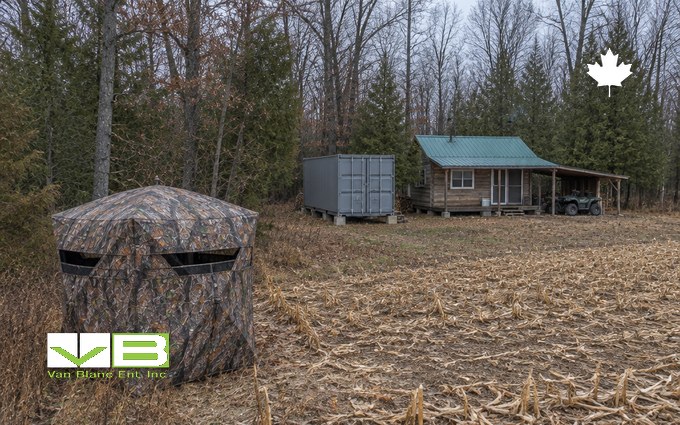
Quick Answer: A hunting blind is chosen by the sit: a pop-up for mobile hunts, a box blind for a field edge hunted all season, a bale blind for open ground. The camp behind it is a separate purchase: bunks, locked gear, cold for game, and a shell surviving eleven empty months.
In This Guide
- The blind and the camp are two purchases
- The five kinds of hunting blind, and which sit each one suits
- Choosing a blind: windows, wind, weight and the bow question
- Placing and brushing in a blind in Ontario bush and field
- Hunter orange, Crown land and the rules that touch a blind
- What an Ontario hunt camp actually is
- What the camp needs: bunks, gear, game and the off-season
- Camp shells compared: cabin, trailer, kit and box
- The container at a hunt camp, honestly
- The blind and camp checklist
- Hunting blind and hunt camp FAQs
Reading Time: 13 minutes
The blind and the camp are two purchases
An Ontario deer hunter shopping for a hunting blind in September is usually shopping for two things and pricing one. The blind is the sit: a fabric hub on a field edge, a plywood box on legs over a cut, a hay-bale shell in a bean field, or a stand up a maple with a skirt around it. It is light, cheap by the standard of everything else in the sport, and it lives in the bush for a season. The camp is the other purchase: the place the crew sleeps, the place the rifles and the quad and the propane live, the cold place the deer hangs, and the building that sits empty and unwatched from the last weekend of November to the first weekend of the next. This guide is honest about which of those we sell. We are a shipping container yard in Brantford, a blind is not a container and never will be, and the half of the page that covers blinds is written the way our car shelter guide covers fabric garages, as a buyer’s guide with no box at the end of it. The camp half is where a steel box earns a hearing, beside the cabin, the trailer and the kit, and the container hunt camp page is where that hearing continues. Blind first, because the season starts with the sit.
The five kinds of hunting blind, and which sit each one suits
Outdoor Life’s 2026 field test sorts the market into five kinds, and the sorting holds for Ontario. The pop-up hub blind is the fabric tent on spring-steel hubs that a hunter carries in and throws up in under a minute; the tested Game Winner deployed in 24 seconds, and the lightest pack-in blind in the test weighed three and a half pounds and folded to 32 inches. It is the blind for public land, for the run-and-gun hunter moving with the rut, and for the archer who needs to be in a new spot by Friday, and it rides north in the truck beside the quad that lives in a box the rest of the year. The semi-permanent blind is a framed structure assembled where it stands and left for the season: the tested Redneck soft-side six-by-six weighed 133 pounds, gave 77 inches of standing room and had corner vertical windows a bowhunter can draw through. The permanent blind is the box blind, an insulated fibreglass or plywood room on a tower or a trailer frame, 375 pounds in the tested example, and it is the field-edge fixture Ontario’s bean-and-corn counties have adopted from the American Midwest. The bale blind is a round-bale shell that stands in a field and needs a couple of months before the season for the deer to stop looking at it. The treestand kit is a fabric skirt around an existing stand, tight enough that drawing a bow inside it is a problem. The deer cooler question starts the moment any of them works.
| Blind | Weight and size | Best sit | Weak point | Bow-friendly? |
|---|---|---|---|---|
| Pop-up hub | 3.5 to 8 lb; up to 60 by 60 by 65 in | Public land, mobile hunts, a new spot each week | Wind; loud zippers; crowded for two | Seated shots; few allow standing draws |
| Semi-permanent frame | About 133 lb; 77 in standing room | A field edge hunted all season on land you control | Assembly on site; not a pack-in | Yes, through corner vertical windows |
| Permanent box blind | About 375 lb; insulated; on a tower | The rifle sit on a private field | Heavy; needs a truck and a spot it can stay | Depends on the window layout |
| Bale blind | Round-bale shell, set by machine | Open fields where a bale looks normal | Needs months of acclimation; low | Limited |
| Treestand kit | Fabric skirt on an existing stand | Concealment on a stand already hung | Tight for a bow | Poor |
Choosing a blind: windows, wind, weight and the bow question
The test’s findings reduce to four questions, three of which are the questions the fabric car shelter guide asks of any tent in an Ontario wind. Windows first: a blind with silent-slide windows can be adjusted with a deer at forty yards, and a blind with zippers cannot, so the zipper is the first thing to test in the store, not the camouflage pattern. Wind second: the cheapest hub blinds behave, in the tester’s phrase, like the house the first pig built out of straw, and every fabric blind in Ontario’s November wind needs the stakes driven and the guy lines tied whatever the box says about setup time. Weight third, and it is a trade with the other two: the three-and-a-half-pound blind that packs in also blows around, and the 133-pound frame that stands up to wind stays where it is assembled. The bow question last: most pop-ups limit the hunter to seated shots through horizontal windows, and the archer who wants to draw standing needs corner vertical windows, which the semi-permanent frames have and the treestand kits do not. Durability sits underneath all four; the premium fabrics survived a hail storm and a 300-yard tumble in the test, and the budget ones fade and tear within a couple of seasons. The wood shed guide’s rule about reading a product by where it cheaps out applies to blinds exactly: it is never the camouflage, it is the zipper, the hubs and the stakes.
Test the zipper before the camouflage
Stand in the blind in the store, open every window, and listen. A window that hisses or zips will do the same with a deer at forty yards. Silent slides, brush-in straps and a full set of stakes are worth more than any pattern printed on the fabric.
Placing and brushing in a blind in Ontario bush and field
A blind works by being ignored, and Ontario deer ignore two things: what has been there long enough and what looks like it belongs. The bale blind is the extreme case, set a few months before the season so it becomes furniture, and that summer visit is also when the road into camp gets measured for a truck, if a box is coming that year. A hub blind is the opposite, and the test’s advice is to brush it in through the attachment straps with local vegetation before the season rather than the morning of, to set it downwind of the expected approach, and to accept that a blind pitched on a Saturday morning is a blind the deer notice on Saturday morning. Field-edge box blinds go up in summer for the same reason, and the trail to them gets walked in so the approach is quiet in November. In the bush the same rules apply with less open ground: a hub blind tucked into a blowdown or a cedar clump, a stand on the downwind side of a runway, and a path in that does not cross the deer’s own. What none of this covers is the dark walk in and out, the quad or the sled that carries the gear, and the place the hunter sleeps, which is the camp, and where the quad and the sled live between hunts is the first camp question most crews meet.
Hunter orange, Crown land and the rules that touch a blind
Two provincial rules reach into the blind. The first is where the blind stands: the regulations summary states that no permanent structures are allowed on Crown land without authorization and that hunting on private land needs the landowner’s permission, which is the sentence that separates the pop-up from the box blind for anyone hunting Crown bush, and the same sentence is why a camp box on a Crown permit site is a conversation with the ministry before it is a delivery. Crown Game Preserves are closed to hunting outright. The second is hunter orange: during the gun seasons for deer, moose and elk, Ontario’s hunting regulations summary requires a hunter orange garment covering at least 400 square inches above the waist, visible from all sides, plus an orange head cover with no camouflage in it, and the summary is explicit that a hunter in a ground blind wears the orange inside the blind and should mark the outside of the blind so other hunters can see it. A tree stand is treated differently for some seasons, and the summary is the place to read that detail for the season being hunted. Everything else about where to stand is fieldcraft, not law, and the hunter who reads the summary once a season and walks the line with the neighbour is ahead of most. The Friday lock-up routine for a loaded box is the camp-side habit that goes with the blind-side rules, because the season that starts with the sit ends with a building nobody is watching.
What an Ontario hunt camp actually is
An Ontario hunt camp is a building or a cluster of them on a bush lot, a private hundred-acre parcel or a Crown land permit site, used hard for a few weeks each fall and left alone the rest of the year. The Ontario Hunt Camps Association exists as the voice of the people who hold them, and its code of ethics is about firearms, conservation and the law rather than about buildings, which tells you what the members think a camp is for. The building itself varies from a frame cabin with a wood stove and a loft that has stood since the 1960s, to a travel trailer dragged in and left, to a bunkie kit raised over a summer, to a steel box set on blocks at the end of a logging road. What they share is a job description that no cottage has. The camp has to sleep four to eight people warm in November. It has to hold rifles, ammunition, a quad or a sled, fuel, propane, saws and a season of food and keep them dry and locked. It has to give the crew a cold, clean place to hang and skin a deer. And it has to survive from December to October with nobody there, through snow load, freeze-thaw, mice, bears and the fellow who walks the bush in March with a pry bar. The trailer against a box as a camp is the two-way version of the shell question that the rest of this page opens out.
Christian LeBlanc, Van Blanc Ent. Inc.: “We delivered a forty to a camp north of Bancroft one November and the owner had the battery wall framed before we backed in. The blind was a pop-up in the truck. The box was the camp. People mix those two up on the phone and I sort it out in the first minute.”
What the camp needs: bunks, gear, game and the off-season
Take the four jobs in order. Bunks mean an insulated room with a heat source, which at most camps is a wood stove or a vented propane heater, and a floor that stays dry, which rules out the trailer with the soft spot and the cabin with the rotten sill. Gear means a room that locks and a room that ventilates: fuel and propane outside or in a ventilated shed, firearms in a locked cabinet inside a locked building, the quad under a roof with a chain through the frame, and the tools and saws on a wall the crew can find in the dark. Game means a place to hang a deer that is cold, shaded, off the ground and away from the bunks, which in a warm November is the difference between meat and a loss; a reefer box as a deer cooler is the industrial answer and a north-side shed with a hoist is the traditional one. The off-season is the job that decides the building: a camp that can be stripped of everything a thief wants and locked so that a pry bar makes no progress is a camp that is still there in October, and a shrouded padlock and a disc lock on cam doors is the highest bar a thief in the bush will meet. Power is optional and increasingly common, from a small solar array on the roof charging a battery bank to a generator in its own enclosure, and the off-grid solar layout for a container is the same design the cabin uses.
Camp shells compared: cabin, trailer, kit and box
Four shells hold Ontario hunt camps, and each fails a different one of the four jobs. The frame cabin is the best bunkhouse and the worst off-season building: wood, windows and a door a pry bar likes, mice in every wall, and a roof whose snow load somebody has to think about every year. The travel trailer is the fastest camp and the shortest-lived: warm the first fall, soft-floored by the fifth, a target for anyone with a hitch, and a building that should itself be stored somewhere for the winter. The kit, a bunkie or a log cabin kit, is the cabin built fresh, with the same virtues and the same off-season weaknesses, plus a foundation and a raising weekend before anyone sleeps in it, and the log cabin kit guide covers what arrives in the crate and what does not. The container is the worst-looking and the best-surviving: steel walls and a steel roof that carry snow and shrug off mice and pry bars, a floor that does not rot, and a shell that is a bunkhouse only after insulation, a heater and a licensed electrician have been through it. The honest camp is often two of these: a cabin for the bunks and a box for the gear and the off-season, or a box lined as the bunkhouse with a lean-to for the deer. The bunkie guide’s construction families is the kit side read fully.
| Camp job | Frame cabin | Travel trailer | Bunkie or log kit | Container |
|---|---|---|---|---|
| Warm bunks in November | Best, with a stove | Good the first years | Good once insulated | Good once lined, insulated and heated |
| Locked, dry gear | Fair; wood door, windows | Poor; a hitch is a key | Fair | Best; cam doors, shrouded lock, no windows unless cut |
| Hanging game | A shed beside it | No | A shed beside it | A reefer, or a lean-to on the shaded side |
| Eleven empty months | Mice, snow load, break-ins | Break-ins, rot, theft of the whole unit | As the cabin | Best; steel roof, steel walls, vented against winter sweat |
| Gets there how | Built on site over a summer | Towed in on a road a truck can use | Bundles by flatbed, boat or hand | Tilt-deck; a logging road a gravel truck has used |
| Leaves again | No | Yes | No | Yes, on the same truck |
Camp box, or cabin plus box?
Tell us where the camp is, how the road in was last used, how many bunks, and whether the box is the bunkhouse or the gear room. We will tell you twenty or forty, the grade, the vents, the lock and the lining, and one honest all-in number with a real lead time, including when the right answer is the cabin you already have and a box beside it.
Family-run in Brantford since 1995 · 200+ containers in stock · 4.9★ across 140+ Google reviews · every box graded by a person, walk it before it lands.
The container at a hunt camp, honestly
Here is the box’s card at a camp, both sides. As the gear room beside an existing cabin, a 20-foot wind-and-watertight container is the best building on the lot: the quad rolls in over a ramp, the fuel and propane stay in a ventilated corner or outside, the rifles go in a cabinet bolted to the floor, the saws and tools hang on shelving that hooks the corrugation, and the doors lock with a disc lock inside a welded shroud that a pry bar cannot reach. As the bunkhouse, a 40-foot high cube is the shell and the lining is the camp: spray foam or panels, a wood stove with a proper chimney or a vented heater, a man door and a window cut in, bunks along one wall, and the electrical done by a licensed electrician with an ESA inspection, all of which the off-grid conversion guide walks through in the order it happens. As a deer cooler, a 20-foot reefer on a generator or a line is the cleanest game room in the county. What the box is not is a blind, a pretty building, or a bunkhouse the afternoon it lands. Grade is the easy call: a used wind-and-watertight box for the gear room, a one-trip box for the shell that gets lined, and a working reefer for the cooler. What moves the number is size, grade, the cuts and the lining, and the distance from Brantford to the end of the road, and the drivers behind a camp-box quote are the same list on every call. We sell outright, never rent; a crew splitting the cost does it among themselves or through a bank with the invoice and the serial number we supply.
Where the camp calls come from
The camp boxes go north: up to the bush around Bancroft and the Haliburton back lots, into the Huntsville and Almaguin camps, and along the Crown roads past Sundridge and South River. Most of the calls come in September, and the crews who call in July get the box set before the road softens. Worth the drive for unbeatable quality, family customer service with 30 years of experience.
The blind and camp checklist
Before the season
- Pick the blind by the sit: hub for mobile and public land, frame or box blind for a private field edge hunted all season, bale for open ground, and test the windows for noise before anything else.
- Set the field blinds in summer, brush in the hub blinds before the season, stake everything, and read the orange rule for the season being hunted.
- Write the camp’s four jobs down: bunks, locked gear, hanging game, eleven empty months. Score the building you have against each.
- Decide whether the fix is a gear box beside the cabin, a lined box as the bunkhouse, or a reefer for the game, and measure the road in for a tilt-deck.
- Strip the camp of everything a thief wants before you leave in November, and lock what stays behind a shrouded padlock.
- Walk a box at our Brantford rows in July, not October, because the road north is easiest before the rain.
A season planned that way starts in a blind the deer do not notice and ends in a camp that is still standing, still locked and still dry when the crew comes back next fall. The blind is the cheap purchase and the camp is the dear one, and the crew that spends its money in that order has read the page correctly; the container against every other building a camp might be is the wider table if the camp is also deciding between a box and a cabin.
Frequently Asked Questions
What is the best type of hunting blind for Ontario deer hunting?
It depends on the sit. A pop-up hub blind for public land and mobile hunts, a semi-permanent frame or a permanent box blind for a private field edge hunted all season, a bale blind for open crop ground where a tent looks wrong, and a treestand kit only for concealment on a stand already hung. Test the windows for noise and stake every fabric blind against November wind.
What does a hunt camp need to survive the off-season?
A roof that carries snow, walls that mice and pry bars cannot get through, a floor that does not rot, ventilation so the closed building does not sweat, and a lock a thief in the bush cannot defeat. Strip the camp of firearms, fuel and anything with resale value before leaving in November. A steel container meets the first four for free, and the container hunt camp guide covers the fifth.
Do I have to wear hunter orange in a ground blind in Ontario?
Yes, during the gun seasons for deer, moose and elk. Ontario’s hunting regulations summary requires a hunter orange garment of at least 400 square inches above the waist plus an orange head cover, states that a hunter in a ground blind wears it inside the blind, and recommends marking the outside of the blind with orange so other hunters can see it. Read the summary for the season being hunted.
Is a shipping container a good hunt camp?
As the gear room beside a cabin, or as the off-season vault, it is the best building on the lot. As the bunkhouse it is a shell that needs insulation, a heater, a door and a window cut in, and a licensed electrician before anyone sleeps in it, which the trailer-against-box comparison scores honestly. It is not a blind and it is not a pretty building.
Can I leave a hunting blind on Crown land in Ontario?
The regulations summary states that no permanent structures are allowed on Crown land without authorization, which is the line between a portable pop-up carried in and out and a box blind or a built stand left standing. On private land the landowner’s permission covers the blind. Crown Game Preserves are closed to hunting altogether.
How does a container get to a hunt camp at the end of a bush road?
On a tilt-deck truck that needs the road a loaded gravel truck could use, roughly 80 feet of straight approach at the spot and a level place for four blocks. Our trucks have delivered to logging roads, hillside pads and camps past the end of maintained road, and the crews who book in July get the box in before the fall rain softens the way in.
Sources
- Outdoor Life. (2026). The Best Hunting Blinds of 2026, Tested and Reviewed. outdoorlife.com
- Government of Ontario. (2026). Ontario Hunting Regulations Summary: General Regulations. ontario.ca
- Destination Ontario. (2026). Hunting on Crown and Public Land. destinationontario.com
- Ontario Hunt Camps Association. (2026). Ontario Hunt Camps Association: Code of Ethics. ontariohuntcamps.com
- Ontario Out of Doors. (2026). Hunter Orange: The Dos and Don’ts. oodmag.com
Reach Van Blanc in Brantford
We have been supplying shipping containers across Ontario since 1995. Our yard is at 90 Morton Avenue East in Brantford, and we deliver right across the province with payment on the day of delivery. No deposit, no upfront wires, no chase-the-paperwork.
Van Blanc Ent. Inc., 90 Morton Ave E Unit 1B, Brantford, ON N3R 7J7, 519-754-6844 (cell) or 1-888-509-6658 (toll-free).
If the blind is sorted and the camp is the problem, call with the road, the bunk count and your postal code, and we will tell you on the spot which boxes are on the ground and when one can be north. Worth the drive for unbeatable quality, family customer service with 30 years of experience.